Why in the News
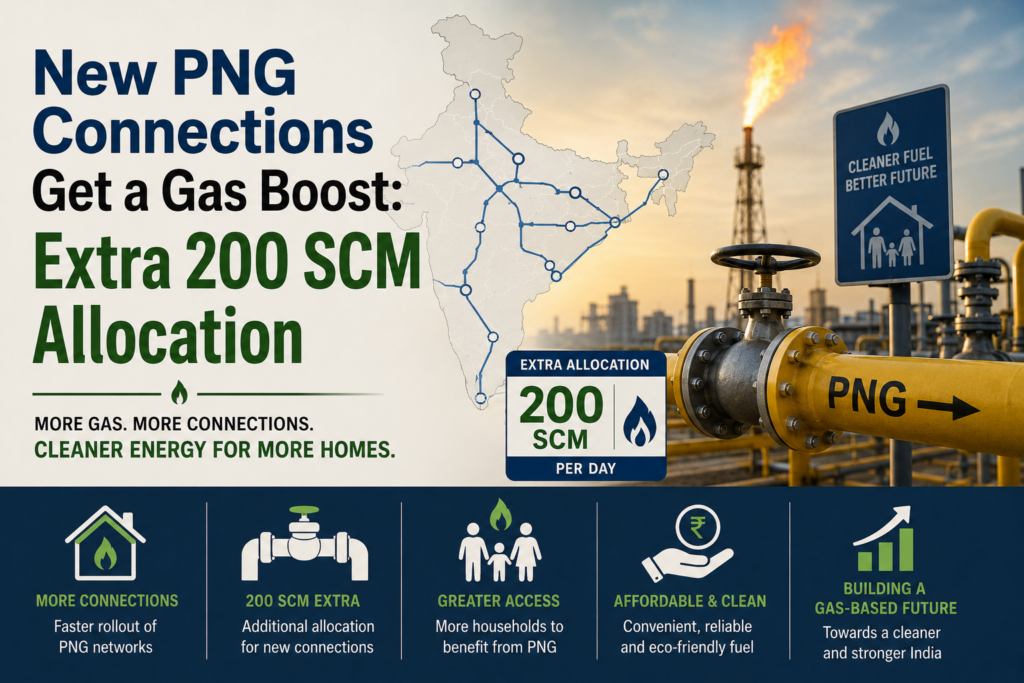
From 1 September, eligible City Gas Distributors (CGDs) will receive an additional 200 Standard Cubic Metres (SCM) of cheaper Administered Price Mechanism (APM) gas for every new billed domestic Piped Natural Gas (PNG) connection.
APM Natural Gas
- Administered Price Mechanism (APM): Domestic gas from nomination fields of national oil companies, priced by the government.
- Generally cheaper than imported Liquefied Natural Gas (LNG).
- Piped Natural Gas (PNG) and Compressed Natural Gas (CNG) receive priority allocation.
- Price is linked to the Indian crude basket, with a floor and ceiling.
City Gas Distribution
- City Gas Distribution (CGD): Pipeline network supplying gas to households, industries, commercial users and vehicles.
- Geographical areas are awarded through competitive bidding by the Petroleum and Natural Gas Regulatory Board (PNGRB).
Piped Natural Gas
- Piped Natural Gas (PNG): Natural gas supplied directly through pipelines and metered like a utility.
- Provides an alternative to Liquefied Petroleum Gas (LPG) cylinders for households.
New Incentive
- 200 SCM of APM gas for every incremental billed domestic PNG connection.
- Effective 1 September.
- Aims to reduce LNG sourcing costs and accelerate household PNG adoption.
- Benefit is linked to actual billed connections, not merely network expansion.
Key Challenges
- Right-of-way and road-cutting permissions
- High household connection costs
- Competition from subsidised LPG
- Limited domestic APM gas availability
- Volatile imported LNG prices
- Natural gas remains outside Goods and Services Tax (GST)
- Low viability in remote and low-demand areas
Foundational Context: The Natural Gas Sector in India
- Share in the energy mix: Natural gas accounts for roughly 6 percent of India’s primary energy mix, against a stated national target of raising it to 15 percent by 2030.
- Import dependence: India imports about half of its natural gas requirement in the form of liquefied natural gas, delivered through regasification terminals on the west and east coasts.
- Two price regimes: Domestically produced gas from nomination fields is sold at the administered price, while gas from deepwater, ultra deepwater and high pressure high temperature fields and imported gas are sold at market linked prices.
- Allocation priority: Domestic piped natural gas for households and compressed natural gas for transport hold first priority in the allocation of administered price gas.
- Network build out: Successive bidding rounds by the sector regulator have authorised city gas distribution networks covering the overwhelming majority of India’s population across more than 300 geographical areas.
- National gas grid: Trunk transmission pipelines are being extended into the eastern and north eastern regions to create a single national gas grid with a unified tariff.
Statutory Framework Governing the Gas Sector
- Petroleum and Natural Gas Regulatory Board Act, 2006: Establishes the sector regulator and gives it authority over downstream refining, processing, storage, transportation, distribution and marketing of petroleum products and natural gas.
- Section 16 of the Petroleum and Natural Gas Regulatory Board Act, 2006: Provides for authorisation of entities to lay, build, operate or expand city gas distribution networks.
- Section 32 of the Petroleum and Natural Gas Regulatory Board Act, 2006: Provides that appeals against the regulator’s decisions lie to the Appellate Tribunal for Electricity, with a statutory disposal timeline of 90 days.
- Oilfields (Regulation and Development) Act, 1948: Governs the regulation of oilfields and the grant of mining leases for petroleum and natural gas.
- Petroleum and Natural Gas Rules, 1959: Prescribe the terms for grant of exploration licences and mining leases for petroleum and natural gas.
- Petroleum Act, 1934 and the Petroleum Rules, 2002: Govern the import, transport, storage and production of petroleum and the safety conditions attached to them.
Back2Basics: Petroleum and Natural Gas Regulatory Board (PNGRB)
- Governing Act: The Petroleum and Natural Gas Regulatory Board Act, 2006.
- Established: Constituted in 2007 under that Act, functioning under the Ministry of Petroleum and Natural Gas.
- Jurisdiction: Regulates downstream activities only, covering refining, processing, storage, transportation, distribution, marketing and sale of petroleum products and natural gas.
- Exclusion from its remit: It does not regulate upstream exploration or production, which falls to the Directorate General of Hydrocarbons and the Ministry directly.
- Core functions: Protecting consumer interest, ensuring competitive markets for gas, authorising city gas distribution networks and pipelines, and fixing transportation tariffs.
- First instance adjudication: The Board is the first instance forum for disputes on tariffs, access and authorisation.
- Appellate forum: Appeals lie to the Appellate Tribunal for Electricity (APTEL) under Section 32 of the Act.
Government Initiatives
- City Gas Distribution bidding rounds: Successive rounds conducted by the regulator to authorise distributors for new geographical areas, with minimum work programme commitments on domestic connections, compressed natural gas stations and pipeline length.
- Pradhan Mantri Urja Ganga: The Jagdishpur to Haldia and Bokaro to Dhamra pipeline project extending the gas grid to eastern India.
- North East Gas Grid: A capital grant supported trunk pipeline network connecting the eight north eastern States to the national gas grid.
- Sustainable Alternative Towards Affordable Transportation (SATAT): Promotes compressed biogas production and its sale through the existing fuel retail network as a substitute for compressed natural gas.
- Unified tariff for natural gas pipelines: A zonal tariff structure that lowers the delivered cost of gas for consumers located far from the source, aiding the eastern and southern build out.
- Hydrocarbon Exploration and Licensing Policy and Open Acreage Licensing Policy: Provide a uniform licence for all hydrocarbons and allow bidders to carve out their own exploration blocks, aimed at raising domestic production.
Key Facts about India’s Gas Sector
- Nodal ministry: The Ministry of Petroleum and Natural Gas.
- Regulator: The Petroleum and Natural Gas Regulatory Board, constituted in 2007.
- Upstream technical arm: The Directorate General of Hydrocarbons, which oversees exploration and production.
- Administered price basis: Since April 2023 the administered price has been set at a fixed percentage of the Indian crude basket price, subject to a floor and a ceiling, following the recommendations of the Kirit Parikh Committee.
- Gas in the primary energy mix: About 6 percent, against the target of 15 percent by 2030.
- Compressed natural gas and domestic piped gas: Both receive 100 percent of their requirement from administered price gas under the priority allocation policy.
“[2019] Consider the following statements:
1. Petroleum and Natural Gas Regulatory Board (PNGRB) is the first regulatory body set up by the Government of India.
2. One of the tasks of PNGRB is to ensure competitive markets for gas.
3. Appeals against the decisions of PNGRB go before the Appellate Tribunals for Electricity.
Which of the statements given above are correct?
(a) 1 and 2 only
(b) 2 and 3 only
(c) 1 and 3 only
(d) Neither 1 nor 2
