Why in the News
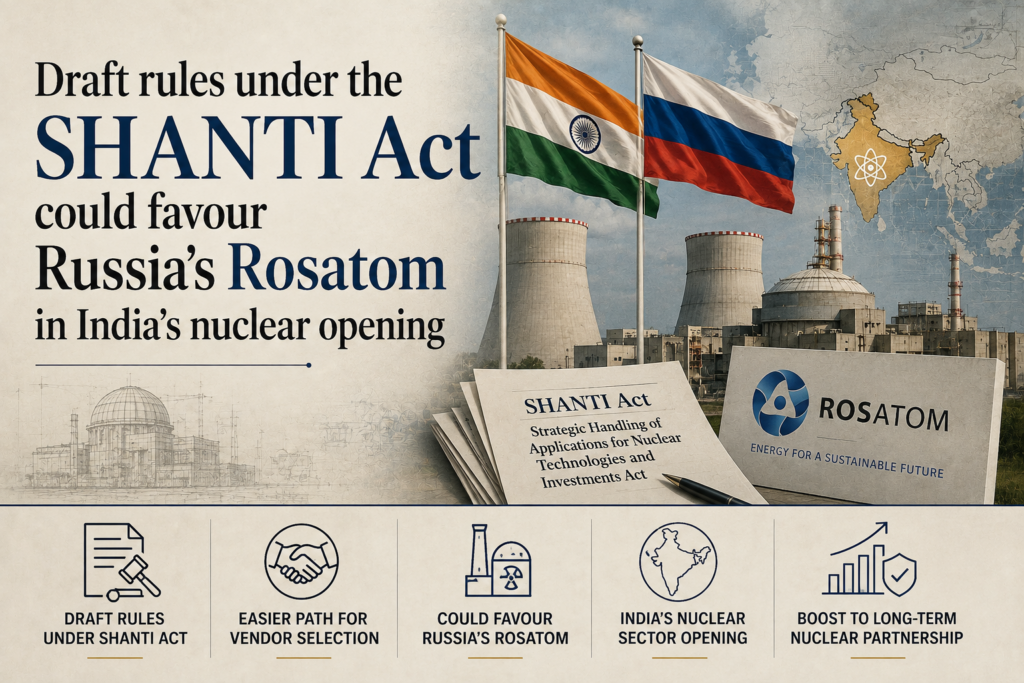
Draft rules issued by the Department of Atomic Energy under the Sustainable Harnessing and Advancement of Nuclear Energy for Transforming India (SHANTI) Act require any foreign nuclear technology brought into India to be design certified by the regulator in its country of origin and already operational there or in another foreign country. Only two Small Modular Reactors are operational anywhere in the world, so a clause written as a safety filter narrows India’s field of eligible suppliers to the one country that already has an operating unit.
Mentor’s Comment
A proven technology test is the most defensible condition a regulator can write. It is also the condition that most reliably locks out every new entrant, because nothing can be operational before someone allows it to operate somewhere first.
What is the SHANTI Act?
- Full name: The Sustainable Harnessing and Advancement of Nuclear Energy for Transforming India Act, referred to as the SHANTI Act.
- Function: It is the statute under which India’s expansion of nuclear power generation is being governed, including the terms on which foreign nuclear technology may be sourced for an Indian plant or reactor.
- Rule making authority: The Department of Atomic Energy (DAE) frames the subordinate rules under the Act, and has now issued them in draft.
- Operative clause in the draft rules: Foreign nuclear technology sourced for a nuclear power plant or reactor in India must mandatorily carry design certification or approval from the regulatory body in its country of origin, and must already be operational there or in another foreign country.
What is a Small Modular Reactor?
- Definition: A Small Modular Reactor (SMR) is an advanced nuclear reactor with about one third the generating capacity of a conventional large power reactor, built from factory made modules rather than site fabricated components.
- Intended use: SMRs are aimed at supplying clean electricity to remote regions with limited grid infrastructure and to individual industrial enterprises.
- India’s interest: India is examining SMRs for localised applications such as energy hungry data centres, and for scaling up baseload capacity quickly.
What do the draft rules actually require of a foreign supplier?
- Home regulator certification: The design must be certified or approved by the regulatory body of the technology’s country of origin.
- Prior operating record: The technology must already be operational in that country or in another foreign country.
- Cumulative condition: Both tests must be met together, so a design certified but not yet built fails the rule, and a demonstration unit without home regulator certification also fails it.
- Practical filter: The clause screens out first of a kind designs, which is the entire category most SMR developers currently sit in.
What does the global SMR field look like?
- Russia, Akademik Lomonosov: A floating power unit with two modules of 35 MWe that began commercial operation in May 2020. It is a non self propelled power barge docked at Pevek harbour, supplying heat to the Arctic port town and electricity to the regional grid, and is the world’s northernmost nuclear power plant.
- China, HTR-PM: A demonstration project grid connected in December 2021 that started commercial operations in December 2023, the second of the two SMRs operational globally.
- United States, Holtec International: The New Jersey based developer’s SMR is still in the design certification phase and is yet to be cleared by its domestic regulator.
- United Kingdom, Rolls-Royce SMR: Also in the design certification phase, with no operating unit anywhere.
- United States, GE-Hitachi BWRX-300: A boiling water reactor derived SMR, likewise awaiting domestic regulatory clearance.
- What the set demonstrates: Only Russia and China clear the operational test today, and Russia is the only country in the world with expertise in floating nuclear power solutions.
What is Russia already positioned to supply in India?
- Existing build: Russia is already constructing conventional nuclear projects in India and holds a lead in the nascent SMR field.
- Kudankulam: The Kudankulam Nuclear Power Project (KKNPP) in Tamil Nadu is India’s largest nuclear power station and the flagship project of Russian and Indian energy cooperation. Units 1 and 2 use Russia’s earlier VVER-1000 light water reactors, where water cools the reactor, and are connected to the national grid supplying south India.
- Serial construction pitch: A key negotiating point from the Russian side is serial construction of high capacity units of Russian design in India based on the new generation VVER-1200 reactor models, with technical specifications being proposed by Russia.
- SMR pitch: Rosatom State Corporation has made a strong pitch for deploying its SMRs for targeted applications in India, and construction of SMRs of Russian design in India is under discussion.
- Floating solutions: In April 2024, Rosatom presented its Indian partners with information on its floating nuclear power solutions.
- Bilateral track: Progress on Kudankulam and the SMR proposal was reviewed at a working meeting in Mumbai on 10 November between the Chairman of the Department of Atomic Energy and the Director General of Rosatom.
Why does cost also point the same way?
- Indigenous benchmark: India’s indigenous pressurised heavy water reactors (PHWRs) cost about Rs 18 crore per MW-electric.
- Russian comparison: Russian reactors are estimated at about Rs 34 crore per MW-electric, which industry insiders describe as only marginally more expensive.
- Western comparison: Light water reactors offered by French and United States companies are significantly more expensive than India’s indigenous PHWRs.
- Where the cost sits: Fuel accounts for a relatively small share of the overall cost of nuclear generation, so the capital number dominates.
- Financing and time: High upfront capital cost remains the key challenge for new projects, and financing costs and the length of the construction period are critical determinants of the final cost of nuclear power.
What are the other major changes in India’s nuclear framework?
- Change to an existing monopoly: The reform track opens nuclear power generation beyond the exclusive preserve of state owned entities, which the Atomic Energy Act, 1962 had reserved for the government.
- Change to an existing liability regime: The Civil Liability for Nuclear Damage Act, 2010, whose Section 17(b) gives the operator a right of recourse against the supplier, is part of the same reform track because that provision is the standing deterrent for foreign vendors.
- New institutional target: A Nuclear Energy Mission for Viksit Bharat carries an outlay of Rs 20,000 crore for research and development on Small Modular Reactors, with at least five indigenously designed SMRs targeted to be operational by 2033.
- New capacity goal: A national target of 100 GW of nuclear capacity by 2047 anchors the entire framework, against present installed capacity of under 9 GW.
- New subordinate rules: The draft rules now released are the first set of subordinate legislation under the SHANTI Act governing sourcing of foreign nuclear technology.
Does a proven technology test buy safety at the cost of competition?
- The case for the clause: A design already certified and operating abroad carries demonstrated safety performance, which is the strongest assurance a regulator can demand before a first Indian deployment.
- The cost of the clause: Almost every SMR developer is in the design certification phase, so a rule keyed to operating status excludes the field rather than ranking it.
- Competition effect: With Holtec, Rolls-Royce SMR and the GE-Hitachi BWRX-300 all outside the gate, price discovery for Indian projects narrows to one supplier’s quotation.
- Reciprocity problem: India’s own first of a kind designs have no operating record either, so a mirror clause applied abroad would keep Indian reactors out of foreign markets.
- Strategic dependence: Serial construction of VVER-1200 units plus SMR supply from the same country deepens a single supplier relationship in a sector with sixty year asset lives.
Challenges to the design certification and prior operation clause
- The eligible field collapses to two countries: Only Russia and China have an operating SMR, e.g. Akademik Lomonosov since May 2020 and HTR-PM since December 2023, so every other developer is excluded until its home regulator acts.
- First of a kind Indian designs get no reciprocal entry: An indigenous SMR has no operating unit anywhere, e.g. the Bharat Small Modular Reactor of about 200 MWe exists only on paper, so a comparable foreign rule would bar it abroad.
- Supplier liability still deters western vendors independently of this clause: Section 17(b) of the Civil Liability for Nuclear Damage Act, 2010 has kept projects frozen, e.g. the Jaitapur project with French supply has been under negotiation since 2010 without a single unit built.
- Construction period risk dominates project cost: Long build times inflate financing cost, e.g. Kudankulam Unit 1 was sanctioned in 1988 and reached criticality only in 2013.
- Fuel supply remains external for safeguarded reactors: Imported uranium underpins the light water fleet, e.g. India sources uranium from Kazakhstan, Uzbekistan, Russia and Canada under Nuclear Suppliers Group waiver arrangements.
- Local acceptance and land acquisition delay siting: Public opposition has stalled commissioning, e.g. protests at Kudankulam through 2011 and 2012 delayed the first unit by over a year.
- SMR economics depend on serial factory production: A handful of units cannot amortise a module factory, e.g. Pevek’s barge served a single Arctic town, which is not a template for grid scale Indian demand.
Conclusion
The rules under the SHANTI Act are at the stage of a draft released by the Department of Atomic Energy for public comment, and the operative clause requires foreign nuclear technology to be design certified in its country of origin and already operational there or abroad. The next milestone is the close of the comment window on 4 September 2026, after which the rules are to be finalised and notified. As drafted, the clause leaves Rosatom as effectively the only qualifying SMR supplier, with Holtec International, Rolls-Royce SMR and the GE-Hitachi BWRX-300 all still in design certification.
