Why in the News
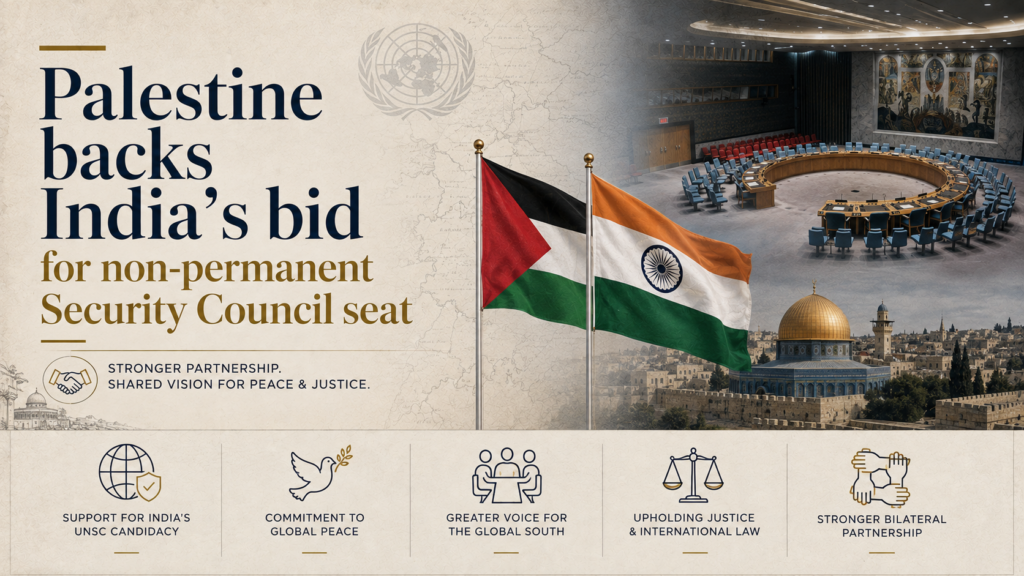
Palestine has backed India’s bid for a non-permanent UN Security Council seat for 2028-29. The support came during India’s renewed diplomatic engagement with Palestine, including plans for a new India-funded hospital in the West Bank and medical assistance for Gaza.
Non-Permanent Seat of the UNSC
- Composition: UNSC has 15 members: 5 permanent members with veto power and 10 non-permanent members.
- Election: Elected by the UN General Assembly for a 2-year term with a two-thirds majority.
- Distribution: Seats follow equitable geographical representation; India contests from the Asia-Pacific Group.
- Rotation: 5 non-permanent seats are elected every year. A retiring member cannot be immediately re-elected.
Significance of Palestine’s Support for India
- Palestine supports India’s 2028-29 candidature and has also expressed support for India having a permanent UNSC seat.
- It views India’s economic and political weight as important for advancing Palestinian interests.
- Palestine expects India to use its relations with Israel to facilitate the peace process.
- The endorsement strengthens India’s image as a country capable of engaging both sides of the Israel-Palestine conflict.
India’s Development Assistance to Palestine
- West Bank: India is finalising an India-funded hospital.
- Vocational training: Support for a vocational training centre.
- Gaza: Discussions on artificial limbs for amputees.
- Medical equipment: Talks on supplying dialysis machines and other equipment, potentially through Jordan.
India’s Position on Palestine
- India has consistently supported:
- A negotiated two-state solution.
- An independent Palestine coexisting peacefully with Israel.
- Development and humanitarian assistance to the Palestinian people.
- The recent visit to Ramallah marked India’s first high-level visit to the affected region since the October 2023 conflict.
India’s De-hyphenated Israel-Palestine Policy
India follows a de-hyphenated approach, treating relations with Israel and Palestine independently.
- Full diplomatic relations with Israel were established in 1992.
- India has deepened strategic cooperation with Israel while continuing to support Palestinian statehood.
- India has continued supporting Palestinian-related resolutions at the UN.
- This balancing gives India diplomatic credibility and leverage with both sides.
“[2009] The Security Council of UN consists of 5 permanent members, and the remaining 10 members are elected by the General Assembly for a term of
(a) 1 year
(b) 2 years
(c) 3 years
(d) 5 years
