Why in the News
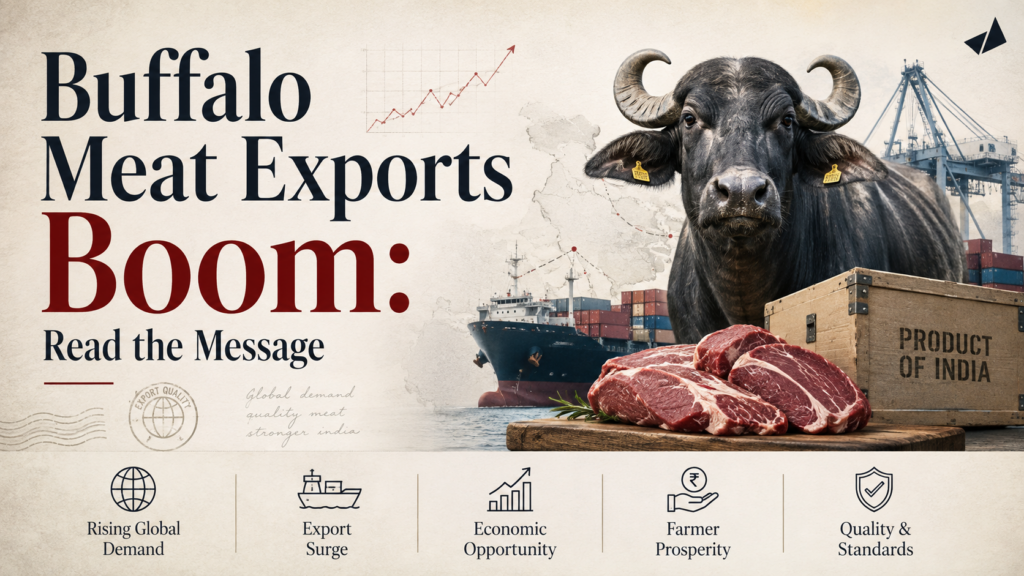
India’s buffalo meat exports hit a record 5.1 billion dollars in 2025-26 and are set to cross 6 billion dollars in the current financial year. The boom rests on a market for culled unproductive buffaloes that lets dairy farmers turn their herds over, and the same herd turnover logic is blocked for cattle by a political prohibition.
What is India’s buffalo meat export trade?
- The product: Buffalo meat, known in international trade as carabeef, is meat obtained from buffaloes and is exported almost entirely in deboned and frozen form.
- The source animal: The animals culled are mostly buffaloes not giving enough milk and males, which have no role in a dairy herd beyond breeding.
- The export channel: Exports are allowed only through government approved abattoirs and processing plants, which is what makes compliance with importing country standards enforceable at the point of slaughter.
- The quality regime: The trade operates under internationally recognised quality and hygiene standards, and the product is now positioned on its own profile rather than as a cheaper alternative to regular cattle beef.
What is a spent animal in dairy farming?
- Definition: A spent animal is a milch animal that has passed the productive phase of its lactation life and no longer yields enough milk to justify the cost of maintaining it.
- Why the term matters here: India’s buffalo meat comes from spent buffaloes that have outlived their usefulness as milkers, not from animals reared for meat.
What is unit value realisation?
- Definition: Unit value realisation is the average price earned per physical unit of a good exported, calculated by dividing total export value by total export quantity.
- What it indicates: A rise in unit value realisation with volumes unchanged shows the product is being sold into a higher grade market rather than simply in larger quantity.
What is the inter calving interval?
- Definition: The inter calving interval is the period between two successive calvings of the same animal, and it determines how frequently the animal returns to a fresh lactation.
- Why it matters: A longer interval means fewer lactations across an animal’s productive life, so lifetime milk output falls even where daily yield is unchanged.
What do the buffalo meat export figures show about the trade’s position?
- A record year: Buffalo meat exports reached a record 5.1 billion dollars in 2025-26.
- The projection: Exports are set to cross 6 billion dollars in the current financial year.
- Price realisation: Unit value realisations have risen from below 3,000 dollars to more than 4,000 dollars per tonne over the last two to three years.
- Established markets: The industry has built a market across countries in Southeast Asia, West Asia and Africa.
- New markets: Uzbekistan, Russia and Georgia are the more recent additions to the destination list.
- The repositioning: The rise in realisation followed concerted effort at raising the product profile of Indian buffalo meat, which shows the gain came from grading and standards rather than from volume alone.
How does the buffalo meat trade support India’s dairy economy?
- It creates a market for the unproductive animal: By creating a market for unproductive buffaloes, meat plants have enabled farmers to replace low yielding and ageing animals with high milking and fresh stock.
- It removes a direct maintenance cost: The fodder, feed, water and labour that go towards maintaining an unproductive animal are a direct cost on the farmer with no returning output.
- It removes an opportunity cost: The same fodder, feed, water and labour, if allocated to a more productive bovine, would produce output, so keeping an unproductive animal costs the farmer the foregone milk as well.
- It makes herd turnover possible: Regular herd turnover is essential for any viable dairy enterprise, and turnover is only possible where the exiting animal has a destination.
- It avoids competition for scarce resources: The buffaloes going to the slaughterhouse are not competing for scarce feed and water with the ones giving milk, which makes the arrangement more sustainable than one where both are maintained.
- It supports rising milk demand: Consumption of milk, especially high fat milk, is growing in India on the back of rising incomes, and buffalo milk is the high fat segment of that demand.
What does the Brazil and United States model show about India’s dual purpose bovine economy?
- Brazil, separate herds for separate purposes: Brazil rears cattle separately for milk and for beef, with beef production built on dedicated meat breeds rather than on animals exiting a dairy herd.
- United States, the same separation: The United States also rears cattle separately for milk and beef, so its beef supply is generated by a purpose built industry independent of dairy herd turnover.
- India’s contrasting structure: In India the meat comes from spent buffaloes that have outlived their usefulness as milkers, so the meat industry is a downstream consequence of dairying rather than a parallel industry.
- What the comparison establishes: The comparison rests on these two country cases alone, and it establishes one design point, that India’s meat output is structurally tied to the productivity cycle of its dairy herd and cannot expand independently of it.
Why can buffaloes alone not meet India’s growing milk demand?
- Lower yields: Buffalo milk yields are lower compared to yields from crossbred cows, so the same herd size produces less milk.
- Later entry into production: The age at which a buffalo first begins producing milk is higher than for a crossbred cow, which shortens its productive life within a given lifespan.
- Longer inter calving intervals: Buffalo inter calving intervals are longer, which reduces the number of lactations an animal delivers across its productive years.
- The medium term conclusion: Buffaloes alone cannot supply India’s increasing milk requirement from a medium to long term perspective, whatever support the meat export market provides to buffalo rearing.
- What follows for cattle: A scientific approach to culling unproductive animals is therefore necessary in cattle too, whether for breeding and reproductive efficiency or for redirecting finite resources to higher yielding stock.
Why does the same culling logic that sustains buffalo dairying not extend to cattle?
- The economics are identical: An unproductive cow imposes the same fodder, feed, water and labour cost on the farmer as an unproductive buffalo, and the same foregone output.
- The outlet is not: Buffaloes have a legal and organised outlet through approved abattoirs, while cattle slaughter is prohibited or heavily restricted in most States.
- The consequence for the farmer: Without an outlet, the farmer either maintains an animal that yields nothing or abandons it, and neither choice permits the herd turnover a viable dairy enterprise requires.
- The consequence for the herd: Blocked turnover holds low yielding animals inside the national cattle herd, which suppresses average productivity and works against the very breed improvement programmes the State funds.
- Where the decision sits: The choice on scientific culling in cattle is a political one, and the political leadership cannot avoid taking that call if dairy productivity is to rise.
Challenges to India’s buffalo meat export trade
- Dependence on a narrow set of importing markets: A large share of export value goes to a small group of destinations, so a single import ban moves the whole trade. Eg. Restrictions on Indian buffalo meat by importing countries on animal health grounds have previously stalled shipments to major West Asian destinations.
- Animal disease status: India’s foot and mouth disease status keeps several high value markets closed regardless of processing standards. Eg. Japan, South Korea and the European Union remain effectively closed to Indian bovine meat on foot and mouth disease grounds.
- Concentration in approved plants: Exports flow only through government approved abattoirs and processing plants, and their number and geographic spread limit the trade’s capacity. Eg. Approved integrated abattoirs are concentrated in a few States in northern and western India, leaving southern producers dependent on long distance animal transport.
- Transport and cruelty compliance: Long distance movement of animals to approved plants attracts enforcement action and litigation under animal welfare law. Eg. The Prevention of Cruelty to Animals (Regulation of Livestock Markets) Rules, 2017 restricted sale of cattle for slaughter in animal markets before they were stayed and later withdrawn.
- Informal segment outside the regime: Domestic slaughter for local consumption occurs largely in municipal and unregistered facilities outside the export quality regime, which carries public health and reputational risk for the whole sector. Eg. Municipal slaughterhouses in several cities have been ordered shut by courts and tribunals for effluent and hygiene violations.
- Currency and tariff exposure: Realisations in dollar terms are sensitive to exchange rate movement and to tariff changes in destination markets. Eg. The shift of Indian buffalo meat into Russia and Georgia followed changes in trade access rather than any change in Indian production.
- Substitution by competing suppliers: Brazil and Australia compete in the same low and mid price bovine meat segments with disease free status and larger scale. Eg. Brazilian beef has displaced Indian buffalo meat in several Southeast Asian markets during periods of price parity.
Conclusion
The buffalo meat export boom is not merely a trade success, it is evidence that a legal culling market is what allows a dairy herd to renew itself. Record exports of 5.1 billion dollars in 2025-26 rest on animals that had stopped producing milk and were therefore consuming feed, water and labour without return. The same logic applies to cattle, where blocked turnover keeps low yielding animals in the herd and holds average productivity down. What remains unresolved is the political decision on scientific culling in cattle, without which breed improvement spending will keep working against a herd it cannot renew.
“[2015, GS3, 12.5] Livestock rearing has a big potential for providing non-farm employment and income in rural areas. Discuss suggesting suitable measures to promote this sector in India.”
