| Question (2020, GS2): “Judicial Legislation is antithetical to the doctrine of separation of powers as envisaged in the Indian Constitution. In this context justify the filing of large number of public interest petitions praying for issuing guidelines to executive authorities. Linkage: This question directly addresses the core tension of the Patna High Court case: whether courts issuing executive-style guidelines (like noise limits and enforcement mechanisms) violates the separation of powers, or if it is justified by the sheer volume of public interest petitions stemming from executive inaction. |
Mentor comment
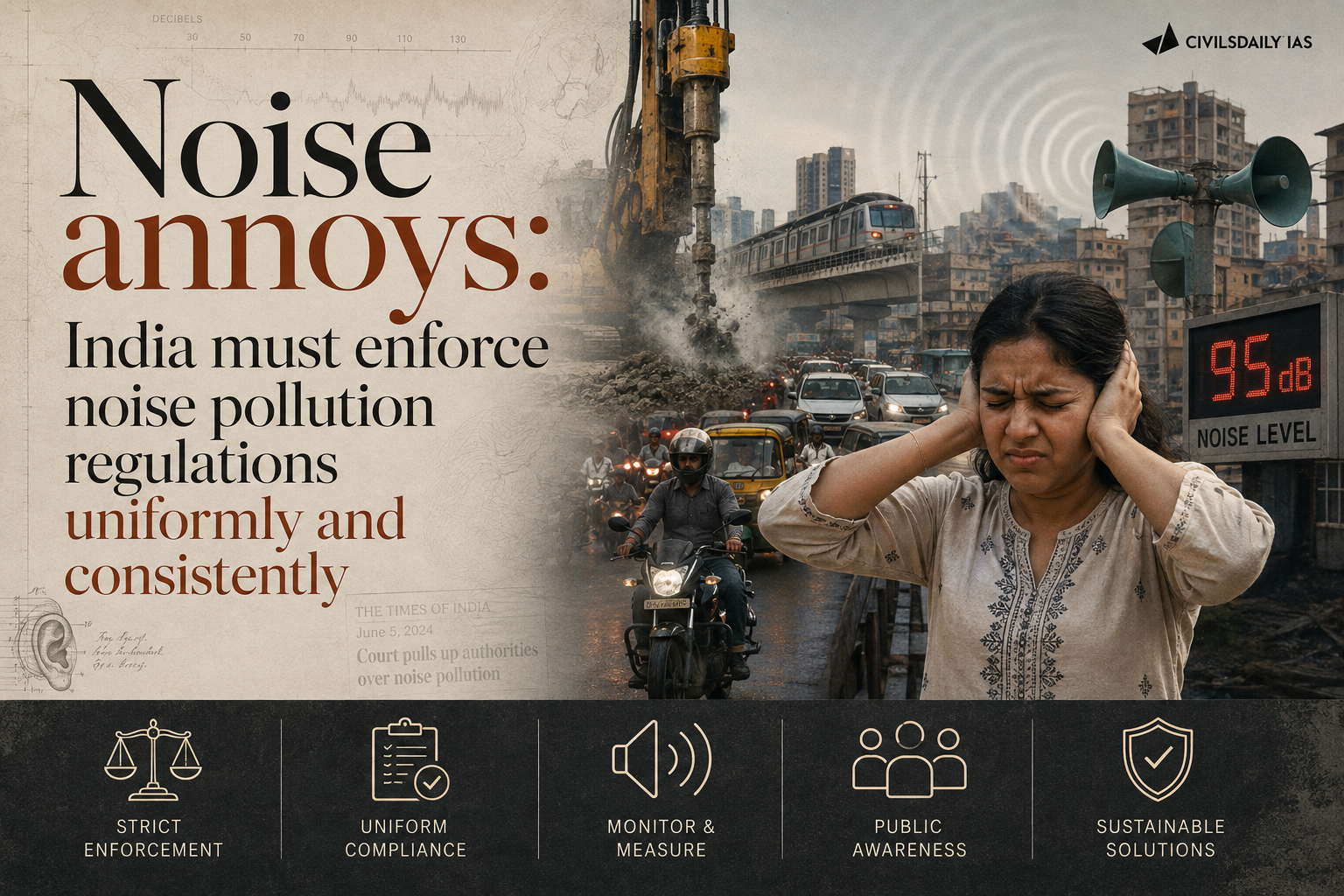
The Patna High Court issued Statewide directives on the emission of high-decibel noise through an order dated 14 August 2026. The order closes an escalation that began in Surendra Prasad vs State of Bihar. A February 2025 hearing before a single judge in that case acknowledged DJ trolleys and loudspeakers to be a major source of noise in Patna. The same hearing criticised the Bihar State Pollution Control Board (BSPCB) for failing to curb the problem. India already has comprehensive noise law, so the directives are not filling a gap in the rules. What is contested is whether a constitutional court that has taken on the functions of a regulator is a remedy or an admission that routine enforcement has collapsed.
What are the Noise Pollution (Regulation and Control) Rules, 2000?
- Subordinate legislation under an environmental statute: The Rules were made under the Environment (Protection) Act, 1986, and noise is separately treated as an air pollutant under the Air (Prevention and Control of Pollution) Act, 1981 when present in harmful concentrations.
- Limits are set zone by zone and by time of day: The Rules fix permissible ambient limits across residential, commercial, industrial and silence zones, with a lower limit at night than by day. Residential areas must stay below 55 decibels by day and 45 decibels at night.
- Silence zones carry a stricter regime: Areas within 100 metres of hospitals, educational institutions and courts are silence zones, with tighter limits and restrictions on loudspeaker use.
- Loudspeakers are barred at night: Loudspeakers and public address systems may not be used between 10 p.m. and 6 a.m., with a limited festival relaxation that a State government may notify.
What is a decibel?
- A logarithmic unit, not a linear one: The decibel scale compresses a very wide range of sound intensities, so a rise of 10 decibels is a tenfold increase in sound energy and is perceived as roughly a doubling of loudness.
- Standards are set as averages, not peaks: Ambient noise limits are expressed as day and night equivalent levels for a zone, which is why a single loud event can breach the limit for an entire area.
How did a single city’s complaint become a Statewide order?
- The Board was told to produce the enforcement record: After criticising the BSPCB, the Court directed it to obtain reports from the police on permissions granted to operators of these noise sources and on the action taken against them.
- The record showed enforcement stopping at the town boundary: In October the police reported seizing equipment and levying fines over three months in Patna, Barh and Fatuha, and taking no action at all in Masaurhi.
- A nil return was treated as evidence of non-enforcement: The judge called the picture “unbelievable” for suggesting there were no noise violations in Masaurhi at all.
- The Court moved from records to persons: Police officers were summoned in the course of the hearings, and boilerplate affidavits filed in response were upbraided from the bench.
- The escalation ended in Statewide relief: The 14 August order extended what began as a Patna grievance into directives binding across Bihar.
What did the Patna High Court direct?
- Enforcement must become routine, not complaint-driven: Authorities were directed to pursue enforcement on their own initiative rather than waiting for a member of the public to file a complaint against a specific source.
- Operators must register themselves: DJs, sound-system operators and event halls were directed to register with the subdivisional authorities, which converts an invisible population of operators into a listed one.
- The cut-off was moved forward by five minutes: Loudspeakers were directed to stop playing at 9.55 p.m., five minutes before the law’s 10 p.m. limit.
- The five minutes are a compliance device, not a concession: The margin gives operators time to wind up, and it removes the defence that carrying on past 10 p.m. is only a matter of a few minutes.
Why does enforcement fail even where the law is comprehensive?
- The failure is in application, not in drafting: Comprehensive rules have existed since 2000, and the Court’s intervention illustrates how dismal enforcement has become despite them.
- Complaint-based enforcement puts the cost on the victim: It is absurd to expect the public to complain about every DJ or horn before the police can respond, and a complainant in a small town faces the operator socially afterwards.
- Governments have an incentive to tolerate the violation: Loud events belong to constituents, and antagonising them carries a political cost that enforcement carries no matching reward for.
- Responsibility is split between two agencies: The pollution control board owns the standards and the police own the power to seize and prosecute, so neither is accountable for the outcome when the other does nothing.
- Episodic action has hardened into the norm: Drives launched around a festival and abandoned afterwards teach operators that the rule applies for a fortnight in the year.
Does uniform noise enforcement collide with the right to practise culture?
- The sources are ordinary social occasions: Loud noise is produced by festivals, weddings, political campaigns and religious events, not mainly by industry, so every enforcement action touches a social gathering.
- Enforcement therefore reads as interference: Rules create friction with people who believe they have a right to practise their culture as they deem fit, which is what makes the state reluctant to act.
- The competing right is also constitutional: Courts have repeatedly held that people have a right under Article 21 to be protected from unlawful noise, so the question is between two claimed rights and not between culture and convenience.
- The claim has already been decided: A Supreme Court ruling of 2005 held that noise pollution violates Article 21 and that the use of loudspeakers, even for religious purposes, is not a fundamental right.
Is a High Court acting as a regulator a solution or a symptom?
- The Court is doing the executive’s work: With episodic enforcement having become endemic, the Patna High Court becoming a quasi-regulator is creditable as a stopgap measure.
- A stopgap is not a regulatory system: A court supervises through hearings and contempt, which is an expensive and slow substitute for routine administrative enforcement by a subdivisional officer.
- Court-driven compliance decays when the case ends: Enforcement sustained by a listed matter tends to lapse once the bench changes or the petition is disposed of.
- The right test is behavioural, not judicial: The success of the order should be measured by whether the State develops a consistent habit of enforcement, not by the number of directions issued.
Challenges to enforcing the Noise Pollution Rules, 2000
- Penalties are too small to deter: Fines under the general environmental penalty provisions are trivial against the earnings of a single wedding or campaign engagement, so paying is cheaper than complying. Eg. Equipment seizures rather than fines were what the Bihar police reported as their main action. Fix. Move to graded penalties linked to the event’s scale and to cancellation of the operator’s registration on a second breach.
- Traffic noise sits outside the permission system: The largest single urban source is road transport, and horns and modified silencers are not covered by any event permission or registration regime. Eg. Metros such as Delhi and Mumbai routinely breach the 55 decibel residential daytime limit. Fix. Enforce horn and silencer standards through automated noise cameras at signalised junctions, linked to the vehicle registration database.
- Silence zones are breached where enforcement matters most: Hospitals, schools and courts sit on arterial roads where the 100 metre silence zone cannot be maintained without traffic management. Eg. Silence zone signage exists around most large hospitals without any accompanying restriction on the road. Fix. Require every notified silence zone to carry a traffic calming plan approved along with the zone notification.
- Festival relaxations become the operating rule: States may permit loudspeaker use beyond the night limit on a small number of days a year, and the exemption expands informally into the surrounding weeks. Eg. Enforcement drives are routinely suspended for the length of a festival season rather than for the notified days. Fix. Publish the notified relaxation dates in advance and require a written order for any extension, subject to review.
- The register has no custodian system: The subdivisional offices directed to hold the operator register have no software, no dedicated staff and no publication duty attached to it. Eg. The nil action return from Masaurhi shows what an unmonitored subdivision produces. Fix. Host the operator register online at State level with each permission and each violation recorded against the operator’s entry.
- Data does not exist to prove a breach: Prosecution needs a calibrated measurement at the time and place of the offence, and most police stations have no sound level meter. Eg. Real-time ambient noise monitoring covers only a handful of Indian cities. Fix. Equip every police station in a notified urban area with a calibrated meter and make the reading an admissible enforcement record.
Conclusion
India’s noise problem is a failure of routine enforcement rather than a gap in law, and the Patna High Court has had to supply the enforcement architecture the executive did not, through mandatory registration, self-initiated policing and a wind-up margin before the statutory cut-off. Court supervision is a legitimate stopgap and it is not a regulatory system. The order will have worked only if the State keeps registering operators and acting on violations after the case is no longer listed. Consistency, not the number of directions, is the measure.
Noise Pollution in India
- About: Noise pollution is excessive, unwanted or harmful sound that disrupts the environment and harms human health, arising from traffic, industry, construction, loud music and public events beyond permissible levels.
- Health burden: Chronic exposure raises hypertension, heart disease and stroke risk, and workplace noise alone causes around 500,000 hearing loss cases globally each year.
- Wider effects: Noise impairs children’s learning and drives stress, anxiety and depression, and it disrupts animal communication and breeding. Eg. Marine traffic noise disorients whales and dolphins that depend on echolocation.
- Policy standing: The United Nations Environment Programme declared noise an emerging environmental threat in 2022, and the European Environment Agency now ranks it among the top three environmental health risks behind only air pollution and temperature.
Laws and Rules Governing Noise Pollution
- Air (Prevention and Control of Pollution) Act, 1981: Includes noise within the definition of an air pollutant where it is present in concentrations harmful to humans, animals, plants, property or the environment, and industrial noise is regulated by State Pollution Control Boards under it.
- Environment (Protection) Rules, 1986: Prescribe source-specific noise standards for motor vehicles, air conditioners, refrigerators, diesel generators and construction equipment.
- Motor Vehicles Act, 1988 and rules made under it: Prohibit multi-toned and shrill horns and the removal or alteration of a silencer, and provide the basis for vehicle noise limits at the point of type approval.
- Bharatiya Nyaya Sanhita, 2023: Retains public nuisance as an offence. Police most often invoke that provision against a loudspeaker operator in the absence of a measured reading.
Key Facts about Noise Standards
- World Health Organization (WHO) Environmental Noise Guidelines, 2018: Recommend 45 decibels by day and 40 decibels at night for road traffic noise, values stricter than India’s residential limits.
- European burden estimate: Transport noise causes an estimated 66,000 premature deaths a year in Europe, along with 50,000 new cardiovascular cases and 22,000 type-2 diabetes cases.
- Scale of exposure: Over 20 per cent of Europeans, more than 110 million people, face harmful transport noise, with 4.6 million reporting severe sleep disturbance.
- Firecracker limit in India: The Central Pollution Control Board caps firecracker noise at 125 decibels measured at 4 metres from the point of bursting.
Back2Basics: State Pollution Control Boards
- Statutory basis: Constituted by State governments under the Water (Prevention and Control of Pollution) Act, 1974, and given further functions under the Air (Prevention and Control of Pollution) Act, 1981.
- Composition: A chairman with knowledge of environmental protection, officials nominated by the State government, representatives of local authorities, and representatives of companies and corporations.
- Core power: Grant, refuse or withdraw consent to establish and consent to operate for any industry discharging effluent or emitting pollutants, which is the licence an industry cannot run without.
- Relationship with the Centre: The Central Pollution Control Board lays down standards, coordinates the boards and resolves disputes between them, and may direct a State board on any matter.
