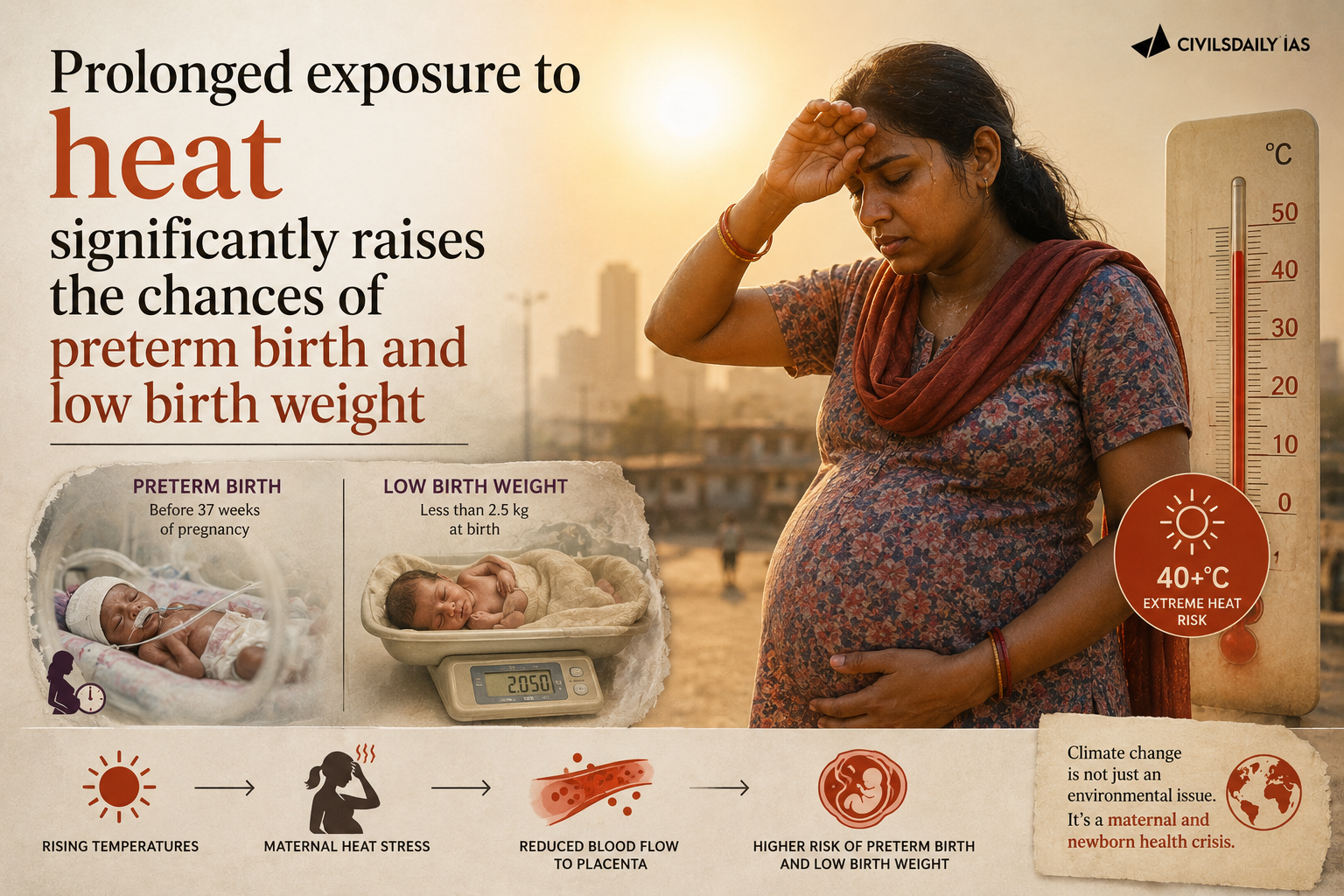
Why in the News
Preterm births in India are rising, and Delhi alone has recorded a 21 per cent increase over the past five years. A study by the Indian Institute of Technology Delhi with international universities analysed National Family Health Survey data for 2015 to 2020. It established that prolonged exposure to heat significantly raises the chances of preterm birth and low birth weight. Motherhood in India continues to be narrated through the language of labour pain, sacrifice and endurance. That language describes a full-term vaginal delivery and nothing else. Causation is moving towards environmental exposure no individual can control. Responsibility is still located in the mother’s body.
What is preterm birth?
- A birth before 37 completed weeks: Preterm birth is delivery before 37 completed weeks of gestation, counted from the first day of the last menstrual period.
- Three severity bands: The World Health Organization classifies births before 28 weeks as extremely preterm, 28 to 32 weeks as very preterm, and 32 to 37 weeks as moderate to late preterm.
- Low birth weight is a separate marker: A newborn weighing under 2,500 g is classified as low birth weight, with or without prematurity. The risk compounds when both are present.
- India carries the largest absolute burden: India records the highest number of preterm births of any country, at roughly three million a year, which is close to a fifth of the global total.
What is kangaroo mother care?
- Skin-to-skin contact as clinical treatment: Kangaroo mother care places the low birth weight infant upright against the parent’s bare chest for prolonged periods, combined with exclusive breastfeeding, to stabilise temperature, heart rate and breathing.
- It is recommended from birth: The World Health Organization advises immediate and continuous kangaroo mother care for infants born under 2,000 g rather than delaying it until the infant is clinically stable.
What does care inside a neonatal intensive care unit actually involve?
- Time is measured by instruments, not routines: Days inside a neonatal intensive care unit (NICU) are structured around oxygen saturation levels, heart-rate monitors and machine alarms rather than feeding schedules or sleepless nights.
- The first contact is mediated by equipment: Early memories of motherhood are of incubators and wires rather than of cradling a child, with infants weighing a few hundred grams held for kangaroo mother care.
- The mother is a patient at the same time: A caesarean delivery leaves the mother recovering from major abdominal surgery. The infant is treated several corridors away, so hours of sitting are managed through incision pain.
- Stays run into weeks, not days: A NICU admission after a very preterm delivery commonly runs six weeks or longer, which is a period of hospital residence rather than a hospital visit.
- Solidarity forms sideways, not from clinicians: Support comes from nurses, guards, hospital staff and other mothers in the same unit, who mark small milestones together and register each other’s setbacks.
Why do preterm births keep rising in India?
- Maternal nutrition: The nutritional health of mothers is a direct contributor, with anaemia and low pre-pregnancy weight raising the risk of early delivery.
- The changing pattern of pregnancies: Later first pregnancies, higher rates of assisted conception and more multiple births all shift the distribution towards earlier deliveries.
- Environmental factors: A significant part of the rise is attributable to environmental exposure rather than to maternal or clinical factors.
What does the parallel rise in caesarean sections indicate?
- Caesarean rates have moved well past the clinical reference range: The National Family Health Survey records 21.5 per cent of deliveries as caesarean nationally, against the 10 to 15 per cent range the World Health Organization treats as the point beyond which population level benefits stop.
- The private sector drives the gap: Caesarean deliveries account for 47.4 per cent of births in private facilities against 14.3 per cent in public facilities. The gap points to provider incentives rather than to clinical need.
- An emergency caesarean is a different event from an elective one: A preterm emergency caesarean is a rescue procedure for foetal or maternal distress, and it arrives without the preparation an elective procedure allows.
- Timing carries its own risk: Caesarean delivery before 39 completed weeks raises neonatal respiratory morbidity, so a rising caesarean rate and a rising preterm rate reinforce each other.
Who is held responsible when a birth goes wrong?
- The dominant script has no place for a preterm birth: An initiation into motherhood that begins at the doors of a neonatal unit has no available story, so the experience goes unnarrated rather than merely unrecognised.
- Scrutiny falls on the mother’s conduct: Society places the burden of a healthy pregnancy almost entirely on women, and a premature birth intensifies that scrutiny into questions about whether she travelled or rested enough. The mother’s body becomes the site of investigation.
- The evidence points the other way: Environmental exposure and clinical practice are population level determinants, and neither is amenable to individual maternal conduct.
- The psychological cost has no recognised name: Conversation around postpartum depression has grown, and the emotional realities of neonatal intensive care motherhood remain largely invisible.
- Even the support offered polices the mother: Nurses urge mothers to stay positive because infants sense their emotions. That instruction converts grief into a further maternal responsibility.
Challenges in maternal and newborn care in India
- Neonatal intensive care capacity is thin outside metros: District level special newborn care units handle stabilisation but not ventilation or surgery, so very preterm infants must be transferred to a medical college or a private hospital. Eg. Referral transport for sick newborns remains the weakest link in the newborn care chain in most States. Fix. Attach a functioning level three unit to every district hospital with a dedicated newborn transport ambulance on a fixed response standard.
- Neonatal intensive care is catastrophic out-of-pocket expenditure: A six-week private NICU stay runs into several lakh rupees and sits outside most insurance cover for a newborn without an existing policy. Eg. Ayushman Bharat covers the mother’s delivery package but not an extended neonatal admission in every State’s package list. Fix. Add a defined neonatal intensive care package with a per-day rate to the national health insurance benefit list, effective from the date of birth.
- Perinatal mental health has no service line: Public maternity facilities have no counsellor attached to the neonatal unit, so the psychological consequences of a preterm birth go unscreened and untreated. Eg. Screening for postpartum depression is not part of the standard postnatal visit schedule. Fix. Post a trained counsellor at every special newborn care unit and add a validated screening question to the routine postnatal check.
- Caesarean rates are unaudited in the private sector: No facility level audit compels a hospital to justify its caesarean rate, so the rate rises without a clinical explanation. Eg. Facility caesarean rates above 50 per cent are recorded in several States without triggering review. Fix. Publish facility-wise caesarean rates using the Robson classification and make registration renewal conditional on a rate review.
- Heat action plans do not name pregnant women: City heat plans list outdoor workers and the elderly as vulnerable groups and generally omit pregnant women, so no advisory or workplace protection reaches them. Eg. Most State heat action plans carry no antenatal advisory component. Fix. Add pregnant women as a notified vulnerable category, with heat advisories issued through antenatal care contacts and Anganwadi workers.
- Kangaroo mother care coverage stays low: The intervention is cheap and evidence-backed, and it requires a mother to remain beside the infant for hours. Most public units are not physically designed for that. Eg. Many newborn units have no space for a mother to stay overnight. Fix. Make mother-side accommodation a licensing condition for any unit designated to handle low birth weight newborns.
Conclusion
Preterm birth in India is being pushed upward by heat exposure and other environmental determinants that no individual pregnancy can be managed against, and the clinical system is simultaneously delivering more babies surgically and earlier. The response has stayed at the level of the individual mother, whose conduct is scrutinised and whose psychological care is not provided at all. Recognising heat as a maternal health exposure, auditing caesarean practice and funding neonatal intensive care are the three interventions the evidence already supports. Until they are in place, the burden of a structural change will keep being carried privately.
“[2025] Consider the following statements:
Statement I: At the 28th United Nations Climate Change Conference (COP28), India refrained from signing the ‘Declaration on Climate and Health’.
Statement II: The COP 28 Declaration on Climate and Health is a binding declaration; and if signed, it becomes mandatory to decarbonize health sector.
Statement III: If India’s health sector is decarbonized, the resilience of its healthcare system may be compromised.
Which one of the following is correct in respect of the above statements?
(a) Both Statement II and Statement III are correct and both of them explain Statement I
(b) Both Statement II and Statement III are correct but only one of the them explains Statement I
(c) Only one of the Statements II and III is correct and that explains Statement I
(d) Neither Statement II nor Statement III is correct
