Why in the News
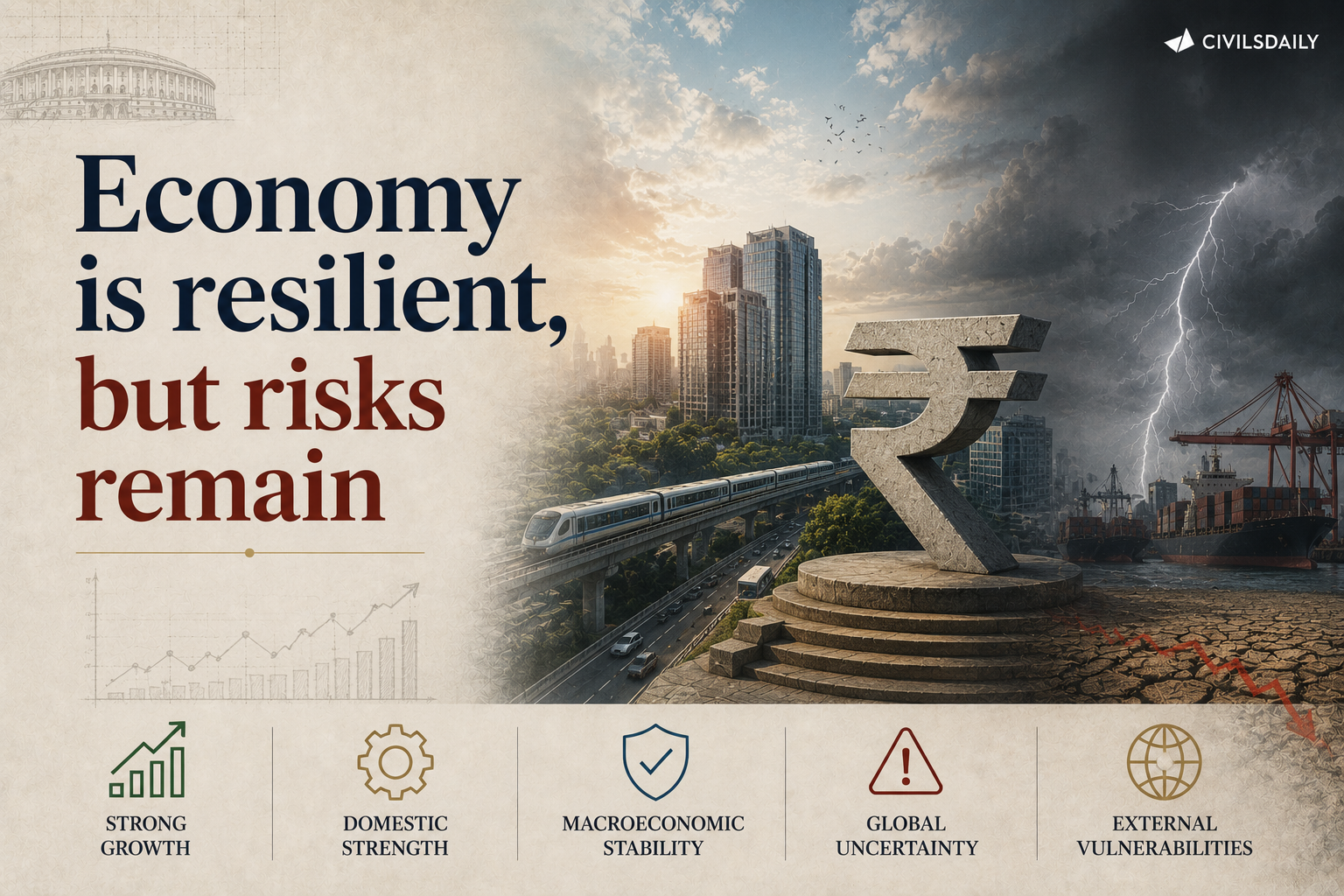
The State of the Economy report, compiled by economists at the Reserve Bank of India (RBI), together with the finance ministry’s monthly economic review, has found that India’s underlying growth momentum held up through the first quarter of the financial year. Both readings point to firm household consumption, industrial output and credit growth even as global conditions stay unsettled. The outlook nonetheless remains clouded by continuing geopolitical and trade related uncertainty, volatile energy prices and a strengthening El Niño (a periodic warming of central and eastern Pacific Ocean waters that disrupts monsoon rainfall patterns), risks that could weigh on growth just as the National Statistics Office (NSO) prepares to release its first quarter Gross Domestic Product (GDP) estimate.
What signals point to resilient domestic growth?
- Steady consumption indicators: E way bill generation has stayed firm, Goods and Services Tax (GST) revenues have remained healthy, and passenger vehicle, tractor and two wheeler sales have all been strong.
- Firm industrial output: The Index of Industrial Production (IIP), a measure of output across mining, manufacturing and electricity, rose 5.8 percent in the quarter, aided by the manufacturing sector, while electricity demand held steady.
- Corporate profitability and credit growth: Firms in both manufacturing and services reported improved operating profits, and bank credit has grown at a brisk pace across both industrial and retail lending.
- Monsoon recovery and exports: A recovery in the monsoon has supported kharif sowing, and exports excluding oil grew 12.8 percent in the first four months of the year, aided by the currency’s depreciation.
- Public capital spending: The Centre’s own expenditure grew by roughly 24 percent in the quarter, keeping public capital spending on track.
What risks could weigh on this resilience?
- External uncertainty: Continuing geopolitical and trade related tensions, along with supply chain pressures, threaten to unsettle the momentum built up domestically.
- Volatile energy prices: Fluctuating global energy prices raise input costs across manufacturing and transport and feed inflation risk.
- A strengthening El Niño: A stronger El Niño could unsettle the rainfall gains that supported this quarter’s kharif sowing and rural demand.
- A cautious institutional tone: The finance ministry’s economic review itself notes that “recent years have been a time for hunkering down and battening down the hatches,” and expects coming years to be no exception.
What does the growth trajectory imply for the GDP estimate?
- RBI’s own projection: At its August Monetary Policy Committee (MPC) meeting, the central bank projected 7 percent growth for the first quarter, a figure broadly matched by assessments from agencies such as Crisil and ICRA.
- The GDP release ahead: The National Statistics Office is set to release its first quarter GDP estimate shortly, with growth seen as likely to surprise on the upside even as the external environment continues to weigh on the outlook.
Conclusion
Domestic demand, industrial output and credit growth show the economy’s underlying momentum has held up, but persistent external risks, from trade tensions to volatile energy prices and a strengthening El Niño, mean policymakers cannot afford complacency. The National Statistics Office’s forthcoming GDP estimate will offer the first concrete test of whether this resilience is translating into headline growth, even as the external environment continues to demand a calibrated policy response.
Back2Basics: What is the State of the Economy report?
- Publisher: It is a monthly assessment published in the Reserve Bank of India’s Bulletin, written by economists in the RBI’s Monetary Policy Department.
- Status: It carries a standard disclaimer that the views expressed are those of the authors and not necessarily those of the RBI.
- Purpose: It reviews high frequency indicators of growth, inflation and the external sector to assess the economy’s current momentum.
[2021] “Explain the difference between computing methodology of India’s Gross Domestic Product(GDP) before the year 2015 and after the year 2015.”
