Why in the News
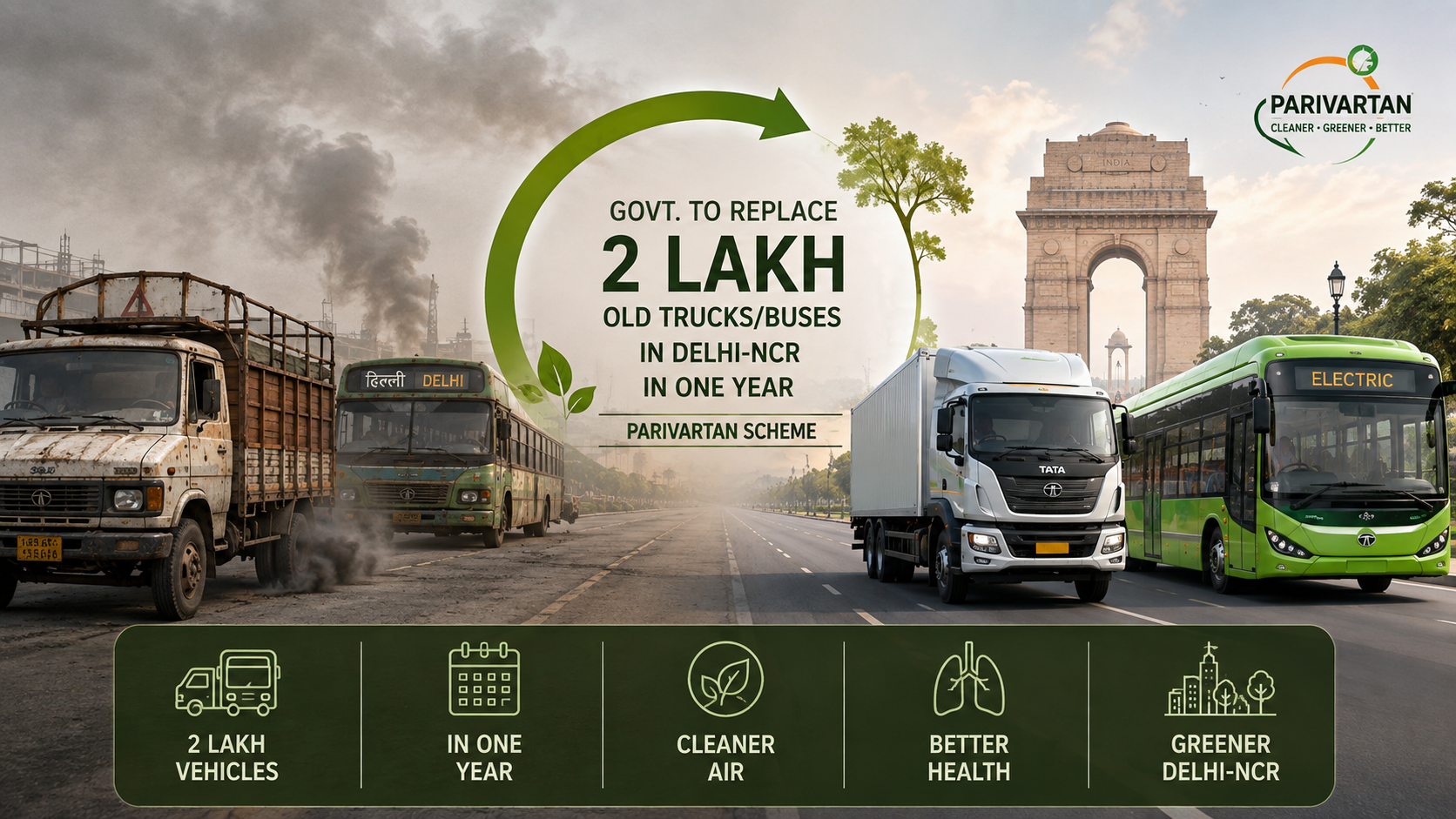
The Union government aims to replace more than two lakh trucks and buses in Delhi and the National Capital Region with BS VI or electric vehicles within a year under the PARIVARTAN scheme, the Road Secretary has said. This brings forward a two year implementation timeline the Union Cabinet had earlier approved for the scheme. Trucks and buses make up only 3.1% of the region’s total vehicle fleet but contribute 36% of vehicular PM2.5 emissions, so the scheme concentrates replacement incentives on a small segment of the fleet rather than vehicles as a whole.
What is the PARIVARTAN scheme?
- A vehicle renewal and incentive scheme: PARIVARTAN (the Programme for Accelerated Renewal and Incentivization of Vehicle Assets for Reducing Transport Air Pollution and Network Emissions) is a Union scheme to replace old trucks and buses in Delhi NCR with cleaner vehicles.
- Targets older commercial vehicles across four jurisdictions: It covers trucks and buses registered in Delhi and the NCR districts of Haryana, Rajasthan and Uttar Pradesh that conform to BS IV or older emission norms.
- Jointly funded and implemented: The scheme is funded through the National Capital Region Planning Board under the Ministry of Housing and Urban Affairs and implemented by the Ministry of Road Transport and Highways.
What incentives does PARIVARTAN offer to push buyers toward cleaner vehicles?
- A large but shared financial outlay: The scheme carries a total financial outlay of Rs. 9,585 crore, of which Rs. 5,041 crore is central budgetary support.
- Lower cost of borrowing: Eligible buyers get a 5% interest subvention on vehicle loans for five years.
- Waived recurring and one time levies: Eligible buyers of new BS VI vehicles get a 100% road tax waiver for 10 years and exemption from registration fees.
- A manufacturer side discount: Eligible buyers also get at least an 8% discount on the ex showroom price from participating vehicle manufacturers.
Challenges to the PARIVARTAN scheme
- Fleet turnover in one year is an aggressive compression: Compressing the replacement of over two lakh vehicles into one year against an originally planned two year timeline strains scrapping, registration and financing capacity built for a slower pace. Eg. India’s separate vehicle scrappage policy has itself faced slow uptake since 2021 because of limited authorised scrapping facility capacity in most States. Fix. Expand authorised vehicle scrapping facility capacity in Delhi NCR ahead of the compressed timeline, rather than relying on facilities sized for the original two year plan.
- Small operators may lack access to the incentives: Interest subvention and manufacturer discounts assume buyers can access formal vehicle financing, which many small truck and bus operators in the informal freight sector cannot. Eg. A large share of India’s freight trucking fleet is owned by operators with one to five vehicles, who typically borrow from informal lenders rather than banks. Fix. Route a dedicated financing window for small fleet owners through public sector banks or the National Capital Region Planning Board itself, with relaxed collateral norms.
- Cross state enforcement is harder than a single city ban: The scheme spans Delhi and NCR districts across three States, and inconsistent enforcement of the BS IV cutoff across State transport departments can let older vehicles keep operating in weaker enforcement pockets. Eg. Delhi’s earlier ban on end of life diesel vehicles pushed many such vehicles into neighbouring NCR districts rather than off the road entirely. Fix. Link registration renewal and permit issuance across all four jurisdictions to a shared, real time vehicle emission compliance database.
Conclusion
The PARIVARTAN scheme now targets replacing over two lakh Delhi NCR trucks and buses within one year instead of two, backed by a Rs. 9,585 crore incentive package. The scheme’s next milestone is the pace of actual vehicle replacement against this compressed one year timeline, particularly among small and informal fleet operators who face the greatest financing and enforcement gaps.