Why in the News
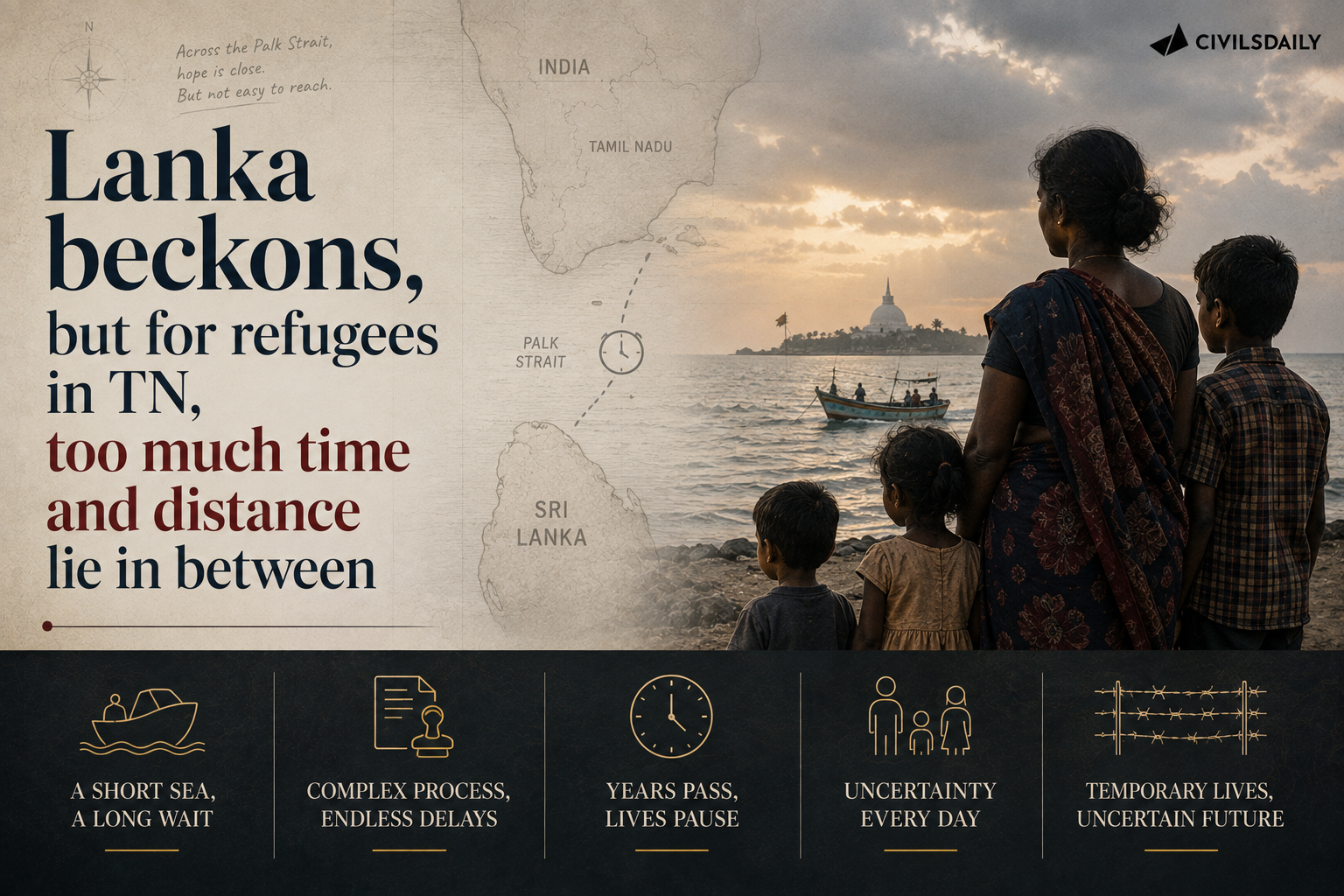
Sri Lanka’s Cabinet has removed the longstanding legal obstacle to the voluntary return of refugees who fled the civil war without valid passports or through unauthorised departure points. Returnees whose Sri Lankan nationality is established may enter through an authorised port after clearance by the State Intelligence Service. Those cleared will not face prosecution under immigration law merely for having left the country without authorisation, and the decision applies to everyone who left before 19 May 2009, the day the civil war ended. The tension is that the barrier being removed was never the operative one: nearly 90,000 Sri Lankan refugees remain in India, and what holds them is land, livelihood and the fact that a large share of them were born here.
Why did the legal bar matter in practice?
- Prosecution on arrival was real: As late as August 2025, four returnees were detained on arrival in Sri Lanka because they had originally left the country illegally.
- International endorsement: The United Nations welcomed the decision as an important step towards the “safe and dignified return” of Sri Lanka’s people.
- No package is attached: The Cabinet decision does not spell out any new resettlement package, so it removes a criminal exposure and adds no material support.
- Movement has already begun: 246 people belonging to 46 families returned between July 2025 and February 2026 without facing official pushback.
What is the scale and profile of the refugee population in India?
- The total: Nearly 90,000 Sri Lankan refugees live in India.
- The camp population: More than 58,000 live in 103 camps spread across 29 districts of Tamil Nadu, including one special camp within the Tiruchi Central Prison complex.
- Outside the camps: Another 30,000 live outside the camp system.
- Duration and birthplace: Nearly 73 percent of those in camps have been in India for more than 30 years, and 44 to 46 percent were born in India.
What does the return data show?
- The early years: Annual returns ran at 1,673 in 2011, 1,264 in 2012, 711 in 2013, 396 in 2014 and 452 in 2015.
- A brief recovery: They rose to 852 in 2016 and 1,520 in 2017, then fell to 1,283 in 2018 and 963 in 2019.
- The collapse: Returns dropped to 196 in 2020, 96 in 2021, 208 in 2022, 326 in 2023, 203 in 2024 and 92 in 2025.
- No response to the decision: About 400 refugees returned over the past two years, 36 are currently on the waiting list from applications filed over nine months, and no surge in applications has been reported since the Cabinet decision.
Why is return still not attractive?
- The obstacle is economic: The reluctance to return turns on Sri Lanka’s economic crisis and uncertainty over livelihoods rather than on immigration law.
- Most have nothing to return to: Only around 15 to 20 percent of the refugees own land in Sri Lanka.
- The return grant has shrunk: The repatriation grant fell from Rs 11,250 per person to Rs 8,000 because of the United Nations funding crunch.
What conditions do refugees face in India?
- Registration never ends: Refugees remain registered with the police and subject to periodic renewals, sometimes weekly, more than three decades after arrival.
- Movement is timed: Camp residents may leave the premises at 6 a.m. and are generally required to return by 6 p.m., with curbs on travel outside Tamil Nadu.
- Housing was provided: The State government gave refugee families houses of 320 square feet.
- No documents means no economy: Without a ration card or a voter identity card, a camp resident cannot take a loan or register a vehicle, so earnings do not convert into assets.
Return or a durable solution in India?
- The first generation weighs both: Those who arrived as children measure land, shelter, employment and their children’s education against a settled but restricted life in India.
- The second generation splits: Some born in India who have never visited Sri Lanka want to leave for want of work, since a government job is closed to them and private wages are low.
- What most are asking for: A large share hope India will offer a durable status here, including citizenship or dual citizenship, rather than requiring return.
- India has no framework to offer it: India has no refugee specific statute, so residence is administered under the Foreigners Act, 1946 through executive policy that can be varied without legislation.
What remains unsettled on the Sri Lankan side?
- The military has not withdrawn: A visible military presence remains in the north, where the Tamil population is concentrated.
- Complaints continue: Tamil groups report surveillance, unresolved land disputes and restrictions around political activity.
- The political demands are unmet: Tamil parties are demanding greater devolution, land release and a new Constitution addressing long standing Tamil aspirations.
Challenges to the voluntary repatriation of Sri Lankan refugees
- Voluntariness cannot be verified without monitoring: A return that is legally voluntary becomes coerced in practice where conditions in the host country deteriorate. Eg. Rohingya returns from Bangladesh have repeatedly stalled over exactly this verification problem. Fix. Allow a neutral agency to interview departing families at the point of exit and to monitor them for a fixed period after arrival.
- Land restitution is the binding constraint: Returnees find their plots occupied by the military, by the state or by other occupants, so a grant buys no place to live. Eg. Land in the Valikamam North high security zone near Jaffna was released to owners only in stages after 2015, decades after acquisition. Fix. Publish a title verification and release timetable for each returning family before departure rather than after arrival.
- Documentation gaps block proof of nationality: Those who left as infants or were born in camps often hold no Sri Lankan birth record, so establishing nationality becomes the first hurdle. Eg. Children born in Tamil Nadu camps are registered with Indian civil authorities, which does not by itself establish Sri Lankan nationality. Fix. Run consular documentation camps inside the settlements, so nationality is settled before an application is filed.
- Support depends on a shrinking international budget: Repatriation assistance is tied to international agency funding rather than to a bilateral commitment, so it contracts whenever donor budgets contract. Eg. Humanitarian funding cuts in 2025 forced agencies to reduce per capita assistance across South Asian operations. Fix. Convert repatriation support into a bilateral package with a fixed per family entitlement agreed between the two governments.
- Qualifications earned in India do not transfer: Schooling and degrees obtained in Tamil Nadu are not automatically recognised in Sri Lanka, which strands the generation most able to work. Eg. A graduate degree earned in India needs equivalence certification before it can be used for employment or further study in Sri Lanka. Fix. Agree a mutual recognition arrangement for school and university qualifications as part of the return framework.
Conclusion
What to watch is whether the Sri Lankan government attaches a resettlement package covering land and housing to its decision, since removing a prosecution risk changes nothing that a returning family actually lives on. The second question sits on India, and it is whether renewable police registration eventually gives way to a durable status for the generation that has known no other country.
Back2Basics
- What it does: Adopted in 1951, it defines who qualifies as a refugee and sets out the rights of refugees and the obligations of the states hosting them.
- Core protection: Article 33 states the principle of non refoulement, which bars returning a refugee to a territory where their life or freedom would be threatened.
- The Protocol: The 1967 Protocol removed the original limitation to events occurring in Europe before 1951, making the Convention universal in scope.
- India’s position: India is not a party to the Convention or its Protocol, though it has served repeated terms on the executive committee of the United Nations High Commissioner for Refugees (UNHCR).
[2022, GS2, 10 marks] India is an age-old friend of Sri Lanka.’ Discuss India’s role in the recent crisis in Sri Lanka the light of the preceding statement.
