Why in the News
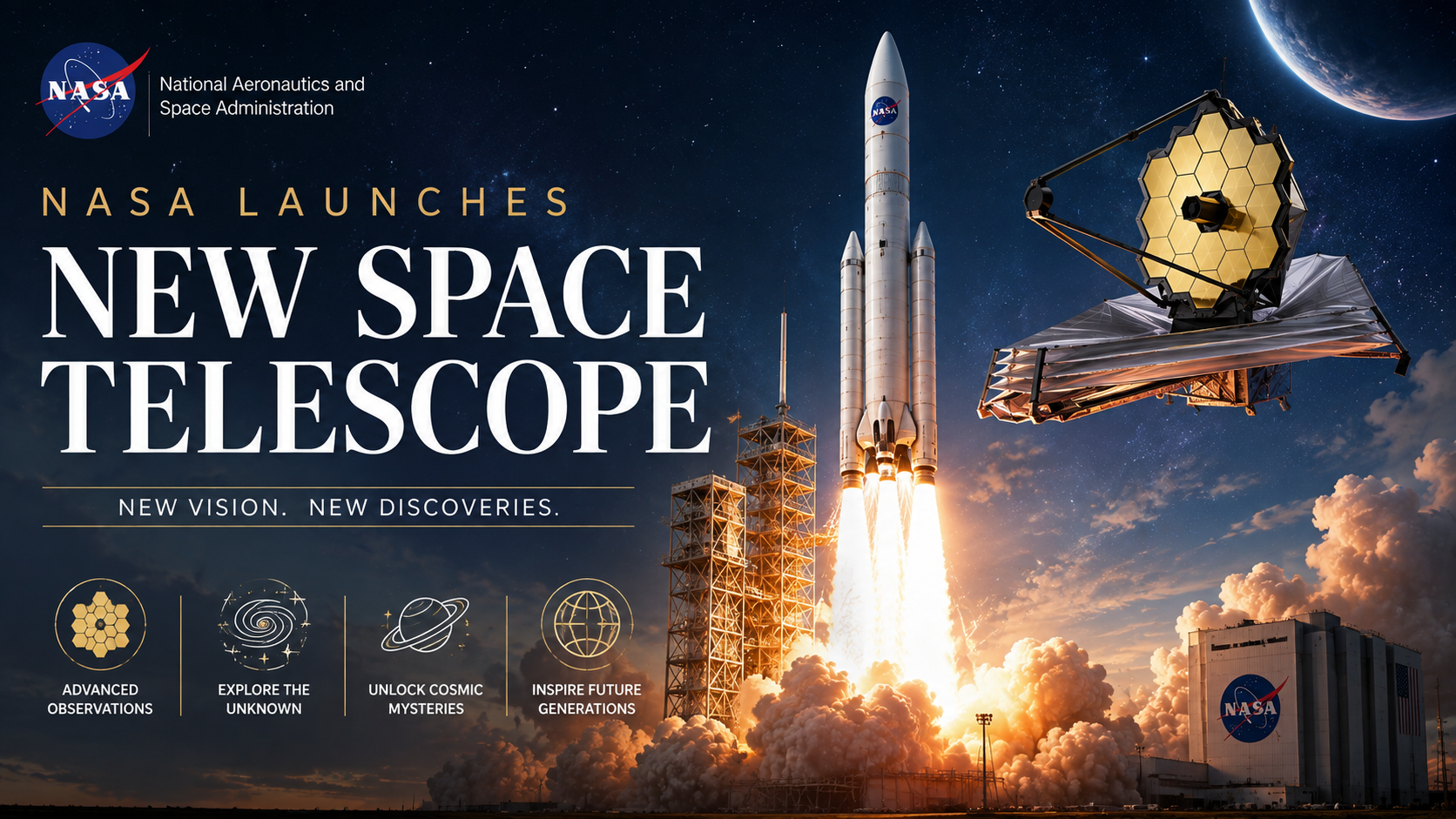
The National Aeronautics and Space Administration (NASA) has launched the Nancy Grace Roman Space Telescope aboard a Falcon Heavy rocket from the Kennedy Space Center. The telescope cost 4.3 billion dollars and is named after NASA’s first chief astronomer. It is bound for an observation point 1.6 million kilometres from Earth, the same location that already hosts the James Webb Space Telescope, and takes more than three months to reach it. A wide survey instrument is therefore being added to a fleet built around narrow and deep observation.
What does the Roman Space Telescope add to the existing fleet?
- The field of view: Roman’s field of view is more than 100 times wider than that of the Hubble Space Telescope, which has been in orbit for 36 years.
- The survey speed: A month of Milky Way observations by Roman would take Hubble a century to complete.
- The division of work with Webb: Webb observes a narrower field and can reach objects almost as old as the Big Bang. Roman spots new worlds first, and Webb then targets them to fill in the detail.
- The wider observing network: Roman joins Hubble and Webb alongside the European Space Agency’s Euclid spacecraft and the National Science Foundation’s Vera C. Rubin Observatory in Chile.
What is the mission set up to observe?
- The expected catalogue: The telescope is expected to record thousands of supernovae, tens of thousands of planets, billions of galaxies and tens of billions of stars.
- The unseen components: It is expected to shed light on the dark matter and dark energy that make up most of the universe and remain concealed.
- The rate of expansion: Its catalogue of galaxies will let scientists establish how quickly the universe is expanding under those forces.
- The centre of the galaxy: It will scan the galactic bulge at the dead centre of the Milky Way, giving the deepest view yet of the heart of the galaxy.
Conclusion
The telescope is in transit and its survey work begins only on reaching its observation point. The next marker is the first release from its galaxy catalogue, since the expansion rate measurement rests on that catalogue rather than any single observation.
Back2Basics: Dark Matter and Dark Energy
- Dark matter: Matter that emits no light and is detected only through its gravitational effect. It is inferred from the rotation speeds of galaxies and from the bending of light by galaxy clusters.
- Dark energy: The name for whatever drives the accelerating expansion of the universe. It was inferred in 1998 from observations of distant Type Ia supernovae.
- Their share of the universe: Ordinary matter accounts for about 5 per cent of the universe’s content, dark matter for about 27 per cent and dark energy for about 68 per cent.
- Why supernovae carry the measurement: A Type Ia supernova has a known intrinsic brightness, so its observed brightness gives its distance. That property makes it the standard yardstick for measuring expansion.
“[2022, GS3, 15 marks] Launched on 25th December, 2021, James Webb Space Telescope has been much in the news since then. What are its unique features which make it superior to its predecessor Space Telescopes? What are the key goals of this mission? What potential benefits does it hold for the human race?”
[2016] With reference to ‘Astrosat’,’ the astronomical observatory launched by India, which of the following statements is/are correct?
1. Other than USA and Russia, India is the only country to have launched a similar observatory into space.
2. Astrosat is a 2000 kg satellite placed in an orbit at 1650 km above the surface of the Earth.
Select the correct answer using the code given below.
[A] 1 only
[B] 2 only
[C] Both 1 and 2
[D] Neither 1 nor 2