Why in the News
A division Bench of the Supreme Court has ordered the Keralam government to take custody of Raman, Keralam’s tallest elephant, in Jayakrishna Menon vs. Krishnankutty & Ors. The Bench observed that the court cannot remain a mute spectator in matters concerning animals and that their wellbeing is of “paramount importance”. It held that it would fail in its duty towards “voiceless animals” if it ignored the elephant’s continued use for temple activities after its own prohibition. The order stands in contrast with Re: City Hounded by Strays, Kids Pay Price (2026). There a three judge Bench adopted a much narrower interpretation of the law. That reading led to the removal of large numbers of dogs from public institutions. The divergence raises the question whether Indian animal law grades animals by their value to humans rather than by their capacity to suffer.
What is equal consideration?
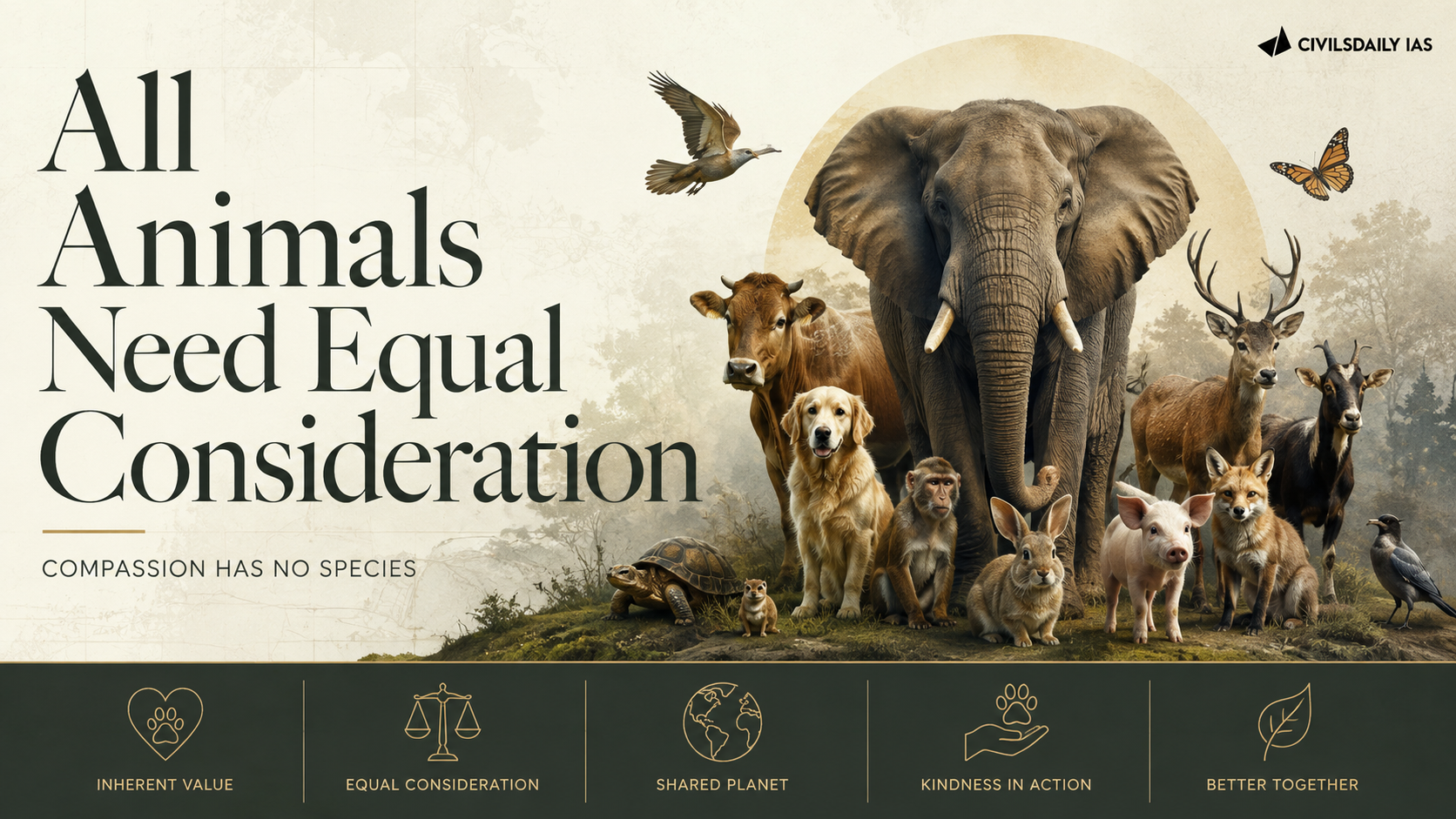
- The principle: Framed by moral philosopher Peter Singer, equal consideration holds that the basic principle of equality does not require equal or identical treatment; it requires that the interests of each being be weighed equally.
- Who qualifies: Every being that has interests, some subjective awareness, or the capacity to feel pleasure or pain.
- Different treatment can follow: Equal consideration for different beings can lead to different treatment and different rights, because their needs differ.
What questions does the differential treatment of two animals raise?
- The court’s own premise: The elephant order implicitly acknowledges an animal’s propensity to suffer and the need to ensure its wellbeing.
- One elephant against lakhs of dogs: Why one elephant’s wellbeing is of paramount importance and the welfare of lakhs of street dogs is disregarded.
- One institution, two approaches: How the same institution adopts two contrasting, if not contradictory, approaches to issues involving similar moral considerations.
- Whether courts should decide at all: Whether the judiciary is the best positioned institution to decide cases that seal the fate of animals, for better or for worse.
Do the differences between the two animals justify different consideration?
- The elephant’s legal standing: The Indian elephant is a charismatic animal, listed as Endangered on the International Union for Conservation of Nature (IUCN) Red List, and explicitly protected under the Wild Life (Protection) Act, 1972.
- The street dog’s legal standing: The street dog is legally perceived as a problem that needs to be tackled.
- Different relationships with humans: One is expected to live in the wild away from human habitation. The other shares public spaces, requiring humans to learn to coexist in shared spaces.
- The test: Whether these differences are significant enough to attract completely different moral and legal considerations.
- What is actually missing: In the two judgments the absence of equal consideration itself drives the differential treatment. Equal consideration would require an assessment of the needs of each animal and then the determination of a course of action.
Why does the remedy lie with Parliament rather than the courts?
- Anthropocentric bias in both statutes: The Wild Life (Protection) Act, 1972 for elephants and the Prevention of Cruelty to Animals Act, 1960 for street dogs evaluate the worth of animals by their value to humans. That valuation determines the nature and level of protection each animal receives.
- A gap in legislative guidance: Two cases involving different animals produced contrasting approaches from the same court. That exposes the absence of a legislative standard for animal well-being across legal categories.
- The Swiss model, cited in passing: The Swiss Constitution ensures the well-being of animals and also protects animal dignity, granting animals an inherent worth.
- Parliament’s responsibility: Parliament should extend protection to every being worthy of moral consideration, through a legislative foundation that provides moral consideration to all animals and pathways for ethical coexistence.
Challenges to an equal consideration standard in Indian animal law
- Fragmented statutes: The same act of harm is governed by different laws depending on the animal’s legal category, so no single test of suffering applies. Eg. Street dogs fall under the Animal Birth Control Rules, 2023 made under the cruelty law, and elephants fall under Schedule I of the wildlife law.
The Fix: Enact a single animal welfare code with a sentience-based standard that applies across categories, with the wildlife schedules layered on top for conservation purposes. - Nominal penalties: Section 11 of the Prevention of Cruelty to Animals Act, 1960 punishes a first cruelty offence with a fine of Rs 10 to Rs 50, unchanged since enactment. Eg. The draft Prevention of Cruelty to Animals (Amendment) Bill, 2022 proposed fines up to Rs 75,000 and imprisonment for gruesome cruelty and has not been introduced in Parliament.
The Fix: Introduce the amendment Bill with graded penalties and a statutory definition of sentience. - Unsettled legal status of animals: High Courts and the Supreme Court have taken different positions on whether animals are legal persons, so lower courts have no stable rule. Eg. The Uttarakhand High Court in Narayan Dutt Bhatt v. Union of India (2018) and the Punjab and Haryana High Court in Karnail Singh v. State of Haryana (2019) declared animals legal persons, a status no Supreme Court ruling has endorsed.
The Fix: Settle the legal status of animals in statute rather than leaving it to divergent judicial declarations. - No enforcement arm: The Animal Welfare Board of India is advisory, and district level societies exist on paper. Eg. The Prevention of Cruelty to Animals (Establishment and Regulation of Societies for Prevention of Cruelty to Animals) Rules, 2001 require a society in every district, and many districts have none.
The Fix: Fund district societies from State budgets with mandated veterinary and inspector staffing and a reporting line to the State Animal Welfare Board.
Conclusion
The two rulings leave a tension unresolved. Indian animal law protects by category, endangered species on one side and nuisance animals on the other, and the capacity to suffer sits on neither side of that line. A court can decide the case before it; it cannot write a standard that applies to every animal. The thing to watch is whether Parliament takes up the pending amendment to the cruelty law and whether it writes sentience, rather than human utility, into the test.
Animal Welfare Law in India
- What it covers: Statutory protection of animals from cruelty and of wild species from harm, spread across a cruelty statute, a wildlife statute and subordinate rules for specific uses such as transport, slaughter, performance and experiments.
- Two regimes: The cruelty law applies to any animal, domestic, captive or stray. The wildlife law protects species by schedule, and the Wild Life (Protection) Amendment Act, 2022 reduced the schedules from six to four.
- Institutions: The Animal Welfare Board of India (statutory since 1962), the Committee for Control and Supervision of Experiments on Animals for laboratory use, and the National Board for Wildlife for protected species.
- Scale: India holds about 60 percent of the world’s Asian elephants, with 29,964 counted in the 2017 synchronised census, and the 20th Livestock Census (2019) counted 1.53 crore stray dogs.
Challenges in Animal Welfare
- Rabies from an unmanaged stray population: Sterilisation and vaccination have not reached the coverage that stops transmission. Eg. India accounts for about 36 percent of global rabies deaths as per the World Health Organization.
The Fix: Fund local bodies to reach 70 percent vaccination coverage of the dog population in each ward, since transmission breaks at that threshold. - Captive elephants at festivals: Parading in heat, crowds and noise causes injury and deaths of animals and people. Eg. The Kerala High Court’s 2024 guidelines on distance and rest norms for parading elephants were contested before the Supreme Court by festival organisers.
The Fix: Enforce microchip registration and the 2024 transfer rules so that every captive elephant has a traceable owner accountable for its welfare. - Culture against welfare: Traditional events with animals are permitted by State amendments to the cruelty law. Eg. A five judge Bench in Animal Welfare Board of India v. Union of India (2023) upheld Tamil Nadu’s Jallikattu amendment.
The Fix: Codify measurable welfare conditions for each permitted event under the Performing Animals rules, with veterinary supervision as a licence condition. - Regulation of livestock trade: Welfare rules for animal markets have collapsed under political contest. Eg. The Prevention of Cruelty to Animals (Regulation of Livestock Markets) Rules, 2017 were stayed by the Supreme Court and withdrawn in 2018.
The Fix: Re-notify market rules confined to welfare conditions such as water, shade and transport limits, without conditions on the purpose of sale.
“[2022] Which one of the following has been constituted under the Environment (Protection) Act, 1986 ?
(a) Central Water Commission
(b) Central Ground Water Board
(c) Central Ground Water Authority
(d) National Water Development Agency
