Why in the News
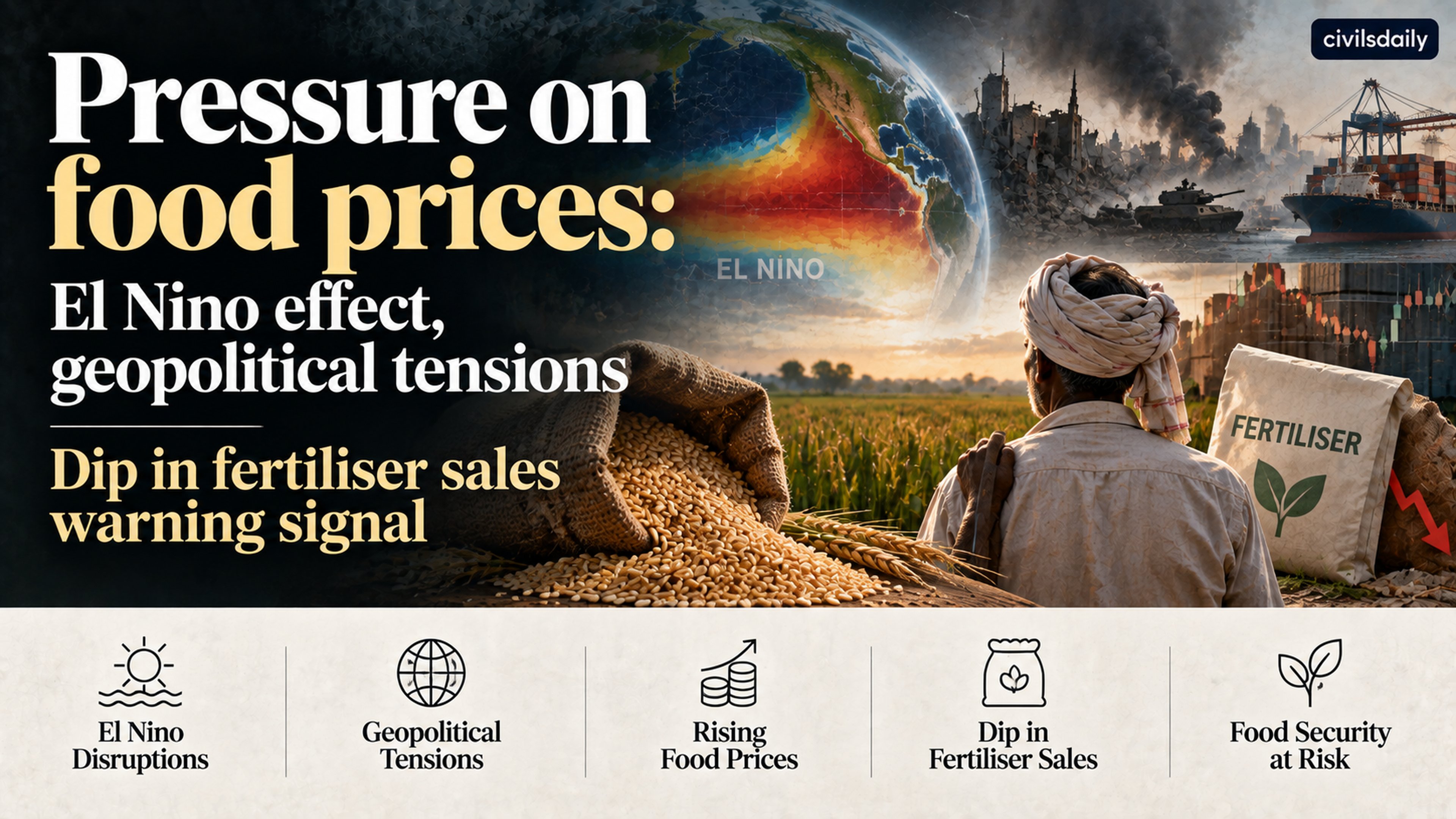
The southwest monsoon has finished 14.7 per cent below the long period average (LPA) as on 14 September, with 24 of India’s 36 meteorological subdivisions more than 10 per cent deficient. The shortfall tracks a strengthening El Nino, which weakened the easterly trade winds in August and cut the transport of moisture laden air towards the subcontinent. Kharif sowing has held up at 1,096.5 lakh hectares, only 1.4 per cent below the same point last year. Fertiliser sales and wholesale mandi prices point the other way. The tension is between a sowing figure that reads as normal and the input and price data that point to lower yields, arriving at the same moment as a turn upward in world food prices.
What is El Nino?
- El Nino: It is an abnormal warming of sea surface temperatures in the equatorial Pacific Ocean off the coasts of Ecuador and Peru, which shifts global atmospheric circulation for several seasons at a time.
- Effect on the Indian monsoon: It weakens the easterly trade winds that carry moisture laden air from east to west towards the subcontinent, so rainfall systems that do form deliver less rain than their number suggests.
- Temperature effect: El Nino suppresses rainfall over India and also raises temperatures, which is why its consequences run past the monsoon into the winter crop season.
- Low pressure system (LPS): It is the rain bearing system of the monsoon, formed when warm moist air near the ground rises, cools and condenses into cloud.
How did the monsoon actually behave month by month?
- June: Not a single low pressure system formed, against a monthly average of three systems covering about 11 days. All India rainfall was 38 per cent below the LPA for the month.
- July: Four systems formed, close to the climatological average, and each persisted longer than usual. Total LPS days reached 24 against an average of 13.56, and rainfall came in 1 per cent above the LPA.
- August: Six systems formed against a normal of 5.38, and LPS days reached 26 against a normal of 16.3. Rainfall still recorded a 16.3 per cent deficit, because weakened easterly trade winds cut moisture transport.
- Season and spatial spread: Cumulative rainfall to 14 September was 14.7 per cent below the LPA, with 24 of 36 subdivisions over 10 per cent deficient. The southern States, along with Marathwada and Vidarbha in Maharashtra, were worst affected.
Why does sowing acreage understate the damage?
- Kharif acreage: Area sown under kharif crops was 1,096.5 lakh hectares as of 11 September, against 1,112.5 lakh hectares for the same period of 2025, a gap of only 1.4 per cent.
- Fertiliser sales: Sales in April to July 2026 fell across di ammonium phosphate (25.6 to 24.4 lakh tonnes), muriate of potash (7 to 5.9 lakh tonnes) and complex fertilisers (50 to 43 lakh tonnes) against the same months of 2025. Only single super phosphate rose, from 20 to 20.2 lakh tonnes.
- Urea: Sales fell 6.6 per cent despite policy interventions to secure natural gas for domestic production and to secure imports through the West Asia supply shocks.
- Mandi prices: Maize at Chhindwara in Madhya Pradesh is around Rs 2,625 a quintal against Rs 2,165 a year ago. Arhar at Akola is Rs 8,650 against Rs 6,200 and soyabean at Dewas Rs 6,150 against Rs 4,300.
- Output forecasts: The United States Department of Agriculture (USDA) has forecast India’s rice output falling to 147 million tonnes from an all time high of 154 million tonnes, and maize to 50 million tonnes from 55.1 million tonnes.
- The temporal and spatial pattern: Extended dry spells interspersed with heavy downpours, with rain largely confined to Odisha, Chhattisgarh, eastern Madhya Pradesh, Gangetic West Bengal, Jharkhand and Uttar Pradesh, translates into lower yields rather than into unsown land.
What does the El Nino outlook mean for the rabi season?
- Current state: El Nino is in a strong state, with average sea surface temperatures in the equatorial Pacific roughly 1.8 degrees Celsius above normal.
- Projection: The National Oceanic and Atmospheric Administration (NOAA) projects a 90 per cent plus chance of a very strong event, meaning sea surface temperatures more than 2 degrees Celsius above normal, running from September through January.
- Decay path: The event is projected to stay strong, above 1.5 degrees Celsius, until March, and weak to moderate, 0.5 to 1.5 degrees Celsius, until May.
- Crops at risk: A short and warm winter would hit the rabi crop, from wheat, rapeseed mustard, chana, masoor and matar to potato, onion, garlic, jeera, saunf and dhaniya.
Why are world food prices turning up now?
- The buffer that held: The West Asia conflict produced no dramatic spike in world food prices, unlike Russia’s invasion of Ukraine in 2022, because back to back bumper crops in 2024 to 2025 and 2025 to 2026 left ample stocks of wheat, rice, maize, sugar, soyabean, rapeseed and palm oil.
- The index: The Food and Agriculture Organisation (FAO) food price index, a weighted average of world prices of a basket of food commodities against a 2014 to 2016 base value of 100, stood at 133.3 points in August, the highest since November 2022 and below the all time high of 160.2 points in March 2022.
- Where the pressure sits: The vegetable oil index was the highest since June 2022 and the cereal index edged to a 27 month high.
- Vegetable oils: Landed Mumbai prices of imported crude palm, soyabean and sunflower oil are $1,285, $1,300 and $1,450 per tonne, against September 2025 averages of $1,164, $1,182 and $1,293.
- Cereals: Wheat export prices firmed over the past year from $228 to $262 per tonne for Argentina, $226 to $290 for the European Union, $251 to $319 for Australia and $235 to $354 for the United States. Corn from Argentina and Brazil is exported at $219 and $238 against $200 and $210 a year ago.
- The direction of travel: A running down of stocks, disrupted trade logistics from escalating tensions in West Asia and Russia Ukraine, and a strengthening El Nino all push world prices the same way.
Challenges to India’s food price management under El Nino
- Import dependence in edible oils: India imports the bulk of its vegetable oil, so a world price move passes into domestic retail prices within weeks regardless of the domestic harvest. Eg. Landed Mumbai prices of crude palm, soyabean and sunflower oil are all above their September 2025 averages.
The Fix: Tie import duty changes to a stated trigger price rather than announcing them after the retail price has already moved. - Procurement concentrated in two crops: Assured purchase at the support price operates at scale for wheat and rice, so a pulse or oilseed grower carries the full price risk of a bad season. Eg. Pulse and oilseed prices at Akola and Dewas moved sharply this year with no procurement floor doing the work.
The Fix: Extend physical procurement capacity to pulses and oilseeds in the deficit districts rather than relying on an announced floor alone. - Input withdrawal is invisible in acreage data: A farmer who sows but cuts fertiliser use produces a yield shortfall that no sowing statistic records until harvest. Eg. Kharif area was 1.4 per cent below last year while fertiliser sales fell across every major category except single super phosphate.
The Fix: Publish district level fertiliser offtake alongside the weekly sowing bulletin so the yield signal arrives before the harvest does. - Irrigation cover decides the rabi outcome: The winter crop depends on stored soil moisture and reservoir levels built during the monsoon, which a deficient season does not deliver. Eg. The southern States, Marathwada and Vidarbha carried deficits above 10 per cent this season.
The Fix: Sequence reservoir releases for the rabi sowing window in the deficient subdivisions rather than for the standing kharif crop alone. - Buffer stocks cannot absorb a domestic and a world shock together: Releasing stock cools the domestic market only where the commodity is one the state actually holds. Eg. Duty free imports of up to 10 lakh tonnes of raw sugar were allowed until 31 October after inventory fell to multi year lows.
The Fix: Hold a standing calibrated import window for commodities with no domestic buffer, so the decision is not taken at the festival season peak.
Conclusion
Food price pressure this year is not a single monsoon question. A rainfall deficit, a pullback in purchased inputs and a turn in world prices are three separate pressures that have arrived together, and only the first of them ends with the season. The winter crop is where the remaining two will be counted, since the same ocean warming that suppressed the rains is projected to persist into the sowing window. The rabi sowing period is the next decision point, and input availability and reservoir cover in the deficient subdivisions are the markers to watch.
Matching Previous Year Question
“[2014, GS1, 10 marks] Most of the unusual climatic happenings are explained as an outcome of the El-Nino effect. Do you agree?”