Why in the News
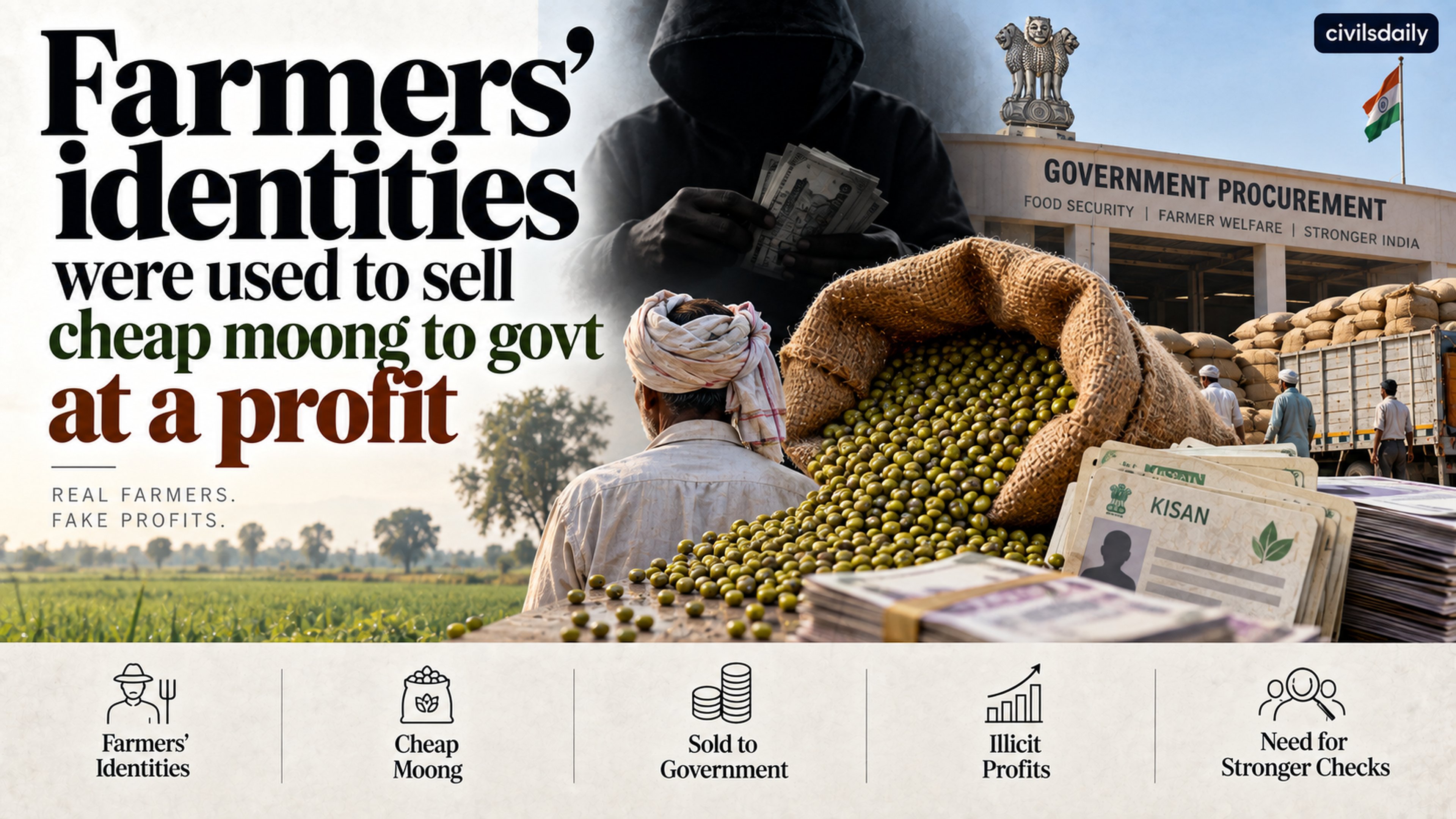
Madhya Pradesh’s Economic Offences Wing (EOW) has booked three computer operators running procurement terminals at cooperative societies in Raisen district for an alleged moong procurement fraud. The operators are alleged to have used the land records of farmers who had never registered to sell under the support price scheme, created procurement registrations in the names of acquaintances, bought moong on the open market at low prices, and sold it to the government at the Minimum Support Price (MSP). The alleged scheme ran across three societies in Badi tehsil over two procurement seasons and netted roughly Rs 13.3 lakh. The criminal case follows two internal cooperative department inquiries. The tension is that the price floor worked exactly as designed while the registration step that decides who may claim it did not, and it has surfaced during sustained farmer protests in the State over moong procurement and MSP implementation.
What is the Minimum Support Price and how does procurement work?
- Minimum Support Price: It is a price floor announced by the Centre for selected crops, so a registered grower is assured a stated rate irrespective of what the open market pays that day.
- Who fixes it: The Commission for Agricultural Costs and Prices recommends the level for each season and the Centre announces it.
- Coverage against actual purchase: The floor covers 22 crops, and assured physical procurement at scale is concentrated overwhelmingly in wheat and rice, so for other crops a declared floor binds only where an agency actually buys.
- The registration step: A grower must first register the land on which the crop was raised, and the produce is then weighed against that registration at a procurement centre before payment is released.
How was the registration system allegedly turned into a trade?
- Operator access to land records: Every operator at a cooperative society has access to the land records of all farmers in the area that centre serves, including those who own plots but have never registered to sell through the support price scheme.
- Fraudulent registration: Agricultural land that no farmer had registered was allegedly registered by the accused in the names of their acquaintances, and moong was then weighed through those registrations.
- The purchase leg: The moong weighed at the centres was allegedly bought from local markets at a lower price, so the registration manufactured a seller who had grown nothing.
- How it surfaced: Farmers in the Raisen hinterland found they had apparently sold moong to the government without ever growing it, registering it or taking it to a procurement centre. Fake registrations were collected and witnesses questioned during the EOW’s complaint verification.
What do the case figures show about the size of the margin?
- Dehri Kala registrations: Entries of 8.095 hectares and a further 4.532 hectares allegedly yielded 151.524 quintals procured at the 2025 support price of Rs 8,682 a quintal, a payout of Rs 13,15,531 against about Rs 4,54,572 spent acquiring the moong, a margin of Rs 8,60,959.
- Registration in an accused’s own name: Another operator registered 3.523 hectares in his own name and procured 42.276 quintals for Rs 3,67,040, against an estimated Rs 1,26,828 of cost, a profit of Rs 2,40,212.
- Bharkachh Kala registrations: Entries of 3.428 hectares yielded 41.136 quintals worth Rs 3,57,142 against an estimated Rs 1,23,408 of cost, clearing Rs 2,33,734.
- How the figures were built: Investigators compared the procurement receipts against prevailing mandi rates for moong of comparable quality at Bareli over the same window.
Why did the price gap make the fraud worth running?
- The spread: Bareli mandi rates for moong swung from as low as Rs 1,500 a quintal to as high as Rs 8,800 depending on grade, against a fixed support price of Rs 8,558 in the 2024 to 2025 season and Rs 8,682 the following season.
- A fixed price against a variable one: The support price does not vary by grade while the mandi rate does, so every lot bought below the floor converts into a guaranteed margin at the procurement centre.
- The alternative route: The Agricultural Produce Market Committee (APMC) told investigators that the procurement route was never the only option open to the farmers whose names were used, since farmers can independently sell their produce.
- The political setting: The case has surfaced during sustained farmer protests in Madhya Pradesh over moong procurement and the implementation of the support price.
Challenges to MSP procurement
- Identity is verified at payment, not at registration: The system checks who is paid but not whether the registered grower actually raised the crop on the registered plot. Eg. Land never registered by any farmer was allegedly registered in the names of acquaintances across three societies in Badi tehsil.
The Fix: Tie every registration to farmer authenticated consent and to a field or satellite verified sowing record for that survey number before weighing is allowed. - The operator is both data entry and gatekeeper: One terminal operator can create a registration, accept the produce and trigger the payment, so no independent step exists to fail. Eg. All three accused in Raisen ran procurement terminals at the societies where the registrations were made.
The Fix: Separate registration, weighing and payment authorisation across three roles, with the cooperative society secretary countersigning first time registrations. - Procurement concentrated in wheat and rice: For crops outside that core the floor operates in short seasonal windows with thin agency capacity, which is where leakage collects. Eg. Maize in Punjab routinely sells below its support price for want of a procurement agency.
The Fix: Publish crop wise and district wise procurement capacity before each season so a grower knows whether the floor will actually be available. - Grade based price variation invites arbitrage: A single flat support price against a wide mandi range for the same crop creates a standing incentive to buy low grade produce and present it at the centre. Eg. Bareli rates ranged from Rs 1,500 to Rs 8,800 a quintal against one fixed floor.
The Fix: Apply published quality parameters with graded deductions at the weighing stage rather than one undifferentiated rate. - Detection depends on the farmer noticing: A farmer who never intended to sell has no reason to check the procurement record, so a fraudulent entry in his name can sit undisturbed for a full season. Eg. The Raisen farmers learned of the sales only when the entries were traced back to them.
The Fix: Send an automatic message to the registered land holder at the moment a registration is created against his survey number, not after payment.
Conclusion
The failure here is not in the price but in the claim on it. A floor enforced correctly at the counter is still capturable by whoever controls the record of who is entitled to walk up to it, and that record sits with the same operator who processes the transaction. The case is at the investigation stage, with three operators booked after two departmental inquiries. What to watch is whether the response stays confined to a criminal case against three terminal operators or extends to separating registration from procurement across the State’s cooperative societies.
Back2Basics: Agricultural Produce Market Committee
- What it is: It is a statutory market body constituted by a State government to regulate wholesale trade in notified agricultural produce within a defined market area.
- Legal basis: Each State’s own Agricultural Produce Market Committee Act governs it, so market rules, fees and the list of notified commodities vary across States.
- What it does: It licenses traders and commission agents, runs the regulated market yard or mandi, and records the sale price and volume of each transaction.
- Why its record matters: The mandi rate it publishes is the reference price against which an alleged support price diversion can be measured.
Matching Previous Year Question
“[2018, GS3, 10 marks] What do you mean by Minimum Support Price (MSP)? How will MSP rescue the farmers from the low-income trap?”