Why in the News
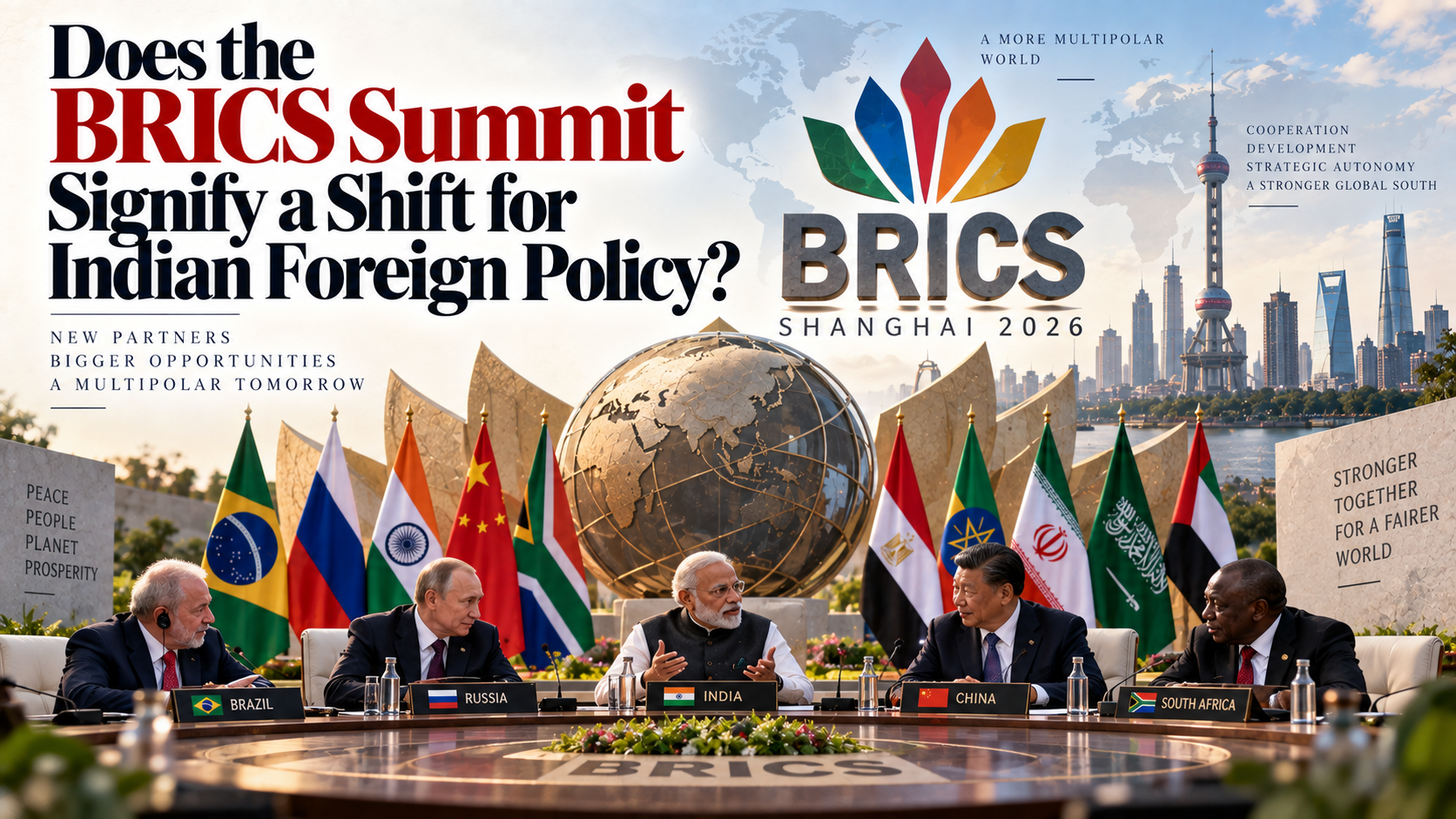
The New Delhi Declaration of 2026, adopted at the BRICS summit hosted by India, pushes back against unilateral western sanctions, criticises Israel over the killing of civilians, the attacks on Lebanon and the forced occupation of Palestinian territory, and supports United Nations reform together with a BRICS payment mechanism. The declaration has been likened to the foreign policy of India’s non aligned past. It is also the first BRICS declaration since 2022 to carry no reference to Ukraine. The tension is whether the text marks an actual shift in Indian foreign policy, or is multilateral language that a national position is not expected to follow.
Is the New Delhi Declaration a return to non alignment?
- Continuity, not a shift: The declaration is in keeping with Indian foreign policy, whether that is described as strategic autonomy and multi alignment or as multi vector engagement. What has changed is optics, with India on the front foot and less apologetic about being emphatically part of a non western forum.
- Non alignment does not describe the present aim: Non alignment was a strategy for a weak state in a bipolar world. The declared ambition in India today is to become one of the poles in a multipolar world.
- The Bandung reference: The declaration invokes the Bandung Spirit in pursuit of a fairer, more inclusive and representative multilateral system. On the second reading that invocation is nostalgia rather than operative policy.
- What the platform is: BRICS is a political platform and not a security platform, so a declaration adopted in it cannot commit a member to anything it would not do bilaterally.
What did the summit’s optics carry, and what did they not?
- A return after seven years: The Chinese President had not travelled to India in nearly seven years before this summit.
- Who else was at the table: The Abu Dhabi Crown Prince sat at the same table, and the outreach session brought in powers that do not otherwise enter great power conversations.
- Socialisation as the actual product: What the platform generated was contact inside it and on its margins rather than agreement, and that contact is not by itself shaping the world order.
- National positions expressly preserved: The declaration calls for exercising restraint and for protecting civilians and civilian infrastructure. It also pointedly recalls the respective national positions of each member.
- Why a multilateral text can go further than a national one: A country can say in a high level multilateral document what it will not say in a national statement. Eg. The phrase “unilateral coercive measures” is understood to mean US actions, without naming a measure or a date.
Why did the declaration drop Ukraine?
- A break in precedent: Every BRICS summit declaration since 2022, including the 2024 summit held in Russia, carried a reference to Ukraine.
- Attributed to Russian insistence: The omission is attributed to a Russian veto exercised to preserve consensus. The Rio declaration last year had condemned a Ukrainian attack on Russia with no equivalent condemnation of anything Russia had done, and dropping the subject entirely replaced that one sided formulation.
- An error of omission: A major multilateral geopolitical forum that stays silent, rather than calling on the belligerents to end the war, has left the central question unaddressed.
- India’s own incentive: India had little reason to press for the language, having sided with the Russian Federation in this war indirectly if not directly.
- The option not taken: Neutral language on Ukraine was available on the precedent of the earlier joint declarations, and was not used.
How does the Israel language sit with India’s bilateral position?
- The bilateral signal: The Prime Minister told the Israeli parliament during a visit in February 2026 that India stood “shoulder to shoulder” with Israel.
- The disjunction: The declaration’s condemnation of Israel is strong, which creates a clear break between the multilateral text and that bilateral statement. The text may be intended to counter the perception that India was drawing too close to Israel.
- Shelter in United Nations language: The declaration cites UN Security Council Resolution 2803 of November 2025, which provided for an International Stabilisation Force and a Board of Peace. Some of the declaration’s language is drawn from that resolution.
- No contradiction of settled policy: The two state solution has been India’s standing position, so the text does not contradict Indian policy on Palestine.
- The room shaped the text: With the United Arab Emirates, Egypt, Iran and Indonesia at the table, there was a limit to how far India could push back against the harshness of the language.
- Where the balance actually sits: The partnership with Israel remains the weightier commitment, since a bilateral address to a parliament is consequential while a multilateral declaration is symbolic.
What does the economic agenda amount to?
- The bloc’s weight: The grouping’s membership accounts for 40 percent of the global economy and 25 percent of global trade.
- Two different propositions in payments: India supports local currency payment mechanisms for bilateral trade. India has not supported a permanent payment mechanism operating under the BRICS umbrella.
- Why a common settlement currency is resisted: There is no single approach to currency settlement that suits every pair of trading partners. A non dollar mechanism would in practice elevate the next dominant currency, and on present weight that currency would be China’s.
- BRICS against the Group of Seven: BRICS is a counterpoint to the Group of Seven (G7), an economic grouping that also carries geopolitical responsibilities.
- India sits on both sides of that line: India is a standing invitee to the G7 along with Australia and South Korea. One proposal is that the G7 dissolve itself into a Democratic 10 (D10) including those three, with India as the bridge between east and west and a voice of the south.
Where should India spend its diplomatic capital next?
- The immediate calendar: The ASEAN East Asia Summit in the Philippines falls in November. Visits by the Prime Minister to the United States, Canada and Brussels follow, with three trade agreements potentially in reach.
- Multi vector engagement as the method: The approach is to keep all stakeholders engaged in multiple directions at once rather than to choose a camp.
- Diplomatic capital is finite: India has only so much of it, so battles, forums and partners have to be picked rather than attended to uniformly.
- The rooms that will decide the next order: The forums framing global rules on artificial intelligence and the governance of space are where the next world order will be made, rather than a platform such as BRICS.
Challenges to BRICS as a vehicle for Indian foreign policy
- The consensus rule produces silence: A single member’s objection removes a subject from the declaration altogether instead of producing balanced language. Eg. The complete absence of any reference to Ukraine from the New Delhi Declaration.
The Fix: Issue a chair’s summary alongside the declaration, so positions that fail consensus are still on the record. - Expansion dilutes coherence: Members with opposed interests make a common position harder to reach as the grouping grows. Eg. Egypt, Ethiopia, Iran and the United Arab Emirates joined in 2024 and Indonesia in 2025.
The Fix: Anchor the agenda in a small set of deliverables such as development finance, where the members’ interests already converge. - Moving off the dollar substitutes one dependence for another: Replacing the dollar as a settlement currency hands the same structural leverage to whichever currency takes its place. Eg. The New Development Bank suspended new transactions in Russia in 2022 to protect its own access to international capital markets.
The Fix: Expand bilateral local currency settlement arrangements rather than build a single common currency mechanism. - The platform cannot handle its members’ own disputes: A grouping with no security function offers no channel for a conflict between two of its members. Eg. India and China are both members while their boundary dispute is handled entirely bilaterally.
The Fix: Keep security questions in the bilateral and plurilateral formats built for them, and hold the grouping to economic and governance reform. - Declarations carry no implementing mechanism: A position agreed in a summit text has no follow through between summits. Eg. Calls for Security Council reform recur in these declarations while two of the grouping’s own members do not support expanding permanent membership.
The Fix: Attach a named working group and a reporting deadline to each declaration commitment.
Conclusion
The declaration reads as a shift and functions as a signal. What a grouping’s text says and what its members do bilaterally have been allowed to diverge, and India’s positions on Israel and on Russia both sit inside that gap. The unresolved question is whether multi vector engagement can keep both registers running once a partner insists on consistency between them. The next test is the sequence of bilateral visits and trade negotiations that follows the summit, where the same positions have to survive contact with a single counterpart.
About BRICS
- Formation: The grouping began as BRIC, with Brazil, Russia, India and China holding their first leaders’ summit in 2009. South Africa joined in 2010 and the grouping became BRICS.
- Expansion: Egypt, Ethiopia, Iran and the United Arab Emirates were admitted as members in 2024, and Indonesia joined in 2025.
- New Development Bank: Agreed at the 2014 Fortaleza summit and headquartered in Shanghai, it finances infrastructure and sustainable development projects in member states and other developing countries.
- Contingent Reserve Arrangement: Also agreed in 2014, it is a currency swap framework members can draw on to meet short term balance of payments pressure.
Back2Basics: Non-Aligned Movement
- Origin: The Bandung Conference of 1955 brought together Asian and African states and set out principles of sovereignty, non interference and peaceful coexistence.
- Founding: The Movement was formally established at the Belgrade Conference of 1961.
- Core idea: Member states declined formal military alignment with either Cold War bloc while retaining the freedom to engage both.
- India’s role: India was among its founding members and hosted the seventh summit at New Delhi in 1983.
Matching Previous Year Question
“[2026, GS2, 10] “BRICS acts as a powerful counterweight in global governance, actively amplifying the voice and influence of the Global South.” Explain the role of BRICS in projecting itself as an alternative to other groupings.”