Why in the News
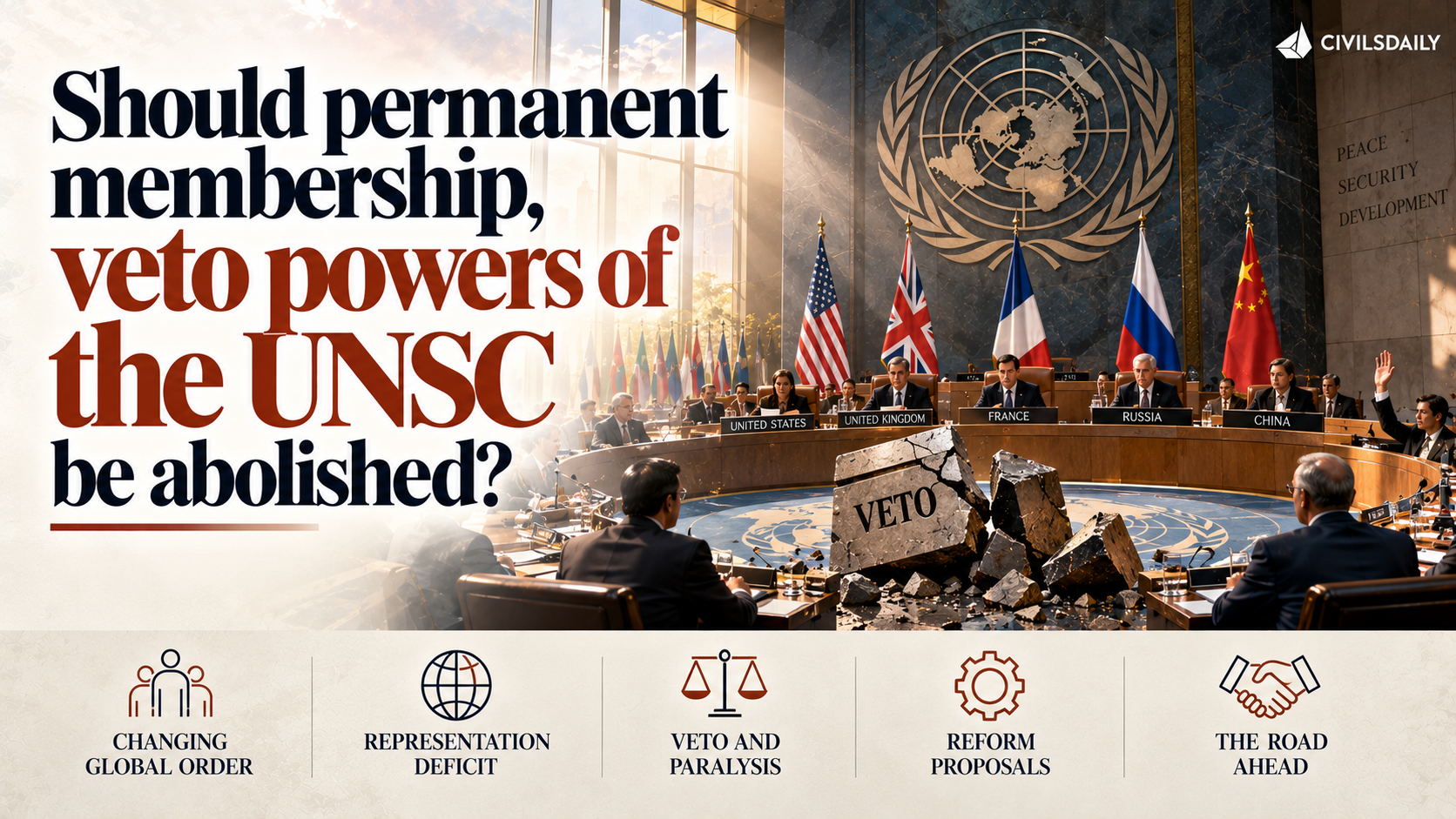
A proposal at the current session of the United Nations General Assembly (UNGA) would have the use of the veto in the United Nations Security Council (UNSC) “regulated” in humanitarian crises and in cases of genocide. It presents the veto as a matter of “responsibility” rather than of “privilege”. The proposal revives the French Mexican initiative of 2015, under which permanent members would voluntarily refrain from using the veto in mass atrocity situations. That initiative itself grew out of a 2013 proposal for a code of good conduct, made after Chinese and Russian vetoes blocked any Security Council resolution on the Syrian civil war. The contested point is that voluntary restraint leaves the veto itself untouched, so the privilege survives the reform meant to discipline it.
What is the French Mexican initiative on veto restraint?
- The commitment: First launched in 2015, the initiative has permanent members voluntarily refrain from using the veto in situations involving genocide, crimes against humanity and large scale war crimes.
- Legal character: It is not an attempt to abolish the veto or to amend the United Nations Charter. It is an exercise in self restraint by the P5, the five permanent members of the Security Council: the United States, the United Kingdom, France, China and Russia.
- Support base: France and Mexico have announced that 128 states now support the declaration, with 21 joining in the last four months. The United Kingdom has joined France in accepting the principle, so two of the five permanent members have now committed to this form of restraint.
Which three questions does the veto debate conflate?
- Use of the veto: Whether a permanent member casts a veto at all in a given situation.
- Accountability for the veto: Whether a permanent member must explain and defend a veto it has already cast.
- Reform of the Security Council: Whether the Council’s size, its membership categories and its decision rules should change.
- What the current proposal reaches: The initiative addresses only the first of the three. Its claim is that even where the veto remains, there must be circumstances of exceptional human suffering in which a permanent member agrees not to exercise it.
Why did the Syrian deadlock produce the first restraint proposal?
- Paralysis in 2013: Chinese and Russian vetoes made it impossible for the Security Council to pass any resolution condemning Syria during the civil war there.
- The Ghouta trigger: A chemical weapons attack at Ghouta in August 2013 was followed in September by the then President of France proposing a “code of good conduct” for the Council.
- Design intent: That was the first proposition that the permanent members could voluntarily restrain veto use in cases of genocide, crimes against humanity or larger war crimes. The attempt was to skirt amending the United Nations Charter and still make the Council more contemporaneous.
What other mechanisms exist short of Charter amendment?
- Liechtenstein initiative, adopted by the UNGA in 2022: It does not prevent a permanent member exercising the veto. Whenever a veto is cast the General Assembly is convened within 10 working days to debate the issue, so the member concerned must explain and defend its action on the Assembly floor.
- Accountability, Coherence and Transparency code of conduct: The Accountability, Coherence and Transparency (ACT) Initiative reaches beyond the permanent members. It asks all members of the Security Council, including the non permanent members, not to vote against credible action designed to prevent or halt genocide, crimes against humanity and war crimes.
- Nature of their force: The strength of both instruments is moral and political rather than legally coercive.
Why will the permanent members not go beyond voluntary restraint?
- Charter amendment requirement: Formal abolition of the veto would require an amendment of the United Nations Charter and the consent of the very permanent members whose privilege is being removed.
- Relative weight inside the P5: The United Kingdom and France are not the heavyweights among the permanent members, so a principled position on regulating the power costs them least.
- Stated purpose of regulation: Better management of how the power is used is presented as the way to keep the Council from being paralysed and to let it act.
- No permanent member proposes elimination: None of the five is talking of eliminating the veto power it holds. There are multiple versions among them of how the Council should be reformed.
- Five overlapping approaches, not a binary: The debate is not simply retain or abolish. It runs across abolition, extension of the veto to new permanent members in the name of equality, voluntary restraint in mass atrocity cases, political accountability after a veto is cast, and broader structural reform of the Council itself.
- Why the pragmatic route is preferred: The current proposal seeks to change the political behaviour of the five without rewriting the Charter, which makes it reformist rather than revolutionary.
- Accountability as the achievable discipline: Requiring a permanent member to justify a veto on the Assembly floor would not prevent action where real national self interest is at stake. It would make that member more cautious, since it would know it must account for the decision.
Can sovereign equality survive the way power is actually distributed?
- The stated ideal: The world is held to be one of sovereign equality among states.
- The survival constraint: Because of the way power is distributed, no international organisation can survive, let alone become effective, if it takes a decision against the fundamental interests of a major power.
- The veto’s textual status: The word veto is not mentioned in the United Nations Charter. It was created through a separate mechanism.
- Word against spirit: Every United Nations member brings its own interpretation of each conflict to the Assembly and to the Council, which leaves a standing gap between the words of international law regimes and their spirit.
Challenges to voluntary veto restraint
- A political commitment binds no one: A declaration of restraint carries no legal obligation, so a member can endorse it and still cast a veto. Eg. Russia vetoed the renewal of the Security Council panel of experts monitoring sanctions on North Korea in March 2024.
The Fix: Require a permanent member that vetoes inside the declared categories to file a written justification recorded in the Council’s official proceedings. - Classification of an atrocity is unsettled: Restraint applies only to named categories of atrocity, and the Council itself decides whether a situation falls inside them. Eg. Myanmar’s treatment of the Rohingya was taken to the International Court of Justice by The Gambia in 2019 rather than characterised by the Council.
The Fix: Route the classification question to a standing determination by the United Nations High Commissioner for Human Rights, so the trigger does not rest with the body being restrained. - The Assembly’s response carries no enforcement: Debating a veto in the General Assembly produces a recommendation and nothing that binds. Eg. Emergency Special Session resolutions on Ukraine from 2022 onward carried large majorities and no enforcement power.
The Fix: Pair each post veto debate with a named follow up instrument, such as a commission of inquiry with a reporting deadline. - Expansion without restraint multiplies the block: Extending the veto to new permanent members in the name of equality would raise the number of states able to stop the Council acting. Eg. The Group of Four, India, Brazil, Germany and Japan, seeks permanent seats, and the Uniting for Consensus group opposes new permanent seats altogether.
The Fix: Settle the veto question before the membership question, so an enlarged Council does not inherit a larger number of vetoes.
Conclusion
The question has moved from whether the veto should exist to whether its use can be disciplined without touching the Charter. Restraint pledges and post veto debates change the political cost of blocking action, and they leave the legal power exactly where the Charter placed it. The unreconciled point is that the only route to abolition runs through the consent of the states whose privilege would be abolished. The marker to watch is whether a permanent member that has endorsed the restraint declaration casts a veto inside the declared categories, since that is the test the pledge has not yet faced.
About Reform of the United Nations Security Council
- About: Reform of the Security Council covers changes to its size, to its categories of membership and to the veto, so that a body designed at the founding of the United Nations reflects the present distribution of states and power.
- Composition: The Council has 15 members. Five are permanent and hold the veto, and ten are non permanent, elected by the General Assembly for two year terms without a veto.
- The amendment route: Article 108 of the United Nations Charter requires an amendment to be adopted by two thirds of the General Assembly and then ratified by two thirds of the members, including all five permanent members.
- The record of change: The Council’s size has been changed once, from 1965, when the non permanent seats were raised from six to ten. Talks on further change have run in the Assembly’s Intergovernmental Negotiations process since 2009.
Government Initiatives
- Group of Four: India coordinates with Brazil, Germany and Japan on a joint claim to permanent seats, with each supporting the others’ candidature.
- L.69 group: India works with this grouping of developing countries from Asia, Africa, Latin America and the Caribbean, together with small island developing states, which presses for expansion in both membership categories.
- Text based negotiations: India has pressed for the Intergovernmental Negotiations to work from a single consolidated negotiating text rather than from open ended discussion.
- Non permanent membership: India has served eight terms as a non permanent member, most recently in 2021 and 2022, chairing the Council’s Taliban sanctions and counter terrorism committees during that term.
Matching Previous Year Question
“[2015, GS2, 12 marks] Discuss the impediments India is facing in its pursuit of a permanent seat in UN Security Council.”