Why in the News?
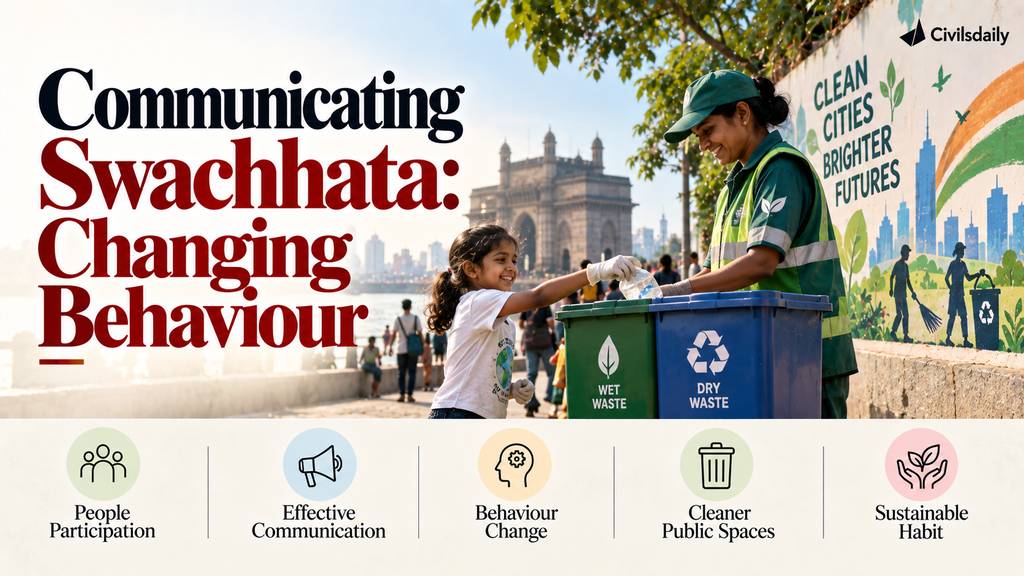
- The Swachh Bharat Mission (SBM) has placed Social and Behaviour Change Communication (SBCC) at the centre of sanitation efforts, moving beyond infrastructure towards sustained behavioural change and community participation. Pasted text
- The approach combines communication, community mobilisation, monitoring, incentives and recognition to make Swachhata a sustained social norm.
Key Highlights
- SBM launched: 2 October 2014.
- Two components:
- SBM-Grameen (SBM-G): Rural sanitation, toilet access and usage, waste management.
- SBM-Urban (SBM-U): Urban sanitation, waste management and clean public spaces.
- SBCC: Focuses on changing knowledge, attitudes, social norms and practices.
- Key approaches:
- Interpersonal Communication
- Community mobilisation
- Mass media
- Digital platforms
- Social media
- Advocacy and partnerships
- Swachhagrahis: Grassroots sanitation volunteers and behaviour-change motivators.
- Nigrani Samitis: Community-level vigilance groups supporting sanitation behaviour and ODF sustainability.
Mahatma Gandhi and SBCC
- SBM was launched on 2 October 2014 with the objective of achieving a Swachh Bharat by Gandhi’s 150th birth anniversary in 2019.
- SBM logo represents Mahatma Gandhi’s spectacles.
- Rural India was declared Open Defecation Free (ODF) on 2 October 2019.
- The term Swachhagrahi draws from Gandhi’s concept of Satyagraha, linking cleanliness with collective action and citizenship.
- Gandhi emphasised cleanliness, sanitation and self-service through institutions such as Sevagram Ashram.
Interpersonal Communication and Community Mobilisation
- Interpersonal Communication (IPC) enables two-way dialogue rather than one-way information dissemination.
- Methods include:
- Home visits
- Face-to-face counselling
- Small-group sessions
- Peer communication
- Community discussions
- Swachhagrahis work with frontline workers, SHGs, community leaders and local networks.
- Nigrani Samitis conduct regular monitoring, particularly around common open defecation spots.
- Tools provided to Swachhagrahis included torches and whistles for field-level vigilance.
- Community platforms include:
- Gram Sabhas
- Chaupals
- Community meetings
- Local forums
Digital and Mass Communication
- Under SBM-U, Google Maps was used to upload information on more than 67,000 public toilet blocks across 3,300+ cities.
- Swachhata App: Digital platform for citizen grievance redressal.
- Mass communication includes:
- Television
- Radio
- Online media
- Community radio
- Social media
- Bulk SMS, WhatsApp and podcasts
- Swachh Talks: Peer-learning webinar series for sharing Swachhata-related field experiences and best practices.
Women and Children
- Women are linked with Swachhata through safety, convenience and self-respect.
- Study cited by the Ministry of Jal Shakti found:
- 93% of women no longer feared being hurt by someone or harmed by animals while defecating.
- 91% reported saving up to an hour and avoiding travel of up to 1 km.
- 93% reported no longer restricting food or water intake to manage sanitation needs.
- In Bihar, toilets are popularly called “Izzatghars”, linking sanitation with women’s dignity.
- Children act as sanitation participants and agents of change through schools, awareness campaigns, Shramdaan and educational activities.
Certification and Recognition
- SBM uses protocols to establish measurable sanitation standards:
- ODF
- ODF+
- ODF++
- Water+
- Star Rating Protocol for Garbage Free Cities
- ODF: Ensures access to toilets and aims to eliminate open defecation.
- ODF+: Focuses on functional and well-maintained community and public toilets.
- ODF++: Focuses on safe containment, evacuation, transportation and processing of faecal sludge.
- Water+: Addresses untreated black and grey water and promotes reuse of treated wastewater.
- Star Rating: Assesses urban solid waste management, including collection, segregation, processing and legacy dumpsite remediation.
Incentives and Behaviour Monitoring
- “Give Polythene Get Gold” campaign in Panchayat Halqa Hiller, Jammu and Kashmir:
- Encouraged collection of plastic waste.
- Supported by youth and women.
- Offered gold coins against specified quantities of collected plastic.
- Swachh Survekshan: Described as the world’s largest urban sanitation survey.
- Citizen participation increased from around 1 lakh citizens in 2016 to nearly 5 crore in 2021.
- Encourages healthy competition among cities and States.
Prelims Quick Revision
- SBM launched: 2 October 2014.
- Rural India declared ODF: 2 October 2019.
- Swachhagrahi: Grassroots sanitation volunteer.
- SBCC: Moves beyond information dissemination towards dialogue, participation and collective action.
- Google Maps: More than 67,000 public toilet blocks across 3,300+ cities.
- Swachh Survekshan: World’s largest urban sanitation survey.
- ODF++: Focuses on safe faecal sludge management.
- Water+: Focuses on black and grey water and reuse of treated wastewater.
UPSC Prelims Trap
- SBCC is not merely IEC: SBCC focuses on sustained changes in attitudes, norms and practices through participation.
- ODF, ODF+ and ODF++ are different: ODF focuses on open defecation, ODF+ adds functional public/community toilets, while ODF++ adds safe faecal sludge management.
- Water+ is related to wastewater, particularly untreated black and grey water, rather than simply toilet access.
- Swachh Survekshan is a monitoring and assessment mechanism, while Nigrani Samitis operate at the community level to support sustained sanitation behaviour.