Masterclass attendees will get a special FREE preparatory package for you. Details here.
Approx 1.5 million forms are filled out every year, half of which never even appear for prelims. Passing the exam is a long way off, many candidates lose self-confidence before even facing it in the exam hall. Almost 99% of the candidates are sent home (fail) after that, without crossing over to the second stage (mains).
This is to highlight not only the difficulty of the UPSC CSE (considered the toughest exam in the world) but also to ingrain certain habits in you that will make this UPSC journey successful for you.
Building a strong foundation to overcome the fear of failure
Digesting NCERTs
Making an impenetrable holistic study plan
Acknowledging the harsh requirements, IPS Shubham will discuss all these 1-1 with you.
IPS, Shubham Nagargoje, also a Super Mentor at CivilsDaily will be taking up a FREE masterclass to help you stay consistent and manage time on one hand, and to help you build a foundation for UPSC CSE prep on the other.
The next 8 months are not only crucial for your preparation but also to fill loopholes, recognize the cause of failures, manage your comfort zone, etc. Everything that you do must be under a plan, a strategy. Strategies are nothing but the pillars of success.
UPSC 2022 Mains will be over by the end of this week. UPSC 2023 exam date is already out and Prelims is scheduled for May 28th, 2023. That’s just 8 months away. Understanding the criticality of time is of utmost importance. If you want to crack UPSC with a rank in 2023, everything that you do must be under a plan, a strategy.
CivilsDaily IAS is conducting a Seminar for UPSC Exam 2023 with Sajal sir and UPSC Rankers
How to clear UPSC 2023 in just 8 months with 5 hrs/day of study time? Get a winning strategy by Sajal sir and UPSC Rankers (Detailed points and agenda below)
Rahul Garg, Assistant Controller General of Accounts addressing the UPSC aspirants: An insightful session
Date and Time:
(Concluded successfully) 25th September 2022 (Sunday) at 1 pm Get recorded session register here.
Post-seminar CivilsDaily will share a special Preparatory Package both for Offline and Online attendees. Details here
You are also entitled to a personalized intensive mentorship session by a senior IAS mentor wherein you can avail a personalized study plan, schedule, and doubt resolution session.
A UPSC beginner – confused about the syllabus, prioritizing subjects, making timetables & targets, or just getting started.
A working professionalor college student who will be attempting UPSC 2023 with a job. Facing a serious time crunch and mismanagement in UPSC preparation.
A veteran or aspirant trying to improve your rank in UPSC 2023 attempt.
Strategic planning will help you fully uncover your options, set priorities for them, and define the methods to achieve them.
Sajal Singh sir with his student Mantri Mourya Bharadwaj, AIR 28, UPSC 2021
This is going to be an interactive 1-1 session with Senior mentors and UPSC Rankers. You will get ample time and opportunity to discuss with Sajal sir and Rankers. These points will be discussed.
12 Important Points to be discussed in the Seminar
1. Trend analysis of UPSC based on the previous 10 years’ CSE exam, Understanding the expectations of UPSC, and devising an evolving adaptive strategy for UPSC 2023 Prelims and Mains.
2. What should be your approach for the next 8 months even if you have just started the preparation? Strategy for next 1 week, 1 month, 3 months, and like that, will be shared with you.
3. How to cover the UPSC syllabus? The syllabus, and not the books, must be completed. Focussing on the essentials first. Eg. This year in Mains 2022 Modern History questions were missing, similarly, there were many firsts in Prelims 2022. How that affects your preparation and how you should prepare?
4. You just need to invest effectively 5 hours per day for UPSC success. How to effectively manage preparation time? Make a timetable and set targets. Learn from the UPSC guru Sajal sir himself.
5. Managing UPSC preparation with a serious time crunch; job – working professionals, college students, and family (especially for homemaker aspirants)
6. Building a strong foundation: NCERT, current affairs, and standard books. How and which one to focus more on? Best sources for GS and Current Affairs.
We’ll also discuss 3 layered mentorship in the Seminar.
7. Breaking the inertia towards answer writing, and attempting mock tests. When and how to attempt tests and start mains answer writing?
8. Do’s and Dont’s; and breaking the myths around UPSC. Eg. Aspirants from rural or non-engineering backgrounds are at a disadvantage.
CivilsDaily’s mentorship: Acknowledged by The Hindu
9. How to take notes and organize information/content for UPSC prelims and Mains answers? Making notes of case studies, schemes, examples, etc. Basically the skill of taking notes. What topics necessitate notes and which do not?
10. UPSC Hacks and tricks like Tikdams that worked for UPSC rankers. A PDF will be shared with you all.
11. Revision techniques that are common, standard, and used frequently. What exactly are they?
12. How to take full advantage of the FREE CivilsDaily’s Preparatory Package and personalized mentorship session (FREE) that will follow?
CivilsDaily’s Super Mentor and IPS Officer Dilpreet Singh
Dilpreet Singh was a CivilsDaily mentorship and Samachar Manthan student. He was a Mechanical Engineer who cleared PCS twice and was a working professional at the time of his UPSC attempt which landed him an AIR 237 and IPS.
Dilpreet Singh is currently a Super Mentor as a part of the Super Mentorship Program with three layers of Mentoring for UPSC CSE 2023-24.
The life of a UPSC aspirant is challenging and demanding. Add to that the pressure from family, job, life, college, etc. it can get pretty overwhelming. In the part conversation with aspirants and even our mentorship students, these issues have been highlighted. But you must understand that every single aspirant even toppers feel or used to feel stressed and overwhelmed by expectations, responsibilities, lack of time, etc.
At times this feeling is for a short burst of time but when you can’t shake that perpetual state of overwhelm, it can lead to chronic stress, anxiety, guilt, failure, inefficiency in preparation, wastage of attempts, and a host of associated physical and emotional symptoms that can seriously affect your well-being.
You need to deal with this feeling. But before that understanding the root cause behind your stress is important.
Work-UPSC Preparation: Working aspirants at times have too much to do, they are engaged in stressful, demanding jobs. End up routinely working evenings and weekends leaving no or very less time for preparation. Results in mismanaged or poor UPSC preparation.
Life-UPSC Preparation: Aspirants have a life, family, and friends and there might be life changes such as moving house, starting a new job, relationships/marriage, or taking care of family/baby. It has a direct impact on UPSC prep.
Traumatic experience. Such as bereavement, relationship breakup, illness, etc.
No prior experience in UPSC preparation or no one to guide leads to a perpetual feeling of getting lost in the vast syllabus and complex preparation cycle.
Perfectionism. If everything always has to be perfect, you’re giving yourself a greater burden. Sometimes just getting through the day is a win. You don’t have to do it all perfectly too – you’re only human!
Pushing yourself too hard all in the wrong direction where results are not visible, and you don’t seem to be moving forward in your UPSC preparation.
We must understand that there are reasons that we can’t control but pinpointing the exact source of overwhelm is necessary which might not be possible on your own.
Below is the 7-step strategy to gain control of your UPSC Preparation.
1. Pinpoint the primary source of overwhelm.
It will tell you what you can control and what you can’t.
This is the first step. Ask yourself important questions like: “What one or two things, if taken off my plate would alleviate 80% of the stress that I feel right now?” It will at least give a sense of awareness as to what is causing you stress. Then only we can move towards solving the issue. At times finding the root cause on your own is difficult. You can reach out to senior UPSC mentors from CivilsDaily and have an open heart 1-1 FREE discussion.
Let us get our hands dirty. Start by writing down everything on your mind about your UPSC preparation status, mock tests and marks you have scored, tasks, and things you have to do including non-UPSC prep stuff. Next, check everything under your control and capture any to-dos, appointments, etc. on one hand and your status of UPSC preparation, on the other.
To avoid procrastination and wasting time you need to connect with your purpose. Make the link between your tasks and your bigger mission.
What’s your purpose in life? Who do you want to be?
Clarifying this will destroy the urge to procrastinate
You know your purpose, now identify the targets to get you there.
3. Set targets
Our mentorship students have their more than a year-long preparation broken down into small, measurable, and manageable chunks through Weekly and Monthly targets. You need to do the same. Break down those goals into smaller manageable targets or tasks. When a task is too big, you won’t know how to start. Break out the smallest next step.
Eg. You are yet to cover Laxmikant for Polity. Don’t aim for the full book. Set a target for just two chapters for the next three days.
Recheck your list, do all the to-dos you captured align with your goals and mission?
4. Prioritize ruthlessly: your tasks according to their importance and urgency
Not all the tasks you have listed and targeted will be UPSC preparation related. Even the targets under UPSC preparation might look equally important and urgent.
“Should I start with Ethics or Optional? Should I make notes now or write answers from current affairs?” Almost all of them look important.
Well, don’t get confused. If you are planning for UPSC 2023 this priority list will be different compared to the one planning for UPSC 2024.
For non-UPSC tasks basic rule is Time-sensitive items first. Next, rank for impact and value.
5. Plan out: make a timetable and a strategy
Talking about UPSC specifically your strategy should be unique to you. No two aspirants have the same set of problems, challenges, or learning styles. Your strategy or timetable will work for you as some past rankers’ timetables or strategies worked for them.
Moreover, this is something that requires expertise and skill. Don’t feel shy to ask for help in this. If you don’t have anyone to help you in this, let us get it done for you.
Spending time with your family and friends nourishes you. Keeping fit ensures you can enjoy life. Don’t neglect it.
6. Execute
Execution is far better and more effective when it is under the supervision of a mentor. Under an accountability system.
The hardest part of tackling overwhelm is to make time to organize yourself. So make it easy for yourself, follow the steps above, and create clarity for yourself. Connect your actions with your purpose and go execute.
Your execution will be far more effective and on track, if there is some supervising figure, a mentor, teacher keeping a check on the targets achieved, tasks completed, etc.
7. Analyze and evaluate your progress. Make necessary course corrections on a regular basis.
Situational awareness is a must when you want to achieve something big. It is very easy to get lost in execution. At regular intervals, you need to evaluate your progress. For UPSC aspirants it might take the form of prelims mocks tests, mains tests, essay writing, or maybe discussions.
Marks scored will give you an indication on your preparation level. Because self-evaluation is mostly ineffective it is advised to get someone experienced to help you. A mentor or UPSC ranker can easily evaluate your UPSC prep status, highlight the mistakes and suggest remedies.
Stressing and feeling guilty about past UPSC attempts or wasted preparation time is of no use. What matters is how well you can learn from the past, analyze and make changes in the present to make the future better.
How does Samanvaya Mentorship work? Introducing 3 layers of mentorship: Get IAS or UPSC ranker as your mentor
1. 1st step starts with this Samanvayacall: Once you fill in the form, we get on a 30-40 minute call with you to understand your prep level, working/ study constraints, and current strategies and create a step-by-step plan for the next week, next month and so on.
2. You are directed and given access to relevant resources and invite-only platform, Habitat where you can ask your daily doubts, discuss your test-prep questions and have real-time, live sessions on news and op-eds, and find your optional groups.
Daily target monitoring.
3. The third and the most personalized tier is the 1 on 1 mentor allotment who stays with you through the course of your UPSC preparation – always-on chat and on scheduled calls to help you assess, evaluate, and chart the next milestone of your IAS 2023-23 journey.
We will also connect you to a UPSC ranker or IAS, who will mentor you in this journey.
Layer 1: You will be assigned a dedicated in-house mentor who will keep track of our progress from start till your final interview.
Layer 2: Sajal Singh sir and the team will be constantly with you through various programs like Samachar Manthan, Prelims, Essay, etc.
Layer 3: A UPSC IAS ranker (one who has cleared this exam) will be supervising your progress as your super mentor.
Who are you?
Working Junta? If you are preparing for IAS 2023-24 and working simultaneously, we can help you design a timetable that fits right in your hectic schedule.
First-time prep? If you are in the last year of college or thinking of dropping a year and preparing for IAS 2023-24 full-time, we can help you pick the right books and craft a practical & personal strategy.
Though you can prepare for UPSC and give your attempts anytime till 32 years, the optimal time to begin your preparation is during your college days. A graduation degree is for 3 years and almost all toppers have prepared for the same amount of time to get the success they now enjoy.
One of the biggest advantages for a college student is that they can easily switch to study mode as there are no other additional family responsibilities or expectations. Plus, an IAS officer who clears the exam within 23 years is more likely to hold the highest position of cabinet secretary than someone who cleared it in their late twenties. Youthful enthusiasm is the biggest internal motivation that college students possess which can help them in clearing this exhausting exam.
So, now that you have broken the news to your parents about wanting to write the UPSC-CSE exam, you might be now wondering — what is UPSC-CSE? How to prepare for it? Should I attend a coaching institute? What is the syllabus? How many hours to study… the list is endlessand daunting.
However, you would have missed the obvious question— What kind of questions come in the paper and what kind of answers UPSC expects from an aspirant?
Is UPSC CSE really about reading Unlimited Sources?
Some of us will ask advices from all our friends and family on how to prepare for the exam, resulting in confusion in following through the UPSC syllabus. Don’t let these questions play the devil and make you postpone your UPSC preparation by a few more years. Having the right direction and guidance can help you save 2-3 critical attempts in UPSC. Listen to our Civilsdaily student and AIR 32 2021 UPSC topper Anay on how he improved his performance after 2 attempts with the guidance of Civilsdaily mentor, Sajal sir.
Without much ado, register yourself for our free 1-on-1 counselling session at Civilsdaily known as Samanvaya. Your counsellors are trained mentors who have given the Mains exam six times and have attended UPSC interview multiple times. Experienced mentors like Sajal sir and his team have nearly mentored 500+ students.
How Sajal sir and CivilsDaily helped these toppers?
List goes on and on.
What are the other mistakes in UPSC preparation first-time aspirants are likely to make?
About 60% of the UPSC toppers have mostly prepared the wrong way in their first attempt. This could range from books, notes to time and consistency. If you want to start in the right direction, then it’s about time you booked a slot with your Samanvaya mentor.
First-time aspirants often make the mistake of reading many sources for a single subject. If there is a new book in the market, they will not hesitate to buy it. UPSC preparation is not about reading multiple books, but one book multiple times.
Few others, answer the essay paper in a very academic and technical manner.
Most of the first-time aspirants skip studying for the language and CSAT paper.
In the first few months of preparation, all of us read the entire 24 pages of the newspaper and waste 3-4 hrs of time. Some of us are over-confident of clearing the exam with our own preparation or by our institute’s coaching. We might be making notes but we will not be updating them or revising them.
First-time aspirants struggle to understand what to skip in a book or what to cover. They take atleast 2-3 months to finish books like Laxmikanth and yet don’t have conceptual clarity.
You can go through this video over here to get a basic understanding of the UPSC preparation.
Toppers were once Beginners. And they began with Samanvaya.
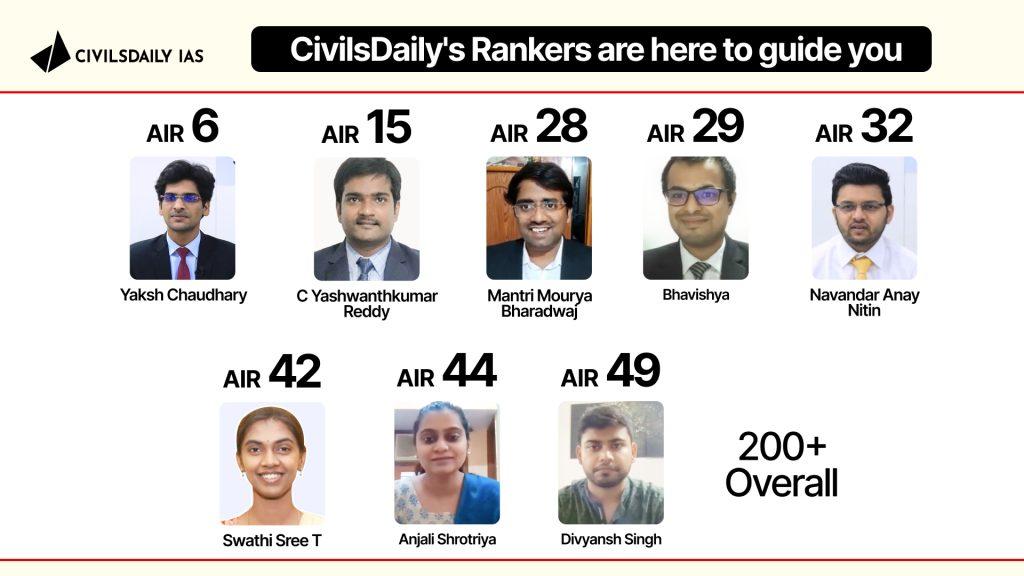
We, at Civilsdaily, are extremely proud to announce the incredible success of our students who have made their dreams come true. Today, we celebrate the hard work, commitment, and dedication with which they prepared for this exam, and succeeded! They are the heroes of today and leaders of tomorrow, and we are extremely glad to have been a part of their journey.
We are also happy to announce that 78 Civilsdaily students (and counting) are now rank holders in UPSC. Our success rate has increased by 77% from last year in terms of rank holders. Civilsdaily is proud to say that 20 of our students are in the top 100 ranks. And this is a phenomenal 25% increase in our success rate for the top 100 positions since last year.
And finally, we are extremely proud of our mentors whose tireless efforts helped our students become officers today. Their daily guidance, skilled mentorship, round-the-clock support, and dedication to work with the students day-in and day-out has led to this wonderful occasion where we celebrate the success of our students together!
How is Samanvaya, UPSC Counselling Session Planned?
At Civilsdaily, your assigned mentors interact with you on a daily basis. They are not just teachers, but coaches, philosophers, and guides. And this is how they will help you succeed:
Motivating you for one whole year and pushing you to complete the modules on time.
Helping you restart preparation despite low scores in test series.
Helping you study for 6 hours every day if you are working.
Guiding you on how to revise the whole syllabus 3 months before prelims and mains.
Providing you topic-wise notes.
Teaching you elimination techniques, tikdams and helpful strategies like 4-2-4 model of preparation.
Keeping you updated on what to study and from where to study.
Three stages of Samanvaya FREE mentorship
1.30-minute counseling session:Once you fill the form, our senior mentors get on a 30-40 minute call with you to understand your preparation level, study constraints, your strategy for the last 6 months, and create measurable targets for next week, next month and so on. You will hear back from us within 24 hours. The first counseling session is absolutely free for all, however, there are limited slots available. So please register now.
2.Access to our invite-only chat platform, Habitat: This is where you can post your daily doubts, discuss your test questions and have real-time, live discussions on news and op-eds, and connect with other aspirants in your optional groups.
3. 1 on 1 mentor allotment: The mentor will be available on scheduled calls with you throughout all the stages of your UPSC preparation and will daily assess, evaluate, and plan the next module according to the available time. We will help you pick the right books, make you practice answers daily, evaluate them and design practical & personalstrategies that you can follow everyday
Register and we’ll email you the Mains 250+ VAM | Highly researched, 360° Comprehensive coverage | You will also get FREE mentorship session on How to make the most out of this material.
With less than a month left for UPSC Mains 2022 your focus must shift towards revision, value addition and improvement of your Mains answers.
It is time now to polish your skills and prepare productively. Collecting important information, news and current affairs, making notes, etc. on your own, at this point in time is a recipe for disaster.
Don’t waste your precious time.
Our CivilsDaily’s Mains team under Sajal sir has handpicked and compiled the most important 250+ topics for UPSC Mains 2022 and we are providing these to you for FREE.
Each topic has been covered in a crisp manner in 2-3 pages.
Every topic has forward backward linkages with current and static part of the syllabus.
All the relevant factual data and statistics has been highlighted in bold for every topic that will help you provide a solid introduction and conclusion.
Relevant case studies and examples have been provided for content enrichment.
How Mains 250+ Value Added Material be useful right now?
You might be wondering, with just a month away is it wise to register for any program right now, even for free? You don’t have to worry. The Mains 250+ VAM is not new information. It’s consolidated revision notes from the standard books and current affairs of UPSC-CSE Mains.
Our initiative last year of compiling issues and topics that had a high probability of being asked in Mains 2021 was a thumping success– our toppers said they greatly benefitted from it.
Coverage of topics in Mains 250+ VAM will have one and only one purpose – to enable you to write great answers to any question from a particular topic. To be able to write a convincing 250-word answer for a topic, you need to know at least 1-2 pages of content for it.
At this point in time studying everything is not desirable nor is it feasible. You don’t have time to read everything, segregate what is important and what’s not, make notes, cover different dimensions, and then find a way to utilize that. What you need at this point in time is efficient and organized coverage of the most relevant topics for the IAS mains exam. With Mains 250+ VAM we aim to help you achieve all this.
Mains 250+ Value Added Material is an intensive and holistic program for IAS Mains 2022 GS papers. We aim to cover 250+ most relevant issues with a 360-degree view, covering all dimensions of each and every topic. Not only you’ll learn and analyze these issues but will also understand how to utilize them via Daily Answer Writing and Mains Test Series.
Topic-Wise Current Affairs From An Issue Perspective
Current affairs in the IAS mains exam must be covered from an ‘issue perspective’ and almost all of them have multiple dimensions to it, various stakeholders involved, have interconnectedness, and can be solved with a multipronged approach only. This should reflect in your answers.
Mains 250+ VAM will help you enrich your pre-existing coverage and will add quality to it. With tests and mentorship, you will get an evaluation and necessary course correction. And we will provide daily answer writing to help you sharpen your answer writing skills and knowledge with our daily initiatives on Habitat.
Excluding your optional subject, we will be providing topic-wise notes from all the other GS papers for free. This includes Ethics case studies as well!
Current affairs are necessary evil for UPSC IAS exam. If you avoid this, you will make blunder. And if you do everything under the Sun, you will regret.
The Hindu/IE is essential and the best place to begin your UPSC preparation. They form a fundamental foundation and can help you understand basic and critical concepts more quickly. But, Are all news topics to be read? Finding reliable sources for this information can be extremely difficult.
CD’ s senior IAS mentor, Ranadheer sir will be taking a Masterclass on Current Affairs
Masterclass Details: 25th August 2022 (Thursday) At 7 PM
Grasp the opportunity to get outstanding tips on ‘what are the best strategies to prepare for Current Affairs ’, and ‘how to read & what to read And how to make notes.
Strategies & Approaches, in This Free Live Webinar by Ranadheer Sir!
Best, minimum Current affairs materials for UPSC-CSE Preparation. So, which news/editorials to actually focus upon.
How to cover newspaper (The Hindu, IE, Etc.) in 40 mins? Do not follow anything regularly. Rather, research a subject/subjects you may not comfortable with and read as much as I could PIB (Feature Section), PRS, IDSA’s ‘Ask an Expert’, Ministry of External Affairs’ ‘In Focus’, Rajya Sabha TV’s ‘Big Picture’ , ‘Science Monitor’, ‘State of the Economy’, ‘India’s World’ are good sources.
How to make notes from the newspaper and magazines? It is critical to understand taking-notes worthy areas in a news. Maps and information about different current issues provided in newspapers. How to keep updating your notes regularly?
How to connect current affairs with GS static part? It’s more vital than anything. UPSC’s pet question areas lies on Current affairs influenced static GK. So, this point will be elaborated in this masterclass.
How to start daily answer writing with daily current affairs? Writing answers is a skill that you must develop as soon as possible. So, how to and where to prioritize current affairs will be discussed thoroughly.
Many more untold experiences that only a topper can explain, will be disclosed in this awesome masterclass
Register for FREE Masterclass on Answer Writing| Book Your Slot | This is part two of Answer writing session by Sumit sir | Samachar Manthan current week’s module FREE on Registration
It’s well said that writing is an art. But, in the case of the IAS exam, Answer writing is a skill rather than an art. Every year lakhs of aspirants sit for the UPSC-IAS exam, but only 0.005% become an IAS/IPS. It doesn’t mean 99% of people lack knowledge. They lack those required skills that an IAS aspirant must have.
Remember, UPSC doesn’t want the best answer. It evaluates whether you use 200 words in a required way.
Answer copy of a UPSC topper. (AIR 4)
Clearing UPSC mains is an art of excellence & can be achieved even by improving 1% a day. All it wants are will and effort, methodical practice, and ultimate guidance.
Our step-by-step answer writing strategy enables you to justifynot only ‘how to care about the distinguishing answer framework’ but also ‘how to introduce and conclude the answer in mains’ and to develop templates for answers that you can recall at short notice. Here we will be focussing on the body of the Mains answer.
Masterclass Details: 19th August 2022 (Friday) At 7 PM – Concluded successfully
Don’t miss out on this chance to get value-added guidance to secure a rank under 100 with your answer writing in a holistic manner! This masterclass is absolutely free. All aspirants are warmly welcome to attend.
Recording will be emailed to you.
What are you going to Learn in This Free Live Masterclass by Sumit sir!
Other than above-mentioned topics we will be discussing these as well.
1. How to structure your answer! Where to insert bullet points! Where and how to insert charts, Etc. will such achieving points will be discussed.
2. Our step-by-step separate plans for GS papers’ answer writing and Essay writing with our Hall of fame toppers’ rule of thumb skills are also discussed.
3. How not to get lost in the word limit for unfamiliar questions. How to maintain ‘Accuracy’, ‘Brevity’, and ‘Clarity’ to every answer?
4. How to identify Opinion-based questions and Fact-based questions. And how not to wait for long for the answers to come out from your mind?
5. In the Essay, how to keep ‘Brainstorming, Outlining, Idea/Argument Placement, and Structuring’ within a stipulated time will also be thoroughly discussed in this masterclass.
6. How to construct your answers with a fitting intro. + Positive-negative combination in body and a well-balanced conclusion.
Only 10000 out of around 11 Lakhs aspirants who appear, qualify in the UPSC Prelims. Just the 1%. This leaves no scope for mistakes, yet many of you keep committing the same mistakes again and again.
Considering the competition, complexity, and vastness of the syllabus, and a long drawn-out preparation cycle clearing IAS prelims becomes a formidable challenge for almost 99% of the aspirants. The key lies in staying in the green zone.
Stay in the Green Zone of Optimum performance with Santosh sir’s Mentorship
In UPSC Prelims preparation it is not just the number of mocks you had attempted, syllabus covered, or UPSC experience you have had that matters but it is rather a combination of many factors. (Click here to discuss with a senior mentor)
UPSC preparation is a long journey and ups and downs, are a part of it. While intensity or motivation can give you a high for a few days but it is consistency that will sail you through. You got to stay in the green zone of optimum preparation for the longest period of time.
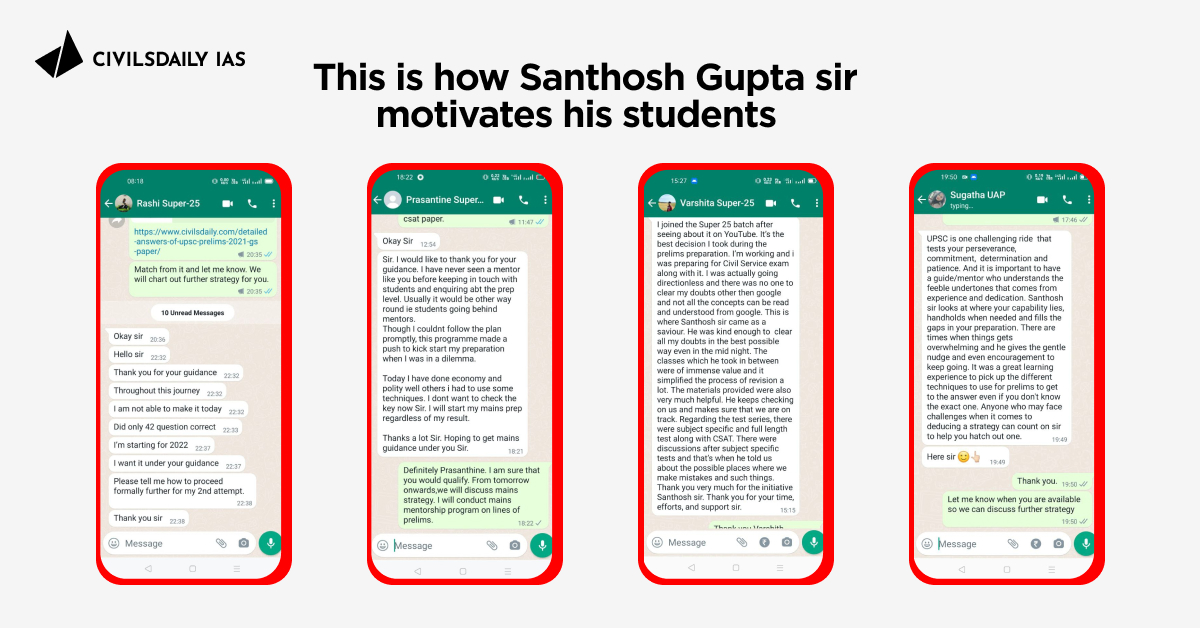
Under Santosh sir’s mentorship, students can feel consistency and improvement in UPSC Prelims preparation.
Santosh sir is always there to ensure his students are following the right sources, makes them understand the concepts, plans strategies for his students, reviews and analyses their progress even on 1-1 calls. Along with academics, he is there with his students through the bouts of demotivation and lows.
A quick bit about Santosh Gupta:
Santosh Gupta sir has scored above 140 twice in UPSC prelims and always 120 plus in all 6 attempts. He wrote all 6 mains and appeared for Interviews 3 times. He has qualified UPSC EPFO and BPSC 56-59th also. He has been teaching and mentoring UPSC aspirants for the last 5 years with tremendous interest in the environment and ecology and Polity.
Consistent effort as per a well-devised strategy and expert mentorship of Santosh sir will sail you through this challenge.
Tavishi failed thrice in the Prelims before but after joining Santosh sir’s mentorship cleared Prelim 2022 in her 4th attempt. Schedule a call with Tavishi’s mentor
SMASH PRELIMS 2023: PERSONALIZED MENTORSHIP, TEST SERIES, LECTURES, NOTES
Our Smash Prelims Program started as a pilot project last year with an aim to introduce step-wise improvement in our chosen 40 aspirants. Over a period of 2 months, Santhosh sir inculcated confidence in aspirants who were either newbies or gave too many attempts. This year, we achieved a remarkable 80% success ratio. This year, we have set our eyes on 100%. Yes, we are as ambitious and aspirational just like any other UPSC aspirant.
Moreover, aspirants must be prepared for the googlies thrown at them by UPSC in the Prelims (new things being tried out by UPSC- like options, topics, etc).
Only barrier between your success and your failure is YOU. If required, change yourself and keep working on your strengths and weaknesses.
About 6 pillared approach of Smash Prelims 2023
Pillar-1: 44 Prelims test
Prelims Tests: 44 (14 Basic + 8 Advanced + 6 CA tests + 10 Full tests + 6 CSAT tests)
Pillar-2: Special Value Additions Notes and Classes by Santosh Gupta
50 Special classes on topics including Polity, History, Economics, Geography, Sessions to cover Environment innovatively, Science & Technology and more.
Pillar-3: Mentorship calls
One-to-one mentorship by core faculty and toppers
One to one Mentor calls after tests
Habitat/WhatsApp support from mentors
Frequent sessions with toppers for support and guidance.
You are 8 times more likely to clear Prelims 2023 with Santosh sir’s mentorship
Procrastination is the act of unnecessarily delaying or postponing decisions or actions. For a UPSC aspirant, it is a sure-shot killer of their IAS dream.
A certain UPSC dream killer.
You decide to study a particular topic or write answers for the day – You get distracted or are lazy or simply confused- You put off these for later and promise to do them tomorrow – That tomorrow never comes – You realize that you have wasted your time – You regret – You are sad the whole day thinking about it – You waste the whole day mourning your wasted time – You realize you have wasted another day – Days turn to weeks and weeks to months. And it is yet another wasted attempt.
Procrastination is often detrimental to people’s ability to successfully pursue their goals.
It also results in anxiety, low self-esteem, demotivation, low confidence, stress, and at times depression. A good chunk of UPSC aspirants face these issues.
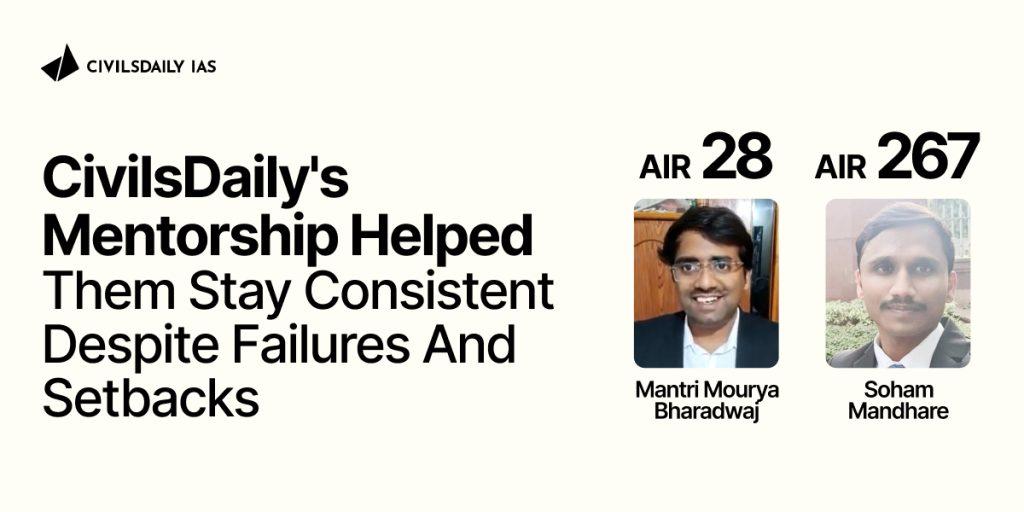
CivilsDaily’s mentorship ensured Working Professional aspirants like Mourya, AIR 28 made the best use of the time they have. Click and Talk to Mourya’s mentor
We need to understand why we procrastinate
After talking to thousands of aspirants and Rankers from CivilsDaily we came to a conclusion that almost 99% of the aspirants procrastinate, to varying degrees. You are not alone. There are several reasons for putting things off for a later time:
1. Fear of failure, or performing badly in the initial stages of preparation is one of the chief reasons. Aspirants often feel underconfident and not prepared to start writing answers, or attempting a Prelims Mock.
2. Overthinking, mostly about irrelevant things – due to ignorance, excess of information. Most of the IAS aspirants waste a lot of time thinking a lot on the best resources, reading a lot of irrelevant books, discussing and fantasizing about various political concepts, etc. You gotta stop it.
3. Perfectionismor waiting for the most appropriate time– 95% is not good as 100%. But its a lot better than zero
It’s tempting to want the best UPSC resources, collect the finest of the notes, try to memorize every concept before you start writing your first answer, or attempt your first IAS Prelims mock.
Don’t wait till you have covered the whole GS syllabus to write your first Essay or first answer. Writing daily answers, even if they are not of UPSC standard will take you a long way to actually writing UPSC level answers in the actual UPSC Mains exam hall.
4. Fear of the wrong choice- any decision is better than no decision. But when a lot of time (attempts), finances, and efforts are at stake the informed decision is the best. Talk to a senior mentor to decide on optional, when, and how to start writing answers, when to start attempting the mock tests, and other important decisions.
5. Boring topics, culture, geography, CSAT, writing long essays. You can’t delegate here, and nor can you leave it, especially when you have time. Talk to some senior, mentor, or teacher who will point out important topics, will help make it a fun activity, or chart out a plan to cover the ‘boring topics’.
You need to understand the reasons why you are procrastinating before you can begin to tackle it.
Aspirants and people, in general, shy away from routines, timetables, systems, and processes because they want to have “freedom” or maybe due to ignorance. But in order to get things done, you need a process, bound by certain rules. It will include:
Breaking down the whole syllabus into small chunks (chapters and sections).
Setting a clear plan of action for the coming week and months, daily targets which are flexible as per your time requirement, and considering other factors. Click here to get a timetable made by UPSC Ranker
Make yourself accountable to the process or mentor so that you are executing (covering the syllabus, giving tests, etc.) on a daily basis.
Measuring your progress on a regular basis. This is best done by a senior or someone experienced who can evaluate your progress based on the tests, and answer writing.
Not fearing bad performance, but instead understanding where you went wrong and how to improve.
Why do you need a mentor to help you fight procrastination?
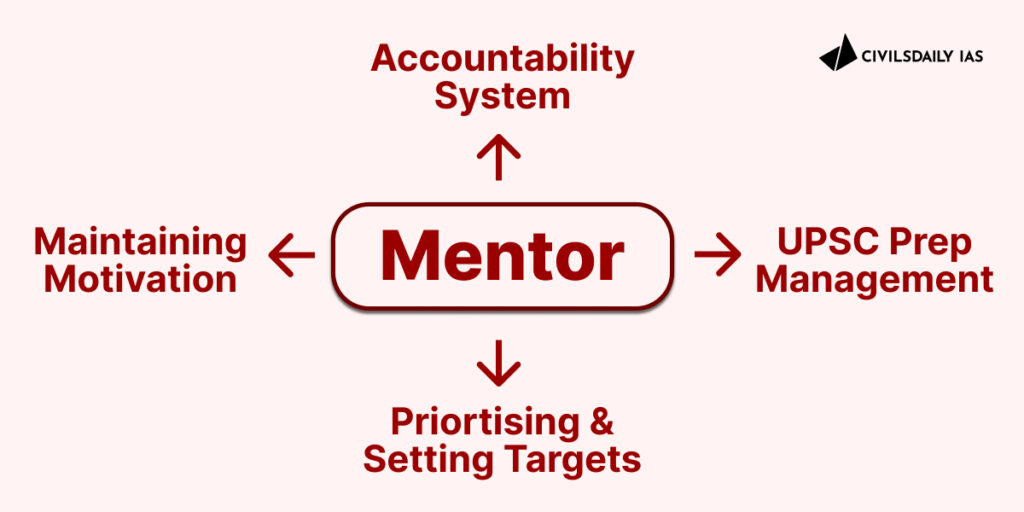
1. Setting an accountability system in place: If you make yourself accountable to someone else, you’re far more likely to achieve your goals. Ask them to check in on your progress from time to time.
2. Setting your own deadlines never works. We rarely respect self-imposed deadlines because we don’t feel too bad about breaking promises we’ve made to ourselves. But we do respect promises we make to others.
Introducing three layers of Mentorship with IAS/UPSC Ranker as your mentor.
3. Prioritising and target setting: A experienced mentor will help you prioritize topics beforehand and set targets. At times aspirants leave topics or subjects like Ethics, Optional till the post-prelims preparation phase. A mentor will integrate these into your preparation from the start.
4. Maintaining motivation and emotional self-control: Not always you will be in a jolly mood or motivated. UPSC prep is a long journey and there will be bouts of lows. An experienced mentor who has gone through the same journey helps in maintaining sanity during the UPSC process.
Mentoring UPSC aspirants like an elder brother.
How does Samanvaya Mentorship work? Introducing 3 layers of mentorship: Get IAS or UPSC ranker as your mentor
1. 1st step starts with this Samanvayacall: Once you fill in the form, we get on a 30-40 minute call with you to understand your prep level, working/ study constraints, and current strategies and create a step-by-step plan for the next week, next month and so on.
2. You are directed and given access to relevant resources and invite-only platform, Habitat where you can ask your daily doubts, discuss your test-prep questions and have real-time, live sessions on news and op-eds, and find your optional groups.
Daily target monitoring.
3. The third and the most personalized tier is the 1 on 1 mentor allotment who stays with you through the course of your UPSC preparation – always-on chat and on scheduled calls to help you assess, evaluate, and chart the next milestone of your IAS 2023-23 journey.
We will also connect you to a UPSC ranker or IAS, who will mentor you in this journey.
Layer 1: You will be assigned a dedicated in-house mentor who will keep track of our progress from start till your final interview.
Layer 2: Sajal Singh sir and the team will be constantly with you through various programs like Samachar Manthan, Prelims, Essay, etc.
Layer 3: A UPSC IAS ranker (one who has cleared this exam) will be supervising your progress as your super mentor.
Who are you?
Working Junta? If you are preparing for IAS 2023-24 and working simultaneously, we can help you design a timetable that fits right in your hectic schedule.
First-time prep? If you are in the last year of college or thinking of dropping a year and preparing for IAS 2023-24 full-time, we can help you pick the right books and craft a practical & personal strategy.
In our interaction with almost 12,000 working professional aspirants (those with a full-time job and preparing for UPSC CSE) over the past couple of months it was revealed that Time management and consistency were the major issue to their preparation.
This is something you aspirants can’t avoid and move on. This Sunday we conducted another power-packed FREE Masterclass session with an IPS officer.
Dilpreet Singh was a CivilsDaily’s mentorship and Samachar Manthan student. He was a Mechanical Engineer who cleared PCS twice and was a working professional at the time of his UPSC attempt which landed him an AIR 237 and IPS.
Why time management?
Time management with the help of a mentor makes your preparation effective.
Time management is a #UPSCskill that tops all other skills in this long journey. Moreover, the complexity and vastness of the syllabus, unpredictability and ever-changing pattern of the UPSC exam, and cut-throat competition necessitate you to invest your time wisely.
Over that, if you are a working professional, college student, or homemaker, and preparing for this exam, and if you don’t have a workable timetable, you won’t be able to stay consistent and your preparation will suffer.
There is no consistency and discipline without time-management. You need guidance for that.
Consistency is the key
Masterclass details
Dilpreet took up an interactive session (1-1 questions) from the aspirants on time management, timetable, and staying consistent. This session in particular is a must for UPSC aspirants who are working professionals and in general, for all aspirants with a serious time crunch.
Other than the points mentioned above we will be discussing the following issues as well.
Management of Priorities – UPSC, family, life, and work.
Reducing time on non-priorities and maintaining focus on daily and weekly targets.
Planning ahead, making targets, staying consistent w.r.t targets and your UPSC preparation.
How should the syllabus be approached to complete it 2 months before UPSC Prelims?
Balancing prelims-mains on one hand and GS-current affairs on the other.
How to determine the primary focus areas of the Prelims, Mains, and Personality tests?
How to apply bookish as well as classroom knowledge to the exam?