💥Join UPSC 2027,2028 Mentorship (July Batch) + XFactor Notes & Microthemes PDF

Author: CD Staff

  • [Prelims Spotlight] Important international economic organisations

    WORLD BANK  GROUP

    World bank group
    • The World Bank Group (WBG) is a family of five international organizations that make leveraged loans to developing countries. It is the largest and most famous development bank in the world and is an observer at the United Nations Development Group. Its five organizations are the International Bank for Reconstruction and Development (IBRD), the International Development Association (IDA), the International Finance Corporation (IFC), the Multilateral Investment Guarantee Agency (MIGA) and the International Centre for Settlement of Investment Disputes (ICSID).

      The World Bank

    • The International Bank for Reconstruction and Development (IBRD), better known as the World Bank, was established at the same time as the International Monetary Fund to tackle the problem of international investment.
    • The World Bank (IBRD) is an inter-governmental institution, corporate in form, whose capital stock is entirely owned by its member-governments. Initially, only nations that were members of the IMF could be members of the World Bank; this restriction on membership was subsequently relaxed.

    International Development Association

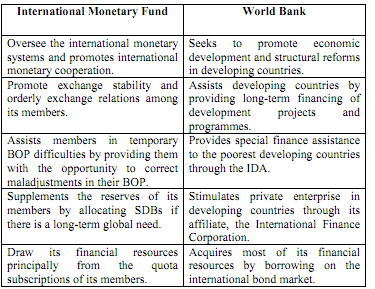
    • The International Development Association (IDA) is the part of the World Bank group that helps the world’s poorest countries. Overseen by 173 shareholder nations, IDA aims to reduce poverty by providing loans (called “credits”) and grants for programs that boost economic growth, reduce inequalities, and improve people’s living conditions.
    • IDA complements the World Bank’s original lending arm—the International Bank for Reconstruction and Development (IBRD). IBRD was established to function as a self-sustaining business and provides loans and advice to middle-income and credit-worthy poor countries. IBRD and IDA share the same staff and headquarters and evaluate projects with the same rigorous standards.
    • IDA is one of the largest sources of assistance for the world’s 771 poorest countries, 39 of which are in Africa, and is the single largest source of donor funds for basic social services in these countries.
    • IDA lends money on concessional terms. This means that IDA credits have a zero or very low interest charge and repayments are stretched over 25 to 40 years, including a 5- to 10-year grace period. IDA also provides grants to countries at risk of debt distress.
    • In addition to concessional loans and grants, IDA provides significant levels of debt relief through the Heavily Indebted Poor Countries (HIPC) Initiative and the Multilateral Debt Relief initiative (MDRI).


    IFC

    • The IFC was established in 1956 to support the growth of the private sector in the developing world.
    • While the World Bank (IBRD and IDA) provides credit and non-lending assistance to governments, the IFC provides loans and equity financing, advice, and technical services to the private sector.


     The Multilateral Investment Guarantee Agency (MIGA)

    • It is an international financial institution which offers political risk insurance and credit enhancement guarantees. Such guarantees help investors protect foreign direct investments against political and non-commercial risks in developing countries. MIGA is a member of the World Bank Group and is headquartered in Washington, D.C., United States.
    • MIGA is owned and governed by its member states, but has its own executive leadership and staff which carry out its daily operations. Its shareholders are member governments which provide paid-in capital and have the right to vote on its matters.


    INTERNATIONAL MONETARY FUND

    You must remember that the name World Bank does not refers to a bank in conventional sense (this is because it performs development function). And International Monetary Fund or IMF performs the lending function(which we associate with banks).
    WB and IMF

    Structure and Size of IMF:

    The International Monetary Fund:

    • 188 countries member.
    • Headquarters:  Washington, D.C.
    • It has 2,300 staff members.

    Functions of IMF

    The International Monetary Fund functions :

    • The IMF is basically a lending institution which gives advances to members in need.
    • It is the mentor of its members’ monetary and exchange rate policies.
    • To maintain the stability in Exchange rate system around the World.

     Operations of IMF and World Bank :
    source


    ADB

    Asian Development Bank (ADB) was set up to fight poverty in Asia and the Pacific. ADB is a multilateral development finance institution dedicated to reducing poverty in Asia and the Pacific.  Established in 1966, ADB is now owned by 63 members, mostly from the region.  The headquarters is in Manila with 24 other offices around the world.

    AIIB & NDB

    AIIB and NDB
    • The New Development Bank (NDB) is established by The BRICS states (Brazil, Russia, India, China and South Africa). According to the Agreement on the NDB, “the Bank shall support public or private projects through loans, guarantees, equity participation and other financial instruments.” Moreover, the NDB “shall cooperate with international organizations and other financial entities, and provide technical assistance for projects to be supported by the Bank
    • The bank is headquartered in Shanghai, China. The first regional office of the NDB will be opened in Johannesburg, South Africa


    AIIB

    Why Has India joined the AIIB?

    There are many reasons for it:

    1. India is preparing start a large number of infrastructure projects, but they’re short of money, so they need help from China. Of course they can get money from ADB or WB, but they also need to find a balance between China and USA.
    2. It’s a great chance to develop economy links between India and China. These two countries both has huge market, and they also keep a rapid growth of economy.
    3. Though AIIB is a Chinese-lead financial institution, India is welcomed to play a important role in it. It’s the reason why the UK, Germany and France all want to be a member of AIIB.

    WTO

    Introduction

    World Trade Organization, as an institution was established in 1995. It replaced General Agreement on Trade and Tariffs (GATT) which was in place since 1946.


    UNO

    The United Nations is an international organization founded in 1945 after the Second World War by 51 countries committed to maintaining international peace and security, developing friendly relations among nations and promoting social progress, better living standards and human rights.

    The United Nations was the second multipurpose international organization established in the 20th century that was worldwide in scope and membership. Its predecessor, the League of Nations, was created by the Treaty of Versailles in 1919 and disbanded in 1946.


    UN TIMELINE:

    http://www.drishtiias.com/uploads/article-images/1405151121.UN-Timeline.gif

    Organisation Structure of UN : 

    http://www.drishtiias.com/uploads/article-images/1405151150.Organisation-structure-of-un.gif
    Structure of UN


    General Assembly: 

    • The General Assembly is the main deliberative, policymaking and representative organ of the United Nations.
    • It is Comprise of all 193 Members of the United Nations.
    • It provides a unique forum for multilateral discussion of the full spectrum of international issues covered by the Charter.

     Security Council: 

    • IT has primary responsibility for the maintenance of international peace and security.
    • It has 15 Members, consisting of 5 permanent members—China, France, Russia, the United Kingdom, and the United States—and 10 non-permanent members.
    • Non Permanent seats are held for two-year terms, with member states voted in by the General Assembly on a regional basis
    • Five permanent members hold veto power over UN resolutions, allowing a permanent member to block adoption of a resolution, though not debate.
    • The presidency of the Security Council rotates alphabetically each month

    Economic and Social Council (ECOSOC) :

    • It is the principal organ to coordinate the economic, social and related work of the United Nations and the specialized agencies and institutions.
    • Voting in the Council is by simple majority; each member has one vote.
    • The president is elected for a one-year term and chosen amongst the small or middle powers represented on ECOSOC.
    • ECOSOC has 54 members, which are elected by the General Assembly for a three-year term.
    • Seats on the Council are allotted based on geographical representation with fourteen allocated to African States, eleven to Asian States, six to Eastern European States, ten to Latin American and Caribbean States, and thirteen to Western European and other States.
    • The work of specialised agencies and programmes of UN like WHO, FAO, UNESCO etc. is coordinated by ECOSOC.

    Trusteeship Council :

    • It was established in 1945 by the UN Charter to provide international supervision for 11 Trust Territories placed under the administration of 7 Member States, and ensure that adequate steps were taken to prepare the Territories for self-government and independence.
    • By 1994, all Trust Territories had attained self-government or independence. Its work completed, the Council has amended its rules of procedure to meet as and where occasion may require.

    The International Court of Justice:

    • It is the UN’s main judicial organ.
    • It is located at the Hague in the Netherlands
    • It settles legal disputes between states and gives advisory opinions to the UN and its specialized agencies.  Its Statute is an integral part of the United Nations Charter.
    • ICJ has 15 judges, who serve 9-year terms; each from a different nation, elected by the General Assembly and Security Council.
    • The Court settles legal disputes between nations only and not between individuals, in accordance with international law. If a country does not wish to take part in a proceeding it does not have to do so, unless required by special treaty provisions. Once a country accepts the Court’s jurisdiction, it must comply with its decision.
    • The Court can only hear a dispute when requested to do so by one or more States.  It cannot deal with a dispute of its own motion.
    • Difference between  the International Court of Justice (ICJ) and  the International Criminal Court (ICC)
    1.  The International Court of Justice has no jurisdiction to try individuals accused of war crimes or crimes against humanity.  As it is not a criminal court, it does not have a prosecutor able to initiate proceedings.
    2.  International Criminal Court set up under the Rome Statute. It  was established as an independent international organization in 2002 and is not governed by the UN.
    3.  All UN member states are automatically members of the ICJ; Nations must individually become members of the ICC.
    4. The ICJ settles disputes between member states, with their consent, on issues of sovereignty, trade, natural resources, treaty violations, treaty interpretation, and etc.
    5.  The ICC tries individual people for genocide, crimes against humanity, war crimes, and crimes of aggression, according to the Rome Statute.
    6. The ICJ issues both binding judgments and advisory opinions. Its judgments may then be enforced by the Security Council if the state fails to comply. The ICC, on the other hand, hands down criminal prosecutions or acquittals.

     Secretariat:

    • It carries out the day-to-day work of the Organization.
    • It services the other principal organs and carries out tasks as varied as the issues dealt with by the UN: administering peacekeeping operations, surveying economic and social trends, preparing studies on human rights, among others.


  • [Prelims Spotlight] Important Submarines and Naval Ships

    1.Indian Naval ship Sahyadri reaches Darwin, Australia for exercise KAKADU 2018

    Exercise KAKADU

    1. After having been deployed to the South China Sea and the Pacific Ocean for over four months, which included representing Indian Navy in multinational exercises MALABAR 18 at Guam and RIMPAC 18 at Hawaii, INS Sahyadri entered the Port of Darwin, Australia to participate in Exercise KAKADU 2018
    2. Indian Navy’s participation in KAKADU 18 provides an excellent opportunity to engage with regional partners and undertake multinational maritime activities ranging from constabulary operations to high-end maritime warfare in a combined environment
    3. It is aimed at enhancing interoperability and development of common understanding of procedures for maritime operations

    About the exercise

    1. Exercise KAKADU, which started in 1993, is the premier multilateral regional maritime engagement exercise hosted by the Royal Australian Navy (RAN) and supported by the Royal Australian Air Force (RAAF)
    2. The exercise is held biennially in Darwin and the Northern Australian Exercise Areas (NAXA)
    3. Exercise KAKADU derives its name from Kakadu National Park, which is a protected area in the northern territory of Australia, 171 km south-east of Darwin
    4. KAKADU 2018 is the 14th edition of the exercise
    5. During the exercise, professional exchanges in harbour and diverse range of activities at sea, including complex surface, sub-surface and air operations would enable sharing of best practices and honing of operational skills.

    2.Operation NISTAR Successfully Culminates with Safe Disembarkations of 38 Indian Nationals at Porbandar

    Operation NISTAR

    • INS Sunayana successfully evacuated 38 Indian Nationals at/ off Socotra Islands during a swift Humanitarian and Disaster Relief Operation (HADR), code named Operation NISTAR.
    • The Indian Nationals were stranded after severe Cyclonic Storm – Mekunu devastated the area around Socotra Island.
    • INS Sunayana was diverted from Gulf of Aden deployment to Socotra Island for search and rescue operations.

    Humanitarian Assistance and Disaster Relief (HADR) in India’s National Strategy

    • HADR operations have attracted the attention of the global community in recent years.
    • The Indian armed forces have a wide experience of disaster relief operations both at home and abroad, where they have been the core of relief operations.
    • Due to its sub-continental size, geographical location and its vulnerability to disasters, India has kept its forces ready to render assistance at short notice.
    • In the six decades since independence, India has experienced a number of natural and man-made disasters such as floods, earthquakes, famines, industrial accidents etc.
    • At the same time, India has partnered the global community in providing relief in affected regions.

    3.INS Karanj boosts Navy’s firepower

    Third Scorpene class submarine joins Naval fleet

    1. The Navy’s third state-of-the-art Scorpene class submarine, INS Karanj, has been launched
    2. The new submarine is named after the earlier Kalvari class INS Karanj, which was decommissioned in 2003
    3. This launch follows the launch of the first two Scorpene submarines — INS Kalavari and INS Khanderi.

    4.Indian Navy inducts its first Deep Submergence Rescue Vehicle

    • The Indian Navy has inducted its first Deep Submergence Rescue Vehicle (DSRV) System at the Naval Dockyard in Mumbai.

    About DSRV

    1. DSRV is used to rescue crew members stranded in submarines that get disabled. The Indian Navy joins a select group of naval forces in the world that boasts of this niche capability.
    2. The DSRV can be operated at a depth of 650 meters and can hold around 15 people.
    3. The Indian Navy in March 2016 had commissioned two DSRVs, the second will deployed at the Eastern Naval Command in Visakhapatnam.
    4. The induction of the DSRV marks the culmination of years of effort of the Indian Navy in acquiring this niche submarine rescue capability.

    Why need DSRV System?

    1. The Indian Navy currently operates submarines of the Sindhughosh, Shishumar, Kalvari Classes as well as nuclear powered submarines.
    2. The operating medium and the nature of operations undertaken by submarines expose them to high degree of inherent risk.
    3. In such an eventuality, traditional methods of search and rescue at sea are ineffective for a disabled submarine.
    4. To overcome this capability gap the Navy has acquired a third generation, advanced Submarine Rescue System considering of a Non-tethered Deep Submergence Rescue Vehicle (DSRV) and its associated equipment.

    What makes Indian DSRV special?

    1. The Indian Navy’s DSRV System is considered to be the most advanced system currently in operation globally for its capability of undertaking rescue from a disabled Submarine upto 650 m depth.
    2. It is operated by a crew of three, can rescue 14 personnel from a disabled Submarine at one time and can operate in extreme sea conditions.

    5.Indian Navy’s Deep Submergence Rescue Vessel (DSRV) Capability

    Context

    • The Indian Navy has inducted a Submarine Rescue System with a Deep Submergence Rescue Vessel (DSRV) along with associated equipment.

    Deep Submergence Rescue Vessel (DSRV)

    1. The Indian DSRV has the capability to rescue personnel from a distressed submarine (DISSUB) up to a depth of 650 m and it is the latest in terms of technology and capabilities.
    2. It has been designed and supplied to meet unique requirements of our submarines by M/s James Fishes Defence, UK.
    3. This System has a Side Scan Sonar for locating the position of the submarine in distress at sea.
    4. It will be providing immediate relief by way of posting Emergency Life Support Containers with the help of Remotely Operated Vehicle (ROV) for the rescue.
    5. To ensure early mobilization, the System permits rapid transportation of the Rescue System from the base to the exact location of the distressed submarine by transportation using air/land/sea vessels.
  • [Prelims Spotlight] Acts and schemes related to Energy and Infrastructure

    1.Saubhagya

    Objectives –

    • To provide electricity connections to over 4 crore families in rural and urban areas by December 2018. -scheme deals the cost of last-mile connectivity to willing households to help achieve the goal of lighting every household by 31 December 2018.
    • The beneficiaries for free electricity connections would be identified using Socio Economic and Caste Census (SECC) 2011 data.
    • Un-electrified households not covered under the SECC data would also be provided electricity connections under the scheme on payment of Rs. 500 which shall be recovered by DISCOMs in 10 instalments through electricity bill.
    • Free connections will be provided to below poverty line (BPL) households.
    • For households outside the reach of national electricity grid, solar power packs along with battery banks shall be provided.
    • The solar power packs of 200 to 300 Wp (Watt peak capacity) with battery bank, comprises of Five LED lights, One DC fan, One DC power plug.
    • The scheme also includes the Repair and Maintenance (R&M) for 5 years.
    • States have also been provided with an incentive of 50% of their loan being converted to grants, if the electrification targets are met by 31 December 2018.
    • Nodal Ministry –State-run Rural Electrification Corporation

    2.UDAY

    Objectives –

    • It has ambitious target of making all discoms profitable by 2018-19.
    • -Improving operational efficiencies of discoms,
    • -Reduction of cost of power,
    • -Reduction in interest cost of discoms and
    • -Enforcing financial discipline on discoms through alignment with state finances.
    • It has all the 3 elements — 1.Clear up the legacy issues of past losses and debt. 2.Provide a financial road map to bring tariffs in line with costs by FY19. 3.Provide enough deterrents for the state govt to not allow the state discoms to become loss ridden post FY18, as losses start to impact their FRBM limits.
    • The State govt. will takeover the discom liabilities over 2-5 year period. 2.This will allow discoms to convert their debt into State bond. These bonds will have a maturity period of 10-15 years. 3.It will allow transfer of 75% outstanding debts incurred by stressed discoms to States’ debt, 50% in 2015-16 and 25% in 2016-17
    • The central government will not include the loans of the discoms in calculation of the state’s deficit till 2016-17.
    • DISCOM debt not taken over by the State shall be converted by the Banks / FIs into loans or bonds.
    • Till November 2017, only states that have not joined it are Odisha and West Bengal
    • Nodal Ministry –Ministry of power

    3.Deendayal Upadhyaya Gram Jyoti Yojana (DUGJY)

    Objectives –

    • To provide 24×7 uninterrupted electricity supply to each rural household across the country by 2022.1. It focuses on feeder separation for rural households and agricultural purpose. 2. Seeks to strengthen the distribution and sub-transmission infrastructure, including metering at all levels in rural areas. 3. It also seeks to strengthen Micro grid and off grid distribution network of rural electrification.
    • Nodal Ministry –Ministry of Power

    4.24×7 – Power for All

    Objectives –

      • To provide 24×7 power available to all households, industry, commercial businesses, public needs, any other electricity consuming entity and adequate power to agriculture farm holdings by FY 19.‘Power for All scheme’ is a joint initiative of the central and state governments, with the objective of providing 24X7 electricity to all households, industry, commercial businesses and other electricity-consuming entities within the time span of four years.
    • Nodal Ministry –Ministry of Power

    5.Integrated Power Development Scheme” (IPDS)

    Objectives –

    • Strengthening of sub-transmission and distribution network in the urban areas;
    • Metering of distribution transformers /feeders / consumers in the urban areas.
    • IT enablement of distribution sector and strengthening of distribution networkThe scheme will help in reduction in AT&C losses, establishment of IT enabled energy accounting / auditing system, improvement in billed energy based on metered consumption and improvement in collection efficiency

    Nodal Ministry –.Ministry of Power

    6.National Smart Grid Mission (NSGM)

    Objectives –

    • The mission entails implementation of a smart electrical grid based on state-of-the art technology in the fields of automation, communication and IT systems that can monitor and control power flows from points of generation to points of consumption.-The major activities envisaged under NSGM are development of smart grid, development of micro grids, consumer engagements and training & capacity building etc.
    • NSGM entails implementation of a smart electrical grid based on state-of-the art technology in the fields of automation, communication and IT systems that can monitor and control power flows from points of generation to points of consumption
    • Nodal Ministry –Ministry of Power

    7.UJALA

    Objectives –

    • To save energy consumption by distributing LED bulbs which are energy efficientThe scheme is being implemented by Energy Efficiency Services Limited (EESL), a joint venture of PSUs under the Union Ministry of Power.
    • It is LED based Domestic Efficient Lighting Programme (DELP).
    • Under it, LED Bulbs are distributed.
    • It wants every home in India to use LED bulbs so that the net power or energy consumption rate comes down and the carbon emission rates can also be checked
    • The scheme will not only help reduce consumers their electricity bills but also contribute to the energy security of India.
    • Nodal Ministry –Ministry of Power

    8.TARANG, UJALA, VIDYUT PRAVAH, GARV, URJA and MERIT

    Objectives –

    • The initiatives were launched keeping in line with the Digital India initiative. The primarily seek to enhance transparency in power sector.All apps released by Power Sector,
    • Nodal Ministry –Ministry of Power

    9.Sustainable Rooftop Implementation for Solar Transfiguration of India (SRISTI)

    Objectives –

    • It will provide incentives for the installation of rooftop solar power plant projects in India.
    • The important features and highlights of this scheme are as follows:-
    • This Solar Power Plant Subsidy Scheme will provide incentives for the sustainable implementation of Rooftop.
    • Subsequently, this scheme will form the advanced version of the previous MNRE scheme in Phase II.
    • Accordingly, govt. will integrate Discoms to implement this solar subsidy scheme.
    • 4.Central govt. will provide financial assistance to implement rooftop solar power plants for the residential users.
    • 5.Henceforth, users of the residential sectors can install the particular in-line capacity as per their necessity and their SERC (State Electricity Regulation Commission) Regulation.
    • Central govt. will provide subsidy up to 5 KWP capacity of power plant.
    • Nodal Ministry –Ministry of New and Renewable Energy (MNRE)

    10.Green Energy Corridors Project

    Objectives –

    • The green energy corridor is grid connected network for the transmission of renewable energy produced from various renewable energy projects.
    • The project was envisaged by Power Grid Corporation of India Limited (PGCIL) in its innovative report titled ‘Green Energy Corridors’.
    • It was proposed as a dedicated transmission network for renewable energy across different renewable energy potential states.
    • Nodal Ministry –Ministry of New and Renewable Energy (MNRE)

    11.India’s Street Lighting National programme (SLNP)

    Objectives –

    • The programme aims to install LED bulbs street-lighting across different cities in the country.
    • The LED lights will replace inefficient lamps.
    • The initiative is part of the Government’s efforts to spread the message of energy efficiency in the country.
    • It will result in energy savings and reduction of greenhouse gas emissions.
    • Nodal Ministry –Ministry of Power, Energy Efficiency Services Limited

    12.SuryaMitra programme

    Objectives –

    • To provide skill training to rural youth in handling solar installations
    • It is Union Government skill development program
    • Aims to create skilled manpower in commissioning, installation, O&M of solar power plants and equipment.
    • It primary objective is to provide entrepreneurship and employability opportunities to rural and urban youth & women.
    • The scheme is aimed at creating 50,000 trained solar photovoltaic technicians by March 2020.
    • Special emphasis is given to skill youth from SC/ST/OBC categories.
    • The qualification required to participate in the program is ITI (Electrical & Wireman) / Diploma in Engineering (Electrical, Electronics & Mechanical).
    • Higher qualified participants such as B.Tech etc are not eligible for this programme.
    • The programme is 100% funded by GOI and implemented by National Institute for Solar Energy (NISE) across the country.
    • In addition, short term training programmes for small hydro, entrepreneurship development, operation & maintenance of solar energy devices and boiler operations in co-generation plants have been organized.
    • National Institute of Solar Energy (NISE) is an autonomous institution of Ministry of New & Renewable Energy (MNRE)).National institute of solar energy

    13.National Mission for Enhanced Energy Efficiency (NMEEE)

    Objectives –

    • PAT (perform, achieve & trade) scheme: Improving efficiency in energy intensive sector.
    • Energy Efficiency Financing Platform (EEFP): provides a platform to interact with financial institutions and project developers for implementation of energy efficiency projects
    • Framework for Energy Efficient Economic Development (FEEED): focuses on developing appropriate fiscal instruments to promote energy efficiency financing
    • Market transformation for Energy Efficiency (MTEE): Accelerating shift toward energy efficient appliances

    14. Setu Bharatam

    Objectives –

    • To free all national highways from railway level crossings and renovate the old bridges on national highways by 2019.
    • .Setu Bharatam is an ambitious programme with an investment of Rs. 50,000 crore to build bridges for safe and seamless travel on National Highways.
    • 2.208 new “road over bridges / road under bridges” are envisaged for construction, while 1500 bridges will be widened, rehabilitated or replaced.
    • Nodal Ministry –The Ministry of Road Transport & Highways

    15.Bharatmala

    Objectives –

    • It is an umbrella program that will subsume unfinished parts of NHDP
    • It will also focus on the new initiatives like development of Border and International connectivity roads, Coastal & port connectivity roads, National Corridors Efficiency improvements, Economic corridors development and others.
    • Around 80 per cent of Bharatmala will be based on a government funded, engineering procurement and construction (EPC) model while the rest will be a hybrid-annuity public private partnership.
    • Nodal Ministry –The Ministry of Road Transport & Highways

    16.National Highways Interconnectivity Improvement Project

    Objectives –

    • This is a project to ensure safe, fast and all weather movement of traffic on National Highways mostly located in backward regions
    • Nodal Ministry –The Ministry of Road Transport & Highways

    17.Logistic Efficiency Enhancement Programme (LEEP)

    Objectives –

    • Aimed at enhancing the freight transportation in India through improving cost, time, tracking and transferability of consignments through infrastructure, procedural and Information Technology (IT) interventions.Under this programme
    • road ministry has shortlisted 15 locations with the highest freight movement for the development of multimodal logistics parks worth Rs.32,853 crore.
    • The parks would be spread over a total area of around 4,800 acres and will be built under the first phase of the ministry’s Logistics Efficiency Enhancement Programme (LEEP).
    • Through the programme, the government is trying to improve efficiency and reduce logistics costs by as much as 10%.
    • The parks are expected to serve four key functions:
    • 1. Freight aggregation and distribution,
    • 2. Multimodal freight movement,
    • 3. Storage and warehousing,
    • 4. Value-added services such as custom clearances.
    • Nodal Ministry –The Ministry of Road Transport & Highways

    18.Vehicle Fleet Modernization Programme

    Objectives –

    • To enable the replacement of old, heavy and medium commercial vehicles as they contribute the maximum of vehicular pollution
    • Nodal Ministry –The Ministry of Road Transport & Highways

    19.Highway Advisory System (HAS)

    Objectives –

    • HAS was launched as a pilot project on Delhi-Jaipur highway.
    • It is a free-to-air information distribution system that uses radio to make the travelling experience on National Highways safer, faster and hassle-free.
    • HAS control centre collects data, processes and analyzes it, generates alerts and sends it to be broadcast by All India Radio.
    • Nodal Ministry –“The Ministry of Road Transport & Highways

    20. Indian Bridge Management System (IBMS)

    Objectives –

    • It is aimed at ensuring safety of bridges in India-IBMS is being developed to create an inventory of all bridges in the country and rate their structural condition so that timely repair and rehabilitation work can be carried out based on the criticality of the structure.
    • How Will it Work?
    • -A unique identification number or National Identity Number (NIN) will be given to each bridge, and the number will be based on the state, RTO zone or based on location (National Highway, State Highway etc.).
    • -Along with NIN, Bridge Location Number (BLN) will also be allotted to every bridge based on specific GPS given latitude-longitude. Another number- Bridge Classification Number (BCN) will be assigned to the bridge structure based on its engineering characteristics.
    • -A Structural Rating Number (SRN) will be assigned to bridge structures on a scale of 0 to 9
    • -Another number – Socio-Economic Bridge Rating Number will specify the contribution of bridge in daily socio-economic activity of that area. IBMS will analyse this data and recognize bridges which need renovation.
    • Nodal Ministry – The Ministry of Road Transport & Highways

    21.National Green Highways Project

    Objectives

    • Under the Green Highways Project the government has made it mandatory to set aside 1% of the total project cost of any NH contract to a Green Fund corpus that will be used for plantation purposes.
    • The afforestation is expected to help in sequestering approximately 12 lakh mt carbon annually
    • The funds to be transferred to the National Highways Authority of India (NHAI) would be used exclusively for plantation and maintenance on all NH stretches being developed on the Engineering Procurement Construction (EPC) and Build Operate Transfer (BOT) mode.
    • The NHAI will act as Fund Manager for maintaining the account and for release of the payments made by the Regional Officer or Project Director based on the recommendation of the monitoring agency-Indian Highways Management Company Ltd (IHMCL).
    • There will be a strong monitoring mechanism in place by using ISRO’s Bhuvan and GAGAN satellite systems. Every planted tree will be counted and auditing will be done. The agencies performing well will receive annual awards.
    • Nodal Ministry – The Ministry of Road Transport & Highways

    22.Kisan Harit Rajmarg Yojana

    Objectives

    • A pilot scheme to extend green belt beyond the existing ‘Right of Way’ of highways by engaging farmers and providing alternative livelihood option to the nearby communities.
    • Nodal Ministry –The Ministry of Road Transport & Highways

    23.Chaar Dham Highway Development Project

    Objectives

    • To improve connectivity to the Char Dham pilgrimage centres in the Himalayas.To improve connectivity to the Char Dham pilgrimage centres in the Himalayas.
    • The project’s main objective is to develop around 900 km of national highways. These highways will be built at an approximate cost of Rs 12,000 crore. 2.It will allow uninterrupted access for pilgrims to the four Himalayan shrines of Kedarnath, Badrinath, Gangotri and Yamunotri in Uttarakhand.
    • The all-weather roads will have tunnels, bridges and fly-overs to enhance road safety and uninterrupted access. It will have proper slope stabilisation to ensure protection against landslides. 3.It will benefit people visiting holy shrines in Uttarakhand. It will generate additional employment for the local population and will change the economy of the State as it will give strong boost to connectivity and tourism.
    • Nodal Ministry – Ministry of Road Transport & Highways

    24.SagarMala

    Objectives

    • To promote port-led direct and indirect development and to provide infrastructure to transport goods to and from ports quickly, efficiently and cost-effective
    • Three pillars:
      • Supporting and enabling Port-led Development
      • Port Infrastructure Enhancement, including modernization and setting up of new ports, and
      • Efficient Evacuation to and from hinterland. 
    • The programme aims to promote port-led development in the country by harnessing India’s 7,500-km long coastline, 14,500-km of potentially navigable waterways and strategic location on key international maritime trade routes.
    • It envisages transforming existing ports into modern world class ports as well as developing new ones.
    • It also aims to develop efficient evacuation systems through road, rail, inland and coastal waterways.
    • Nodal Ministry: Ministry of Shipping

    25.Pradhan Mantri Awas Yojana(Urban)

    Objectives

    • To provide housing for all by the year 2022.
    • The Mission will be implemented during 2015-2022 and will provide central assistance to Urban Local Bodies (ULBs) and other implementing agencies through States/UTs for:
    • 1.In-situ Rehabilitation of existing slum dwellers using land as a resource through private participation 2.Credit Linked Subsidy 3. Affordable Housing in Partnership 4. Subsidy for Beneficiary-led individual house construction/enhancement.

    Nodal Ministry – Ministry of Urban Ministry

    26.National Urban Housing Fund

    • To finance Pradhan Mantri Awas Yojana (Urban) which aims to build 1.2 crore affordable houses in urban areas by 2022.-NUHF will be placed under aegis of Building Materials and Technology Promotion Council (BMTPC).
    • It will be raised from non-budgetary sources and will tap into existing government entities such as Housing and Urban Development Corp. (Hudco).
    • NUHF will facilitate raising requisite funds in next four years and plug any budgetary shortfalls.
    • It will smoothly sustain construction of houses to address gap in Urban Sector progresses by maintaining flow of Central Assistance under different verticals i.e. Affordable Housing in Parternership (AHP), Beneficiary Linked Construction (BLC), In-Situ Slum Redevelopment (ISSR) and Credit Linked Subsidy Scheme (CLSS).
  • [Burning Issue] Nitrogen Pollution in India

    Nitrogen Pollution

    • While nitrogen is the dominant gas in the atmosphere, it is inert and doesn’t react.
    • However, when it is released as part of compounds from agriculture, sewage and biological waste, nitrogen is considered reactive.
    • It may be polluting and even exert a potent greenhouse gas effect.
    • Nitrous oxide (N2O) is 300 times more potent than carbon dioxide but isn’t as prevalent in the atmosphere.
    • Other than air pollution, nitrogen is also linked to the loss of biodiversity, the pollution of rivers and seas, ozone depletion, health, economy, and livelihoods.
    • Nitrogen pollution is caused, for example, by emissions from chemical fertilisers, livestock manure and burning fossil fuels.
    • Gases such as ammonia (NH3) and nitrogen dioxide (NO2) contribute to poor air quality and can aggravate respiratory and heart conditions, leading to millions of premature deaths across the world.
    • Nitrate from chemical fertilisers, manure and industry pollutes the rivers and seas, posing a health risk for humans, fish, coral and plant life.

    Nitrogen: A limited necessity

    • Nitrogen is essential to all life on Earth as it forms an important component of life-building and propagating biochemical molecules like proteins.
    • But overuse in agriculture in the form of fertilisers and other fields have made this important element more bane than boon.
    • Some of these forms of nitrogen like N2O can have far reaching impacts for humanity.
    • N2O is 300 times more potent as a greenhouse gas than carbon dioxide (CO2).

    Nitrogen emission in India

    • NOx emissions grew at 52% from 1991 to 2001 and 69% from 2001 to 2011 in India.
    • Agriculture is the largest contributor to nitrogen emissions.
    • Non-agricultural emissions of nitrogen oxides and nitrous oxide were growing rapidly, with sewage and fossil-fuel burning — for power, transport and industry — leading the trend.

    Nitrogen: The “new carbon” for India

    • In 2017, a large team of Indian scientists had come out with The Indian Nitrogen Assessment (INA).
    • India had become the third country/entity after the United States and the European Union to have assessed the environmental impact of nitrogen on their respective regions comprehensively.
    • The INA shows that agriculture is the main source of nitrogen pollution in India. Within agriculture, cereals pollute the most.
    • Rice and wheat take up the maximum cropped area in India at 36.95 million hectares (ha) and 26.69 million ha respectively.

    Overuse of Fertilizers

    • India consumes 17 Mt (million tonnes) of nitrogen fertiliser annually as per the data of the Fertiliser Association of India.
    • Only 33 per cent of the nitrogen that is applied to rice and wheat through fertilisers is taken up by the plants in the form of nitrates (NO3). This is called Nitrogen Use Efficiency or NUE.
    • The remaining 67 per cent remains in the soil and seeps into the surrounding environment, causing a cascade of environmental and health impacts.

    India is curious about it

    • The Indian government is leading a resolution on nitrogen pollution in the UNEA in Nairobi that starts from this March 11.
    • This is a historic event as India has never pushed for a resolution of such importance at any UN congregation before.
    • And this has happened because India can now leverage its own nitrogen assessment and its strong support to South Asian and other regional assessments with a more inclusive approach.
    • This would lead a process for faster global consensus and a more realistic programme of action.

    How Nitrogen turned into pollutant from nutrient how it is affecting health and environment?

    • Nitrogen is an inert gas that’s necessary for life. But we’re changing it into forms that are harmful, overloading the environment with it, and throwing the natural nitrogen cycle out of whack.
    • Nitrogen compounds running off farmland have led to water pollution problems around the world, while nitrogen emissions from industry, agriculture and vehicles make a big contribution to air pollution.
    • Over 80% of the nitrogen in soil is not utilised by humans. While over four-fifths of the nitrogen is used to feed livestock, only about six per cent reaches humans in case of non-vegetarian diet, as compared to the 20% that reaches the plate of a vegetarian.
    • Nitrogen becomes a pollutant when it escapes into the environment and reacts with other organic compounds. It is either released into the atmosphere, gets dissolved in water sources such as rivers, lakes or groundwater, or remains in the soil. While it might lead to favourable growth of species that can utilise this nutrient, nitrogen as a pollutant is often detrimental to the environment and health.


    Effects on health:

    According to the World Health Organization, nitrate-contaminated drinking water can cause reduced blood function, cancer and endemic goiters. Surplus inputs of nitrogen compounds have been found to cause soil acidification. The lowering pH, as a result of the acidification, can lead to nutrient disorders and increased toxicity in plants. It may also affect natural soil decomposition.


    Nitrogen pollution has a significant impact on the environment:

    • It creates of harmful algal blooms and dead zones in our waterways and oceans; the algae produce toxins which are harmful to human and aquatic organisms (and indirectly affects fisheries and biodiversity in coastal areas).
    • Contamination of drinking water. 10 million people in Europe are potentially exposed to drinking water with nitrate concentrations above recommended levels. This can have an adverse effect on human health.
    • Food Security: Excessive nitrogen fertiliser application contributes to soil nutrient depletion. As the world needs to feed an ever growing population loss of arable land is major global problem.
    • The release of Nitrous Oxide is essentially a greenhouse gas which is harmful to the environment.

    About South Asian Nitrogen Hub (SANH)

    • The South Asian Nitrogen Hub (SANH) is a major international research programme to tackle the challenge that nitrogen pollution poses in South Asia.
    • The SANH will be established with funding from UK Research and Innovation (UKRI) under its Global Challenges Research Fund (GCRF).
    • 18 Indian research institutions are part of a group of 50 which have received £20 million funding from the United Kingdom Government.
    • The SANH will study the impact of the different forms of pollution to form a coherent picture of the nitrogen cycle.
    • In particular, it will look at nitrogen in agriculture in eight countries – India, Pakistan, Bangladesh, Nepal, Afghanistan, Sri Lanka, Bhutan and Maldives.
    • Its recommendations will support cleaner and more profitable farming, as well as industrial recycling of nitrogen, fostering development of a cleaner circular economy for nitrogen.

    What are the challenges ahead?

    • Nitrogen is crucial to food production in India, however, its excessive usage in agriculture has put us under serious risk.
    • We cannot produce sufficient food to feed the entire nation without nitrogen, but at the same time, we cannot keep releasing a higher amount of nitrogen due to its polluting effects.
    • Thus the challenge is to optimally utilize the nitrogen while reducing its negative impacts.

    What is the way forward?

    • Since the issue of nitrogen pollution starts to gain global attention, there have been innovations seeks to improve its efficiency by optimizing usage.
    • A simpler method of minimizing nitrogen application in soil is Precision farming where small quantities of nitrogen are administered routinely rather than applying large doses uniformly across the field.
    • Zero Budget Natural Farming which involves usage of locally available materials such as cow dung and cow urine to increase soil productivity and plant growth.
    • Also, tablets and coated forms of nitrogen, when applies at the root level = release nutrients slowly to the crops.
      • Notably, Bangladesh has managed to improve the efficiency of nutrient uptake by plants by applying fertilizers through tablets.
      • A similar initiative has been taken in India with neem-coated urea.
    • These methods combined with the organic fertilizers and optimal timing of application, sowing, and watering, have shown marked improvement over traditional efficiencies of nitrogen.

    Developed regions such as the US and Europe have published detailed reports regarding nitrogen usage and pollution. However, India is nowhere near aggregating something similar to its own. Thus the Nitrogen pollution is the problem of improper management rather than inability. The costs of abating nitrogen pollution would be much lesser than the benefits to health and the environment.


  • [Prelims Spotlight] International Organizations related to environment conservation

    Earth System Governance Project (ESGP)

    Established When and by Whom:  Developed under the auspices of the International Human Dimensions Programme on Global Environmental Change. It started in January 2009.

    Headquarter: The Earth System Governance Project Office is hosted at Lund University, Sweden.

    Key Functions:

    The Earth System Governance Project aims to contribute to science on the large, complex challenges of governance in an era of rapid and large-scale environmental change.

    The project seeks to create a better understanding of the role of institutions, organizations and governance mechanisms by which humans regulate their relationship with the natural environment

    The Earth System Governance Project aims to integrate governance research at all levels. The project aims to examine problems of the ‘global commons’, but also local problems from air pollution to the preservation of waters, waste treatment or desertification and soil degradation

    However, due to natural interdependencies local environmental pollution can be transformed into changes of the global system that affect other localities. Therefore, the Earth System Governance Project looks at institutions and governance processes both local and globally

    The Earth System Governance Project is a scientific effort, but also aims to assist policy responses to the pressing problems of earth system transformation


    Global Environment Facility (GEF)

    Established When and by Whom: The Global Environment Facility was established in October 1991 as a $1 billion pilot program in the World Bank to assist in the protection of the global environment and to promote environmental sustainable development.

    Headquarter: Washington, District of Columbia, United States of America

    Key Functions:

    The Global Environment Facility (GEF) unites 183 countries in partnership with international institutions, civil society organizations (CSOs), and the private sector to address global environmental issues while supporting national sustainable development initiatives.

    Today the GEF is the largest public funder of projects to improve the global environment.

    An independently operating financial organization, the GEF provides grants for projects related to biodiversity, climate change, international waters, land degradation, the ozone layer, and persistent organic pollutants.

    Funding: The GEF also serves as the financial mechanism for the following conventions:

    • Convention on Biological Diversity (CBD)
    • United Nations Framework Convention on Climate Change (UNFCCC)
    • UN Convention to Combat Desertification (UNCCD)
    • Stockholm Convention on Persistent Organic Pollutants (POPs)
    • Minamata Convention on Mercury

    India specific trivia:

    *India has formed a permanent Constituency in the Executive Council of the GEF together with Bangladesh, Sri Lanka, Bhutan, Nepal and Maldives.

    The Council Meetings are held semi-annually or as frequently necessary. At each meeting, the Council elects a Chairperson from among its members for the duration of that meeting. India’s Executive Director in the World Bank represents the GEF Council from our Constituency.

    India is both a donor and a recipient of GEF. It has been a leading developing country participant in the GEF since its inception in 1991 and has played a major role in shaping the restructuring of the GEF. It had contributed US $ 6.0 million to the core fund in the GEF Pilot Phase.

    India has pledged an amount of US $ 9.0 million towards the resources of each of the Five GEF replenishments. The total funds pledged so far amounts to US$ 51 million and an amount of US$ 48.75 million has been paid by December 2012 towards GEF replenishments.

    Ministry of Finance is the political focal point while Ministry of Environment & Forests is the Operational Focal Point for the GEF Projects.


    Global Green Growth Institute

    Established When and by Whom: GGGI was first launched as a think tank in 2010 by Korean President Lee Myung-bak, and was later converted into an international treaty-based organization in 2012 at the Rio+20 Summit in Brazil.

    Headquarter: It is headquartered in Seoul, Republic of Korea

    Key Functions: GGGI works to produce three major outcomes: adoption and implementation of green growth plans; provision of research for policymakers; and private sector engagement in the implementation of the national green growth plans. The organization uses three approaches to achieve these outcomes: Green Growth Planning & Implementation (GGP&I), Knowledge Development & Management (KDM), and Public-Private Cooperation (PPC).

    Funding: Funds are given by Contributing members. Contributing members are defined as Member countries that make a multi-year financial contribution of core funding of no less than USD 15 million over three years. Participating members are defined as Member countries that are not contributing members.

    India specific trivia:

    GGGI has been working in India to promote green growth and sustainable development since 2013.

    GGGI has worked at national, state, and city levels to develop and implement green growth strategies that reconcile short-term priorities with long-term vision of higher economic growth, environmental sustainability, and social inclusion

    At the state level, GGGI worked closely with the governments of Karnataka, Himachal Pradesh (HP), and Punjab to develop comprehensive green growth strategies together with each.

    GGGI also supported each of the three state governments in adopting integrated analytical approaches to assess green growth challenges and prioritize opportunities across key sectors, including energy, water, agriculture, and forestry

    Building on these strategies, in 2015, GGGI supported the state governments in implementing specific green growth opportunities by formulating detailed project proposals, policy implementation roadmaps, and capacity building initiatives.


    KIMO (Local Authorities International Environmental Organisation)

    Established When and by Whom: KIMO was founded in August 1990 by four municipalities and from this modest start has grown in size to represent over 70 members in Belgium, Denmark, The Faroe Islands, Germany, The Netherlands, Sweden and the United Kingdom.

    Headquarter: Esbjerg, Denmark

    Key Functions:

    • KIMO is committed to the development of sustainable coastal communities by:
    • Preventing pollution of the seas and coastal waters of North Western Europe and preserving, improving and enhancing them for future generations
    • Protecting coastal communities from the impacts of marine pollution and climate change.
    • Representing its member local authorities and associated members at an international and national level.


    Intergovernmental Panel on Climate Change (IPCC)

    Established When and by Whom:   It was first established in 1988 by two United Nations organizations, the World Meteorological Organization (WMO) and the United Nations Environment Programme (UNEP), and later endorsed by the United Nations General Assembly.

    Headquarter: Geneva, Switzerland

    Key Functions:

    • The IPCC produces reports that support the United Nations Framework Convention on Climate Change (UNFCCC).
    • IPCC reports cover all relevant information to understand the risk of human-induced climate change, its potential impacts and options for adaptation and mitigation.
    • The IPCC does not carry out its own original research.
    • Thousands of scientists and other experts contribute on a voluntary basis.
    • The 2007 Nobel Peace Prize was shared, in two equal parts, between the IPCC and an American Environmentalist.

    The aims of the IPCC are to assess scientific information relevant to:

    1. Human-induced climate change,
    2. The impacts of human-induced climate change,
    3. Options for adaptation and mitigation.

    Funding: The IPCC receives funding through the IPCC Trust Fund, established in 1989 by the United Nations Environment Programme (UNEP) and the World Meteorological Organization (WMO).

    India specific trivia: India will have its own climate change models to project the impact of global warming over the decades and these will form part of the forthcoming Sixth Intergovernmental Panel on Climate Change Reports that is expected to be available in 2020.


    International Union for Conservation of Nature (IUCN)

    Established When and by Whom: The International Union for Conservation of Nature (IUCN) is the world’s oldest and largest global environmental organisation.

    Founded in 1948, today IUCN the largest professional global conservation network. IUCN has more than 1,200 member organizations including 200+ government and 900+ non-government organizations.

    Headquarter: The Union’s headquarters are located in Gland, near Geneva, in Switzerland.

    Key Functions: Conserving biodiversity is central to the mission of IUCN. The main areas of function are:

    1. Science  – the IUCN Red List of Threatened Species™.
    2. Action – hundreds of conservation projects all over the world.
    3. Influence – through the collective strength of more than 1,200 government and non-governmental Member organizations.

    Funding:  Funded by governments, bilateral and multilateral agencies, foundations, member organisations and corporations.

    More about the IUCN

    Governance by a Council elected by member organizations every four years at the IUCN World Conservation Congress.

    Observer Status at the United Nations General Assembly.

    India specific trivia:

    • India became a State Member of IUCN in 1969, through the Ministry of Environment, Forest and Climate Change (MoEFCC).
    • The IUCN India Country Office was established in 2007 in New Delhi.
    • IUCN India works with Members and Commissions to reduce ecosystem and species loss by providing the necessary tools and knowledge to value, conserve and use biodiversity sustainability; enhance governance and policy for better management of ecosystems and habitats, including protected areas; and address challenges related to poverty alleviation, food security and climate change.


    United Nations Environment Programme (UNEP)

    Established When and by Whom: It was founded as a result of the UN Conference on the Human Environment (Stockholm Conference) in 1972

    Headquarter: Nairobi, Kenya

    Key Functions:

    • It coordinates UN’s environmental activities, assisting developing countries in implementing environmentally sound policies and practices.
    • Its activities cover a wide range of issues regarding the atmosphere, marine and terrestrial ecosystems, environmental governance and green economy.
    • UNEP has also been active in funding and implementing environment related development projects
    • UNEP has aided in the formulation of guidelines and treaties on issues such as the international trade in potentially harmful chemicals, transboundary air pollution, and contamination of international waterways
    • UNEP is also one of several Implementing Agencies for the Global Environment Facility (GEF) and the Multilateral Fund for the Implementation of the Montreal Protocol
    • The International Cyanide Management Code, a program of best practice for the chemical’s use at gold mining operations, was developed under UNEP’s aegis.

    Funding:  The three main sources of funding of UN Environment are the UN Regular Budget, the Environment Fund, the core funding that enables UN Environment to implement its global and regional work, and Earmarked Contributions.

    India specific trivia: UN Environment has sponsored the development of solar loan programs, with attractive return rates, to buffer the initial deployment costs and entice consumers to consider and purchase solar PV systems.

    The most famous example is the solar loan program sponsored by UN Environment helped 100,000 people finance solar power systems in India.

    Success in India’s solar program has led to similar projects in other parts of the developing world like Tunisia, Morocco, Indonesia and Mexico.


    World Nature Organization (WNO)

    Established When and by Whom:  WNO initiative was born in 2010 by states which are threatened by rising sea levels. The WNO Treaty officially entered into force on 1st May 2014.

    Location : Geneva

    Key Functions:

    • It is an intergovernmental organisation which promotes global environmental protection.
    • WNO acts as a centre of competence for environmental protection, green technologies and sustainability, and as a mediator and initiator, making available experience of practical applications and strategies, offering support on all issues related to responsible conduct as regards the natural environment and its resources and assisting States to benefit from efficient development and from scientific and technology transfer.
    • The World Nature Organization  promotes sustainable conduct as regards the natural environment, together with new, environments-friendly technologies, green economies and renewable energies.

    India specific trivia: India is not a member

    World Food Programme

    Established When and by Whom:  The WFP was formally established in 1963 by the FAO and the United Nations General Assembly.

    Headquarter: Rome

    Key Functions:

    • The WFP strives to eradicate hunger and malnutrition, with the ultimate goal in mind of eliminating the need for food aid itself.
    • WFP’s efforts focus on emergency assistance, relief and rehabilitation, development aid and special operations.
    • WFP food aid is also directed to fight micronutrient deficiencies, reduce child mortality, improve maternal health, and combat disease, including HIV and AIDS.
    • WFP has coordinated the five-year Purchase for Progress (P4P) pilot project which assists smallholder farmers by offering them opportunities to access agricultural markets and to become competitive players in the marketplace.

    Funding:  The WFP operations are funded by voluntary donations from world governments, corporations and private donors

    India specific trivia: The World Food Programme has been working in India for over 50 years. In line with the developments in India, WFP has realigned its focus from a food aid provider to a catalytic partner to the Government of India, strengthening food-based social safety nets.


    International Whaling Organization

    Established When and by Whom:  The IWC was set up under the International Convention for the Regulation of Whaling which was signed in Washington DC on 2nd December 1946.

    Headquarter:

    Key Functions:

    • The preamble to the Convention states that its purpose is to provide for the proper conservation of whale stocks and thus make possible the orderly development of the whaling industry.
    • An integral part of the Convention is its legally binding ‘Schedule.’  The Schedule sets out specific measures that the IWC has collectively decided are necessary in order to regulate whaling and conserve whale stocks.
    • These measures include catch limits (which may be zero as it the case for commercial whaling) by species and area, designating specified areas as whale sanctuaries, protection of calves and females accompanied by calves, and restrictions on hunting methods. Unlike the Convention, the Schedule can be amended and updated when the Commission meets (a change requires at least three quarters majority agreement).
    • There are a number of reasons why changes to the Schedule may be necessary.  These include new information from the Scientific Committee, and variations in the requirements of aboriginal subsistence whalers.
    • The Commission also co-ordinates and, in several cases, funds conservation work on many species of cetacean. In addition to research, this includes building an international entanglement response capacity, working to prevent ship strikes, and establishment of Conservation Management Plans for key species and populations.
    • The Commission has also adopted a Strategic Plan for Whalewatching to facilitate the further development of this activity in a way which is responsible and consistent with international best practice.

    Funding:  Financial contributions from member governments form the IWC’s core income, but additional voluntary donations to support particular work programmes are generously made by non-governmental organisations (NGOs), industry bodies, and also by member governments.

    India specific trivia: India is a Member

    Bio-carbon Fund initiative

    Established When and by Whom:  The BioCarbon Fund Initiative for Sustainable Forest Landscapes (ISFL) is a multilateral fund, supported by donor governments and managed by the World Bank. It is has been operational from 2013.

    Headquarter: USA

    Key Functions:

    • It seeks to promote reduced greenhouse gas emissions from the land sector, from deforestation and forest degradation in developing countries (REDD+), and from sustainable agriculture, as well as smarter land-use planning, policies and practices.
    • The initiative will be managed by the BioCarbon Fund, a public-private program housed within the World Bank that mobilizes finance for activities that sequester or conserve carbon emissions in forest and agricultural systems.
    • The new Initiative for Sustainable Forest Landscapes seeks to scale up land-management practices across large landscapes, including improved livestock management, climate-smart agriculture, and sustainable forest management, with a focus on protecting forests and greening and securing supply chains.
    • It will engage a broader range of actors, including the private sector, initially through a portfolio of four to six programs in Africa, Asia, and Latin America.

    Funding: Norway, the United Kingdom, and the United States together committed $280 million – up to $135 million from Norway, $120 million from the U.K, and $25 million from the U.S. – as part of their efforts to slow climate change.


    Arctic Council

    Established When and by Whom: The Arctic Council was founded on the initiative of the Government of Finland in September 1989 where officials from the 8 Arctic Countries met in Rovaniemi, Finland, to discuss cooperative measures to protect the Arctic environment.

    Headquarter: The location of the Secretariat was rotated biennially with the Chairmanship of the Arctic Council.

    Key Functions:

    The Arctic Council is an intergovernmental forum promoting cooperation, coordination, and interaction among the Arctic States, Arctic indigenous communities and other Arctic inhabitants on common Arctic issues, in particular on issues of sustainable development and environmental protection in the Arctic.

    The main focus areas of the Arctic Council are:

    1. The Environment and climate change
    2. Bio-diversity
    3. Oceans
    4. The indigenous Arctic peoples

    Funding: By member states

    India specific trivia: India is an Observer State.

  • [Prelims Spotlight] Major Rivers in India

    Indus River System

    Indus
    • Ancient name Sindhu
    • Origin Bokharchu Glacier, Near Mansarovar
    • In Tibet, Called Singi Khamban / Lion’s mouth
    • Enters In India through Ladakh, flows only in J &K
    • Enters Pak through hair pin bend of Nanga Parbat
    • Finally Discharges in Arabian Sea
    • Flows approx. ( 709 / 2880 ) Km in India
    • India uses 20 % of its water by Indo  Pak water treaty of 1960
    Shyok
    • Originates from Rimo Glacier
    • Known as river of death
    • flows through Ladakh in India
    • A tributary of the Indus River
    Jhelum
    • Ancient name Vitasta
    • Origin Verinag Spring (Kashmir)
    • Tributary of Indus, flows only in J &K
    • Flows Northward to Wular Lake
    • Cut through gorge in Pir- Panjal range to reach Muzzafarabad (POK)

    Indus River System

    Chenab
    • Ancient name Akshani / Iskmati
    • Origin Bara Lacha Pass (Himachal)
    • Known as chandra-bhaga in Himachal
    • Chandra River Water flowing south from the pass
    • Bhaga River     Water Flowing north from the pass
    • Flows Northward & parallel to Pir –Panjal Range for some distance
    • Cut through gorge in Pir – Panjal & Turns southward
    • Largest tributary of Indus, Flows through Himachal & J & K
    • Famous Projects Duhasti, Baglihar & Salal hydroelectric project
    Ravi
    • Ancient name Purushni
    • Origin Kullu hills near Rohtang Pass (Himachal)
    • Tributary of Chenab
    • Smallest of 5 rivers
    • Flows through Indo – Pak boundary
    • Flows northward b/w Pir – Panjal & Dhauladhar Ranges
    • Cut a gorge through Dhauladhar range & flows southward
    Beas
    • Ancient name Vipasha
    • Origin Beas kund near Rohtang Pass, Himachal
    • Tributary of Satluj
    • Only river flowing entirely in India
    • Runs southward, Cut a deep gorge in Dhauladhar & turns west to meet Satluj near Harike (Punjab)
    • Famous Project Pong Dam
    Sutluj
    • Ancient name Shatadru
    • Origin Rakas lake, Tibet, near Mansarovar
    • Enter Himachal at Shipki La Pass
    • Collects water from Ravi, Chenab, Jhelum & Beas to join Indus near Mithalkot (Pak)
    • Famous Projects Naptha Jhakri Project & Bhakra Nagal Dam with Govind Sagar Reservoir

    Ganga River System

    • Origin As Bhagirathi from Gangotri Glacier (Uttarkashi – Uttarakhand)
    • Alakananda unites with Bhagirathi at Devprayag, Uttarakhand Henceforth known as Ganga
    • Passing through Rishikesh, it debounches in plains of Haridwar
    • From Haridwar, it flows Southward to reach Allahabad where it joins Yamuna
    • Near Rajmahal Hills, it turns southeast & bifurcate at Farraka into Hoogly (Kolkata) & Padma (BD)
    • At Bangladesh, Ganga merges with Brahmputra (Known as Jamuna in Bangladesh) at Goalundo Ghats
    • Mixture is known as Padma River
    • Then it merges with Meghna & finally falls in Bay of Bengal
    • Meghna Known as Barack river in India 
    • Major tributaries → Yamuna, Gomti, Ghaghara, Gandak, Kosi, Son & Punpun

    India River System

    Ghaghara
    • Origin Bharchachungar Glacier (Rakas lake) near Mansarovar
    • Joins Ganga at Chhapr.
    • Known as Manchu or Karnali in Nepal.
    • Known as Saryu or Ghaghra in UP
    • Perennial river
    • Major tributaries Sarda & Rakti 
    Gandak
    • Origin Sino – Nepal Boundary (Dhaulagiri range)
    • Known as Kalyani in Nepal
    • Major River of Nepal
    • Joins Ganga at Sonpur, Bihar
    Kosi
    • Origin Gosainath peak (Tibet)
    • Merges with river Ganga at Bhagalpur (Bihar)
    • Consists of 7 streams & known as Saptakoshi in Nepal
    • Main stream Arun, Tamur & Sun Koshi
    • Formerly Known as Sorrow of Bihar
    • Major Projects Kusha Dam
    Son
    • Origin Amarkantak Plateau (Near north of origin of Narmada)
    • Flows through Kaimur Range to meet Ganga at Patna 
    Gomti
    • Originates from Gomat Taal / Fulhaar jheel – Pilibhit
    • A tributary of Ganga
    Yamuna
    • Origin Yamunotri Glacier (Uttarkashi – Uttarakhand)
    • Largest Tributary of Ganga
    • After cutting deep gorge across Shivalik, it enters into plains near Tajewala
    • Flows southward up to Agra & then turns southeast to meet Ganga at Allahabad
    • Famous tributaries Chambal, Sind, Betwa & Ken
    Betwa
    • Major Tributaries Tributary of Yamuna, rises from Vindhya range, MP
    • Major Projects       → Matatila dam & Rajghat dam
    Ken 
    • Rises from Kaimur hills in Satna (Madhya Pradesh), a tributary of Yamuna
    • Famous for its Shajar stone &  Raneh waterfalls
    Chambal
    • Origin Vindhya Range (Mhow, MP)
    • Passes through Kota & Dhaulpur (Rajasthan)
    • Merge with Yamuna at Etawah (UP)
    • forms boundary between Rajasthan & MP
    • Major tributaries       Kali Sindh, Parvati & Banas
    • Main Power Projects Gandhisagar, Rana Pratap Sagar & Jawahar Sagar
    Banas 
    • Originate from eastern slopes of Aravali
    • Tributary of Chambal
    Damodar  
    • Origin Eastern part of Chhota Nagpur Plateu
    • Meets Hoogli at Falta
    • Power Projects Talaiya, Maithan, Barakar & Panchet

    Brahmaputra River System

    • Origin  Chemayungdung Glacier (Kailash Range, Tibet)
    • In Tibet, known as TSANG – PO
    • In China, known as YARLUNG ZANBO
    • Forms grand canyon in Tibet
    • Turns southward near Namcha – Barwa
    • Enters Arunachal Pradesh as Dihang River at Sadiya, emerging from the mountains
    • Joined by Dibang river from the north & Lohit river from the south  Known as Brahamputra
    • Turns at Dhubri to enter into Bangladesh
    • After joining Teesta, known as Jamuna in BD
    • Joins Ganga & Megna Merges to BOB.
    • Forms many river island of which Majuli is world 2nd largest one
    • Major tributaries → Dihang, Lohit, Subansiri, Teesta, Meghna (Barack in Assam), Manas 

    India River System

    Teesta
    • Major tributary of Brahmaputra
    • Rises from Sikkim
    • Known as lifeline of Sikkim
    Lohit
    • Tributary of Brahmaputra
    • Flows through Arunachal Pradesh
    • Along with river Dihang merges into Brahmaputra, at Sadia town (Arunachal Pradesh)

    Peninsular Rivers India – Flowing East to West

    Luni
    • Desertic river, also known as the Sagarmati
    • Rises from the western slopes of the Aravalli Range near Ajmer
    • Ends in the marshy lands of Rann of Kutch in Gujarat
    • Inspite of high salinity, it is a major river in region
    • Serves as a primary source of irrigation
    Sabarmati
    • Rises from Dhebar lake in Aravalli Range of the Udaipur (Rajasthan)
    • Flow Route: Udaipur Gulf of Khambat Arabian Sea via Estuary
    Mahi
    • Rises from Vindhya range (MP)
    • flows through MP, Rajasthan & Gujrat & drains in Gulf of Cambay
    • Famous Projects → Banswara Dam & Kadana dam

    Peninsular Indian Rivers

    Narmada
    • Origin Amarkantak, Shahdol, MP
    • Also known as Rewa River
    • Flows through rift valley of Vindhya & Satpura
    • Flow Route: MP Bharuch (Gujrat) Gulf of Khambat (Gujrat) Arabian Sea via Estuary
    • Longest among all east to west flowing rivers
    • Known as Life line of MP
    • Forms Duandhar falls at Jabalpur
    • Only tributary Hiran River
    • Aliabet Largest Island in Estuary
    • Famous projects →Sardar Sarovar Dam, Maheshwar Dam, Indira Gandhi Sagar Dam
    Tawa
    • Rises in the Satpura Range of Betul (MP)
    • Narmada’s longest tributary
    Tapi
    • Origin Mahadev hills, Satpura range, Betul district, MP
    • Flow Route: MP   Maharashtra Gulf of Khambat or Cambay Arabian Sea via Estuary
    • Famous projects → Kakrapar Dam & Ukai Dam
    Periyar
    • Rises from Western Ghats in Kerala
    • Flows towards west & drains in Arabian Sea via an estuary

    Peninsular Rivers India – Flowing West to East

    Mahanadi
    • OriginDandakaranya Hills, Raipur
    • Flow Route: Chhattisgarh Orissa EGs BOB
    • Famous Project : Hirakund Dam
    Godavari
    • Origin Triambakeshwar Plateau, Nashik, WGs
    • Largest Peninsular River
    • Known as Dakshina / Vriddha Ganga
    • Flow Route: Nashik  Andhra Pradesh BOB
    • Famous Tributaries Penganga, Sabri, Wardha & Indravati
    • Famous Projects       Poochampad,  Jayakwadi, Polavaram
    Penganga
    • Rises from Ajanta hills (Maharashtra)
    • a tributary of River Wardha which finally merges into Godavari

    South Indian Rivers

    Krishna
    • Origin Mahabaleshwar, Maharashtra, WGs
    • Flow Route: Maharashtra Andhra Pradesh BOB
    • Famous Projects Koyna, Tugrabhdra, Srisailam & Nagarjuna Sagar Dam
    Tungabhadra
    • a major tributary of Krishna
    • Rises from Western Ghats
    Bhima
    • Rises from Balaghat range (Maharashtra)
    • Tributary of Krishna
    Kaveri
    • Origin Brahamgiri hills, Karnataka, WGs
    • Flow Route: Karnataka Kaveripatnam (TN) BOB
    • Perrenial River
    • Forms Shivasundaram Waterfalls
    • Famous projects Krishnaraja sagar & Mettur
    Penner 
    • Rises from Karnataka
    • Flows b/w Krishna & Kaveri
    • Drains into BOB
    Vaigai
    • Rises from Palni hills (TN)
    • A seasonal river flows through TN
    • Drains in Gulf of Mannar
  • [Prelims Spotlight] Indian heritage and Culture

    Different forms of traditional theatre

    Bhavai

    • It is a traditional theatre form of Gujarat and Rajasthan.
    • Kutch and Kathiawar are the main centres of this theatre form.
    • It is a synthesis of devotional and romantic sentiments.
    • It consists of dance to narrate series of small plays known as Vesha or Swanga.
    • It is accompanied by semi-classical music.
    • Bhungal, tabla, pakhaawaj, rabaah, sarangi, manjeera etc.

    Nautanki

    • Nautanki is popular in the state of Uttar Pradesh. It is an offshoot of Swang.
    • It is mentioned in Abu Fazl’s Ain-e-Akbari.
    • The theme is based on historical, social and folk tales, delivered through dance and music.
    • Kanpur, Lucknow, and Hathras are the most popular centres of this theatre form.
    • Dialogues are delivered in a lyrical fashion accompanied by drum beats called Nagara.


    Rasleela

    • It is a theatre form popular in Uttar Pradesh.
    • It depicts the legends of Lord Krishna.
    • In this theatre form, dialogues are in pros combined with songs and scenes from the pranks of Krishna.

    Bhand Pather

    • It is a traditional theatre form of Kashmir.
    • It consists of unique combinations of dance, drama, and acting.
    • Surnai, Nagara, and dhol are the instruments used in this theatre form.
    • It is mainly performed by the farming community, reflecting their ideas and way of living.

    Swang

    • It is a popular theatre form of Punjab and Haryana.
    • It is mainly a musical drama sung through verses.
    • Ektara, Harmonium, Sarangi, Dholak, and Kharta are the instruments used in it.
    • Rohtak and Haathras are the two important style in this theatre form.

    Maach

    • Maach is a theatre form of the region of Malwa in Madhya Pradesh.
    • The term Maach is used for the stage as well as the play.
    • It is based on mythological themes and later romantic folks tales were also included.
    • Songs are given importance between the dialogues in this theatre form.
    • Dialogues in this form are called Bol and Ryhm in narration is termed as Vanag.
    • Tune of the theatre is known as Rangat.

    Ankia Naat

    • It is a theatre form present in the state of Assam.
    • It was started by Shankaradeva and his disciple Mahadeva in the 16th century A.D.
    • Cultural glimpses of Assam, West Bengal, Odisha, Mathura, and Brindavan can be seen this theatre form.
    • The narration begins with a story in Sanskrit and later switch to Brajboli or Assamese.
    • the narrator called as Suthradhar is accompanied by a group of musicians known as Gayan-Bayan Mandali who play the ‘Khol’ and cymbals.
    • Use of Masks to depict special expression is one of the unique features of this theatre form.

    Dashavatar

    • It is the most developed theatre form of Konkan and Goa.
    • The ten incarnation of Lord Vishnu– the god of preservation and creativity are personified by the performers.
    • Apart from makeup, performers wear a mask of wood and papier mache.

    Krishnanattam

    • It is a folk theatre form of Kerala.
    • It came into existence in the 17th century under the patronage of Calicut king Manavada.
    • It narrates the birth, childhood pranks and various deeds depicting victory of good over evil by Sri Krishna.
    • It is performed for eight consecutive days.
    • Different plays are Avataram, Kaliamandana, Rasa Krida, Kamasavadha, Swayamvaram, Bhanayudham, Vivida Vadham, and Swargarohana.

    Yakshagana

    • It is the oldest theatre form popular in Karnataka.
    • It emerged in the Vijayanagara empire and was performed by Jakkula Varu community.
    • It is a descriptive dance drama.
    • It is presented from dusk to dawn.
    • The stories are drawn from Ramayana, Mahabharata and other epics from both Hindu and Jain tradition.

    Therukooth

    • Therukooth is a popular folk drama of Tamil Nadu.
    • Therukooth means “street play”.
    • It is performed during the annual temple festival of Mariamman(Rain God) for a rich harvest.
    • It plays various themes and one the theme is based on Draupathi in Hindu epic Mahabharata.
    • It is a combination of song, music, dance, and drama.
    • Harmonium, drums, and cymbals are the instrument used in it.

    Koodiyattam

    • It is Sanskritic theatre tradition of Kerala.
    • Chakyaar(actor), Nambiar(instrumentalist) and Nangyaar( those taking woman’s role) are the main characters of Koodiyattam.
    • The main protagonists are Suthradhar(narrator) and the Vidushak(jesters). Dialogues are delivered by Vidushak alone.
    • Hand gestures and eye movements are the features of this theatre form.

    Villu Paatu

    • It is a musical theatre popular in Tamil Nadu and Kerala.
    • Villu Paatu means bow-song.
    • In this, using a bow-shaped instrument, the stories of Ramayana are narrated.

    Mudiyettu

    • Mudiyettu is a traditional folk theatre of Kerala.
    • It is performed in the month of Vrichigam. ie November-December.
    • It is performed only in Kali Temple as a presentation to Goddess.
    • It is a part of Bhadrakali cult. It depicts the triumph of Goddess Bhadrakali over the asura Darika.
    • Mudiyettu is performed by Marar and Karuppu community.
    • Shiva, Narada, Darika, Danavendra, Bhadrakali, Kooli, and Koimbidar are the seven charaters of Mudiyettu.
    • In 2010, Mudiyettu was inscribed in the UNESCO’s Representative List of Intangible Cultural Heritage of Humanity after Koodiyattam

    Some of the other important theatre forms are Kala of Vaishnaite tradition, Bhuta in Karnataka, Daskathia in Odisha, Garodas in Gujarat, Jatras in Eastern India, Kariyila in Himachal Pradesh, Powda in Maharashtra, Burra Katha in Andhra Pradesh, Bayalata in Karnataka and Kuruvanji in Tamil Nadu.

  • Gear up for This week’s Samachar Manthan lecture on 28th April Sunday

    Dear students,

    We understand that the UPSC exam is a generalist exam. It’s more important to cover more issues than to cover one issue in more depth. Hence, through Samachar Manthan, we are trying to maintain a fine balance of covering many important news items and having a detailed discussion on selected topics which require the same. On daily basis a news gets repeated multiple times. Scattered knowledge is not adequately useful when you have to write a 200 words answer within 6-7 minutes. To handle this, Samachar manthan covers such issues in a comprehensive and consolidated manner which is the smart strategy.

    Benefits of Samachar Manthan

    • Packed 3 – 3.5 hours Weekly videos will focus on news and its importance from both prelims and mains perspective.
    • This program will also help you understand how to utilize current affairs in all your prelims and mains papers.
    • This ideology makes this course the best utilization of your time.
    • Detailed coverage would mean analysis from all the angles like background or history, features, significance, challenges and way forward. Also, multiple sources like epw, diplomat magazine etc will be referred to in the video lectures.
    • Such an approach will help in writing multidimensional answers.
    • Also which part of the topic is important from mains and prelims perspective will also be discussed.
    • Audio Visual Learning is more impactful than simply glancing through the material. So that you are able to retain information for long also interlink with any new information you get.
    • 4 stage structure of Video->Notes->testing->review to perfect your preparation
    • The sequence of video->Notes->testing->review is the best way to ensure maximum retention and a rock solid preparation. Each component of the program has been meticulously crafted.

    For example this week, we will be covering the following issues;

    Economics
    [op-ed snap] Slowing down fast: Industrial growth
    Renewable Energy Certificates
    [op-ed snap] Hard landing: Jet Airways’ temporary halt
    [op-ed snap] Capital gains

    Enviro & Biodiversity
    [pib] Resilient Cities Asia-Pacific (RCAP) Congress
    Long Period Average: The IMD yardstick for determining rainfall
    Western Disturbances
    The Face of Disasters 2019 Report
    [op-ed snap] Humanise the law

    Governance
    India short of 6 lakh doctors, 2 million nurses: U.S. study
    Explained: What Supreme Court said on petition to disqualify tainted candidates
    [op-ed snap] The ethical act of voting
    [op-ed snap] The Lack of a Legal Status for the Model Code of Conduct Leaves Room for Ambiguity
    CSIR plans genome sequencing to map population diversity
    [op-ed snap] A manifesto for health

    International Relations
    Bhutan govt to place bill for ratification of BBIN initiative at its upper senate
    [op-ed snap] Indian elections, South Asian concerns
    External Affairs Ministry sets up Indo-Pacific Wing
    China backs “Wuhan spirit” despite differences on BRI
    [op-ed snap] A bad deal

    Polity
    [op-ed snap] Level-playing field matters
    How Justice Chandrachud’s dissent on Aadhaar influenced Jamaica ruling
    [op-ed snap] Indelicate imbalance
    [op-ed snap] Sealed disclosure
    [op-ed snap] The legacy of Ambedkar
    Voting rights of undertrials and convicts

    Science Tech
    CSIR plans genome sequencing to map population diversity
    Saturn’s moon Titan has 100-m deep methane lakes
    Universe’s first molecule detected in space

    Security Issues
    India successfully test-fires Sub-sonic cruise Missile Nirbhay

    Trivia
    Explained: History behind Notre Dame- Soul of the French nation


    And these issues will be covered in detail

    • Genome Sequencing
    • Wuhan Spirit
    • Loc Trade Suspension
    • Industrial Growth
    • Aviation Sector Concerns

    So to be thorough in your preparation and to have an integrated approach, join Samachar Manthan here.


  • [Prelims Spotlight]Important reports and indexes ( Part 2 )

    Technology and Energy Security

    Report name – Technical Cooperation Report

    Issuing agency – IAEA (International Atomic Energy Agency)


    Report name – Nuclear Technology Review

    Issuing agency – IAEA (International Atomic Energy Agency)


    Report name – Safety Reports

    Issuing agency – ICAO (International Civil Aviation Organization)


    Report name – Global Innovation Index

    Issuing agency – Cornell University INSEAD and the World Intellectual Property Organization (WIPO)


    Report name – World Energy Outlook (WEO)

    Issuing agency – International Energy Agency


    Report name – Southeast Asia Energy Outlook

    Issuing agency – International Energy Agency


    Report name – OPEC Monthly Oil Market Report

    Issuing agency – OPEC (Organization of the Petroleum Exporting Countries )


    Report name – World Oil Outlook

    Issuing agency – OPEC (Organization of the Petroleum Exporting Countries)


    Report name – World Intellectual Property Report (WIPR)

    Issuing agency – WIPO (World Intellectual Property Organization)


    Report name – Global Information Technology Report

    Issuing agency – WEF (World Economic Forum)


    Report name – The Energy Report

    Issuing agency – WWF (World Wildlife Fund)


    Social development

    Report name – Global Wage Report

    Issuing agency – ILO (International Labour Organization)


    Report name – World Employment and Social Outlook

    Issuing agency – ILO (International Labour Organization)


    Report name – World Social Protection Report

    Issuing agency – ILO (International Labour Organization)


    Report name – Global Hunger Index

    Issuing agency – Welthungerhilfe and Concern Worldwide


    Report name – World Happiness Report

    Issuing agency – Sustainable Development Solutions Network (SDSN)


    Report name – Global Corruption Report (GCR)

    Issuing agency – Transparency International


    Report name – Levels and Trends in Child Mortality Report

    Issuing agency – UN Inter-agency Group


    Report name – The State of the World’s Children reports

    Issuing agency – UNICEF (United Nations Children’s Emergency Fund )


    Report name – Report on Regular Resources

    Issuing agency – UNICEF (United Nations Children’s Emergency Fund )


    Report name – The Global Report

    Issuing agency – UNHCR (United Nations High Commissioner for Refugees). To read more about UNHCR, click here and here.


    Report name – State of world population

    Issuing agency – UNFPA (United Nations Population Fund)


    Report name – Global education monitoring Report

    Issuing agency – UNESCO (United Nations Educational, Scientific and Cultural Organization)


    Report name – Global Gender Gap Report

    Issuing Agency – World Economic Forum (WEF)


    Report name – Human Capital Report 2016

    Issuing agency – World Economic Forum


    Security Issues

    Report name – World Wildlife Crime Report

    Issuing agency – UNODC (United Nations Office on Drugs and Crime)


    Report name – World Drug Report

    Issuing agency – UNODC (United Nations Office on Drugs and Crime)


    Report name – Global Report on Trafficking in Persons

    Issuing agency – UNODC (United Nations Office on Drugs and Crime)


    Report name – Reports on Counterfeiting and Organized Crime

    Issuing agency – UNICRI (United Nations Interregional Crime and Justice Research Institute)


    Report name – Global Money Laundering Report

    Issuing agency – FATF (Financial Action Task Force)

  • [Prelims Spotlight] Innovations in Biotechnology and Medical Sciences

    1.Why India wants to study human microbiome

    Background

    1. From November 19 to 22, Pune hosted an international conference on microbiome research- a field of study that is still in its infancy in India.
    2. That could be set to change, with a proposed project that would study and map the human microbiome across the country.

    What is human microbiome?

    1. The human body carries diverse communities of microorganisms, which are mainly bacterial. These are referred to as “human microbiome”.
    2. These organisms play a key role in many aspects of host physiology, ranging from metabolism of otherwise complex indigestible carbohydrates and fats to producing essential vitamins.
    3. Not all microbiomes are harmful. They help maintaining immune systems and acts as a first line of defense against pathogens.

    Scope for Research

    1. Research on the human microbiome has thrown light on various aspects how different parts of the human body are occupied by characteristic microbial communities.
    2. It throws light on how various factors contribute in shaping the composition of the microbiome, including the genetics, dietary habits, age, geographic location and ethnicity.
    3. These studies laid a strong foundation to decipher the microbiome’s implications on health and a wide range of diseases.

    Indian Microbiomes are Unique

    1. Scientists at NCSS have conducted a meta-analysis on intestinal microbiota (community of commensal, symbiotic and pathogenic microorganisms) of healthy Indian individuals and compared it with that of individuals from other parts of the world.
    2. It shows that the Indian population harbours a distinct gut microbial community, which, scientists calls for an in-depth investigation of the Indian microbiome.

    2.A universal flu vaccine identified

    Potential vaccine for flu

    1. Scientists have identified a potential universal influenza vaccine that could protect people against most strains of the virus
    2. The candidate vaccine elicited a strong antibody response to a structure on the surface of flu viruses, called the hemagglutinin (HA) stalk
    3. It has the potential to be developed into a universal flu vaccine, which — unlike the current seasonal flu vaccines — could be given a few times over a lifetime to provide protection potentially similar to a tetanus vaccine.

    3.Hybrid pixel detector technology (Medipix3)

    The next wave in medical imaging

    1. The hybrid pixel detector technology which the Large Hadron Collider used to track accelerated particles has been used to produce the first three-dimensional colour images of the human body
    2. A chip of the Medipix family developed by CERN, the European Organisation for Nuclear Research, has been used to take colour see-through images of body parts which are a generation ahead of the currently available technology

    Current technologies and their shortcomings

    1. The traditional radiological practices are complementary
    2. Techniques based on X-rays suffer from the deficit that they can sharply visualise only hard tissues
    3. The shadows of soft tissues are less precise
    4. Blood vessels and other conduits are imaged with invasive dyes
    5. Magnetic resonance imaging (MRI) provides a slightly different picture, based on the difference in water and fat content in tissues
    6. Positron emission tomography (PET) finds widest use in oncology

    New Technology and its advantages

    1. The Medipix3 promises a single solution superior to its predecessors
    2. Using algorithms to model very accurate spectroscopic data in three dimensions, it shows all tissues with equal clarity, in colour
    3. In the case of a fracture, for instance, not only would it show physical damage to a bone — which is what an X-ray depicts — but it would also reveal trauma to surrounding tissue and reveal if blood and nerve supply is compromised
    4. Also, it would depict structures exactly as they are, and not all of us are built exactly the same
    5. In the near future, when medical care will be customised to the individual, this exactitude would make a difference to the efficacy of care
    6. If a complete image of a human were taken by a future iteration of this technology, it might even be possible to 3D print a lost limb or a malfunctioning organ
    7. Researchers have already used Medipix to image cancerous tissue, bones and joints and the blood supply to the heart.


    4.Rajasthan institute comes up with new sheep insemination technique

    New insemination technique for sheep

    1. Scientists at the Central Sheep and Wool Research Institute (CSWRI), Avikanagar, have come up with a new laparascope-assisted insemination technique for sheep

    Why important?

    1. The new technique has resolved the difficulties involved in freezing of semen and inability to transit the tortuous reproductive tract of the ruminant mammals kept as livestock
    2. The success with frozen semen in the sheep was earlier very low because of its poor freezability

    How can the new technique help?

    1. The new technique would help achieve up to 60% survival in the birth of lambs and would have an immense potential for rapid multiplication of elite germplasm
    2. As many as 40 females can be inseminated from a single ejaculate using the technique
    3. The new technique’s invention would be of great help in the breed improvement programmes.

    5.IIT-Roorkee scientists develop app to monitor patients at risk of heart failure

    Mobile app for monitoring Heart Failure

    1. IIT Roorkee have developed a mobile app that can remotely monitor patients at risk of heart failure and provide them with medical assistance
    2. Name of the app: ‘Dhadkan’ 

    Particulars of the app

    1. It can automatically send notifications to both the doctor and the patient, in case of any drastic changes in patient’s data indicating possibility of imminent heart failure
    2. The mobile app has been designed to be ‘easy-to-use’ so that people in rural areas can also benefit
    3. The app also provides for two-way communication between doctors and patient
    4. In addition, patients have the freedom to send ECG reports to the doctor if needed

    Working

    1. It collects patient’s data (at any desired interval) on blood pressure, heart rate, and weight, and transmits it to the authorized caregiver (a doctor, nurse or paramedic) who is linked to the patient during the initial registration

    6.Scientists report previously-unrecognised anatomical structure in the human body


    Connective tissue proteins discovered

    1. Researchers have reported a previously unrecognised structure in the human body which may have implications in the mechanisms of major diseases
    2. The study reveals that layers below the skin’s surface, which were long thought to be dense, connective tissues are instead interconnected, fluid-filled compartments
    3. This series of spaces, supported by a meshwork of strong (collagen) and flexible (elastin) connective tissue proteins, may act like shock absorbers that keep tissues from tearing as organs, muscles, and vessels squeeze, pump, and pulse as part of daily function

    How is this new find helpful?

    1. These anatomic structures may be important in cancer metastasis, oedema, fibrosis, and mechanical functioning of many or all tissues and organs
    2. This finding has potential to drive dramatic advances in medicine, including the possibility that the direct sampling of interstitial fluid may become a powerful diagnostic tool.

    7.In Haryana, the making of an Indian brain template

    Database of brain images

    1. A group of scientists is preparing a one-of-its-kind database of brain images that, when compiled together, could result in a so-called Indian Brain Template (IBT)
    2. The research is being carried out at National Brain Research Centre (NBRC)

    Usefulness of IBT

    1. It will serve as a guide to neuroscientists and surgeons, who have so far based their knowledge of intricate brain anatomy on Caucasian models
    2. Scientists will be looking out for the quantity of a molecule called glutathione, an antioxidant known to help repair cell damage
    3. Reduced glutathione concentrations in the parietal cortical region — near the back of the brain near where the skull bulges — may help predict Alzheimer’s disease.

    8.Electricity from soil bacteria and reading lights from plants

    Generating electricity from plants and microbes

    1. A group of researchers at the Wageningen University in the Netherlands has hit upon a method that generates electricity from living plants and the microbes
    2. These microbes live beneath plants in the soil, where the plants drop their roots

    Plant microbial fuel cells

    1. The plant does photosynthesis, using sunlight, water, and atmospheric carbon dioxide, generating food in the form of carbohydrates and oxygen for our breathing
    2. The microbes in the soil use some of this organic material coming out of the plants into the ground, metabolize them and, in the process, generate carbon dioxide and hydrogen ions and electrons
    3. While the plant above the ground does photochemistry, the bacteria beneath do electrochemistry, generating positive and negative ions
    4. Scientists have placed positive and negative electrodes in appropriate positions and obtained an electric current, just as we do with batteries
    5. This method of producing electricity is through what is termed as plant microbial fuel cells (PMFC)

    Advantages

    1. The method is completely natural and environment-friendly
    2. It needs no externally added material and is part of a cyclic process in nature

    Making plants glow

    1. A firefly glows because it has an enzyme that converts a molecule called luciferin into oxyluciferin, and the energy released in this reaction comes out in the form of visible light
    2. The enzyme is called luciferase
    3. Plants do not have luciferin or luciferase
    4. If we can somehow inject into a plant luciferin and luciferase, perhaps the plant too will emit light
    5. The technology of nanoparticles is being experimented to do this