💥Join UPSC 2027,2028 Mentorship (July Batch) + XFactor Notes & Microthemes PDF

Author: Explains

  • Blue economy: Prospects in Indian ocean

    As we hear about the activities going on in South east china sea (chinese claim), Indian ocean (piracy), time has come to clear some terms about blue economy. It will be significant for India in strengthening prospects in indian waters. Let’s analyse this in detail.

    blueecobanner


    What is Blue economy?

    • Gunter Pauli’s book, “The Blue Economy: 10 years, 100 innovations, 100 million jobs” (2010) brought the Blue Economy concept into prominence
    • Blue Economy began as a project to find 100 of the best nature-inspired technologies that could affect the economies of the world
    • While sustainably providing basic human needs – potable water, food, jobs, and habitable shelter
    • This is envisaged as the integration of Ocean Economy development with the principles of social inclusion, environmental sustainability and innovative, dynamic business models
    • It is creation of environment-friendly infrastructure in ocean, because larger cargo consignments can move directly from the mothership to the hinterland through inland waterways, obviating the need for trucks or railways

    What makes Indian water attractive? How is it geographically different?

    • Vast coastline of almost 7,500 kilometres, with no immediate coastal neighbours except for some stretches around the southern tip
    • This is not possible, for instance, in the Persian Gulf region because of the proximity to trade routes and contiguous countries
    • In some sense, India has the advantage of a latecomer, helped by natural geography
    • For an offshore transloading zone, the availability of calm waters during the monsoons is a problem
    • But this can be overcome by conducting such operations closer to the coast and seasonally, in calmer waters

    What are some developments initiated by India?

    • An offshore infrastructure project was successfully launched by the ministry of shipping, for transporting imported coal to the thermal power station at Farakka in West Bengal
    • Such transshipment, out on the high seas yet within India’s economic zone at the Sandheads in the Bay of Bengal, worked out to be financially viable and environmentally friendlier, compared to traditional handling of cargo at ports
    • As ship sizes become bigger, transshipment/ lighterage operations on the high seas are becoming more viable

    Blueeconomyheader


    What are the potential efficiencies from blue economy infrastructure?

    • Ports can multiply operations because each cargo shipment is of small parcel size, with no extra capital expenditure for dredging or for large berths and associated equipment
    • As larger surpluses are generated, some parts can be utilised for better and more environment-friendly “smart ports” Less physical congestion unclogs bottlenecks at ports
    • Faster clearances mean less waiting time and savings on demurrage, so a shorter waiting time for ships also helps the environment by reducing fuel burn
    • As transloading takes place on the high seas, it creates an opportunity to spread the cargo across more ports
    • It makes ample sense to create a well-distributed network for handling bulk cargo along the entire coastline
    • If we introduce “smartness” to transloading zones, we can add value and reduce transaction costs

    How does maritime diplomacy set rules in Indian ocean?

    • Maritime diplomacy had its heyday back in the 1980s, with the sensational discovery of manganese nodules and cobalt crusts on the ocean floor
    • The euphoria over marine mining led to the establishment of the International Seabed Authority <An intergovernmental body based in Kingston, Jamaica, was established to organize, regulate and control all mineral-related activities in the international seabed area>
    • The UNCLOS, the “constitution of the seas”, which came into force in 1994, became the basis for the legal rights for mining in the open sea
    • The interest in seabed mining flagged because of escalating costs, but it’s being revived on account of the demand for minerals and metals in industrial development, particularly in China, Japan and India

    Why are regional organisations considered as most active players?

    • The importance of regional organisations has increased in the context of the blue economy as PM Modi spoke to the SAARC leaders
    • In September 2015, the Indian Ocean Rim Association (IORA) hosted the first Ministerial Blue Economy Conference and identified priorities
    • Goal 14 of the UN’s Sustainable Development Goals (SDGs) — “Conserve and sustainably use the oceans, seas and marine resources for sustainable development”
    • This makes detailed references to the reduction of marine pollution, conservation of coastal and marine areas and regulated fish harvest

    Why is blue economy significant for India?

    • The new focus on the Asia-Pacific highlights the security and economic dimensions
    • The US rebalancing of forces and counter-measures by China have created a new cold war
    • New partnerships are in the making in the Asia-Pacific, seeking Indian participation by competing powers
    • The blue waters of the Indian Ocean have become a new theatre of tension

    What does Delhi needs to do to transform its efforts into action?

    • India can profitably integrate its ongoing programmes like Make in India, smart cities, skill development and self-reliance in defence
    • Delhi’s forthcoming chairmanship of the BRICS will offer a splendid opportunity to highlight the cooperation needed for the blue economy
    • The imperatives of cooperation and the need for adept diplomacy are evident
    • Prime Minister endorsed the blue economy during his visit to Seychelles, Mauritius and Sri Lanka
    • Diplomats aspiring to a “blue diplomacy” should begin to grasp the immense possibilities of the blue economy
    • It will be diplomats in coastal and island countries and with the UN, IORA and Saarc, who will have to operationalise it
    Published with inputs from Arun | Image source - cri.org
  • Tribal Development in 2015 | Part – 1

    To start with, lets take a sector wise snapshot –


    #1. EDUCATION:

    • Bilingual Primers: To overcome language barriers in learning among tribal children, all Tribal Research Institutes have been funded to prepare bilingual primers (both in tribal and regional languages) which would be reproduced through Sarva Shiksha Abhiyan. Odisha, Gujarat, Jharkhand, Maharashtra have already initiated this process
    • Vacations: Synchronization of vacation with Tribal Festivals has been advocated to check drop out
    • To provide physical safety and quality education and its access, nearly 20,000 seats during FY 14-15, about 40,000 seats during CFY in hostel/residential school facility have been sanctioned.
    • To make education relevant for the tribal children- vocational training integrated with residential schools with one of the teachers acting as mentor cum counselor.
    • Training of tribal girl/lady as ANM and their posting as Assistant Warden in Girls hostel for girl safety and counselling.
    • Toilets: Every tribal area school without toilet targeted to have functional toilets with focus on girls toilets and funds provided for safety and inculcating hygiene and sanitation habits.
    • Scholarships: Increasing the number of scholarships for ST students in professional education and research from 667 to 1000 scholarships per year under the Scheme of Top Class Education and from 625 to 750 fellowships per year for ST students under the National Fellowship scheme.


    #2. RESEARCH:

    • Grant-in Aid to Tribal Research Institutes (TRI) scheme: has been revised from the FY 2014-15 to extend 100% financial assistance to strengthen them in the areas of Research & Documentation of tangible and intangible heritage and Training & Capacity building etc.
    • TRIs of Andhra Pradesh, Assam, Chhattisgarh, Jharkhand, Karnataka, Kerala, Madhya Pradesh, Maharashtra, Manipur,Odisha, Tamil Nadu, Telangana, Tripura, West Bengal & Andaman & Nicobar Islands supported for carrying out the following activities:
    1.  Research Studies/ Evaluation Studies/ Ethnographic / Anthropological Studies.
    2.  Organization of Exhibitions/Conferences/Workshops on tribal issues, etc
    3. Training and Capacity building
    4. Exchange of visits for Tribal youth
    5.  Tribal festivals, etc.

    The functions of the TRI: to work as body of knowledge and research, to support evidence based policy, planning and legislations, capacity building, dissemination of information and creation of awareness etc.


    STRENGTHENING OF INSTITUTIONS:

    • Strengthening of Integrated Tribal Development Agency/Integrated Tribal Development Project (ITDA/ ITDP) for effective delivery of public goods and services to tribals in Tribal Areas
    • Society for Protection of Tribals: Will be set up by Ministry of Tribal Affairs, in collaboration with the Government of NCT of Delhi; an autonomous body; would help the migrant tribals access basic citizen services, including Rescue, Rehabilitation and counselling services, through a 24 X 7 helpline
    • Tribal Research Institute – have been revived to make them vibrant institutions through 100% funding for core staff and activities. TRI, Odisha has been declared as National Resource Centre
    • Centre of Excellence has been set up for study of Tribal language and literature in Viswa Bharati, Shantiniketan, and West Bengal
    • Forest Right Act development: Till the end of September, 2015, 44,01,563 claims have been filed and 17,02,047 titles have been distributed under the Forest Rights Act, 2006. Out of these, 16,61,214 individual, 38,685 community and  2148 CFR titles have been distributed, covering a total area of around 89 lakh acres of land.


    Published with inputs from Swapnil


  • Important judgements of Supreme Courts in 2015 | Part 2


    #1. Section 66A IT Act held unconstitutional 

    Shreya Singhal vs. Union of India

    To punish somebody because he uses a particular medium of  communication is itself discriminatory and falls foul of Article 14 in any case.

    Summary:

    Netizens had a good year with Supreme Court striking down Section 66A of Information Technology which was viewed as ‘draconian’ by many. The Apex court bench comprising of Justices J. Chelameswar and R.F. Nariman held that Section 66A arbitrarily, excessively and disproportionately invades the right of free speech and upsets the balance between such right and the reasonable restrictions that may be imposed on such right.”

    Important observations:

    • Very basis of Section 66A- that online speech has given rise to new forms of crimes – is incorrect, and that Sections 66B to 67C and various Sections of the IPC are good enough to deal with all these crimes
    • Infringes the fundamental right to free speech and expression and is not saved by any of the eight subjects covered in Article 19(2)
    • Suffers from vagueness because unlike the offence created by Section 66 of the same Act,  none of the terms are even attempted to be defined and cannot be defined. The result  being that innocent persons  are  roped  in  as  well  as  those  who  are  not.
    • Rights under Articles 14 and 21 are breached  because there is no intelligible differentia between those who use the internet and those who use words or writing or other mediums of communication.

    To punish somebody because he uses a particular medium of  communication is itself discriminatory and falls foul of Article 14 in any case.

    • Makes no distinction between mass dissemination and dissemination to one person
    • Does not require that such message should have a clear tendency to disrupt public order– a reasonable restriction on freedom of speech
    • For something to be defamatory, injury to reputation is a basic ingredient. Section 66A does not concern itself with injury to reputation. Something may be grossly offensive and may annoy or be inconvenient to somebody without at all affecting his reputation. Therefore it is clear that the Section is not aimed at defamatory statements at all.


    #2. No compromise in Rape cases

    State of MP vs. Madanlal

    “Under no circumstances, a rape case can be compromised.”

    Summary:

    After a couple of High Courts allowed mediation to take place between the Rape Victim and the Accused, the Supreme Court in a strong worded judgment held that in a case of rape or attempt of rape, the conception of compromise under no circumstances can really be thought of.

    The Supreme Court accordingly ruled out mediation in such cases.

    Apex Court bench of Justices Dipak Misra and Prafulla C. Pant observed “any kind of liberal approach or thought of mediation in this regard is thoroughly and completely sans legal permissibility.”

    Observations:

    • These are crimes against the body of a woman which is her own temple.
    • These are offences which suffocate the breath of life and sully the reputation.  And reputation, needless to emphasise, is the richest jewel one can conceive of in life. No one would allow it to be extinguished.
    • When a human frame is defiled, the “purest treasure”, is lost.
    • Dignity of a woman is a part of her non-perishable and immortal self and no one should ever think of painting it in clay.
    • There cannot be a compromise or settlement as it would be against her honour which matters the most. It is sacrosanct.
    • Some of the appellate Judges have paved the path of unbelievable laconicity to deal with criminal appeals which, if we permit ourselves to say, ruptures the sense of justice and punctures the criminal justice dispensation system.

    The concluding remarks:

    “The woman’s right to bodily integrity stems from constitutional rights, human rights and not conservative notions of reputation, chastity, honour, dignity.Compromise in rape cases is prohibited by law. It is important for Supreme Court, and all other courts to premise their decisions on legal reasoning and not because they are kindly or charitably disposed towards women. Recent judgments of the courts make a compelling case for an urgent dialogue on the constitutional and human right to equality, rights of women and sexual violence, across the legal system.”

    Published with inputs from Swapnil
  • North Korean Fusion Bomb test in bid to change world power equation

    The January 6, 2016 ‘thermonuclear’ test by the Democratic People’s Republic of Korea (DPRK) is the fourth in the series of nuclear tests beginning in 2006. Is it a quest to attain credible deterrence against USA, Let’s see it!

    Let’s first go into some North Korean nuke history.

    What has North Korea tested in the past?


    • North Korea’s tests in 2006 and 2009 are thought to have been plutonium fission devices, but speculation was rife that its 2013 test was of an uranium-enriched device, though this has never been confirmed. <In general, uranium devices are much more difficult to fabricate and operate>
    • A test based on a uranium device would spell new dangers because weapons-grade plutonium enrichment happens in large facilities
    • That are easier to spot and uranium enrichment uses many, possibly small, centrifuges that can be hidden away
    • North Korea has also depleted its stocks of weapons-grade plutonium but has plentiful reserves of uranium ore
    • The fusion/H-bomb finds root in the history, as more powerful and technologically advanced than atomic weapons, such as those that devastated 2 Japanese cities in World War II
    • H-bombs use fusion, the merging of atoms to unleash massive amounts of energy, whereas atomic bombs use nuclear fission, or the splitting of atoms.
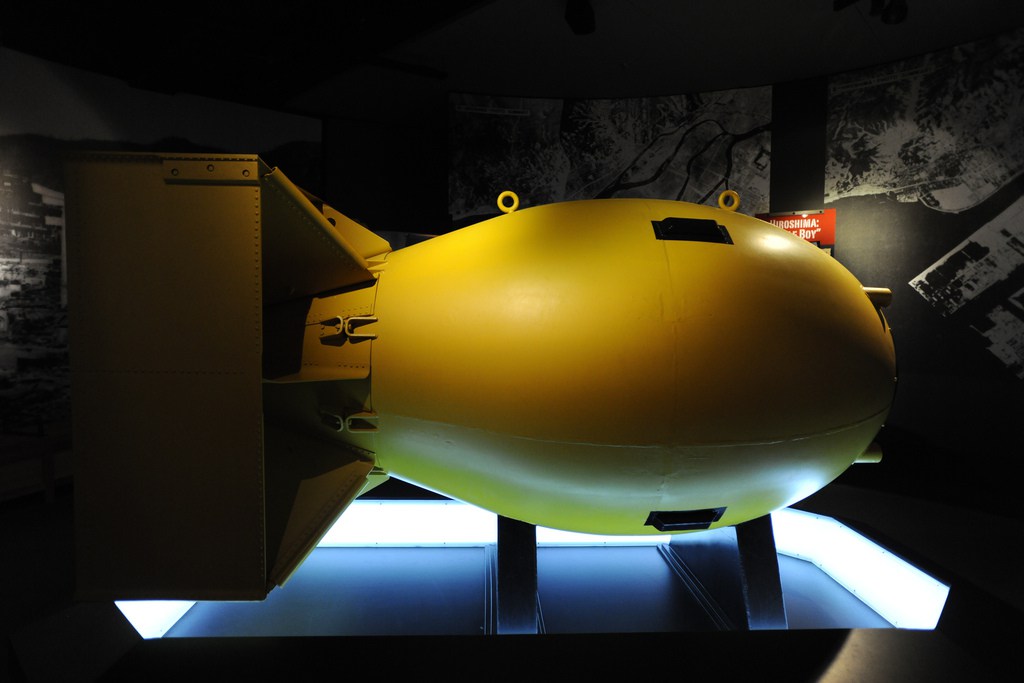
    fatMan image - A mockup of ‘Fat Man’, the bomb that blew up over Nagasaki on August 9, 1945. Credit: euthman/Flickr, CC BY 2.0
    fatMan image – A mockup of ‘Fat Man’, the bomb that blew up over Nagasaki on August 9, 1945. Credit: euthman/Flickr, CC BY 2.0


    What is Nuclear fusion?

    • In physics, nuclear fusion is the process by which multiple nuclei join together to form a heavier nucleus
    • It is accompanied by the release or absorption of energy depending on the masses of the nuclei involved.
    • In a hydrogen bomb, 2 isotopes of hydrogen, deuterium and tritium are fused to form a nucleus of helium and a neutron
    • This fusion releases 17.6 MeV of energy. Unlike nuclear fission, there is no limit on the amount of the fusion that can occur

    Let’s get back to learn some changing equations in new world order.

    Is it quest to attain deterrence against United States?

    • The supreme leader Kim Jong Un (KJU) had warned that, if aggressors dare to provoke us, even to a slight degree, we will never
      tolerate it, and respond resolutely with a merciless sacred war of justice, a great war for national reunification
    • It declared: “The United States has persisted in ignoring our just demand for replacing the Armistice Agreement with a separate pact to remove the danger of war, ease tension and create a powerful environment in the Korean peninsula. The Korean Armistice Agreement is the armistice which ended the Korean War. It was signed between U.S. and North Korea in 1953.
    • Instead, it has clung to its anachronistic policy hostile towards the DPRK, escalating the tension and egging its vassal forces on to stage a ‘human rights’ racket against the country
    • In May 2015, Pyongyang had announced that it had successfully tested a Submarine Launched Ballistic Missile (SLBM). However, South Korean experts had treated this claim with considerable scepticism 
    • Whether the most recent North Korean test was that of a Hydrogen Bomb will be known after a while, but the objective was miniaturisation of the system so that the nuclear weapon can be mounted on a missile 
    • North Korea has made it known that it wants recognition by the world community as a nuclear weapon power and no amount of external pressure would force it to pause in that quest

    What was the Global Reaction?

    • The UN Security Council condemned the nuclear test, declared that it is a ‘clear violation’ of its previous resolutions, and pledged to pursue new sanctions against North Korea
    • USA, South Korea and Japan have agreed to work together to forge a united and strong international response to North Korea’s reckless behaviour
    • Japan hinted at some unilateral measures, include strengthening of the anti-missile defence systems protecting Japan from a North Korean attack

    Who is in the real position to apply pressure on North Korea?

    • Only China is in a position to apply some credible pressure on North Korea since 88 per cent of North Korea’s foreign trade is with China
    • According to the South Koreans, China has been applying the existing UN sanctions against North Korea faithfully and the export of about 900 dual-use items has been prohibited to that country
    • China is comfortable with strategic ambiguity about the nuclear status of North Korea
    • But the insistence of an open declaration by the North of its Nuclear Weapon Power status would disrupt its strategic calculations in the region as the response from Japan could upset the regional power equation
    • Seoul expects China to do more to denuclearise North Korea particularly in view of the rapidly warming ROK-China relations

    Has North Korea’s approach towards South Korea changed?

    • In the midst of heightened tensions, there are signs that North Korea is working with the aim of driving a wedge between the United States and South Korea
    • For which it is pursuing 2 independent policies – one of nuclearisation and acceptance as a nuclear weapons power
    • The second of not upsetting the apple cart with South Korea and continue with the current policy of no peace – no war
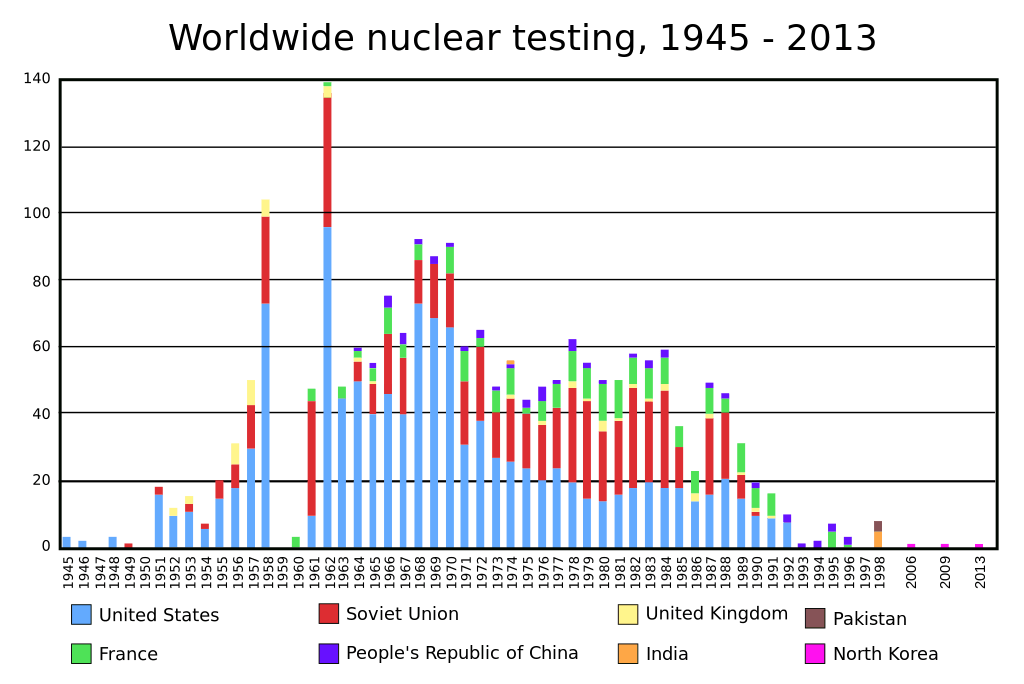
    world nuke test image - Source: Wikimedia Commons, CC BY-SA 2.5
    world nuke test image – Source: Wikimedia Commons, CC BY-SA 2.5

    Conclusion on sidelines

    • Analysing the events of the past 1 year, it would be fair to conclude that Kim Jong Un has firm control over all the levers of power in North Korea, including the military
    • The reclusive country would continue on the course set by Kim II Sung and Kim Jong II, pursuing a policy of ‘Military First’, the ‘Juche’ concept of self-reliance and seeking effective nuclear strike capability against the United States
    • Juche is a political philosophy, became the official autarkic state ideology of the DPRK in 1972 Although foreign scholars often describe juche as “self-reliance,” the true meaning of the term is much more nuanced.
    • The peninsula would continue to be divided as neither side is keen on unification despite their public protestations in favour of reuniting the long-divided country
    • The paramount objective of the DPRK leadership continues to be the survival of the regime and its politico-economic system, and it is unlikely to allow tensions with South Korea or the United States to come to a point that would lead to hostilities

    Whatever the truth of this test, for diplomacy, observers say it dashes any hopes of North Korea returning to stalled talks involving the US, Russia, China and others.


    Published with inputs from Arun
  • Important judgements of Supreme Courts in 2015 | Part 1


    #1. NJAC held unconstitutional

    Supreme Court Advocates on Record Association vs. Union of India

    “The judiciary cannot risk being caught in a web of indebtedness towards the government.”

    It is after 35 years that a constitutional amendment has been quashed by the top court.

    Summary:

    Within a year of both houses of Union Legislature passed much awaited National Judicial Appointments Commission Bill, the Supreme Court struck down the NJAC Act by 4:1. Justices J S Khehar, MB Lokur, Kurian Joseph and Adarsh Kumar Goel declared the 99th Amendment and NJAC Act unconstitutional while lone minority, Justice Chelameswar upheld it. The judgement rendered by five judges runs over 1000 pages.

    Major observations of the Supreme Court:

    • Does not provide an adequate representation, to the judicial component in the NJAC.
    • Insufficient to preserve the primacy of the judiciary, in the matter of selection and appointment of Judges, to the higher judiciary (as also transfer of Chief Justices and Judges, from one High Court to another)
    • The Law Minister:

    The inclusion of the Union Minister of Law and Justice as an ex officio Member of the NJAC is:


    • ultra vires the provisions of the Constitution, because it impinges upon the principles of “independence of the judiciary” & “separation of powers
    • Violative of the “basic structure” of the Constitution
    • Against Principles of Natural Justice: Because Government is the major litigant and cases involve large sums of money. And inclusion of Law Minister would be against “judge of own case“, a part of PNJ.


    • Will of the people: The Union government had previously argued that NJAC represented the will of the people. However, rejecting the Centre’s argument, court noted that “the will of the people is the Constitution while the Parliament represents the will of the majority at a given point of time which is subordinate to the Constitution”.

    Culture of Reciprocity: Bench feared a culture of “reciprocity” of favours: FEELINGS OF PAY BACK TO POLITICAL-EXECUTIVE WOULD BE DISASTROUS TO THE INDEPENDENCE OF JUDICIARY, especially when govt is the major litigant in higher courts.


    #2. Yakub Memon & the midnight hearing

    Yakub Abdul Razak Memon vs. State of Maharashtra

    Summary:

    The year 2015 witnessed a rare event of the Apex Court opening its gates for hearing an urgent Writ petition. Yakub Memon’s final plea before the Apex Court was heard in Court Room 4 which was opened for an unprecedented 90-minute hearing that started at 3.20 AM and ended a little before dawn. The Bench comprising Justice Dipak Misra, Justice Amitava Roy and Justice P.C. Pant agreed and observed that granting further time was not necessary in the present case. The bench said the execution was “inevitable” after rejection of the mercy petitions. Yakub was executed the very next day on his birthday.

    Background:

    • Memon, a CA by profession was awarded the death sentence by a special TADA Court in Mumbai on July 27, 2007 for his role in the serial blasts.
    • Charges also included arranging finances for carrying out the 13 serial explosions.
    • Explosions left 257 dead and over 700 injured across the city on March 12, 1993.
    • In 2013, Supreme Court had upheld the TADA Court verdict convicting Memon for his role in the Bombay blasts.
    • Memon is the only one of 11 people whose death sentence in the case has been upheld. The sentences of the others were commuted to life imprisonment.

    Observations of the Supreme Court:

    • Stay on the death warrant could be a ‘travesty of justice‘: since ample opportunity was provided to Memon, after the rejection of the first mercy petition.

    Memon’s review petition was heard for ten days, when law mandates a hearing of only half an hour.

    • The President rejected after due consideration of all relevant fact. 22 years have passed since the incident. There is no error in judgments passed by this court.
    • At the drop of a hat one can add new challenges and developments and expect the President to act in exercise of power under Article 72 and thereafter on rejection of clemency they would challenge that in a court of law.

    Counter arguments:

    • The authorities were “hell bent” on executing Memon without giving him the right to challenge the rejection of his mercy petition by the President as right to life of a condemned prisoner last till his last breath.
    • How the President could have rejected Yakub’s fresh mercy plea in such a short time.
    • According to rules, the nearest legal centre must be contacted the day mercy plea gets rejected. That did not happen.

    
    Published with inputs from Swapnil
  • India and Myanmar relations: Change in dynamics by democratic triumph

    After decades of struggle, finally democracy triumphed over military junta and Myanmar parliament enters democratic era after 54 years of military rule. It’s time to glance over India-Myanmar relations and how India will be benefited from such stable democratic government.

    India and Myanmar have traditionally had much in common, with cultural, historical, ethnic and religious ties, in addition to sharing a long geographical land border and maritime boundary in the Bay of Bengal. Let’s see it in brief!

    How did India and Myanmar engagement begin ?

    • Myanmar is India’s bridge to east, and an important ally for growing its regional power.
    • India and Myanmar’s relationship officially got underway after the Treaty of Friendship was signed in 1951.
    • For many years, India did not open up to the authoritarian regime, and it was only over a period of time that India started engaging with the military junta of Myanmar.
    • The region’s focus has revolved around the SAARC countries and China, Myanmar is becoming increasingly important for India in both a strategic and economic context.

    What about bilateral trade ties?

    • Bilateral trade has grown from $12.4 million in 1980-81 to $2.18 billion in 2013-14.
    • Agricultural items like beans and pulses and forest based products make up nearly 90 percent of India’s imports.
    • Myanmar is also the beneficiary of a duty-free tariff preference scheme for least developed countries (LDCs).
    • Both countries also signed a border trade agreement in 1994 and have 2 trade points along their 1,643 km border.
    • India has also promoted some trade events such as the India Product Show 2012, which represented 19 Indian companies.

    But, How shared cultural links promote unique relations between both countries?

    • The two countries have shared cultural exchanges through various cultural troupes.
    • One such exchange was in 2009 when Myanmar sent a 13 member student group that attended a SAARC cultural festival in India.
    • This was followed by another major event at which the Indian embassy in Yangon organized the annual Indian Film Festival, which is a major event on the Yangon cultural calendar.

    Does India have historical bond with Myanmar?

    • Yes! Yangon was once a center for India’s independence struggle.
    • The Indian National Army (INA), formed by Indian nationalists during World War II in 1942 with the motto of Ittehad, Itmad aur Qurbani (Unity, Faith and Sacrifice).
    • Comprised over 40,000 soldiers, who fought valiantly against the British imperialist forces.
    • Netaji Subhas Chandra Bose became leader of the INA in 1943 and undertook a groundbreaking march towards Indian territories from Burmese soil with the aim of achieving Indian independence.<This time we can expect question on Netaji and his work, as we know current happenings about Netaji’s files declassified>
    • General Aung San, Burma’s independence hero, was a close friend of Netaji, the supreme commander of the INA.
    • That friendship was reflected in cordial relationship between the soldiers of the INA and their counterparts in the Burmese National Army (BNA).
    • So, it’s good to use this historical bond for building more coherent and strong relations with Myanmar.

    How Myanmar is Strategically significant to India?

    • Myanmar is strategically important to India as it is the only ASEAN country that shares a land border with India.
    • It is also the only country that can act as a link between India and ASEAN.
    • Myanmar is India’s gateway to Southeast Asia and could be the required impetus to realize India’s Look East Policy.
    • India has also decided to upgrade the Kalewa-Yargyi road segment to highway standard.
    • Myanmar would develop the Yargyi-Monywa portion, and this would help to connect Moreh in India to Mae Sot in Thailand via Myanmar.
    • This in turn would improve India’s connectivity and relationship with both Myanmar and Thailand.

    How can India become regional pivot in Asia?

    • If India is to become an assertive regional player in Asia, it has to work toward developing policies that would improve and strengthen it domestically.
    • This will encourage more confidence in its ability to lead the region and be an important global player.
    • Competition with China should also be considered and taken seriously. As China’s growing influence in the region would lead to a more one-sided dynamic in the region.
    • China has asserted itself through its soft power as well as through its trade and economic relations with Myanmar by taking up large infrastructure projects in the country.
    • India on the other hand needs to use its soft power more effectively, and at the same time strengthen itself domestically and regionally.

    What are advantages that India has over China with regard to Myanmar?

    • One is the democratic process, which results in different governments at the center and states through free and fair elections.
    • There is also the respect for institutions that are strong enough to hold the country together.
    • Finally, cooperation in different multilateral forums such as ASEAN and BIMSTEC strengthen the relationship between the 2 countries.
    • Apart from these reasons, India has sent a clear signal that while economic ties are important, it is keen to build a holistic relationship and is prepared to assist in institution building in Myanmar.

    What is the significance of Connectivity in India-Myanmar Relations? 

    <How North-Eastern region can play vital role in this?>

    • Myanmar’s vast oil and natural gas reserves and other resources make it a natural partner for many countries in the world.
    • India, being its next door neighbour, cannot be indifferent to this reality.
    • Besides, geo-political considerations, historical and civilizational links, and the ethnic overlap across their borders, have all come together to make India’s North-East the land bridge between the South and South-East Asia through Myanmar.
    • The 1,640 km-long border between Myanmar and the Indian states of Arunachal Pradesh, Nagaland, Manipur and Mizoram signifies the importance of this eastern neighbour for India.
    • India expects to reap various economic benefits by bolstering bilateral trade and investment, which critically depends upon better connectivity in the region.

    How bilateral cooperation agreement gives impetus to India’s Look-East Policy?

    • The strategic location of Myanmar is pivotal to India in reaching out to the economically vibrant South-East Asian countries.
    • India’s Look-East Policy envisages building infrastructure and expanding the transportation network including railroads, aimed at furthering surface connectivity in the region.
    • It is recognized that in addition to more economic contacts, such connectivity will promote social stability in the region by facilitating people-to-people contact amongst trans-border ethnic groups.
    • It is expected that insurgent outfits would lose their recruitment base once the local resources begin to be exploited and employment is generated leading to overall development. 
    • Concrete economic benefits are expected to come up in the region with establishment of border haats.
    • In addition, internal trade routes have the potential to enhance accessibility to sub-regional markets that connect Bangladesh, Myanmar and Bhutan.

    Way forward

    • The basic foundation for the relationship between India and Myanmar has been laid by previous governments, the onus is on the present Indian administration to demonstrate that it can take the relationship to a higher level.
    • India can become a strong regional player through a more proactive approach, cement India’s place in the region and grow into a powerful, global country.

    Published with inputs from Arun

  • The First Firangis | Chapter 6 | The Anglo Mysore wars

    In the previous chapter (written light years ago), we read about how the imperialist “Marquess of Wellesley” extended the british dominion in India but putting an end to Mysore and doing more nasty things like extending the subsidiary alliance to most of the indian kingdoms (like a boss).


    Now the plan was to continue presenting the indian struggle for independence from the side of firangis, but some of you wanted to know more about the anglo mysore wars and so, here is an attempt to make things easy for you.

    Admittedly, these 4 wars, fought from 1767 to 1799 (32 years!) span a really long time in history. The timelines criss-cross with 3 empires which were humbled in course of time by the firangis (Marathas, Mysore & Nizam of Hyd).

    Here’s a really quick timeline of what all happened – 


    4 wars – 4 legions – 3 treaties and the great mysore rocket

    I hope you know about the mysore rockets right? No? Let’s tackle this bit of trivia first. The Mysorean rockets used by Hyder Ali during the Battle of Pollilur (2nd anglo-mysore war) were much more advanced than any the British East India Company had previously seen!

    So, after they slay Tipu in the fourth and final battle, they (the firangis) took their indigenous rocket development to the next level to use in the Napoleonic wars. 

    #1. First Anglo-Mysore War

    1. Hyder Ali had just made peace with Marathas so that they don’t team up against him when he goes on to attack the Brits at Madras
    2. Brits had support from Nizam but that guy just balked out in the last moment! He gets bullied again by the brits (at a later date)
    3. So, Brits were from two places – Bombay Brits & Madras Brits. But somehow the daring Hyder that he was, he kept on with the fight that led the Brits to conclude a peace treaty with him

    As per the Treaty of Madras:

    1. Both the Parties returned the areas won by each other
    2. The District of Arcot was given to Nawab of Arcot
    3. British & Hyder Ali promised that they would support each other if there is any foreign invasion

    #2. Second Anglo-Mysore War

    Now, what happens when you (allegedly) have a strong ally with you? More ambitions, more audacity, neh? That’s what Hyder thought after signing that treaty of madras. He started demanding tributes from the smaller states on the border of Maratha and Mysore. The Marathas responded this in 1770 with a force of over 30 thousand. This is the point when Hyder rings up the Brits to come for the rescue! Of course they did not. Hyder lost the battle – had to pay a huge tribute to the marathas and this episode left him high and dry.

    Hyder did not like this one bit and he swears revenge from the Brits FOREVER.

    The second anglo-mysore war begins now. It was one of the most bloodiest battle in the history of India (exaggeration helps). If you consider the 2nd anglo-mysore war as a T-20 world cup, then there many minor-major battles held in this 4 year period. Also, please note that Hyder Ali died during this prolonged battle period. So, Tipu Sultan rose to the occasion and marched ahead.

    • The siege of Arcot – Hyder won
    • The battle of Porto Novo – won by Sir Eyre Coote
    • The battle at Pollilur – won by Hyder (remember the rockets!)

    So, anyway – you win some – you lose continued and eventually the war ended with the last British-Indian treaty with an Indian ruler on equal footing, the 1784 Treaty of Mangalore. 


    #3. Third Anglo-Mysore War

    Mangalore Treaty of 1784, which was signed on the end of the Second Anglo Maratha war had an article regarding transfer of the Prisoners. Now it is said that Tipu Sultan did not honour this part of the deal – strike 1. 

    It so happened that Tipu developed a beef with the local raja of Travancore about a disputed land. Travancore was a British ally, so when Tipu moved against him, Brits got a chance to home in on Tipu.

    Where were the Marathas and the Nizams or the world? All credit goes to the diplomacy of Lord Cornwallis who kept Tipu aloof from the Marathas , Coorg and Nizams.

    Result? Tipu lost. The peace was restored by the Treaty of Srirangapatnam which was signed in 1792.

    This treaty was a big blow to Tipu Sultan. Half of his territories were snatched away and divided into Marathas, British and Nizam. Many would have thought it wise to retreat now but Tipu was seething with fear.


    #4. The Final Battle

    Marquess of Wellesley was a shrewd imperialist. He had got a wiff of a possible french-mysore collaboration and he did not want to give Tipu another chance. This battle was just a formality now. Tipu’s troops were outnumbered 4:1 in this war. The Nizam of Hyderabad and the Marathas launched an invasion from the north. Phew!

    He lost. He died fighting. The Wodeyar dynasty was restored its place in Mysore and rest of the territory was divided by the Brits, Marathas and Nizam.


    If you just joined us into reading the firangis, give the previous ones a quick read. Part 1 is here.


  • Pradhan Mantri Fasal Bima Yojana – Min Premium, Max Insurance


    The government’s new crop insurance scheme could be a lifesaver for farmers at a time when the pain of rural distress is unimaginable, as they are facing three successive crop failures due to inclement weather conditions.

    In 2015-16, the central assistance towards drought relief is several times higher than what it spends to subsidise crop insurance premiums every year.

    Before the scheme was announced, a RBI-constituted committee has also emphasized on the same.

    What were the recommendations of RBI-constituted committee?

    • The committee called for phasing out interest subsidy on short-term agricultural loans.
    • The money saved should be used for into an universal crop insurance scheme for farmers.

    Reasons underlying the recommendation:

    • NSSO data shows that banks and cooperative societies account for 57.7% of outstanding loans of farming households.
    • The dependence on informal credit increases with reduction in the landholding size.
    • Farming is increasingly done by tenant cultivators/ share croppers.
    • Since, farmer has no regular income, so they are forced to go to money lenders to sustain their consumption.
    • Govt. spends nearly Rs.13000 crore annually on interest subvention for crop loans, which can be redirected towards subsidy on insurance premium.

    <The govt. rolled out Modified National Agricultural Insurance Scheme for the XII plan period across India, but it failed to solve the agrarian crisis.>

    Let’s analyse the short-coming in the earlier crop-insurance scheme

    • Premium rates were as high as 25%.
    • Lack of awareness.
    • Sum insured were way below the gross value of output for most crops.
    • Policy claims can’t even cover half of the value of produce when the crop suffers heavy damage.
    • The money pay back procedure was too complicated.


    What are the features of Pradhan Mantri Fasal Bima Yojana?

    The scheme will replace the existing two schemes National Agricultural Insurance Scheme as well as the Modified NAIS. The new Crop Insurance Scheme is in line with ‘One Nation – One Scheme’ theme.

    Nodal Agency: Department of Agriculture, Cooperation & Farmers Welfare , Ministry of Agriculture & Farmers Welfare. It will implement the scheme in co-ordination with various other agencies such as financial institutions, PRIs, etc.

    • Uniform premium to be paid by farmers. <Rate of premium will be about 1/10th of existing rates>
      • Kharif crops – 2%
      • Rabi crops – 1.5%
      • Horticulture & commercial crops – 5% <of premium amount>
    • No upper limit on govt. subsidy, even if the balance premium is 90%, govt. will bear the burden.
    • Govt. liability on premium subsidy would be shared between Centre and States on a 50:50 basis.
    • Smart phones, remote-sensing drones and GPS technology will be used to capture and upload data of crop cutting to reduce the delays in claim payment to farmers.
    • The scheme aims to increase insurance coverage to 50% from the existing levels of 25-27% of crop area.
    • The new scheme will also be executed by private insurance companies.
    • There will be exemption from Service Tax liability of all the services involved in the implementation of the scheme.

    Risk Covered

    A Comprehensive risk insurance is provided to cover yield losses due to:

    • Non-preventable risks, such as Natural Fire and Lightning, Storm, Hailstorm, Cyclone, Typhoon, Tempest, Hurricane, Tornado.
    • Risks due to Flood, Inundation and Landslide, Drought, Dry spells, Pests/ Diseases.
    • In cases where majority of the insured farmers of a notified area, having intent to sow/plant and incurred expenditure for the purpose, are prevented from sowing/planting the insured crop due to adverse weather conditions, shall be eligible for indemnity claims upto a maximum of 25% of the sum-insured.
    • In post-harvest losses, coverage will be available up to a maximum period of 14 days from harvesting for those crops which are kept in “cut & spread” condition to dry in the field.

    International Experience

    The mechanism of higher subsidy for crop premiums in Indian scheme is not out of line with international standards.

    • The US covers over 120 million hectares and gives subsidy to the tune of around 70%.
    • China insures its farmers for a sown area of around 75 million hectares with a subsidy on premiums of about 80%.

    How the scheme overcomes the shortcomings of previous scheme?

    • Farmers will have to pay the low premium rates and balance premium will be paid by the govt. to provide full insured amount, against the crop loss on account of natural calamities.
    • The sum insured will be calculated by multiplying the MSP of a crop with the average 7-year threshold yield for the particular village panchayat area where it is grown.
    • The improvement over previous scheme is that the premiums will be determined by the sum insured, unlike currently where premium determines sum insured.
    • CACP( Commission for Agricultural Costs and Prices) has argued that premium will drop to 3.5% of sum insured if 50% of India’s gross cropped area is insured.
    • Once the new scheme kicks in, farmers in high-risk areas would stand to benefit the most

    One of the best thing is that it will also rid farmers of the web of complex rules of the earlier insurance schemes.

    How is current Insurance coverage in the country?

    • Currently, only 45.82 million hectares out of 195 million hectares was covered under crop insurance in 2014.
    • Coverage is higher in states of Rajasthan, Karnataka, Bihar, Odisha and Chattisgarh.
    • UP, West Bengal and Gujarat are worst performers in terms of coverage.

    <There are various suggestions pouring from wide spectrum of society to implement scheme in a better manner to mitigate the agrarian distress and suicides>

    What steps could be taken to implement scheme in a better manner?

    • Crop insurance should be done in a transparent manner & within a specified period of time.
    • Make use of advanced technology like automatic weather stations, drones and low earth orbit satellites.
    • Compensation must be paid to farmers account directly, within a short duration after assessment of crop damage.
    • Accountability of each stakeholder needs to be clarified and fixed.
    • Crop-damage assessment must be done within 2 weeks of the extreme weather event.
    • Implementing the scheme will require huge premium subsidy outgo, more so in a drought year.

    What kinds of financial and technological infrastructure is required?

    • Information has to be digitised plot wise, the plot of the tiller who has paid the premium has to be synchronised/seeded with their bank account, Aadhar and mobile number.
      • Ministry of rural development will be required to clean up land records.
      • Ministry of agriculture and farmer’s welfare to digitise plot-wise information.
      • Banks to seed the account of tillers.

    Published with inputs from Pushpendra 
  • Start-up India, Stand up India : Wings to fly [Part II]

    We have seen first part of Action plan for Start ups, now let’s see another part in brief!

    Let’s see Funding Support and Incentives?

    #Providing Funding Support through a Fund of Funds

    1. In order to provide funding support to Startups, Government will set up a fund with an initial corpus of INR 2,500 crore and a total corpus of INR 10,000 crore over a period 4 years (i.e. INR 2,500 crore per year) .
    2. The Fund will be in the nature of Fund of Funds, which means that it will not invest directly into Startups, but shall participate in the capital of SEBI registered Venture Funds.
    3. The funds of fund shall ensure support to a broad mix of sectors such as manufacturing, agriculture, health, education, etc.

    #Credit Guarantee Fund for Startups

    • To catalyse entrepreneurship by providing credit to innovators.
    • In order to overcome traditional Indian stigma associated with failure of Startup enterprises in general.
    • To encourage experimentation among Startup entrepreneurs through disruptive business models, credit guarantee comfort would help flow of Venture Debt from the formal Banking System.

    #Tax Exemption to Startups for 3 years

    • With a view to stimulate the development of Startups in India and provide them a competitive platform, it is imperative that the profits of Startup initiatives are exempted from income-tax for a period of 3 years.
    • This fiscal exemption shall facilitate growth of business and meet the working capital requirements during the initial years of operations.

    #Launch of Atal Innovation Mission (AIM) with SETU Program

    To serve as a platform for promotion of world-class Innovation Hubs, Grand Challenges, Startup businesses and other self-employment activities, particularly in technology driven areas.

    The Atal Innovation Mission (AIM) shall have 2 core functions:

    • Entrepreneurship promotion –

    Through Self-Employment and Talent Utilization (SETU), wherein innovators would be supported and mentored to become successful entrepreneurs and establishment of 500 Tinkering Labs.

    • Innovation promotion –

    To provide a platform where innovative ideas are generated.

    Launch of Grand Innovation Challenge Awards for finding ultra-low cost solutions to India’s pressing and intractable problems

    The main components proposed to be undertaken as part of the mission include:

    #1. Setting up of 7 New Research Parks Modeled on the Research Park Setup at IIT Madras

    • To propel successful innovation through incubation and joint R&D efforts between academia and industry
    • The IIT Madras Research Park endeavors to enable companies with a research focus to set up a base in the Park and leverage the expertise of IIT Madras.
    • Creating a collaborative environment between industry and academia through joint research projects and consulting assignments.

    #2. Promoting Startups in the Biotechnology Sector

    Department of Biotechnology endeavors to scale up the number of Startups in the sector by nurturing approximately 300-500 new Startups each year to have around 2,000 Startups by 2020.

    The Department of Biotechnology shall be implementing the following measures along with its PSU Biotechnology Research Assistance Council (BIRAC) :

    • Biotech Equity Fund – BIRAC AcE Fund in partnership with National and Global Equity Funds (Bharat Fund, India Aspiration Fund amongst others) will provide financial assistance to young Biotech Startups.
    • Bengaluru-Boston Biotech Gateway to India has been formed.
    • Letter of Intent has been signed between DBT, GoI and Department of IT, Government of Karnataka for the same.

    Finally, can we expect Startup India will be the real boost for Make in India and Digital India Mission ? Let us know!

    Would you like to give answer of this question!

    #Q.Will the Start-up India campaign end up making India the start-up hub of the world? Critically comment.


    Published with inputs from Arun
  • Geography | Ocean Currents

    Ocean Currents can be a confusing topic. Understanding the complete mechanism and various interrelationships in play when it comes to ocean currents can be overwhelming. The following visualisation by NASA will help you understand the role of ocean and ocean currents. Many terms and themes discussed here will be taken up in subsequent sections.

    Ocean Currents are influenced by 2 kinds of forces.

    1. Primary or Causation forces – that initiate the movement of water.
    2. Secondary forces – that modify the flow of the waters.

    Primary forces 

    Ocean is driven by the atmosphere above it in 2 ways

    1.Wind Stress or Frictional Drag – Friction between wind and oceans creates a frictional drag known as wind-stress. It impacts the upper 100m of the ocean surface and sets the water in motion.

    2.Insolation – Heating by solar energy. The heating causes water to expand.

    >Causes water to expand. In the equatorial regions, the height is 8cm higher. This causes a slight gradient and water tends to flow down the slope.

    >Causes precipitation and evaporation which changes the salinity and hence the density of water.

    Secondary forces

    1.Coriolis Force – The effects of this force has been discussed in atmospheric circulations. It causes winds to deflect toward the right in the Northern Hemisphere and toward the left in the Southern Hemisphere, resulting in curved paths. It has a similar impact on Ocean Currents deflecting them to the right in the Northern Hemisphere and to the left in the Southern Hemisphere.

    2.Gravity – Gravity acts of the density difference of water. Density is a function of temperature and salinity and insolation, precipitation and evaporation plays an important role.

    3.Shape of the ocean basin –

    *NCERT somewhat differs in its definition of Primary and Secondary forces, but the above classification is apter.

    Types of Ocean Currents

    There are 2 types of Ocean Currents

    1. Surface Currents also called Wind-Driven Currents 

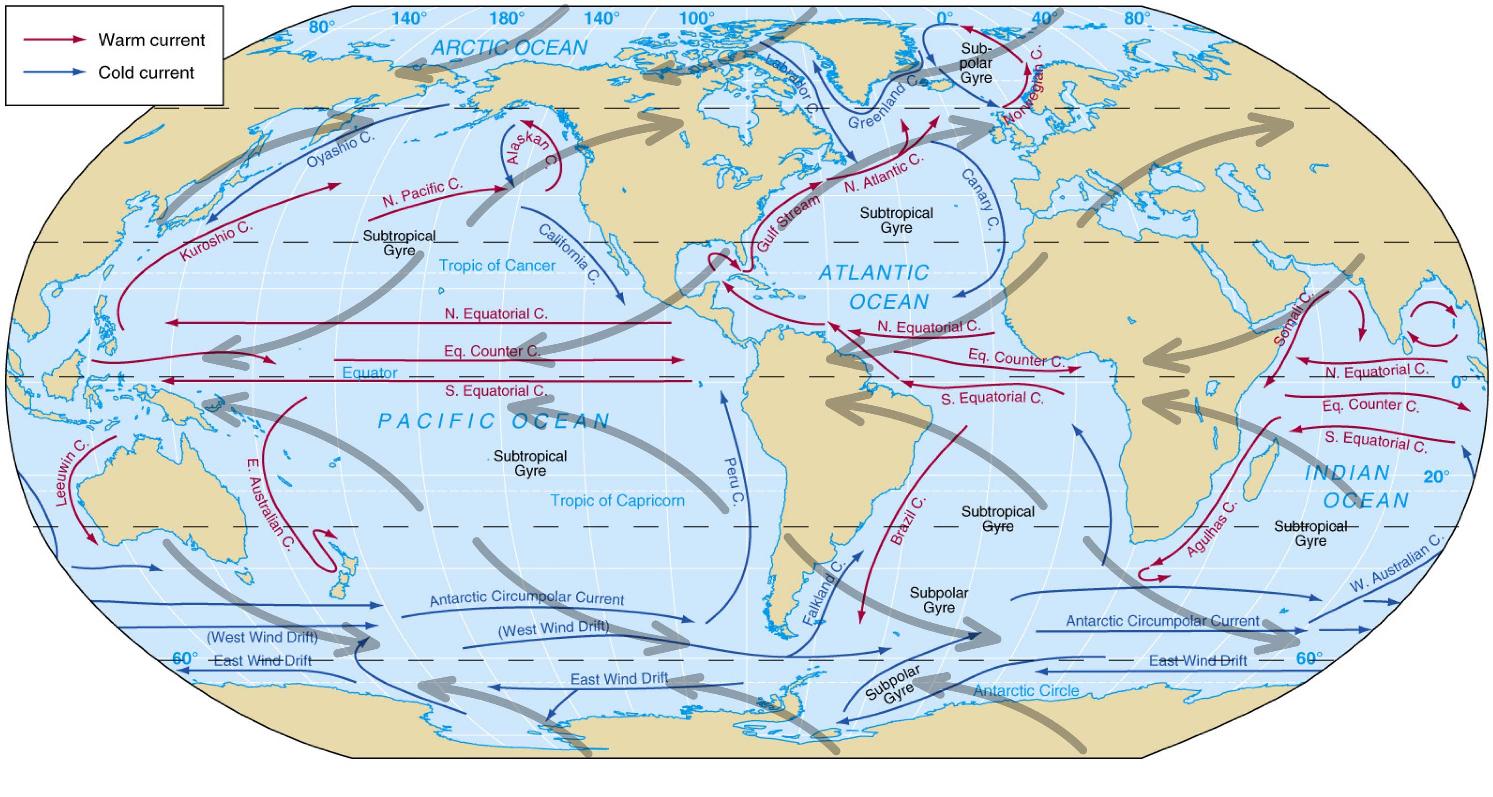
    The Surface Currents are a result of the Wind-stress and are modified by Coriolis force. Hence Surface currents mimic Atmospheric Wind Circulations. The diagram below shows how Easterlies are inline with equatorial current, the Westerlies are inline with Kuroshio and Gulf Stream.

    Ocean currents are constrained by the continental masses that border the three major oceans. This causes slight variations in their movement.

    To understand the mechanism, we touch upon few concepts.

    Ekman Spiral

    Ekman Spiral is the result of Coriolis force on the movement of surface water. The wind-stress moves the uppermost layer of water. This layer, in turn, drags the layer below it. Each deeper layer moves more slowly than the layer above it until the movement ceases at a depth of about 100 meters.

    All layers of water are deflected by Coriolis force to the right in the Northern Hemisphere and to the left in the Southern Hemisphere. As a result, each successive layer moves 45 deg. to the direction of drag force being applied. The diagram below captures this aptly. This creates a twisting effect creating the spiral. The spiral is known as Ekman Spiral and each subsequent layer is called the Ekman Layer.

    The average movement of all the layers comes out to be 90 deg to the direction of the surface wind.

    Gyres

    Ekman Spiral give rise to ‘Gyres’. These are ocean-circling currents that occur north and south of the equator. They do not occur at the equator, where the Coriolis effect is not present. There are five in all: two in the Pacific – north, and south of the equator, two in the Atlantic, and one in the Indian Ocean, south of the equator. In the northern Indian Ocean, the landmasses of Asia prevent the formation of a full gyre. Instead, there is a seasonally reversible current, driven by the Monsoon winds.

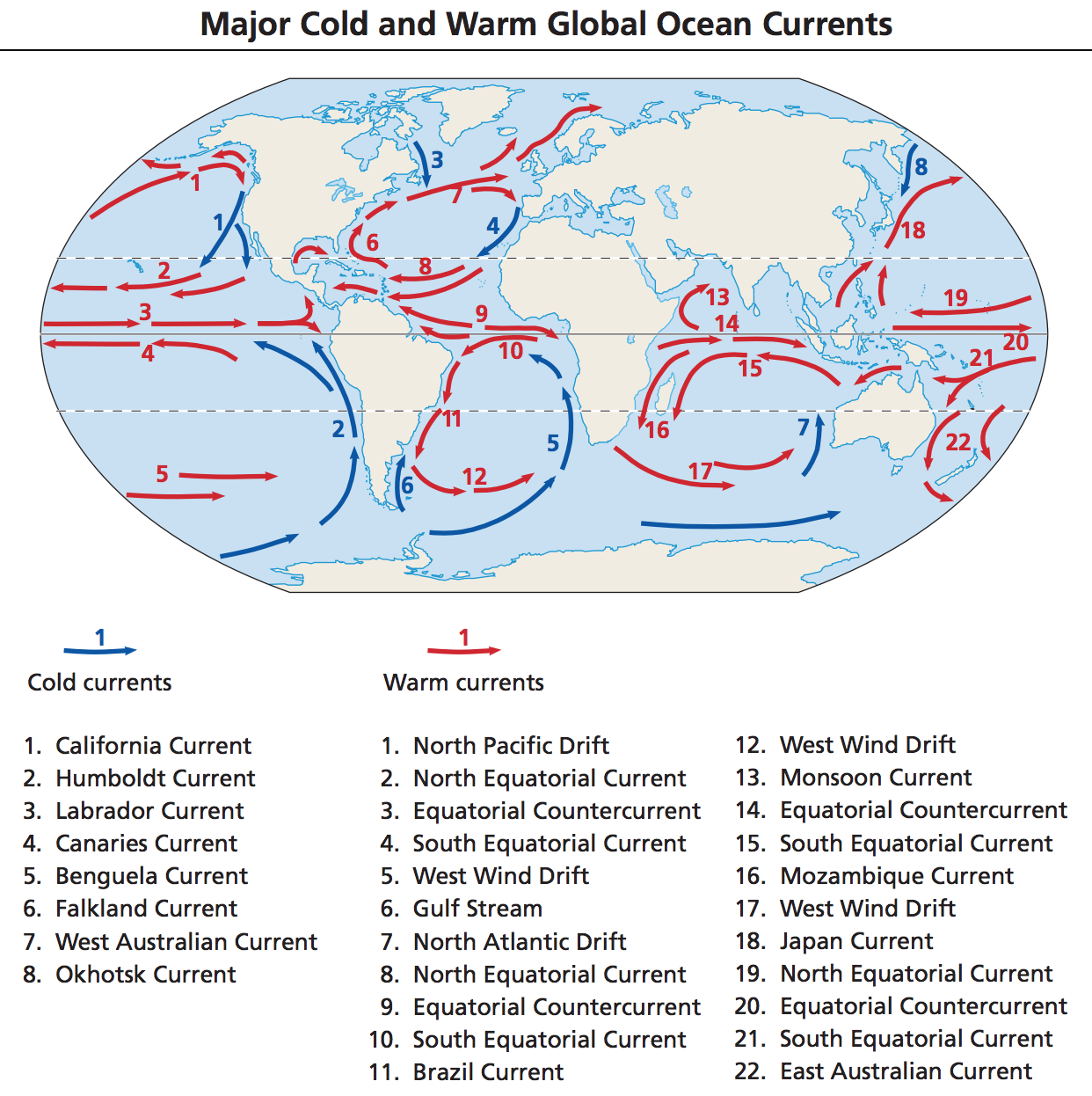
    Surface ocean currents are further divided into warm and cold currents


    2. Deep-water Currents also called Thermohaline Currents

    While wind effects drive ocean currents in the upper 100 meters of the ocean’s surface, ocean currents also flow thousands of meters below the surface. These deep-ocean currents are driven by differences in the water’s density, which is controlled by temperature (thermo) and salinity (haline). This process is known as thermohaline circulation.

    Cold, salty water is dense and sinks to the bottom of the ocean and eventually returns to the surface through mixing. On a global scale, this sinking and rising of ocean water creates what scientists call the ‘great ocean conveyor belt.’

    Case Study: The Gulf Stream

    Gulf Stream is where you don’t see a clear-cut distinction between the Wind-Driven and Thermohaline.The first part of the Gulf Stream that represents the warm waters to a certain extent are Wind Driven