💥Join UPSC 2027,2028 Mentorship (July Batch) + XFactor Notes & Microthemes PDF

Author: Explains

  • Discussing Budget 2016-17 | Tax Reforms

    In this section, we will deal with the issue which can guide the future investments for an economy – Tax Reforms.

    budget_tax reforms

    Focus Areas

    Small Enterprises

    • The corporate income tax rate is lowered for relatively small enterprises i.e companies with turnover not exceeding Rs 5 crore to 29% plus surcharge and cess, from the next financial year.
    • Govt. has increased the turnover limit under Presumptive taxation scheme to Rs 2 crores to bring big relief to a large number of assesses in the MSME category.

    Start Ups

    • 100% deduction of profits for 3 out of 5 years for startups set up during April 2016 to March 2019. MAT will apply in such cases
    • Startups will look at India as a favourable destination instead of relocating to more tax friendly regimes such as Singapore
    • New manufacturing companies to be given an option to be taxed at 25% + surcharge and cess, provided they do not claim deductions and other incentives
    • Read about the whole start up stand up policy in our two part explainer, click here and here

    Cess and Surcharge

    • Surcharge is increased on persons having income above Rs 1 crore from 12% to 15% <progessive taxation, taxing superrich>
    • The Krishi Kalyan Cess @ 0.5% will be imposed on all taxable services. The proceeds would be exclusively used for financing initiatives relating to improvement of agriculture and welfare of farmers
    • An Infrastructure cess @ 1% on small petrol, LPG, CNG cars, 2.5% on diesel cars of certain capacity and 4% on other higher engine capacity vehicles and SUVs
    • The ‘Clean Energy Cess’ levied on coal, lignite and peat is renamed as ‘Clean Environment Cess’ and simultaneously increased its rate from Rs 200 per tonne to Rs 400 per tonne <click here to know difference b/w tax, cess and surcharge with an awesome infographic>

    Miscellaneous Provisions

    • To implement General Anti Avoidance Rules (GAAR) from 1.4.2017
    • Exemption of service tax on services provided for skill development &
      entrepreneurship
    • Changes in customs and excise duty rates on certain inputs to reduce
      costs and improve competitiveness of domestic industry
    • 13 cesses which are levied by various ministries in which revenue collection is
      less than Rs 50 crore in a year will be abolished

    Opportunities Missed

    • The finance minister could have reduced corporate tax rate by half a percent overall, rather than distorting the structure. Most countries have reduced corporate tax rates to attract inward investments <Lowering the corporate tax rate leads to money being reinvested back into businesses, increasing hiring and creating more output, and therefore spending in the economy>
    • There is no clarity about when the govt will lower the corporate tax rate to the proposed 25% from 30%. The reduction in corporate tax rate and phase out of exemptions must be in tandem to ensure a smooth transition from a high tax regime to a more competitive tax regime
    • The reduction in corporate tax rate should eventually lead to a phasing out of the MAT, as the difference between the basic tax rate and the effective MAT rate is likely to narrow
    • There is no clarity about the future of SEZs, in case tax incentives are phased out. <Already, SEZs have lost popularity since FY12, when a MAT and a Dividend Distribution Tax were implemented to prevent erosion of the tax base. Phasing out tax holidays could reduce investments in SEZs further amid sharply slowing exports>–

    Criticism

    There are several incremental measures, but no intention to undertake deep, structural reforms in tax policy or administration

    • It takes some steps forward on administrative simplification, but then doesn’t go far enough by amending the provision on retrospective taxation
    • There seems some discord between govt. and Income tax department, as Income tax department continues to send notices
    • It does provide some tax relief to SMEs under direct taxes, but doesn’t extend it to cover indirect taxes
    • The tax amnesty scheme clearly gives a signal to tax evaders that there will be ample opportunities to convert their unaccounted, untaxed incomes and assets into “white” incomes and assets, with zero risk of prosecution

    PS: Please click on the green hyperlinked text to read more about the concepts. Revise and revise & feel free to ask pertinent questions.

    Read more about GST Bill: All you need to know about and follow our story on       GST: Most Important Tax Reform since 1947 and Minimum Alternate Tax.


    Published with inputs from Pushpendra | Image: Finmin
  • Important Judgements of the Supreme Court in 2015 | Part 5


    Catch up on the previous links to this series:


    #9. RBI bound to disclosure under RTI

    Reserve Bank of India vs. Jayantilal Mistry

    Summary:

    Coming down heavily on the Reserve Bank of India (RBI) for depriving information under the RTI Act, 2005 in the name of fiduciary relationship between itself and the banks, the Supreme Court has in a landmark decision declared that RBI does not place itself in a fiduciary relationship with the Financial institutions because, the reports of the inspections, statements of the bank, information related to the business obtained by the RBI are not under the pretext of confidence or trust.

    SC observations:

    • RBI is supposed to uphold public interest and not the interest of individual banks. RBI is clearly not in any fiduciary relationship with any bank. RBI has no legal duty to maximize the benefit of any public sector or private sector bank, and thus there is no relationship of ‘trust’ between them.
    • RBI has a statutory duty to uphold the interest of the public at large, the depositors, the country’s economy and the banking sector. Thus, RBI ought to act with transparency and not hide information that might embarrass individual banks.
    • It is duty bound to comply with the provisions of the RTI Act and disclose the information sought by the respondents herein.
    • The exemption contained in Section 8(1)(e) applies to exceptional cases and only with regard to certain pieces of information, for which disclosure is unwarranted or undesirable. If information is available with a regulatory agency not in fiduciary relationship, there is no reason to withhold the disclosure of the same.
    • The RBI and the Banks have sidestepped the General public’s demand to give the requisite information on the pretext of Fiduciary relationship and Economic Interest.
    • This attitude of the RBI will only attract more suspicion and disbelief in them. RBI as a regulatory authority should work to make the Banks accountable to their actions

    Counterview:

    • Information sought for is exempted under Section 8(1)(a), (d) and (e) of the Right to Information Act, 2005
    • As the regulator and supervisor of the banking system, the RBI has discretion in the disclosure of such information in public interest
    • The disclosure of information would prejudicially affect the economic interest of the State
    • Further, if the information sought for is sensitive from the point of adverse market reaction leading to systematic crisis for financial stability

    What is RTI Act Section 8?

    (1) Notwithstanding anything contained in this Act, there shall be no obligation to give any citizen,—

    (a) information, disclosure of which would prejudicially affect the sovereignty and integrity of India, the security, strategic, scientific or economic interests of the State, relation with foreign State or lead to incitement of an offence;
    (d) information including commercial confidence, trade secrets or intellectual property, the disclosure of which would harm the competitive position of a third party, unless the competent authority is satisfied that larger public interest warrants the disclosure of such information;
    (e) information available to a person in his fiduciary relationship, unless the competent authority is satisfied that the larger public interest warrants the disclosure of such information;

    What is a ‘fiduciary relationship’?

    • Where one person places complete confidence in another in regard to a particular transaction or one’s general affairs or business.
    • The relationship is not necessarily formally or legally established as in a declaration of trust, but can be one of moral or personal responsibility, due to the superior knowledge and training of the fiduciary as compared to the one whose affairs the fiduciary is handling

    #10. Acid Attack Victims in disability list

    Parivartan Kendra vs. Union of India

    Summary:

    The Supreme Court has directed all the States and Union Territories to consider the plight of Acid Attack victims and take appropriate steps with regard to inclusion of their names under the disability list. Apex court bench of Justices M.Y. Eqbal and C. Nagappan said that State shall upon itself take full responsibility for the treatment and rehabilitation of the victims of acid attack as per the Guidelines provided in Laxmi vs. Union of India.

    SC observations:

    • The State has failed to check the distribution of acid falling into the wrong hands even after giving many directions by this Court in this regard. Henceforth, a stringent action be taken against those erring persons supplying acid without proper authorization and also the concerned authorities be made responsible for failure to keep a check on the distribution of the acid.
    • Laxmi’s case doesn’t put a bar on the Govt. to award compensation limited to Rs.3 Lakhs. The State has the discretion to provide more compensation to the victim in the case of acid attack.
    • The enhancement of the Compensation will act in two ways
    1. It will help the victim in rehabilitation
    2. It will also make the State to implement the guidelines properly as the State will try to comply with it in its true sprit so that the crime of acid attack can be prevented in future.

    State shall upon itself take full responsibility for the treatment and rehabilitation of the victims of acid attack as per the Guidelines.


    Published with inputs from Swapnil
  • Discussing Budget 2016-17 | Governance and Ease of Doing Business

    In this section, we will deal with the issue which is of critical importance to the growth of every economy – Governance and Ease of Doing Business

    Take a look at overall approach of govt. towards Governance and Ease of Doing Business. Want to read the story of Ease of Doing Business, click here


    Focus Area

    Rationalisation of Personnel

    Govt. has set up a task force to look into the rationalisation of human resources in various ministries. A comprehensive review and rationalisation of autonomous bodies is also under process.

    Procurement

    • A technology driven platform will be established to facilitate procurement of goods and services by various ministries and agencies of the Government
    • This will bring more transparency and efficiency in govt procurement of goods and services

    Amendment to Companies Act

    • Govt. will introduce a bill to amend Companies Act, to remove the difficulties and impediments to ease of doing business
    • It would also improve the enabling environment for start-ups

    Inflation

    Govt has approved creation of buffer stock of pulses through procurement at Minimum Support Price and at market price through Price Stabilisation Fund, in order to deal with the problem of abrupt increase in prices of pulses <Despite recent cooling down of food inflation, sudden spurt in prices of onions, pulses etc is a common feature of Indian agriculture. What are the reasons? Enumerate steps taken by the govt along with suggestions to remedy the problem. Answer in the comments.>

    Want to understand intricacies of inflation, CPI, WPI, PPI etc, click here 

    New Initiatives

    Ek Bharat Shreshtha Bharat

    • It seeks to link States and Districts in an annual programme that connects people through exchanges in areas of language, trade, culture, travel and tourism
    • It will strengthen understanding of each other and create a closer engagement between different States and Districts in a structured manner

    Targeted Subsidies

    Govt. will take several measures to ensure targeted disbursement of govt. subsidies and financial assistance to the actual beneficiaries:

    • Govt. has introduced a bill for Targeted Delivery of Financial and Other Subsidies, Benefits and Services by using the Aadhar framework. A social security platform will be developed using Aadhar to accurately target beneficiaries
    • Govt. will introduce DBT for fertilizers on a pilot basis in a few districts across the country with a view to improving the quality of service delivery to farmers
    • Govt. will take provide automation facilities in 3 lakh Fair Price Shops out of 5.35 lakh Fair Price Shops in the country by March 2017

    Update- Lok Sabha has already passed the Aadhar bill which was introduced as money bill. <Enumerate the salient provisions of Aadhar bill? Does it come into conflict with privacy and thus violative of fundamental right to privacy? Was govt right in introducing it as money bill? What are the implications of bills being introduced as money bill? Answer in the comments>

    Criticism– No big bang reform measures announced

    PS: Please click on the green hyperlinked text to read more about the concepts. Revise and revise & feel free to ask pertinent questions.


    Published with inputs from Pushpendra | Image: Finmin
  • Discussing Budget 2016-17 | Fiscal Discipline

    In this section, we will deal with the issue which is of critical importance to the growth of every economy – Fiscal Discipline

    budget_fiscal

    Before, you know about fiscal position of the country. For a better understanding, do read our Budget Deficits Explained

    Focus Areas

    Fiscal Position

    Fiscal Deficit: The fiscal deficit in RE 2015-16 and BE 2016-17 have been retained at 3.9% and 3.5% of GDP respectively

    Revenue Deficit: Govt. has improved upon the Revenue Deficit target from 2.8% to 2.5% of GDP in RE 2015-16.

    Seventh Pay Commission

    Govt has constituted a committee to examine the Seventh Pay Commission Report and give its recommendations.

    Follow our story on Seventh Pay Commission here.

    Rationalisation of Central Schemes

    • Govt has rationalised and restructured more than 1500 Central Plan Schemes into about 300 Central Sector and 30 Centrally Sponsored Schemes Answer in the comments.>
    • A sub-group of CMs was formed under NITI Ayog to review the Centrally Sponsored Schemes, which suggested that there should be two basket of schemes – one mandatory for all states and other optional

    New Initiatives

    Expenditure

    The total expenditure in the Budget for 2016-17 has been projected at Rs 19.78 lakh crore, consisting of Rs 5.50 lakh crore under Plan and Rs 14.28 lakh crore under Non-Plan.< Keep in mind, our non-Plan expenditure is higher than Plan expenditure> Answer in the comments.>

    Various committees have questioned the merit in having Plan and Non-Plan classification of govt expenditure. Govt. has decided that the classification will be done away with from fiscal 2017-18 and it will give greater focus to Revenue and Capital classification of govt expenditure.

    Quality of Expenditure: Every new scheme being sanctioned by govt will have a sunset date and outcome review, in order to improve the quality of govt expenditure Answer in the comments.>

    Fiscal Responsibility and Budget Management Act (FRBM Act)

    • Since FRBM involves rule-based budgeting, it has significantly helped both central and state govt
    • However, there are suggestions to move from fixed numbers for fiscal deficit targets to a fiscal deficit range as the target. This would give necessary policy space to the govt to deal with dynamic situations
    • Therefore, Budget proposed a committee to review the implementation of the FRBM Act

    PS: Please click on the green hyperlinked text to read more about the concepts. Revise and revise & feel free to ask pertinent questions.


    Published with inputs from Pushpendra | Image: Finmin
  • The Strategic Importance of Space Law for India

    • There is a growing clamour for a comprehensive, legally binding treaty to commit nations to keep outer space a zone of peace.
    • With outer space becoming the fourth dimension of warfare, India cannot remain a mute spectator to the grim reality of final frontiers emerging as a new theatre of war.
    • For India, a comprehensive space act has become a critical necessity to give a greater level of acceleration to its space activities.


    Since the dawn of the space age heralded by the launch of Soviet Sputnik way back in October 1957, there has been a burgeoning growth in the global space activities, underpinning the need for a regulatory mechanism supported by a legal framework to facilitate the smooth, robust growth of the exploration of final frontiers without any negative fall outs for earthlings.

    There is a growing clamour for a comprehensive, legally binding treaty to commit nations to keep outer space a zone of peace. For obvious reasons, USA has expressed its opposition to such a treaty.

    The 1967 UN outer space treaty ratified by all the countries of the world is perhaps the first ever comprehensive legal mechanism aimed at regulating the global space activities. This treaty specifically forbids the use of outer space for testing and deploying weapons of destruction including nuclear devices.

    For it treats outer space as the common heritage of mankind meant for peaceful uses. Even so, countries including USA, former Soviet Union and China have exploited outer space for experimenting with anti- satellite and killer satellite systems.

    However, it is imperative for India to register its entry date so that the cut off date, whenever it comes as part of this proposed treaty, does not work to India’s disadvantage in so far as preparing for the country for space war is concerned.
    Indeed, with outer space becoming the fourth dimension of warfare, India cannot remain a mute spectator to the grim reality of final frontiers emerging as a new theatre of war.

    While legally binding international treaties are vitally essential to regulate the healthy and meaningful growth of space activities without any negative or problematic consequences for earthlings, individual space faring nations too should have their own space acts to regulate their space activities in consonance with dynamics of global space activities.

    For India, which has made a mark as a leading space faring nation in the aftermath of the successful probes to moon and Mars, a comprehensive space act has become a critical necessity to give a greater level of acceleration to its space activities.

    Increased private participation in Indian space activities would allow ISRO to concentrate on cutting edge areas of research and focus on deep space probes.

    And with the Indian Government making vigorous efforts to use space technology to drive a range of developmental and governance activities in the country, the need for a well conceived space act has become all the more pronounced.

    In this context, A.S.Kiran Kumar, Chairman, Indian Space Research Organisation (ISRO) says that a detailed paper on the subject has already been submitted to the Indian Government, following a wide ranging discussions with academicians and legal experts in January 2015.

    He also made it clear that the proposed space act would need to be cleared by the Indian Parliament. According to Kumar, very few countries in the world have their own exclusive legislations pertaining to the use of outer space. But Kumar made the point that a law is necessary for the Government to spell out how it would go about tackling space related issues including untoward incidents.

    Right at the moment, ISRO continues to monopolise Indian space activities with Indian industries, in both the private and public sector, providing supplies and services on a modest scale. As such, the proposed Indian space act will have provisions to boost private participation in the rapidly expanding Indian space activities.

    On the commercial front, the proposed space law would open up the avenues for private players to enter the satellite and launch vehicle business of the country in a big way. Once the space act comes into force, private players will be in position to own and operate satellite systems as well as launch vehicles.

    For promoting Indian space business, now being spearheaded by the Bangalore based Antrix Corporation, the commercial arm of the Indian space programme, ISRO would need to step up its capability for building and delivering launch vehicles and satellites with a vastly enhanced frequency.

    For this strategy to assume a practical shape ISRO should encourage Indian industries to float consortium to build and deliver satellites and launch vehicles in a ready to use condition. Indeed, for this change over, a space act spelling out a dynamic and enhanced role for the Indian industry in the country’s space programme would work as a facilitator.

    The anti satellite test carried out by China in early 2007 heightened the clamour in India for preparing the country for the eventuality of a space war. In a stunning demonstration of its military might, China successfully destroyed its ageing weather watch satellite by using a modified version of a ground based ballistic missile.

    ISRO has already on hand a proposal to rope in private industries and encourage them float consortiums to build and launch four stage Polar Satellite Launch Vehicle(PSLV) described as a Indian space workhorse on a routine basis.
    To this end, it has mooted the idea of setting up a space industrial corridor close to Satish Dhawan Space Centre (SDSC), the Indian space port on the eastern coast of India.

    Similarly, ISRO is looking at the possibility of promoting an industrial park in Bangalore where in private industrial consortiums would take up the responsibility of building and delivering the satellites in a ready to use condition.

    For instance, the success of the European space transportation company, Arianespace, is not little due to the active participation of the European industries. Right at the moment, Arianespace accounts for around 60 percent of the global market for launching satellites on commercial terms. The Ariane vehicle deployed by Arianespace has proved to be a reliable and efficient space transportation system.

    ISRO, being a purely civilian set up with a mandate to promote the peaceful uses of outer space, the Indian defence set up will look at the prospect of having an exclusive agency to exploit the military potentials of outer space. In particular, the Indian defence establishment is exploring the possibility of setting up a launch pad dedicated to orbit military satellites.

    Against this backdrop, the Indian military set up will also scrutinise the draft of the Indian space act. Verily, the proposed space act should take care of the needs and concerns of military set up in terms of using outer space to sustain its strategic superiority.

    Indian defence experts have suggested the need for India to go in for both defensive and offensive space war strategy.

    In all probability, the Indian military establishment would press for addressing the issue of space security arising out of the efforts to deploy anti satellite and killer satellite devices.

    Similarly, the need for harnessing the potentials of space technology for military applications could be an important issue for the Indian defence set up. For ISRO, on account of its purely civilian mandate, cannot associate directly with any endeavour involving the space defence programme.

    It is in the fitness of things Indian defence experts have suggested the need for India to go in for both defensive and offensive space war strategy. The defensive aspect involves hardening of satellites against the machinations of the space based and ground based “killer devices” including anti satellite systems.
    Against this backdrop the proposed Indian space act should contain a legal provision to support a well defined space security plan to be unveiled by the Indian defence establishment.

    In particular the, tri service Indian aerospace command , which unfortunately is yet to be approved by the Indian Government , should have under its control a well equipped space and missile force to take care of all aspects of space war.

    “Agni-V can be used to launch mini satellites into a low earth orbit when access to one’s major satellite constellation gets disrupted” observed the then DRDO chief V.K.Saraswat

    Of course, Defence Research and Development Organisation (DRDO) has made it clear that it is capable of engineering “building blocks” of a killer satellite system to help prepare the country for the eventuality of a space war. What’s more, a modified version of the long range Agni-V missile can be used to launch defence satellites into a low earth orbit during emergency.

    Certainly it is well within the Indian capability to develop advanced technological elements to face the threat of a full fledged space war in the future. All that is required is the go ahead from the political dispensation in New Delhi.
    Whether the Narendra Modi led Government would take a bold decision to give a green signal for an Indian space war strategy, one would need to wait and watch.

    This article was first published here.

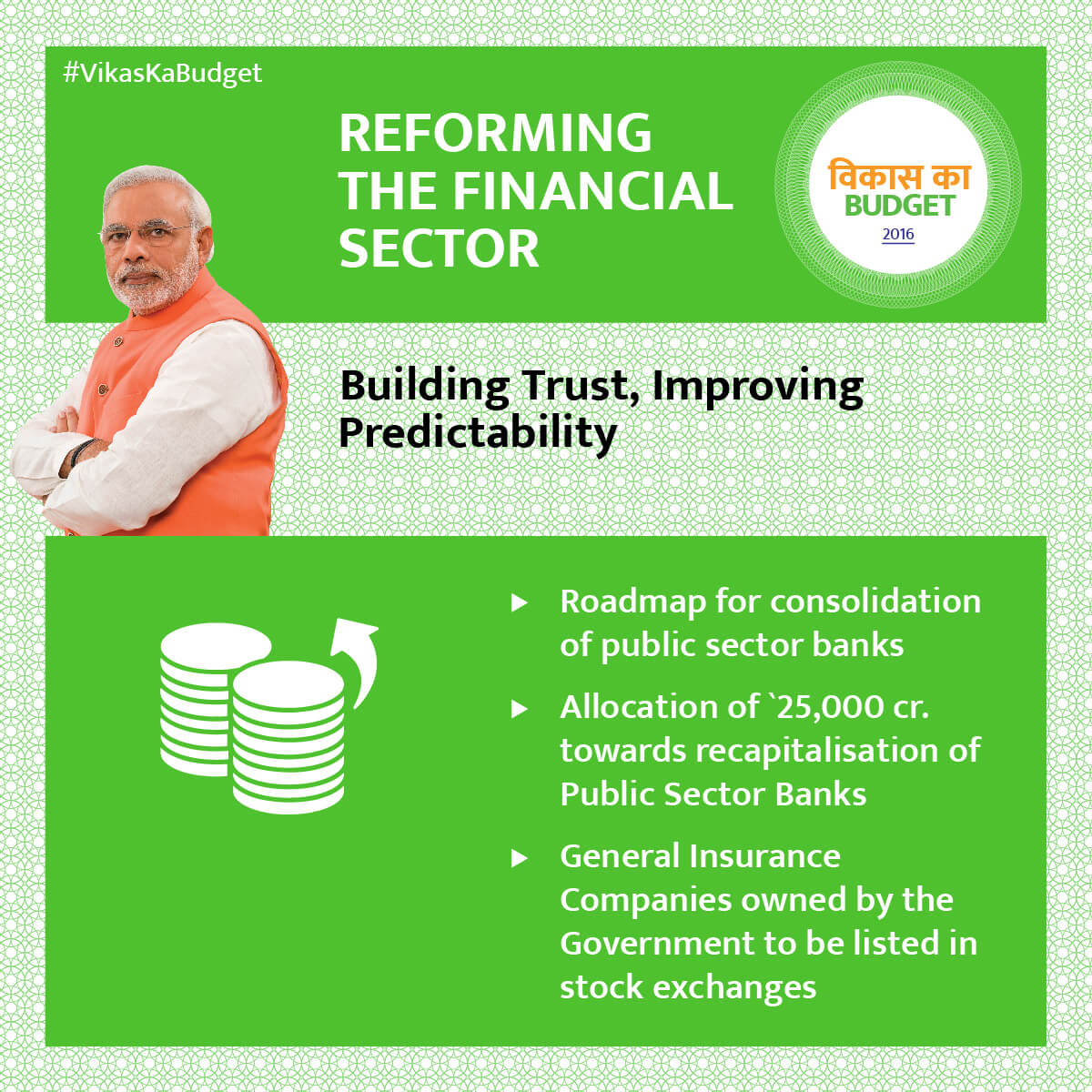
  • Discussing Budget 2016-17 | Financial Sector Reforms

    In this section, we will deal with the issue which is of critical importance to the growth of every economy – Financial Sector Reforms.

    Take a look at overall approach of govt. towards financial sector reforms:

    • Rs 25,000 crore towards recapitalisation of public sector banks
    • Target of disbursement under MUDRA increased to 1,80,000 crore
    • Banking Board Bureau to be operationalised
    • General Insurance companies will be listed in the stock exchange

    budget _ finance reforms

    Focus Areas

    Monetary Policy Committee

    Govt. will amend RBI Act 1934, to provide statutory basis for a Monetary Policy Framework and a Monetary Policy Committee through the Finance Bill 2016.

    Capital Market

    • RBI will improve greater retail participation in govt securities
    • SEBI will develop new derivative products in the commodity derivatives market

    Revamping Public Sector Banks

    • Govt. to allocate Rs. 25000 crore towards recapitalization of public sector banks
    • The Bank Board Bureau will be operationalized during 2016-17
    • The Debt Recovery Tribunals will be strengthened with focus on improving the existing infrastructure for speedier resolution of stressed assets
    • Efforts are made to address structural issues in various sectors like Power, Coal, Highways, Sugar and Steel, with a focus on reviving stalled projects

    Read more about Indradhanush and PJ Nayak committee on bank reforms and do watch our video explainer on NPAs.

    Pradhan Mantri Mudra Yojana

    Govt. had launched this scheme for the benefit of bottom of the pyramid entrepreneurs. Banks and NBFC-MFIs have sanctioned about Rs. 1 lakh crore to over 2.5 crore borrowers under PMMY. Govt. has increased the target next year to Rs. 1,80,000 crore.

    Read more about Mudra bank and follow our story on Micro-finance.

    New Initiatives

    Bankruptcy code for Financial Sector Insolvency

    Govt. will introduce a comprehensive Code on Resolution of Financial Firms as a Bill, in order to provide a specialised resolution mechanism to deal with bankruptcy situations in banks, insurance companies and financial sector entities

    This code along with the Insolvency and Bankruptcy Code 2015, will provide a comprehensive resolution mechanism for our economy.

    Bill on Illicit Deposit Schemes

    Govt. will bring in a comprehensive central legislation to deal with the menace of illicit deposit taking schemes as poor and the financially illiterate are the worst-victims.

    Amendments in SARFAESI Act, 2002

    Govt. will bring necessary amendments in the SARFAESI Act 2002, tackle the problem of stressed assets in the banking sector. It will enable the sponsor of an Asset Reconstruction Companies to hold up to 100% stake in it and permit non-institutional investors to invest in Securitization Receipts.

    Financial Data Management Centre

    The centre will be set up under the aegis of the Financial Stability Development Council to facilitate integrated data aggregation and analysis in the financial sector.

    What’s Financial Stability Development Council?

    The idea to create such a super regulatory body was first mooted by the Raghuram Rajan Committee in 2008. Finally in 2010, the then Finance Minister of India, Pranab Mukherjee, decided to set up such an autonomous body dealing with macro prudential and financial regularities in the entire financial sector of India.

    Chairperson: The Union Finance Minister of India

    Post Office ATMs

    To provide better access to financial services, especially in rural areas, we will undertake a massive nationwide rollout of ATMs and Micro ATMs in Post Offices over the next three years.

    Read more about Payment Banks’ revolution.

    Listing of General Insurance companies

    The general insurance companies owned by the govt will be listed in the stock exchanges, in order to promote public shareholding in govt-owned companies as a means of ensuring higher levels of transparency and accountability.

    Read more about Reforms in Banking Sector.

    PS: Please click on the green hyperlinked text to read more about the concepts. Revise and revise & feel free to ask pertinent questions.


    Published with inputs from Pushpendra | Image: Finmin
  • Discussing Budget 2016-17 | Infrastructure and Investment

    In this section, we will deal with the sector that holds the potential to transform India – Infrastructure and Investment Sector.

    budget_infra

    Focus Area

    Road Sector

    The process of road construction will be accelerated and govt. has allocated Rs. 55,000 crore in the Budget for roads and highways. Govt. will approve nearly 10,000 kms of National Highways in 2016-17 and nearly 50,000 kms of State highways will also be taken up for up-gradation as National Highways.

    Read more about Developments In Road Sector.

    Port

    Govt has started a series of measures for modernizing the ports and increasing their efficiency. Govt. is planning to develop new greenfield ports both in the eastern and western coasts of the country along with expedition of National Waterways.

    Read more about Sagarmala Project.

    Civil Aviation

    Govt. is drawing an action plan for revival of un-served and under-served airports. There are some 160 airports and air strips which can be revived at an indicative cost of Rs. 50 crore to Rs. 100 crore each. Union govt. will partner with the States to develop some of these airports for regional connectivity.

    Read more about Developments In Civil Aviation Sector.

    Oil and Gas

    Govt is planning to incentivise gas production from deep-water, ultra deep-water and high pressure-high temperature areas, which are presently not exploited on account of higher cost and higher risks.

    Read more about Ministry of Petroleum and Natural Gas: Important Updates.

    Power Sector

    Govt. will diversify the sources of power generation for long term stability. A comprehensive plan will be prepared to augment the investment in nuclear power generation.

    Read more about India’s Nuclear Dilemma at the World’s Stage and Policy Wise: India’s Power Sector and recently launched UDAY scheme.

    Financing

    Govt will permit mobilisation of additional finances by various institutions such as NHAI, PFC, REC, IREDA, NABARD and Inland Water Authority to the extent of Rs. 31,300 crore through raising of bonds during 2016-17.

    New Initiatives

    Abolition of Permit-Raj

    Govt. will bring necessary amendments in the Motor Vehicles Act and open up the road transport sector in the passenger segment. An enabling eco-system will be provided for the States which will have the choice of adopting the new legal framework. Entrepreneurs will be able to operate buses on various routes, subject to certain efficiency and safety norms.

    Impact: It will lead to more efficient public transport facilities, greater public convenience, new investments, creation of new jobs, growth of start-up entrepreneurs and other multiplier effects.

    Reviving the Public Private Partnership

    Govt. will take various measures to revive the PPP sector:

    • It will introduce Public Utility (Resolution of Disputes) Bill to streamline institutional arrangements for resolution of disputes in infrastructure related construction contracts, PPP and public utility contracts
    • Guidelines for renegotiation of PPP Concession Agreements will be issued without compromising transparency
    • A new credit rating system for infrastructure projects will be developed, instead of relying upon a standard perception of risk which often result in mispriced loans

    Read more about recently released Kelkar Committee Report.

    Reforms in FDI policy

    100% FDI will be allowed through FIPB route in marketing of food products produced and manufactured in India, as lot of fruits and vegetables either do not fetch the right prices or fail to reach the markets. This move will benefit farmers, give impetus to food processing industry and create vast employment opportunities.

    Govt. has also proposed changes in the areas of insurance and pension, Asset Reconstruction Companies, Stock Exchanges, etc

    Public Sector Enterprises

    Govt. has approved a new policy for management of its investment in PSUs, including disinvestment and strategic sale. Govt. will leverage the assets of CPSEs for generation of resources for investment in new projects. The NITI Aayog will identify the CPSEs for strategic sale.

    The Department of Disinvestment is being re-named as the Department of Investment and Public Asset Management (DIPAM).

    Challenge

    There is a need for consolidation, starting from approval to implementation, apart from an institutional mechanism for fair pricing and competition in infrastructure policy.

    Criticism

    There are no big reforms or major policy turnarounds in this regard.

    PS: Please click on the green hyperlinked text to read more about the concepts. Revise and revise & feel free to ask pertinent questions.


    Published with inputs from Pushpendra | Image: Finmin
  • Important Judgements of Supreme Court in 2015 | Part 4


    Catch up on the previous links to this series:

    #7. States cannot unilaterally grant remission

    Union of India vs. Sriharan

    Summary:

    In a setback to seven life convicts in the Rajiv Gandhi assassination case which includes four Sri Lankans, will remain in Vellore Central Prison in Tamil Nadu, as a five judge Constitution bench of the Supreme Court ruled that the Tamil Nadu government headed by J Jayalalithaa could not have unilaterally granted them remission.

    Observations:

    • Since the case was probed and prosecuted by CBI, a central agency, the decision should not have been taken without the “concurrence” of the Central government
    • Life sentence in such cases should mean life in jail till death
    • ‘REMISSION CAN BE CANCELLED’: SC upheld the 2008 Swamy Shraddananda judgment- Courts can ignore remission right of prisoner in heinous crimes like mass murder and terrorism by awarding sentences ranging from 20 to 40 years unless it is not rarest of rare offences meritting death sentence.
    • Interpreting Section 435 (2) of the CrPC: the word ‘consultation’ means ‘concurrence’. This means that TN Govt should have got the prior consent of the Centre before issuing its February 19 order to remit the sentences.

    Politics of remission:

    Read more here: reviving the politics of remission

    Recently polls have been announced in Tamil Nadu.
    There is every possibility that remission action can be used as a trump card to gain votes.
    So, need we not check this as it goes against Model Code of Conduct- influencing votes by populist policies?

    What does Election Commission of India has to say on it?
    Q- Would action be taken if any reference was made on the Tamil Nadu government’s decision to remit the life sentence of the Rajiv Gandhi assassination case convicts?
    Ans- As and when the reference comes, the Commission will take an appropriate view to ensure that our voters are not influenced.

    #8. Minimum Edu Qualification rule for Panchayat elections upheld

    Rajbala vs. State of Haryana

    Summary:

    Two Judge Bench of the Supreme Court of India upheld the validity of Haryana Panchayati Raj (Amendment) Act, 2015 (Act 8 of 2015), which introduced the minimum educational qualification for candidates to contest the panchayat elections. The Bench consisting of Justice Chelameswar and A.M.Sapre held that both the rights namely “Right to Vote” and “Right to Contest” are not fundamental Rights but only constitutional rights of the citizen.

    Observations:

    • Prescription of an educational qualification is not irrelevant for better administration of the PANCHAYATS
    • The classification cannot be said either unreasonable or without a reasonable nexus with the object sought to be achieved
    • Every person who is entitled to vote is not automatically entitled to contest for every office under the Constitution
    • Constitution itself imposes limitations on the right to contest depending upon the office
    • It also authorises the prescription of further disqualifications/qualification with respect to the right to contest

    Trivia:

    Supreme Court also upheld the clauses of the Act which disqualify persons who are in arrears of amounts to cooperative bodies and the electricity bills and also if a person has no functional toilet at his place of residence.


    Published with inputs from Swapnil
  • Important Judgemets of Supreme Court in 2015 | Part 3


    Catch up on the previous links to this series:

    #5. Unwed mother can become sole guardian of a child

    ABC vs. State (NCT of Delhi)

    Summary:

    In a landmark judgment, a Supreme Court bench headed by Justice Vikramajit Sen held that an unwed mother in India can apply to become the sole guardian of a child, without giving notice to the father of the child and without disclosing his identity.

    The Court also directed that if a single parent/unwed mother applies for the issuance of a Birth Certificate for a child born from her womb, the Authorities concerned may only require her to furnish an affidavit to this effect, and must thereupon issue the Birth Certificate, unless there is a Court direction to the contrary.

    Background:

    • The child was born in 2010, and the woman petitioner raised him without any assistance from or involvement of his putative father
    • She desired to make her son her nominee in all her savings and other insurance policies
    • But was informed that she must either declare the name of the father or get a guardianship/adoption certificate from the Court
    • She then filed an application under Section 7 of the Guardians and Wards Act, 1890 (the Act) before the Guardian Court for declaring her the sole guardian of her son
    • Section 11 of the Act requires a notice to be sent to the parents of the child before a guardian is appointed
    • However, both the Courts (the guardian court and Delhi High court) held that she needed to disclose the father’s name to get his consent while filing a guardianship petition
    • Then she filed a petition in SC against ruling of the trial court and the Delhi High Court

    SC observations:

    • The predominant thought in these jurisdictions, as is in India, is to bestow guardianship and related rights to the mother of a child born outside of wedlock
    • The mother need not disclose the identity of the father and include him as a party to the guardianship petition in certain cases
    • The ruling relied on the best interest of the child, which requires that the procedural requirement should be done away with

    #6. Section 364A IPC awarding death penalty not unconstitutional

    Vikram Singh vs. Union of India

    Summary:

    The Supreme Court of India dismissed an appeal by a death row convict, and held that Section 364A awarding death penalty as a possible punishment, for kidnapping any person threatening to cause death in order to compel Government or any other person, to pay ransom, is not unconstitutional.

    Three Judge Bench of Justices T.S. Thakur, R.K. Agrawal and Adarsh Kumar Goel examined the background of the Section 364A and held that it was enacted for the safety and security of the citizens and the unity, sovereignty and integrity of the country.

    About Section 364A:

    • Introduced: 1993
    • Awards: death penalty or life imprisonment
    • For: kidnapping or abducting any person and threatening to cause death or hurt to such person
    • Protects: the Government, any foreign State or international inter-governmental organisation or any other person

    Observations:

    • Private persons are also covered:
      Section 364A is wide enough to cover even cases where the demand for ransom is made not as a part of any terrorist act but also for monetary gain from a private individual.
    • 364A deals with ordinary crimes too:
      The counsel for petitioner had argued- since the Kidnapping/abduction of a person for ransom is already covered by other provisions of IPC hence Section 364A was added only to deal with terrorist related ransom situations and not ordinary crimes.
      However, the SC held that ingredients of 364A are unique, and cannot be found in other provisions of IPC even in the provisions dealing with extortion.
    • Rule of Ejusdem generis does not apply:
      The meaning of the term ‘person’ can not be restricted to the ‘government’ or ‘foreign State’ or ‘international inter-governmental organisations’ only.
    • Section 364A not disproportionate:
      Citing various Indian and foreign decisions, the court laid down the principles governing proportionality of punishments
      ○ Punishments must be proportionate to the nature and gravity of the offences for which the same are prescribed
      ○ Prescribing punishments is the function of the legislature and not the Courts’.
      ○ The legislature is presumed to be supremely wise and aware of the needs of the people and the measures to meet those needs
      ○ Courts show deference to the legislative will and wisdom and are slow in upsetting the enacted provisions dealing with the quantum of punishment prescribed for different offences
      ○ Courts, however, have the jurisdiction to interfere when the punishment prescribed is so outrageously disproportionate or so inhuman or brutal which cannot be accepted by any standard of decency
      ○ Absence of objective standards for determining the legality of the prescribed sentence makes the job of the Court reviewing the punishment difficult
      ○ Courts cannot interfere with the prescribed punishment only because the punishment is “perceived to be” excessive

    What is Ejusdem Generis?

    • A Latin term which means “of the same kind
    • It is used to interpret loosely written statutes
    • Where a law lists specific classes of persons or things and then refers to them in general then the general statements only apply to the same kind of persons or things specifically listed


    Published with inputs from Swapnil
  • Discussing Budget 2016-17 | Skills and Job Creation

    In this section, we will deal with the sector which seeks to empower the youth – Skills and Job Creation.

    Take a look at basic statistics, which will give you a larger picture about govt.’s approach towards Education, Skills and Job Creation, where the emphasis is to make India a knowledge based and productive society:

    • 1500 Multi-skill training institutes to be set up
    • Objective to skill 1 crore youth in the next 3 years under the PM Kaushal Vikas Yojna
    • National Skill Development Mission has imparted training to 76 lakh youth


    Focus Areas

    #1. Skill India Mission

    The National Skill Development Mission has created an elaborate skilling eco-system and imparted training to 76 lakh youth. Govt. will set up 1500 multi-Skill training institutes across the country, to capitalise our demographic advantage.

    Govt. will further scale up Pradhan Mantri Kaushal Vikas Yojna to skill one crore youth over the next 3 years.

    Benefits: The emphasis on skill development will resonate with India’s youth seeking to improve their employability quotient.

    Career Portal

    Govt. had launched National Career Service in July, 2015, where 35 million jobs seekers have registered. Govt. will make 100 Model Career Centres operational by the end of 2016-17. It will also inter-link State Employment Exchanges with the National Career Service platform.

    New Initiative

    Certification

    Govt. will set up a National Board for Skill Development Certification in partnership with the industry and academia.

    Benefits: This will help formally skilled youth to be recognised for employment purposes in public & private sector.

    Massive Open Online Courses

    Entrepreneurship education and training will be provided in 2200 colleges, 300 schools, 500 govt ITIs and 50 vocational training centres through Massive Open Online Courses. Govt. will make efforts to connect aspiring entrepreneurs, particularly those from remote parts of the country, to mentors and credit markets.

    Job Creation

    Govt of India will pay the Employee Pension Scheme contribution of 8.33% for all new employees drawing a salary of up to Rs.15,000 a month and enrolling in EPFO, for the first 3 years of their employment.

    Govt. will amend Income Tax Act in order to broaden the scope of employment generation incentives.

    Benefits: This will incentivize the employers to recruit unemployed persons and that too in the formal sector. It could also lead to migration of informal sector workers to the formal sector. Of the 470 million plus workforce in India, less than 10% are in the formal sector.

    Retail Sector

    In order to simplify the regulations for the retail sector, which is the largest service sector employer in the country, Govt will circulate a model Model Shops and Establishments Bill, which can be adopted by the State Govts on voluntary basis. The model bill seeks to allow small and medium shops to remain open all 7 days a week on voluntary basis. This will help in creation of new jobs in retail sector.

    Challenge

    • In India, only about 2.2% of workforce had received formal vocational training. Even those who had received any form of vocational training, the majority had either acquired a hereditary skill or learned on the job
    • Without access to affordable and appropriate skills training, young people, particularly those leaving rural areas and small towns for big cities, will be stuck in low-wage, insecure jobs that will leave them in want or poverty
    • Job creation has not kept pace with India’s demographic momentum, and in the coming days, it will pose a problem for a skilled workforce

    Learn about Deen Dayal Upadhyaya Grameen Kaushalya Yojana and Agency involved in Skill IndiaFollow our story on Skill India too.

    PS: Please click on the green hyperlinked text to read more about the concepts. Revise and revise & feel free to ask pertinent questions.


    Published with inputs from Pushpendra | Image: Finmin