💥Join UPSC 2027,2028 Mentorship (July Batch) + XFactor Notes & Microthemes PDF

Author: Explains

  • Discussing Budget 2016-17 | Education

    In this section, we will deal with the sector which will determine how well we use our demographic dividend – Education Sector.

    Take a look at basic statistics, which will give you a larger picture about govt.’s approach towards Education, Skills and Job Creation, where the emphasis is to make India a knowledge based and productive society:

    • Allocation for education sector – Rs 68,968 cr
    • Higher Education Financing Agency to be set-up with initial capital base of Rs 1000 Crores
    • Digital Depository to be set-up for certificates, mark sheets, etc
    • Initiative to make world-class teaching and research institutions

    budget_edu

    Focus Areas

    #1. School Education 

    Govt. will allocate increasing share for quality improvement under Sarva Shiksha Abhiyan. 62 new Navodaya Vidyalayas will be opened in the remaining uncovered districts over the next two years

    #2. Higher Education

    Govt. will ensure an enabling regulatory architecture to empower 10 public and 10 private institutions to emerge as world-class Teaching and Research Institutions. This will enhance affordable access to high quality education for ordinary Indians.

    Benefits: Govt. seeks to stress on the importance of teaching along with recognising the role of private sector in the education sector – not all world-class institutions that emerge from India need to be publicly funded.

    Read more about The State Of Affairs In Higher Education

    New Initiative

    Finance

    Govt. will setup a Higher Education Financing Agency with an initial capital base of Rs. 1,000 crores. It will be a not-for-profit organisation that will leverage funds from the market and supplement them with donations and CSR funds. These funds will be used to finance improvement in infrastructure in the top institutions.

    According to ministry of corporate affairs, education and skill development attracted 23% of the CSR spending for FY15.

    Benefits: Since Banks are finding it difficult to manage the NPAs from the education loans, a dedicated agency would give the much needed thrust.

    Digital Depository

    Govt. will establish a Digital Depository for School Leaving Certificates, College Degrees, Academic Awards and Mark sheets, on the pattern of a Securities Depository. This will help validate authenticity, safe storage and easy retrieval of these documents.

    Read more about Digital India Initiatives

    Criticism

    • There is little to offer in terms of any concrete steps to improve the quality of elementary education
    • Teachers training does not figure in this year’s budget
    • The whole purpose of CSR is defeated if the govt lays down the agenda on what the priority areas for companies should be. It also shifts the accountability for CSR from the company to the govt
    • It seems that the Rs.1000 crore fund will be mostly used for redressal of the problems of students seeking educational loan. Also, the current outstanding educational loans are around Rs.50,000 crore, how a fund of Rs.1,000 crore will resolve the massive requirements of educational loans

    Future

    There is group of secretaries proposal to phase out Sarva Shiksha Abhiyan as it currently exists and replace it with an outcome-based financing program that links 20% of the education budget to performance on outcomes

    Read more about Ministry of Human Resource Development : Important Updates

    PS: Please click on the green hyperlinked text to read more about the concepts. Revise and revise & feel free to ask pertinent questions.


    Published with inputs from Pushpendra | Image: Finmin
  • 2016-17 के बजट पर चर्चा: सामाजिक क्षेत्र

    सामाजिक क्षेत्र: समाज के कमजोर वर्गों के विकास के मायने में सामाजिक क्षेत्र अहम हो जाता है।

    आइये सबसे पहले बुनियादी आंकड़ों पर एक नजर डालते हैं क्योंकि आकंड़े इस बात का आईना होते हैं कि सरकार ने किस तरह से बड़ी आबादी के व्यापक हितों को योजनाओं के तहत साधा है।

    • शिक्षा और स्वास्थ्य देखभाल सहित सामाजिक क्षेत्र के लिए 1,51,581 करोड़ रुपये का आबंटन।
    • भारत की जनसंख्या के एक तिहाई हिस्से को नई स्वास्थ्य बीमा योजना से जोड़ा गया।
    • 3000 मेडिकल स्टोर्स को प्रधानमंत्री जन औषधि योजना के तहत खोले जाने का ऐलान।
    • सभी बीपीएल परिवारों को रसोई गैस कनेक्शन दिया जाना।
    • देशभर के जिला अस्पतालों में डायलिसिस सेवाएं प्रदान करने के लिए नेशनल डायलिसिस सर्विस शुरू करने की घोषणा।

      social

    मुख्य बिंदु

    #1. जेनेरिक दवाएं

    सरकार ने प्रधानमंत्री जन औषधि योजना के तहत वर्ष 2016-17 के दौरान  3,000 नए दवा स्टोर खोल उनके माध्यम से जेनेरिक दवाओं की आपूर्ति करना सुनिश्चित किया है। यानी लोगों को सस्ती कीमतों पर अच्छी दवाएं उपलब्ध होंगी। फार्मा सेक्टर का विकास इसी से जुड़ा पहलू है।

    #2. अनुसूचित जाति, अनुसूचित जनजाति और महिलाएं

    सरकार ने अनुसूचित जाति और अनुसूचित जनजाति और महिलाओं को उद्यमी बनाने की दिशा में कदम बढ़ाया है। सरकार ने इस वर्ग को सक्षम बनाने के लिए स्टैंडअप इंडिया योजना की पहल की है। इस योजना के चलते इस वर्ग के 2.5 लाख लोगों को सीधा फायदा पहुंचेगा साथ ही इन दोनों वर्ग के उद्यमियों को सहायता उपलब्ध कराने के लिए राष्ट्रीय अनुसूचित जाति/ जनजाति केंद्र स्थापित किया जाएगा। इस योजना से प्रत्‍येक श्रेणी के एक उद्यमी के लिए प्रति बैंक शाखा कम से कम ऐसी दो परियोजनाओं को मदद मिलेगी। इस योजना से कम से कम 2.5 लाख उद्यमियों को लाभ मिलेगा।

    #2. उद्यमियता- एससी/एसटी और महिलाएं

    सरकार का उद्योग संघों और सूक्ष्‍म, लघु और मध्‍यम उद्यम मंत्रालय की भागीदारी में राष्‍ट्रीय अनुसूचित जाति/जनजाति केन्‍द्र की स्थापना करने का प्रस्‍ताव है। यह केन्‍द्र अनुसूचित जाति/जनजाति के उद्यमियों को केन्‍द्र सरकार की खरीदारी नीति 2012 के अधीन अपनी जिम्‍मेदारी पूरी करने के लिए वैश्विक सर्वश्रेष्‍ठ कार्य विधि अपनाने और स्‍टैंड अप इंडिया पहल का लाभ उठाने के लिए पेशेवर मदद उपलब्‍ध कराएगा।

    नए कदम

    स्वास्थ्य बीमा देश में गरीबी की रेखा से नीचे जीवन यापन करने वाले लोग हर साल कई खतरनाक बीमारियों और आकस्मिक हादसों मे मारे हैं।  एक नई स्वास्थ्य सुरक्षा योजना में परिवार प्रति 1 लाख रुपए के लिए स्वास्थ्य कवर प्रदान किया गया है। वरिष्ठ नागरिकों को 30,000 रुपये तक एक अतिरिक्त टॉप-अप पैकेज उपलब्ध कराया जाएगा।  

    स्वास्थ्य देखभाल

    इस समय देश मेें कई सुदूरवर्ती इलाकों के लोग स्वास्थ केंद्रों पर पहुंचने से पहले ही दम तोड़ देते हैं। उनका डायलिसेस ही नहीं हो पाता है। गुर्दे खराब होने की स्थिति में  रोगियों को नियमित जांच की जरूरत होती है। सरकार ने इस संबंध में पीपीपी मोड के माध्यम से राष्ट्रीय स्वास्थ्य मिशन के तहत एक ‘राष्ट्रीय डायलिसिस सेवा कार्यक्रम’ का शुभारंभ किया है।

    रसोई गैस

    बीपीएल परिवारों को सरकार सब्सिडी देकर गैस कनेक्शन मुहैया कराएगी।  इस घोषणा से 2016-17 में लगभग 1.5 करोड़ बीपीएल परिवारों को फायदा होगा। सरकार देश में रसोई गैस को पूरे देश में सर्व सुलभ कराने की हिमायती है। इससे काफी हद तक उन गरीब महिलाओं और बीपीएल परिवारों के लोगों को फायदा होगा जिनके परंपरागत चूल्हों खाने बनाने से सेहत पर खराब असर पड़ता है।

    आलोचना

    • स्वास्थ्य नीति के लिए सरकार की समग्र सोच क्या है इस पर बजट में कोई रोशनी नहीं डाली गई है। हालांकि इसमें बीमा सेक्टर पर काफी बढ़चढ़कर बातें कही गई हैं लेकिन उसकी अपनी सीमाएं हैं।  इसे सरकार की स्वास्थ्य नीति की ताकत नहीं कहा जा सकता।
    • नई बीमा योजना, नाम बदलकर महज राष्ट्रीय स्वास्थ्य बीमा योजना का रूपांतरण लगता है।


  • Discussing Budget 2016-17 | Rural Sector

    In this section, we will deal with the sector which is very important for a country like India, where more than two-third of the population resides in villages – Rural Sector.

    Take a look at basic statistics, which will give you a larger picture about govt.’s approach towards rural sector, where emphasis is on rural employment and infrastructure:

    • Total allocation for rural sector is 87,700 cr
    • Rs. 2.87 lakh cr grant-in-aid to Gram Panchayats and Municipalities
    • Rs. 38,500 crore has been allocated for MGNREGS in 2016-17
    • 100% village electrification by May 2018
    • 300 Rurban Clusters will be developed under the Shyama Prasad Mukherjee Rurban Mission
    • Digital Literacy mission to cover additonal 6 cr households

    rural_budget

    Focus Areas

    #1. Decentralization

    As per 14th Finance Commission recommendations, the budget has allocated a sum of Rs. 2.87 lakh cr grant-in-aid to Gram Panchayats and Municipalities, which is higher by 228% as compared to the previous 5-year period.

    Each Gram Panchayat will receive an average assistance of Rs 80 lakh, where as each Urban Local Body will get Rs. 21 cr.

    #2. Mitigating Rural Distress

    • Every block in the distress areas will be set up as an intensive Block under the Deen Dayal Antyodaya Mission
    • Formation of Self Help Groups will be speeded up to promote multiple livelihoods
    • Cluster Facilitation Teams will be set up under MGNREGS to ensure water conservation and natural resource management
    • Priority to these districts under Pradhan Mantri Krishi Sinchaii Yojna

    #3. Infrastructure Creation

    Govt will develop 300 Rurban clusters under the Shyama Prasad Mukherjee Rurban Mission.

    These Clusters will incubate growth centres in rural areas by providing infrastructure amenities and market access for the farmers. They will also expand employment opportunities for the youth.

    #4. Electrification

    Govt is targeting to achieve 100% village electrification by 1st May, 2018. The budget has allocated Rs. 8,500 crore for Deendayal Upadhayaya Gram Jyoti Yojna and Integrated Power Development Schemes.

    #5. Modernization of Land Records

    Govt. has revamped National Land Record Modernisation Programme, to build an integrated land information management system, which is critical for dispute free titles.

    #6. Sanitation

    Govt. will reward villages that have become free from open defecation, under Swachh Bharat Mission

    New Initiatives

    Promotion to Digital Literacy

    About 12 crore households out of the total 16.8 crore rural households, do not have computers and are unlikely to have digitally literate persons. In this regard, there are already 2 schemes, which are approved to promote digital literacy:

    • National Digital Literacy Mission
    • Digital Saksharta Abhiyan

    Govt. will launch a new Digital Literacy Mission Scheme for rural India to cover around 6 crore additional households within the next 3 years. This will help India to derive greater benefit from our demographic advantage.

    Improving Governance of PRI’s

    Govt. will make efforts to develop governance capabilities of Panchayat Raj Institutions so that they can deliver on the Sustainable Development Goals. In this regard, govt. has proposed to launch a new restructured scheme, called Rashtriya Gram Swaraj Abhiyan.

    PS: Please click on the green hyperlinked text to read more about the concepts. Revise and revise & feel free to ask pertinent questions.


    Published with inputs from Pushpendra | Image: Finmin
  • Discussing Budget 2016-17 | Agriculture and Farmer’s Welfare

    Amidst global and domestic headwinds, Finance Minister presented a growth and development-oriented Budget that seeks to transform india for the benefit of farmers and the vulnerable. We will take a look at the budget in terms of various sectors.

    In this section, we will deal with the sector which received a lot of attention in this budget – Agriculture and Farmer’s Welfare

    Take a look at basic statistics, which will not be useful for memorizing, but certainly will help you in analyzing the shifting focus of govt. towards agriculture.

    • Total allocation for Agriculture and Farmers’ welfare is 35,984 crore
    • 28.5 lakh heactares of land will be brought under irrigation
    • 5 lakh acres to be brought under organic farming over a 3-year period
    • Rs 6,000 crore for recharging of ground water recharging
    • Dedicated irrigation fund in NABARD of Rs.20.000 crore

    budget_farmers


    Focus Areas

    #1. Food Security to Income Security

    Govt. is targeting to double the farmers’ income in 5 years. Govt. will re-orient its efforts both in farm and non-farm sectors. The access to markets becomes critical in this respect, so govt. will implement a Unified Agriculture Marketing Scheme which envisages a common e-market platform that will be deployed in selected 585 regulated wholesale markets.

    #2. Irrigation

    Irrigation is a critical input for increasing agriculture production and productivity. Out of 141 million hectares of net cultivated area in the country, only 46% is covered with irrigation. A dedicated Long Term Irrigation Fund will be created in NABARD with an initial corpus of about `20,000 crore.

    The ‘Pradhan Mantri Krishi Sinchai Yojana has been strengthened and will be implemented in mission mode. 28.5 lakh hectares will be brought under irrigation under this scheme. Govt. is taking efforts to fast track 89 irrigation projects languishing under AIBP, which will help to irrigate 80.6 lakh hectares.

    Under the sustainable management of ground water resources, at least 5 lakh farm ponds and dug wells in rain fed areas will be created and 10 lakh compost pits for production of organic manure will be taken up by making productive use of the allocations under MGNREGA.

    #3. Conserve Soil Health and Fertility

    There is a National Project on Soil Health and Fertility and govt. is implementing Soil Health Card Scheme. It enables farmers to get information about nutrient level of the soil and can make judicious use of fertilizers. The target is to cover all 14 crore farm holdings by March 2017.

    #4. Credit Availability

    Govt. is making special efforts to ensure adequate and timely flow of credit to farm sector. The target for agricultural credit in 2016-17 will be at an all-time high of Rs. 9 lakh crore, as against the target of Rs. 8.5 lakh crore in 2015-16.

    Govt. has made the provision of Rs. 15,000 crore towards interest subvention, in order to reduce the burden of loan repayment on farmers

    #5. Food Processing Industry

    100% FDI will be allowed through FIPB route in marketing of food products produced and manufactured in India. It will benefit farmers as fruits and vegetables will fetch right prices and also reduce their wastage. It will also give impetus to food processing industry and create vast employment opportunities.

    New Initiatives

    Finances

    A  Krishi Kalyan Cess will be imposed at 0.5% on all taxable services, proceeds of which would be exclusively used for financing initiatives relating to improvement of agriculture and welfare of farmers. To know more about basics of cess – Read more.

    Broadening MSP

    Govt. will make efforts to ensure that the benefit of MSP reaches farmers in all parts of the country. Govt. will encourage remaining states to take up decentralized procurement. An online procurement system will be undertaken through the Food Corporation of India. Govt has also made effective arrangements  for pulses procurement.

    Dairy Development

    Govt. will bring four new projects to make dairying more remunerative to the farmers:

    • Pashudhan Sanjivani – An animal wellness programme and provision of Animal Health Cards (‘Nakul Swasthya Patra’)
    • An advanced breeding technology
    • Creation of ‘E-Pashudhan Haat’ – An e-market portal for connecting breeders and farmers
    • A National Genomic Centre for indigenous breeds

    Agriculture Insurance

    In order to protect the farmer from the adverse consequences of nature, govt. has recently announced PM Fasal Bima Yojna, which will have nominal premium and highest ever compensation in case of crop loss.


    PS: Please click on the green hyperlinked text to read more about the concepts. Revise and revise & feel free to ask pertinent questions.

    Published with inputs from Pushpendra | Image: Finmin
  • Vikas ka Budget | Key points from the Ministry of Finance – 2016

    It is true that the Budget could be difficult to understand. Sarkar just made it easier for you to know how your tax-money is being spent. Try evaluating whether your Government is doing enough.

    This time, we were pleasantly surprised to find the lengths to which the Ministry of Finance has gone to make it easier for everyone to understand the Budget.

    What’s in it for me!

    #1. How does it helps a farmer, Khem Lal Khushwaha?


    #2. How does it helps a daily wage labourer, Mohan Patel?


    #3. How does it helps a student, Shushmita?


    There are a few more character sketches and a lot more variations across sectors/ benefits at the Finmin website. Do check out the Vikas ka budget – click here.

    If you have any questions (however basic), feel free to drop them here.

    Source: Finmin.nic.in
  • 9 important takeaways from Union Budget 2016

    The budget focuses its efforts on what needs fixing – the rural distress, the jobs problem, the banking crisis, and infrastructure deficit.


    As you prepare for your IAS examination in 2016, keep these recurring themes in mind! Even government is waking up to take them seriously.

    First, the budget sticks to the fiscal deficit roadmap and promises to bring down the deficit to 3.5 percent in 2016-17. Read more on this, click here.

    Second, the corporate sector has been let down, with the promised reduction in corporate taxes restricted to small and new companies. To know all about taxes and ease of doing business, click here.

    Third, the most exciting idea is the introduction of a tax amnesty scheme for domestic black money or undeclared incomes. Black money holders have to pay 45 percent tax – a penalty about 10 percent more than normal – to get immunity from questioning and penal action.

    Read all about black money and the economics around it, click here.

    Fourth, the big numbers are in infrastructure investment. Between railways and roads, both national highways and rural roads, the total investment in 2016-17 will be a massive Rs 2,18,000 crore – this should be a stimulant for jobs and investment. We have been following up developments in this sector for the year round. Click here.

    Fifth, the organised sector is being incentivised to take on more employees with the centre offering to pay the 8.33 percent pension contributions of new employees for three years.

    Sixth, the budget lowers the axe on rich promoters, who have benefited from the fact that dividend tax is paid by companies. They thus got a benefit not intended for the rich. Not any more. Promoters and big shareholders will now face 10 percent additional tax when dividend payments exceed Rs 10 lakh.

    Seventh, the bottom end of the middle class gets some relief. Taxpayers in the sub-Rs 5 lakh income bracket will get a tax rebate of around Rs 3,000. Two crore taxpayers will benefit.

    Eight, there is a strong financial sector angle in the budget. Jaitley has proposed a strong exit policy which will involve legislating the Indian Financial Code, the Bankruptcy Code and quicker disposal of debt recovery cases in debt tribunals.

    Follow up the developments of 2015-16, click here.

    Ninth, the big pitch was to the rural and farm sector. The FM promised Rs 2.87 lakh crore of fiscal transfers to villages, and all villages will be electrified by 2018. This government obviously believes in doing things in mission mode. After Jan Dhan, now it is time for full electrification and taking cooking gas to all rural households.

    Source: SwarajyaMag | Image: India.com
  • Economic Survey: 6 Important suggestions which Sarkar must take

    “I am the chief economic adviser, not the chief political decider,” chief economic advisor Arvind Subramaniam said in response to a question about whether the suggestions in the Economic Survey 2015-16 will find space in the budget.

    But, you are an aspirant, aren’t you? And in a rare case that the interview panel grills you on your analysis on the Economic Survey, here’s what can save your ass!

    #1. Do something urgently on subsidies

    The survey lists seven items – kerosene, electricity, LPG, railways, petrol, diesel, aviation turbine fuel and gold – on which the implicit subsidy to the rich amounts to RS 10 lakh crore! “. . . rectifying some egregious anomalies may be good not only from a fiscal and welfare perspective, but also from a political economy welfare perspective, lending credibility to other market-oriented reforms,” the Survey says.

    #2. Work seriously on ending tax exemptions

    • No profession should escape the tax net
    • Clear reference to agricultural income, which is not taxed at all
    • While the government is working on ending tax exemptions for the corporate sector, what about the agriculture sector!

    #3. Don’t raise exemption thresholds

    • The Survey junks the theory put out by Thomas Piketty that India under-taxes and under-spends
    • Bring more people under tax net. Let the threshold stay where it is!

    #4. Spread the JAM (Jan Dhan Yojana, Aadhar and Mobile transactions) trilogy to new areas

    • How to go about it? What about its efficacy? The Survey suggests doing this based on two criteria – the extent of leakages and the extent of central government control
    • Subsidies with higher leakages have larger returns after introduction of JAM
    • It will be easier to roll out JAM in areas where the central government is the main provider of the subsidy

    #5. Focus on easier exits

    Not just about corporate exits! The Survey expands the paradigms of exits

    • Allow easier entry to encourage competition; address legal lacuna through laws (which is being done with the new bankruptcy law)
    • In the case of agriculture, exit from the current cereal-centric, regionally concentrated, input-intensive policies to pulses-oriented, regionally-broad based, more-for-less inputs system

    #6. Undertake serious reform of the fertiliser sector

    The Survey suggests a cap on the number of subsidised bag each farming household can purchase and insistence on biometric authentication at the point of sale (POS)


    Source: Swarajyamag

    PS: This was just a trailer. Original series on Economic Survey with back2basics reference coming soon.

  • Railway Budget 2016-17: Reorganize, Restructure & Rejuvenate

    Suresh Prabhu has set out an ambitious medium-term goal to reset the country’s oldest institution, including its governance, and restore its key place in the Indian economy. Railway is facing twin challenges of finances and ability to be a growth driver for the economy

    Few Glimpses of Railway Budget 2016-17

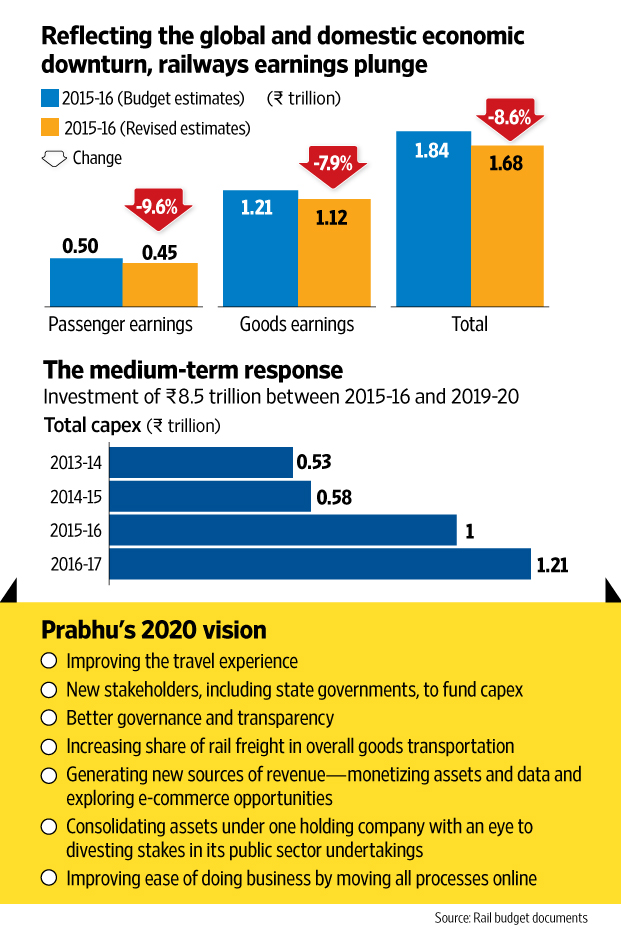
    • The minister fixed the revenue target for next fiscal at Rs.1.84 trillion, marginally above the budget estimate of 2015-16, though it failed to achieve its target for this year by a big margin
    • Railways will have to bear the burden of an additional payout of Rs.28,000 crore as part of the 7th Pay Commission recommendations
    • The railways will end up with operating ratio of 90 for 2015-16. For 2016-17, it expects the operating ratio to further worsen to 92 
    • No changes in passenger fares and freight rates

    Finances

    Railwaythe

    There is shortfall in traffic receipts worsened by low freight demand from core sector. The Railway minister outlined the medium-term plan of investing Rs.8.5 trillion by 2019-20. The investment plan for 2016-17 is Rs 1,21,000 crore –

    • Transfer from the Union budget – Rs.45,000 crore
    • Internal resources – Rs.12,700 crore
    • Partnerships with state governments – Rs.18,000 crore
    • Life Insurance Corporation of India – Rs.23,000 crore
    • Indian Railway Finance Corporation – Rs.21,700 crore

    Do you know about Sundry earnings of Railways?

    Sundry Earnings: All earnings on add-on services (which are not free of cost), including WiFi, concierge service, advertising, etc. Simply put, Railway puts all its non-tariff earning as Sundry Earnings in its account books. 

    These earnings stood at an estimated Rs. 6229 crore this year.

    Budget Proposal

    • The target of non-tariff earnings for next year has been scaled up by 53% to Rs. 9590 crore
    • Advertising is a major source of non-tariff revenues. So, Railways will install around 20,000 screen across its ecosystem to display ads
    • The Railways will also monetise its data bank on passengers so that frequent travellers get value-added, targeted services
    • Railways to monetise land on tracks by leasing out for horticulture and tea plantation
    • Holding company to be explored for monetising assets of Railway companies

    Freight

    Challenge: The freight business provides two-thirds of Indian railways’ revenues, but it is struggling with capacity constraints and slow industrial demand. Also, our freight rates are among the highest in the world, which make our products uncompetitive.

    Budget Proposal: To expand the list of commodities it services—increasing it to 40 from nine at present by including automobiles, packaged consumer goods, cotton, fruits and vegetables.

    Dedicated Freight Corridors: It is proposed to take up the following freight corridors:

    • North-South connecting Delhi to Chennai,
    • East-West connecting Kharagpur to Mumbai
    • East Coast connecting Kharagpur to Vijayawada

    Impact: They can radically slash transit time for goods. Also, shifting of freight traffic from existing tracks to the new corridors would release capacities, helping increase speed of passenger trains.

    Criticism: The high freight rates have diverted railway traffic to roads. In fact, discounting for the fuel component in freight charges, the rates should have been reduced this year.

    New Trains

    The budget announced 4 new types of trains:

    • Antyodaya Express: A long-distance, fully unreserved, superfast train service, for the common man, to be operated on dense routes
    • Humsafar: It will be a fully air-conditioned train for the budget passengers
    • Tejas: It will showcase the future of train travel. It will travel at 130 km an hour and offer on-board WiFi services
    • Uday: It will be an overnight double decker service for the busiest routes in the country with 40% more carrying capacity

    Better Governance

    Challenges: Departmental orientation, absence of cross-functional collaboration and lack of business focus

    Budget Proposal: To reorganize the Railway Board along business lines and suitably empower Chairman, Railway Board to lead the organization effectively

    Vulnerable Sections : Old People/ Disabled/ Women/ Porters

    • A “Saarthi seva” will be introduced to help the old and disabled at stations. Railways to increase lower berth quota for senior citizens by 50%.
    • Disabled enabled toilet in 11 Class-A stations this year
    • 33% reservation to women in reserved quota in Railways
    • Porters to be called ‘Sahayaks’ now. They will be trained in soft skills

    Sanitation

    • 17000 bio toilets and additional toilets at 475 stations will be provided before the close of this year
    • World’s first Bio-Vacuum toilet was developed by IR and is being used in Dibrugarh Rajdhani Express
    • For those queasy about train travel because of dirty toilets and coaches, the minister has “clean-my-coach” on demand through SMS

    Improving Railway Stations

    • 400 stations to be re-developed through PPP
    • Beautification of stations at pilgrimage centres: Ajmer, Amritsar, Gaya, Mathura, Nanded, Nashik, Puri, Tirupati, Varanasi, Nagapattinam and others

    Technology

    • 400 railway stations to be equipped with wifi, 100 this year.
    • To reduce the waiting period for passengers, the railways will introduce bar-coded tickets at select stations.
    • Scanners and access control on a pilot basis on major stations.

    Railway Budget: Few Shortfalls

    • There is a shortfall in the number of engines required to run even our existing fleet of freight and passenger vehicles. With increased capacity, we will need many more locomotives. The budget does not indicate a comprehensive strategy for these issues
    • Most tracks and rolling stock are already fit for speeds above 100 kmph for passenger services and above 75 kmph for goods services. However, average speeds of passenger services are around 40-50 kmph and those of freight 20-25 kmph. This is because we don’t have the capacity to run them at optimum speed. Increasing capacity by doubling/ quadrupling lines would in itself improve speeds. Budget does not have much to offer to overcome this lacunae

    Want to read more?

    Published with inputs from Pushpendra
  • Understanding the refugee crisis and lessons for India

    Know about some basic terminologies used in this context

    Refugee: A refugee is someone who has been forced to leave their country in order to escape war, persecution or natural disaster.

    Asylum: It is a protection granted by a state to someone who has left their home country as a political refugee.

    Migrant: A person who choose to leave their home state, principally in search of a better life. It is a voluntary choice and not a involuntary act. They do not enjoy any protection under international law.

    Special Status of Refugees

    They enjoy certain special protections under the law:

    • Safety from being deported to the country where they face persecution
    • Protection of basic human rights without radical or religious discrimination or of national origin
    • Access to fair and efficient asylum procedures
    • Provision of administrative assistance

    Know the Refugees: Statistics & Countries

    According to International Organisation for Migration, 3.5 lakh migrants and refugees have tried to cross the Mediterranean sea into Europe. Almost 2500 died in Mediterranean sea during first half of 2015.

    Refugees are mostly from West Asia comprising of war-torn countries like Syria, Iraq and Libya. West Asia was used by the political powers in Europe and US to serve their political interest in the name of supporting pro-democratic forces, ending in promoting radical groups and thus destabilizing it.

    The unending civil conflict in Afghanistan and decline in socio-economic conditions in Pakistan has further fueled the crisis.

    Why refugees are migrating to Europe?

    First of all, Europe is economically prosperous, socially secure and presence of better immigration laws makes it a perfect destination for refugees.

    But, it is not alone the brighter side of Europe, but the adverse condition in the home country, which are outside the control of common people, leading to mass migration.

    Refugee vs. Migrant debate in Europe

    This comes in the backdrop of UN forecast that about 3000 people per day will try to reach Europe in the next few months, which has worried European policy makers. The European powers had increased patrolling around the Mediterranean sea and security in the border areas.

    • Europe is portraying the refugees as economic migrants i.e. those who are in search of better life
    • They consider the influx of people as a threat to standard of living and social structure of Europe
    • The main reason for such portrayal is that migrants do not enjoy any protection and privileges under international law, while refugees do


    Lessons for India: Need for a coherent domestic asylum policy

    India is neither a signatory to the 1951 UN Refugee Convention nor it has a domestic asylum framework/National Asylum law. Interestingly, none of South Asian countries are signatories to the refugee convention.

    Reason: There is a fear that if govt. does any of the above, it might lead to influx of refugees. Already, it is finding difficulty in tackling illegal migration from Bangladesh.

    However, India has repeatedly stated its commitment to protect refugees. The country has also signed a number of international conventions that have a bearing on its obligation to refugees. Some of legal rights are available to refugees as well. For instance, RTE applies to all children in India, including refugees. Refugees can take the benefit of govt. health services, justice system, etc.

    Future

    Germany has shown some solidarity with the refugees by granting asylum to 8 lakh people. However, France and Britain have shown signs of reluctance and resorted to tightening of asylum rules. The failure to reach a consensus on the refugees, will lead to the guilty of not being able to live up to European values.


    Published with inputs from Pushpendra