đŸ’„Join UPSC 2027,2028 Mentorship (July Batch) + XFactor Notes & Microthemes PDF

Author: Explains

  • Progress in Dedicated Freight Corridor: Ministry of Railway Updates 

    Freight operations on the Indian Railways are set to witness a paradigm shift with the stage-wise completion of its 2 dedicated freight corridors, the Western Dedicated Freight Corridor (WDFC) and the Eastern Dedicated Freight Corridor (EDFC), over the next 4 years, beginning 2017-18. Let’s have some updates from Ministry of Railway!

    What are the objectives of Dedicated Freight Corridors (DFCs)?

    • To create world-class rail infrastructure with advanced technology and knowledge to carry higher throughput per train.
    • To improve overall transport efficiency.
    • To offer customer guaranteed, faster transit, energy efficient, environment-friendly transport.
    • To encourage total supply chain management.
    • Increase Rail share in the freight market.

    What’s the mandate for DFCs?

    • Effective independence in decision-making and functions with a market focus and business orientation.
    • DFCs will provide non-discriminatory access to freight trains belonging to Indian Railways and other qualified operators.
    • A Complementing Indian Railways for increasing the Rail share.

    So, that’s why Dedicated Freight Corridor Corporation of India Limited (DFCCIL) come into picture?

    • Dedicated Freight Corridor Corporation of India (DFCCIL) is a Special Purpose Vehicle set up under the administrative control of Ministry of Railways.
    • To undertake planning & development, mobilization of financial resources and construction, maintenance and operation of the DFCs.
    • DFCCIL has been set up with 100% equity by Ministry of Railways and registered as a company under the Companies Act 1956 on 30th October, 2006.

    Did you know about Golden Quadrilateral ?

    • The genesis of the Dedicated Freight Corridor is due to saturation in rail transportation capacity of Indian Railways on the Golden Quadrilateral.
    • The Indian Railways’ network linking the 4 metropolitan cities of Delhi, Mumbai, Chennai and Howrah, along with its 2 diagonals (Delhi-Chennai and Mumbai-Howrah) commonly known as the Golden Quadrilateral.
    • Adding up to a total route length of 10,122 km, carries more than 58% of its revenue earning freight traffic.

    What are the reasons that led to demand for additional capacity for rail freight transportation?

    • Growing international trade along existing Eastern and Western Routes.
    • In the first phase, the Government of India has approved construction of two corridors-the Western DFC (1504 route km) and Eastern DFC (Estimated 1856 route km)- spanning a total length of about 3360 route km.
    • The Eastern Corridor, starting from Dankuni in West Bengal will pass through the states of Jharkhand, Bihar, Uttar Pradesh and Haryana to terminate at Ludhiana in Punjab.
    • The Western Corridor connecting Dadri in Uttar Pradesh to Mumbai – Jawaharlal Nehru Port (JNPT), will traverse through NCR and the states of Haryana, Rajasthan, Gujarat and Maharashtra.

    How will these corridors helps in Industrial Growth?

    Multi Modal Logistic Hubs

    • The DFC network would attract setting up of Multimodal Logistics Parks along the corridor to facilitate value addition including packaging, retailing, labeling, pelletizing, transportation etc.
    • The last mile connectivity in terms of door to door services will be provided to the customers by 3PL service providers.

    Delhi-Mumbai Industrial Corridor (DMIC) & Amritsar-Delhi-Kolkata Industrial Corridor (ADKIC)

    • Impact of DFCCIL is visible as a driver of Industrial Growth with planning and development of DMIC & ADKIC along the DFC.
    • Industrial Corridors have been planned using the backbone of the DFC.
    •  Industrial Corridor will get benefits from the World-Class Rail Infrastructure of the DFC.
    • The traffic originating from the Industrialized Corridor will contribute significantly to traffic on the DFC.

    Let’s see progress of these 2 significant corridors –

    Western Corridor

    • Western Corridor comprising of estimated 1504 km of a double line track from Jawaharlal Nehru Port Trust to Dadri via Vadodara-Sanand-Palanpur Phulera-Rewari.
    • The Corridor will provide a boost to EXIM Trade.

    Eastern Corridor

    • The Eastern Corridor with a route length of estimated 1856 km and consisting of the some distinct segments.
    • Traffic on EDFC comprises of coal for the power plants in the northern region of India from Coalfields located in state of Bihar, Jharkhand and Bengal , finished steel, food grains, cement, fertilizer, limestone from Rajasthan to steel plants in the east and general goods.

    How will DFC aim at reducing Carbon Footprints?

    • DFC aims at to follow a low carbon path adopting various technological options which can help DFC to operate in a more energy-efficient fashion.
    • As per detailed study on a Green House Gas (GHS) emission forecasting for a 30-year period Cumulative GHG emissions over the 30-year period in the case of no-DFC scenario would have been 582 million ton CO2 while in the DFC scenario it would be 124.5 million ton CO2.
    • This demonstrates that in absence of DFC implementation approximately 4.5 times more GHG would be emitted in 30-year period for freight transportation envisaged on the Eastern and Western Corridor.

    Are there any future corridors in the list?

    Ministry of Railways has assigned DFCCIL to undertake Preliminary Engineering & Traffic Survey (PETS) for 4 additional corridors, which is in progress.

    • East-West Corridor (Kolkata-Mumbai) Approx 2330 Kms.
    • North-South Corridor (Delhi-Chennai) Approx 2343 Kms.
    • East Coast Corridor (Kharagpur-Vijayawada) 1100 Kms.
    • Southern Corridor (Chennai-Goa) Approx 899 Kms.

    Source - PIB features
  • India-Russia relations : Momentum in transforming Strategic Partnership

    In late December, Indian Prime Minister made his first state visit to Russia to take part in the 16th annual bilateral summit. PM Modi and Russian President Vladimir Putin used the summit to review bilateral ties across a number of areas. Let’s glance over revamped relations of India-Russia!


    Can we have some background of bonding legacy?

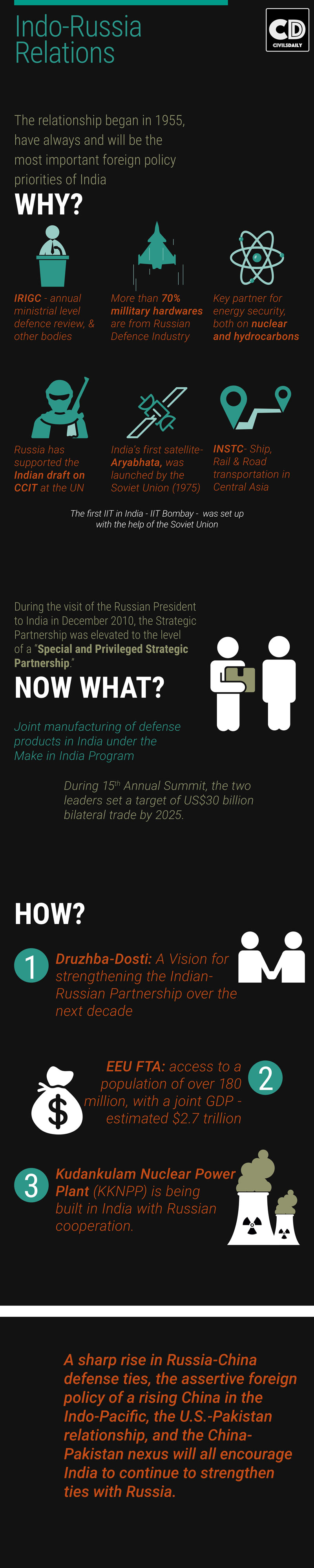
    • Relations with Russia are a key pillar of India’s foreign policy, and Russia has been a longstanding time-tested partner of India.
    • India & Russia signed “Declaration on the India-Russia Strategic Partnership” in October 2000.
    • Under the Strategic Partnership, several institutionalized dialogue mechanisms operate at both political and official levels to ensure regular interaction and follow up on cooperation activities.
    • During the visit of the Russian President to India in December 2010, the Strategic Partnership was elevated to the level of a “Special and Privileged Strategic Partnership.”

    Let’s dive into the PM’s visit for bilateral summit in Russia?

    • With the signing of sixteen agreements, this is being seen as very significant in sustaining and expanding India-Russia ties.
    • One major step taken is a deepening of India’s defense partnership with Russia for Make in India.
    • On the eve of Modi’s visit to Russia, the Indian government announced the purchase of five S-400 supersonic air defense systems from Russia, costing around $6 billion.
    • For instance, the two sides agreed that the Kamov 226 helicopter would be manufactured in India.

    How will bilateral partnership boost Make in India programme?

    • India and Russia agreed to strengthen the defense partnership in line with the “Make in India” program. So while only the public sector has been involved in defense cooperation between the two countries to date.
    • The new initiatives will encourage joint manufacturing of defense products in India and motivate the private sector to play a role in developing a strong defense manufacturing base in India.
    • It should be emphasized that “Make in India” also aims at having India emerge as an essential player in the global defense market.
    • India is forecast to spend $250 billion over the next decade upgrading its military and Russia wants to seize the opportunity to become a major part of this mission, expressing its readiness to work jointly with India on defense manufacturing.

    So, How does economic and trade cooperation matters in economic growth?

    • Enhancing trade and economic cooperation between India and Russia is a key priority for the two governments.
    • On the economic front, India and Russia decided to institutionalize the CEO’s Forum, which will meet twice a year – once in India and the other in Russia.
    • During 15th Annual Summit, the two leaders set a target of US$30 billion bilateral trade by 2025.
    • Hydrocarbons is an active area for exploring cooperation between the two countries.
    • In May 2014, ONGC and Rosneft signed an MoU for bilateral cooperation in subsurface surveys, exploration, appraisal and hydrocarbons production in the offshore Arctic region of Russia.
    • In September 2015, OVL signed an agreement with Rosneft to acquire 15% stakes in Vankorneft project.


    Did you know about India-Eurasian Economic Union FTA?

    • Moscow is a gateway for India to Central Asia.
    • In this regard a significant move by PM Modi was the effort to move forward on the India-Eurasian Economic Union (EEU) Free Trade Agreement (FTA).
    • The EEU FTA will introduce the free movement of goods, capital, services and people-people contacts and provides for common transport, agriculture and energy policies, with provisions for a single currency and greater integration in the future.
    • The FTA between India and the EEU comprises of Russia, Belarus, Armenia, Kyrgyzstan, and Kazakhstan.
    • It offers India access to a huge market with a population of over 180 million, with a joint GDP of an estimated $2.7 trillion.
    • As Russia tries to re-calibrate its economic orientation towards the Asian region, India, as one of the fastest growing G20 economies can be a significant partner for Russia.

    Shall we move into Political Relations?

    • Annual Summit meeting is the highest institutionalized dialogue mechanism under the Strategic Partnership between India and the Russian Federation.
    • So far, 15 Annual Summit meetings have taken place alternatively in India and Russia with the 15th Annual Summit held in New Delhi during the visit of President Putin to India on 11 December 2014.
    • During the Summit, 20 documents were signed covering cooperation in nuclear energy, defence, hydrocarbons, science & technology, trade and investment etc.
    • Prime Minister Modi and President Putin also adopted a Joint Statement “Druzhba-Dosti: A Vision for strengthening the Indian-Russian Partnership over the next decade.”

    Let’s see our Defence Cooperation with Mighty Russia?

    • India-Russia military technical cooperation has evolved from a simple buyer – seller framework to one involving joint research, development and production of advanced defence technologies and systems.
    • BrahMos Missile System, Joint design and development of the Fifth Generation Fighter Aircraft, as well as the licensed production in India of SU-30 aircraft and T-90 tanks, are examples of such flagship cooperation.
    • An Indian contingent participated in the military parade in Moscow on 9 May 2015, during the 70th anniversary of the victory in the World War II.
    • The Inter Governmental Commission on Military Technical Cooperation (IRIGC-MTC) is in place to review defence cooperation between the two countries.

    Let’s know about importance of International North-South Trade Corridor (INSTC) ?

    • The INSTC was initiated by Russia, India and Iran in September 2000.
    • To establish transportation networks among the member states and to enhance connectivity with the land locked region of Central Asia.
    • The North-South Transport Corridor is an ancient route that connected South Asia with North Europe for centuries.
    • This route was used by the European, Indian, Russian and many other foreign traders.
    • During the late 17th and early 19th centuries, Indian traders used this route to reach out to the Central Asian markets.
    • The modern day INSTC is a multi-modal transportation route linking Indian Ocean and Persian Gulf to the Caspian Sea via Iran, and onward to northern Europe via St. Petersburg in Russia.

    How is it important to India to protect its strategic and economic interest?

    • The INSTC envisages movement of goods from Mumbai (India) to Bandar Abbas (Iran) by sea, from Bandar Abbas to Bandar-e-Anzali (an Iranian port on the Caspian Sea) by road.
    • Then from Bandar-e-Anzali to Astrakhan (a Caspian port in the Russian Federation) by ship across the Caspian Sea, and thereafter from Astrakhan to other regions of the Russian Federation and further into Europe by Russian railways.
    • Given India’s strategic interests in the West and the Central Asian region, and need for greater economic and energy cooperation between South, Central and the West Asian region.
    • New Delhi has stepped up its engagement to reconnect with its extended neighbourhood.

    Was there any momentum on Nuclear power deal?

    • Russia is an important partner in peaceful uses of nuclear energy and it recognizes India as a country with advanced nuclear technology with an impeccable nonproliferation record.
    • In December 2014, Department of Atomic Energy (DAE) and Russia’s Rosatom signed the Strategic Vision for strengthening cooperation in peaceful uses of atomic energy between India and Russia.
    • Kudankulam Nuclear Power Plant (KKNPP) is being built in India with Russian cooperation.
    • KKNPP Unit 1 became operational in July 2013, and attained full generation capacity on 7 June 2014.
    • While its Unit 2 is in the process of commissioning in the later part of 2015.
    • India and Russia have signed a General Framework Agreement on KKNPP Units 3 & 4 and subsequent contracts are under preparation.

    What’s Next to the geopolitical space?

    • Needless to say, defence remains at the centre-stage of the bilateral relationship, although with a diversified supplier base India is at a better position today to negotiate deals with Russia especially concerning technology transfer and co-production.
    • A sharp rise in Russia-China defense ties, the assertive foreign policy of a rising China in the Indo-Pacific, the U.S.-Pakistan relationship, and the China-Pakistan nexus will all encourage India to continue to strengthen ties with Russia.
    • It is clear that India-Russia relations remain vital for both countries amid a changing regional and global security environment.

    Published with inputs from Arun
  • Outcome of Paris Climate Summit

    Paris Agreement was recently adopted by 195 countries of UNFCCC, which agreed to take measures to control climate change.

    We had written 4 explainers for a comprehensive coverage and they can be read here – 

    As we move ahead, let’s take a look at this agreement with respect to various dimensions and debates, which are going on in the international sphere.

    When this agreement will enter into force?

    The agreement in Paris will come into effect only after 2020 when the Kyoto Protocol, an existing international mechanism to deal with climate change, comes to an end.

    What is the temperature goal?

    The agreement says that its objective is to keep the global temperature rise below 2 degree Celsius, but pursue efforts to keep it below 1.5 degree Celsius from pre-industrial times.

    It also says that IPCC will come with a special report in 2018 on the impacts of global warming of 1.5 degree Celsius and above pre-industrial levels. <IPCC reports form the scientific basis on which the world is taking climate action>

    Let’s analyse the implications

    • Least Developed Countries (LDCs) and Small Island Developing Countries (SIDCs) were demanding that the rising temperature be kept under 1.5 degree Celsius from pre-industrial times.
    • LDCs fear that cost of adaptation will be high, if the temperature is allowed to risee upto 2 degree Celsius.

    What about Finance and Technology Transfer ?

    Finance

    Developed nations have been asked to provide financial resources, but $ 100 bn mark does not figure in the agreement. $ 100 bn has been shifted to the decision text, which is a list of all decisions taken at the conference.

    Developing countries are also asked to raise financial resources, even as voluntary effort.< This was one of the demands of the developed countries to widen the base of countries who will provide financial resources>

    There has to be a balance between the mitigation and adaptation needs of the developing countries, while allocating financial resources.

    Technology

    The developed countries to abide by their promises to provide technology development and transfer, and capacity building to developing countries.

    Why is it a matter of concern?

    • Paris Agreement is a permanent document, while the decisions of the conference can be modified.
    • This gives a message that developed nations will provide $ 100 bn every year from 2020, but they will not increase it annually, as demanded by developing countries.

    Carbon Neutral, by when?

    The agreement says that, world should peak emissions as soon as possible and achieve a balance between sources and sinks of greenhouse gases (GHGs) in the second half of this century.

    This means that to limit the amount of GHG emitted by human activity to the same levels which can be absorbed naturally such as trees, soil, ocean, etc beginning 2050.

    What happens to INDCs?

    In the run-up to the Paris conference, 186 countries submitted their INDCs, giving information about the climate actions they planned to take until 2025 or 2030. INDCs would henceforth be called only Nationally Determined Contributions.

    Every country needs to communicate NDCs every 5 years. Each NDC has to be progressively more ambitious than the previous one.

    However, NDCs are not legally binding, i.e. the targets set by nations will not be binding under the Paris Climate Agreement. <India, China and South Africa were unwilling to sign up for this condition because they felt that it could hamper economic growth and development>

    What is Global Stocktake?

    • It refers to a proposed a 5-yearly review of the impact of countries climate change actions.
    • It will assess whether the net result of the climate actions being taken was consistent with the goal of keeping the increase in global average temperature from pre-industrial times to within 2 degree Celsius.
    • It is mandatory for every country to participate in the global stocktake, the exercise will not assess whether actions of any individual country are adequate or not.

    The best part of global stocktake is that it will also assess whether developed countries are adequate help to developing countries by providing money and technology.

    Is Differentiation principle at Stake?

    Experts are divided on whether developed countries succeeded in their effort to do away with concept of Common But Differentiated Responsibilities.

    The Paris agreement firmly anchors ‘differentiation’ for developing countries. At many places, differentiation is achieved by having different kind of commitments for developed and developing countries.

    Developed countries are expected to take the lead on mitigation and support, while developing countries are expected to take actions within the context of their sustainable development and poverty eradication imperatives.

    Let’s see what is the other point of view.

    • All parties have to report NDCs every 5 years.
    • There is no differentiation in reporting, inventory of GHGs and progress made in implementation of NDCs.< Inventory is basically a list of all units which release GHGs>
    • The stocktake is universal for aggregate actions and it will happen in 2023 and every 5 years henceforth.
    • Developed countries are asked to take absolute economy-wide emission reduction targets, while developing countries will enhance mitigation efforts, but are encouraged to move towards economy-wide reduction in the light of national circumstances.

    Published with inputs from Pushpendra 
  • Striking the Sec 66A of IT Act: The Shreya Singhal Case

    Supreme Court takes freedom of speech to the Net by striking down much abused Section 66A. The apex court has reaffirmed the importance of free speech.

    Do you remember? It is the same provision which became famous following the arrest of two girls for posting content against the bandh called for Bal Thackeray’s death. Since then, several arrests have been made by different State police.

    The provisions were challenged in Supreme Court by a law student, and the case came to be known as – Shreya Singhal vs Union of India 2015.

    What are the provisions of Information Technology Act, 2000?

    • It regulates the use of internet including the message service, social media, etc.
    • It creates separate offences for the misuse of internet & prescribes higher punishment for similar offences committed in print/electronic media.
      For Example –

      • Sec 66A made defamation as cognizable offence with a punishment of not more than 3 years with/without fine. <But, same offence is a non-cognizable offence under IPC>
      • Sec 67A of IT Act, confers a punishment that may range from 5-10 years of imprisonment with 1-2 lakh fine, for transmitting the obscene or vulgar offences across internet.< A similar offence would attract lesser punishment under IPC>
    • Sec 69A provided power to govt. to issue directions to block public access of any information through any computer source.

    Why Section 66A was challenged?

    • Section 66A had extremely wide parameters, which allow whimsical interpretations by law enforcement agencies.
    • There was no clarity over terms like offensive, grossly menacing, causing annoyance, etc opening it to many interpretations.
    • It outlawed all political satire, cartoons, caricatures and spoof writing indirectly.

    What was Govt. of India’s stand to protect Section 66A?

    • The Section 66A of the IT Act acts as a necessary deterrent against publishing or writing “objectionable” or “grossly offensive” contents in cyberspace.
    • The provision is essential for controlling inflammatory content provoking violence.
    • The Centre failed to impress the bench, by assuring that it will be administered in a reasonable manner.

    How Section 66A was in conflict with Fundamental Rights?

    It violated the freedom of speech and expression given under Article 19 (1)(a).

    ISP argued that it even violated right to equality given under Art. 14, as separate offences cannot be created for people using internet. < However, SC rejected this opinion, because there is clear intelligible difference between internet and other medium of communication. Can you imagine, what is the difference, please post in the comments box>

    What was court’s judgment in Shreya Singhal vs Union of India Case?

    • SC held that Sec 66A is unconstitutional and void on the ground that it was excessively vague, open-ended and undefined.
    • It did not give clear direction, either to the users of internet or to the law enforcement agencies on what acts performed on internet would amount to defamation.
    • Court held that vagueness of Sec 66A, took away the freedom of speech and the right to descent. It had a intimidating effect on free speech.

    Why scrapping Section 66A may not be in India’s best interests?

    • Some experts argue that India’s IT Act provides legal remedies for a just a handful of cyber crimes & many have been left out.
    • The new kinds of cyber crimes are emerging on a daily basis, which was facilitated by the vagueness of Sec 66A.
    • The ruling will only mean several steps backwards for the govt. and the country on this aspect.
    • However, it maybe very difficult to prove instances of cyber stalking, bullying or annoyance by applying provisions of the non-Internet world. < These activities are easily facilitated by the instant nature of the Internet>

    Why did SC upheld Section 69A of the IT Act?

    • SC upheld the constitutional validity of section 69A, which is exercised by govt. to issue directions to block an internet site.
    • Although, reasons for blocking have to be recorded in writing, which would be amenable to judicial scrutiny.
    • Powers under section 69A comes under ‘reasonable’ restriction as expressed in article 19(2) and thus it is legal.

    Published with inputs from Pushpendra
  • China-Pakistan Equation: Is it India’s Dilemma?

    In April, China struck 51 agreements with all-weather ally Pakistan, including the multibillion dollar economic corridor through the PoK that will expand the communist giant’s influence in India’s neighbourhood.

    Before we deep dive, let’s first know historical background

    Kashmir_region_2004
    India claims the entire erstwhile princely state of Jammu and Kashmir based on an instrument of accession signed in 1947. Pakistan claims Jammu and Kashmir based on its majority Muslim population, whereas China claims the Shaksam Valley and Aksai Chin.

    • The origin of the Sino-Pak equation could be traced in China–Pakistan Economic Corridor (CPEC), finds root to the Border Agreement of 1963, considered a milestone in China-Pakistan relations.
    • The agreement ceded the 5000 plus square mile Trans Karakorum Tract to China and served as a precursor to the Karakoram Highway, conceived later as a strategic link defining China and Pakistan’s ‘all-weather friendship’.
    • The then Defence Minister of India, Krishna Menon, elaborately enunciated India’s position on the issue at the UN, condemning the agreement as illegitimate.
    • Besides, India lodged an “emphatic protest” to China and conveyed its concerns in a letter of protest.
    • Decades down the line, while India’s policy orientation and broader claim on Gilgit Baltistan remains unchanged, its stance on Chinese investments in the Karakoram Highway, and Chinese efforts to leverage this territorial link to build a strategic corridor, is perceived to be weakening over time.

    What is the China–Pakistan Economic Corridor (CPEC) project?

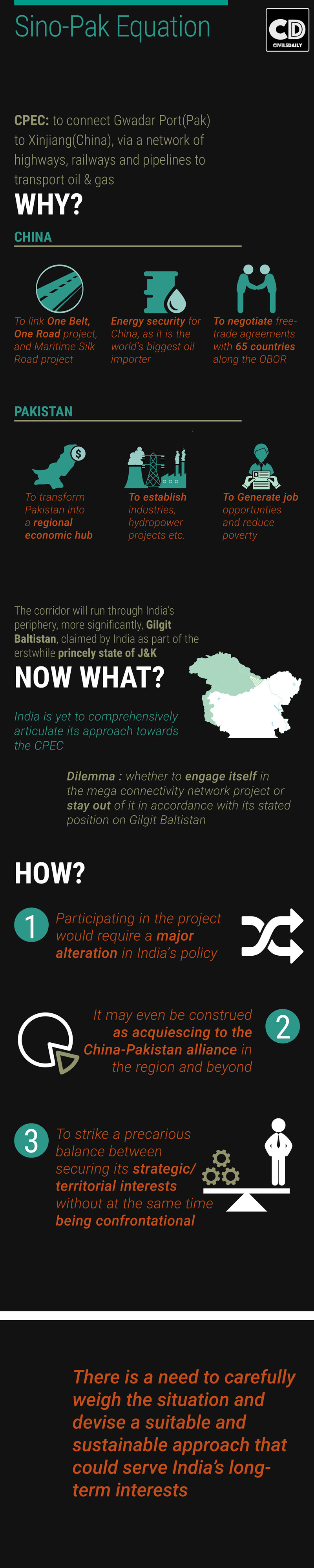
    • The China–Pakistan Economic Corridor (CPEC) is biggest connectivity project aims to connect Gwadar Port in southwestern Pakistan to China’s northwestern autonomous region of Xinjiang, via a network of highways, railways and pipelines to transport oil and gas.
    • The economic corridor is considered central to China–Pakistan relations and will run about 3,000 km from Gwadar to Kashgar.
    • The Corridor is an extension of China’s proposed 21st century Silk Road initiative.
    • According to a Firstpost report, this is the biggest overseas investment by China announced yet and the corridor is expected to be operational within 3 years.

    Why Gwadar Port is strategically so important to China?

    • Gwadar forms the crux of the CPEC project, as it is envisaged to be the link between China’s ambitious One Belt, One Road (OBOR) in Maritime Silk Road project.
    • In total, more than $1 billion worth of projects are to be developed around the port of Gwadar by December 2017.

    But, what are the geopolitical reasons to China’s OBOR project?


    • There are compelling geopolitical reasons, such as energy security, for China to push forward with its One Belt, One Road plans at a time when its trading partners are potentially excluding it from strategic agreements.
    • Trans-Pacific Partnership (TPP) countries, the Transatlantic Trade and Investment Partnership (TTIP) and the EU-Japan agreement show comprehensive liberalisation agendas, but do not include China and have the potential to increase trading costs.
    • In response, China plans to negotiate free-trade agreements with 65 countries along the OBOR.
    • Until now China has signed 12 free-trade agreements including Singapore, Pakistan, Chile, Peru, Costa Rica, Iceland, Switzerland, Hong Kong and Taiwan.
    • Further 8 are under negotiation with Japan, Korea, Australia, Sri Lanka, Norway, the Regional Comprehensive Economic Partnership, Asean and the Gulf Cooperation Council (GCC).

    How will CPEC benefits to Pakistan ? Is it a Game changer for Pak?

    • China and Pakistan hope the massive investment plan will transform Pakistan into a regional economic hub as well as further boost the growing ties between Pakistan and China.
    • The CPEC is considered a significant project that seeks to cement Sino-Pakistan bilateral ties and further consolidate their strategic ties.
    • According to The Guardian, “The Chinese are not just offering to build much-needed infrastructure but also make Pakistan a key partner in its grand economic and strategic ambitions.”

    What’s the claim from India in CPEC?

    • The corridor will run through India’s periphery, more significantly, Gilgit Baltistan, claimed by India as part of the erstwhile princely state of J&K.
    • In due course, this geographical reality of the CPEC could potentially impinge upon India’s geopolitical calculations and pose a strategic challenge.

    How does China look at CPEC?

    • In December 2014, the Chinese state-run Xinhua published a statement announcing the closure of the strategic Khunjerab Pass and in the process referred to Gilgit Baltistan as part of Pakistan.
    • Until then, China had maintained that J&K was a bilateral problem/dispute between India and Pakistan.
    • Whether terming Gilgit Baltistan as part of Pakistan reflected a possible shift in the Chinese position on the J&K— a change from its previously held neutral position – was debated in the Indian media for a while.
    • In the Gilgit Baltistan segment, the CPEC project design includes a major expansion of the Karakoram Highway, establishing industrial parks in special economic zones, constructing hydropower projects, railway line and road building.
    • The project also entails building hydropower projects and motorways/highways in the so-called Azad Jammu and Kashmir (AJK).

    What’s the India’s claim and response to it?

    • India’s High Commissioner to Pakistan, noted: “India has no worry over the construction of Pakistan-China Economic Corridor as an economically strong Pakistan would bring stability in the region.”
    • India is yet to comprehensively articulate its approach towards the CPEC despite the fact that the corridor bodes strategic implications for India.
    • The corridor will pass through the Gilgit Baltistan region where China has invested in the past in infrastructure and hydropower projects.
    • India has occasionally raised objections to Chinese infrastructure investment in the region.
    • New Delhi’s move to raise objections to Pakistan’s plan of holding an election in Pakistan-occupied Kashmir’s Gilgit-Baltistan region may appear to be an afterthought.
    • In fact, the belated assertion of a simple principle: In a dispute, express your maximal position, rather than the one you will compromise on.

    Is it India’s Dilemma?

    • Is it because of a realization that in a changed strategic landscape, the options for India vis-a-vis a project like CPEC are limited and complicated?
    • Is India conflicted about whether to engage itself in the mega connectivity network project or stay out of it in accordance with its stated position on Gilgit Baltistan and the so-called AJK?


    How does it pose a policy challenge to India?

    • Participating in the project would require a major alteration in India’s policy.
    • Overlooking the territorial dimension could be interpreted as a massive climb-down from its stated position.
    • It may even be construed as acquiescing to the China-Pakistan alliance in the region and beyond.
    • Thus, the CPEC poses a policy challenge to India on how best to strike a precarious balance between securing its strategic/territorial interests without at the same time being confrontational.
    • Charting a policy course is essential since China has, of late, through stray remarks extended an invitation for India to participate in the Silk Route ‘one route one belt’ project.

    How will CPEC get materialised despite scepticism?

    • Ironically, in Pakistan itself, there is growing cynicism about the CPEC’s prospects and feasibility because of security-related concerns and inter-provincial political discord on route preferences.
    • Nevertheless, given the Chinese determination to find a route to oil-rich West Asia through Pakistan, and the Pakistani desperation to provide every possible assurance to China about safeguarding its investments, the project is likely to be implemented, even if its scope may be limited.
    • One has to remember that China and Pakistan have weathered geographical and logistical extremes in the past to build the highest metalled road on one of the toughest terrain, i.e. the Karakoram Highway.
    • Moreover, the Pakistani decision to raise a special security division to protect Chinese workers and interests in Pakistan, indicates its resolve to implement the project in all earnestness.

    The Way forward

    • While India’s overall stance on PoK remains understated, the commencement of the CPEC warrants more serious attention than what has been accorded so far.
    • There is a need to carefully weigh the situation and devise a suitable and sustainable approach that could serve India’s long-term interests.
    • It is imperative that some of the explicit strategic concerns regarding the CPEC figure in the bilateral round of talks during the Indian Prime Minister’s forthcoming visit to Pakistan.

    What do you think on such a big triangular geostrategic politics? How will it resolved from Sino-India relations? Let us know!


    Published with inputs from Arun | Image: Wikipedia
  • All that you need to remember about the Indian Remote Sensing satellite system

    Let’s clear up some basics from Indian Remote Sensing satellites, as we have seen it in the newscard @Civilsdaily App, but take a glance for IRS knowhow.


    Let’s first take a look in history?

    • The launch of India’s first civilian IRS-1A in March 1988, marked the beginning of a successful journey in the course of the Indian Space Programme.
    • The Indian Earth Observation activities carried out under the National Natural Resources Management System (NNRMS).
    • With a host of payloads in the thematic series of Indian Remote Sensing Satellites (IRS) and the INSAT systems, the Indian Earth Observation (EO) system has been providing operational services to the user community.

    What is the IRS Satellite system?

    • The Indian Remote Sensing satellite system has one of the largest constellations of remote sensing satellites in operation in the world today.
    • IRS series of satellites provide data in a variety of spatial, spectral and temporal resolutions.
    • With these and the planned thematic series of satellites, such as Cartosat-3, Megha Tropiques, SARAL, and Insat-3D.
    • The National Remote Sensing Centre (NRSC) is the focal point for distribution of remote sensing satellite data products in India and its neighboring countries.
    • NRSC has an earth station at Shadnagar, about 55 Km from Hyderabad, to receive data from almost all contemporary remote sensing satellites.

    But, What is Megha-Tropiques?

    • Megha-Tropiques is an Indo-French Joint Satellite Mission for studying the water cycle and energy exchanges in the tropics.
    • The main objective is to understand the life cycle of convective systems that influence the tropical weather and climate and their role in associated energy and moisture budget of the atmosphere in tropical regions.


    Let’s know some IRS satellites in brief

    RESOURCESAT – 1

    • RESOURCESAT – 1, the tenth satellite in IRS series, was launched onboard PSLV – C5 in 2003.
    • It was placed in 820 km high polar Sun Synchronous Orbit.
    • The images and data are being used for advanced applications like vegetation dynamics, crop yield estimates, disaster management support.

    CARTOSAT – 1

    • CARTOSAT – 1 was launched into a 617 km polar sun synchronous orbit in 2005 on board PSLV – C6 from Satish Dhawan Space Centre (SDSC), SHAR, Sriharikota.
    • The data from Cartosat-1 is used for the preparation of cartographic maps, cadastral mapping updation, land use and GIS applications.

    OCEANSAT – 2

    The main objectives of OCEANSAT – 2 are to study surface winds and ocean surface strata, observation of chlorophyll concentrations, monitoring of phytoplankton blooms, study of atmospheric aerosols and suspended sediments in the water.

    RISAT – 2

    • RISAT – 2 is a Radar Imaging Satellite using an active SAR (Synthetic Aperture Radar) imager with all weather capability to take images of the earth.
    • This Satellite will enhance ISRO’s capability for Disaster Management applications.
    • India’s first satellite with SAR and has a day-night, all-weather monitoring capability.

    SARAL

    • SARAL or Satellite with ARgos and ALtiKa is a cooperative altimetry technology mission of ISRO and CNES (Space Agency of France), was successfully launched on 25 February 2013.
    • The overall objectives are to assess development of operational oceanography, understanding of climate and developing forecasting capabilities.

    Published with inputs from Arun
  • Sagarmala Project: Smart ports for Blue Revolution in India

    The Union Cabinet chaired by the Prime Minister Modi, on March,2015 gave its ‘in-principle’ approval for the concept and institutional framework of Sagarmala Project. Let’s take a glance on it.


    What’s the prime objective of Sagarmala?

    The prime objective of the Sagarmala project is to promote port-led direct and indirect development and to provide infrastructure to transport goods to and from ports quickly, efficiently and cost-effectively.

    What’s the current issue and background of ports in India?

    • At present there are around 200 ports (small and big) in the country, of these, only 12 are major ports which are government owned ports, which handle about 58% of sea-borne traffic.
    • These major ports operate as Trusts under the Major Ports Trust Act, 1963, except for the Port of Ennore, which is a company under the Companies Act.
    • There are legacy issues with these govt owned major ports, they do not keep pace with emerging technology, requirements of international trade, emerging trends in containerisation, flexible rules, size of ships etc.

    Which are the 12 Major Ports ?

    These are Kolkata (including Dock Complex at Haldia), Visakhapatnam, Chennai, V.O. Chidambaranar (Tuticorin), Cochin, New Mangalore, Mormugao, Jawaharlal Nehru Port Trust (JNPT), Mumbai, Kandla and Ennore.


    Just, Look back into the history?

    In 2003, then PM Vajpayee proposed Project Sagarmala with following features:

    • Setup Sagarmala Development Authority (Similar to National highway authority of India).
    • It will get money via Maritime development cess. (5 paise per kg on cargo).
    • It will improve ports, shipping industry, inland water transport, coastal shipping.
    • PPP and FDI to gather more investment.

    Then, which are the Key pillars to achieve Smart-development ?

    • Supporting and enabling Port-led Development through appropriate policy and institutional interventions.
    • Providing for an institutional framework for ensuring inter-agency and states’ collaboration for integrated development.
    • Port Infrastructure Enhancement, including modernization and setting up of new ports.
    • Efficient Evacuation to and from hinterland.

    What are some of the measures to make Smart Ports?

    • Ports should be registered as Companies under Companies Act.
    • The port administration should only look after the provisions of infrastructure and safety and not day-to-day running of the port
    • There is still no regulation to control the trade practices.
    • Hence, there is a dire need to introduce a regulatory architecture that takes care of ex-ante declaration of rates of services.

    Then, what’s the plan to implement such a vast initiative?

    • For a comprehensive and integrated planning for “Sagarmala”, a National Perspective Plan (NPP) for the entire coastline shall be prepared within six months.
    • It will identify potential geographical regions to be called Coastal Economic Zones (CEZ).
    • While preparing the NPP, synergy and integration with planned Industrial Corridors, Dedicated Freight Corridors, National Highway Development Programme, Industrial Clusters and SEZs would be ensured.

    What are the suggestions for effective mechanism at state level?

    • Set up State Sagarmala Committee to be headed by CM / Minister in Charge of Ports.
    • Sagarmala Coordination and Steering Committee (SCSC) shall be constituted under the chairmanship of the Cabinet Secretary and others.
    • This Committee will provide coordination between ministries, state governments and agencies connected with implementation and review the progress of implementation of the National Perspective Plan.

    How does it ensure the sustainable development in CEZ?

    • This would be done by synergising and coordinating with State Governments and line Ministries of Central Government through their existing programmes.
    • Such as those related to community and rural development, tribal development and employment generation, fisheries, skill development, tourism promotion etc.
    • In order to provide funding for such projects and activities that may be covered by departmental schemes a separate fund by the name ‘Community Development Fund’ would be created.

    What’s the role of Institutional Framework ?

    • It has to provide for a coordinating role for the Central Government.
    • It should provide a platform for central, state governments and local authorities to work in tandem and coordination under the established principles of cooperative federalism.

    What’s the role of NSAC?

    A National Sagarmala Apex Committee (NSAC) is envisaged for overall policy guidance and high level coordination, and to review various aspects of planning and implementation of the plan and projects.

    So, Is it Good to have smart ports on the line of Smart Cities?

    Can you answer some questions?

    #1. Can you examine the bottlenecks in Indian port infrastructure and list the initiative taken in recent times to address this issue?

    #Q.2 Indian port infrastructure can be revamped by Sagarmala project by effective management? critically comment.


    Published with inputs from Arun
  • Freedom of Speech and Criminal Defamation Law

    Recently, Supreme Court has reserved its verdict on constitutional validity of criminal defamation law.

    Lets try to understand the concept of defamation and then we will move on to criminal defamation and its relation with fundamental rights, which is the center-point of the debate.

    What is Defamation?

    Defamation means destroying the reputation of an individual or organisation through slander (speech), libel (written) or both.

    Slander: To make a false spoken statement that causes people to have a bad opinion of someone.
    Libel: The act of publishing a false statement that causes people to have a bad opinion of someone.

    Defamation gives rise to both civil and criminal liability.
    This means that the guilty may be punished with a simple imprisonment of less than 2 years arising out of criminal liability and/or he may be subjected to monetary compensation arising out of civil liability.

    What does IPC have to say about Defamation?

    There are two sections under IPC, viz. Sec 499 and Sec 500, which pertains to the criminal defamation.

    Sec 499: Whoever, by words either spoken or intended to be read, or by signs or by visible representations, makes or publishes any imputation concerning any person intending to harm, or knowing or having reason to believe that such imputation will harm, the reputation of such person, is said, except in the cases hereinafter expected, to defame that person.

    Sec 500: Punishment for defamation: Whoever defames another shall be punished with simple imprisonment for a term which may extend to two years, or with fine, or with both.

    PIL petitions were filed before the SC arguing that criminalisation of defamation deters free speech.

    What was government’s stand in the SC?

    • Govt argued that in India citizens are unlikely to have enough liquidity to pay damages for civil defamation.
    • Online defamation in the Internet age can be effectively countered only by making it a criminal offence, and that the law is part of the state’s compelling interest to protect the dignity and reputation of citizens.

    What is the criticism of criminal defamation?

    • Citizens are afraid of expressing their opinion freely and openly because of possible fear of punishment.
    • It indirectly violates the freedom of press, as it has chilling effect on the publication of free and independent news articles.
    • Section 499 and 500 prevent the citizens from even expressing their legitimate criticism of govt. and public officials.
    • The recent history of defamation laws is riddled with misuse by politicians and corporate’s to silence the media, activists and criticism.

    Why there are concerns regarding its misuse?

    • It is liable to be misused where many complaints can be filed across the country in various courts against the person for allegedly making a single defamatory statement.
    • This possibility of misuse of Sec 499 and 500 has an intimidating effect on the citizen and they are afraid of using their right under Article 19(1)(a) freely.
    • Critics of such a law argue that civil liability is a sufficient means of safeguarding the reputation of person.

    Let’s know a bit about Article 19(1)(a) and Art 19(2)

    Article 19(1)(a) confers right to freedom of speech and expression on all citizens.

    Article 19(2) allows the state to make laws which impose reasonable restrictions on this right in the interests of the sovereignty and integrity of India, the security of the state, friendly relations with foreign states, public order, decency or morality or in relation to contempt of court, defamation or incitement to an offence.

    What are concerns, if the criminal liability is removed?

    • The argument says that in the absence of penal provisions, there will be no deterrence against the misuse of free speech to destroy the reputation of a person which is earned over his lifetime.
    • If the defamation is to be treated merely as a civil liability, then the defamer may be too poor to pay compensation to the victim and it cannot act as a sufficient deterrent.
    • During elections, the absence of criminal liability will give rise to hate speeches more frequently destroying the free and fair nature of elections in the country.

    How to strike the balance between the two extremes?

    There is a need to balance free speech and dignity of an individual which is possible only by retaining the criminal nature of defamation.

    If Sec 499 and 500 are misused, the logical approach should be to place a regulatory mechanism to prevent that misuse, but not to withdraw them.


    Published with inputs from Pushpendra


  • Khawalailung village: A Mizo ‘role model’ of Peace and Development

    On 25th October 2015’s ‘Mann-ki-Baat’ radio programme through All India Radio, when the Prime Minister Narendra Modi took the name of the hitherto little known Mizoram’s Khawalailung village from the remote Champai district, most Mizos were impressed.

    Almost the entire state echoed in one tone ‘kalaw mein’ (Thank You in Mizo language) to the Prime Minister Sh. Narendra Modi for his radio talk.

    Khawahlailung_village_mizoram


    So, What’s special about Khawalailung villages?

    Most Mizo villages are community maintained, disciplined and clean. Visitors are often stunned to witness the kind of self-governing mechanism, even symbolism and perfectionist methods are maintained on the movement of dogs, cattle and chickens in these villages.

    Community and voluntary works are held to clean the village frequently, butchering of animals and selling meat on roadsides are banned and animals are slaughtered only in an appointed slaughterhouse and meat, staple food of the natives are sold only in a designated meat market. There are also segregated areas for selling fish.

    How is this change inclusive of the Swachh Bharat Abhiyan? 

    Cleanliness of villages across Mizoram, across northeastern India and the rest of India is also part of an ambitious national programme being undertaken under Swachh Bharat Abhiyan.

    Now the village Khawalailung will be perhaps in a position to be showcased as a model village under both National Clean Mission and also Sansad Adarsh Gram Yozana.

    The new Adarsh Gram Yojana is a Rural Development programme, broadly focusing upon the development in the villages which includes social development, cultural development and spread motivation among the people on social mobilization of the village community. This programme was also launched by the on the birth anniversary of Jayaprakash Narayan on 11 October, 2014.

    Some statistics about this special village

    To start with, one vital statistics about the village Khawlailung is that the hamlet has higher literacy rate compared to the state’s (Mizoram) own records. In 2011, literacy rate of Khawlailung village was 95.05 per cent compared to 91.33 per cent of Mizoram. In Khawlailung Male literacy stood at 97.01 per cent while female literacy rate was 93.10 per cent.

    How do Mizo villages transform into Model Villages?

    Under the ‘model village’ or Adarsh Gram programme, Khawlailung village with a population of 520 villagers has already taken important initiatives, like a Joint Action Committee (JAC) was constituted in the village to check the menace of drugs and alcohol-related problems.

    Seminars on importance of cleanliness were held many times in the village and many sanitation groups were formed to undertake practical work.

    For projects under the aegis of Agriculture sector, the village was also benefitted with the grant of machines for juicing sugarcane for 22 families engaged in manufacture of molasses/raw sugar (gur) at a highly subsidised rate.

    Similarly, beneficiaries were identified and assistance provided under the Integrated Wasteland Development Project (IWDP) for construction of farm pond and terrace.

    Under Rashtriya Krishi Vikas Yojana (RKVY) families were also identified and provided with one piglet each. In fact, the list of good works in the tiny village can go on.

    But what needs to be appreciated and in fact emulated is the pragmatic and inherently hard working nature of the Mizo people.

    If the villagers in other northeastern states and more so in rural areas in states like Jharkhand and Chhattisgarh can emulate the Mizo people, things can change a lot.

    Originally a primordial economy, Mizoram today represents a modern society with higher rate of literacy, good knowledge bank of English education and quality works in cane works, handloom and agriculture.

    Truly, going by the spirit of the statement, it is high time for the people of the region to mobilise wider public opinion against all sorts of violence and bring about lasting peace in the north east region.


    Source - PIB features | Pic - Mizo
  • UNFCCC Updates : Lima-Paris Action Agenda

    As we know, 21st Conference of the Parties (COP21) to the United Nations Framework Convention on Climate Change (UNFCCC) in Paris making a progress on crucial climate change issue. Let’s take a glance on Lima-Paris Action Agenda


    What’s the prime motive of LPAA?

    1. The Lima-Paris Action Agenda (LPAA) is a joint undertaking of the Peruvian and French COP presidencies, the Office of the Secretary-General of United Nations and the UNFCCC Secretariat.
    2. It aims to strengthen climate action throughout 2015, in Paris in December and well beyond through mobilizing robust global action towards low carbon and resilient societies.

    What are the LPAA initiatives – addressing Water and Ocean Resilience?

    • Paris Pact on Water and Adaptation
    • MegaCities Coalition on water
    • Business Alliance for Water and Climate Change
    • Adaptation of the West African coastal areas
    • Maritime Regions in Action against Climate Change.

    What’s the Paris Pact on Water and Climate Change Adaptation?

    • A broad coalition of nations, river basin organizations, business and civil society announced the creation of the international Paris Pact on Water and Climate Change Adaptation.
    • This is to make water systems, the very foundation of sustainable human development, more resilient to climate impacts.
    • Water Resilience Focus event highlighted key partnerships and coalitions to make river basins, lakes, aquifers and deltas more resilient to climate change and reduce human interference with oceans.
    • Almost 290 water basin organisations are engaged under pact.


    What’s the scope of Paris pact on Water?

    These major collaborative projects combined represent over US$20 million in technical assistance and potentially over US$ 1 billion in financing.

    They include –

    • A financial commitment by India to build climate resilience through improved groundwater management.
    • In the Niger Basin (9 African countries involved), the launch of a 10-year investment plan to strengthen resilience to climate change.
    • In Jordan, Lebanon, Monaco, Morocco, Spain and Tunisia, a 7-year commitment under Mediterranean Water Platform to assess the state and trends of water resources, supported by the European commission.
    • In China, a 3-year commitment to improve management of the Hai river basin, supported by France.

    What about Cities? Are they committing to strengthen the resilient water systems?

    • Indeed, the Mega Cities Coalition, involving 10 megacities with 85 million people, is establishing a knowledge exchange platform.
    • The World Bank Group’s financial commitment of USD 200 million to enhance Water Security and Climate Resilience in Kenya’s Coastal Region.
    • A financing program, including 50 million euros from AFD and 15 million euros from Senegal, to protect 300 000 people from flooding Pikine, a suburb of Dakar.

    How many countries planning to join a coalition to enhance resilience of deltas?

    • The Delta Coalition includes 12 countries (Colombia, Egypt, Indonesia, Japan, South-Korea, Mozambique, Myanmar, Netherlands, Philippines, Vietnam, France and Bangladesh).
    • To bring deltas to the forefront of global policy discussions, build partnerships and focus on action, aiming to increase resilience for almost 250 million people in deltas in these 12 countries.

    How does it enhance the action on conservation and resilience of oceans to climate change?

    • Commercial shipping: The maritime transport sector is taking action to reduce greenhouse gases emissions 20 % by 2020 in tonnes-km, and 50 % by 2050.
    • Adaptation and marine ecosystem conservation: More marine protected areas, World Heritage recognition, children’s education, innovative funding support such as debt-for-nature swaps.
    • Coastal risk management and adaptation: Solutions to rising sea levels, coastal erosion, flooding and extreme climate.

    Do you really think that, Lima-Paris Action Agenda would pave the way for sustainable development and climate change? Why or why not?


    Published with inputs from Arun