💥Join UPSC 2027,2028 Mentorship (July Batch) + XFactor Notes & Microthemes PDF

Author: Root

  • GS Paper 4 – UPSC Civil Services Mains Examination – 2018

    Section A

    1. 

    (a) State the three basic values, universal in nature, in the context of civil services and bring out their importance. (150 words)

    (b) Distinguish between “Code of ethics” and “Code of conduct” with suitable examples.
    (150 words)

    2.

    (a) What is mean by public interest? What are the principles and procedures to be followed by the civil servants in public interest? (150 words)

    (b) “The Right to Information Act is not all about citizens’ empowerment alone, it essentially redefines the concept of accountability. Discuss. (150 words)

    3.

    (a) What is mean by conflict of interest? Illustrate with examples, the difference between the actual and potential conflicts of interest. (150 words)

    (b) “In looking for people to hire, you look for three qualities: integrity, intelligence and energy. And if they do not have the first, the other two will kill you.” – Warren Buffett

    What do you understand by this statement in the present-day scenario? Explain. (150 words)

    4.

    (a) “In doing a good thing, everything is permitted which is not prohibited expressly or by clear implication”. Examine the statement with suitable examples in the context of a public servant discharging his/her duties. (150 words)

    (b) With regard to the morality of actions, one view is that means is of paramount importance and the other view is that the ends justify the means. Which view do you think is more appropriate? Justify your answer. (150 words)

    5.

    (a) Suppose the Government of India is thinking of constructing a dam in a mountain valley bond by forests and inhabited by ethnic communities. What rational policy should it resort to in dealing with unforeseen contingencies (150 words)

    (b) Explain the process of resolving ethical dilemmas in Public Administration. (150 words)

    6.

    What do each of the following quotations mean to you in the present context?

    (a) “The true rule, in determining to embrace, or reject anything, is not whether it has any evil in it; but whether it has more evil than good. There are few things wholly evil or wholly good. Almost everything, especially of governmental policy, is an inseparable compound of the two; so that our best judgement of the preponderance between them is continually demanded. ” -Abraham Lincoln ( 150 words)
    (b) “Anger and intolerance are the enemies of correct understanding. “ – Mahatma Gandhi (150 words)

    (c) “Falsehood takes the place of truth when it results in unblemished common good.” -Tirukkural (150 words)


    Section B

     7. Rakesh is a responsible district level officer, who enjoys the trust of his higher officials. Knowing his honesty, the government entrusted him with the responsibility of identifying the beneficiaries under a health care scheme meant for senior citizens.

    The criteria to be a beneficiary are the following:
    (a) 60 years of age or above.
    (b) Belonging to a reserved community.
    (c) Family income of less than 1 Lakh rupees per annum.
    (d) Post-treatment prognosis is likely to be high to make a positive difference to the quality of life of the beneficiary.

    One day, an old couple visited Rakesh’s office with their application. They have been the residents of a village in his district since their birth. The old man is diagnosed with a rare condition that causes obstruction in the large intestine. As a consequence, he has severe abdominal pain frequently that prevents him from doing any physical labour. The couple has no children to support them. The expert surgeon whom they contacted is willing to do the surgery without charging any fee. However, the couple will have to bear the cost of incidental charges, such as medicines, hospitalization, etc., to the tune of rupees one lakh. The couple fulfils all the criteria except criterion ‘b’. However, any financial aid would certainly make a significant difference in their quality of life.

    How should Rakesh respond to the situation? (250 words)


     8. As a senior officer in the Ministry, you have access to important policy decisions and upcoming big announcements such as road constructions projects before they are notified in the public domain. The Ministry is about to announce a mega road project for which the drawings are already in place. Sufficient care was taken by the planners to make use of the government land with the minimum land acquisition from private parties. Compensation rate for private parties was also finalized as per government rules. Care was also taken to minimize deforestation. Once the project is announced, it is expected that there will be a huge spurt in real estate prices in and around that area.

    Meanwhile, the Minister concerned insists that you realign the road in such a way that it comes closer to his 20 acres farmhouse. He also suggests that he would facilitate the purchase of a big plot of land in your wife name at the prevailing rate which is very nominal, in and around the proposed mega road project. He also tries to convince you by saying that there is no harm in it as he is buying the land legally. He even promises to supplement your savings in case you do not have sufficient funds to buy the land. However, by the act of realignment, a lot of agricultural lands has to be acquired, thereby causing a considerable financial burden on the government, and also the displacement of the farmers. As if this is not enough, it will involve cutting down of a large number of trees denuding the area of its green cover.

    Faced with this situation, what will you do? Critically examine various conflicts of interest and explain what your responsibilities are as a public servant. (250 words)


    9. It is a State where prohibition is in force. You are recently appointed as the Superintendent of Police of a district notorious for illicit distillation of liquor. The illicit liquor leads to many death, reported and unreported, and causes a major problem for the district authorities.
    The approach till now had been to view it as a law and order problem and tackle it accordingly. Raids, arrest, police cases, and criminal trials – all these had only limited impact. The problem remains as serious as ever.

    Your inspections show that the parts of the district where the distillation flourishes are economically, industrially and educationally backward. Agriculture is badly affected by poor irrigation facilities. Frequent clashes among communities gave boost to illicit distillation. No major initiatives had taken place in the past either from the government’s side or from social organizations to improve the lot of the people.

    Which new approach will you adopt to bring the problem under control? (250 words)

    10. A big corporate house is engaged in manufacturing industrial chemicals on a large scale. It proposes to set upon the additional unit. Many states rejected its proposal due to the detrimental effect on the environment. But one state government acceded to the request and permitted the unit close to a city, brushing aside all opposition.

    The unit was set up 10 years ago and was in full swing till recently. The pollution caused by the industrial effluents was affecting the land, water and crops in the area. It was also causing serious health problems to human beings and animals. This gave rise to a series of agitation thousands of people took part, creating a law and order problem necessitating stern police action. Following the public outcry, the State government ordered the closure of the factory.

    The closure of the factory resulted in the unemployment of not only those workers who were engaged in the factory but also those who were working in the ancillary units. It also very badly affected those industry which depended on the chemicals manufactured by it.

    As a senior officer entrusted with the responsibility of handling this issues, how are you going to address it? (250 words)


    11.  Dr X is a leading medical practitioner in a city. He has set up a charitable trust through which he plans to establish a super-speciality hospital in the city to cater to the medical needs of all sections of the society. Incidentally, that part of the State had been neglected over the years. The proposed hospital would be a boon for the region.
    You are heading the tax investigation agency of that region. During an inspection of the doctor’s clinic, your officers have found out some major irregularities. A few of them are substantial which had resulted in considerable withholding of tax that should be paid by him now. The doctor is cooperative. He undertakes to pay the tax immediately.
    However, there are certain other deficiencies in his tax compliance which are purely technical in nature. If these technical defaults are pursued by the agency, considerable time and energy of the doctor will be diverted to issues which are not so serious, urgent or even helpful to the tax collection process. Further, in all probability, it will hamper the prospects of the hospital coming up.

    There are two options before you:

    1) Taking a broader view, ensure substantial tax compliance and ignore defaults that are merely technical in nature.
    2) Pursue the matter strictly and proceed on all fronts, whether substantial or merely technical.

    As the head of the tax agency, which course of action will you opt and why? (250 words)

    12. Edward Snowden, a computer expert and former CIA administrator, released confidential Government documents to the press about the existence of Government surveillance programmes. According to many legal experts and the US Government, his action violated the Espionage act of 1971, which identified the leak of State secret as an act of treason. Yet, despite the fact that he broke the law, Snowden argued that he had a moral obligation to act. He gave a justification for his “whistle blowing” by stating that he had a duty “to inform the public as to that which is done in there name and that which is done against them.”
    According to Snowden, the Government’s violation of privacy had to be exposed regardless of legality since more substantive issues of social action and public morality were involved here. Many agreed with Snowden. Few argued that he broke the law and compromised national security, for which he should be held accountable.

    Do you agree that Snowden’s actions were ethically justified even if legally prohibited? Why or why not? Make an argument by weighing the competing values in this case (250 words )
  • GS Paper 3 – UPSC Civil Services Mains Examination – 2018

    1. “Access to affordable, reliable, sustainable and modern energy is a sine qua non to achieve Sustainable Development Goal (SDGs).” Comment on the progress made in India in this regard. (150 words) (10 Marks)
    2. Comment on the important changes introduced in respect of the Long-term Capital Gain Tax – (LCGT) and Dividend Distribution Tax (DDT) in the Union Budget for 2018-2019. (150 words) (10 Marks)
    3. What do you mean by Minimum Support Price (MSP)? How will MSP rescue the farmers from the low-income traps? (150 words) (10 Marks)
    4. Examine the role of supermarkets in supply chain management of fruits, vegetables and food items. How do they eliminate the number of intermediaries? (150 words) (10 Marks)
    5. Discuss the work of ‘Bose-Einstein Statistics’ done by prof. Satyendra Nath Bose and show how it revolutionized the field of physics. (150 words) (10 Marks)
    6. What are the impediments in disposing of the huge quantities of discarded solid wastes which are continuously being generated? How do we remove safely the toxic wastes that have been accumulating in our habitable environment? (150 words) (10 Marks)
    7. What is wetland? Example the Ramsar concept of ‘wise use’ in the context of wetland conservation. Cite two examples of Ramsar sites from India. (150 words)(10 Marks)
    8. Sikkim is the first ‘Organic State ‘in India. What are the ecological and economical benefits of Organic State? (150 words) (10 Marks)
    9. The China-Pakistan Economic Corridor (CPEC) is viewed as a cardinal subset of China’s larger “One Belt One Road” initiative .Give a brief description of CPEC and enumerate the reasons why India has distanced itself from the same. (150 words) (10 Marks)
    10. Left Wing Extremism (LWE) is showing a downward trend, but still effects many parts of the country. Briefly explain the government of India’s approach to counter the challengers post by LWE.
      (150 words) (10 Marks)
    11. How are the principles followed by the NITI Aayog different from those followed by the erstwhile planning commission in India? (250 words)(15 Marks)
    12. How would the recent phenomena of protectionism and currency manipulations in world trade effect macroeconomic stability of India? (250 words) (15 Marks)
    13. Assess the role of National Horticulture Mission (NHM) in boosting the production, productivity and income of horticulture farms. How far has it succeeded in increasing the income of farmers? (250 words) (15 Marks)
    14. How has the emphasis on certain crops brought about changes in cropping patterns in recent past? Elaborate the emphasis on millets production and consumption. (250 words) (15 Marks)
    15. Why is there so much activity in the field of biotechnology in our country? How has this activity benefitted the field of biopharma? (250 words) (15 Marks)
    16. With growing energy needs should India keep on extending its nuclear energy programme? Discuss the facts and fears associated with nuclear energy. (250 words)(15 Marks)
    17. How does biodiversity vary in India? How is the Biological Diversity Act, 2002 helpful in conservation flora and fauna? (250 words) (15 Marks)
    18. Describe various measures taken in India for Disaster Risk Reduction (DRR) before and after signing ‘Sendai Framework for DRR (2015-2030)’. How is this framework different from ‘Hyogo Framework for Action, 2005’? (250 words) (15 Marks)
    19. Data security has assumed significant importance in the digitized world due to rising cybercrimes. The justice B.N Sreekrishna Committee Report addresses issues related to data security. What, in your view, are the strengths and weaknesses of the Report relating the protection of personal data in cyberspace? (250 words) (15 Marks)
    20. India’s proximity to two of the world’s biggest illicit opium-growing states has enhanced her internal security concerns. Explain the linkages between drug trafficking and other illicit activities such as gunrunning, money laundering and human trafficking. What countermeasures should be taken to prevent the same? (250 words) (15 Marks)
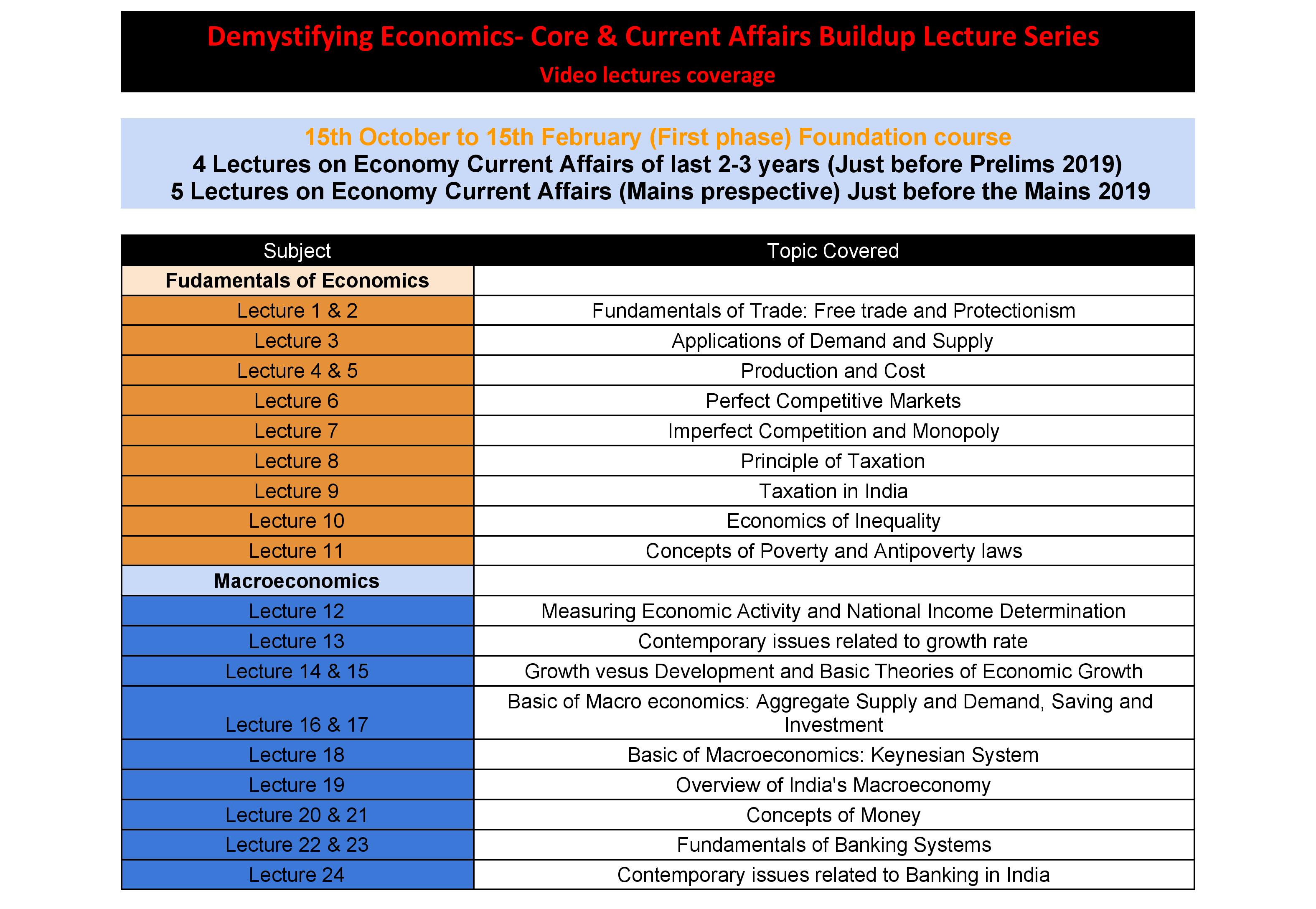
  • Demystifying Economics- Core & Current Affairs Buildup Lecture Series

    View the schedule of lectures here: Click2View

    Importance of Economics for UPSC

    Prelims exam

    Year   Questions asked

    2016   29

    2017   29

    2018   25

    Thus on an average 1/4th of the prelims paper can be solved easily if you have good command in economics.

    Mains exam

    GS paper 3

    Year    Total Marks

    2017    125 Marks

    2016    112.5 Marks

    2015    125 Marks

    In Essay Paper

    1 topic Every year

    Total Weightage in mains: 375 Marks

    Objectives of this course

    Economics is not only the most important subject in all 3 tiers of the exam (Prelims, Mains and interview) but also the most feared subject

    Rather than understanding the concepts, many aspirants indulge in rot learning and mugging up the concepts but since Economics is not a theoretical subject like History this method does not actually work in the actual exam. The objective of this course is to make Economics as a subject interesting, lucid, layman and enjoyable.

    After the end of the course, economics will be on your fingertips and you will be able to apply that knowledge not just in UPSC exam but also in other subsidiary exams like State PSC, RBI Grade B, CAPF, SSC, Bank PO etc.

    The other focus of this course is to strengthen the basics and conceptual clarity of the student so that he can apply that knowledge in understanding the contemporary economic issues.

    Is it relevant only to UPSC students?

    This course is relevant for not just UPSC students but also for State PSC, RBI Grade B, SSC, Bank PO and other competitive exams

    What will this course offer?

    1. Static Lectures

    100 hours of static Lectures covering NCERT’s, All advanced UPSC books like Mishra and Puri, Dutt and Sundaram, Paul Krugman, Mankiw etc

    Watch sample videos of the course here:

    2. Lectures on contemporary issues both 2019 Mains specific and 2019 Prelims specific

    35 – 40 Hours of lectures on Contemporary issues (From 2012 to 2018)

    Sources: All important magazines and newspapers like Economist, EPW, Livemint, Business Standard, Economic times

    3. Notes

    Notes on both static and current part will be given

    4. Tests

    6 Prelims test of Economics (100 Questions each)

    6 Mains test (10 Questions each)

    5. Mentorship

    -Telegram group where students can ask any doubts with the faculty. Students can also call the faculty at a defined time every day.

    6. Unlimited access

    Unlimited access to videos during the validity of the course. Can access the course 24/7 as per your convenience.

    7. Special Coverage of Budget and Economic Survey 2019

    Get all the details of the course and join here: Click2Join


    About the Faculty

    Himanshu Arora

    MPhil Economics (JNU)

    Works at Prime Minister Economic Advisory Council

    -Writes regularly in various famous Indian and international weeklies like Millenium post and Huffington Post.

    -Worked as Assistant Professor in Delhi University

    Read some of his articles here:

    Looking beyond geopolitics

    Empowering citizens is better than entitlements

    China in Xi Era

    ‘We the People’

    Sajal Singh

    MSc Economics (Gokhale Institute of Politics and Economics)

    MS Financial Economics Carleton University Canada

    NET (JRF) Economics Qualified

    Core Faculty @ Civilsdaily.com

  • GS Paper 2 – UPSC Civil Services Mains Examination – 2018

    1. In the light of recent controversy regarding the use of Electronic Voting Machines (EVM), what are the challenges before the Election Commission of India to ensure the trustworthiness of elections in India? (10 marks, 150 words)
    2. Whether National Commission for Scheduled Castes (NCSC) can enforce the implementation of constitutional reservation for the Scheduled Castes in the religious minority institutions? Examine. (10 marks, 150 words)
    3. Under what circumstances can the Financial Emergency be proclaimed by the President of India? What consequences follow when such a declaration remains in force? (10 marks, 150 words)
    4. Why do you think the committees are considered to be useful for parliamentary work? Discuss, in this context, the role of the Estimates Committee. (10 marks, 150 words)
    5. “The Comptroller and Auditor General (CAG) has a very vital role to play.” Explain how this is reflected in the method and terms of his appointment as well as the range of powers he can exercise. (10 marks, 150 words)
    6. “Policy contradictions among various competing sectors and stakeholders have resulted in inadequate ‘protection and prevention of degradation to environment.” Comment with relevant illustrations. (10 marks, 150 words)
    7. Appropriate local community level healthcare intervention is a prerequisite to achieve ‘Health for All’ in India. Explain. (10 marks, 150 words)
    8. E-governance is not only about utilization of the power of new technology, but also much about critical importance of the ‘use value’ of information. Explain. (10 marks, 150 words)
    9. “India’s relations with Israel have, of late, acquired a depth and diversity, which cannot be rolled back.” Discuss.  (10 marks, 150 words)
    10. A number of outside powers have entrenched themselves in Central Asia, which is a zone of interest to India. Discuss the implications, in this context, of India’s joining the Ashgabat Agreement, 2018.  (10 marks, 150 words)
    11. Whether the Supreme Court Judgement (July 2018) can settle the political tussle between the Lt. Governor and elected government of Delhi? Examine. (15 marks, 250 words)
    12. How far do you agree with the view that tribunals curtail the jurisdiction of ordinary courts? In view of the above, discuss the constitutional validity and competency of the tribunals in India. (15 marks, 250 words)
    13. Indian and USA are two large democracies. Examine the basic tenets on which the two political systems are based. (15 marks, 250 words)
    14. How is the Finance Commission of India constituted? What do you know about the terms of reference of the recently constituted Finance Commission? Discuss.  (15 marks, 250 words)
    15. Assess the importance of the Panchayat system in India as a part of local government. Apart from government grants, what sources the Panchayats can look out for financing developmental projects? (15 marks, 250 words)
    16. Multiplicity of various commissions for the vulnerable sections of the society leads to problems of overlapping jurisdiction and duplication of functions. Is it better to merge all commissions into an umbrella Human Rights Commission? Argue your case.  (15 marks, 250 words)
    17. How far do you agree with the view that the focus on lack of availability of food as the main cause of hunger takes the attention away from ineffective human development policies in India?  (15 marks, 250 words)
    18. The Citizen’s Charter is an ideal instrument of organisational transparency and accountability, but it has its own limitations. Identify the limitations and suggest measures for greater effectiveness of the Citizen’s Charters.  (15 marks, 250 words)
    19. What are the key areas of reform if the WTO has to survive in the present context of ‘Trade War’, especially keeping in mind the interest of India?  (15 marks, 250 words)
    20. In what ways would the ongoing US-Iran Nuclear Pact Controversy affect the national interest of India? How should India respond to its situation?  (15 marks, 250 words)
  • GS Paper 1 – UPSC Civil Services Mains Examination – 2018

    1. Safeguarding the Indian art heritage is the need of the moment. Comment (10 marks, 150 words)
    2. Assess the importance of the accounts of the Chinese and Arab travellers in the reconstruction of the history of India. (10 marks, 150 words)
    3. Throw light on the significance of the thoughts of Mahatma Gandhi in the present times. (10 marks, 150 words)
    4. Why is Indian Regional Navigational Satellite System (IRNSS) needed? How does it help in navigation? (10 marks, 150 words)
    5. Why is India taking keen interest in the Arctic region? (10 marks, 150 words)
    6. Define mantle plume and explain its role in plate tectonics. (10 marks, 150 words)
    7. What are the consequences of spreading of ‘Dead Zones’ on marine ecosystem? (10 marks, 150 words)
    8. “Caste system is assuming new identities and associational forms. Hence, caste system cannot be eradicated in India.” Comment. (10 marks, 150 words)
    9. ‘Despite implementation of various programmes for eradication of poverty by the government in India, poverty is still existing’. Explain by giving reasons. (10 marks, 150 words)
    10. How the Indian concept of secularism different from the western model of secularism? Discuss. (10 marks, 150 words)
    11. The Bhakti movement received a remarkable re-orientation with the advent of Sri Chaitanya Mahaprabhu. Discuss. (15 marks, 250 words)
    12. Discuss whether formation of new states in recent times is beneficial or not for the economy of India. (15 marks, 250 words)
    13. Why indentured labour was taken by the British from India to their colonies? have they been able to preserve their cultural identity over there? (15 marks, 250 words)
    14. “The ideal solution of depleting groundwater resources in India is water harvesting system.” How can it be made effective in urban areas? (15 marks, 250 words)
    15. Defining blue revolution, explain the problems and strategies for pisciculture development in India. (15 marks, 250 words)
    16. What is the significance of Industrial Corridors in India? Identifying industrial corridors, explain their main characteristics. (15 marks, 250 words)
    17. Mention core strategies for the transformation of aspirational districts in India and explain the nature of convergence, collaboration and competition for its success. (15 marks, 250 words)
    18. ‘Women’s movement in India has not addresses the issues of women of lower social strata.’ Substantiate your view. (15 marks, 250 words)
    19. ‘Globalisation is generally said to promote cultural homogenisation but due to this cultural specificities appear to be strengthened in the Indian society.’ Elucidate. (15 marks, 250 words)
    20. ‘Communalism arises either due to power struggle or relative deprivation.’ Argue by giving suitable illustrations. (15 marks, 250 words)
  • Factors behind NCM: History Simplified with Marker Technique

    This video is made by Piyush Sadangi under the CD Launchpad initiative

    Use Headphones for better voice quality

    It discusses the factors that led to the Non-Cooperation Movement via a unique methodology named Marker Technique to retain concepts better.

    Let us know the review in the comments section of the video

  • ESSAY PAPER – UPSC Civil Services Mains Examination – 2018

    No questions on women, education, social issues. Mostly philosophical topics.

    Section A had objective topics (1&4) but Section B was a bummer. Let us know what you think?

    SECTION – A

    1.Alternative technologies for a climate change resilient India
    2.A good life is one inspired by love and guided by knowledge
    3.Poverty anywhere is a threat to prosperity everywhere
    4.Management of Indian border disputes – a complex task

    SECTION – B

    1. Customary morality cannot be a guide to modern life
    2. ‘The past’ is a permanent dimension of human consciousness and values
    3. A people that values its privileges above its principles loses both
    4. Reality does not conform to the ideal, but confirms it


  • Remember about ASEAN with Marker Technique

    This video is made by Piyush Sadangi under the CD Launchpad initiative

    Use Headphones for better voice quality

    It discusses all important details about ASEAN via a unique methodology named Marker Technique to retain concepts better.

    Let us know the review in the comments section of the video


  • Last Minute Tips Before Mains 2018

    With the vacancies for this year being around 782, the cut-off for Main is expected to be even higher. Thus, a sound preparation strategy is crucial, not only to clear the cut-off but also to secure a higher rank.
    While what constitutes a sound strategy will differ from one individual to another, what should be the same for anyone preparing for the Civil Services (Main) exam is their attitude.
    Watch this video by Sajal sir for last minute tips to gain those extra marks in Mains


    If you are in need of expert guidance before Mains 2018, don’t hesitate to ask. Mail us on hello@civilsdaily.com and we will connect you to our experts in order to help you become better prepared and relieved before the exam


    Overall strategy

    Keenly analyse the previous five years’ question papers. Pinpoint the focus areas in each. Thereafter, develop your own strategy for the different sections based on your findings.

    Keep the timetable of the Main exam in mind. This year, for the first time, aspirants will be getting a week and a gap for optional subjects. So, try and allot time in a balanced manner to optional subjects as well as the GS papers.

    Try and cover the entire syllabus. The exam has a reputation of being unpredictable. One way of tackling this is to analyze the previous years’ papers. To do that, you first need to cover the syllabus of all the four papers of GS, as well as the optional papers.

    Current Affairs

    Undoubtedly, a consistent point of concern for almost all CSE aspirants; mainly due to the vast syllabus, which makes it difficult to prepare all the relevant topics.

    A word of caution: most students end up cramming the present year’s current affairs; when, in reality, it has been observed that at the Main level UPSC includes current affairs related to the past 2-3 years.

    You can take help from our 100 Probable Issues for Mains Compilation: Click2Get

    Essay

    Develop an in-depth understanding of burning issues. Watching, or listening to, quality debates will be of immense help.

    Read important burning issues here: Click2Read

    Ethics (GS-4)

    Connecting, at a deeper level, with the society around you will surely help in coming up with better answers and solutions. Delve into the reasons behind the thoughts of important personalities.

    For case studies, track issues from our day-to-day lives. Keep challenging yourselves with various problems plaguing the society; and try to come up with your own, genuine solutions. This, in turn, will help you a lot in case studies.

    Answer Writing

    Your knowledge serves little purpose if you cannot communicate it well to the examiner. So, it is of utmost importance to hone your answer-writing skills.

    Remember, writing answers that catch the eye of the examiner and compel them to read is an art. And like any other art form, rigorous practice is needed to present your views in limited words, but in a balanced manner

  • Batch 4: CD Prime Test Series for Prelims 2019

    We are now accepting admissions for Batch 4

    Join Batch 4 of Test series here: Click2Join

    Click2View the detailed schedule of test series with complete booklist to be followed.


    Get a 10% discount for early joiners. We will be extending the discount on this batch till 7th October (the date for the first test of this batch) to ensure that students join before tests start and they stay regular with the schedule

    UPDATE #2

    We are upgrading the program further to provide you more Comprehensive Preparation

    Apart from the static subject videos, now we will also provide Economic Survey & Budget Analysis Videos covering key concepts and important terms for Prelims 2019.  Economic Survey analysis will be available from 2016 to 2018 covering trends in Indian Economy as well as key issues related to it.

    That makes the total video lectures to be 75 hours

    UPDATE  #1

    Demolish UPSC series
    We are releasing 60+ Hours of Advanced Video Lectures on Static subjects – Polity, History, Geography, Economy

    These cover the most important topics from prelims perspective

    Basic knowledge will be helpful in understanding these though it’s not mandatory
    CD remains committed to its students’ success. We are ready to go the extra mile to turn your dreams into reality.

    Join Batch 4 of Test series here: Click2Join


    Here is the detailed schedule of lectures:

    Importance of Economic Survey and Budget

    Economic Survey and Budget are the 2 most important documents that you will go through in your exam preparation.

    • Economic Survey discusses all the major government initiatives with the explanation.
    • If we go by the trend, every year around 20 questions in prelims and 7-8 questions in mains are directly related to the Economic Survey and Budget.
    • Questions in prelims paper stress on important phrases, key analysis, and technical terms. Hence they have to be thoroughly studied.
    • Almost mandatory to imbibe actual phrases used in Economic Survey to frame answers for Main Examination. for example, if a Question is asked on Banking sector problems in the mains exam, you can always quote the 4R recommendations of the 2016th economic survey.
    • Adding the important and relevant facts and figures significantly enhance your marks in General Studies Paper-III.
    • Deep knowledge of the current policies and programs of the government also help an aspirant to write meaningful Essays in UPSC Civil Services Main Examination. For example, Wiping every tear from every eye “Twin balance sheet problem”, “translating potential into actuality” “ Chakravuyh challenge” etc.
    • According to the new trend economy and the environment is going hand in hand. So questions can come from that perspective also.
    • Many statistics and schemes are now being asked in Prelims

    Watch the video to know how we ensure you get 120+ score in Prelims

    The only TS that is supervised by top rankers and provides personalized attention to students. Check out the 7 points that make it the best in the market.

    Follow the video below to understand what makes the TS unique. Our planning and execution remains perfect.

    https://www.youtube.com/watch?v=QWUJ-nQWqkE


    It goes without saying that Civilsdaily’s Flagship Test Series Program has created a name for itself. It is preferred among students in their advanced stages of preparation.
    Here is what ABHILASH BARANWAL, AIR 44, CSE-2017 had to say about CD

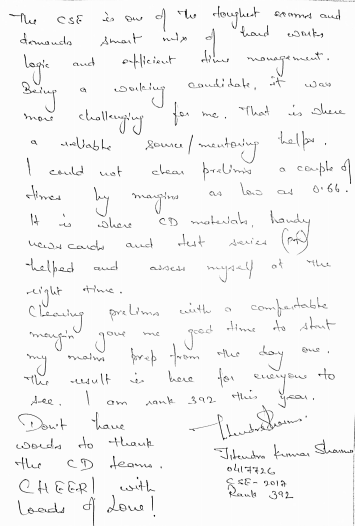
    Here is what  JITENDRA KUMAR SHARMA, AIR 392, CSE-2017 had to say –

    This year, we have upgraded the program to make it the best offering in the market.

    Introducing CD Prime TS 2019

    1. One comprehensive program – Our TS is a full-fledged course in itself! With a mix and match of various kinds of questions and detailed explanation wherever need. It is a very effective way of both, starting a subject and revising one.

    2. Telegram Groups moderated by to Toppers.  Mentorship taken to a whole new level. You will be helped at every step of the way.

    3. Introducing questions-types – Judging the quality of any TS is very subjective. While some will say its great, others will say its quality has decreased over time. That is why we have introduced the concept of question-types. They ensure consistency in quality. How? We have explained that in the end.

    4. Dedicated monthly CA Tests – Exclusive focus on Current Affairs(CA) by having dedicated monthly CA tests. Besides, exhaustively preparing for CA questions, it has helped students precisely figure out what their weaknesses are.  

    5. Tikdams and mastering the art of intelligent guesses – Tikdam Technique is an innovation by Dr. V(AIR 20) and has helped students gain additional marks. Our TS is the only TS that puts a conscious effort to build student’s risk-taking appetite.

    6. Subject and sub-subject Level Tagging – These tags will help you understand the importance of themes and revise other questions from them.

    7. Two-tier quality check  – Our questions pass through a rigorous true stage assessment criteria. The first being done by CD’s core content team with the final approval from a coterie of rankers.


    What are questions types 

    Wherever applicable, we will try to stick to the format decided below. It standardizes questions to a decent extent.

    A. Consolidation Questions
    These questions consolidate information from different topics to help you see concepts holistically and also aid retention.
    Eg. Consider this question. You would not have studied all the ‘Majorities’ together but under separate topics. This question will help you understand the concept in entirety.

    Consider the following questions on the types of Majority
    1. Special Majority of not less than 2/3 of the Members present and voting is required in the passage of a resolution under Art. 249 and Art. 312ONLY.
    2. Impeachment of the President requires Not less than 2/3 of the Members present and voting along with Majority of the Total Strength of the House.

    Which of the statements given above is/are correct?
    a)1
    b)2
    c)Both
    d)None

    Explanation – A very detailed account of the types of Majority is given here https://www.civilsdaily.com/types-of-majorities/
    Statement 1 is correct despite having ‘ONLY’ in it.

    B. Comparative Questions
    Comparative questions help you understand the relative differences between related topics. Consider the question below. Instead of asking a question on HC or SC separately, we have clubbed it together.

    Consider the following statements with respect to the appointment of judges of High Court & Supreme Court
    1. The minimum qualifications prescribed in the Constitution is same for judges of HC & SC.
    2. While SC judges are appointed by the President, HC judges are appointed by the SC.
    Which of the following is/are incorrect?
    a) 1 only
    b) 2 only
    c) Both 1 and 2
    d) None

    Explanation – 3 qualifications are common to both judges of HC and SC
    1. Citizen of India
    2. Judge of HC for 5 years
    3. Advocate in HC for 10 years
    In case of judges of SC, there is an additional qualification – If he/she is a distinguished Jurist in the opinion of the President. Judges of HC are also appointed by the President. The controversy around appointments has been in news very frequently. Please read – https://www.civilsdaily.com/story/judicial-appointments-conundrum-post-njac-verdict/

    C. Interactive Questions
    These questions will ask you to go through a concept/related concepts and reply back with comments. This will help you re-visit the entire concept rather than simply answer one specific aspect of the topic.

    Eg., consider the following question –
    The conversion of Ammonia (NH3) to nitrite (NO2-) and then to nitrates (NO3-) is called

    a) Nitrification
    b) Ammonification
    c) Assimilation
    d) Denitrification
    Answer A

    Explanation
    Nitrification
    In this process, the ammonia is converted into nitrate by the presence of bacteria in the soil. Ammonia is oxidized to form nitrites by bacteria such as Nitrosomonas species. Nitrates are converted into nitrates by Nitrobacter. This conversion is very important as ammonia gas is toxic for plants.
    Make a note of all the processes involved in the Nitrogen Cycle – nitrogen fixation, assimilation, ammonification, nitrification, and denitrification process.
    Leave their definitions/organisms involved in the comments.

    D. Star-marked/special questions
    These are advanced questions that are not from standard sources but relevant for the exam. These questions will help you build additional knowledge without going through specialized books.
    Eg. Questions on books by freedom-fighters, News not covered by the Hindu, IE, PIB but of very high importance in world affairs.

    Besides these, questions indirectly related to CA will also be asked. 

    Do I need to join a TS for prelims at all?

    Despite UPSC being unpredictable, prelims TS is the only program that can help you assess how your preparation is. Besides few questions that are directly asked from TS, it helps in developing a good understanding of how to prepare/what to prepare/what to prioritize and so on.

    In today’s hyper-competitive exam scenario, it’s almost impossible to clear the exam without a good TS in hand.

    Join Batch 4 of Test series here: Click2Join