This video is made by Piyush Sadangi under the CD Launchpad initiative
Use Headphones for better voice quality
It discusses a unique methodology named Marker Technique to remember things in a better way.
Let us know the review in the comments
This video is made by Piyush Sadangi under the CD Launchpad initiative
Use Headphones for better voice quality
It discusses a unique methodology named Marker Technique to remember things in a better way.
Let us know the review in the comments
Check your centers.
Click on the link below –
https://upsconline.nic.in/eadmitcard/admitcard_csm_2018/admit_card.php#hhh1
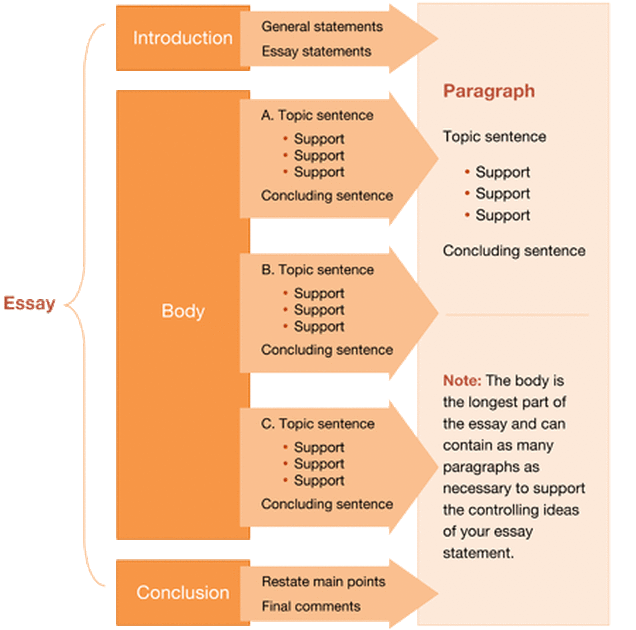
The first paper in the Civil Services Examination (Mains) is the Essay writing paper. This paper doesn’t have any well-defined syllabus, so it is one of the most neglected paper during preparation. The vast syllabi of optional papers and general studies papers coupled with the lethargy of aspirants to practice answer writing often leads to unpreparedness for this paper. If prepared well, this paper can be a game changer.
The most commonly asked question by the aspirant is, “How to prepare for essay paper?”
Let us start by understanding what is expected from a candidate in this paper. The notification of UPSC mentions that “Candidates may be required to write essays on multiple topics. They will be expected to keep closely to the subject of the essay to arrange their ideas in orderly fashion and to write concisely. Credit will be given for effective and exact expression.” Thus, it is very clear that UPSC is looking for
The evaluation of the essays written considers comprehension, originality of thought, clarity of expression and integrated thinking with the assimilation of ideas. Thus, the notification makes it very clear that UPSC is expecting short, precise, accurate and exact discussion on the topic. Describing your thoughts in fewer words requires practice.
We will now discuss in detail various aspects related to essay paper.
1. Choosing Essay Topic
Choosing the topic is the most decisive part of essay paper. One should deliberate seriously over the options given before starting to write. Below mentioned are some tips one can follow for choosing a topic.
2. How to Write an Essay Introduction
The introduction is the first impression upon the examiner. Given the subjectivity in this paper, the introduction is the key to good marks. The introduction should be crisp and precise laying down the thesis statement in an effective manner.
3. How to Write Body of the Essay
The main body of the essay should exhibit your capability of coherent analysis. One should desist from discussing only one-sided view of the topic even if you are trying to take a one-sided stand in conclusion. Discussing both sides of the topics leads to an impression that you are open to discussion. Below mentioned are some points which can help in writing the main body.
4. How to Write Essay Conclusion
The conclusion is the difficult part because of the short amount of time available for writing a conclusion. One should not write it in a haphazard manner.

Civilsdaily team brings you the 100 Most Important Issues that need to be read and understood for Mains 2018. This compilation contains all 100 issues that have high probability of appearing in Mains 2018 and beyond.
One of the great advantages of having a tech platform which connects daily news and op-eds dynamically to its relevant newstrail is that over the time it helps us understand how a topic has evolved both qualitatively (facets of issues, complexity) and quantitatively (number of newscards, op-eds written and connected).
With that objectivity in hand and UPSC’s changing patterns in mind, we sat together to write down Explainers on the 100 probable topics for this years’ IAS Mains.
Each explainer has a Mains level question for you to attempt and review. We have also included Mindmap in most of the issues for better retention and quick revision before the exam
Note: This PDF is already provided to the subscribers of our Prelims TS, Samachar Manthan Program & Mains TS subscribers. They don’t need to buy it separately
We are looking for kick-ass teachers and mentors with exceptional command over UPSC syllabus and diverse knowledge beyond standard books.
Candidates should
1. Either have exhausted their attempts or should no longer be appearing for exams
2. Should be willing to relocate to Delhi
3. Working with us full-time
4. Preference to those already worked in reputed institutes
What can you gain out of the association?
Both intellectual and financial growth. By joining us at this stage, you will grow as we grow. You will be a part of a journey that can alter the whole UPSC preparation scenario
If you are interested in applying to this position, fill up the google form here: Click2Apply
We will be considering applications received only over the given Google form. Please fill up the form from the link given in this post for your job application so that we can better scrutinize your application.
1 Test each for GS Paper 1, 2, 3 and 4 containing best questions for Mains 2018 preparation. Questions will be a mix of Static as well Current Affairs as per the UPSC trend in last few years.
Schedule
GS Paper 1- 1st September
GS Paper 2- 5th September
GS Paper 3- 9th September
GS Paper 4- 13th September
What is special about these tests?
1. Question Formulation
Rather than the regular uninspiring questions, we have gone the extra mile and crafted unique, intellectually-stimulating questions. These will reward analytical ability and problem-solving skills.
We will make the 1st question paper public so you can assess our claims for yourself.
2. Answer Checking
Answer-copy evaluation in the industry has become stagnant. The focus is restricted to superficial, memory-based lapses rather than on analytical excellence and cross-domain inter-linkages.
Our stress will be on the following –
1. Superior introduction and conclusion.
2. Usage of subject-specific vocabulary.
3. Articulation proficiency.
4. Substantiating evidence like Government and International Reports and Indices.
5. Prominent and contemporary examples.
Overall, the program is the perfect tool that will equip you with everything that is needed to crack the exam
Price: Rs 2500
What are we offering?
1. 4 Full-length tests of GS1, GS2, GS3 & GS4. The difficulty level will be above the UPSC Mains Papers so that you are prepared in the best possible way for facing any kind of paper.
2. Detailed Sample Answers with “Mentor’s Comment” by Rank holders to help you gauge better the needs of the question.
3. The supplementary content provided will be helpful in covering multiple related questions.
4. Telegram Groups with Rank holders and Core faculty members.
5. Thorough answer checking with oversight of rankers like Dr. Vipin Garg(AIR 20), Swapnil Pawar (AIR 525).
6. Mentor Call after every test to discuss in detail your strengths and weaknesses. You can schedule an in-person meeting with mentors at our office in Karol Bagh.
7. Detailed video discussion of each test.
8. Magazines, listicles and other relevant study material.
Prime TS folks will get a 30% discount as promised
Watch the Video Lecture covering a topic of Week 2 of the Samachar Manthan program here:
View the topics covered in Week 1 & download detailed notes here: Click2Download
UPDATE 1
We will also provide Economic Survey & Budget Analysis Videos covering key concepts and important terms for Prelims and Mains 2018/19
Economic Survey analysis will be available from 2016 to 2018 covering trends in Indian Economy as well as key issues related to it.
We are also releasing 60+ Hours of Advanced Video Lectures on Static subjects – Polity, History, Geography, Economy
These cover the most important topics from Prelims perspective
Basic knowledge will be helpful in understanding these though it’s not mandatory
We are delighted to launch Batch 2 of Samachar Manthan as well as Samachar Manthan with Answer Writing for 2018-2019. The course is designed to help you develop a solid command on your newspaper reading and current affairs analyzing skills. Since it builds your core, it is important for both prelims and mains.
Our students have benefited a lot from the classes and many have done well in 2018 Prelims despite the paper being tricky. Read a few testimonials here:


What are we offering and how is it unique?
1. Mentorship and guidance taken to a whole new level
Once you enroll, you’ll be assigned a Telegram group headed by Sajal Sir and rankers like Dr. Vipin Garg AIR 20, Swapnil Pawar AIR 525 and others. Our past students have found this immensely beneficial.
Here’s what some of our students had to say about our mentorship. 
2. 4 stage structure of Video->Notes->testing->review to perfect your preparation The sequence of video->Notes->testing->review is the best way to ensure maximum retention and a rock solid preparation. Each component of the program has been meticulously crafted.
3. Our video lectures and notes on weekly CA are brief but comprehensive Packed 3-3.5 hours Weekly videos will focus on news and its importance from both prelims and mains perspective. We understand that the UPSC exam is a generalist exam. It’s more important to cover more issues than to cover one issue in more depth. Hence, we maintain a fine balance of covering cover many important news items and have a detailed discussion on selected topics which require the same. This program will also help you understand how to utilize current affairs in all your prelims and mains papers. This ideology makes this course the best utilization of your time.
Here’s what some of our students had to say about the lectures.

4. Guest Lectures on specific issues by Dr. Vipin Garg, IAS (Rank 20, UPSC 2016) and our distinguished mentor K.Siddhartha Sir. Besides the above, you will have access to our monthly magazines and weekly notes/links to important news/external material. You will have access to all modules included in our Mentorship program – Study-plan, strategy discussion, specific weaknesses, overall guidance. Since our mentors will have information about your performance
5. Weekly Mains Test and Evaluation by our team of subject experts The video and notes will be followed by a test released every weekend. It will have 10 high-quality questions. This will complete your study loop and enhance your retention. >Mains level questions with feedback. Sample review is attached.
 > Answer Enhancement We chose the Question & Answer format because it is perfectly aligned with the requirements of the exam. Having information is very different from presenting it in an answer with a proper structure. This will help in better retention of prelims specific information and prepare a solid ground for your mains prep. After every 2nd test you attempt, you can reach out to our mentors for personalized feedback.

6. Current Affairs Monthly Prelims Test package This was a feedback we received from many students. They wanted appropriate focus on the current affairs program. Prime Students get their usual discount of 30%
Last Date to appear- Wednesday 22 August (Till midnight). Results will be announced on Thursday 23rd August
We expect students to have completed Polity and Modern History by now.
Even if you have completed one of the two, you should appear for the test and attempt questions from that specific subject
The questions are of moderate difficulty and primarily from the core materials.
This is to help you assess if you are on the right track and are not passively reading books.
Most of the questions for the Open Test are from our Test Series. The aim is to demonstrate the level of our Test Series and how it is the best source to prepare and conquer prelims.
Questions will be from different themes ensuring complete coverage. The explanations can be regarded as a study material in itself.
Question Types ensure the questions framed are good. Watch the video to know more
We will be extending the discount on this batch till 2nd September (the date for the first test of this batch) keeping in mind interest of students who were awaiting prelims results to decide further course of action and now want to join a test series for Prelims 2019. This is also to ensure that students join before tests start and they stay regular with the schedule
We are upgrading the program further to provide you more Comprehensive Preparation
Apart from the static subject videos, now we will also provide Economic Survey & Budget Analysis Videos covering key concepts and important terms for Prelims 2019. Economic Survey analysis will be available from 2016 to 2018 covering trends in Indian Economy as well as key issues related to it.
That makes the total video lectures to be 75 hours
Demolish UPSC series
We are releasing 60+ Hours of Advanced Video Lectures on Static subjects – Polity, History, Geography, Economy
These cover the most important topics from prelims perspective
Basic knowledge will be helpful in understanding these though it’s not mandatory
CD remains committed to its students’ success. We are ready to go the extra mile to turn your dreams into reality.Join Batch 3 of Test series here: Click2Join
Here is the detailed schedule of lectures:

Economic Survey and Budget are the 2 most important documents that you will go through in your exam preparation.
Watch the video to know how we ensure you get 120+ score in Prelims
The only TS that is supervised by top rankers and provides personalized attention to students. Check out the 7 points that make it the best in the market.
Follow the video below to understand what makes the TS unique. Our planning and execution remains perfect.
https://www.youtube.com/watch?v=QWUJ-nQWqkE
It goes without saying that Civilsdaily’s Flagship Test Series Program has created a name for itself. It is preferred among students in their advanced stages of preparation.
Here is what ABHILASH BARANWAL, AIR 44, CSE-2017 had to say about CD

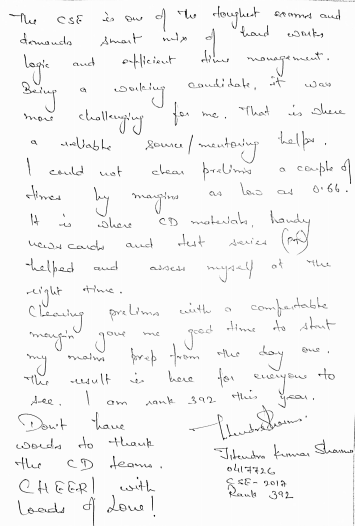
Here is what JITENDRA KUMAR SHARMA, AIR 392, CSE-2017 had to say –
This year, we have upgraded the program to make it the best offering in the market.
Introducing CD Prime TS 2019
1. One comprehensive program – Our TS is a full-fledged course in itself! With a mix and match of various kinds of questions and detailed explanation wherever need. It is a very effective way of both, starting a subject and revising one.
2. Telegram Groups moderated by to Toppers. Mentorship taken to a whole new level. You will be helped at every step of the way.
3. Introducing questions-types – Judging the quality of any TS is very subjective. While some will say its great, others will say its quality has decreased over time. That is why we have introduced the concept of question-types. They ensure consistency in quality. How? We have explained that in the end.
4. Dedicated monthly CA Tests – Exclusive focus on Current Affairs(CA) by having dedicated monthly CA tests. Besides, exhaustively preparing for CA questions, it has helped students precisely figure out what their weaknesses are.
5. Tikdams and mastering the art of intelligent guesses – Tikdam Technique is an innovation by Dr. V(AIR 20) and has helped students gain additional marks. Our TS is the only TS that puts a conscious effort to build student’s risk-taking appetite.
6. Subject and sub-subject Level Tagging – These tags will help you understand the importance of themes and revise other questions from them.
7. Two-tier quality check – Our questions pass through a rigorous true stage assessment criteria. The first being done by CD’s core content team with the final approval from a coterie of rankers.
What are questions types
Wherever applicable, we will try to stick to the format decided below. It standardizes questions to a decent extent.
A. Consolidation Questions
These questions consolidate information from different topics to help you see concepts holistically and also aid retention.
Eg. Consider this question. You would not have studied all the ‘Majorities’ together but under separate topics. This question will help you understand the concept in entirety.
Consider the following questions on the types of Majority
1. Special Majority of not less than 2/3 of the Members present and voting is required in the passage of a resolution under Art. 249 and Art. 312ONLY.
2. Impeachment of the President requires Not less than 2/3 of the Members present and voting along with Majority of the Total Strength of the House.
Which of the statements given above is/are correct?
a)1
b)2
c)Both
d)None
Explanation – A very detailed account of the types of Majority is given here https://www.civilsdaily.com/types-of-majorities/
Statement 1 is correct despite having ‘ONLY’ in it.
B. Comparative Questions
Comparative questions help you understand the relative differences between related topics. Consider the question below. Instead of asking a question on HC or SC separately, we have clubbed it together.
Consider the following statements with respect to the appointment of judges of High Court & Supreme Court
1. The minimum qualifications prescribed in the Constitution is same for judges of HC & SC.
2. While SC judges are appointed by the President, HC judges are appointed by the SC.
Which of the following is/are incorrect?
a) 1 only
b) 2 only
c) Both 1 and 2
d) None
Explanation – 3 qualifications are common to both judges of HC and SC
1. Citizen of India
2. Judge of HC for 5 years
3. Advocate in HC for 10 years
In case of judges of SC, there is an additional qualification – If he/she is a distinguished Jurist in the opinion of the President. Judges of HC are also appointed by the President. The controversy around appointments has been in news very frequently. Please read – https://www.civilsdaily.com/story/judicial-appointments-conundrum-post-njac-verdict/
C. Interactive Questions
These questions will ask you to go through a concept/related concepts and reply back with comments. This will help you re-visit the entire concept rather than simply answer one specific aspect of the topic.
Eg., consider the following question –
The conversion of Ammonia (NH3) to nitrite (NO2-) and then to nitrates (NO3-) is called
a) Nitrification
b) Ammonification
c) Assimilation
d) Denitrification
Answer A
Explanation
Nitrification
In this process, the ammonia is converted into nitrate by the presence of bacteria in the soil. Ammonia is oxidized to form nitrites by bacteria such as Nitrosomonas species. Nitrates are converted into nitrates by Nitrobacter. This conversion is very important as ammonia gas is toxic for plants.
Make a note of all the processes involved in the Nitrogen Cycle – nitrogen fixation, assimilation, ammonification, nitrification, and denitrification process.
Leave their definitions/organisms involved in the comments.
D. Star-marked/special questions
These are advanced questions that are not from standard sources but relevant for the exam. These questions will help you build additional knowledge without going through specialized books.
Eg. Questions on books by freedom-fighters, News not covered by the Hindu, IE, PIB but of very high importance in world affairs.
Besides these, questions indirectly related to CA will also be asked.
Do I need to join a TS for prelims at all?
Despite UPSC being unpredictable, prelims TS is the only program that can help you assess how your preparation is. Besides few questions that are directly asked from TS, it helps in developing a good understanding of how to prepare/what to prepare/what to prioritize and so on.
In today’s hyper-competitive exam scenario, it’s almost impossible to clear the exam without a good TS in hand.
In this video, Sajal sir discusses job profiles of IAS & allied services that will help you choose these services better while filling DAF for UPSC Mains & Interview
Watch the video and let us know your doubts in the comments section of the video to get them resolved by experts