💥Join UPSC 2027,2028 Mentorship (July Batch) + XFactor Notes & Microthemes PDF

Author: CD Staff

  • CIVIL SERVICES REFORMS : Can Indic Principles address the modern governance challenges ?

    Note4Students:

    India’s civil services, long considered the “steel frame” of governance, are now under increased scrutiny for their ability to adapt to contemporary challenges. This article equips you with a robust framework to address such questions by covering critical themes like politicization, inefficiency, and centralized governance, supported by case studies, Supreme Court judgments, and government initiatives. While aspirants typically mention reforms like Mission Karmayogi or lateral entry, they often neglect analysis of deeper systemic issues such as Politicization and Frequent Transfers. The Back2Basics section serves as a quick reference for essential components of civil services reforms. It breaks down critical aspects like recruitment, performance appraisals, capacity building, and accountability, along with the initiatives undertaken by the government (e.g., 360-degree appraisals, Citizen Charters, and Digital India). This concise and structured content helps aspirants connect static and current dimensions effortlessly.

    PYQ Anchoring

    1. GS 2: “Institutional quality is a crucial driver of economic performance”. In this con text suggest reforms in Civil Service for strengthening democracy. (2020)
    2. GS 2:  Initially Civil Services in India were designed to achieve the goals of neutrality and effectiveness, which seems to be lacking in the present context. Do you agree with the view that drastic reforms are required in Civil Services. Comment. (2017)

    Microthemes: Civil Services

    The government has launched initiatives such as Mission Karmayogi, highlighting efforts to reform India’s bureaucratic system, often referred to as the “steel frame” of governance.

    Critical challenges of India’s bureaucratic structure

    India’s bureaucratic framework, particularly the Indian Administrative Service (IAS), faces several critical challenges:

    • Politicization: Frequent transfers and promotions based on political loyalty rather than merit have eroded professionalism and morale. Lack of time to specialize due to frequent departmental rotations hampers the development of domain expertise.
    • Corruption and Inefficiency: India ranks moderately on the World Bank’s Government Effectiveness Index, signaling persistent issues in policy implementation and governance.
    • Centralized Governance: Power has increasingly been centralized in the Prime Minister’s Office (PMO), reducing the autonomy of civil servants and creating implementation bottlenecks.
    Impact of Centralized Governance

    Reduced Autonomy: Senior bureaucrats lose independence, leading to a culture of compliance over innovation.

    Implementation Bottlenecks: Concentrating decisions at the top slows responses to emerging challenges and reduces efficiency.

    Neglect of Expertise: Over-reliance on top-down directives sidelines bureaucratic insights, impacting policymaking and governance outcomes.

    Ancient Indic Principles for Enhancing Modern Governance

    Ancient Indic principles provide timeless wisdom that can address contemporary governance challenges. These principles emphasize ethical leadership, inclusivity, sustainability, and active citizen participation. By integrating these values into modern frameworks, governance can become more effective, equitable, and aligned with the needs of society.

    PrincipleDescriptionContemporary Examples
    Ethical Leadership and Accountability (Raj Dharma)Leaders must prioritize justice, fairness, and the public good, upholding values of transparency and responsibility.Implementation of Lokpal and Lokayukta Acts to tackle corruption; PM’s emphasis on “minimum government, maximum governance.”
    Inclusive Development (Antyodaya)Ensures the upliftment of the most marginalized, promoting equity in resource distribution and opportunities.Ayushman Bharat for healthcare access; Aspirational Districts Programme targeting backward regions.
    Sustainability and Environmental Harmony (LiFE & Karmayogi)Advocates sustainable practices and continuous skill development among public servants to address environmental and societal challenges.India’s “Mission LiFE” for sustainable lifestyles; National Programme for Civil Services Capacity Building (NPCSCB).
    Participative Governance (Sab Ka Prayas)Encourages citizen involvement in policymaking and implementation through collective effort and shared responsibility.Swachh Bharat Abhiyan’s success through community participation; MyGov platform for public policy feedback.
    Empathy and Responsibility (P2G2)Promotes a governance model based on empathy, inclusiveness, and shared responsibility between the state and citizens.COVID-19 crisis management with active public participation; “Har Ghar Jal” campaign for clean water access.

    Efforts taken to reform the bureaucracy in India

    • Commission Recommendations:
      • 1st Administrative Reforms Commission (1966): Advocated specialization within the IAS for efficiency.
      • 2nd Administrative Reforms Commission (2005): Suggested lateral entry for domain experts, mandatory training, and establishing a National Institute of Public Administration.
    • Central Government Initiatives:
      • Mission Karmayogi (2020): Aims to create a future-ready civil service with continuous learning through digital platforms.
      • Lateral Entry Reforms: Introduced to bring domain expertise into senior roles.
    • Supreme Court Judgments:
      • T.S.R. Subramanian v. Union of India (2013): Prohibited civil servants from following oral political directives; mandated a Civil Services Board.
      • Delhi Government Services Case (2023): Reinforced federalism by upholding Delhi’s legislative authority over services.

    Way Forward

    1. Empower Decentralized Governance: Strengthen local and state-level administrative autonomy to reduce over-centralization.
    2. Implement Performance-Based Reforms: Institutionalize meritocracy with performance-linked promotions and lateral entry mechanisms.
    3. Adopt Global Best Practices:Learn from initiatives like the proposed Department of Government Efficiency (DOGE) in the USA to streamline India’s bureaucracy.
    4. Efficient Capacity Building: Expand programs like Mission Karmayogi to ensure civil servants are equipped with modern governance skills.

    #BACK2BASICS : CIVIL SERVICES REFORMS
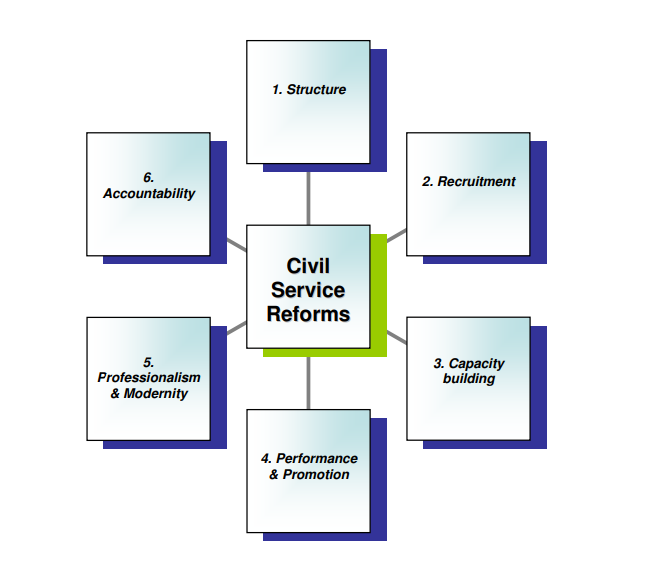
    Components of Civil Services Reforms and Indian Government Initiatives

    ComponentKey AspectsReforms Undertaken by Indian Government
    1. Size and Structure– Rationalize ministries, departments, and officials to reduce redundancy.Rightsizing of Ministries: Streamlining ministries to avoid overlaps.
    – Focus on core governance functions and eliminate duplication.– Creation of Mission Karmayogi (2020) to redefine roles and responsibilities.
    2. Recruitment– Merit-based recruitment with reduced political patronage.– Adoption of Lateral Entry: Specialists from the private sector inducted into senior positions.
    – Incorporate specialized skills and foster public-private mobility.Simplification of UPSC Syllabus to focus on domain expertise and leadership skills.
    3. Capacity Building– Upgrade training programs to align with emerging challenges in technology and governance.Mission Karmayogi Digital Platform: Continuous learning and skill-building for civil servants.
    – Emphasize HR development and advanced training modules.Induction Programs for IAS, IPS, and IFS officers to introduce modern governance tools.
    4. Performance and Promotion– Reform appraisal systems like ACR to make them transparent and performance-driven.– Introduction of 360-Degree Appraisal Mechanism to ensure holistic evaluation of officers’ performance.
    – Link promotions and incentives to quantifiable outcomes.Mid-Career Training Programs introduced to encourage specialization and leadership skills.
    5. Professionalism and Modernity– Ensure neutrality and reduce political interference.Ethics Training Modules introduced as part of IAS training to instill impartiality and integrity.
    – Promote e-governance for transparency and accountability.Digital India Program leveraged to introduce e-governance across ministries.
    6. Accountability– Strengthen reporting mechanisms and ensure transparency through legislation.– Implementation of the Right to Information (RTI) Act for citizen empowerment.
    – Introduce citizen charters and grievance redressal systems.– Introduction of Citizen Charters in key government departments for service delivery standards.
  • The Real Impact of Cash Transfers: What’s Working and What Needs Fixing?

    Why This?

    If you’re gearing up for the UPSC exam, you’ve probably read a lot about cash transfer schemes and their role in welfare. But did you skip over the challenges like financial sustainability or the need for community-driven models? Here’s the deal: UPSC isn’t just about cramming facts, it wants you to dig deeper. It’s not enough to know about PM-Kisan or DBT; understanding the limitations and trade-offs is key. The special part here? The comparison between cash transfer schemes and community-based projects. This insight is crucial for answering those complex GS-2 governance based  questions. Don’t miss out!

    PYQs Anchoring

    • GS 2: Electronic cash transfer system for the welfare schemes is an ambitious project to minimize corruption, eliminate wastage and facilitate reforms. Comment. 2013
    • GS 2: Reforming the government delivery system through the Direct Benefit Transfer Scheme is a progressive step, but it has its limitations too. Comment. 2022

    Microthemes: Welfare and Development Schemes

    In the Maharashtra and Jharkhand Assembly elections, cash transfer schemes for women became a key focus of political campaigns. In August, the Maharashtra government launched the ‘Mukhyamantri Majhi Ladki Bahin Yojana,’ giving ₹1,500 a month to eligible women in their Aadhaar-linked bank accounts. Similarly, the Jharkhand government introduced the ‘Jharkhand Mukhyamantri Maiya Samman Yojana,’ offering ₹1,000 a month to eligible women.

    Reasons for popularity of cash transfer schemes 

    Direct cash transfer schemes are not a new idea in politics. According to Axis Bank, 14 states in India already have such programs, reaching nearly one-fifth of the country’s adult women. Below are the reasons for rising popularity in cash transfer schemes:

    ReasonDescriptionExample
    Increased Voter TurnoutWomen’s participation in elections has significantly risen, reflecting their growing political influence.Women’s voter turnout increased from 47% in 1962 to 66% in 2024, especially in states like Bihar and Uttar Pradesh.
    DBT EfficiencyDirect Benefit Transfers (DBT) eliminate middlemen and reduce corruption, ensuring direct delivery of funds to beneficiaries.The PM-Kisan Scheme directly transfers funds to farmers, cutting delays and middlemen.
    Immediate Political GainsShort-term welfare schemes deliver visible assistance, creating quick political capital compared to long-term projects.Telangana’s KCR Kit Scheme provides financial aid to mothers immediately after childbirth.
    Standardization of WelfareSuccessful welfare models inspire replication in other states, showcasing policy learning and adaptation.Tamil Nadu adopted a maternal welfare scheme modeled after Odisha’s Mamta Scheme.
    Fear of Missing Out (FOMO)States implement similar schemes to remain competitive in garnering electoral support.Rajasthan’s Guaranteed Income Schemes followed Chhattisgarh’s Nyuntam Aay Yojana.
    Addressing Structural IssuesFocused on gender-related challenges like education gaps and child marriage, enhancing targeted social welfare.Madhya Pradesh’s Ladli Laxmi Scheme promotes girl child education and financial empowerment.

    Significance of Bypassing Middlemen

    Direct Cash Transfer (DCT) schemes have revolutionized welfare delivery by ensuring funds reach beneficiaries directly, reducing delays and leakage. They empower individuals to make choices about spending, boosting financial inclusion and local economies. For instance, schemes like PM-KISAN or DBT in LPG subsidies have shown how effective they can be. However, bypassing middlemen is crucial to realizing their full potential. 

    Middlemen often dilute the benefits through corruption or mismanagement. Leveraging technology like Aadhaar-linked accounts and real-time monitoring can eliminate such inefficiencies, ensuring every rupee serves its purpose—uplifting lives without unnecessary hurdles.

    AdvantageDescriptionExample
    Reduction of CorruptionMinimizes corruption by eliminating intermediaries in welfare distribution processes.MGNREGA payments transitioned to DBT, reducing delays and systemic corruption.
    Personalized Political RelationshipsDirect assistance fosters goodwill and loyalty among beneficiaries, enhancing political relationships.West Bengal’s Lakshmi Bhandar Scheme provides monthly stipends to women, building goodwill.
    Immediate ImpactOffers instant financial relief, addressing urgent needs of economically vulnerable populations.Delhi’s Widow Pension Scheme provides immediate support to widowed women in financial distress.
    Enhanced AccountabilityEnsures better tracking and transparency of fund utilization through digital monitoring systems.PM-KISAN transfers are monitored digitally, ensuring timely and accurate disbursements.
    Promotion of Financial InclusionBrings unbanked individuals into the formal financial system, empowering them economically.Jan Dhan-Aadhaar-Mobile (JAM) trinity has enabled access to banking services for millions.

    Key Challenges of Cash Transfer Schemes

    1. Lack of Welfare Innovation
      • Over-reliance on cash transfers hinders the development of diverse, community-based welfare models.
      • Many states replicate cash assistance programs without exploring alternatives such as local empowerment or infrastructure development.
    2. Political Conformity
      • Opposition-controlled states often implement cash transfer schemes to align with central government policies, lacking unique or locally adapted welfare strategies.
      • Even progressive states like Kerala have adopted cash transfers despite previously having strong, distinct welfare systems.
    3. Efficiency vs. State Capacity
      • A focus on cash transfers diverts attention from addressing systemic issues in welfare delivery.
      • Critics argue that schemes like PM-Garib Kalyan Yojana address the symptoms of poverty rather than tackling the root causes, such as employment generation and education reform.
    4. Temporary Solutions
      • Cash transfers offer short-term relief but fail to address long-term solutions to systemic poverty.
      • Programs like Jagananna Ammavodi in Andhra Pradesh provide financial support for education but lack skill-building components necessary for sustainable growth.
    5. Financial Sustainability
      • Relying heavily on cash transfers may strain government finances, especially in the long run.
      • Without regular budgeting adjustments or innovative financing methods, such schemes may face challenges in maintaining financial sustainability.
    6. Exclusion Errors
      • Cash transfer schemes may exclude deserving individuals due to inaccuracies in beneficiary databases or targeting methods.
      • Inaccurate beneficiary lists can lead to marginalized groups being left out of crucial assistance programs.

    Way Forward

    1. Diversification of Welfare Approaches: Move beyond cash transfers by exploring community-based projects and sustainable welfare models.
    2. Improved Targeting and Inclusivity: Enhance the accuracy of beneficiary identification through better data management systems and regular audits.
    3. Focus on Long-term Solutions: Shift the focus from short-term relief to long-term poverty alleviation strategies. Implement programs that include skill-building, job creation, and education reforms alongside cash transfers to address root causes of poverty.
    4. Financial Sustainability and Innovation: Develop innovative financing mechanisms, such as public-private partnerships, to ensure the long-term sustainability of cash transfer programs.Regularly reassess funding strategies to avoid over-reliance on government budgets and ensure that funds are allocated efficiently and sustainably.

    #Back to basics: Cash transfer schemes

    Definition: Direct monetary benefits are transferred to beneficiaries’ bank accounts.

    What is the difference between cash transfer schemes and community based projects?

    ParameterCash Transfer SchemesExample (Cash Transfer)Community-Based ProjectsExample (Community-Based Projects)
    DefinitionDirect monetary benefits transferred to beneficiaries’ bank accounts.PM-Kisan: Income support for farmers.Welfare delivery through community-driven initiatives addressing collective needs.MGNREGA: Employment for public asset creation.
    FocusIndividual financial assistance for immediate relief.Janani Suraksha Yojana: Promotes institutional deliveries.Long-term empowerment through community engagement and infrastructure development.Self-Help Groups (SHGs): Empower rural women to address socio-economic challenges.
    EfficiencyEfficient: Reduces bureaucracy and ensures direct fund transfer.Delhi Widow Pension Scheme: Ensures quick financial relief.Challenging: Requires robust administration and local participation, which can delay implementation.Watershed Development Program: Restores ecosystems for better agriculture.
    Target PopulationTargets specific groups like women, farmers, or low-income households.Ladli Scheme: Promotes girl child welfare.Benefits the entire community, fostering inclusiveness.Amul Cooperative Model: Drives rural economic development through cooperatives.
    SustainabilityLimited: Addresses immediate needs but lacks sustained welfare mechanisms.Rythu Bandhu: Financial aid to farmers for seasonal crops.High: Builds long-term assets like schools, roads, and water resources.Watershed Development Program: Supports sustainable agricultural practices.
    Economic ImpactBoosts consumer spending in the short term.Delhi Widow Pension Scheme: Increases immediate consumption.Improves infrastructure, enhancing productivity and community well-being.Amul Cooperative Model: Rural milk cooperatives boost the economy.
    AccountabilityHigh transparency through DBT but limited public scrutiny of fund utilization.Ladli Scheme: Ensures transparency in fund distribution.Accountability is shared by community members but may face inefficiency or misuse.Sabla Scheme: Empowers adolescent girls through nutrition and education initiatives.
  • [Burning Issues] Indian State of Forests Report: Growing Green or Losing Ground?

    NOTE4STUDENTS:

    Among the topics that often get overlooked, biodiversity and forest conservation are crucial for GS Paper 3 but tend to be neglected. In this article, we dive into the key findings from the India State of Forest Report (ISFR) 2023, along with government initiatives under Back2Basics, to offer insights that could make a big difference in your exam preparation. The Article also defines important terms, like forest cover, tree cover, and mangrove cover, giving you the terminology you need to sound knowledgeable and precise in your answers. While most candidates rush through data-heavy content, this article emphasizes the value of information such as the loss of forest cover in the Western Ghats or the expansion of bamboo areas, which can directly be used to answer questions on environmental policy and its effects. It’s the type of content that often gets left out, but is exactly what the UPSC is looking for—real facts and figures.

    PYQ ANCHORING

    GS 3: How does biodiversity vary in India? How is the Biological Diversity Act, 2002 helpful in conservation of flora and fauna? (2018)

    MICROTHEMES : Biodiversity

    Recently, the India State of Forest Report (ISFR) 2023 has been released by the Minister for Environment, Forest, and Climate Change, at the Forest Research Institute, Dehradun. The report, published biennially by the Forest Survey of India (FSI) since 1987, provides an in-depth assessment of forest and tree resources based on remote sensing data and field surveys. The recently released report is the 18th report in the series. 

    India State Of Forest Report

    The report provides comprehensive data on forest cover, tree cover, mangroves, growing stock, carbon stock, forest fires, and agroforestry.

    KEY TERMS

    TermDefinition
    Recorded Forest AreaArea officially recorded as forest in Government records.
    Forest CoverLand with a tree canopy density exceeding 10%, regardless of ownership and legal status, including orchards, bamboo, and palm plantations covering at least one hectare in area.
    Tree CoverPatches of trees outside the Recorded Forest Area, smaller than 1 hectare in size, irrespective of canopy density.
    Dense ForestAreas with a canopy density of 40% and above.
    Very Dense Forests (VDF)Lands with forest cover having a canopy density of 70% and above.
    Open Forests (OF)Lands with forest cover having a canopy density between 10-40%.
    Trees Outside Forest (TOF)All trees growing outside Recorded Forest Areas, irrespective of patch size.

    FINDINGS OF THE REPORT

    CategoryDetails
    Forest and Tree CoverThe total cover is 8,27,357 sq. km, accounting for 25.17% of India’s geographical area. Forest cover: 7,15,343 sq. km (21.76%), Tree cover: 1,12,014 sq. km (3.41%).
    Increase in Forest and Tree CoverIncrease of 1,445 sq km compared to 2021: Forest cover increased by 156 sq km, Tree cover increased by 1,289 sq km. Top states: Chhattisgarh (684 sq km), UP (559 sq km), Odisha (559 sq km), Rajasthan (394 sq km).
    States with Maximum Forest IncreaseMizoram (242 sq km), Gujarat (180 sq km), Odisha (152 sq km).
    Largest Area under Forest and Tree CoverMadhya Pradesh (85,724 sq km), Arunachal Pradesh (67,083 sq km), Maharashtra (65,383 sq km). Forest only: Madhya Pradesh (77,073 sq km), Arunachal Pradesh (65,882 sq km), Chhattisgarh (55,812 sq km).
    Highest Percentage under Forest Cover19 states/UTs exceed 33%, with 8 states/UTs exceeding 75%: Lakshadweep (91.33%), Mizoram (85.34%), Andaman & Nicobar Islands (81.62%).
    Mangrove CoverTotal mangrove cover: 4,992 sq km.
    Growing StockTotal stock: 6,430 million cum (4,479 million cum inside forests, 1,951 million cum outside). Increased by 262 million cum: +91 million cum in forests, +171 million cum outside forests.
    Increase in Bamboo Bearing AreaTotal bamboo area: 1,54,670 sq km, an increase of 5,227 sq km since 2021.
    Additional Carbon SinkIndia achieved 2.29 billion tonnes of additional carbon sink (base year: 2005), nearing the 2030 target of 2.5–3.0 billion tonnes.

    Concerns Highlighted

    1. Loss of Forest Cover in the Western Ghats: For the first time, the 2023 forest report assessed forest cover in the Western Ghats. Shockingly, eco-sensitive zones in this region have lost 58.22 sq km of forest since 2013.
    2. Decline in Dense Forests: India has lost around 24,651 sq km of dense forests since 2003, about 6.3% of their total area. From 2021 alone, 3,913 sq km of dense forests were lost—an area larger than Goa.
    3. Shrinking Mangroves: Mangrove forests, known for their resilience to disasters, decreased by 7.43 sq km compared to 2021. Gujarat saw the largest loss at 36 sq km, followed by Andaman and Nicobar Islands losing 4.65 sq km.
    4. Decline in Northeast Forests: Forest cover in Northeast India continues to decline, with a loss of 327.30 sq km in 2023.
    5. Falling Short of National Forest Goals: The 1988 National Forest Policy set a goal of having one-third (33%) of India’s land under forest or tree cover. Currently, the figure is just 25.17%, leaving much to be achieved.
    6. The Plantation vs. Natural Forest Debate:While plantation areas are growing, they often consist of single-species trees, making them prone to pests, fires, and diseases. Natural forests, by contrast, are rich in biodiversity, store more carbon, and stabilize ecosystems. Experts warn against depending too much on plantations as a substitute for natural forests.

    Key Reasons Behind India’s Growing Forest Cover

    The India State of Forest Report 2023 highlights several factors that have contributed to the rise in forest cover across the country:

    1. Afforestation Programs:
      Large-scale tree-planting drives under schemes like the National Afforestation Programme (NAP) and Green India Mission (GIM) have played a major role in expanding forest areas.
    2. Agroforestry Practices:
      Farmers are increasingly growing trees alongside crops through programs like the Sub-Mission on Agroforestry (SMAF), which has boosted tree cover.
    3. Community Efforts:
      Local communities actively participate in reforestation through Joint Forest Management Committees (JFMCs), strengthening conservation efforts.
    4. Advanced Technology:
      Remote sensing and forest monitoring tools have improved forest management and helped restore degraded areas efficiently.
    5. Awareness and Ecotourism:
      Rising awareness about biodiversity and climate change, along with CSR-driven afforestation initiatives, has encouraged more people to join conservation programs, adding to the country’s green cover.

    Way Forward

    1. Incentives for Tree Planting:
      Financial support, tax breaks, and subsidies can encourage individuals and organizations to plant trees. For example, China’s Grain-for-Green Program pays farmers to convert agricultural land into forests.
    2. Restoring Degraded Land:
      Degraded areas can be revitalized through techniques like soil improvement and watershed management. Ethiopia’s Tigray Reforestation Project demonstrates how terracing and tree planting can transform arid land.
    3. Public-Private Partnerships (PPP):
      Collaborating with businesses and NGOs can bring funding and expertise to green projects. Japan’s Toyota Green Wave Project supports forest restoration efforts through such partnerships.
    4. Seed Banks and Nurseries:
      Setting up seed banks and nurseries ensures access to high-quality planting materials. The UK’s Millennium Seed Bank Project preserves seeds for future reforestation needs.

    The India State of Forest Report (ISFR) 2023 offers essential data on forest conservation and helps policymakers, researchers, and environmentalists support sustainable natural resource management.

    #BACK2BASICS : STEPS TAKEN BY INDIA OVER THE YEARS

    Scheme/InitiativeDetails
    National Mission for a Green India (GIM)Launched in 2014 to enhance forest cover through protection, restoration, and expansion. Rs. 944.48 crore allocated for 17 States and 1 UT, focusing on plantations and eco-restoration via Joint Forest Management Committees (JFMCs).
    Nagar Van Yojana (NVY)Initiated in 2020 to develop green spaces in urban and peri-urban areas. Rs. 431.77 crore allocated for 546 projects across 31 States/UTs to promote urban greenery.
    School Nursery Yojana (SNY)Aimed at raising awareness about plant importance by involving schools in tree-planting initiatives. Rs. 4.80 crore allocated for 743 projects across 19 States/UTs.
    Mangrove Initiative for Shoreline Habitats & Tangible Incomes (MISHTI)A five-year initiative (2023-2028) focusing on mangrove restoration along India’s coastline. Rs. 17.96 crore allocated for states like Andhra Pradesh, Gujarat, Kerala, Odisha, West Bengal, and U.T. of Puducherry.
    Conservation of Mangroves and Coral Reefs (National Coastal Mission)Provides financial support to 9 coastal states and 1 Union Territory to protect and conserve mangroves and coral reefs, aiming to safeguard vital coastal ecosystems.
    National Plan for Conservation of Aquatic Ecosystems (NPCA)Supports wetland conservation and management on a cost-sharing basis between Central and State Governments to promote sustainable practices.
    Ek Ped Maa Ke NaamLaunched in 2024 to encourage citizens to plant trees in honor of mothers, fostering a personal connection to nature and sustainability.
    Compensatory Afforestation Fund Management and Planning Authority (CAMPA)Compensates for the loss of forest cover due to land diversion for non-forestry purposes under the Van Sanrakshan Evam Samvardhan Adhiniyam, 1980.
    Afforestation Targets under the Twenty-Point ProgrammeAnnual targets set for afforestation in states/UTs, utilizing Central/State schemes and efforts by NGOs, private entities, and civil society.
    Awareness and Mass Plantation DrivesPromotes tree planting through events like Van Mahotsav and Wildlife Week and raises awareness with conferences, workshops, and campaigns.
    Indian Forest Management StandardIntroduced as part of the National Working Plan Code (2023) to establish sustainable forest management criteria and frameworks, benefiting small-scale timber producers.
    National Action Plan on Forest FireLaunched in 2018 to prevent forest fires, build community resilience, and enhance fire control capacity.
    Joint Forest Management and Eco Development CommitteesEncourages community involvement in forest and wildlife protection as per the 1988 National Forest Policy, ensuring local participation in conservation.
  • [Burning Issue] “Crimes Against Humanity” Treaty & India’s Stance

    Note4Students:

    As aspirants prepare for the UPSC GS Paper 2 and explore topics related to international organizations, it’s essential to focus on the implications of international treaties and India’s position in global justice mechanisms. This article aims to provide a detailed overview of India’s complex position regarding a proposed CAH treaty and highlights the underlying concerns in relation to international criminal law. The key takeaways from the article, such as India’s concerns about overlap with existing laws, reluctance to allow foreign judicial intervention, and its preference for national jurisdiction, are critical for constructing strong responses to questions related to international governance mechanisms.

    PYQ ANCHORING: 

    GS 2: ‘Sea is an important Component of the Cosmos’. Discuss in the light of the above statement the role of the IMO(International Maritime Organisation) in protecting environment and enhancing maritime safety and security. (2022)

    MICROTHEMES: Miscellaneous Organisations

    India’s stance on a proposed Crimes Against Humanity (CAH) treaty reflects its longstanding reservations about the Rome Statute and the International Criminal Court (ICC).

    ‘Crimes Against Humanity’

    ComponentDescriptionExample
    Widespread or Systematic ActsCrimes involve widespread or systematic attacks against civilian populations.The Rwandan Genocide (1994): Systematic killing of the Tutsi ethnic group.
    Acts IncludedOffenses include murder, extermination, enslavement, deportation, torture, rape, enforced disappearance, and persecution.Bosnian War (1992–1995): Mass extermination, forced deportation, and persecution of Bosniaks and Croats.
    Targeted at CiviliansSpecifically directed against civilian populations rather than combatants.Syrian Civil War: Chemical attacks on civilians in Ghouta, Syria (2013).
    State or Organizational PolicyCommitted as part of a policy or plan by a state or non-state entity.Holocaust (1941–1945): Nazi Germany’s systemic policy of extermination of Jews and minorities.
    Intent and KnowledgePerpetrators act with intent and knowledge of the attack on civilians, disregarding human dignity.My Lai Massacre (1968): Intentional killing of hundreds of unarmed Vietnamese civilians by U.S. soldiers.
    International RecognitionRecognized under international law and prosecuted by bodies like the ICC.Darfur Conflict (2003–present): ICC issued an arrest warrant for Sudanese President Omar al-Bashir for crimes against humanity.

    Indian Approach to Crimes Against Humanity

    ComponentIndian Approach
    Non-Party to the Rome StatuteIndia has not signed the Rome Statute, opposing the jurisdiction of the International Criminal Court (ICC). It argues that issues related to crimes against humanity (CAH) should be addressed through national legal systems rather than international mechanisms.
    Call for In-Depth StudyIndia advocates for a comprehensive examination of the need for a dedicated CAH treaty, reflecting its belief that existing international frameworks may already address these issues sufficiently.
    Concerns Over DuplicationIndia fears that a new CAH treaty might overlap with existing frameworks like the Rome Statute, potentially creating complexities and redundancies in ensuring accountability.
    Lack of Domestic LegislationIndia does not currently have specific domestic laws addressing CAH. Justice S. Muralidhar of the Delhi High Court has highlighted the legislative gap, noting that neither CAH nor genocide is covered under India’s criminal laws.
    Emphasis on National JurisdictionIndia prioritizes national jurisdiction for prosecuting international crimes like CAH, preferring to handle these matters domestically rather than submitting to international judicial mechanisms.
    Legislative Gaps and OpportunitiesWhile India has ratified international conventions like the Genocide Convention, it lacks enabling legislation to implement these provisions domestically. This highlights the need for new laws to align with international standards while retaining sovereignty.

    REASONS India Should Have Proper Legislation Related to CAH

    1. Inadequate Domestic Legislation: Despite ratifying the Genocide Convention, India lacks domestic laws to enforce its provisions, leaving a gap in prosecuting crimes like genocide and CAH.
    2. International Accountability: Enacting CAH laws would bring India’s legal framework in line with international standards, enhancing its role in global justice efforts.
    3. Justice for Mass Atrocities: India’s history of communal violence highlights the need for CAH laws to ensure accountability and deterrence against future atrocities while protecting human rights.
    4. Leadership in Human Rights: Adopting CAH laws would strengthen India’s global standing in human rights advocacy, enabling it to address issues like terrorism and promote justice and dignity.
    5. Empowering National Courts: CAH laws would enhance the capability of Indian courts to address serious human rights violations, reinforcing India’s preference for domestic jurisdiction.
    What Are India’s Specific Concerns Regarding the Definitions and Scope of Crimes Against Humanity?

    1. Definition of Crimes: India objects to the inclusion of “enforced disappearance” as a CAH while advocating for “terrorism” to be recognized as such, reflecting its focus on issues relevant to its national security.

    2. Scope of Application: India argues that only crimes committed during armed conflicts should qualify as CAH, opposing broader definitions that include peacetime offences. This position aligns with India’s strategic interests and its approach to framing accountability primarily in terms of state actions during conflicts.

    WAY FORWARD

    In the case of State v. Sajjan Kumar, the Delhi High Court highlighted a troubling pattern of mass killings in India, referencing incidents in Mumbai (1993), Gujarat (2002), and Muzaffarnagar (2013). In these cases, criminals received political support, allowing them to escape prosecution.

    India’s absence from the International Law Commission (ILC) weakens its position on advocating for a rules-based global order. Ignoring crimes against humanity tarnishes India’s image as a democratic nation committed to justice. It would be beneficial for India to actively participate in discussions with the ILC, using this opportunity to address gaps in its own criminal justice system.

    India’s policymaking has often followed the principle of “Think globally, act locally”, but when it comes to crimes against humanity, India should flip this approach and “Act locally, inspire globally”. By aligning with the International Criminal Court and the Rome Statute, India would take a significant step toward promoting human rights and enhancing its governance.

    India’s active involvement in shaping the Crimes Against Humanity (CAH) treaty would signal its commitment to upholding the rule of law, both at home and globally. It would ensure that power remains accountable, governance becomes fairer, and the state embraces ethical values in its actions, contributing to a more just world.

    BACK 2 BASICS: INTERNATIONAL CRIMINAL COURT

    About the International Criminal Court (ICC)

    • Purpose: The ICC is a global tribunal dedicated to holding individuals accountable for some of the world’s most severe crimes.
    • Status: It is the only permanent international criminal tribunal.

    Background of the ICC:

    • Established: On 17 July 1998 through the Rome Statute.
    • Jurisdiction and Functions: The Rome Statute outlines the ICC’s jurisdiction, structure, and functions.
    • Entered into Force: The Statute became effective on 1 July 2002.

    Mandate of the ICC:

    The ICC investigates and tries individuals for the following crimes:

    • Genocide
    • War Crimes
    • Crimes Against Humanity
    • Crime of Aggression

    ICC Headquarters and Members:

    • HQ: The ICC is located in The Hague, Netherlands.
    • Members: There are 123 States Parties to the Rome Statute, which includes countries that recognize the ICC’s authority. However, some notable exceptions are the U.S., China, Russia, Israel, and India.

    Funding:

    The ICC is primarily funded by:

    • Contributions from States Parties
    • Voluntary contributions from governments, international organizations, individuals, corporations, and other entities.

    Composition of the ICC:

    • Judges: The court has 18 judges, each representing different member countries, who serve non-renewable nine-year terms.
    • Presidency: Composed of three judges – the President and two Vice-Presidents.
    • Judicial Divisions: These are:
      • Pre-Trial Division
      • Trial Division
      • Appeals Division
    • Office of the Prosecutor (OTP): Responsible for handling referrals, gathering information, investigating crimes, and prosecuting offenders.
    • Registry: Provides administrative and operational support to the court’s various functions.

    Jurisdiction of the ICC:

    • Unlike the International Court of Justice (ICJ), the ICC focuses on individual prosecutions rather than disputes between states.
    • The ICC can only handle a case if:
      • The country where the crime occurred is a party to the Rome Statute.
      • The perpetrator’s home country is a party to the Rome Statute.
    • The ICC has jurisdiction only if national courts are unwilling or unable to prosecute the alleged crimes.
    • Only crimes committed after the Rome Statute’s entry into force on 1 July 2002 can be prosecuted.

    Relationship with the United Nations (UN):

    • Article 2 of the Rome Statute outlines the ICC’s relationship with the UN.
    • While the ICC is not a UN body, it has a cooperation agreement with the UN.
    • UN Security Council: If a situation falls outside the ICC’s jurisdiction, the UN Security Council can refer the matter to the ICC, granting it jurisdiction over the case.
  • [Burning Issue] Grassroots Empowerment: Why ULG Elections Matter ?

    Note4Students:

    You’ve likely read about local governance and its evolution, but have you thought about its real impact? Most discussions about local elections stop at the basics – when elections are due and who’s in charge. But to ace UPSC, you need more: why local elections are often delayed, and the disconnect between voters and local governance. The special section here that stands out is the financial autonomy of Urban Local Governments (ULGs) – a game-changer for efficient governance. Remember, it’s not just about understanding functions, but also tackling the real issues that hinder ULGs’ functionality.

    PYQs Anchoring:

    GS 2:  The strength and sustenance of local institutions in India has shifted from their formative phase of ‘Functions, Functionaries and Funds’to the contemporary stage of ‘Functionality’. Highlightthe critical challenges faced by local institutions in terms of their functionality in recent times. (2020)

    Microthemes: Local Governments

    It may come as a surprise to many that despite the constitutional mandate of holding elections to municipalities every five years, elections are routinely delayed across thousands of urban local governments.

    Significance of Urban Local Government (ULG) Elections

    PointDetailsExamples
    Decentralized GovernanceULGs enable grassroots democracy by decentralizing self-governance and decision-making.Bengaluru’s Municipal Corporation (BBMP) ensures localized solutions for city-specific issues like traffic congestion.
    Service DeliveryULGs manage civic services like water, sanitation, public health, and urban planning, improving quality of life.Mumbai’s BMC played a pivotal role in managing waste and public health during the COVID-19 pandemic.
    Local DemocracyElections legitimize ULGs, fostering accountability and citizen participation in governance processes.The 2021 Kolkata Municipal Corporation elections highlighted voter engagement in urban infrastructure planning.
    Economic ImpactULGs contribute to urban development and GDP growth through efficient city management and infrastructure.Delhi Municipal Corporation initiated public-private partnerships for waste-to-energy projects, boosting urban economy.
    Social ImpactULGs drive inclusive urban policies, addressing housing, education, and healthcare for marginalized groups.Jaipur’s municipal programs for slum redevelopment significantly improved living conditions for urban poor.

    Reasons for Lower Voter Turnout in Urban Local Elections

    ReasonDetailsExamples
    Lack of AwarenessVoter awareness about the importance of local elections is often limited compared to state or national elections.In the 2022 Mumbai municipal elections, voter turnout was only 47%, partly attributed to inadequate outreach campaigns.
    Perceived ImpactVoters often feel local elections have a smaller impact on their lives compared to higher-level elections.In Delhi, the 2017 municipal elections saw only 54% turnout, with many citing doubts about tangible governance changes.
    Political DisengagementUrban residents may feel disconnected from local governance, especially when local issues are not prioritized.In Bengaluru’s 2021 municipal elections, poor turnout (45%) was linked to limited campaign focus on civic issues like waste management.
    Timing and Scheduling IssuesULG elections may be held separately from general or state elections, leading to voter confusion or indifference.In Pune, ULG elections held during weekdays in 2017 saw lower turnout (49%) due to inconvenient scheduling for working professionals.
    Voter FatigueFrequent elections across different levels can reduce voter enthusiasm for local polls.In Tamil Nadu, after the state assembly elections in 2021, the subsequent ULG elections saw a turnout drop to 52%.

    Way Forward

    1. Empower State Election Commissions (SECs): Strengthening SECs with autonomy and resources to ensure timely and fair elections. For instance, granting authority for ward delimitation can reduce election delays.
    2. Regular Elections: Mandating elections every five years and aligning them with state and national polls, as recently recommended by the High-Level Committee, can ensure consistency and improve turnout.
    3. Decentralization of Powers: Implementing the 74th Constitutional Amendment fully to transfer decision-making powers to ULGs, ensuring greater autonomy in urban planning and governance.
    4. Public Participation: Promoting community engagement initiatives, such as participatory budgeting and local town hall meetings, to enhance transparency and accountability.
    5. Capacity Building for Local Officials: Training programs for local government officials on urban management, technology integration, and financial management can improve efficiency and service delivery.
    6. Strengthening Financial Autonomy: ULGs should have access to adequate funds through property taxes, user charges, and grants to carry out developmental activities without over-reliance on state governments.

    #Back to Basics: Local Governments: History of events and issues

    Timeline of Key Events and Developments in Local Governance in India

    PeriodKey Events and DevelopmentsSignificant Contributions/People
    1947-1960sIndia’s Constitution mentioned local governance but lacked a clear framework. The Community Development Programme (1952) launched but failed to achieve significant outcomes.Jawaharlal Nehru (supporter of centralized governance but supportive of local governance), Vinoba Bhave, Jayaprakash Narayan (supporters of self-reliant village republics).
    1950s-1970sBalwantrai Mehta Committee (1957) and others (e.g., K. Santhanam 1963, Ashok Mehta 1977) pushed for local governance reforms.Leaders and activists like Balwantrai Mehta, K. Santhanam, Ashok Mehta advocated for democratic decentralization and stronger local governance.
    1970sCentralized control under Indira Gandhi slowed local governance development. In 1977, Janata Party supported local governance.Indira Gandhi (centralized control), Janata Party (supported decentralization), opposition-led states (e.g., West Bengal under CPI, Karnataka under Ramakrishna Hegde) pushed for reforms.
    1980sRajiv Gandhi emphasized reforms for local governance, introducing a bill in 1988, which was blocked by the Rajya Sabha.Rajiv Gandhi aimed to strengthen local governance but faced opposition from non-Congress states.
    1990sEmergence of new political parties, especially regional and caste-based, led to local governance being seen as a tool for greater representation of marginalized groups.Regional and caste-based parties pushed for local reforms, leading to the passage of the 73rd and 74th Constitutional Amendments in 1992.
    1992The 73rd and 74th Constitutional Amendments were passed, recognizing rural panchayats and urban municipalities, marking a major milestone in local governance.Major political reforms solidified local governance, with recognition of rural panchayats and urban municipalities in India’s democratic system.

    Summary: Evolution of Local Governance Issues in India

    1. Pre-1992: Weak Constitutional Status
      • Colonial and Post-Independence Era: Local governance was weak and lacked autonomy. During British rule, it mainly focused on rural development, and after independence, local governments had no real powers.
    2. 1992: The 73rd and 74th Amendments
      • Decentralization: These amendments gave local governments constitutional status, with clear frameworks for elections and functions. However, challenges included slow implementation and lack of financial independence.
    3. Late 1990s to Early 2000s: Capacity Building
      • Skill Gaps: Local bodies lacked trained officials in governance and financial management.
      • Women’s Participation: While reservations opened doors for women, leadership training and societal barriers remained challenges.
    4. Mid-2000s to Early 2010s: Urbanization and Service Delivery
      • Urban Local Governments’ Struggles: With rising urbanization, local bodies struggled to provide essential services due to weak infrastructure and limited financial autonomy.
      • Power Devolution Issues: States retained key functions, causing inefficiencies in local governance.
    5. 2014 Onwards: Focus on Local Governance
      • Smart Cities and Swachh Bharat Mission: These missions highlighted the importance of local bodies, but their execution faced challenges due to capacity and financial limitations.
    6. Recent Developments and Issues
      • COVID-19: Local governments played a key role in crisis management but were exposed due to lack of preparedness and financial vulnerability.
      • Climate Change and Disaster Management: Local bodies faced challenges in managing natural disasters like those in Kerala.
    7. Current and Emerging Issues
      • Financial Dependency: Local governments still rely on state and central grants, limiting their ability to address local needs.
      • Politicization: Political interference from state governments continues to hamper the effectiveness of local bodies.
      • Digital and Green Governance: The transition to e-governance is slow due to inadequate infrastructure, and local bodies face barriers in adopting sustainable practices.
    8. Future Challenges
      • Urban-Rural Divide: Rural and urban local bodies face distinct challenges requiring tailored solutions.
      • Inclusive Governance: Ensuring the participation of marginalized groups and women remains an ongoing challenge.
      • Strengthening Devolution: True devolution, especially financial autonomy, is necessary for empowering local governments.

    In conclusion, despite constitutional recognition, local governments still face significant hurdles, including financial dependency, limited administrative capacity, and political interference. Strengthening local governance is essential for addressing the challenges of urbanization, climate change, and sustainable development.

  • Ashoka’s Edicts and Inscriptions

    15th Sept 2024

    UPSC 2025 countdown has begun! Get your personal guidance plan now! (Click here)

    • The first tangible evidence of Buddhism is represented by the rock and pillar edicts of Asoka detailing wide expansion of Buddhism through the sponsorship of one of the most powerful kings of Indian history.
    • These edicts mention that Buddhism reached as far as the Mediterranean, and many Buddhist monuments were created in a wide area. Buddhism and the Buddha are mentioned, the edicts focus on social and moral precepts rather than religious practices or the philosophical dimension of Buddhism.
    • In these inscriptions, Ashoka refers to himself as “Beloved of the Gods” and “King Priya-darshi.”
    • The inscriptions found in the eastern part of India were written in the Magadhi language, using the Brahmi script. In the western part of India, the language used is closer to Sanskrit, using the Kharoshthi script,one extract of Edict 13 in the Greek language, and one bilingual edict written in Greek and Aramaic.
    • These edicts were decoded by British archeologist and historian James Prinsep.
    • Major themes are Ashoka’s conversion to Buddhism, the description of his efforts to spread Buddhism, his moral and religious precepts, and his social and animal welfare program.

    Pillers:

    • Ashoka pillars, (usually made of chunar sandstone), as a symbol of the state, assumed a great significance in the entire Mauryan Empire.
    • Objective: The main objective was to disseminate the Buddhist ideology and court orders in the entire Mauryan empire.
    • Language: While most Ashoka pillar edicts were in Pali and Prakrit language, few were written in Greek or Aramaic language also.
    • Architecture: Mauryan pillars mainly comprise of four parts:
    • Shaft: A long shaft formed the base and was made up of a single piece of stone or monolith.
    • Capital: On top of shaft lay the capital, which was either lotus-shaped or bell-shaped.
    • Abacus: Above the capital, there was a circular or rectangular base known as the abacus.
    • Capital Figure: All the capital figures (usually animals like a bull, lion, elephant, etc) are vigorous and carved standing on a square or circular abacus.

    Major Rock Edicts

    • Major Rock Edict I

    Prohibits animal slaughter. Bans festive gatherings and killings of animals. Only two peacocks and one deer were killed in Asoka’s kitchen. He wished to discontinue this practice of killing two peacocks and one deer as well.

    • Major Rock Edict II

    Provides for care for man and animals, describes about Chola, Pandyas , Satyapura and Keralputra Kingdoms of South India

    • Major Rock Edict III

    Generosity to Brahmans. Issued after 12 years of Asoka’s coronation. It says that the Yuktas (subordinate officers and Pradesikas (district Heads) along with Rajukas (Rural officers ) shall go to the all areas of kingdom every five years and spread the Dhamma Policy of Asoka.

    • Major Rock Edict IV

    Dhammaghosa is ideal to the mankind and not the Bherighosa. Impact of Dhamma on society.

    • Major Rock Edict V

    Concerns about the policy towards slaves. He mentions in this rock edict ” Every Human is my child…”Appointment of Dhammamahamatras is mentioned in this edict.

    • Major Rock Edict VI

    Describes King’s desire to get informed about the conditions of the people constantly. Talks about welfare measures.

    • Major Rock Edict VII

    Requests tolerance for all religions

    • Major Rock Edict VIII

    Describes Asoka’s first Dhamma Yatra to Bodhgaya & Bodhi Tree.

    • Major Rock Edict IX

    Condemns popular ceremonies. Stress in ceremonies of Dhamma.

    • Major Rock Edict X

    Condemns the desire for fame and glory. Stresses on popularity of Dhamma.

    • Major Rock Edict XI

    Elaborates Dhamma

    • Major Rock Edict XII

    Directed and determined request for tolerance among different religious sects.

    • Major Rock Edict XIII

    Asoka’s victory over Kalinga . Victory of Asoka’s Dhamma over Greek Kings, Antiochus, Ptolemy, Antigonus, Magas, Alexander and Cholas, Pandyas etc. This is the Largest Edict. It mentions Kamboj, nabhaks, Bhoja, Andhra etc.

    • Major Rock Edict XIV

    Describes engraving of inscriptions in different parts of country.

    Ashoka’s 7 pillar edicts: 

    These were found at Topra (Delhi), Meerut, Kausambhi, Rampurva, Champaran, Mehrauli:

    • Pillar Edict I: Asoka’s principle of protection to people.
      • Pillar Edict II: Defines Dhamma as the minimum of sins, many virtues, compassion, liberality, truthfulness, and purity.
      • Pillar Edict III: Abolishes sins of harshness, cruelty, anger, pride, etc.
      • Pillar Edict IV: Deals with duties of Rajukas.
      • Pillar Edict V: List of animals and birds which should not be killed on some days and another list of animals which have not to be killed at all.
      • Pillar Edict VI: Dhamma policy
      • Pillar Edict VII: Works done by Asoka for Dhamma policy.
    • Minor Pillar Inscriptions
      • Rummindei Pillar Inscription: Asokha’s visit to Lumbini & exemption of Lumbini from tax.
      • Nigalisagar Pillar Inscription, Nepal: It mentions that Asoka increased the height of stupa of Buddha Konakamana to its double size.
    • Major Pillar Inscriptions
      • Sarnath Lion Capital: Near Varanasi was built by Ashoka in commemoration of Dhammachakrapravartana or the first sermon of Buddha.
      • Vaishali Pillar, Bihar, single lion, with no inscription.
      • Sankissa Pillar, Uttar Pradesh
      • Lauriya-Nandangarth, Champaran, Bihar.
      • Lauriya-Araraj, Champaran, Bihar
      • Allahabad pillar, Uttar Pradesh.

  • [21st August 2024] India’s Ethanol Blending Target: Progress, Challenges, and Regional Dynamics

    Why in the News? 

    India is on track to achieve its ambitious goal of blending 20% ethanol with petrol by 2025-26. While significant progress has been made in increasing ethanol production, the initiative is not without its challenges. The food versus fuel debate and concerns about fuel efficiency in existing vehicles continue to loom large over the ethanol economy.

    State of Ethanol Production in India

    • Dramatic Increase in Ethanol Blending: Ethanol blending percentage rose from 8% in 2021 to 13-15% in recent years. Significant progress indicates a strong push towards meeting the 20% blending target.
    • Substantial Investment in Production Capacity: The sugar industry has invested approximately ₹40,000 crore to boost ethanol production. This investment is key to increasing the country’s ethanol production capacity.
    • Nearing Production Targets: India is close to achieving its target of producing 1,380 crore litres of ethanol. Production contributions come from both sugarcane-based and grain-based distilleries.
    • Government Roadmap and NITI Aayog Projections: NITI Aayog’s roadmap called for a significant increase in ethanol production, with a focus on grain-based distilleries. By December 2023, nearly all ethanol capacity targets had been achieved. The expansion has primarily relied on sugarcane-based production.

    The Food vs. Fuel Debate & other Concerns

    • Food Security Concerns: The push for ethanol blending has raised alarms about its potential impact on food security. Increased use of food grains, particularly maize, for ethanol production is at the center of the concern.
    • Rising Maize Imports: Recent data shows an increase in maize imports from April to June this year.The rise is driven by higher demand for fuel ethanol and restrictions on using sugarcane products.
    • Price hike Concerns: Despite industry assurances of sufficient food stocks, the diversion of grains for ethanol production could lead to price hikes. Sectors like poultry, livestock feed, and starch production could be negatively affected.India’s maize yield is still below global averages, intensifying concerns about the strain on food supplies.
    • Water Usage Concerns: Expanding sugarcane production to meet ethanol targets has significant environmental implications, especially concerning water usage. Sustaining ethanol production from sugarcane may require an additional 400 billion litres of water.
    • Impact on Agricultural Sustainability: The increased water demand for sugarcane could divert irrigation resources from essential food crops. This diversion raises concerns about the long-term sustainability of agriculture in the region.
    • Competition for limited resources: Government policy supports using maize, surplus rice, and damaged grains for ethanol production. This approach could intensify competition for these resources, potentially impacting food availability.
    • Impact on Vehicle Efficiency: Ethanol has a lower energy content, which can reduce fuel efficiency in vehicles not designed for higher ethanol blends. A NITI Aayog report indicates that ethanol blending could decrease fuel efficiency by an average of 6% in such vehicles.

    The ongoing debate underscores the need to shift towards more sustainable 2G and 3G ethanol technologies. These advanced technologies have less impact on food security compared to 1G ethanol, which relies on food grains and sugarcane.

    Regional Variations in Ethanol Production and Policy

    Ethanol production and its economic impact vary widely across different Indian states, influenced by local economic priorities, agricultural practices, and policy frameworks.

    • Uttar Pradesh: As the largest contributor to India’s ethanol blending program, Uttar Pradesh is fully aligned with the central government’s ethanol mission. The state has reserved 25% of its ethanol production for Extra Neutral Alcohol (ENA), used in liquor production. However, the higher value of ethanol made from molasses, especially B-heavy molasses, has made fuel ethanol more attractive to distilleries.
    • Tamil Nadu: In Tamil Nadu, the lucrative liquor market dominates the ethanol economy, and fuel ethanol production has not gained as much traction. The state government controls the liquor market, and the high water requirements for sugarcane cultivation limit the expansion of ethanol production from this crop. There is also resistance to using rice for ethanol production due to its association with liquor.
    • Maharashtra: Maharashtra presents a different scenario, where ENA production for industrial uses, such as manufacturing and medicine, is more profitable than ethanol blending. However, there is potential for ethanol production to become more attractive if steady contracts for blending can be secured, reducing the need for additional processing after ensuring purity.

    Conclusion

    India’s ethanol blending program has made significant progress, but the challenges of balancing food security, agricultural sustainability, and vehicle efficiency must be carefully managed to ensure the initiative’s long-term success. The varying approaches and impacts across different states underscore the need for a balanced and inclusive strategy to achieve the national ethanol blending targets.

  • Important Aspects of Governance

    X-Factor Notes on Important Aspects of Governance for UPSC CSE Mains GS Paper II Prepared by Civilsdaily IAS’ Core Team & AIR 2, Animesh Pradhan

    Previous Year Questions on Important Aspects of Governance

    [2019] In the context of neo-liberal paradigm of development planning, multi-level planning is expected to make operations cost effective and remove many implementation blockages.’- Discuss.(15M)

    [2019] The need for cooperation among various service sectors has been an inherent component of development discourse. Partnership bridges bring the gap among the sectors. It also sets in motion a culture of ‘Collaboration’ and ‘team spirit’. In the light of statements above examine India’s Development process. (15M)

    [2016] In the integrity index of Transparency International, India stands very low. Discuss briefly the legal, political, economic, social and cultural factors that have caused the decline of public morality in India.

    [2016] Effectiveness of the government system at various levels and people’s participation in the governance system are interdependent. Discuss their relationship with each other in context of India.(12.5M)

    [2016] Has the Indian governmental system responded adequately to the demands of Liberalization, Privatization and Globalization started in 1991? What can the government do to be responsive to this important change?(12.5M)

    [2015] In the light of the Satyam Scandal (2009), discuss the changes brought in corporate governance to ensure transparency, accountability.

    1. Important Quotes & Definitions

    “Good governance is not about implementing everything; it’s about prioritizing intelligently.” – Ha-Joon Chang
     
    “Governance is not merely a necessity but a catalyst for the development of any nation.” – Narendra Modi
     
    “The best form of governance is the one that accomplishes the desired societal goals at the least social cost.” – Kaushik Basu

    “Governance is about designing, building, and maintaining institutions that serve widely shared ethical values.” – Frances Hesselbein
     
    “Good governance is perhaps the single most important factor in eradicating poverty and promoting development.” – Kofi Annan
     
    “Governance has to be responsive to the needs and claims of people and, more specifically, to those of the poor and the underprivileged.”       – Amartya Sen
     

    International Monetary Fund (IMF): Governance is a framework of rules, institutions, and practices that set limits on behavior, steering the actions of individuals and firms, and defining their rights and obligations.
     
    World Bank: 1992 report entitled “Governance and Development” – Governance is the manner in which power is exercised in the management of a country’s economic and social resources for development.”

    Corporate Governance

    World Bank: Corporate governance is about promoting corporate fairness, transparency, and accountability.

    Organisation for Economic Co-operation and Development (OECD): Corporate governance involves a set of relationships between a company’s management, its board, its shareholders, and other stakeholders. Corporate governance provides a structure through which the objectives of the company are set, and the means of attaining those objectives and monitoring performance are determined.

    Good Governance

    The African Development Bank (AfDB): Good governance is an approach to a government that is committed to creating a system that protects human rights and civil liberties.

    World Bank: WB defined Good Governance as the manner in which power is exercised in the management of a country’s economic and social resources for development. 

    Good governance is epitomized by predictable, open, and enlightened policy-making; a bureaucracy imbued with a professional ethos; an executive arm of government accountable for its actions; and a strong civil society participating in public affairs.

    2. Evolution of Governance in India

    ModelDescriptionExamples
    Entitlement-Based Model: Post-Independence EraState-led Development Theory – Initially focused on establishing administrative frameworks necessary for a new nation.Five-Year Plans (1951): Aimed to industrialize and modernize the economy. 
    License Raj (1950s-1980s): Required numerous licenses, fostering bureaucratic oversight and limiting economic freedom.
    Shift Towards Participation-Based Model: Late 20th CenturyPromoted equality and freedom, moving towards participatory democracy and neoliberal economic policy.73rd and 74th Constitutional Amendments (1992): Empowered local bodies, enhancing grassroots governance.
    LPG Reforms and Rolling back of state
    Establishment of Rights-Based Legislations: 21st CenturyRights-Based Approach – Solidified the rights-based model with key legislations recognizing basic services as legal rights.Right to Information Act (2005): Increased governmental transparency.  
    Right to Education Act (2009): Made education a fundamental right for children aged 6 to 14. 
    Food Security Act (2013): Guaranteed subsidized grains to 67% of the population.
    Governance Reforms and Initiatives Post-2014Minimum Government Maximum Governance – Focused on digital governance, transparency, and enhancing citizen engagement.Digital India (2015): Aimed to transform India into a digitally empowered society and knowledge economy. 
    Goods and Services Tax (GST) Implementation (2017): Simplified a complex tax system into a single tax regime, enhancing business efficiency.

    3. Data on Important Aspects of Governance

    CategoryData and Details
    Public Delivery of ServicesAadhar Generated: 1.35 billion (99% Adults)
    Exclusion due to Aadhar Issues: 2.3% (2023 survey), 1.3% PDS biometric failure
    DBT
    Total DBT transfer in 2023-24 – 6.91 Lakh Cr through 314 schemes of 57 Ministries. It has saved around 3.5 Lakh Cr of the government
    Under the state government schemes, the cumulative DBT is Rs 274934 crore. For the financial year 2021-22, it amounts to Rs 1674 crore under 137 schemes of 27 Departments.
    Governance – RTIRTI Applications: Since 2005, more than 4.2 crore RTIs have been filed and 26 lakh second appeals are there before the commissions.
    In 2019-20, the Central government ministries and departments received 1.29 million RTI applications. 
    The rejection of RTI applications on grounds of “national security” by Central government ministries increased by 83% during 2020-21, even though the overall rejection rate decreased by 2.95%
    In 2022, 3.14 lakh RTI appeals were pending. This is a 44%  increase from 2019 and a 10% increase from 2021.
    highest number of pending cases were in Maharashtra at 99,722 followed by Uttar Pradesh, Karnataka, the Central Information Commission (32k) and Bihar.
    In 29 information commissions across the country only 5% of the positions are occupied by women.
    4.6% rejection rate, 35% increase in national security rejections
    Only 11 information commissions out of 29 provide e-filing facility for RTI applications or appeals, but only five are functional.  
    E-GovernanceAccess: 30% of women in rural areas have internet
    Schools with Internet: 27% (2023-2024)
    E-Courts: HC disposed 24 million cases, DC disposed 44 million cases
    over 188 million individuals and 18,000 organizations have issued over 8 billion documents on DigiLocker.
    Legal, Judicial, and Police ReformsPending Cases: 70,000 in SC, 60 lakh in HCs, 4.35 crore in lower courts
    Vacancy: 5,900 judges
    Police and PrisonsPolice-Population Ratio: 155 per lakh. Best police ratio in Nagaland, Andaman & Nicobar
    Prison Occupancy: 132% (2024)
    Undertrials: 68% of prisoners
    CorruptionIndia ranked 93 out of 180 countries on the corruption perceptions index for 2023.

    4. Key Aspects of Governance

    DimensionComponentExamples
    Political DimensionNature of Political ContestationInstitutional Autonomy for RBI, ECI etc
    Exercise of FranchiseEnsuring free and fair elections
    Profile and Conduct of Political RepresentativesIntegrity, accountability, and behavior of elected officials
    Quality/Functioning of the Political ExecutiveEfficiency, responsiveness, and transparency of the executive branch
    Political DecentralizationPrinciple of Subsidiarity
    Legal & Judicial DimensionGeneral Conditions of Rule of Law and Internal Security
    Accessibility, Approachability, and Citizen-Friendliness of the Policee-FIR
    Police Administration and FunctioningPolice Reforms – Prakh Singh Judgment
    Access to Justice and Judicial Administrationtimely and affordable access to justice for all citizens FR U/A 21
    Corruption Perception, Vigilance, and EnforcementLokpal Act
    Administrative DimensionCitizen Orientation, Responsiveness, and TransparencyRTI, Citizen Charter
    Efficient management and development of human resources within the administrative machineryMission Karmayogi
    Ensuring sound financial management practices to optimize resource utilizationPFMA
    Basic Service DeliveryHousing for All
    Economic DimensionEnsuring responsible fiscal management, budgeting, and financial disciplineFRBM Act
    Creating a conducive environment for businesses to thrive, including regulatory reforms and ease of doing businessFDI Liberalization
    Enhancing support and development of agriculture, fisheries, and forestryPM Kisan
    Social DimensionWelfare of the Poor and Vulnerable Sections and Improved Standard of livingMGNREGA
    Encouraging the active participation of civil society organizations in governance and development processesSocial Audit
    Ensuring a free and responsible media that acts as a watchdog and provides a platform for public discourseInvestigative Journalism
    Promoting sustainable development through effective environmental governance and management practices

    5. Different Models of Governance

    ModelDescriptionSpecific Example
    Government-as-Machine ModelThe government functions like a machine with strict adherence to rules and regulations, lacking flexibility and responsiveness.Traditional public administration in India, where bureaucratic processes often lead to delays and inefficiencies in service delivery.
    Government-as-Network ModelThe government operates as a complex, interconnected system, emphasizing connection, communication, and collaboration to solve problems.Smart City initiatives in India, where various stakeholders, including government, private sector, and citizens, collaborate to improve urban living.
    Market ModelThe government allows the private sector to provide services, aiming for efficiency and better service delivery compared to traditional public sectors.Delhi Electricity Board’s privatization.
    Participatory State ModelEmphasizes increased individual and collective participation in government decision-making processes, especially for typically excluded segments.Gram Sabhas 
    Deregulated Government ModelFocuses on reducing bureaucratic control, providing more managerial freedom, and making decisions based on societal needs and collective input.Liberalization reforms in India post-1991
    Entitlement-Based ModelThe state provides essential goods and services to citizens who are seen as passive recipients, e.g., food grains under the Public Distribution System (PDS) in India.Public Distribution System (PDS) 
    Rights-Based ModelAims to empower citizens as active participants in decision-making and strengthens the capacity of governments to fulfill their duties to citizens.Right to Information Act (RTI) 

    6. Good Governance

    “In the happiness of his people lies the king’s happiness, in their welfare his welfare”.   -Kautilya

    “The exercise of economic, political and administrative authority to manage a country’s affairs at all levels. It comprises the mechanisms, processes and institutions, through which citizens and groups articulate their interests, exercise their legal rights, meet their obligations and mediate their differences.” – UNDP

    12th FYP – Good governance is vital for a well-functioning society, ensuring effective resource use and service delivery, while providing social legitimacy.

    Minimum Government Maximum Governance emphasizes reducing the size and scope of government intervention, while ensuring that the governance mechanisms are effective, transparent, and accountable. The government focuses on creating a conducive environment for businesses and citizens, acting more as a facilitator than as a controller.

    Evolution of Good Governance

    1. 1980s: Rise of Governance: With globalization-led economic reforms, “governance” became a key term, emphasizing the process and manner of governing towards sustainable development.
    2. End of Cold War: Changing Perspectives: The end of the Cold War altered the approach of developed countries and multilateral aid agencies towards developing nations, previously influenced by the bi-polar world.
    3. 1990s: World Bank’s Role: The World Bank introduced good governance in its lending policies for developing countries.
    1. 1992 Governance and Development Report: Advocated using good governance to manage a country’s economic and social resources for development.
    2. 1996 Policy Shift: Focused on corruption in borrowing countries, making it central to lending decisions.
    1. IMF’s Structural Adjustment Programme 1990: Recognized the necessity of good governance for successful market reforms.
    2. Policy Shifts and Foreign Investment: Developing countries, competing for foreign investment, shifted policies to improve governance.

    Core Principles of Good Governance (UNESCAP)

    PrincipleDescriptionSpecific Example
    ParticipationEveryone can voice their opinions through institutions or representatives, ensuring freedom of association and expression.Gram Sabhas where villagers gather to discuss and make decisions on local issues.
    Rule of LawImpartial enforcement of laws, especially human rights laws.SC Judgment in K. Bharti Judgment
    TransparencyGovernment policies must be carried out under existing regulations and accessible to everyone, including those affected.Right to Information Act (RTI)
    ResponsivenessInstitutions and processes should serve all stakeholders in a reasonable time.Online grievance redressal systems like the Centralized Public Grievance Redress and Monitoring System (CPGRAMS).
    Consensus-OrientedDecisions should be acceptable to all, even if not everyone’s wishes can be accommodated.EIA
    Equity and InclusivenessEnsure justice and equal opportunity for everyone to improve their welfare.Reservation policies, RTE
    Effectiveness and EfficiencyDecision-making processes and institutions should meet everyone’s needs while using resources wisely.Implementation of the Direct Benefit Transfer (DBT) system 
    AccountabilityInstitutions must be answerable to the public to improve societal quality.Public audits by the Comptroller and Auditor General (CAG) of India 

    7. Impact of Poor Governance on Development 

    PESTLE AspectAspectDetailsExamples
    PoliticalCorruptionCorruption leads to inefficient resource allocation, hindering economic growth and public trust.The 2G Spectrum scam and the Commonwealth Games scam.
    Political Instabilitydisrupts development processes and deters foreign investment.Frequent changes in state governments due to political turmoil.
    Policy Implementation Failureslead to ineffective governance and unmet development goals.Leakages in PDS
    Lack of Transparencyreduces accountability and increases corruption.Non-transparent allocation of natural resources (“Coalgate” scandal)
    Low Public Trustleading to decreased civic engagement and social cohesion.Lower voter turnout in 2024 elections compared to 2014 and 2019
    EconomicPoor Economic ManagementIneffective economic policies and poor fiscal management can lead to economic instability and reduced investor confidence.1991 BOP Crisis
    Regulatory UncertaintyFrequent changes in regulations and policies can create an unstable business environment.Changes in GST Slabs
    Inefficient Market Systemsreduce competitiveness and innovation.Monopolistic practices, inverted duty structure.
    SocialSocial InequalityPoor governance exacerbates social inequalities, limiting opportunities for marginalized communities.Inequitable access to quality education and healthcare services in rural and urban areas.
    Quality of lifeInconsistent access to basic services like clean water, sanitation, and healthcare in various regions.Delhi Water Crisis 2024
    Human Rights ViolationsPoor governance can lead to violations of human rights, affecting citizens’ well-being and freedom.Custodial Deaths in TN
    Displacements and poor rehabilitationDisproportionately affecting TribalsSardar Sarovar Dam Project
    TechnologicalDigital DivideUnequal access to digital technologies limits opportunities for education and economic growth.Only 27% of rural households have internet access, compared to 66% in urban areas (National Sample Survey).
    Cybersecurity ThreatsPoor governance in cybersecurity can lead to data breaches and financial losses.The data breach at Aadhaar 
    E-Governance Implementation IssuesDelays and inefficiencies in e-governance projects can reduce their effectiveness.The delay in rolling out the e-Health initiative in various states 
    Inadequate Tech InfrastructurePoor technological infrastructure hampers access to online services and economic activities.Frequent power outages and slow internet speeds in rural areas limit digital engagement
    Legal-AdministrativeJudicial DelaysSlow judicial processes undermine the rule of law and discourage investment.over 4 crore cases pending in lower courts.
    Bureaucratic Inefficiency and Red TapismInefficient bureaucracy can delay project approvals and implementation, hindering development.The average turnaround time for Indian ports is 2.1 days compared to 0.4 days for Norway, 0.6 days for Netherlands, and 0.8 days for Singapore.
    CorruptionCorruption within administrative bodies can lead to misuse of resources and unfair practices.The Vyapam scam, NEET paper leak
    Human Resource MismanagementPoor management of human resources can lead to underperformance and low morale among public servants.shortage of healthcare workers during the pandemic 
    EnvironmentalEnvironmental DegradationIneffective governance in environmental regulation leads to degradation and unsustainable resource use.Poor implementation of EIA

    8. Steps Taken

    AspectStepDetailsSpecific Data
    PoliticalLokpal and Lokayuktas Act (2013)Established an anti-corruption ombudsman to investigate corruption complaints against public officials.1,200 cases investigated by Lokpal as of 2023.
    Increased EnforcementStrengthened actions against corruption with more cases prosecuted and assets seized by the Enforcement Directorate (ED).Assets worth ₹1 lakh crore seized between 2014-2023.
    E-Voting Pilot ProjectsTesting electronic voting methods to increase voter participation.Conducted in 8 states with positive feedback.
    Electoral ReformsReforms to enhance the transparency and efficiency of the electoral process.Use of VVPAT machines
    EconomicGoods and Services Tax (GST)Simplified the tax structure, making it more transparent and efficient.GST collections averaged ₹1.4 lakh crore monthly in FY 2023.
    Insolvency and Bankruptcy Code (IBC)Provided a structured process for insolvency resolution to improve the ease of doing business.4,540 cases resolved, recovering ₹2.5 lakh crore as of 2023.
    Direct Benefit Transfer (DBT)Transfers subsidies directly to beneficiaries’ bank accounts to reduce leakages.₹20.98 lakh crore transferred through DBT schemes.
    Fiscal Responsibility and Budget Management (FRBM) ActEnsures fiscal discipline by setting targets for the government’s fiscal deficit and debt.Fiscal deficit reduced to 4.5% of GDP by FY 2023.
    Disinvestment and FDI ReformsEncourages private sector participation in public sector units and liberalizes foreign direct investment norms.Disinvestment target of ₹1.75 lakh crore set for FY 2023; FDI inflows increased to $81.72 billion in 2021-22.
    SocialSwachh Bharat MissionA nationwide campaign to clean up the streets, roads, and infrastructure of India’s cities and rural areas.Over 100 million toilets built; rural sanitation coverage increased to 100%.
    Skill IndiaProvides skill development training to enhance employability of the workforce.Over 5 crore people trained under the PMKVY (Pradhan Mantri Kaushal Vikas Yojana).
    Atal Pension YojanaProvides pension benefits to workers in the unorganized sector.4 crore subscribers enrolled as of 2023.
    National Pension Scheme (NPS)A voluntary, defined contribution retirement savings scheme.4.5 crore subscribers with ₹7.72 lakh crore in assets under management as of 2023.
    Pradhan Mantri Awas Yojana (PMAY)Aims to provide affordable housing to the urban poor.1.12 crore houses sanctioned under PMAY-Urban as of 2023.
    TechnologicalAadhaar (Unique Identification)Provides a unique identity to residents, facilitating direct benefit transfers and reducing leakages.1.3 billion Aadhaar cards issued, reducing leakages in subsidies by 20%.
    E-Governance ProjectsImplementing e-governance initiatives to improve service delivery and transparency in government processes.3.5 billion e-transactions recorded under Digital India in 2023.
    BharatNetAims to connect all gram panchayats with high-speed internet.1.5 lakh gram panchayats connected as of 2023.
    National Digital Health Mission (NDHM)Creates a digital health ecosystem to manage health records electronically.24 million health IDs created by 2023.
    UMANG AppProvides a unified platform for accessing government services.Over 3.75 crore downloads and 2000+ services available as of 2023.
    LegalRight to Information Act (2005)Empowered citizens to request information from the government, increasing transparency.4.8 lakh RTI applications filed annually.
    Judicial ReformsImplementing fast-track courts and e-courts to reduce case backlogs and improve judicial efficiency.1,800 fast-track courts operational, reducing pendency by 20%.
    Data Protection BillAims to protect citizens’ data privacy and regulate data usage by companies.Bill passed in 2023, aiming to regulate data handling.
    Consumer Protection Act (2019)Strengthens consumer rights and provides mechanisms for redressal.Over 3.5 lakh cases resolved under the new act.
    Lok Adalats (People’s Courts)Offers alternative dispute resolution to reduce court burden.1.3 crore cases settled through Lok Adalats in 2023.
    EnvironmentalNational Action Plan on Climate Change (NAPCC)Outlines eight missions focusing on climate change mitigation and adaptation.Solar capacity increased to 60 GW as part of the Solar Mission.
    Namami Gange ProgrammeAims to clean and rejuvenate the Ganges River.₹30,000 crore sanctioned; significant reduction in pollution levels.
    Afforestation and Green India MissionPromotes afforestation to increase green cover.1.5 million hectares afforested under the Green India Mission.
    National Clean Air Programme (NCAP)Targets reducing air pollution levels across cities.20-30% reduction in particulate matter in 102 cities by 2024.
    Environmental Impact Assessment (EIA)Requires environmental clearances for large projects to assess and mitigate environmental impacts.Over 5,000 projects assessed annually for environmental impact.
    Improving Service DeliveryCitizen’s ChartersOutlines service delivery standards for government departments, improving transparency.Over 1,000 Citizen’s Charters implemented across various departments.
    Sevottam ModelFramework for improving public service delivery through standard setting and performance evaluation.Adopted by multiple government departments to enhance service quality.
    Social AuditsEngages community participation in auditing government programs for transparency and accountability.Conducted in over 6 lakh Gram Panchayats under MGNREGA.
    Decentralization73rd and 74th Constitutional Amendments (1992)Strengthens local governance through Panchayati Raj Institutions and Urban Local Bodies.Over 3 million elected representatives in Panchayati Raj Institutions.
    NITI AayogPromotes cooperative federalism and involves states in policy formulation.States’ active involvement in policy planning and execution since its establishment in 2015.
    14th Finance CommissionIncreases financial devolution to states for better local governance.42% share of central taxes devolved to states, enhancing their fiscal autonomy.
    Other InitiativesAspirational Districts Programme (ADP)Targets rapid development in underdeveloped districts to improve quality of life.115 districts identified, with significant improvements in health, education, and infrastructure.
    Good Governance Index (GGI)Ranks states and Union Territories based on governance performance to encourage reforms.Regular ranking published to promote competitive federalism among states.
    StateInitiativeDetailsSpecific Data
    KeralaKerala Infrastructure Investment Fund Board (KIIFB)Mobilizes resources for large infrastructure projects.Over ₹20,000 crore mobilized for infrastructure projects.
    Haritha Keralam MissionFocuses on sustainable development through waste management and water conservation.Over 1 crore saplings planted and numerous water bodies rejuvenated.
    e-District ProjectProvides government services digitally for quick and efficient delivery.Over 1 crore transactions processed through the e-District platform.
    Citizen’s Call CenterA 24/7 helpline for information and assistance on government services.Over 10 lakh calls handled annually.
    MaharashtraRight to Public Services ActEnsures timely delivery of public services with penalties for non-compliance.Over 500 services covered under the act.
    Aaple Sarkar PortalDigital platform for accessing a wide range of government services online.Over 3 crore users registered and millions of services availed.
    Maharashtra State Skill Development Society (MSSDS)Focuses on skill development and vocational training.Over 10 lakh youth trained and placed.
    Jalyukt Shivar AbhiyanA water conservation initiative to make Maharashtra drought-free.Over 16,000 villages benefited from the program.
    Tamil NaduAmma Unavagam (Amma Canteens)Provides subsidized meals to the urban poor.Over 500 canteens serving lakhs of meals daily.
    Amma Maternity Nutrition KitProvides nutritional supplements to pregnant women.Over 10 lakh kits distributed annually.
    Tamil Nadu e-Governance Agency (TNeGA)Implements e-governance initiatives for better service delivery.Over 200 government services available online.
    Chief Minister’s Comprehensive Health Insurance SchemeProvides health insurance to economically weaker sections.Over 1.5 crore beneficiaries enrolled.
    KarnatakaSakalaGuarantees timely service delivery and tracks application status online.Over 1.5 crore applications processed with 98% on-time delivery.
    Ksheera BhagyaProvides free milk to school children to improve nutrition and academic performance.Over 65 lakh children benefited.
    JanasevakaDoorstep delivery service for government services.Over 1 lakh services delivered at doorsteps.
    BhoomiDigitizes land records for transparency in land transactions.Over 70 lakh land records digitized.
    Andhra Pradeshe-PragatiA comprehensive e-governance initiative to provide integrated services to citizens.Over 400 services integrated under the platform.
    NTR Bharosa SchemeProvides financial assistance to senior citizens, weavers, and disabled persons.Over 50 lakh beneficiaries supported.
    Mana Badi Nadu-NeduAims to transform government schools with improved infrastructure and facilities.Over 15,000 schools upgraded.
    RajasthanBhamashah YojanaEmpowers women and promotes financial inclusion through direct benefit transfers.Over 1 crore women benefited.
    RajNetConnects all panchayats and government offices through high-speed internet.Over 11,000 panchayats connected.
    Jal Swavlamban AbhiyanFocuses on water conservation and management to ensure water self-sufficiency.Over 21,000 villages benefited from water conservation projects.
    GujaratMukhyamantri Amrutam (MA) YojanaProvides health insurance for families below the poverty line.Over 50 lakh families covered.
    Gujarat Solar Power PolicyPromotes solar energy generation to make Gujarat a solar hub.Over 9,000 MW of solar power capacity installed.
    Smart Village InitiativeEnhances infrastructure and services in villages to promote rural development.Over 300 villages transformed into smart villages.
    West BengalKanyashree PrakalpaProvides financial aid to girls for education and prevention of early marriage.Over 70 lakh girls benefited.
    Sabuj Sathi SchemeDistributes bicycles to school students to promote education and reduce dropouts.Over 1 crore bicycles distributed.
    Utkarsh BanglaOffers vocational training to improve employability of youth.Over 6 lakh youth trained.
    Uttar PradeshMission ShaktiFocuses on women’s safety, dignity, and empowerment.Over 1.5 crore women benefited.
    Mukhyamantri Arogya AbhiyanProvides free medical treatment to economically weaker sections.Over 1 crore beneficiaries covered.
    One District One Product (ODOP)Promotes local crafts and products to boost the economy and create jobs.Over 1,000 products from various districts promoted.

    9. Issues With Government Schemes

    AspectIssueDetailsExamples and Specific Data
    Structural IssuesEntitlement-Based ModelPassive Citizenry: Government welfare schemes often create dependency rather than promoting self-reliance. Public Distribution System (PDS)
    Colonial LegacyThe hierarchical and centralized administrative structures inherited from the colonial era often result in inefficiency and a lack of responsiveness.Mai Baap Culture
    Poor Accountability MechanismsDespite initiatives like the Right to Information (RTI) Act, mechanisms such as citizen charters and social audits are not effectively enforced.
    Secrecy and Multiplicity of LawsThe legal framework is often cumbersome and opaque, leading to delays in justice. The average duration for case disposal in Indian courts is over three years​​.
    Design and PlanningTop down approachSchemes often adopt a one-size-fits-all approach without considering regional disparities.Farm Laws
    Insufficient Feasibility StudiesLack of preliminary studies leads to impractical schemes and wasted resources.Low cost recovery in Atal Setu Bridge.
    Complex GuidelinesOverly complex and bureaucratic guidelines deter private sector participation and delay implementation.Lack of private sector participation in Smart Cities Mission
    Overlapping Jurisdictional IssuesOverlap between central and state schemes can lead to confusion and inefficiency.PM-KISAN and state-level schemes like Rythu Bandhu  caused duplication of efforts​.
    Centre-State ConflictDisagreements between central and state governments impede scheme implementation.Odisha, West Bengal and Delhi are not implementing Ayushman Bharat Scheme​.
    ImplementationCorruption and LeakagesMisappropriation of funds and resources often undermine the effectiveness of schemes.PDS faces 46.7% leakages​. (NSSO)
    Poor Monitoring and EvaluationInadequate monitoring mechanisms lead to poor oversight and accountability.40% of PMGSY roads needed repairs within a year​.
    Inaccurate TargetingIncorrect identification of beneficiaries leads to exclusion errors and inclusion errors.PM-KISAN had over 10 lakh ineligible recipients​ ​.
    Digital DivideReliance on digital platforms excludes those without internet access or digital literacy.25% of rural households lack internet access, affecting DBT reach​.
    FundingResource ConstraintsInsufficient funding hampers comprehensive implementation and coverage.Ayushman Bharat has 30% of health centers non-operational​​.
    Populist Spending Governments often overspend, leading to fiscal deficits. This results in reduced resources for the private sector and increased inflation.Loan Waivers
    Capital vs. Revenue ExpenditureEmphasis on capital expenditure over revenue expenditure leads to numerous infrastructure projects but insufficient staffing, affecting human development indicators.Doctor to population ration in India is 1:834 
    Funding Delayshinder timely execution and beneficiary payments.MGNREGA had ₹10,000 crore in pending wages as of March 2023​ .
    Misallocation of FundsDiversion of funds due to mismanagement or corruption.Midday Meal Scheme reported substandard meals in several states​​.
    Technological Implementation IssuesIssues with integrating and using technology effectively in schemes.PDS technical glitches affected over 1 crore beneficiaries in 2022​​.
    Private Sector Dominant Public SectorThe government still controls critical sectors like health and education, lacking the application of “Minimum Government Maximum Governance.”
    Slow PrivatizationDespite claims that the government shouldn’t be in business, the pace of privatization is slow, and disinvestment targets are rarely met. The government set a disinvestment target of ₹1.75 lakh crore for FY2021-22, revised it to ₹78,000 crore later, but the actual proceeds were only ₹14,638 crore.
    TechnologicalPoor Technological InfrastructureOnly 30% of gram panchayats connected to high-speed internet as of 2023​.
    Cybersecurity ThreatsData breaches and cyber-attacks compromise the integrity and trust in digital schemes.Aadhaar data breach exposed millions of citizens’ information​.
    Technical GlitchesFrequent technical issues disrupt the smooth operation of digital schemes.GSTN issues caused compliance delays for over 5 lakh taxpayers​.
    Impact and OutcomeLimited Impact EvaluationLack of systematic evaluations prevents assessment of scheme success and necessary improvements.30% of Ujjwala Yojana beneficiaries reverted to traditional fuels​.
    Sustainability IssuesShort-term focus and lack of long-term sustainability planning.20% of Jalyukt Shivar structures non-functional within 2 years​​.
    Lack of Beneficiary Feedback MechanismAbsence of systematic mechanisms to gather and incorporate beneficiary feedback.Non-institutionalization of Social Audits
    Limited ReachSome schemes fail to reach all intended beneficiaries, especially in remote areas.15% of targeted schools not covered by Midday Meal Scheme in 2022​.
    Unintended ConsequencesSome schemes have unintended negative impacts that undermine their objectives.Loan waivers led to reduced credit discipline among farmers​.
    Political and AdministrativePolitical InterferencePolitical involvement distorts scheme priorities and implementation, leading to favoritism and inefficiency.25% of Pradhan Mantri Gram Sadak Yojana projects affected by political interference​​.
    Bureaucratic HurdlesRed tape and bureaucratic hurdles delay project approvals and implementation.Requirement of multiple clearances
    Inter-Departmental Coordination Issuesleads to fragmented and inefficient scheme execution.ICDS faced issues due to poor coordination, affecting 30% of projects​ .
    Frequent Changes in LeadershipFrequent changes in administrative leadership disrupt the continuity and implementation of schemes.

    10. Citizen Participation and Good Governance

    Citizen participation is essential in democracy, allowing people to influence public decisions, hold leaders accountable, and help develop their communities. Good governance includes transparency, accountability, and inclusivity, crucial for sustainable development.

    “No one is born a good citizen; no nation is born a democracy. Rather, both are processes that continue to evolve over a lifetime.” – Kofi Annan

    Benefits

    AspectImportanceExamples
    Enhances AccountabilityEnsures public officials are answerable and reduces corruption.The Right to Information Act (2005) 
    Improves Policy FormulationIncorporates diverse perspectives for comprehensive policies.The National Education Policy (2020) involved extensive public consultations, resulting in a more inclusive framework​.
    Enhances Service DeliveryAligns services with actual needs and improves efficiency.The Sevottam model in India improves service delivery through citizen feedback and performance evaluation​​.
    Strengthens DemocracyEmpowers citizens and fosters a sense of civic responsibility.Panchayati Raj Institutions in India enable local self-governance and direct citizen participation in decision-making​​.
    Builds Trust in GovernmentPromotes mutual trust and perceived legitimacy of actions.Right to Service in Maharashtra.
    Facilitates Social CohesionInvolves marginalized communities, preventing conflicts.Social audits in schemes like MGNREGA promote inclusivity and help resolve local issues effectively​​.
    Promotes Sustainable DevelopmentEnsures development projects are sustainable and community-supported.The Jal Swavlamban Abhiyan in Rajasthan leverages local participation in water conservation​​.
    TheoryExplanationExamples
    Participatory Democracy TheoryEmphasizes broad participation of constituents in political decision-making processes.Gram Sabhas
    Deliberative Democracy TheoryFocuses on discussion and deliberation among citizens to reach consensus on public issues.public hearings in urban planning projects​​.
    Social Capital TheorySuggests that networks of relationships among people in a society enable it to function effectively.Community organizations and social networks likePanchayati Raj Institutions​​.
    Agency TheoryFocuses on the relationship between principals (citizens) and agents (government officials), emphasizing accountability.Mechanisms like audits, watchdog organizations, and transparent reporting to ensure government accountability
    Public Choice TheoryApplies economic principles to the study of political behavior, highlighting self-interest influences.Understanding how voter behavior and lobbying can influence policy decisions, as seen in the Sevottam model for public service delivery​​.

    Challenges in Citizen Participation

    ChallengeDetailsExamples
    Lack of AwarenessCitizens often lack information about their rights and the processes for participation.Low awareness about Pension Schemes​.
    Digital DivideLimited internet access and digital literacy prevent many citizens from engaging with e-governance platforms.25% of rural households in India lack internet access, affecting the reach of schemes like DBT​​.
    Low Levels of EducationIlliteracy and low educational levels hinder effective participation in governance processes.Low literacy among women leading to ‘Sarpanch Pati ’ in Panchayati Raj​ 
    Lack of CapacityCitizens often lack the skills and knowledge required to participate effectively in governance.Training programs for citizen participation in schemes like social audits are limited and inconsistent​​.
    Distrust in GovernmentHistorical instances of corruption and inefficiency lead to a lack of trust in government initiatives.
    Exclusion of Marginalized GroupsMarginalized communities often find it difficult to participate due to social and economic barriers.Preventing Dalits from participation in Gram Sabha in TN
    Geographical BarriersRemote and rural areas face logistical challenges in accessing participatory platforms and services.
    Bureaucratic HurdlesComplex administrative processes, red tape discourage citizen participation.Complicated procedures for accessing benefits under schemes like PMAY 
    Poor Communication ChannelsIneffective communication between government and citizens leads to misunderstandings and apathy.
    Economic ConstraintsEconomic hardship can limit the time and resources citizens can devote to participation.Daily wage laborers might prioritize earning a livelihood over participating in governance activities​.

    11. Way Forward

    AspectMeasureRecommendations/Examples
    Enhancing Transparency and AccountabilityImproved Effectiveness of the RTI ActReduce exemptions for security and economic institutes, ensure records are machine-readable, implement legislation akin to the Whistleblower Protection Bill of 2015.
    Enhancing Service Delivery MechanismsEffective Implementation of Citizen’s ChartersDecentralized formulation, meaningful dialogues with civil society, periodic evaluations, clear procedures for redress.
    Promotion of Social AuditsEnsure guidelines for all citizen-centric programs include social audit mechanisms.
    Encouraging Citizen InitiativesReward schemes to encourage public service improvements.
    Establishment of Public Service ValuesCode of Ethics for Civil ServantsDefining core values applicable across all government levels, enforce penalties for violations, enhance the code of ethics to address conflicts of interest.
    Improving Public Sector Work CultureTraining and DevelopmentEnhanced training programs for pre-entry and mid-career, performance-linked pay, managerial autonomy, employee recognition through awards and newsletters.
    IT Reforms for Good GovernanceInfrastructure and Skill EnhancementEssential IT infrastructure, reliable electricity and internet services, continual skill upgradation for staff.
    Boosting Citizen Participation in GovernanceParticipatory BudgetingCommunity members allocate portions of the public budget.
    Joint Assessment and MonitoringCollaborative evaluations for significant local flagship programs.

    12. Global Best Practices

    AspectMeasureExamples
    Transparency and AccountabilityWhistleblower ProtectionThe United States’ Whistleblower Protection Act provides strong protections for federal employees​​.
    Open Data InitiativesThe UK Government’s Open Data portal​.
    Citizen Feedback MechanismsSouth Korea’s e-People system allows citizens to file complaints and suggestions online​​.
    Public ParticipationParticipatory BudgetingPorto Alegre in Brazil is known for its participatory budgeting process, involving thousands of residents in budget decisions​.
    Inclusive Policy-MakingCanada’s Gender-Based Analysis Plus (GBA+) ensures diverse perspectives are considered in policy-making​​.
    Rule of LawStrengthening Judicial IndependenceThe Judicial Appointments Commission in the UK ensures a transparent and merit-based selection of judges​​.
    Anti-Corruption MeasuresThe Anti-Corruption Commission in Botswana has been effective in reducing corruption levels​.
    Service DeliveryDigital GovernanceEstonia’s e-Estonia initiative provides a wide range of government services online, improving accessibility and efficiency​​.
    Citizen ChartersThe UK’s Citizen Charter introduced in 1991 set service standards for various public services​.
    Ethics in Public ServiceCode of Ethics for Civil ServantsSingapore’s Code of Conduct for civil servants emphasizes integrity and accountability​​.
    Performance ManagementNew Zealand’s performance management framework assesses the effectiveness of public sector employees and agencies​.
    Human RightsHuman Rights-Based ApproachSweden’s approach to governance integrates human rights into all public policies and practices​.
  • [27th April 2024] Sounding the gavel on Curative Jurisdiction

    PYQ Relevance:

    Mains: 
    Q) What was held in the Coelho case? In this context, can you say that judicial review is of key importance amongst the basic features of the Constitution?(UPSC IAS/2016) 

    Q) Starting from inventing the ‘basic structure’ doctrine, the judiciary has played a highly proactive role in ensuring that India develops into a thriving democracy. In light of the statement, evaluate the role played by judicial activism in achieving the ideals of democracy. (UPSC IAS/2014) 

    Prelims:
    In India, Judicial Review implies (UPSC IAS/2017):
    a) The power of the Judiciary to pronounce upon the constitutionality of laws and executive orders.
    b) The power of the Judiciary to question the wisdom of the laws enacted by the Legislatures.
    c) The power of the Judiciary to review all the legislative enactments before they are assented to by the President.
    d) The power of the Judiciary to review its own judgements given earlier in similar or different cases.

    Note4Students: 

    Prelims: Difference between Curative Jurisdiction and Judicial review;

    Mains: Challenges related to Curative Jurisdiction ;

    Mentor comments: In 2002, the Court took on a new power called the “Curative Jurisdiction”. It is a power to correct its judgments, after they have become final. This is distinct from the power of review under Indian law, which enables all courts to rectify errors which are apparent from their records.The Court has a constitutional role to declare the law. The law must, and often does, progress with the growth in human knowledge and with societal change. The judgments of courts must reflect and sometimes trigger the changes in law. It is for this reason that courts modify their views. Examples of changes in the Court’s views include the right of privacy, decriminalisation of homosexuality and so on. Curative Jurisdiction is different. This is not merely the Court changing its view on a position of law but is a reversal of the Court’s own view in a specific case, above and beyond even the power of review.

    Let’s learn. 

    Why in the news? 

    A top court that swings back and forth based on changing trends lacks the constancy and gravitas that is fundamental to a court of last resort. This article talks about the Curative Jurisdiction.

    Difference between Curative Jurisdiction and Judicial review

    • Curative Jurisdiction: Curative jurisdiction refers to the power of a court to review and correct its own judgments or orders to prevent a miscarriage of justice. It is a remedial mechanism available in exceptional cases where there has been a manifest error or violation of principles of natural justice that cannot be rectified through regular avenues like appeals or review petitions.
    • Judicial Review: Judicial review is the power of a court to review the actions or decisions of other branches of government (executive and legislative) or administrative bodies to ensure they comply with the constitution, laws, or established legal principles.

    The Delhi Metro Rail judgment:

    • Background of the Case: The case involves a dispute between Delhi Metro Rail Corporation Ltd. (DMRC) and Delhi Airport Metro Express Pvt Ltd (DAMEPL) regarding the termination of a long-term contract related to a stretch of the Delhi metro rail.
    • Basis of Termination: DAMEPL terminated the contract citing the presence of defects in the metro’s construction and invoked a termination clause that allowed termination if DMRC failed to cure such defects.
    • Arbitral Tribunal’s Decision: The Arbitral Tribunal ruled in favor of DAMEPL, upholding the termination based on the existence of defects and DMRC’s failure to cure them.
    • Safety Concerns: Prior to termination, DAMEPL had stopped rail operations, citing safety concerns. After termination, both parties jointly requested the Commissioner of Metro Rail Safety (CMRS) to reopen operations, which was sanctioned with certain conditions.
    • Supreme Court’s Decision: DMRC challenged the arbitral award in the Supreme Court, which upheld the award, emphasizing the limited scope to challenge arbitral awards under Indian law.
    • Curative Petition: A curative petition was filed, which is a rare legal remedy used to prevent miscarriage of justice. In an unprecedented move, the Supreme Court set aside the arbitral award in this case through the curative petition.

    The interference by the Court in this case was based on two primary grounds:

    • Interpretation of Termination Clause: The Court found fault with the Arbitral Tribunal’s interpretation of the termination clause. It held that the Tribunal’s requirement for DMRC to completely cure the breach was unreasonable. Instead, the Court asserted that it was sufficient for DMRC to take effective steps to address the breach, and complete cure was not necessary.
    • Importance of CMRS Sanction: The Court also criticized the Arbitral Tribunal for disregarding the significance of the CMRS sanction, which was considered vital evidence. The Tribunal’s failure to consider this evidence was deemed problematic by the Court.

    This intervention is notable for two reasons:

    • Firstly, it marks a departure from the Court’s previous stance of minimal interference in arbitral awards. Historically, the Court had been reluctant to overturn arbitral awards unless there were clear grounds for doing so. This case demonstrates a shift in that approach.
    • Secondly, the Court acknowledged that its own previous verdict, which aligned with its traditional stance, was incorrect. This admission highlights the Court’s willingness to reassess its own decisions and rectify errors when necessary.

    Challenges related to Curative jurisdiction:

    • Consistency and Reliability: The Court is seen as the final interpreter of the law and its decisions are expected to provide stability and guidance, not oscillate based on changing trends or immediate perceptions.
    • Institutional Integrity: There is concern that frequent revisiting of decisions through curative jurisdiction may undermine the integrity and authority of the Supreme Court as an institution. The Court’s role in declaring the law for the nation and posterity requires a higher standard of scrutiny and deliberation beyond correcting individual errors.
    • Raises questions on judicial interference: The exercise of curative jurisdiction raises questions about the extent of permissible judicial interference, particularly in arbitration cases where there is a general policy of minimal judicial intervention. Courts have traditionally adopted a hands-off approach to arbitration awards to respect the autonomy of arbitral tribunals.

    Conclusion: Establish clear guidelines and criteria for the exercise of curative jurisdiction to ensure consistency and predictability in its application. This could include defining the threshold for invoking curative jurisdiction, specifying the types of errors or violations that warrant its use, and outlining the procedural requirements for filing curative petitions.