💥Join UPSC 2027,2028 Mentorship (July Batch) + XFactor Notes & Microthemes PDF

Author: CD Staff

  • [Sansad TV] Perspective: Supreme Court’s PMLA Ruling

    UPSC 2022 countdown has begun! Get your personal guidance plan now! (Click here)
    PC: The Hindu

    Context

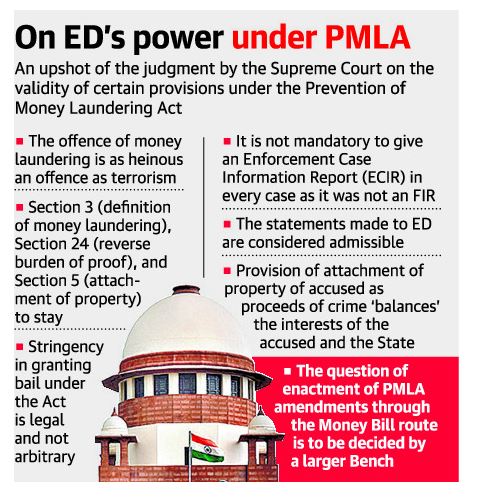
    • Delivering its verdict on a batch of petitions concerning the interpretation of certain provisions of the Act, the SC bench opined that money laundering is a “heinous” crime.
    • In this article, we will talk about the Supreme Court’s ruling on the Prevention of Money Laundering Act.

    Why in news?

    • The verdict came on an extensive challenge raised against the amendments introduced in 2002 Act by way of Finance Acts.
    • Also bail provisions in PMLA act were contested in the apex court.

    Key observations by the Supreme Court

    • Possessions of proceeds: Mere possession of proceeds of crime (without any integration, layering etc.) are sufficient to allege money laundering
    • Preventing crucial crimes: PMLA not only affects the social and economic fabric of a nation but also tends to promote other serious offenses like terrorism and drug trafficking.
    • Curbing illicit financing: The court noted that the law was enacted to address the urgent need for comprehensive legislation to prevent money laundering and prosecute those indulging in activities related to the proceeds of crime.
    • Power of arrests are legible: The court also upheld the EDs powers relating to arrest, attachment of property involved in money laundering, search and seizure under the PMLA, which were challenged by multiple petitioners.
    • Money laundering is no ordinary offence: It is, therefore, a separate class of offence requiring effective and stringent measures to combat the menace of money laundering,” the Court held.
    • Enforcement Case Information Report (ECIR): ECIR cannot be equated with FIR and ECIR is an internal document of the ED. Supply of ECIR to accuse is not mandatory and only disclosure of reasons during arrest is enough.
    • Twin bail: On the issue of twin bail conditions under the PMLA, the court ruled that the stringent conditions for bail under the Act are legal and not arbitrary.
    • Quantum of Punishment: The punishment provided for the offence is certainly one of the principles in deciding the gravity of the offence. However, it cannot be said that it is the sole factor in deciding the severity of offence as contended by the petitioners.
    • Predicate offense: The court made it clear that the offence under Section 3 is dependent on illegal gain of property as a result of criminal activity relating to a scheduled offence. It relates to the process or activity connected with such property that constitutes the offence of money laundering.

    What were the petitions?

    • Petitions were filed against the amendments, which the challengers claimed would violate personal liberty, procedures of law and the constitutional mandate.
    • The petitioners included many veteran politicians who all claimed that the “process itself was the punishment”.
    • There were submissions that the accused’s right against self-incrimination suffered when the ED summoned them and made them sign statements on threats of arrest.
    • But the court said these statements were recorded as part of an “inquiry” into the proceeds of crime.
    • A person cannot claim right against self-incrimination at a summons stage.

    What is Money Laundering?

    • Section 3 of the Act defines money laundering.
    • It initially read that anyone involved in any process or activity connected with the proceeds of crime including its “concealment, possession, acquisition or use” and projecting or claiming it as untainted property shall be guilty of the offense of money-laundering.
    • In 2019, the government made a change to Section 3, adding “or” between the words “concealment”, “possession”, and “acquisition”.
    • The petitioners before the top court, comprising politicians and industrialists, complained that the 2019 amendment enlarged the ambit of the principal section by including mere concealment or possession.

    Explaining beyond legal terms

    • Money laundering is the illegal process of making large amounts of money.
    • This money is generated by a criminal activity but may appear to come from a legitimate source.
    • Criminal activities include drug trafficking, terrorist funding, illegal arms sales, smuggling, prostitution rings, insider trading, bribery, and computer fraud schemes that produce large profits.

    What are the different stages involved in money laundering?

    Generally, money laundering is a three-stage process:

    1. Placement: The crime money is injected into the formal financial system.
    2. Layering: Money injected into the system is layered and spread over various transactions and book-keeping tricks to hide the source of origin.
    3. Integration: Laundered money is withdrawn from the legitimate account to be used for criminal purposes. Now, money enters the financial system in such a way that the original association with the crime is disassociated. The money now can be used by the offender as legitimate money.

    Note: All three sources may not be involved in money laundering. Some stages could be combined or repeated many times.

    What are different methods of money laundering?

    • Smurfing (the criminal breaks up large chunks of cash into multiple small deposits, often spreading them over many different accounts, to avoid detection.)
    • Use of currency exchanges
    • “Mules” (cash smugglers, who sneak large amounts of cash across borders and deposit them in foreign accounts, where money-laundering enforcement is less strict.)
    • Investing in commodities such as gems and gold that can be moved easily to other jurisdictions
    • Discreetly investing in and selling valuable assets such as real estate, cars, and boats;
    • Gambling and laundering money at casinos;
    • Counterfeiting
    • Using shell companies (inactive companies or corporations that essentially exist on paper only).
    • Hawala transactions

    What are some of the national and global efforts to combat money laundering?

    [A] Some of the national efforts are:

    1. Smugglers and Foreign Exchange Manipulators (Forfeiture of Property) Act, 1976,
    2. Narcotic Drugs and Psychotropic Substances Act, 1985, and
    3. Prevention of Money-Laundering Act, 2002 (PMLA), PMLA (Amendment) Act, 2012

    Other than these efforts two important agencies/ units involved are-

    1. Financial Intelligence Unit-IND: It is an independent body reporting directly to the Economic Intelligence Council (EIC) headed by the Finance Minister.
    2. Enforcement Directorate (ED): It is a law enforcement agency and economic intelligence agency responsible for enforcing economic laws and fighting economic crime in India. Main function of ED is to Investigate offenses of money laundering under the provisions of the Prevention of Money Laundering Act, 2002(PMLA).

    Note: India is a full-fledged member of the FATF and follows its guidelines.

    [B] Some of the global efforts are

    • Vienna Convention,
    • 1990 Council of Europe Convention
    • International Organization of Securities Commissions (IOSCO)
    • Financial Action Task Force (It has been set up by the governments of the G-7 countries),
    • IMF
    • United Nations office on Drugs and Crime

    Why prevent money laundering?

    • Corruption in high offices: This is a major facilitator of money laundering.
    • Worldwide nexus: Three “supra-national or transnational” crimes which have brought together the global community are narcotics, money laundering and terrorism.
    • Existence of safe homes: People accused of money laundering run to small nations with no extradition treaty with India where they can buy citizenship.
    • Preventing terrorism: Money laundering and terrorism financing activity in one country can have serious cross-border and even global adverse effects.
    • Huge social costs: This include allowing drug traffickers, smugglers, and other criminals to expand operations and the transfer of economic power from the market, government, and citizens to criminals.

    Critical view of the Judgment

    • Lack of judicial standards: It is argued that the judgment falls short of judicial standards of reviewing legislative action.
    • Downplay of FRs: It invokes legal framework for combating money-laundering so inviolable that possible violation of fundamental rights can be downplayed.
    • Overemphasis on global pledge: The judgment repeatedly invokes the “international commitment” behind Parliament’s enactment of the law to curb the menace of laundering.
    • Selective targeting is justified: The ED has also been manifestly selective in opening money-laundering probes, rendering any citizen vulnerable to search, seizure, and arrest at the whim of the executive.
    • Self-incrimination and reverse burden of proof: This was violative of Article 20(3), which provided protection against self-incrimination.
    • Obsolete arguments: The Court relied on Article 39 of the Constitution, part of the DPSP that mandates the State to prevent concentration of wealth, to uphold the stringent bail conditions under PMLA.
    • Free hand to ED: The constitutionality of several provisions of the PMLA has been considered in the latest judgment and all of them have been upheld, the Court should have at least placed some additional safeguards on exercise of powers by the ED.

    Is further Constitutional Challenge possible?

    • The judgment may be reviewed further by a five or seven-judge bench but the likelihood of the same immediately is not high.
    • As we have seen in the past, judgments of constitutional significance tend to be revisited (if at all) after several years when a situation arises which renders such interference absolutely necessary.
    • But yes a larger bench is already considering the issue of whether amendments can be passed to PMLA under Finance Act like a money bill.
    • It may be worth pointing out, however, that it can sometimes take years for a Constitution Bench (a five, seven or nine-judge bench of the top court) to arrive at a conclusion.

    Way ahead

    • The evolving threats of money laundering supported by the emerging technologies need to be addressed with the equally advanced Anti-Money Laundering mechanisms like big data and artificial intelligence.
    • Both international and domestic stakeholders need to come together by strengthening data sharing mechanisms amongst them to effectively eliminate the problem of money laundering.
    • Similarly, FRs do exist everywhere. And they cannot be used as brackets to prevent investigation agencies since the FRs of large section of population matters than any individual.

    UPSC 2022 countdown has begun! Get your personal guidance plan now! (Click here)

  • [Burning Issue] India’s Civil Aviation Crisis

    UPSC 2022 countdown has begun! Get your personal guidance plan now! (Click here)

    Let’s talk about what’s happening in the aviation sector:

    1. Quite a lot flights are not taking off
    2. Staff are striking,
    3. Luggage is not being loaded or are going missing,
    4. Pilots don’t want to fly
    5. Airports want airlines to cut capacity but airlines won’t oblige
    6. Queues are long and passengers are suffering

    India’s ailing Aviation Sector

    • It is facing a unique crisis a crisis of credibility and safety.  Let me show you some recent headlines to start with.
    • The windshield of a go air flight cracks mid-air, two go air flights suffer engine snags, a flight could not take off because of a dog on the runway.
    • A bird was found in the cockpit of an Air India Express cruising at 37 000 feet.
    • One flight suffered an engine snag another noticed smoke in the cabin.

    India’s Aviation Industry: A backgrounder

    • India is the world’s third largest aviation sector it is home to more than 150 million flyers every year.
    • There are 15 airlines, two more will soon be operational and more than a million flights land and take off from India every year.
    • The country has 137 airports and dreams of adding 100 more according to airbus.  India’s domestic air traffic will grow five times in the next two decades.
    • Nearly 90% of the aviation traffic is domestic and low-cost carriers account for nearly 70% of the domestic seats.
    • The average domestic fare has fallen by more than 70% since 2005.

    Why are India’s airlines suffering so many technical glitches?

    • Why are there so many emergency landings you must have heard of the DGCA or the directorate general of civil aviation it is the government body that’s responsible for airline safety issues the dgca is blaming these snags on staff shortage.
    • Every flight is inspected and certified before take-off.
    • Aircraft maintenance engineers they’re called AME aircraft maintenance engineers.
    • This malfunction is happening because of a shortage of engineers.

    Who’s responsible for the shortage?

    • You see a lot of airlines have outsourced engineering to whom the likes of Air India engineering which is still owned by the government of India then there is Artworks Max Aerospace group gmr, spice jet technique.
    • Some of these companies are short of staff and this staff shortage is risking lives.

    Reasons behind the Crisis

    • In the past years, aviation was one sector that was shining in terms of double-digit growth in passenger traffic for many years.
    • However, that too is currently seeing complications, reflecting the adverse growth in the general economy.
    • It should be noted that the aviation sector is a very high multiplier of both economic growth and employment and any downturn would affect the economy itself.
    • However, airlines are currently in a financial mess.

    (1) Pandemic incurred losses

    • Indian airlines and airports incurred financial losses worth Rs 22,400 crore in the last financial year amid the coronavirus pandemic, according to official data.
    • Besides, 75 per cent of Airports Authority of India-operated airports are incurring losses. Also, AAI’s revenue came down to Rs 889 crore during April-June this year.

    (2) High fuel prices and taxes

    • As far as the domestic sector is concerned, airlines work at a huge disadvantage as they are burdened by high taxes and levies at one end and high Air Turbine Fuel (ATF) prices on the other.
    • The ideal cost of ATF should not exceed beyond 25% of the total operating cost.  
    • A central excise imposition of 14% and sales tax levied by the state governments on ATF can be as high as 30%.
    • Attempts to bring ATF under GST and cutting it down to 12% have not been accepted by the GST Council.

    (3) Rupee depreciation

    • Any deterioration of the exchange rate of rupees to the US dollar also causes adverse impacts on the profits of the airlines.
    • Deterioration of international fuel prices also plays a role.
    • Due to this toxic mix, the operational cost in the domestic sector remains high.

    (4) Economics of tickets fare

    • Due to the large order of planes, the total capacity of seats is increasing, leading to the increasing need to fill up the growing availability of seats.
    • Thus, airline ticket prices are decided by algorithms that change fares based on several factors like past bookings, remaining capacity, average demand per route, probability of selling more seats later etc.
    • This computer-based dynamic pricing system causes passengers acute distress during holidays/festivals or calamities when price sharply increase.

    (5) Airport and aircraft maintenance

    • The Airports Authority of India (AAI) is the custodian of all civil airports in India.
    • While a dozen airports are profitable, the rest are cross-subsided by AAI.
    • Airport improvement involves not just upgrading the terminals, but also the runway, navigational aid and equipment needed for the safety and security.
    • The AAI is currently leasing out bigger airports on a long-term basis.
    • However, the lessee company is selected based on the highest percentage of revenue it can share with the AAI.
    • The Delhi International Airport share 46% of its revenue while Mumbai is a little less. The newly privatized airports are even higher.

    (6) Skill shortage

    • Although India has the world’s second-largest population, the aviation industry faces a severe shortage of skilled workforce.
    • The low-quality training institutes are not training the necessary engineers, technicians and other professionals to meet the demand of this sector.
    • These are the reasons behind aircraft maintenance engineers.

    (7) Disproportionate workforce

    • While some airlines like Air India have surplus manpower, some like IndiGo are suffering from manpower shortage.
    • In fact, the surplus manpower of Air India is one of the major causes of its financial crisis.

    (8) Congestions at airports

    • India’s major airports suffer from congestion of passengers and limited runways.
    • For instance, Mumbai Airport, which is a single runway airport handles over 900 flights each day on an average.
    • That is approximately 38 to 40 flights each hour.
    • Thus, congestion leads to delay in operations and a decrease in the operational efficiency of both airlines and airports.

    Impact of such incidences

    • These incidences are hurting India’s image in recent weeks.
    • Several Indian flights had to make emergency landings abroad, even in Pakistan.
    • Now India and Pakistan don’t have an aviation agreement the two countries, do not have direct flights and they don’t see eye to eye we know that.
    • What about India, the world began questioning India’s aviation sector. The repeated technical snags are making headlines in West Asia in the UK.
    • This raises concerns about flight safety in India and Indian carriers.

    Another aspect: Ambitious UDAN Scheme

    • The Ude Desh Ka Aam Nagrik (UDAN) scheme is a low-cost flying scheme launched with the aim of taking flying to the masses.
    • The first flight under UDAN was launched by the PM in April 2017.
    • It is also known as the regional connectivity scheme (RCS) as it seeks to improve air connectivity to tier-2 and tier-3 cities through revival of unused and underused airports.

    Working of the Scheme

    • Airlines are awarded routes under the programme through a bidding process and are required to offer airfares at the rate of ₹2,500 per hour of flight.
    • At least 50% of the total seats on an aircraft have to be offered at cheaper rates.
    • In order to enable airlines to offer affordable fares they are given a subsidy from the govt. for a period of three years.

    Present status

    • A total of nine rounds of bidding have taken place since January 2017.
    • The Ministry of Civil Aviation has set a target of operationalizing as many as 100 unserved and underserved airports and starting at least 1,000 RCS routes by 2024.
    • So far, the Airports Authority of India (AAI) has awarded 948 routes under UDAN, of which 403 routes have taken off that connect 65 airports.
    • Out of the total 28 seaplane routes connecting 14 water aerodromes, only two have commenced.

    Issues with the UDAN

    • Discontinuance: In reality, some of the routes launched have been discontinued as most of the routes awarded under UDAN are not active.
    • On-paper Ambitions: UDAN was expanded to provide improved connectivity to hilly regions and islands through helicopters and seaplanes. However, they mostly remain on paper.
    • The reasons include:
    1. Failure to set up airports or heliports due to lack of availability of land
    2. Airlines unable to start flights on routes awarded to them or finding the routes difficult to sustain
    3. Adverse impact of the COVID-19 pandemic

    Various challenges

    • Lack of funds: Many small airlines await infusion of funds, to be able to undertake maintenance of aircraft, pay rentals to lessors, give salaries to its staff, etc.
    • Maintenance issue: Many players don’t have more than one or two planes and they are often poorly maintained. New planes are too expensive for these smaller players.
    • Availability of pilots: Often, they also have problems with the availability of pilots and are forced to hire foreign pilots which costs them a lot of money and makes the business unviable.
    • Competition: Only those routes that have been bagged by bigger domestic players such as IndiGo and SpiceJet have seen a better success rate.

    Way forward

    • Aviation is a critical component of the nation’s transportation sector and plays a pivotal role in economic growth and employment generation.
    • Aviation could be a major growth engine to make India a $5 trillion economy by 2024.
    • The government should look into the aviation sector holistically, as a part of the economy as it is going to play a crucial role in economic development and is no more a sector of the privileged class only.
    • The current model of taxation of the civil aviation industry appears unsustainable.
    • Therefore, fuel taxes should be brought under the GST to reduce the operation cost of the airlines.
    • This sector has shown the indomitable spirit- never hesitant to be in the frontline by ensuring the safe movement of people and essential cargo during the nation’s fight against the pandemic.
    • Some leeway at the right time will safeguard aviation to catch up the growth trajectory faster.

    UPSC 2022 countdown has begun! Get your personal guidance plan now! (Click here)

  • [Sansad TV] Perspective: CAATSA Waiver for India

    UPSC 2022 countdown has begun! Get your personal guidance plan now! (Click here)
    Context

    • The US House of Representatives has passed by voice vote a legislative amendment that approves waiver to India against the punitive CAATSA sanctions for its purchase of the S-400 missile defence system from Russia.
    • The amendment was authored and introduced by Indian-American Congressman Ro Khanna.
    • It had urged the Biden administration to use its authority to provide India with a CAATSA waiver to in the face of aggression from China.

    What is the CAATSA?

    • CAATSA is a law that came into effect in the US in 2017, meant to punish countries having deep engagements with Russia, North Korea, and Iran using economic sanctions.
    • It said countries having a “significant transaction” with Russian intelligence and military agents will be subject to at least five kinds of sanctions.
    • Ordinary transactions will not invite sanctions, and the decision of who has sanctions imposed on them comes down to the interpretation of “significant transaction”.
    • This is one of the various waivers or exemptions mentioned, such as the transaction not affecting US strategic interests, not endangering the alliances it is a part of, etc.

    Why did the US enact a law like CAATSA?

    • The US flagged issues of Russia’s alleged interference in the 2016 Presidential elections, and its role in the Syrian war as some of the reasons for punishing engagement with it.
    • EU countries that had even more significant ties with Russia for oil and gas supply before the Ukraine-Russia conflict in 2022, had also criticised CAATSA.

    Countries facing sanctions

    • The US has placed sanctions on China and Turkey for purchase of the S-400.
    • The sanctions included denial of export licences, ban on foreign exchange transactions, blocking of all property and interests in property within the US jurisdiction and a visa ban.

    Reasons behind exemption to India

    • CAATSA impacts Indo-US ties, and dents the image of the US as a reliable partner at a time when it is projecting India as a key player in its Indo-Pacific strategy.
    • US administration for countries like India has favoured relief, citing the “strategic opportunity” that India presents, and also the opportunity “to trade in arms with India”.
    • Indeed, the US defence industry sees India as a major market, over the last decade, deals with India have grown from near zero to $15 billion.
    • Both in term of the number and value of contracts, the US is way ahead of other major suppliers.
    • The CAATSA exemption also underlines the growing defence and security cooperation that has seen India sign a logistics pact with the US.
    • Also US designated India as a Major Defence Partner, and both countries coming together on Indo-Pacific strategy, the newly resurrected Quad.
    • It also marks an acceptance by the US of the point of principle that as a sovereign country, India cannot be dictated on its strategic interests by a third country.

    Benefits to US by this waiver

    • This connection is centred on an eventual ‘payback’ to the US for lifting the spectre of CAATSA, looming over New Delhi since 2018.
    • India is procuring some 140-odd F/A-18s for both the Indian Navy and the Indian Air Force for around $30-35 billion.
    • Prospective F/A-18 sales would significantly boost the US economy, buffeted by unemployment and inflation running at 8.6%, its highest since 1981.
    • The waiver amendment also urged the US to do more to support India’s decision to reduce its reliance on Russian-made weapons.

    Why did India sign the S-400 deal?

    • Security paradigm: S-400 is very important for India’s national security considerations due to the threats from China, Pakistan and now Afghanistan.
    • Air defence capability: The system will also offset the air defence capability gaps due to the IAF’s dwindling fighter squadron strength.
    • Russian legacy: Integrating the S-400 will be much easier as India has a large number of legacy Russian air defence systems.
    • Strategic autonomy: For both political as well as operational reasons, the deal is at a point of no return.

    Way forward

    • The revision in bilateral ties is consistent with the prevailing strategic tone of bilateral ties.
    • Through associations like Quad and, more recently, I2U2, strategic linkages have also been strengthened.
    • India’s strategic interests require a shift away from Russians who are increasingly leaning over China.
    • Following its invasion of Ukraine, Russia’s reliance on China has grown dramatically, and this position is considered unlikely to change in the near future.

    UPSC 2022 countdown has begun! Get your personal guidance plan now! (Click here)

  • [Burning Issue] Chinese Evergrande Crisis

    UPSC 2023 countdown has begun! Get your personal guidance plan now! (Click here)

    Context

    • China is witnessing one of the most challenging economic crisis in its history.
    • The real estate market which accounts for nearly 30% of its GDP has come crashing down in the past 1 year.
    • Property sales plummeted by 72%, 1000s of people are protesting in 86 cities, and now there is a banking crisis where banks have started freezing the accounts of the Depositors.
    • In its heaviest crackdown on depositors, it has deployed tanks against the protesters. 

    And in spite of all this trouble, experts say that this is the just beginning of one of the worst economic crises that is followed in China!!  The question is-

    Chinese Evergrande Crisis: A backgrounder

    What is Evergrande?

    • Evergrande is a Real Estate company which currently owns more than 1,300 projects in more than 280 cities across China.
    • The broader Evergrande Group now encompasses far more than just real estate development.
    • Its businesses range from wealth management, making electric cars and food and drink manufacturing.
    • It even owns one of country’s biggest football teams – Guangzhou FC.

    What is the crisis?

    • Chinese property giant Evergrande, whose liabilities exceed $300bn (£228bn), failed to meet interest payments to international investors.
    • That prompted Fitch, an agency that rates companies’ financial risk, to declare Evergrande in default.
    • The crisis has spooked investors who fear contagion across China’s property and banking sectors.
    • Fitch, whose risk ratings are closely followed by major investors seeking to deploy billions of dollars, said it contacted Evergrande about the non-payment but received no response.

    How did it land itself in trouble?

    • Evergrande expanded aggressively to become one of China’s biggest companies by borrowing more than $300bn.
    • Last year, Beijing brought in new rules to control the amount owed by big real estate developers.
    • The new measures led Evergrande to offer its properties at major discounts to ensure money was coming in to keep the business afloat.
    • Now, it is struggling to meet the interest payments on its debts.
    • This uncertainty has seen Evergrande’s share price tumble by almost 90% over the last year.

    Why would it matter if Evergrande collapses?

    There are several reasons why Evergrande’s problems are serious.

    • Loss of public money: Many people bought property from Evergrande even before building work began. They have paid deposits and could potentially lose that money if it goes bust.
    • Loss to investors: There are also the companies that do business with Evergrande. Firms including construction and design firms and materials suppliers are at risk of incurring major losses, which could force them into bankruptcy.

    Economic impact on China

    • Huge dependence on a single company: Evergrande is an enormous company embedded across China’s financial system and economy, which relies heavily on the property for growth and jobs.
    • Credit crunch in the economy: If Evergrande defaults, banks and other lenders may be forced to lend less. This could lead to what is known as a credit crunch, when companies struggle to borrow money at affordable rates.
    • Withdrawal of foreign investments: Companies that can’t borrow find it difficult to grow, and in some cases are unable to continue operating. This may also unnerve foreign investors, who could see China as a less attractive place.
    • Snowball effect on debts: In theory, a collapse could chase investors away from other publicly traded developers, setting off a chain of defaults.
    • Rise in unemployment: A collapse could also undermine the economic activity and jobs created by Evergrande and its downstream suppliers.
    • Visible bankruptcy: Cash is so short the company this summer started paying some suppliers with unfinished apartments instead of money.  

    Why Chinese people are fuming over the streets?

    • Many investors have expressed concerns about the Chinese government’s lack of communication about its plans.  
    • Continued absence of a clear message from Beijing is posing notable downside risk to growth.
    • Given wide use of property as collateral for loans to companies and local governments, a deep and widespread drop in prices, however unlikely, could threaten the financial system.
    • To head off further damage, the government faces the challenge of ensuring customers get the homes they bought.

    What is China’s government doing to prevent a crisis?

    • The government of the province, where Evergrande is based, said that at the company’s request it would dispatch a working group to help Evergrande manage its risks and maintain normal operations.
    • China’s central bank said it supported the decision to step in and would cooperate, while banking and securities regulators said they would work together to maintain the health of the broader property market.
    • Chinese authorities had earlier asked local governments to prepare to step in—only at the last minute—if Evergrande fails to manage its affairs in an orderly fashion.
    • This approach signals Beijing’s reluctance to bail out the debt-saddled property developer while bracing to cushion any economic or social fallout.

    What exactly went wrong with the Real estate market in China?

    There were two immediate triggers that precipitated the crisis at Evergrande.

    • Chinese regulators, as part of a widespread crackdown on sectors such as the digital economy and education, kicked off probes into the high borrowings of property developers.
    • To counter that, Evergrande tried selling off some of its business.
    • But a progressive slowing down of China’s property market and tapering demand for new houses crimped cash flows.
    • These two factors combined to precipitate the cash crunch at Evergrande.
    Three red lines
    In August 2020, in an effort to better manage the heavily leveraged sector, Chinese regulators introduced rules dubbed the “three red lines” to limit borrowing of real estate firms.
    The three red lines mandate that developers maintain:
    1. A debt-to-asset ratio of 70% or lower,
    2. A 100% cap on net debt to equity,
    3. Enough cash on hand to satisfy short-term borrowing, debts, and liabilities.

    Why is the world worrying?

    A collapsing property market in China has triggered alarm bells across the world.

    (1) Future of manufacturing

    • It is still the manufacturing hub of the world and if its economy falters, countries around the globe would suffer from slower and more expensive exports.
    • Contract electronics and semiconductor manufacturing, where China is a global leader, had already stalled various sectors such as auto, consumer electronics and more due to Covid-induced supply bottlenecks.
    • This would only go up further in an economic crisis.

    (2) Future of BRI Projects

    • China is also the global creditor of the developing world. Developing countries dependent on China for infrastructure projects, would be hard-hit.
    • The Xi-government has sponsored numerous projects under the Belt and Road Initiative.
    • Currently, BRI projects are valued at over $1 trillion across 139 countries around the globe. These building sites, highways, power generation plants and so on could be left unfinished.

    (3) Disburse of finances

    • China’s extended property boom that started in the mid-1990s has now ensured that nearly three quarters of the country’s household wealth is locked up in housing.
    • An impending collapse at the biggest real estate company could have a serious knock-on effect on the entire economy.
    • It could drag down growth and potentially setting off a cascading impact that could singe the global commodities and financial markets.

    Impact on India

    • India’s buoyant iron ore exports, much of which is headed to China, could also see an impact if the twin crises in China triggers an extended slowdown in the Chinese real estate market.
    • In India’s stock markets, the metals segment, which has been surging since the start of the year and appeared to show signs of overheating.
    • Analysts view this more as a short-term correction, but there could be an extended impact if the crisis in China were to remain unresolved.
    • And there could potentially be a sustained impact on global growth prospects, dampening the nascent recovery that is underway in markets such as India.

    Why global sentiments now are against China?

    • Aggressive expansion: In recent years, China has expanded its diplomatic and economic relationships through aggressive means.
    • Covertness of BRI: It has been positioning itself as a donor of much-needed public goods through it’s the Belt and Road Initiative.
    • As China’s influence has grown, so have the number of countries concerned with its:
    • Lack of economic reciprocity
    • Dominant technological policies
    • Coercive foreign policy practices, and
    • Regional military ambitions
    • In Asia, where strong economic ties with China are critical to development, Beijing has still managed to drum up resentment for its unyielding position on territorial claims in the South China Sea.
    • Criticism of Chinese policies, both at home and abroad, has revealed the grittier side of Beijing’s diplomacy.
    • The coronavirus has only further highlighted this dynamic.

    Will China collapse?

    What do incidences say?

    • Freezing of bank accounts: Some Chinese banks have responded by seizing purchasers’ savings deposits, claiming they are really ‘mortgage investment products.’
    • Putting tanks over protestors: This has sparked open protests outside some banks, leading to the government surrounding the banks with tanks.

    However, there is not going to be a financial crash in China. Why?

    That’s because the government controls the financial levers of power:

    1. The central bank,
    2. The big four state-owned commercial banks which are the largest banks in the world (who lends Pakistan always)
    3. The so-called ‘bad banks,’ which absorb bad loans
    4. Big asset managers

    Hence we can say that China is too big to collapse.

    How can China achieve this?

    Ans. Socialistic Autocracy

    • The government can order the big four banks to exchange defaulted loans for equity stakes and forget them.
    • It can tell the central bank, the People’s Bank of China, to do whatever it takes.
    • It can tell state-owned asset managers and pension funds to buy shares and bonds to prop up prices and to fund companies.
    • It can tell the state bad banks to buy bad debt from commercial banks.
    • It can get local governments to take up the property projects to completion.
    • So a financial crisis is ruled out because the state controls the banking system.

    What are the lessons India needs to learn from the Chinese economic Crisis?

    • What we need to learn from this Chinese crisis is that investment instruments driven by mindless social norms will often cost both the people and the economy heavily.
    • In this case the Chinese definition of a well-seeded person got a ton of debt piled up for the Chinese people in spite of the sky high prices.
    • In our case in India the same thing happened with fixed deposits (FDs) because we outright considered FDs to be safe because of the social norm without understanding inflation.
    • Similarly the mindless purchase of gold is now hindering our economy so take a step back and assess whether your instruments are backed by calculated strategy or just mindless social norms.
    • The Indian real-estate sector has been stagnant.
    • If companies in the sector are to be believed, this has primarily been because of high interest rates. But what is basically holding back people are high home prices.
    • We need homes in a price range of ₹10-15 lakh for real estate to become a major contributor to economic growth, like it has been in the Chinese case.

    UPSC 2023 countdown has begun! Get your personal guidance plan now! (Click here)

  • [Sansad TV] Mudda Aapla: Culture of Freebies

    UPSC 2022 countdown has begun! Get your personal guidance plan now! (Click here)

    Context

    • With the poll season round the corner, political parties are busy planning to lure the electorate with their promises which also include freebies.
    • Over the years the politics of freebies has become an integral part of the electoral battles and the scenario is no different in the forthcoming assembly polls in five states.
    • There are arguments both in favour and against this practice. In this article, we shall learn analyse all aspects of this issue.

    Freebie Politics in India: A backgrounder

    • The term Freebies is not new; rather it is a prevalent culture in Indian politics (in the name of socialism).  
    • The political parties are always trying to outdo each other in luring the Indian voters with assorted freebies.
    • From free water to free smartphones the Indian politicians promise everything to attract prospective voters in favour.
    • This trend has gained more momentum in the recent times with the political parties being innovative in their offerings as the ‘traditional free water and electricity’ is no longer sufficient as election goodies.

    Examples of freebies

    1. Promise of Rs 15 lakh in our bank accounts 😀
    2. Free TV, Laptops
    3. Free electricity
    4. Loan waivers
    5. Offering free public transport ride to all women in Delhi

    Why are such policies popular among the public?

    • Failure of economic policies: The answer lies in the utter failure of our economic policies to create decent livelihood for a vast majority of Indians.
    • Quest for decent livelihood: The already low income had to be reoriented towards spending a disproportionately higher amount on education and health, from which, the state increasingly withdrew.
    • Prevailing unemployment:  Employment surveys have shown that employment growth initially slowed down from the 1990s, and then has turned negative over the past few years.
    • Increased cost of living: Real income growth of the marginal sections has actually slowed down since 1991 reforms.
    • Increased consumerism: The poor today also spend on things which appear to be luxuries; cellphones and data-packs are two such examples which are shown as signs of India’s increased affluence.
    • Necessity: For migrant workers, the mobile phone helps them keep in touch with their families back home, or do a quick video-call to see how their infant is learning to sit up or crawl.

    Can Freebies be compared with Welfare Politics?

    • These freebies are not bad. It is a part of social welfare.
    • Using freebies to lure voters is not good.
    • Voter’s greediness may lead to a problem in choosing a good leader.
    • When we don’t have a good leader then democracy will be a mockery.

    Impact of such policies

    • Never ending trail: The continuity of freebies is another major disadvantage as parties keep on coming up with lucrative offers to lure more number of votes to minimize the risk of losing in the elections.
    • Burden on exchequer: People forget that such benefits are been given at the cost of exchequer and from the tax paid.
    • Ultimate loss of poors: The politicians and middlemen wipe away the benefits and the poor have to suffer as they are deprived from their share of benefits which was to be achieved out of the money.
    • Inflationary practice: Such distribution freebie commodity largely disrupts demand-supply dynamics.
    • Lethargy in population: Freebies actually have the tendency to turn the nation’s population into: Lethargy and devoid of entrepreneurship.
    • Money becomes only remedy: Everyone at the slightest sign of distress starts demanding some kind of freebies from the Govt. 
    • Popular politics: This is psychology driving sections of the population expecting and the government promptly responds with immediate monetary relief or compensation.

    What cannot be accounted to a freebie?

    • MGNREGA scheme (rural employment guarantee scheme)
    • Right to Education (RTE)
    • Food Security through fair price shops ( under National Food Security Act)
    • Prime Minister Kisan Samman Yojana (PM-KISAN)

    Arguments in favour

    • Social investment: Aid to the poor is seen as a wasteful expenditure. But low interest rates for corporates to get cheap loans or the ‘sop’ of cutting corporate taxes are never criticized.
    • Socialistic policy: This attitude comes from decades of operating within the dominant discourse of market capitalism.
    • Election manifesto: Proponents of such policies would argue that poll promises are essential for voters to know what the party would do if it comes to power and have the chance to weigh options.
    • Welfare: Economists opine that as long as any State has the capacity and ability to finance freebies then its fine; if not then freebies are the burden on economy.
    • Other wasteful expenditure: When the Centre gives incentives like free land to big companies and announce multi-year tax holidays, questions are not asked as to where the money will come from.

    A rational analysis of freebies

    • Winning election and good governance are two different things. The role of freebies to avail good governance is definitely questionable.
    • The social, political and economic consequences of freebies are very short-lived in nature. 
    • There are many freebies and subsidies schemes available in many States but we still find starvation deaths, lack of electricity, poor education and health service. 
    • Hence the sorrow of the masses of India cannot be solved by freebies or by incentives.

    So are not freebies meant only to attract voters and swing voters by concentrating on a preferential group or community?

    Way forward

    • It can be agreed that a democracy requires popular support for its rule to continue. The sops and freebies to the poor buy it the requisite votes.
    • But the democratic process of election and election promises should be clear. It should not control voters thought. 
    • What some people term as ‘populism’ actually constitutes what real economics should be.
    • If you deprive people of what they really need, you will have to throw allurements at them.
    • This can only be stopped if political masters try to follow what economist EA Schumacher had conveyed through his seminal work Small is beautiful – “Treat economics as if people matter.”

    Conclusion

    • There is nothing wrong in having a policy-led elaborate social security programme that seeks to help the poor get out of poverty.
    • But such a programme needs well thought out preparation and cannot be conjured up just before an election.

    Perhaps the best observation has come from Y K Alagh, economist and educationist, that the electorate is nobody’s fool. It will take all the freebies already being distributed and then vote according to its carefully thought out assessment of performance. Much depends on whether the electorate can see through all this posturing.

  • [Burning Issue] Intra Party Democracy / Democratization of Political Parties

    https://www.idea.int/sites/default/files/2018-9-14-taking-stock-of-the-global-state-of-democracy-IDEA.PNG

    UPSC 2023 countdown has begun! Get your personal guidance plan now! (Click here)

    One should not be surprised that the democratic system of administration was not new to India. Ever since ancient times, India had it and she lost it. We all have read about “Kingdoms, Kings and Early Republic” through NCERT since our preparation began.

    Context

    • In Maharashtra, recently splits in the ruling party led to the fall of a tripartite government which had acclaimed dynast and popular leaders.
    • Most political parties in India were no doubt dynastic, i.e. the future leader is almost always a family member of the present party leader (no doubt they are anyhow ousted with the present regime in India).
    • This however highlights huge vacuum in intra-party discipline and coherence of ideologies.
    • Thus the character of any India’s political institution or party system is a result of its political culture.

    Today’s debate is – Is India being held back due to a lack of democracy in its political parties? Or does the freedom to start a new political party compensate for this defect?

    Point of discussion

    • In India, there is no real movement toward the democratization of parties.
    • The selection of candidates, Chief Ministers and office-bearers of party units is usually left to the discretion of a handful of leaders who take decisions behind closed doors.

    “It is not that India did not know what is Democracy,” Dr.B.R.Ambedkar, the Chairman of the Drafting Committee told the Constituent Assembly while presenting the final draft of the Constitution, “There was a time when India was studded with republics, and even where there were Mahajanpada monarchies, they were either elected or limited. They were never absolute. It is not that India did not know Parliaments or Parliamentary procedures. A study of the Buddhist Bhikshu Sanghas discloses that not only there were Parliaments- for the Sanghas were nothing but Parliaments- but the Sanghas knew and observed all the rules of Parliamentary Procedure known to modern times.”

    Constituent Assembly Debates

    Political Parties in India: A Backgrounder

    • A party system is a concept in comparative political science concerning the system of government by political parties in a democratic country.
    • In India, there is a multi-party system in place, with the number of parties at the national level fluctuating.
    • Furthermore, India has a diverse range of political parties, including left, centrist, and right-wing parties, as well as communal and non-communal parties.

    Features of Political Parties in India

    The key features of the Indian Party system are:

    1. Ideology base
    2. Multi-Party System
    3. Pre-poll Alliances
    4. Coalition System
    5. Opposition’s Multi-Party Character

    Issues with Political Parties in India

    • Lack of proper organisation: Another feature of the Indian party system is its lack of structure. Political parties live and die by their organization.
    • Groupism inside India’s party structure: In India, groupism is a major problem for every political party. This shatters a party’s cohesiveness, causing it to split into several factions. Ex. INC, NCP, TMC.
    • Extra-constitutional ways of gaining power: Political parties do not hesitate to utilize uncertain measures to gain political power in addition to legitimate means. Ex. Resort Politics
    • Populist tendencies: In India, it is well noticed that political parties turn to populist politics in order to gain power. They take unfair advantage of people’s emotions and compulsions, promote populist slogans, and mislead the public. Ex. Temple reconstruction movements
    • Lack of discipline among party members:  It has been observed that members of various political parties are unconcerned about party discipline, preferring instead to sling dirt at one another. Ex. Undue political statements
    • Communal characteristics: The people of India are influenced by caste and religion, and they have a strong sense of allegiance to their caste and religion. Ex. Political party in Hyderabad.
    • Criminalization of politics: Leaders are valued for their capacity to attract crowds and raise funds as elections become more and more expensive.

    Why are tainted candidates inducted by political parties?

    • Innocent until proven guilty maxim: The other reason offered by political parties is summarised by the maxim of Indian law, which is that any accused is innocent until proven guilty.
    • Popularity: Such candidates with serious records seem to do well despite their public image, largely due to their ability to finance their own elections and bring substantive resources to their respective parties.
    • Prospected victory: The logic of a candidate with criminal charges doing better for the cause of people of is another flawed argument.
    • Destabilizing other electors: Others do not seek to punish these candidates in instances where they are in contest with other candidates with similar records.
    • Vested interests: Some voters tend to view such candidates through a narrow prism: of being able to represent their interests by hook or by crook.

    Why voice for democracy within?

    • Dynastic politics: Many political parties in India has charges of dynastic politics irrespective of the political insights of the person who inherits the legacy.
    • Opaque appointments:  Although election of the party president cannot be the sole criteria for judging intraparty democracy, political parties view the matter only through the procedure of electing the chiefs.
    • Dominants: The party head positions are mostly influenced by some external forces which have larger say in finance and caste (or) religion.
    • Personality cult: There is a tendency of hero worship in people and many times a leader takes over the party and builds his own coterie, ending all forms of intra-party democracy.
    • Centralised power: Most parties are subservient to one supreme leader or a charismatic personality.   Such leaders are valued for their capacity to attract crowds and raise funds as elections become more and more expensive.
    • Lack of institutionalization: Most of political parties still refuse to lay down settled and predictable procedures for almost everything they do, from the selection of candidates to the framing of a manifesto.

    How this impacted election has mandates?

    • Weaker opposition: In India, strong and well-organized opposition is required for parliamentary democracy to succeed, yet it does not exist.
    • Non-coherence: There are several national and regional political parties performing the role of opposition at the moment, both at the national and state levels, but they are not unified on many political topics and do not have a uniform agenda.
    • Electoral autocracy: India is often accused to be a flawed democracy on accounts of its alleged far-right-wing political government. There has been increased pressure on human rights groups, intimidation of journalists and activists, and a spate of attacks, especially against Muslims.
    • Against public aspirations: People vote for fulfilling their demands and put much effort with aspirations that a stable government would be at their behest to resolve their issues.
    • Unstable government: This point needs no explanation. We have largely seen the perils of poor decision-making of politicians due to a lack of consensus among the allies.

    Even Monarchies were either elected or limited but never absolute Bhakti or hero-worship sure road to dictatorship, says Dr.Ambedkar

    A critical evaluation

    • Political parties have become oligarchies: India’s success in consolidating a democratic system of government has paradoxically forestalled pressure for party reform.  .
    • One person diktat rules the parties: Most parties are subservient to one supreme leader who can impose his/her offspring on the party, and even electoral defeat does not loosen their control or hold over the party.
    • Election manifesto is nowhere relevant post-election: Political parties with the exception of the Left parties still refuse to lay down settled and predictable procedures for almost everything they do, from the selection of candidates to the framing of a manifesto.
    • Party reform is a pressing one in India: While many argue that intraparty democracy is essential to sustain broader political democracy, this is not a panacea for the numerous problems facing parties.
    • Vague system is the status-quo:  The biggest weakness of parties is that they are leader-centric and most leaders are unwilling to institutionalize the procedures.
    • Diktat of the party high-command actually rules a govt.: As a rule, strong leaders rarely support institutionalization because it constrains their discretion and personal power.  
    • Partisan mobilization of the left-liberals: There is a major challenge facing the party system by party activity driven by partisan mobilisation lies at the root of much of the schism and disruption of Indian politics today. Ex. Leftists frequently meeting the Chinese.
    • Sake of electioneering and winning never ends: Another aspect is the reduction of party organisations into election-winning machines. This has become the only role a party envisages for itself.
    • Lack of political will persists: If party funds are raised and controlled centrally, this weakens the State units and rank and file vis-à-vis the central leadership on a range of issues including leadership selection and nominations for elections.

    Need for imbibing democracy

    • Ensuring equal opportunity: The absence of intra-party democracy adversely impacts the constitutional right of all citizens to equal political opportunity to participate in politics and contest elections.
    • Less factionalism: A leader with strong grassroot connection would not be side-lined. This will allow less factionalism and division of parties thereby ensuring a stable govt in power.
    • Popular representation: A transparent party structure with transparent processes will allow proper ticket distribution and candidate selection.  The selection would not be based on the whims of a few powerful leaders in the party but will represent the choice of the larger party.
    • Accountability of the legislators: A democratic party will be accountable to its party members, for they will lose elections in the next cycle for their shortcomings.
    • Decentralising power: Every political party has State and local body units, an election at each level will allow creation of power centres at different levels. This will allow decentralisation of power and the decision making will take place at the ground level.
    • Legal loopholes: Currently, there is no express provision for internal democratic regulation of political parties in India except political defection. The ECI’s power to require parties to hold regular internal elections for office bearers, and candidate selection is compromised in the absence of any penal provisions.

    How to attain internal democracy within parties?

    • Internal elections: It shall be the duty of the political party to take appropriate steps to ensure holding of elections at all levels. The political party shall hold elections in an unpartisan ways by their ‘karyakartas’.
    • Strengthening Anti-defection Law: The Anti-Defection Act of 1985 requires the party legislators to act according to the party whip which is decided by the diktats of the highest party leadership. One way to democratise political parties is to promote intra-party dissent.
    • Limited reservations: Seats can be reserved for women and members of the backward community including minorities.
    • Empowering ECI: The ECI shall be competent to inquire into allegations of non-compliance of any of the provisions requiring elections.
    • Social audit and penal provisions: ECI should have the penal power to deregister a party until free and fair elections in the party are conducted.
    • Encouraging new generation of leaders: For long, there is a widespread impression created that lot of good people shy away from politics. It is therefore necessary that this impression be changed and efficient people brought into political arena.

    Way forward

    • The 170th report of the Law Commission of India on reform of electoral laws, dedicated an entire chapter on the necessity of providing laws relating to internal democracy within parties.
    • It observed that a political party which does not respect democratic principles in its internal working cannot be expected to respect those principles in the governance of the country.
    • The National Commission for Review of Working of Constitution states that there should be comprehensive legislation regulating the registration and functioning of political parties or alliances of parties in India.
    • The Administrative Reforms Commission II (ARC), 2008 Ethics and Governance Report pointed out that corruption is caused by over-centralization.

    Conclusion

    • Politics is inseparable from political parties as they are the prime instruments for the execution of democracy in the country.
    • We must emphasize our PM’s call for a debate on internal democracy in political parties.
    • It is imperative that political parties open their eyes to growing calls for electoral political reforms and take steps towards bringing in intra-party democracy.

    UPSC 2023 countdown has begun! Get your personal guidance plan now! (Click here)

  • [Sansad TV] Diplomatic Dispatch: India and the Commonwealth

    UPSC 2023 countdown has begun! Get your personal guidance plan now! (Click here)

    Context

    • Recently, the 26th Commonwealth Heads of Government Meeting (CHOGM) took place from June 20 to 25 in Kigali, Rwanda.
    • External Affairs Minister Dr S Jaishankar led the Indian delegation.

    In this article, we examine the role of the Commonwealth and India’s unique relationship with it.

    What is the Commonwealth of Nations?

    • The Commonwealth of Nations is an intergovernmental organization of 53 member states that are mostly former territories of the British Empire.
    • It dates back to the first half of the 20th century with the decolonization of the British Empire through increased self-governance of its territories.
    • It was originally created as the British Commonwealth of Nations through the Balfour Declaration at the 1926 Imperial Conference.
    • It was formalized by the UK through the Statute of Westminster in 1931.
    • The symbol of this free association is Queen Elizabeth II, who is the Head of the Commonwealth.

    History of its creation

    • The Commonwealth was created in the early 1900s when nations that were formerly a part of the British Empire began to secede.
    • India is one of the founding members of the modern Commonwealth.
    • India’s first Prime Minister, Jawaharlal Nehru, played a key role in the creation of the modern Commonwealth in 1949, Indian policy-makers over the years have considered it as a relic of empire and steeped in colonial legacy.
    • Membership today is based on free and equal voluntary cooperation.

    Working of Commonwealth

    • Commonwealth members has no legal obligations to one another.
    • Instead, they are united by language, history, culture and their shared values of democracy, human rights and the rule of law.

    Actual functioning: Commonwealth Heads of Government Meeting (CHOGM)

    • CHOGM which takes place every two years is a platform for all Commonwealth leaders to meet and discuss issues pertaining to the Commonwealth.
    • The motto behind the meeting is to reaffirm common values, address the shared global challenges and agree how to work to create a better future.

    Why is Britain promoting Commonwealth?

    • The Commonwealth has become an important forum for London to recalibrate foreign policy.
    • Britain also wants to reinvent itself politically after Brexit.

    India & the Commonwealth

    • India became a member in 1947, the first with chiefly non-European populations.
    • India’s new political interest in the Commonwealth is evident by the participation of PM at the 25th Commonwealth Heads of Government Meeting (CHOGM) in London in 2018.
    • It marked the first Indian PM’s presence in a Commonwealth Summit after nearly a decade.

    India’s interest in the Commonwealth

    • Old global grouping: First, the membership of the Commonwealth, virtually spanning the entire globe.
    • Scope for bilateral engagement: For India, membership and prospective leaders of the Commonwealth helps enhance its bilateral ties with individual countries.
    • Extending India’s soft power: The growing importance of small states for India’s foreign policy. For a rising India, the Commonwealth is the most natural theatre to demonstrate its credibility as a “leading power”.
    • Indian diaspora: Commonwealth-wide presence of Indian diaspora who once went there as indentured labour is another factor.
    • Ring-fencing against rivals:  China is not and will never be a member of the Commonwealth.
    • Economic interests: India has the largest economy in the Commonwealth after the UK, India is expected to overtake the UK as the fifth-largest economy in the world and the largest in the Commonwealth.

    Issues with the Commonwealth

    • No agenda: The grouping has no political or economic power, and even former immigration advantages between Commonwealth countries have also ceased to exist.
    • Declining relevance as a group: Considering its declining importance former PM Manmohan Singh skipped two CHOGM meets, while Narendra Modi didn’t attend the last one, held in Malta in 2015.
    • Imperialistic setup: Amidst the calls for the position of Commonwealth Head to be more democratically shared or rotated the announcement of Prince Charles as the successor has also put a dent on its democratic credentials.

    Importance of Commonwealth

    • Reach to small nations: From the Indian perspective, the Commonwealth offers opportunities to reach out to small states that make up around 60% of Commonwealth members.
    • Extending diplomatic presence: In some of these states, India has no diplomatic presence, and forging relations with these countries could help India secure crucial votes during UN or multilateral contests it is involved in.
    • Voice for small nations: It is also a larger network of countries than any other, except for the UN, which gives a chance for smaller countries to have their voices heard and make their concerns heard.
    • Most peaceful alliance: On a geopolitical scale, the Commonwealth continues to be an impressive show of the force of a peaceful alliance.
    • Democratic bloc: Also, for India, it provides an excellent opportunity to give shape to a model of international cooperation and partnership distinct from that of China.

    Way Forward

    • India’s new political interest in the Commonwealth is encouraging. This provides a focus on the Commonwealth looking towards the future.
    • India has clear opportunities to enhance its global role and maximize its bilateral relations within the multilateral framework of the Commonwealth.
    • It will seek to focus on enhancing trade and investment in a multilateral Commonwealth-wide context.
    • The bloc may prove to be an important channel through which India can attempt to build a consensus to develop collaborative ways in dealing with global institutional reforms.

    UPSC 2023 countdown has begun! Get your personal guidance plan now! (Click here)

  • [Burning Issue] Global Trade in Rupees

    UPSC 2023 countdown has begun! Get your personal guidance plan now! (Click here)

    Context

    • The Reserve Bank of India has announced an arrangement for the country’s traders to settle imports and exports in rupees.
    • This move is aimed at promoting growth of global trade with emphasis on exports from India and to support the increasing interest of the global trading community in the Indian Rupee.

    Background: Russia-Ukraine War

    • India is a trade deficit country, meaning it imports more than it exports.
    • This forces the country to maintain large forex reserves since world trade still occurs in US dollars.
    • This is not the first time that the RBI has allowed international trade in rupees – the sanctions on Iran a few years ago resulted in the two countries trading in rupees instead of dollars.
    • The Russia-Ukraine war and the subsequent sanctions have provided RBI with another opportunity to push for trading in rupees.

    US Dollar: The Global Currency

    • The U.S. dollar has been the world’s dominant currency since the end of World War II.
    • Roughly half of the international trade, international loans, and global debt securities are denominated in USD.
    • The USD became the official reserve currency of the world in 1944. The decision was made by a delegation from 44 Allied countries called the Bretton Woods Agreement.
    • Despite the challenges faced by the US economy due to fiscal and external deficits of the 1980s, the dollar’s share of global reserves remained steady and reserves even grew as time progressed.
    • The dominance of the dollar is backed by strong and highly credible institutions, deep markets and the fact that it is freely convertible.
    • Almost 40% of the world’s debt is issued in dollars. As a result, foreign banks need a lot of dollars to conduct business. This became evident during the 2008 financial crisis.

     What is the Rupee Settlement System?

    • Banks acting as authorized dealers for such transactions would have to take prior approval from the regulator to facilitate this.
    • All exports and imports under the invoicing arrangement may be denominated and invoiced in Rupee.
    • Exchange rate between the currencies of the two trading partner countries may be market determined.
    • Exporters and importers can now use a Special Vostro Account linked to the correspondent bank of the partner country for receipts and payments denominated in rupees.
    • These accounts can be used for payments for projects and investments, import or export advance flow management, and investment in Treasury Bills subject to Foreign Exchange Management Act, 1999 (FEMA).
    • Also, the bank guarantee, setting-off export receivables, advance against exports, use of surplus balance, approval process, documentation, etc., related aspects would be covered under FEMA rules.
    Nostro and Vostro Accounts: Nostro and vostro are terms used to describe the same bank account; the terms are used when one bank has another bank’s money on deposit.They are used to differentiate between the two sets of accounting records kept by each bank.Nostro comes from the Latin word for “ours,” as in “our money that is on deposit at your bank.”Vostro means “yours,” as in “your money that is on deposit at our bank.”

    Why such a move?

    • Trade facilitation: This will also facilitate trade with countries like Russia which are facing sanctions.
    • FOREX savings: India imports more than it exports so the country will also save foreign currency under the new arrangement.
    • Rupee appreciation: The rupee is at a historic low against the dollar. It will also help stabilize rupee.
    • Mitigating war impact: Payments had become a pain point for exporters immediately after the Russia-Ukraine war broke out, especially after Russia was cut off from the SWIFT payment gateway.
    • Convertibility easing: We see this as a first step towards 100% convertibility of rupee.
    • Energy security: It will also help buy discounted crude oil from Russia, which now accounts for 10% of all imported crude.
    • Export promotion: As such, the new mechanism will help India promote its exports.

    Which countries would prefer this system?

    • War mongering Russia: For now, it looks like trade settlements in rupee will be limited to countries like Russia and Iran who are facing sanctions from the West
    • Bankrupt Sri Lanka: SL is going through economic turmoil and India has been consistently extending lines of credit to SL.
    • Immediate neighbors: Other countries may include immediate neighbors of India.

    Rupees over Dollars: Why countries would prefer Rupees?

    • At a very simplistic level, this is like two Indians deciding to use an alternative mode of exchange that they have come up with, instead of using rupees.
    • In other terms, this is similar to the barter system.
    • The main reason for countries to want to trade with India in rupees is this:
    1. USD has been going through a phase of strength against most currencies in the world
    2. Strong USD performance has essentially made imports expensive for most countries
    3. Sri Lanka, which is going through one of its worst economic crises in decades, is a glaring example of a country in which the economy has come to a halt due to a drastic fall in forex reserves
    • While the Sri Lankan Rupee has declined over 83 percent against the US Dollar, its fall against the Indian Rupee has been lower at 70 percent.
    • So instead of paying 83 percent more to make purchases in USD, Sri Lanka can pay in Indian Rupees and save some money.

    Challenges

    • Trade surplus countries’ preference: The question that RBI and the Indian government will have to answer is this – why would countries with a trade surplus with India want to trade in rupees?
    • Negative trade balance: China had a $73-billion trade surplus with India in 2021-22 – that is, Indian imports from China exceeded its exports to China by $73 billion.
    • Idle money lying useless: If China were to trade with India in rupees, it would have Indian rupees worth $73 billion (about ₹5.77 lakh crore) sitting idle in its Rupee Vostro accounts in an Indian bank.
    • Few countries interested: Countries whose exports to India are more than imports, will not be too enthusiastic to trade in rupees, especially if the difference is huge as in the case of China.

    Way forward

    • In a multipolar world where Free Trade Agreements (FTAs) are frequent, undermining the dollar’s dominance seems prominent.
    • This has been the dream of governments that have looked uneasily at US global primacy, and formed coalitions.
    • It is predicted that the sanctions against Russia has foreshadowed the decline of the dollar as the reserve currency.

    Conclusion

    • No doubt! This move wouldn’t kill the dollar.
    • A currency’s dominance depends on demand of the currency and India would need to export stuff to create that demand.
    • If all the nations in the world stop using dollars only then it would fall.

    UPSC 2023 countdown has begun! Get your personal guidance plan now! (Click here)

  • [Sansad TV] Mudda AapKa: Supreme Court Suggests “Bail Act”

    UPSC 2023 countdown has begun! Get your personal guidance plan now! (Click here)

    Context

    • Lamenting that jails across the country were flooded with undertrial prisoners, the apex court urged the Centre to introduce reforms in the bail laws.
    • It stated that bail applications should be disposed of within two weeks while those for anticipatory bail be decided within six weeks

    What is Bail?

    • Bail is the conditional release of a defendant with the promise to appear in court when required.
    • The term also means the security that is deposited in order to secure the release of the accused.
    • In India’s legal world, the term offense has been categorized as bailable offenses and non-bailable under the Code of Criminal Procedure.

    Why need Bail?

    • Bail is a fundamental aspect of any criminal justice system.
    • The practice of bail grew out of the need to safeguard the fundamental right to liberty.
    • Liberty is the right of one whose guilt has not yet been proven.

    Types of Bail in India

    • Depending upon the sage of the criminal matter, there are commonly three types of bail in India:
    1. Regular bail: Regular bail is generally granted to a person who has been arrested or is in police custody. A bail application can be filed for regular bail under sections 437 and 439 of CrPC.
    2. Interim bail: This type of bail is granted for a short period of time and it is granted before the hearing for the grant of regular bail or anticipatory bail.
    3. Anticipatory bail: Anticipatory bail is granted under section 438 of CrPC either by session court or High Court. An application for the grant of anticipatory bail can be filed by the person who discerns that he may be arrested by the police for a non-bailable offense.

    Conditions for Grant of Bail in Bailable Offences

    • Section 436 of the Code of Criminal Procedure, 1973, lays down that a person accused of a bailable offense under IPC can be granted bail if:
    1. There are sufficient reasons to believe that the accused has not committed the offence.
    2. There is sufficient reason to conduct a further inquiry in the matter.
    3. The person is not accused of any offence punishable with death, life imprisonment or imprisonment up to 10 years.

    Conditions for Grant of Bail in Non-Bailable Offences

    • Section 437 of Code of Criminal Procedure, 1973 lays down that the accused does not have the right to apply for bail in non-bailable offences.
    • It is discretion of the court to grant bail in case of non-bailable offences if:
    1. The accused is a woman or a child, bail can be granted in a non-bailable offence.
    2. There is a lack of evidence then bail in non-Bailable offenses can be granted.
    3. There is a delay in lodging FIR by the complainant, bail may be granted.
    4. The accused is gravely sick.

    What is the recent ruling about?

    • The Supreme Court underlined that arrest is a draconian measure that needs to be used sparingly.
    • The ruling is essentially a reiteration of several crucial principles of criminal procedure.

    Why bail needs reform?

    • Huge pendency of undertrials: Referring to the state of jails in the country, where over two-thirds lodged are undertrials,
    • Indiscriminate arrests: Of this category of prisoners, majority may not even be required to be arrested despite registration of a cognizable offense, being charged with offenses punishable for seven years or less.
    • Disadvantageous for some sections: They are not only poor and illiterate but also would include women. Thus, there is a culture of offense being inherited by many of them.
    • Colonial legacy: Theoretically, the court also linked the idea of indiscriminate arrests to magistrates ignoring the rule of “bail, not jail” to a colonial mindset.

    Is there any bail law on bail?

    • The CrPC does not define the word bail but only categories offenses under the Indian Penal Code as ‘bailable’ and ‘non-bailable’.
    • The CrPC empowers magistrates to grant bail for bailable offenses as a matter of right.
    • This would involve release on furnishing a bail bond, without or without security.

    And what is UK law?

    • The Bail Act of the United Kingdom, 1976, prescribes the procedure for granting bail.
    • A key feature is that one of the aims of the legislation is “reducing the size of the inmate population”.
    • The law also has provisions for ensuring legal aid for defendants.
    • The Act recognises a “general right” to be granted bail.

    What has the Supreme Court held on reforms?

    The court’s ruling is in the form of guidelines, and it also draws the line on certain procedural issues for the police and judiciary:

    • Separate law on Bail: The court underlined that the CrPC, despite amendments since Independence, largely retains its original structure as drafted by a colonial power over its subjects.
    • Uniform exercise of discretionary powers: It also highlighted that magistrates do not necessarily
    • Avoid indiscriminate arrests: The SC also directed all state governments and Union Territories to facilitate standing orders to comply with the orders and avoid indiscriminate arrests.

    Way forward

    • Bail Law would certainly take care of not only the unwarranted arrests but also the clogging of bail applications before various courts.
    • With restrictive bail conditions and a conservative view on bail, we may forget the meaning of personal liberty, which is the greatest of human freedoms enjoyed in India.

    UPSC 2023 countdown has begun! Get your personal guidance plan now! (Click here)

  • [Burning Issues] Crumbling States Finances: A Risk Analysis

    Context

    • The RBI recently released a very important document about the economy of the States of India.
    • Some of our Indian states have been managing their finances so bad that these states could be heading towards the same state as Sri Lanka’s economy!
    • And we all know what’s happening in Sri Lanka right now!
    • The worst part is that if this continues for a long time, the entire country of India will lose money and could face another economic crisis!

    Questions raised:

    • Why is this RBI document comparing Indian states to the economic crisis in Sri Lanka?
    • How are these states doing the same mistakes as the Sri Lankan government?
    • And most importantly as citizens of India what are pointers that you need to keep eye on before you cast your vote for the so-called leaders of India?

    Crumbling state finances:

    How can we arrive at this conclusion?

    (1) Debt-GSDP Ratio

    • Punjab, Rajasthan, Kerala, West Bengal, Bihar, Andhra Pradesh, Jharkhand, Madhya Pradesh, Uttar Pradesh and Haryana turn out to be the states with the highest debt burden.
    • Highest debt-GSDP ratio in FY22 are Punjab (53.3%), Rajasthan (39.8%), West Bengal (38.8%), Kerala (38.3%) and Andhra Pradesh (37.6%).
    • All these states receive revenue deficit grants from the Centre.
    • What exacerbated the debt-GSDP ratio was that while numerator (liabilities) rose sharply, the denominator (nominal GDP) fell sharply.

    (2) Fiscal Deficit

    • The Fiscal Responsibility and Budget Management (FRBM) Act, 2005 prescribes the ceiling for debt to GSDP ratio at 25 per cent.
    • Eight out of the 15 states studied here, exceed the prescribed limit in FY22.
    • Odisha was a clear outlier with a 15.79 per cent Debt-GSDP ratio.
    • States like Tamil Nadu and Karnataka were marginally higher than the mandated limit. 

    (3) Fiscal deficit to GSDP

    • Large borrowing by some States is due to the sharp expansion in their fiscal deficits, much beyond the mandated level.
    • Bihar recorded highest fiscal deficit to GSDP ratio at 11.30 per cent as per FY22 revised estimates followed by Rajasthan (5.2 per cent), Punjab (4.60 per cent) and Uttar Pradesh (4.27 per cent).

    (4) Interest cover

    • High borrowings or fiscal deficit-GDP ratio is not something to be worried about as long as the States have adequate revenue surplus to fund them.
    • This can be gauged by looking at the interest cover as measured by the revenue receipts of the State divided by its interest payment.
    • For instance, Bihar had the highest fiscal deficit as a percentage of GSDP, however, the state has adequate revenue receipts to cover its interest burden, with interest cover of 11.3.
    • Odisha topped the list with highest interest coverage ratio since it has been diligently lowering its borrowing as well as the resultant interest burden.
    • Punjab, Haryana, West Bengal, Tamil Nadu and Kerala appear weak going by this metric with interest cover under 6 times. 

    (5) Increase in Market Borrowings

    • Most States increased their market borrowing during the pandemic as their fiscal deficits expanded.
    • Tamil Nadu topped the list of states with highest gross market borrowings in both FY21 and FY22.
    • But not all states were on a borrowing spree.
    • Odisha stayed away from market borrowing through state development loans (SDLs) in FY22.

    (6) Revenue buoyancy

    • Revenue buoyancy of States has already been affected since the Goods and Services Tax (GST) came in and states’ ability to raise taxes has come down.
    • Interest payments, salaries and pensions fall under the committed expenditure of State governments.
    • This committed expenditure of Kerala and Tamil Nadu accounts for 71 per cent and 67 per cent of their budgeted revenue receipts respectively in FY23. 
    • A larger proportion of the budget allocated for committed expenditure items limits the state’s flexibility to decide on other expenditure priorities such as developmental schemes and capital outlay.

    (7) Dependency on Centre

    • Own tax revenue of Haryana, Kerala and Andhra Pradesh constitutes about half of their total revenue collections.
    • The major source of revenue of other States is Central transfers.
    • Within own tax revenue, States’ goods and services tax (SGST), States’ excise duties and sales tax are the major sources of revenue

    (8) Poor capital outlay

    • High revenue expenditure results in poor spending quality, as reflected in their high revenue spending to capital outlay ratios.
    • Capital outlay is the money spent on acquiring assets while revenue expenditure indicates daily operations expenses like salaries and pensions.

    What factors led to the financial vulnerabilities of Indian states?

    (1) Pandemic

    • The prolonged COVID crisis has worsened fiscal positions of governments around the world as reflected in mounting debt levels.
    • The sustainability of public debt at national and sub-national levels has again assumed centre-stage as the dominant fiscal risk.
    • In particular, the pandemic has taken a heavy toll on finances of states in India.

    (2) Freebie Politics

    (3) DISCOM sector distress and payment crisis

    • The power sector accounts for much of the financial burden of state governments in India, both in terms of subsidies and contingent liabilities.
    • Illustratively, many state governments provide subsidies, artificially depressing the cost of electricity for the farm sector and a section of the household sector.
    • Despite various financial restructuring measures17, the performance of the DISCOMs has remained weak, with their losses surpassing the pre-UDAY level of 0.4 per cent of GDP.

    (4) Pension expenditure

    • The government’s fiscal burden in providing a safety net to the elderly could rise to as much as 4.1% of the GDP by 2030 from 2.2% at present, a report by global analytical company Crisil has said.
    • Currently, the central government spends 3-3.4% of GDP on education and just over 1% of GDP on medical and public health, water supply and sanitation.
    • This is an ever-increasing challenge, as the old live longer, and demographic transitions reduce the number of young to pay for the old.
    • Many states are opting out of New Pension Scheme (NPS) to the old pension scheme which is a huge burden on the exchequer.

    A rational analysis

    (1) Certain necessary expenditures cannot be avoided

    • States often try and provide some kind of relief to voters.
    • We can certainly be in favour of expanding, for example, the MGNREGA type of spending and subsidy in the form of food ration schemes.
    • These go a long way in increasing the productive capacity of the population. So, they’re not just freebies.
    • They build a healthier and a stronger workforce, which is a necessary part of any growth strategy.
    • That is similar to a State spending on education or health.

    (2) Certain election promises create dysfunctions

    • There are obviously cases where State governments have gone astray and have gone into providing all sorts of freebies or gifts.
    • But when it comes to simply giving away loan waivers, we cannot go in favour of these because they have undesired consequences such as destroying the whole credit culture.
    • It blurs the very basic question as to why is it that a large majority of the farming community is getting into a debt trap repeatedly.

    (3) Non-essentiality of welfare expenditure

    • We know about free electricity that is being given in various States to rural communities.
    • This has sometimes led to disastrous consequences in terms of the declining water table, wastage of electricity and various other things.
    • There are nuances to the issue, and one will have to get into those nuances to take a final call on whether a certain welfare spending is necessary or not.

    (4) Necessary expenditures/ merit freebies

    • Some people have been questioning subsidies going into education, such as for laptops and other things.
    • Some of them have now become necessities for increasing productivity, knowledge, skills, and various other things.
    • So, we need a more nuanced understanding of the issue.

    Way forward

    • Fiscal discipline: The state governments must restrict their revenue expenses by cutting down expenditure on non-merit goods in the near term.
    • Stabilize debt levels: In the medium term, these states need to put efforts toward stabilising debt levels.
    • Power sector reforms: Further, large-scale reforms in the power distribution sector would enable the DISCOMs to reduce losses and make them financially sustainable and operationally efficient.
    • Focus on capital creation: In the long term, increasing the share of capital outlays in the total expenditure will help create long-term assets, generate revenue and boost operational efficiency.
    • Risk testing: State governments need to conduct fiscal risk analyses and stress test their debt profiles regularly to be able to put in place provisioning to manage fiscal risks efficiently.