💥Join UPSC 2027,2028 Mentorship (July Batch) + XFactor Notes & Microthemes PDF

Author: CD Staff

  • 19th Aug 2021 | Economics Test – 01

    [WpProQuiz 745]


    [WpProQuiz_toplist 744]

  • Important Acts: Pre-Independence of India

    19th Aug, 2021

    Regulating Act of 1773

    • The first step was taken by the British Parliament to control and regulate the affairs of the East India Company in India.
    • It designated the Governor of Bengal (Fort William) as the Governor-General (of Bengal).
    • Warren Hastings became the first Governor-General of Bengal.
    • Executive Council of the Governor-General was established (Four members). There was no separate legislative council.
    • It subordinated the Governors of Bombay and Madras to the Governor-General of Bengal.
    • The Supreme Court was established at Fort William (Calcutta) as the Apex Court in 1774.
    • It prohibited servants of the company from engaging in any private trade or accepting bribes from the natives.
    • Court of Directors (the governing body of the company) should report its revenue.

    Pitt’s India Act of 1784

    • Distinguished between commercial and political functions of the company.
    • Court of Directors for Commercial functions and Board of Control for political affairs.
    • Reduced the strength of the Governor General’s council to three members.
    • Placed the Indian affairs under the direct control of the British Government.
    • The companies’ territories in India were called “the British possession in India”.
    • Governor’s councils were established in Madras and Bombay.

    Charter Act of 1813

    • The Company’s monopoly over Indian trade terminated; Trade with India open to all British subjects.

    Charter Act of 1833

    • Governor-General (of Bengal) became the Governor-General of India.
    • First Governor-General of India was Lord William Bentick.
    • This was the final step towards centralization in  British India.
    • Beginning of a Central legislature for India as the act also took away legislative powers of Bombay and Madras provinces.
    • The Act ended the activities of the East India Company as a commercial body and it became a purely administrative body.

    Charter Act of 1853

    • The legislative and executive functions of the Governor-General’s Council were separated.
    • 6 members in Central legislative council. Four out of six members were appointed by the provisional governments of Madras, Bombay, Bengal and Agra.
    • It introduced a system of open competition as the basis for the recruitment of civil servants of the Company (Indian Civil Service opened for all).

    Government of India Act of 1858

    • The rule of Company was replaced by the rule of the Crown in India.
    • The powers of the British Crown were to be exercised by the Secretary of State for India
    • He was assisted by the Council of India, having 15 members
    • He was vested with complete authority and control over the Indian administration through the Viceroy as his agent
    • The Governor-General was made the Viceroy of India.
    • Lord Canning was the first Viceroy of India.
    • Abolished Board of Control and Court of Directors.

    Indian Councils Act of 1861

    • It introduced for the first time Indian representation in the institutions like Viceroy’s executive+legislative council (non-official). 3 Indians entered the Legislative council.
    • Legislative councils were established in Center and provinces.
    • It provided that the Viceroy’s Executive Council should have some Indians as the non-official members while transacting the legislative businesses.
    • It accorded statutory recognition to the portfolio system.
    • Initiated the process of decentralisation by restoring the legislative powers to the Bombay and the Madras Provinces.

    India Council Act of 1892

    • Introduced indirect elections (nomination).
    • Enlarged the size of the legislative councils.
    • Enlarged the functions of the Legislative Councils and gave them the power of discussing the Budget and addressing questions to the Executive.

    Indian Councils Act of 1909

    • This Act is also known as the Morley- Minto Reforms.
    • Direct elections to legislative councils; first attempt at introducing a representative and popular element.
    • It changed the name of the Central Legislative Council to the Imperial Legislative Council.
    • The member of the Central Legislative Council was increased to 60 from 16.
    • Introduced a system of communal representation for Muslims by accepting the concept of ‘separate electorate’.
    • Indians for the first time in Viceroys executive council. (Satyendra Prasanna Sinha, as the law member)

    Government of India Act of 1919

    • This Act is also known as the Montague-Chelmsford Reforms.
    • The Central subjects were demarcated and separated from those of the Provincial subjects.
    • The scheme of dual governance, ‘Dyarchy’, was introduced in the Provincial subjects.
    • Under the dyarchy system, the provincial subjects were divided into two parts – transferred and reserved. On reserved subjects, Governor was not responsible to the Legislative council.
    • The Act introduced, for the first time, bicameralism at the center.
    • Legislative Assembly with 140 members and Legislative council with 60 members.
    • Direct elections.
    • The Act also required that the three of the six members of the Viceroy’s Executive Council (other than Commander-in-Chief) were to be Indians.
    • Provided for the establishment of the Public Service Commission.

    Government of India Act of 1935

    • The Act provided for the establishment of an All-India Federation consisting of the Provinces and the Princely States as units, though the envisaged federation never came into being.
    • Three Lists: The Act divided the powers between the Centre and the units into items of three lists, namely the Federal List, the Provincial List and the Concurrent List.
    • The Federal List for the Centre consisted of 59 items, the Provincial List for the provinces consisted of 54 items and the Concurrent List for both consisted of 36 items
    • The residuary powers were vested with the Governor-General.
    • The Act abolished the Dyarchy in the Provinces and introduced ‘Provincial Autonomy’.
    • It provided for the adoption of Dyarchy at the Centre.
    • Introduced bicameralism in 6 out of 11 Provinces.
    • These six Provinces were Assam, Bengal, Bombay, Bihar, Madras and the United Province.
    • Provided for the establishment of Federal Court.
    • Abolished the Council of India.

    Indian Independence Act of 1947

    • It declared India as an Independent and Sovereign State.
    • Established responsible Governments at both the Centre and the Provinces.
    • Designated the Viceroy India and the provincial Governors as the Constitutional (normal heads).
    • It assigned dual functions (Constituent and Legislative) to the Constituent Assembly and declared this dominion legislature as a sovereign body.

    UPSC 2022 countdown has begun! Get your personal guidance plan now! (Click here)


    Samanvaya: Free 1-to-1 mentorship for UPSC IAS

    Fill up this form to schedule a free on-call discussion with senior mentor from Civilsdaily. Once submitted we will call you within 24 hours.

    Civilsdaily Samanvaya 1-On-1 Mentorship Form

    Field will not be visible to web visitor

  • Last 5 Hrs Left || Avail Guaranteed 15 % Scholarship on all CivilsDaily IAS courses till 19th August: CivilsDaily IAS celebrating 75th Independence Week || Registration Open (UAP/Foundation 2022 New Batch Starting August 21st)

    Last 5 Hrs Left || Avail Guaranteed 15 % Scholarship on all CivilsDaily IAS courses till 19th August: CivilsDaily IAS celebrating 75th Independence Week || Registration Open (UAP/Foundation 2022 New Batch Starting August 21st)

    Dear Aspirants,

    While we cheer and celebrate our 75th independence day, we cannot lose focus on what’s coming next! Yes, the dates for the UPSC exam 2022 are out and we have less than 10 months or 300 days to prepare.

    But do not worry, we are here to help!

    Becoming an IAS officer is your personal tryst with destiny and we want to make sure that your dreams do come true. And in the spirit of Independence Day, you can access all of our resources at a discount of 15%.

    You can have your own dedicated mentor to guide you through the entire process of the exam, you can access our exclusive videos, and any course that you buy is now available with a 15% discount IF YOU REGISTER NOW!

    The discount is valid until 19th August if you register now, and you can start preparing for IAS 2022 in the right spirit! 

    Don’t wait, the clock has already started ticking!

    Courses on which you can avail the Discount:

    1.UAP/Foundation 2022

    2.Samachar Manthan 2022 (New Batch starting from 21st August)

    3. 60 day Prelims Plan (2021)

    4.MEP 2022 Super 50 under Birendra Sir

    5.Prelims TS 2022 (with Mentorship)

  • Last 8 Hrs Left || Avail Guaranteed 15 % Scholarship on all CivilsDaily IAS courses till 19th August: CivilsDaily IAS celebrating 75th Independence Week || Registration Open (UAP/Foundation 2022 New Batch Starting August 21st)

    Last 8 Hrs Left || Avail Guaranteed 15 % Scholarship on all CivilsDaily IAS courses till 19th August: CivilsDaily IAS celebrating 75th Independence Week || Registration Open (UAP/Foundation 2022 New Batch Starting August 21st)

    Dear Aspirants,

    While we cheer and celebrate our 75th independence day, we cannot lose focus on what’s coming next! Yes, the dates for the UPSC exam 2022 are out and we have less than 10 months or 300 days to prepare.

    But do not worry, we are here to help!

    Becoming an IAS officer is your personal tryst with destiny and we want to make sure that your dreams do come true. And in the spirit of Independence Day, you can access all of our resources at a discount of 15%.

    You can have your own dedicated mentor to guide you through the entire process of the exam, you can access our exclusive videos, and any course that you buy is now available with a 15% discount IF YOU REGISTER NOW!

    The discount is valid until 19th August if you register now, and you can start preparing for IAS 2022 in the right spirit! 

    Don’t wait, the clock has already started ticking!

    Courses on which you can avail the Discount:

    1.UAP/Foundation 2022

    2.Samachar Manthan 2022 (New Batch starting from 21st August)

    3. 60 day Prelims Plan (2021)

    4.MEP 2022 Super 50 under Birendra Sir

    5.Prelims TS 2022 (with Mentorship)

  • Lack of self-assessment silently kills your IAS preparation. Know where you stand! Take this 5 seconds self-assessment test for 2022

    This is the cycle that makes or breaks a UPSC aspirant’s dreams. Follow this cycle and you will become an IAS officer.

    The cycle has 4 elements: Study, Assessment, Feedback, And Improvement. Every aspirant studies and they study almost similar things. While almost everyone improves with time, the difference between success and failure lies in the ‘assessment’ and ‘feedback.’

    When was the last time you assessed yourself? Anyways there is no harm in doing that again. Just be honest and take this simple 5 seconds self-assessment test to know where you stand in terms of your preparation and improvement.

    Before we move forward you must understand these things:

    1. UPSC is a long drawn process. A marathon.
    2. There will be UPs and DOWNs in your preparation.
    3. You have to maximise UPs and minimize DOWNs and stay consistent with the UPs.
    4. Peak at the RIGHT time.

    If you fall in the Green Zone, excellent! But you have to maintain this:

    (ask us how!)

    But if you fall in RED Or ORANGE Zone, It’s a crisis!

    If you are in the RED or ORANGE Zone:
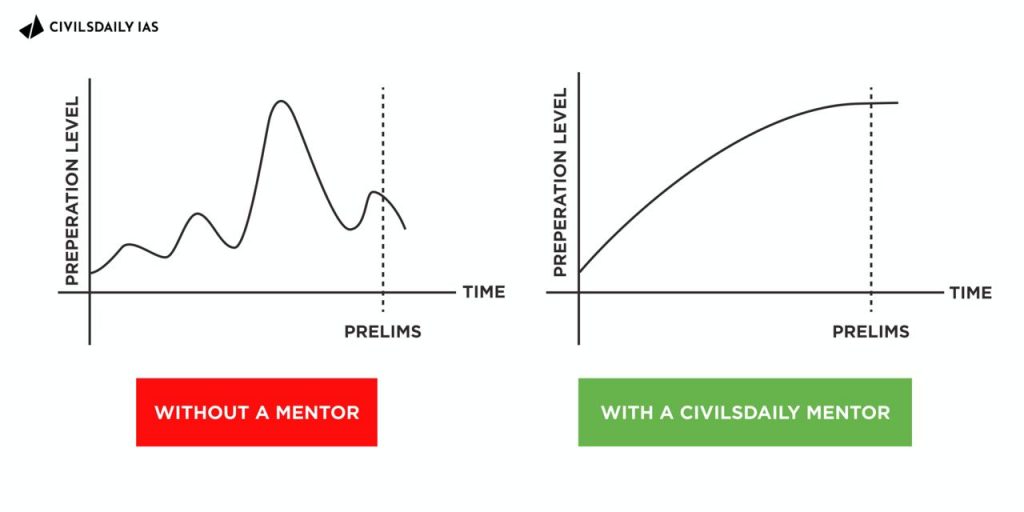
    1. Reset your targets – A mentor can help you set achievable targets based on your learning pace along with the right study material.
    2. Test yourself consistently – A mentor can help you assess your progress thoroughly and ensure that you stay focused throughout.
    3. Get the right feedback – Get practical feedback from senior mentors and serving officers on a regular basis.
    4. Consolidate – Your mentor can help you learn, consolidate, and build on your preparation, every step of the way.

    Here’s the thing: You are not alone in your preparation and we are here to help you at every stage. Just get in touch with us and we will make sure that the first shot you take at UPSC will be the best!

    Schedule your free mentorship session with Senior IAS Mentor from Civilsdaily and get started now!

    Our mentors have helped students achieve their dreams, you could be a success story too!

    Do not miss out. Speak with a mentor now!

  • Lack of self-assessment silently kills your IAS preparation. Know where you stand! Take this 5 seconds self-assessment test for 2022

    Lack of self-assessment silently kills your IAS preparation. Know where you stand! Take this 5 seconds self-assessment test for 2022

    This is the cycle that makes or breaks a UPSC aspirant’s dreams. Follow this cycle and you will become an IAS officer.

    The cycle has 4 elements: Study, Assessment, Feedback, And Improvement. Every aspirant studies and they study almost similar things. While almost everyone improves with time, the difference between success and failure lies in the ‘assessment’ and ‘feedback.’

    When was the last time you assessed yourself? Anyways there is no harm in doing that again. Just be honest and take this simple 5 seconds self-assessment test to know where you stand in terms of your preparation and improvement.

    Before we move forward you must understand these things:

    1. UPSC is a long drawn process. A marathon.
    2. There will be UPs and DOWNs in your preparation.
    3. You have to maximise UPs and minimize DOWNs and stay consistent with the UPs.
    4. Peak at the RIGHT time.

    If you fall in the Green Zone, excellent! But you have to maintain this:

    (ask us how!)

    But if you fall in RED Or ORANGE Zone, It’s a crisis!

    If you are in the RED or ORANGE Zone:

    1. Reset your targets – A mentor can help you set achievable targets based on your learning pace along with the right study material.
    2. Test yourself consistently – A mentor can help you assess your progress thoroughly and ensure that you stay focused throughout.
    3. Get the right feedback – Get practical feedback from senior mentors and serving officers on a regular basis.
    4. Consolidate – Your mentor can help you learn, consolidate, and build on your preparation, every step of the way.

    Here’s the thing: You are not alone in your preparation and we are here to help you at every stage. Just get in touch with us and we will make sure that the first shot you take at UPSC will be the best!

    Schedule your free mentorship session with Senior IAS Mentor from Civilsdaily and get started now!

    Our mentors have helped students achieve their dreams, you could be a success story too!

    Do not miss out. Speak with a mentor now!

  • [Yojana Archive] NECTAR – Strengthening S&T in the NE Region

    UPSC 2022 countdown has begun! Get your personal guidance plan now!

    July 2021:”North-East India”

    What is NECTAR?

    • NECTAR stands for North East Centre for Technology Application and Reach.
    • It is an autonomous organisation, set up under the Department of Science & Technology, Government of India is the ‘one-stop shop’ for technological support to the North East people.
    • NECTAR is providing technological applications and scientific support to the farmers, entrepreneurs, or any organisation associated with rural corporation, construction, or any other industry in North East, where technology intervention and technical support are needed.

    Its establishment

    • NECTAR was formed in the year 2012, with the merger of erstwhile National Mission on Bamboo Applications (NMBA) and Mission on Geospatial Application (MGA).
    • It is headquartered in Shillong, Meghalaya.

    Its mandate

    • Overall development: NECTAR has the mandate of equitable and inclusive social and economic development of the NER. NECTAR has created linkages between the farmers and markets of metro cities.
    • Agro Industries: The areas in which NECTAR has played flagship roles include agro and food processing, renewable energy source bamboo applications like construction and structural applications, composites and wood substitutes, bamboo for energy, bamboo in industrial products, bamboo-planting material, skill development, and employment generation.
    • Security: NECTAR is also working for the applications to internal security, watershed analysis, development of fixed wing micro unmanned aerial vehicles, mapping of tsunami vulnerable areas, and Brahmaputra River embankment mapping and erosion study.

    Bamboo Sector:

    Bamboo-based technologies with a green material approach

    • NECTAR is working on bamboo-based construction and structural applications with a green material approach.
    • Huge industrial applications of bamboo have been identified.
    • Under this effort, support is being provided to the projects related to structural engineering and in development of bamboo composites by utilizing the natural higher tensile strength and a weight-to-strength ratio of the material.
    • In the areas of the development of technologies related to wood substitutes and composites, various relief and rehabilitation projects using bamboo composite material and prefabricated housing units have been initiated.
    • Gasifiers based on bamboo have been developed to produce clean and renewable electricity, and a range of valuable by-products such as high-grade charcoal has also been developed.

    Schemes of technology solutions for employment generation:

    • The Centre is offering two major schemes to NER: TOSS – Technology Outreach and Service Scheme and BAANS – Bamboo Applications and Support Scheme.
    • The schemes are targeted for building and expanding partnerships with people, communities, local bodies, NGOs, SHGs and research and technology institutions.
    • TOSS is an umbrella scheme of NECTAR to establish linkages with individuals and institutions to deliver technology solutions to the NER which have clear potential to generate social or economic growth in the region.

    Conclusion

    • NECTAR is playing an important role in the development of NER.
    • It is very important to connect the technologies with common people, various organizations, entrepreneurs, and farmers so that the mandate of that technology can be proved.
    • People from the NER should take advantage of the technologies developed and supported by NECTAR.
    • Successful case studies of NECTAR must be shared at the Krishi Vigyan Kendras of NER, NGOs, various community centres, innovation centres, entrepreneurial organisations, colleges and universities so that every section of the NER can be benefited with the technological applications.

    UPSC 2022 countdown has begun! Get your personal guidance plan now!

  • [Burning Issue] The fall of Kabul and implications for the India and world

    UPSC 2022 countdown has begun! Get your personal guidance plan now! (Click here)

    The Taliban entered Afghanistan’s capital Kabul, following a week of rapid territorial gains from retreating government forces battling to hold off the Islamist militant group. President Ashraf Ghani has fled the war-torn country.

    Afghanistan being rugged and mountainous, ethnically heterogeneous, and poorly developed; foreign powers are now intervening on both sides of the conflict. Its leadership was demoralized by the unseemly haste of the US troops’ withdrawal.

    Let us learn some key facts about the Taliban’s history and ideology.

    Who are the Taliban?

    The Taliban (literally meaning “students”) or Taleban, who refer to themselves as the Islamic Emirate of Afghanistan (IEA) are a Sunni Islamic fundamentalist political movement and military organization in Afghanistan currently waging war (an insurgency, or jihad) within that country.

    A history of the Taliban

    • The Taliban emerged in 1994 around the southern Afghan city of Kandahar.
    • It was one of the factions fighting a civil war for control of the country following the withdrawal of the Soviet Union and subsequent collapse of the government.
    • It originally drew members from so-called “mujahideen” fighters who, with support from the United States, repelled Soviet forces in the 1980s.
    • About 90,000 Afghans, including several bountied terrorists, were trained by Pakistan’s ISI during the 1980s.
    • Hence it can be concluded that the Taliban have arisen from those US-Saudi-Pakistan-supported Mujahedeen: The West helped the Taliban to fight the Soviet takeover of Afghanistan.

    What is its ideology?

    At the core of its diplomacy lies the untenable violent extremism based on radical religious ideology.

    • During its five years in power, the Taliban enforced a strict version of Sharia law.
    • Women were predominantly barred from working or studying, and were confined to their homes unless accompanied by a male guardian.
    • Public executions and floggings were common, Western films and books were banned, and cultural artifacts seen as blasphemous under Islam were destroyed.

    International recognition of the Taliban

    • Only four countries, Bangladesh, Pakistan, Russia and Saudi Arabia, recognized the Taliban government when it was in power.
    • The vast majority of other countries, along with the United Nations, instead recognized a group holding provinces to the north of Kabul as the rightful government-in-waiting.
    • The United States and the United Nations imposed sanctions on the Taliban, and most countries show little sign it will recognize the group diplomatically.
    • Other countries such as China have begun cautiously signaling they may recognize the Taliban as a legitimate regime.

    The 9-11

    • The United States invasion of Afghanistan occurred after the September 11 attacks in late 2001 and was supported by close US allies.
    • Its public aims were to dismantle al-Qaeda and deny it a safe base of operations in Afghanistan by removing the Taliban from power.
    • US President George W. Bush demanded that the Taliban hand over Osama bin Laden and expel al-Qaeda; bin Laden had already been wanted by the FBI since 1998.
    • The Taliban declined to extradite him unless given what they deemed convincing evidence of his involvement in the 9/11 attacks and ignored demands to shut down terrorist bases and hand over other terrorist suspects apart from bin Laden.
    • The US demand was dismissed by the Taliban with meaningless delaying tactics. Disgusted with it, the US launched Operation Enduring Freedom on October 7, 2001.

    Afghan Peace Process

    • The Afghan peace process comprises the proposals and negotiations in a bid to end the ongoing war in Afghanistan.
    • This ‘US-Taliban deal signed in February 2020 was seen in India as a “victory for Taliban and Pakistan”.
    • Besides the US, major powers such as China, India, Russia, as well as NATO play a part that they see as facilitating the peace process.
    • The peace process has not made much headway mainly because violence by the Taliban continues unabated.
    • The Taliban now view this as an important milestone and is busy trying to establish their military superiority on the ground.

    Why did the US quit?

    1. Huge cost: The Afghan war is estimated to have cost $2-trillion, with more than 3,500 American and coalition soldiers killed. Afghanistan lost hundreds of thousands of people, both civilians and soldiers.
    2. Failure in curbing insurgency: After all these, the Taliban is at its strongest moment since the U.S. launched the war. The insurgents’ control or contest the government control in half of the country, mainly in its hinterlands.
    3. Face saving: The US better recognized its defeat and considered not to sacrifice more American soldiers and inflict more suffering on the Afghan people.
    4. Global recognition to Taliban: Taliban is now more organized as an organization with diplomats on par with modern democratic nations with state apparatus propaganda.

    What are the implications of the deal for India?

    • India has been backing the Ghani-led government and was among very few countries to congratulate Ghani on his victory.
    • There has not been formal contact with top Taliban leaders, the Indian mission has a fair amount of access to the Pashtun community throughout Afghanistan through community development projects of about $3 billion.
    • Due to so, although the Pakistan military and its ally Taliban have become dominant players in Kabul’s power circles, South Block insiders insist that it is not all that grim for New Delhi.
    • These high-impact projects, diplomats feel India has gained goodwill among ordinary Afghans, the majority of whom are Pashtuns and some may be aligned with the Taliban as well.

    What are India’s key investments in Afghanistan?

    India’s contribution has been phenomenal in every area in Afghanistan since India built the Afghan Parliament. India has been a major military and developmental assistance partner for Afghanistan. Let us have a look at various projects India has built across Afghanistan.

    A soft corner

    • Afghanistan is vital to India’s strategic interests in the region.
    • It is also perhaps the only SAARC nation whose people have much affection for India.
    • Taliban takeover would mean a reversal of nearly 20 years of rebuilding a relationship that goes back centuries.

    Projects across the country

    (1) Salma Dam:

    • It is one of India’s high-visibility projects is located — the 42MW Salma Dam in Herat province.

    (2) Zaranj-Delaram Highway:

    • The other high-profile project was the 218-km Zaranj-Delaram highway built by the Border Roads Organisation.
    • India had transported 75,000 tonnes of wheat through Chabahar to Afghanistan during the pandemic.

    (3) Parliament building:

    • The Afghan Parliament in Kabul was built by India at $90 million. It was opened in 2015.

    (4) Stor Palace:

    • It is the restored Stor Palace in Kabul, originally built in the late 19th century, and which was the setting for the 1919 Rawalpindi Agreement by which Afghanistan became an independent country.

    (5) Power Infrastructure:

    • Other Indian projects in Afghanistan include the rebuilding of power infrastructure such as the 220kV DC transmission line from Pul-e-Khumri, to the north of Kabul. 

    (6) Health Infrastructure:

    • India has reconstructed a children’s hospital it had helped build in Kabul in 1972 —named Indira Gandhi Institute for Child Health in 1985 — that was in shambles after the war.
    • ‘Indian Medical Missions’ have held free consultation camps in several areas. Thousands who lost their limbs after stepping on mines left over from the war have been fitted with the Jaipur Foot.

    (7) Transportation:

    • India gifted 400 buses and 200 mini-buses for urban transportation, 105 utility vehicles for municipalities, 285 military vehicles for the Afghan National Army, and 10 ambulances for public hospitals in five cities.
    • It also gave three Air India aircraft to Ariana, the Afghan national carrier, when it was restarting operations.

     (8) Ongoing Projects:

    • Shatoot Dam: India had concluded with Afghanistan an agreement for the construction of the Shatoot Dam in Kabul district, which would provide safe drinking water to 2 million residents.

    Bilateral trade

    • The India-Afghanistan trade has grown with the establishment of an air freight corridor in 2017.
    • In 2019-20, bilateral trade crossed $1.3 billion. The balance of trade is heavily tilted — exports from India are worth approximately $900 million, while Afghanistan’s exports to India are about $500 million.
    • Afghan exports are mainly fresh and dried fruit.
    • Exports include pharmaceuticals, medical equipment, computers and related materials, cement, and sugar.
    • Trade through Chabahar started in 2017 but is restricted by the absence of connectivity from the port to the Afghan border.

    India and the Taliban

    • A Qatari official revealed that there was a “quiet visit by Indian officials to speak with the Taliban”.
    • India wants to play a positive role and sabotage those countries that support other terror groups in Afghan.
    • India is pressing on a peace process all around Afghanistan so that all countries shall be peaceful.

    Why Taliban’s control over Afghanistan is a matter of concern for India and the world?

    (1) Border issues and export of terrorism:

    • The Taliban is occupying the border areas with other countries instead of central Afghanistan and have taken control of the districts bordering Iran, Turkmenistan, Tajikistan, Pakistan and Uzbekistan.
    • The Taliban is only 400 km away from the Line of Control in Jammu and Kashmir. The Taliban have captured the Badakhshan province of Afghanistan, which borders PoK.
    • If Taliban establish their government by capturing all the districts of Afghanistan, then they will be able to easily send their terrorists to Jammu and Kashmir and help Pakistan.

    (2) China factor:

    • Apart from Pakistan, China can also become a challenge for India. That is because while Pakistan has influence over the Taliban, China is currently the biggest investor for Afghanistan.
    • At present, there are big Chinese projects going on in Afghanistan and the Taliban knows that if it wants to keep its position strong then it will need Chinese money the most.

    (3) Violence and loss of lives:

    • India is concerned over the violence and loss of lives in Afghanistan. Violence has increased manifold after peace talks have started.
    • It supports zero tolerance against violence.

    (5) India’s investments are at stake:

    • India, which has committed $3 billion in development aid and reconstruction activities, backs the Ashraf Ghani government in the war-torn country.

    (6) Democracy:

    • New Delhi wants an all-inclusive “Afghan-led, Afghan-owned and Afghan-controlled” peace process—not one that is remote-controlled by Pakistan, seen as the backers of the Taliban.

    (7) Neighborhood first:

    • Afghanistan is a part of India’s extended neighborhood and a link to Central Asia.

    (8) Pakistan controlling Afghan policy on India:

    • Taliban’s extremist ideology leans heavily towards Pakistan’s official foreign policy towards India. A Taliban-controlled government in Kabul would mean Pakistan controlling Afghan policy on India.

    Reasons for Taliban’s success in Afghanistan:

    1. Lack of national sentiment in the Afghan army:

    • The Afghan national army could never exist. The United States spent billions of dollars on their build-up and salaries, but there were several allegations of corruption in reaching out to those salaries soldiers.
    • Many soldiers did not exist – they were only on paper and their salaries were being eaten by the officer.
    • Many soldiers from various gangs lacked national spirit. So they started running away as soon as they saw the enemy.

    2. The Taliban have a close understanding of local geography:

    • The Afghan army had sophisticated weapons and aircraft, but it was difficult to maintain them. Also, the Taliban tracked down and killed their pilots.
    • The American weapons of Afghan soldiers who had fled the war were easily available to those who fought for the Taliban. The Taliban already had weapons from the Soviet invasion.
    • The Taliban had a close knowledge of local geography. There was also the help of many locals. Therefore, even though the weapons were slightly less, the deficiency was filled with this information.

    3. Taliban gets revenue from drug trafficking:

    • The Taliban generates huge revenue from drug trafficking. They closed each border and tightened the financial pulses of the government in Kabul.

    4. Government fails to instill confidence in soldiers to fight:

    • Although the United States had formed a democratic government in Afghanistan, the local people had a similar image of the Western rule. Therefore, the army and the people also did not trust the government.
    • When the Taliban troops arrived to Kabul, it was President Ashraf Ghani who stepped out.
    • Therefore, the national army was in a state of disrepair. The government failed to instill confidence in the soldiers to fight.

    5. Efficient propaganda and intelligence:

    • The Taliban are a revolutionary movement, deeply opposed to the Afghan tribal system and focused on the rebuilding of the Islamic Emirate.
    • Their propaganda and intelligence are efficient, and the local autonomy of their commanders in the field allows them both flexibility and cohesion.

    6. Use of local sentiments:

    • They have made clever use of ethnic tensions, the rejection of foreign forces by the Afghan people, and the lack of local administration to gain support in the population.
    • Doing so, they have achieved their objectives isolating the local Afghan administration, and establishing a parallel administration.

    Pakistan’s affinity with the Taliban

    • The Pakistani security and political establishment is now savoring the Taliban victory.
    • While this is not possible to verify, Pakistan’s has undeniable in providing the Taliban shelter on its territory.
    • The safe havens had existed from virtually the start of the US “war on terror” in 2001.
    • The US was aware of this, but because its need for Pakistan as a logistics back end for the war in Afghanistan was greater.
    • Concerns: An immediate fallout would be an influx of refugees, which would be a drain on Pakistan’s slender resources.

    Taliban as a proxy

    Over the last three decades, Pakistan has viewed the Taliban as serving a two-fold purpose:

    1. First, a Taliban regime in Kabul and its umbilical connection with Pakistan would ensure the Pakistan military a free pass over Afghanistan, territory that it has coveted for “strategic depth” in its enmity with India.
    2. Second, ensuring Pakistan agency over Afghan routes into Central Asia.

    Why China is supporting the Taliban?

    • Security of CPEC projects in Pakistan is the prime Chinese concern.
    • China today commands an economy worth $14.7 trillion — more than 17 times its size in 1996 — and a massive trade-and-infrastructure initiative that stretches across the Eurasian landmass.
    • Beijing’s fears about Islamist extremism among its own Uyghur minority have also deepened in recent years, leading it to build a vast police state adjacent to Afghanistan.

    What next for India

    • As India considers its options, it is fairly certain that while India will lose influence in Afghanistan, the India-Pakistan relationship will acquire one more layer of difficulty due to the Taliban comeback.
    • Like all radical groups, the Taliban will have trouble balancing its religious ideology with the imperatives of state interests.
    • India would want to carefully watch how this tension plays out. Equally important is the nature of the relationship between the Taliban and Pakistan.
    • India must fully prepare for a renewal of cross-border terror, but there is a lot less global acceptance of terrorism today than in the permissive 1990s.

    Way forward

    • In the short-term, the Afghan people—especially women—must be spared violence and brutality arising from the Taliban regime’s assumption of power.
    • Over the longer term, they must be allowed to live under the broad norms of the 21st century, assured of their safety, dignity and liberty.
    • Taliban have several sections that are both radical and some want talks with the international community.
    • So international organizations like the UN must come forward to stop the sponsor of terrorism.
    • Nations should come together against the Taliban so that it can’t move forward without any foreign aid.
    • Aid and developmental cooperation through the UN, India, USA must be done simultaneously for the restoration of democracy.
    • Tangible demonstration of commitment is required from all stakeholders for a political settlement and to have a permanent ceasefire in Afghanistan.

    UPSC 2022 countdown has begun! Get your personal guidance plan now! (Click here)

  • Lack of self-assessment silently kills your IAS preparation. Know where you stand! Take this 5 seconds self-assessment test for 2022

    Lack of self-assessment silently kills your IAS preparation. Know where you stand! Take this 5 seconds self-assessment test for 2022

    This is the cycle that makes or breaks a UPSC aspirant’s dreams. Follow this cycle and you will become an IAS officer.

    The cycle has 4 elements: Study, Assessment, Feedback, And Improvement. Every aspirant studies and they study almost similar things. While almost everyone improves with time, the difference between success and failure lies in the ‘assessment’ and ‘feedback.’

    When was the last time you assessed yourself? Anyways there is no harm in doing that again. Just be honest and take this simple 5 seconds self-assessment test to know where you stand in terms of your preparation and improvement.

    Before we move forward you must understand these things:

    1. UPSC is a long drawn process. A marathon.
    2. There will be UPs and DOWNs in your preparation.
    3. You have to maximise UPs and minimize DOWNs and stay consistent with the UPs.
    4. Peak at the RIGHT time.

    If you fall in the Green Zone, excellent! But you have to maintain this:

    (ask us how!)

    But if you fall in RED Or ORANGE Zone, It’s a crisis!

    If you are in the RED or ORANGE Zone:

    1. Reset your targets – A mentor can help you set achievable targets based on your learning pace along with the right study material.
    2. Test yourself consistently – A mentor can help you assess your progress thoroughly and ensure that you stay focused throughout.
    3. Get the right feedback – Get practical feedback from senior mentors and serving officers on a regular basis.
    4. Consolidate – Your mentor can help you learn, consolidate, and build on your preparation, every step of the way.

    Here’s the thing: You are not alone in your preparation and we are here to help you at every stage. Just get in touch with us and we will make sure that the first shot you take at UPSC will be the best!

    Schedule your free mentorship session with Senior IAS Mentor from Civilsdaily and get started now!

    Our mentors have helped students achieve their dreams, you could be a success story too!

    Do not miss out. Speak with a mentor now!

  • 18th Aug 2021 | Current Affairs Test – 03

    [WpProQuiz 744]


    [WpProQuiz_toplist 741]