💥Join UPSC 2027,2028 Mentorship (July Batch) + XFactor Notes & Microthemes PDF

Author: CD Staff

  • [Burning Issue] Gati Shakti Master Plan: Infra Boost for India

    UPSC 2022 countdown has begun! Get your personal guidance plan now! (Click here)

    On India’s 75th Independence Day, Prime Minister Narendra Modi announced that the Centre will launch ‘PM Gati Shakti Master Plan’, a Rs. 100 lakh-crore project for developing ‘holistic infrastructure’ and to and give an integrated pathway to country’s economy.

    What are the focus areas of the project?

    • Gati Shakti will be a National Infrastructure Master Plan for our country
    • Leveling up local manufacturers: The Gati Shakti plan will help raise the global profile of local manufacturers and help them compete with their counterparts worldwide.
    • Economic zones: It also raises possibilities of new future economic zones. India needs to increase both manufacturing and exports.
    • Infrastructure development: Infrastructure development has the ability to create a multiplier effect with every rupee invested, yielding much higher returns.
    • Employment opportunity: To act as a source of employment opportunities for the youth in future.

    Why need such a plan?

    • The push for infrastructure is in line with the government’s efforts to step up capital expenditure in infrastructure to promote economic growth.
    • Infrastructure development has the ability to create a multiplier effect with every rupee invested, yielding much higher returns.
    • A similar plan, called the National Infrastructure Pipeline was previously announced.

    Let us learn about the National Infrastructure Pipeline in short.

    What is the National Infrastructure Pipeline (NIP)?

    • NIP includes economic and social infrastructure projects.
    • During the fiscals 2020 to 2025, sectors such as Energy (24%), Roads (19%), Urban (16%), and Railways (13%) amount to around 70% of the projected capital expenditure in infrastructure in India.
    • It has outlined plans to invest more than ₹102 lakh crore on infrastructure projects by 2024-25, with the Centre, States and the private sector to share the capital expenditure in a 39:39:22 formula.

    What are the key benefits of NIP?

    • Economic: Well-planned NIP will enable more infra projects, grow businesses, create jobs, improve ease of living, and provide equitable access to infrastructure for all, making growth more inclusive.
    • Government: Well-developed infrastructure enhances the level of economic activity, creates additional fiscal space by improving the revenue base of the government, and ensures the quality of expenditure focused in productive areas.
    • Developers: Provides a better view of project supply, provides time to be better prepared for project bidding, reduces aggressive bids/ failure in project delivery, ensures enhanced access to sources of finance as a result of increased investor confidence.
    • Banks/financial institutions (F1s)/investors: Builds investor confidence as identified projects are likely to be better prepared, exposures less likely to suffer stress given active project monitoring, thereby less likelihood of NPAs.

    Why the infra sector is given more emphasis these days?

    • Pandemic induces Slowdown: Slowdown due to the pandemic is a good time to catch up on infrastructure capacity and increase the expenditure.
    • Multiplier effect on job creation and economy: Infrastructure spending is a critical component of the fiscal stimulus as it has multiplier effects on the economy and job creation.
    • Inclusive Growth: Quality infrastructure is important not only for faster economic growth but also to ensure inclusive growth and uplifting standard of living of people.
    • Easy access for essential Social Services: Lack of adequate infrastructure not only holds a lack of economic development, but it also causes additional costs in terms of time, effort and money of the people for accessing essential social services.

    What are the recent projects included in the Infrastructural planning?

    • Sectors such as energy (24%), roads (18%), urban (17%) and railways (12%) amount to around 71% of the projected investments.
    • The projects will also be spread across sectors such as irrigation, mobility, education, health, water and the digital sector.

    What are the key infrastructure sectors which have a massive role in India’s economic development?

    (1) Green Infrastructure:

    • Green infrastructure refers to natural or semi-natural ecosystems that provide water resource management by introducing the natural water cycle into urban environments.
    • It provides effective measures to manage urban flooding, water supply and quantity regulation, at the same time generating multiple environmental benefits.
    • India will benefit if investments are steered towards green-infrastructure projects.
    • Green bonds can provide a long-term source of debt capital for renewable infrastructure projects.
    • Germany is one country that has been a nest for the innovation and application of green technologies. This can provide a useful lesson for India.
    • By reducing local temperatures and shading building surfaces, green infrastructure reduces the cooling demand of buildings, thus cutting energy needs.

    (2) Logistics Sector:

    • The logistics sector needs to be improved because of its impact on improving competitiveness in the economy.
    • Improving logistics sector has huge implication on exports and it is estimated that a 10% decrease in indirect logistics cost can increase 5-8% of exports.
    • The Indian logistics sector provides livelihood to 22 million-plus people and improving the sector would facilitate a 10% decrease in indirect logistics cost, leading to a growth of 5-8% in exports.
    • The worth of Indian logistics market would be around US$ 215 billion in next two years compared to about US$ 160 billion currently. Today, the Indian logistics sector is a sunshine industry and is going through a phase of transformation.
    • key objectives for logistics in India, to be achieved in the next five years:
      1. Creating a single point of reference for all logistics and trade facilitation matters in the country which will also function as a knowledge and information sharing platform
      2. Driving logistics cost as a % of GDP down from estimated current levels of 13-14% to 10% in line with best-in-class global standards and incentivize the sector to become more efficient by promoting integrated development of logistics

    (3) Social Infrastructure:

    • Social services include, education, sports, art and culture; medical and public health, family welfare, water supply and sanitation, housing; urban development; welfare of Schedule Castes (SCs), Schedule Tribes (STs) and Other Backward Castes (OBCs), labor and labor welfare; social security and welfare, nutrition, relief on account of natural calamities etc. Expenditure on ‘Education’ pertains to expenditure on ‘Education, Sports, Arts and Culture’.
    • India is committed to achieve these SDGs and a strong social infrastructure is key to achieve them.
    • The government has been focusing on provisioning of assets such as schools, institutes of higher learning, hospitals, access to sanitation, water supply, road connectivity, affordable housing, skills and livelihood opportunities.
    • This gains significance given the fact that India is home to the world’s youngest population as half of its population is below the age of 25.
    • It has also been estimated that demographic advantage in India is available for five decades from 2005-06 to 2055-56, longer than any other country in the world. This demographic advantage can be reaped only if education, skilling and employment opportunities are provided to the young population.
    • Being a developing economy “there is not enough fiscal space” to increase expenditure on critical social infrastructure.
    • India has made significant progress in quantitative indicators such as enrolment levels and physical infrastructure like construction of school buildings, drinking water facilities, toilet, etc.
    • India has been successful in achieving gender parity in the school sector and in higher education it is moving towards a better gender parity.
    • Growing expenditure on health is burdening the public in general and is one of the highest in South Asian countries as per Economic Survey 2020-21.

    (4) Ports:

    • The major economies of the world have always realized the potential of shipping as a contributor to economic growth. For instance, control of the seas is a key component of China’s Belt and Road Initiative (BRI).
    • The entire shipping infrastructure in peninsular India only helps foreign shipping liners. Foreign ship owners carry our inbound and outbound cargo. This is the case in container shipping too.
    • India has unrealized potential in shipping, with 7,500 km of coastline and 14,500 km of navigable or potentially navigable waterways.
    • More than one billion tonnes of cargo was handled across over 200 ports in India in 2015 with maritime logistics accounting for 90 per cent of international trade by volume and 72 per cent by value.
    • As a country, we have still not optimized our carrying capacity. Much of foreign currency is drained as transshipment and handling costs every day.
    • As a result, there is a wide gap between carrying capacity and multi-folded cargo growth in the country.
    • India needs to revamp institutional and regulatory environment around ports.
    • Corporatization of ports is one way of achieving efficient and world class ports by the conversion of major port trusts into truly commercial organizations.
    • In terms of infrastructure, it is important to maintain draft to serve bigger vessels, ensure mechanization of ports through introduction of new equipment and procedures, build new facilities, upgrade existing facilities and automate systems/procedures.

    (5) Transport infrastructure

    • India’s population growth and economic development requires improved transport infrastructure, including through investments in roads, railways, and aviation, shipping and inland waterways.
    • A key goal of India’s suite of regulatory reforms is to attract more foreign investment into the sector, including through new investment vehicles and innovative financial instruments. By 2030, transport is expected to attract over 60 per cent of infrastructure investment in India.
    • We need sound public transport infrastructure because if we do not have proper infrastructure we cannot have urbanization.
    • The Government of India has a range of projects to improve road infrastructure-
      • The National Highways Development Projects, which require investments of up to USD170 billion
      • The Bharatmala project, stretching from India’s western to eastern land borders which is unique and unprecedented in terms of its size and design.
      • The Northeast Express Highway (1,300 km express highway in northeast India).
    • Technologically sound projects which are engineering marvels such as the Dhola-Sadiya Bridge, Chenani Nashri Tunnel and Bogi-Beel bridge and world-class expressways such as the Eastern Peripheral Expressway and Western Peripheral Expressway are the recent key achievement showing India’s technological readiness in the sector.
    Road Infrastructure in India

    (6) RAIL

    • India’s railways play a major role in affordable transport of passengers and cargo across the country
    • It is one of the largest networks in the world with 7,216 stations; 92,000 km of track and 1.3 million employees.
    • Indian railways carried eight billion passengers and transported over one billion tonnes of freight in 2017–18
    • However, most major corridors are facing severe capacity constraints and there are safety issues.
    • The Ministry of Railways plans to improve and expand the rail network, renew the train fleet, and improve passenger safety.
    • It plans to invest up to $170 billion over the next five years, with the largest proportion aimed at network expansion and decongestion, and safety.64 Investments are also planned for station redevelopment and the dedicated freight corridor between Delhi and Mumbai.
    • The Government of India is seeking greater private investment through:
      • Allowing 100 per cent FDI in railways for construction, operation and maintenance of suburban corridor projects, high-speed train projects, railway electrification and signaling, among others.
      • Encouraging the development of new investment vehicles such as the Railways of India Development Fund to attract long term investment from global institutional investors.

    What are the major constraints in the implementation of infrastructural projects?

    The major implementation constraints that will be faced possibly in future are:

    • Revenue shortfall: Slippage in revenue estimates may not be ruled out on account of the realization of lower than anticipated increases in nominal GDP growth, direct tax buoyancy, and disinvestment targets.
    • Lesser funds with States: The Union government has accepted the 15th Finance Commission report recommendation, according to which vertical share of tax devolution from the center to states has been reduced 42% to 41%.
    • Increasing Fiscal Deficit: Infrastructure development in India will be funded by fiscal stimulus. This can be reflected as the Centre has indicated taking the fiscal deficit to 4.5% of GDP by 2025-26.
      • However, the rising fiscal deficit can cause macro-economic stability issues like high inflation, crowding out, a downgrade of international ratings, etc.
    • Structural Problems: Due to the lengthy processes in land acquisition and payment of compensation, the rate of implementation of projects is very slow on global standards.
      • Getting approvals are very difficult in terms of land access, environmental clearances; impending litigation in court delays the infrastructure projects.
      • Time and cost overruns due to delays in project implementation and procedural
      • Delays and lesser traffic growth than expected to increase the riskiness of the projects
      • Stalled or languishing projects and a shortfall in funds for maintenance

    Conclusion

    • Infrastructure development is the key to economic growth and well-being of the country’s people, as it will propel economic growth, improve quality of life contribute to GDP nationally.
    • It is seen that investments in infrastructure equal to 1% of GDP will result in GDP growth of at least 2% as infrastructure has a “multiplier effect” on economic growth across sectors.
    • Capacity creation and expansion in important segments like roads and highways, power, railways, renewable sector, ports, airports, metros etc, is a must for delivering impressive results.
    • Over the period, formalization of the economy has taken place and any growth now onwards once projects like Gati Shakti Master Plan, NIP is in place will be more sustainable, rather than a boom-and-bust process.
    • Therefore, massive infrastructure development is a sure way of achieving the government’s $5 trillion economy target.
    • This is will give a boost to several sectors, create new jobs directly and indirectly, and eventually boost the commercial market, thereby propelling the country’s economic growth.
    • Huge fiscal stimulus, provided by the government in the Budget 2021 is a step in the right direction. However, it needs to address structural and macroeconomic stability concerns, emanating from high public expenditure.

    UPSC 2022 countdown has begun! Get your personal guidance plan now! (Click here)

  • Live Free Session on Indian Polity || Only a Few Seats Left || Register Now || 5 High-Value Topics for Prelims 2021 and How to Simplify Polity for UPSC IAS 2022

    Live Free Session on Indian Polity || Only a Few Seats Left || Register Now || 5 High-Value Topics for Prelims 2021 and How to Simplify Polity for UPSC IAS 2022

    Dear aspirants,

    Polity is the key to success in UPSC, and here’s why:

    1. Up to 20 questions in Prelims – 40 marks!
    2. Command over Polity means great writing material in essays.
    3. The knowledge of polity can be used in GS papers, IR, and national issues.
    4. Polity concepts are highly useful in writing Ethics answer.
    5. Master polity and your score can rise by 100 marks in Mains.
    6. It is easy to master the subject if you know the right tricks!

    This is why we believe that all UPSC aspirants who are serious about clearing Prelims in this attempt should know the 5 Most Valuable Topics in polity and the smart way of completing the syllabus in time. And we would like to share these with you for FREE in the upcoming session with Sudhanshu Sir.

    For example, these are the areas that UPSC has focused on in the previous years:

    And this is where these questions were sourced from:

    But what about this year? Sudhanshu sir will explain, in detail, in the session.

    What can you expect to learn in the session?

    1. 5 Most valuable topics to be covered for Prelims.
    2. How to complete the Polity syllabus ‘effectively.’
    3. How to revise the syllabus in record time.
    4. How to use the knowledge of Polity for better answer writing.
    5. How to use the knowledge of polity for writing better essays.
    6. How to make sure you answer ALL the polity questions in Prelims correctly.
    7. How to use Polity to gain advantage over other candidates.

    You can learn all of this and more for absolutely free in the session. 

    DO NOT miss this opportunity to know the right way of completing your Polity syllabus for UPSC 2022. The session is absolutely free and you can gain up to 40 MARKS in Prelims by attending this session. But there are just limited slots available so we request you to register now!

    Date: 28/8/21

    Time: 5:30 P.M.

  • Constitutional and Statutory Bodies


    UPSC 2022 countdown has begun! Get your personal guidance plan now! (Click here)

    27st Aug 2021

    Constitutional bodies


    Appointment

    Tenure

    Removal

    Process of removal

    Eligibility for reappointment w/i govt.

    Attorney general (Advocate general)

    President (governor)

    Pleasure of President (governor)

    President (governor)

    No reason needs to be mentioned

    Yes

    Election Commission (SEC)

    President (governor)

    6 years/ 65

    President

    CEC and SEC by a special majority

    Other ECs on the recommendation of CEC

    Yes

    Finance commission (SFC)

    President (governor)

    Specified by president

    NA

    NA

    Yes

    UPSC (SPSC)

    President (governor)

    6 years/ 65

    President

    After enquiry by supreme court

    Members can become Chair, state members can become chair or member or chair of UPSC

    CAG

    President

    6 years/ 65

    President

    Special majority

    No


    Statutory bodies


    Appointment

    Committee members

    Other members

    Tenure

    Removal

    NHRC (SHRC)

    President (Governor)

    6 (PM + LOP Lok Sabha)

    Speaker, Deputy CP RS, LOP RS, home minister

    3 years*/ 70

    President after Supreme Court inquiry

    CIC (SIC)

    President (Governor)

    3 ((PM + LOP Lok Sabha)

    Cabinet Minister nominated by PM

    As prescribed by the Central Govt*./ 65

    President (governor for SIC) after supreme court inquiry

    CVC

    President (governor)

    3 ((PM + LOP lok sabha)

    Home minister

    4 years/ 65

    President after Supreme court inquiry

    Lokpal

    President

    5 (PM + LOP lok sabha

    Speaker, CJI, eminent jurist

    5 years/ 70

    Like a Supreme Court judge

    * After amendments in the respective acts in 2019.

    In the news: 
    1. Amendment to the RTI Act (July 2019)
    • Section 13 of the original Act sets the term of the central Chief Information Commissioner and Information Commissioners at five years(or until the age of 65, whichever is earlier). The amendment proposes that the appointment will be “for such term as may be prescribed by the Central Government”.
    • The amendment proposes that the salaries, allowances and other terms of service of the Chief Information Commissioner and the Information Commissioners “shall be such as may be prescribed by the Central Government” which was earlier at par with Chief Election Commissioner.
    1. Amendment to Protection of Human Rights Act (July 2019)
    • It reduced the term of the Chairperson and Members of the Commission and the State Commissions from five to three yearsand shall be eligible for re-appointment.
    • Provision was added which says a person who has been a Judge of the Supreme Court is also eligible to be appointed as Chairperson of the Commission in addition to the person who has been the Chief Justice of India.
    • The amendment made provision that a person who has been a Judge of a High Court is also made eligible to be appointed as Chairperson of the State Commissionin addition to the person who has been the Chief Justice of the High Court.
    • It conferred upon State Commissions, the functions relating to human rights being discharged by the Union territories, other than the Union territory of Delhi, which will be dealt with by the Commission.


    UPSC 2022 countdown has begun! Get your personal guidance plan now! (Click here)

    Samanvaya: Free 1-to-1 mentorship for UPSC IAS

    Fill up this form to schedule a free on-call discussion with senior mentor from Civilsdaily. Once submitted we will call you within 24 hours.

    Civilsdaily Samanvaya 1-On-1 Mentorship Form

    Field will not be visible to web visitor
  • Live Free Session on Indian Polity || Only a Few Seats Left || Register Now || 5 High-Value Topics for Prelims 2021 and How to Simplify Polity for UPSC IAS 2022 || High scoring topic details shared

    Live Free Session on Indian Polity || Only a Few Seats Left || Register Now || 5 High-Value Topics for Prelims 2021 and How to Simplify Polity for UPSC IAS 2022 || High scoring topic details shared

    Dear aspirants,

    Polity is the key to success in UPSC, and here’s why:

    1. Up to 20 questions in Prelims – 40 marks!
    2. Command over Polity means great writing material in essays.
    3. The knowledge of polity can be used in GS papers, IR, and national issues.
    4. Polity concepts are highly useful in writing Ethics answer.
    5. Master polity and your score can rise by 100 marks in Mains.
    6. It is easy to master the subject if you know the right tricks!

    This is why we believe that all UPSC aspirants who are serious about clearing Prelims in this attempt should know the 5 Most Valuable Topics in polity and the smart way of completing the syllabus in time. And we would like to share these with you for FREE in the upcoming session with Sudhanshu Sir.

    For example, these are the areas that UPSC has focused on in the previous years:

    And this is where these questions were sourced from:

    But what about this year? Sudhanshu sir will explain, in detail, in the session.

    What can you expect to learn in the session?

    1. 5 Most valuable topics which must be covered for Prelims.
    2. How to complete the Polity syllabus ‘effectively.’
    3. How to revise the syllabus in record time.
    4. How to use the knowledge of Polity for better answer writing.
    5. How to use the knowledge of polity for writing better essays.
    6. How to make sure you answer ALL the polity questions in Prelims correctly.
    7. How to use Polity to gain advantage over other candidates.

    You can learn all of this and more for absolutely free in the session. 

    DO NOT miss this opportunity to know the right way of completing your Polity syllabus for UPSC 2022. The session is absolutely free and you can gain up to 40 MARKS in Prelims by attending this session. But there are just limited slots available so we request you to register now!

    Date: 28/8/21

    Time: 5:30 P.M.

  • [RSTV Archive] India- France Relationship

    UPSC 2022 countdown has begun! Get your personal guidance plan now! (Click here)
    Context  

    • Bilateral ties between New Delhi and Paris cover a gamut of issues including defense, maritime, space, security, and energy.
    • The two nations have managed to carve out a forward-looking partnership that is aimed at strengthening bilateral cooperation on issues such as terrorism, climate change, sustainable growth and development, infrastructure, urbanization, and science and technology.

    Background

    • France-India have a ‘special relationship’ with each other, so much so that by August 2019, France has been called “India’s new best friend” by a researcher of the Hudson Institute.
    • Both nations have a centuries-old history of trade relations.
    • From the 17th century until 1954, France maintained a colonial presence in the Indian subcontinent; Puducherry, one of its former Indian territories, is a popular tourism destination for French travellers to India.
    • India has largely referred French constitutional principles in its constitution making

    Highlights of the recent meet

    • India and France explored ways to strengthen cooperation in the Indo-Pacific, including under a trilateral mechanism with Australia to address emerging challenges in the maritime and space domains.
    • The two foreign ministers held extensive talks covering all aspects of the bilateral strategic ties as well as regional and global challenges.

    Key areas collaboration

    (A) Strategic cooperation

    • France has decided to be part of India’s Indo-Pacific Oceans Initiative (IPOI).
    • Both nations have explored ways to strengthen cooperation in the Indo-Pacific.
    • This includes the India-France-Australia trilateral mechanism, addressing emerging challenges in the maritime and space domains and working together in the area of climate action and biodiversity protection.

    (B) Trade

    • Bilateral trade with France has witnessed a steady rise in the last decade reaching USD 10.75 billion in 2020.
    • The two sides also recognised the importance of fast tracking the discussions on an India-EU trade and investment agreement.

    (C) Defence collaboration

    • The defence and security ties between India and France are on an upswing in the last few years.
    • India had signed an inter-governmental agreement with France in September 2016 for procurement of 36 Rafale fighter jets at a cost of around Rs 58,000 crore.
    • Dassault Aviation, the manufacturer of Rafales, has delivered 14 jets to the Indian Air Force so far.

    (D) Technological collaboration

    • The first space agreement between France and India dates back to 1964. Existing partnerships between the two nations cover almost all areas of space activity.
    • Space agencies of India and France inked an agreement for cooperation for the country’s first human space Mission Gaganyaan.
    • The agreement provides for CNES to support implementation of a scientific experiment plan on validation missions, exchange information on food packaging and the nutrition programme, and above all the use by Indian astronauts of French equipment, consumables and medical instruments.
    • ISRO will also be launching the joint Oceansat 3-Argos mission this year.
    • With the new agreement, France will be taking part in the great technological and human challenge that is the Gaganyaan programme.

    Energy

    • India-France alliance is the main pillar of the International Solar Alliance launched by India.

    (E)Cultural ties

    • Indian culture enjoys wide following amongst the people of France. An Indian Cultural Centre, named Vivekananda Cultural Centre, is being opened in Paris.
    • The International Day of Yoga has been organized by the Embassy of India in Paris and other cities of France since 2016 and have received wide acclaim and press coverage.

    Conclusion

    • India and France both share the same vision for a new balanced multipolar world, which must be based on the rule of law.
    • They also share the same vision on the main challenges of the times, be they security developments in Asia and the Indo-Pacific, or combating international terrorism. But it is by possessing the capability of ensuring national security and making strategic choices that most efficiently defend their shared principles and visions.

    UPSC 2022 countdown has begun! Get your personal guidance plan now! (Click here)

  • 5 High-value topics for Prelims 2021 and how to Prepare Polity for UPSC 2022 || Free Session || High scoring topic details shared

    5 High-value topics for Prelims 2021 and how to Prepare Polity for UPSC 2022 || Free Session || High scoring topic details shared

    Dear aspirants,

    Polity is the key to success in UPSC, and here’s why:

    1. Up to 20 questions in Prelims – 40 marks!
    2. Command over Polity means great writing material in essays.
    3. The knowledge of polity can be used in GS papers, IR, and national issues.
    4. Polity concepts are highly useful in writing Ethics answer.
    5. Master polity and your score can rise by 100 marks in Mains.
    6. It is easy to master the subject if you know the right tricks!

    This is why we believe that all UPSC aspirants who are serious about clearing Prelims in this attempt should know the 5 Most Valuable Topics in polity and the smart way of completing the syllabus in time. And we would like to share these with you for FREE in the upcoming session with Sudhanshu Sir.

    For example, these are the areas that UPSC has focused on in the previous years:

    And this is where these questions were sourced from:

    But what about this year? Sudhanshu sir will explain, in detail, in the session.

    What can you expect to learn in the session?

    1. 5 Most valuable topics to be covered for Prelims.
    2. How to complete the Polity syllabus ‘effectively.’
    3. How to revise the syllabus in record time.
    4. How to use the knowledge of Polity for better answer writing.
    5. How to use the knowledge of polity for writing better essays.
    6. How to make sure you answer ALL the polity questions in Prelims correctly.
    7. How to use Polity to gain advantage over other candidates.

    You can learn all of this and more for absolutely free in the session. 

    DO NOT miss this opportunity to know the right way of completing your Polity syllabus for UPSC 2022. The session is absolutely free and you can gain up to 40 MARKS in Prelims by attending this session. But there are just limited slots available so we request you to register now!

    Date: 28/8/21

    Time: 5:30 P.M.

  • 26th Aug 2021 | Polity Test 02

    [WpProQuiz 754]


    [WpProQuiz_toplist 751]

  • Constitution – Special provisions


    26th Aug 2021

    Emergency provisions


      National emergency


    (art 352)

    State Emergency/ President’s rule  (Art 356) Financial emergency
    Grounds War, External aggression, armed rebellion <threat or actual> Failure of constitutional machinery of state or can’t comply with the directions of centre Threat to financial credit
    Who declares President after written cabinet recommendation President President
    Parliamentary approval w/i 1 month by both houses w/i 2 month by both houses w/i 2 month by both houses
    Type of majority Special Simple Simple
    Duration 6 months from approval 6 months from approval Indefinitely
    Reapproval Any number of times Max 3 years Not applicable
    Revocation By president or by LS only by simple majority By president, By president
    Legislature and laws on state list Continues, both parliament and state can pass laws Suspended or dissolved and only parliament can make laws Can issue directions to reserve money bill and finance bills for president
    Executive Continues, both union govt and state govt have powers Dismissed, president administers through governor Can issue direction to reduce salaries including those of supreme court and high court judge
    FRs, Art 19 automatically suspended, 20 and 21 can’t be, right to move courts for others can be suspended by presidential orders NA NA

    Schedule 5 and 6

      Schedule 5 Schedule 6
    Deal with – Scheduled area and STs in any state except ATMM Administration of tribal areas Assam, Tripura, Meghalaya, Mizoram
    Autonomy Limited autonomy. Only tribal advisory council at state level More autonomy, autonomous districts
    Schedule area President declares, can increase or decrease the area Governor can organize, reorganize autonomous districts
    Executive power of state Applicable but special responsibility of governor Same
    Acts of parliament or legislature Governor can modify the law or state that they are not applicable same

    Special Provisions for the Other States

    Part XXI of the Constitution
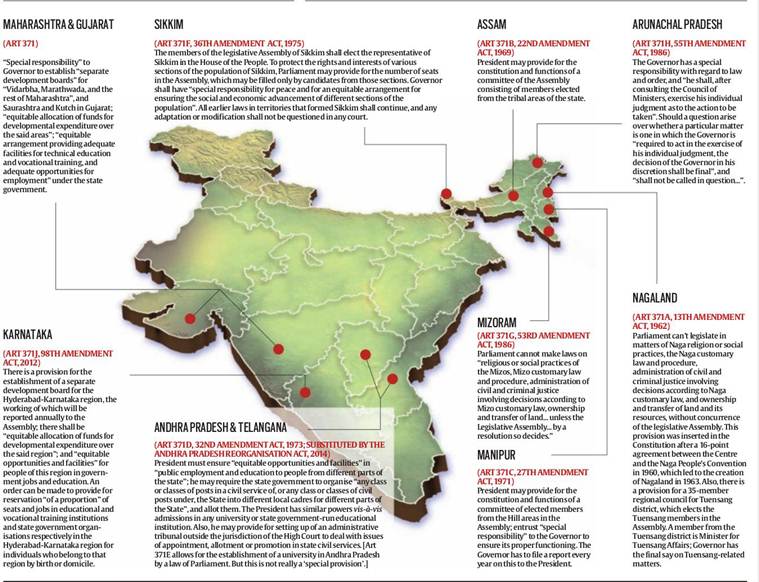
     The part ‘Temporary, Transitional and Special Provisions’, includes, apart from Article 370 (Temporary Provisions with respect to the State of Jammu and Kashmir) Articles 371, 371A, 371B, 371C, 371D, 371E, 371F, 371G, 371H, and 371J.
     These define special provisions with regard to other states of the Indian Union.

    Special Provisions but not special treatment
     All these provisions take into account the special circumstances of individual states and lay down a wide range of specific safeguards that are deemed important for these states.
     In this range of Articles from 371 to 371J, Article 371I, which deals with Goa, stands out in the sense that it does not include any provision that can be deemed “special”.
     Article 371E, which deals with Andhra Pradesh and Telangana, too, is not that “special”.
     The special provisions laid down in Article 370 before it was modified were obviously much more far-reaching than the special provisions for other states, described in Articles 371, 371A-H, and 371J.
    The following special provisions are guaranteed by the Constitution to states
    other than Jammu and Kashmir:
    Maharashtra and Gujarat (Article 371)
    The Governor has a “special responsibility”-
     To establish “separate development boards” for “Vidarbha, Marathwada, and the rest of Maharashtra”, and Saurashtra and Kutch in Gujarat;
     To ensure “equitable allocation of funds for developmental expenditure over the said areas”, and “equitable arrangement providing adequate facilities for technical education and vocational training, and adequate opportunities for employment” under the state government.

    Nagaland (Article 371A, 13th Amendment Act, 1962)
     Parliament cannot legislate in matters of Naga religion or social practices, the Naga customary law and procedure, administration of civil and criminal justice involving decisions according to Naga customary law.
     Parliament also cannot intervene in ownership and transfer of land and its resources, without the concurrence of the Legislative Assembly of the state.

     This provision was inserted in the Constitution after a 16-point agreement between the Centre and the Naga People’s Convention in 1960, which led to the creation of Nagaland in 1963.
     Also, there is a provision for a 35-member Regional Council for Tuensang district, which elects the Tuensang members in the Assembly.
     A member from the Tuensang district is Minister for Tuensang Affairs. The Governor has the final say on all Tuensang-related matters.
    Assam (Article 371B, 22nd Amendment Act, 1969)
     The President of India may provide for the constitution and functions of a committee of the state Assembly consisting of members elected from the tribal areas of the state.
    Manipur (Article 371C, 27th Amendment Act, 1971)
     The President of India may provide for the constitution and functions of a committee of elected members from the Hill areas of the state in the Assembly, and entrust “special responsibility” to the Governor to ensure its proper functioning.
     The Governor has to file a report every year on this subject to the President.
    Andhra Pradesh and Telangana (Article 371D, 32nd Amendment Act, 1973; substituted by the Andhra Pradesh Reorganization Act, 2014)
     The President must ensure “equitable opportunities and facilities” in “public employment and education to people from different parts of the state”.
     He may require the state government to organize “any class or classes of posts in the civil service of, or any class or classes of civil posts under, the State into different local cadres for different parts of the State”, and allot them.
     The President has similar powers vis-à-vis admissions in any university or state government-run educational institution.
     Also, he may provide for setting up of an administrative tribunal outside the jurisdiction of the High Court to deal with issues of appointment, allotment or promotion in state civil services.
     Article 371E allows for the establishment of a university in Andhra Pradesh by a law of Parliament. But this is not really a ‘special provision’ in the sense of the other provisions in this part of the Constitution.
    Sikkim (Article 371F, 36th Amendment Act, 1975)
     The members of the Legislative Assembly of Sikkim shall elect the representative of Sikkim in the House of the People.
     To protect the rights and interests of various sections of the population of Sikkim, Parliament may provide for the number of seats in the Assembly, which may be filled only by candidates from those sections.
     The Governor shall have “special responsibility for peace and for an equitable arrangement for ensuring the social and economic advancement of different sections of the population”.
     All earlier laws in territories that formed Sikkim shall continue, and any adaptation or modification shall not be questioned in any court.
    Mizoram (Article 371G, 53rd Amendment Act, 1986)
     This provision lays down that Parliament cannot make laws on “religious or social practices of the Mizos, Mizo customary law and procedure, administration of civil and criminal justice involving decisions according to Mizo customary law, ownership and transfer of land… unless the Legislative
    Assembly… by a resolution so decides”.
    Arunachal Pradesh (Article 371H, 55th Amendment Act, 1986)
     The Governor has a special responsibility with regard to law and order, and he shall, after consulting the Council of Ministers, exercise his individual judgment as to the action to be taken.
     Should a question arise over whether a particular matter is one in which the Governor is “required to act in the exercise of his individual judgment, the decision of the Governor in his discretion shall be final”, and “shall not be called in question”
    Karnataka (Article 371J, 98th Amendment Act, 2012)
     There is a provision for the establishment of a separate development board for the Hyderabad-Karnataka region, the working of which will be reported annually to the Assembly.
     There shall be “equitable allocation of funds for developmental expenditure over the said region”, and “equitable opportunities and facilities” for people of this region in government jobs and education.
     An order can be made to provide for reservation “of a proportion” of seats and jobs in educational and vocational training institutions and state government organisations respectively in the Hyderabad-
    Karnataka region for individuals who belong to that region by birth or domicile.

  • 5 High-value topics for Prelims 2021 and how to Prepare Polity for UPSC 2022 || Free Session || High scoring topic details shared

    5 High-value topics for Prelims 2021 and how to Prepare Polity for UPSC 2022 || Free Session || High scoring topic details shared

    Dear aspirants,

    Polity is the key to success in UPSC, and here’s why:

    1. Up to 20 questions in Prelims – 40 marks!
    2. Command over Polity means great writing material in essays.
    3. The knowledge of polity can be used in GS papers, IR, and national issues.
    4. Polity concepts are highly useful in writing Ethics answer.
    5. Master polity and your score can rise by 100 marks in Mains.
    6. It is easy to master the subject if you know the right tricks!

    This is why we believe that all UPSC aspirants who are serious about clearing Prelims in this attempt should know the 5 Most Valuable Topics in polity and the smart way of completing the syllabus in time. And we would like to share these with you for FREE in the upcoming session with Sudhanshu Sir.

    For example, these are the areas that UPSC has focused on in the previous years:

    And this is where these questions were sourced from:

    But what about this year? Sudhanshu sir will explain, in detail, in the session.

    What can you expect to learn in the session?

    1. 5 Most valuable topics to be covered for Prelims.
    2. How to complete the Polity syllabus ‘effectively.’
    3. How to revise the syllabus in record time.
    4. How to use the knowledge of Polity for better answer writing.
    5. How to use the knowledge of polity for writing better essays.
    6. How to make sure you answer ALL the polity questions in Prelims correctly.
    7. How to use Polity to gain advantage over other candidates.

    You can learn all of this and more for absolutely free in the session. 

    DO NOT miss this opportunity to know the right way of completing your Polity syllabus for UPSC 2022. The session is absolutely free and you can gain up to 40 MARKS in Prelims by attending this session. But there are just limited slots available so we request you to register now!

    Date: 28/8/21

    Time: 5:30 P.M.

  • [Yojana Archive] Long-term Peace & Development in NER

    NORTH-EAST REGION

    UPSC 2022 countdown has begun! Get your personal guidance plan now! (Click here)

    Context

    • In the past decade, there has been long term peace all over the Northeast region leading to new ideas flourishing and investments flowing in.
    • There are many examples that the North East is changing as this new breed is going into unchartered territory as the region provides more opportunities than challenges.
    • There are sporadic incidents, slow pace in achieving a Naga solution, but the peace has taken an irreversible stand and today in front of the mighty denim of peace for all the people.
    • The emerging challenge is to invent new ways of ensuring the participation of States in the formulation of national policies and motivating them for effective implementation in key development areas.

    Achievements in NER

    • Today the North East is insurgency free.
    • Occasional incidents arc too insignificant in front of the grater picture.
    • Sooner or later the last remaining accord- the Naga Accord will be signed.

    Opportunities for NER: Gateway to the East

    • The region is a vantage entry point to southeastern Asian markets.
    • Moreover, no less than five major bridges over Brahmaputra, along with the world’s longest bridge at Dhubri-Phulbari are in the various stages of construction which are going to unlock North East India completely.
    • The two single biggest fast-moving projects is the 1500-kilometer-long Trans Arunachal Highway from Sousa north of Teepee to Naharkatiya near Nagaland through Arunachal Pradesh. The project is worth $1.4 Billion.
    • The other one is the Jirbam-Imphal railway line, opening up Manipur to the vast railway network of India.
    • Under the Special Accelerated Road Development Programme in North-East (SARDP-NE), the Trans-Arunachal highway is being developed.
    • Under the initiative, a sub-regional Motor Vehicle Agreement allows buses and later private vehicles with a Bhutan, Bangladesh, India and Nepal (BBIN) permit.

    Concerns

    • Lack of Agricultural Infrastructure: The absence of efficient cold storage chains exposes cultivators to market fluctuations.
    • Tourism isn’t in full capacity: Tourism, too, has not made much headway due to poor infrastructure development.
    • Federal Issues: There are uncoordinated and fragmented efforts by individual states.
    • High expenditure: Each Ministry of the Union Government is required to spend at least 10 per cent of its budget in the North-East.
    • Lack of investment: To harness the full potential of these sectors, significant investments will be required in upgrading the region’s infrastructure, education and skill development.

    SWOT Analysis of the NER

    Strengths

    • Several tourist attractions such as Blue Mountain (Phawngpui-Mizoram), Palak Lake (Mizoram), Kangla Fort (Manipur), Majuli (river island in Assam).
    • Presence of an ethnic, tribal culture each with unique customs and traditions.
    • The north-eastern region has a very well-performing gender development index.
    • Rich bamboo reserves.
    • The abundance of natural resources like limestone as well as water for hydropower potential.
    • Safe and clean, pollution-free environment.

    Weakness

    • Lack of proper connectivity.
    • Limited tourism infrastructure facilities.
    • Scarcity of skilled and unskilled labour.
    • Floods and landslides in the monsoons make places inaccessible.
    • Landlocked states.

    Opportunities

    • Development of the handicraft industry.
    • Flood management system to improve accessibility.
    • Linkages to existing tourism circuits.
    • Trade can drastically be improved by improving infrastructural facilities and accessibility.

    Threats

    • Overuse and commercialization of eco-sensitive zones could lead to depletion of resources and weakening of attraction.
    • Regional connectivity concerns.
    • Land banks and land availability not addressed.
    • Migration of local people to urban areas for employment prospects.

    Conclusion

    • The North-East region has great potential to develop not just as a self, sustaining economic unit of India but also contribute to the success story of the country, which is reflected by the PM’s focus on this region.

    UPSC 2022 countdown has begun! Get your personal guidance plan now! (Click here)