💥Join UPSC 2027,2028 Mentorship (July Batch) + XFactor Notes & Microthemes PDF

Author: Staff @CD

  • How has Samanvaya Mentorship helped Civilsdaily Student Smriti Chetna Improve her Prelims and Mains Scores? || Book Your First Free 1-on-1 Counselling Session with us in next 24 hours|| LINK INSIDE

    How has Samanvaya Mentorship helped Civilsdaily Student Smriti Chetna Improve her Prelims and Mains Scores? || Book Your First Free 1-on-1 Counselling Session with us in next 24 hours|| LINK INSIDE

    Smriti Chetna is a student of Civilsdaily mentor Ravi sir. She joined the Ultimate Assessment Program (UAP) on 18 August 2020. As she is happy with Civilsdaily, she has now upgraded to UAP 2022.

    You can also get your first free counselling session (30-40 minutes) from Civilsdaily by filling the form now. An expert mentor will reach out to you in the next 24 hours.

    Initially, Smriti wasn’t confident about Prelims when she began her preparation but found Mains to be manageable. Though she had joined Civilsdaily in 2020, she started studying for UPSC-CSE in 2019. At that time, Smriti had enrolled in multiple institutes. Though, most of these institutes had promised a personal mentor, she was unable to get in touch with them on a daily basis. Also those mentors never scheduled test-series on a weekly basis. Hence, despite preparing for a year, Smriti had scored only 70 marks out of 250 in her first test series by Civilsdaily.

    She then started writing 20-25 test series over the course of UAP 2021 and in her last test, her scores have drastically improved. She now scores in the range of 130-135 marks in prelims’ and 110+ in mains’ papers.

    Smriti Chetna: “Believe in yourself, Believe in your dream and Surround yourself with those who Believe you can achieve your dream“.

    We had a chance to catch up with Civilsdaily student and aspiring civil servant, Smriti. In between her college studies and UPSC CSE preparation, we were able to have a quick 15 minute chat with her.

    Smriti, what has motivated you to prepare for UPSC as a college student?

    My father is a government officer and we have discussions (sometimes, even debates) over dinner on how we can improve systemic changes that impede the growth of our country. From this, I have realized that as a country we do have the laws, money, resources and manpower for high growth. What’s lacking is the right execution. Only government and civil servants can do this. Though my dad is not an IAS officer, I have seen him bring changes in whatever capacity he is allowed. When I was in school, our chief guests on annual days were IAS or IPS officers. Their inspiring speeches and my dad’s work has what interested me to prepare for UPSC.

    Why do you think mentorship is very important for your UPSC-CSE preparation?

    I think its important for every aspirant to be in the right company when they are preparing for this unpredictable and tedious exam. They need to believe in your preparation as much as you do. Our parents provide us financial and emotional support, friends provide us moral support and the right mentor gives you logistic and logical support. There are days when I felt I won’t be able to compete against lakhs of aspirants, that’s when Ravi sir reminded me of my improvement and encouraged me that I can crack it with the same consistency. We need someone, who tells us we are performing well especially when we cannot see that ourselves. The mentorship at Civilsdaily helped me become mentally stronger as a person. In other institutes, mentors are allotted only for doubt resolution. But at Civilsdaily, I am getting end-to-end support.

    You found prelims to be difficult initially, why so? How has Ravi sir mentored you for prelims?

    I was not good at remembering the exact factual data. I have done UPSC-CSE prelims paper analysis from 2018-2021. I must say, the Civilsdaily prelims test series are at the same level and some of them are even tougher than the actual UPSC-CSE paper. I have also personally checked if the subject-wise test series covers all the topics in the syllabus. There are 4-5 questions even from topics that aspirants consider to have lesser weightage. Under Ravi sir’s mentorship, I learnt to pay attention to stats and figures for prelims. He also helped me with the different elimination techniques I can use to get the right answer. Samachar Manthan is my favorite aspect of the Ultimate Assessment Program. The current affairs is neatly consolidated topic-wise from The Hindu, Indian Express, PIB, RSTV, Yojana and Kurukshetra. It’s a good material to revise your current affairs 3-4 months before the exam. The more tests I take, the lesser fears and anxiety I have about the upcoming UPSC-CSE exam. I get value-added materials, coaching notes and online classes from Civilsdaily as well.

    How was your preparation 1-2 weeks into UAP and how is it now?

    When I started out, I used to take 2-3 months to complete a standard book. However, I would still not have my concepts clear. Right now in my third revision, I am able to complete the entire Laxmikanth book in one week. With respect to mains answer writing, I never used to answer all the keywords of the questions. Now, I am able to organise an answer in my mind as I answer it. After evaluating my answers, Ravi sir would give me a call where he would discuss where I could have included diagrams or flowcharts and the other sources I can refer for better answers on a topic.

    I always feel as a beginner, you have to be easy on yourself. Don’t write off UPSC CSE, just because you did not understand the concepts on Day 01.

    What’s more important for a UPSC Aspirant — Intelligence or Consistency?

    Few of my friends who started at the same time as me, performed much better in tests and had more knowledge on a topic than I did. But now, they are not interested in preparing for the examination anymore. I would definitely rank consistency over intelligence.

    I can give another example from my own preparation. As I am pursuing a BA degree in History, I find the UPSC history subject to be easy. However, Geography was a subject I grappled with in the initial few months. After a solid two years of preparation, I am scoring equal marks in Geography and History. This is only due to consistency.

    Are group studies detrimental or useful for your UPSC preparation?

    Group studies online, especially the way Civilsdaily has structured it, removes the cons generally associated with group studies. When we study with our friends, we generally do for an hour or so before hanging out at a joint and chit-chatting. That does not happen over here. We explain concepts that we are not clear about to each other, sometimes share links of important reading material. When you are able to make another person understand a concept, you feel more positive about yourself.

    Any final advice you would like to give to beginners?

    Always go through the videos of toppers who have given multiple attempts before clearing the exams. Because, what has worked for others might not work for you, but what has not worked for others will also not work for you. I understood how important it was to study for your optional subject everyday after watching these videos.

    What is Ravi sir’s mentorship all about which boosted Smriti’s confidence & marks nearly 2x times? Let’s hear him talk about it.

    Smriti used to consult multiple mentors in other institutes but now she only prefers the mentorship of Civilsdaily. What’s unique about the mentorship of Civilsdaily?

    After talking to other students, I learnt that the mentors in other institutes are egoistic and have a ‘know-it-all’ attitude. They often demotivate students for what they call as ‘silly mistakes’. They even go to the extent of predicting if a student is likely to clear UPSC or not. But in Civilsdaily, mentors believe in working like a GPS. We understand what direction the student is in right now and tell them the closest route they can take to complete the syllabus and score marks in their tests. We are nobody to judge a learner. That’s why aspirants like Smriti prefer Civilsdaily mentorship.

    With respect to Smriti, how did you guide her?

    Smriti is a very passionate and hardworking student, but I noticed that she would take study breaks that lasted more than a month or two. This didn’t deter me from putting across reminders to her. I believe that a mentor shouldn’t stop encouraging an aspirant in the initial months even if they don’t show the inclination to prepare. The syllabus is vast and overwhelming and it’s understandable that a beginner can get demotivated.

    Due to this, Smriti gradually opened up to me about her issues. I understood that she gets panic attacks and it would take her nearly 2-3 weeks to recover. I decided that as a mentor, I had to be empathetic and sensitive to her issues and not brush them aside. Smriti often felt guilty about her study breaks and I assured her that it was okay to take a break as she deserved one. I asked her to hang out with her friends and family more often and go on a walk in the park with them. Over a period of time, Smriti could recover from a panic attack in 2-3 days instead of 2-3 weeks.

    I then started giving her weekly targets to achieve and congratulated her upon successful completion in the study group. I would assign her a topic to read and ask her to explain the same to me. I would let her teach me those topics. When she missed out points, I would immediately tell her why adding a certain point will help her in the exam. After this, I even asked her to conduct few sessions on Habitat for other learners. This made her confident to continue her preparation.

    Let’s get into the specifics, what are other methods you used to mentor Smriti on a day-to-day basis?

    All of my test-series, whether prelims or mains are conducted on Zoom with the camera on so that I can monitor the students. This will discourage a student from taking unnecessary breaks and they will only utilize the three hours to answer questions.

    When she had taken the Mains test series of other institutes, Smriti would take 5-6 hours to complete all questions. Over here, she finishes a test-series within the stipulated time of 3 hours.

    Besides this, when a student starts studying I will ask them to say ‘Hi’ . When they are taking a break they need to say ‘Bye’ and when they resume their studies they need to say ‘Hi’ once again. At the end of the day, I would calculate the number of hours they spent studying and let them know the same. I never used to judge them for studying less. It’s like how a fitness tracker works. Whoever is interested in completing 1000 steps in a day will compensate for the next day if they are unable to achieve today’s target. This pushed Smriti to study for long hours.

    While initially, she could not study for more than two hours everyday, now she studies for 8 hours without a break (12 hours with breaks). This is something she does by her own interest without me insisting her to follow it.

    We have heard about the virtual library in your mentorship. What is that?

    Virtual library is a practice wherein the student gets their study materials, logs in to a zoom session with other aspirants. All of them study silently. On the go, I share any extra reports or current affairs articles they have to read along with their standard books. While studying, if any student has a doubt they can ask in the session and it will be resolved.

    Sometimes, our virtual library will be divided into small study group of 3-4 members who will all study the same topic together and discuss the aspects of the topic to each other. This is to prevent the aspirant from feeling lonely in their long preparation journey. Many students have reacted positively to this initiative as well, they get a sense of companionship and competitiveness when they are studying as a group.

    What are few of the topics which students find difficult?

    Economy is a subject where most of the students grapple with. I get a lot of doubts on topics like RBI, security market and bonds.

    We have asked Smriti as well, but we want your take on this. What do you think of Smriti’s performance in the past 10 months?

    She is a consistent performer. Though, initially she had scored only 30 out of 250 marks in GS Essay, now she is scoring above 100+ in all the mains test series. I am confident if she maintains the same consistency she can clear the exam in 2022.

    That being said, I feel she can score better in mains. While evaluating her papers, I understood she is not including relevant factual data to back up her answers. I will be providing her committee reports and recommendations and mentor her in this direction from now on.

    Get your first free counselling session (30-40 minutes) from Civilsdaily by filling the form below —

  • How has Samanvaya Mentorship helped Civilsdaily Student Smriti Chetna Improve her Prelims and Mains Scores? || Book Your First Free 1-on-1 Counselling Session with us in next 24 hours|| LINK INSIDE

    How has Samanvaya Mentorship helped Civilsdaily Student Smriti Chetna Improve her Prelims and Mains Scores? || Book Your First Free 1-on-1 Counselling Session with us in next 24 hours|| LINK INSIDE

    Smriti Chetna is a student of Civilsdaily mentor Ravi sir. She joined the Ultimate Assessment Program (UAP) on 18 August 2020. As she is happy with Civilsdaily, she has now upgraded to UAP 2022.

    You can also get your first free counselling session (30-40 minutes) from Civilsdaily by filling the form now. An expert mentor will reach out to you in the next 24 hours.

    Initially, Smriti wasn’t confident about Prelims when she began her preparation but found Mains to be manageable. Though she had joined Civilsdaily in 2020, she started studying for UPSC-CSE in 2019. At that time, Smriti had enrolled in multiple institutes. Though, most of these institutes had promised a personal mentor, she was unable to get in touch with them on a daily basis. Also those mentors never scheduled test-series on a weekly basis. Hence, despite preparing for a year, Smriti had scored only 70 marks out of 250 in her first test series by Civilsdaily.

    She then started writing 20-25 test series over the course of UAP 2021 and in her last test, her scores have drastically improved. She now scores in the range of 130-135 marks in prelims’ and 110+ in mains’ papers.

    Smriti Chetna: “Believe in yourself, Believe in your dream and Surround yourself with those who Believe you can achieve your dream“.

    We had a chance to catch up with Civilsdaily student and aspiring civil servant, Smriti. In between her college studies and UPSC CSE preparation, we were able to have a quick 15 minute chat with her.

    Smriti, what has motivated you to prepare for UPSC as a college student?

    My father is a government officer and we have discussions (sometimes, even debates) over dinner on how we can improve systemic changes that impede the growth of our country. From this, I have realized that as a country we do have the laws, money, resources and manpower for high growth. What’s lacking is the right execution. Only government and civil servants can do this. Though my dad is not an IAS officer, I have seen him bring changes in whatever capacity he is allowed. When I was in school, our chief guests on annual days were IAS or IPS officers. Their inspiring speeches and my dad’s work has what interested me to prepare for UPSC.

    Why do you think mentorship is very important for your UPSC-CSE preparation?

    I think its important for every aspirant to be in the right company when they are preparing for this unpredictable and tedious exam. They need to believe in your preparation as much as you do. Our parents provide us financial and emotional support, friends provide us moral support and the right mentor gives you logistic and logical support. There are days when I felt I won’t be able to compete against lakhs of aspirants, that’s when Ravi sir reminded me of my improvement and encouraged me that I can crack it with the same consistency. We need someone, who tells us we are performing well especially when we cannot see that ourselves. The mentorship at Civilsdaily helped me become mentally stronger as a person. In other institutes, mentors are allotted only for doubt resolution. But at Civilsdaily, I am getting end-to-end support.

    You found prelims to be difficult initially, why so? How has Ravi sir mentored you for prelims?

    I was not good at remembering the exact factual data. I have done UPSC-CSE prelims paper analysis from 2018-2021. I must say, the Civilsdaily prelims test series are at the same level and some of them are even tougher than the actual UPSC-CSE paper. I have also personally checked if the subject-wise test series covers all the topics in the syllabus. There are 4-5 questions even from topics that aspirants consider to have lesser weightage. Under Ravi sir’s mentorship, I learnt to pay attention to stats and figures for prelims. He also helped me with the different elimination techniques I can use to get the right answer. Samachar Manthan is my favorite aspect of the Ultimate Assessment Program. The current affairs is neatly consolidated topic-wise from The Hindu, Indian Express, PIB, RSTV, Yojana and Kurukshetra. It’s a good material to revise your current affairs 3-4 months before the exam. The more tests I take, the lesser fears and anxiety I have about the upcoming UPSC-CSE exam. I get value-added materials, coaching notes and online classes from Civilsdaily as well.

    How was your preparation 1-2 weeks into UAP and how is it now?

    When I started out, I used to take 2-3 months to complete a standard book. However, I would still not have my concepts clear. Right now in my third revision, I am able to complete the entire Laxmikanth book in one week. With respect to mains answer writing, I never used to answer all the keywords of the questions. Now, I am able to organise an answer in my mind as I answer it. After evaluating my answers, Ravi sir would give me a call where he would discuss where I could have included diagrams or flowcharts and the other sources I can refer for better answers on a topic.

    I always feel as a beginner, you have to be easy on yourself. Don’t write off UPSC CSE, just because you did not understand the concepts on Day 01.

    What’s more important for a UPSC Aspirant — Intelligence or Consistency?

    Few of my friends who started at the same time as me, performed much better in tests and had more knowledge on a topic than I did. But now, they are not interested in preparing for the examination anymore. I would definitely rank consistency over intelligence.

    I can give another example from my own preparation. As I am pursuing a BA degree in History, I find the UPSC history subject to be easy. However, Geography was a subject I grappled with in the initial few months. After a solid two years of preparation, I am scoring equal marks in Geography and History. This is only due to consistency.

    Are group studies detrimental or useful for your UPSC preparation?

    Group studies online, especially the way Civilsdaily has structured it, removes the cons generally associated with group studies. When we study with our friends, we generally do for an hour or so before hanging out at a joint and chit-chatting. That does not happen over here. We explain concepts that we are not clear about to each other, sometimes share links of important reading material. When you are able to make another person understand a concept, you feel more positive about yourself.

    Any final advice you would like to give to beginners?

    Always go through the videos of toppers who have given multiple attempts before clearing the exams. Because, what has worked for others might not work for you, but what has not worked for others will also not work for you. I understood how important it was to study for your optional subject everyday after watching these videos.

    What is Ravi sir’s mentorship all about which boosted Smriti’s confidence & marks nearly 2x times? Let’s hear him talk about it.

    Smriti used to consult multiple mentors in other institutes but now she only prefers the mentorship of Civilsdaily. What’s unique about the mentorship of Civilsdaily?

    After talking to other students, I learnt that the mentors in other institutes are egoistic and have a ‘know-it-all’ attitude. They often demotivate students for what they call as ‘silly mistakes’. They even go to the extent of predicting if a student is likely to clear UPSC or not. But in Civilsdaily, mentors believe in working like a GPS. We understand what direction the student is in right now and tell them the closest route they can take to complete the syllabus and score marks in their tests. We are nobody to judge a learner. That’s why aspirants like Smriti prefer Civilsdaily mentorship.

    With respect to Smriti, how did you guide her?

    Smriti is a very passionate and hardworking student, but I noticed that she would take study breaks that lasted more than a month or two. This didn’t deter me from putting across reminders to her. I believe that a mentor shouldn’t stop encouraging an aspirant in the initial months even if they don’t show the inclination to prepare. The syllabus is vast and overwhelming and it’s understandable that a beginner can get demotivated.

    Due to this, Smriti gradually opened up to me about her issues. I understood that she gets panic attacks and it would take her nearly 2-3 weeks to recover. I decided that as a mentor, I had to be empathetic and sensitive to her issues and not brush them aside. Smriti often felt guilty about her study breaks and I assured her that it was okay to take a break as she deserved one. I asked her to hang out with her friends and family more often and go on a walk in the park with them. Over a period of time, Smriti could recover from a panic attack in 2-3 days instead of 2-3 weeks.

    I then started giving her weekly targets to achieve and congratulated her upon successful completion in the study group. I would assign her a topic to read and ask her to explain the same to me. I would let her teach me those topics. When she missed out points, I would immediately tell her why adding a certain point will help her in the exam. After this, I even asked her to conduct few sessions on Habitat for other learners. This made her confident to continue her preparation.

    Let’s get into the specifics, what are other methods you used to mentor Smriti on a day-to-day basis?

    All of my test-series, whether prelims or mains are conducted on Zoom with the camera on so that I can monitor the students. This will discourage a student from taking unnecessary breaks and they will only utilize the three hours to answer questions.

    When she had taken the Mains test series of other institutes, Smriti would take 5-6 hours to complete all questions. Over here, she finishes a test-series within the stipulated time of 3 hours.

    Besides this, when a student starts studying I will ask them to say ‘Hi’ . When they are taking a break they need to say ‘Bye’ and when they resume their studies they need to say ‘Hi’ once again. At the end of the day, I would calculate the number of hours they spent studying and let them know the same. I never used to judge them for studying less. It’s like how a fitness tracker works. Whoever is interested in completing 1000 steps in a day will compensate for the next day if they are unable to achieve today’s target. This pushed Smriti to study for long hours.

    While initially, she could not study for more than two hours everyday, now she studies for 8 hours without a break (12 hours with breaks). This is something she does by her own interest without me insisting her to follow it.

    We have heard about the virtual library in your mentorship. What is that?

    Virtual library is a practice wherein the student gets their study materials, logs in to a zoom session with other aspirants. All of them study silently. On the go, I share any extra reports or current affairs articles they have to read along with their standard books. While studying, if any student has a doubt they can ask in the session and it will be resolved.

    Sometimes, our virtual library will be divided into small study group of 3-4 members who will all study the same topic together and discuss the aspects of the topic to each other. This is to prevent the aspirant from feeling lonely in their long preparation journey. Many students have reacted positively to this initiative as well, they get a sense of companionship and competitiveness when they are studying as a group.

    What are few of the topics which students find difficult?

    Economy is a subject where most of the students grapple with. I get a lot of doubts on topics like RBI, security market and bonds.

    We have asked Smriti as well, but we want your take on this. What do you think of Smriti’s performance in the past 10 months?

    She is a consistent performer. Though, initially she had scored only 30 out of 250 marks in GS Essay, now she is scoring above 100+ in all the mains test series. I am confident if she maintains the same consistency she can clear the exam in 2022.

    That being said, I feel she can score better in mains. While evaluating her papers, I understood she is not including relevant factual data to back up her answers. I will be providing her committee reports and recommendations and mentor her in this direction from now on.

    Get your first free counselling session (30-40 minutes) from Civilsdaily by filling the form below —

  • 8th December 2021| Daily Answer Writing Enhancement(AWE)

    Topics for Today’s questions:

    GS-1    Distribution of key natural resources across the world (including South Asia and the Indian subcontinent)

    GS-2    Structure, organization and functioning of the Executive and the Judiciary—Ministries and Departments of the Government; pressure groups and formal/informal associations and their role in the Polity.

    GS-3    Science and Technology- developments and their applications and effects in everyday life.

    GS-4    Case Studies

    Questions:

    Question 1)


    Q.1 Write a brief note on the distribution of shale gas resources in India. Also, list down the challenges associated with its exploration. (15 Marks)


    Question 2)

    Q.2 What are implications of pendency of cases with significant constitutional questions in the Supreme Court? How it affects the functioning of democracy. (10 Marks)

    Question 3)

    Q. 3 What are the lessons offered by the issues faced in the regulation of cryptocurrency for the regulator and the government in India. (10 Marks)

    Question 4)  

    Q.4 Big firms often undertake sub-contracting to complete large infrastructure projects in a timely manner. You recently joined one such firm as a manager responsible for awarding these contracts. Looking at the past records, you find that all contracts for the past few years have been awarded to a particular firm, X. Your superior has asked you to award an upcoming contract to the same firm. Although, not binding, company procedure maintains that sub-contracting work should be offered after competitive bids. This is to ensure that the firm most suitable for the project in terms of operations and finance gets the contract. When you discuss this with your superior, he insists that hiring of the firm X has been done as per legal norms of the company and no official rule has been violated. You decide to contact the owner of the firm X. After doing so, you realize that he is the nephew of your superior, who is also a shareholder in the company. (a) State the ethical issues involved in the case. (b) Does this form of transaction between two private parties constitute a conflict of interest? Justify. (c) Evaluate the possible ways of awarding contracts in such a situation with their merits and demerits. Also state which method would be more suitable in each situation. (20 Marks)


    HOW TO ATTEMPT ANSWERS IN DAILY ANSWER WRITING ENHANCEMENT(AWE)?

    1. Daily 4 questions from General studies 1, 2, 3, and 4 will be provided to you.

    2. A Mentor’s Comment will be available for all answers. This can be used as a guidance tool but we encourage you to write original answers.

    3. You can write your answer on an A4 sheet and scan/click pictures of the same.

    4.  Upload the scanned answer in the comment section of the same question.

    5. Along with the scanned answer, please share your Razor payment ID, so that paid members are given priority.

    6. If you upload the answer on the same day like the answer of 11th  October is uploaded on 11th October then your answer will be checked within 72 hours. Also, reviews will be in the order of submission- First come first serve basis

    7. If you are writing answers late, for example, 11th October is uploaded on 13th October, then these answers will be evaluated as per the mentor’s schedule.

    8. We encourage you to write answers on the same day. However, if you are uploading an answer late then tag the mentor like @Staff so that the mentor is notified about your answer.

    *In case your answer is not reviewed, reply to your answer saying *NOT CHECKED*. 

    For the philosophy of AWE and payment: 

  • How has Samanvaya Mentorship helped Civilsdaily Student Smriti Chetna Improve her Prelims and Mains Scores? || Book Your First Free 1-on-1 Counselling Session with us in next 24 hours|| LINK INSIDE

    How has Samanvaya Mentorship helped Civilsdaily Student Smriti Chetna Improve her Prelims and Mains Scores? || Book Your First Free 1-on-1 Counselling Session with us in next 24 hours|| LINK INSIDE

    Smriti Chetna is a student of Civilsdaily mentor Ravi sir. She joined the Ultimate Assessment Program (UAP) on 18 August 2020. As she is happy with Civilsdaily, she has now upgraded to UAP 2022.

    You can also get your first free counselling session (30-40 minutes) from Civilsdaily by filling the form now. An expert mentor will reach out to you in the next 24 hours.

    Initially, Smriti wasn’t confident about Prelims when she began her preparation but found Mains to be manageable. Though she had joined Civilsdaily in 2020, she started studying for UPSC-CSE in 2019. At that time, Smriti had enrolled in multiple institutes. Though, most of these institutes had promised a personal mentor, she was unable to get in touch with them on a daily basis. Also those mentors never scheduled test-series on a weekly basis. Hence, despite preparing for a year, Smriti had scored only 70 marks out of 250 in her first test series by Civilsdaily.

    She then started writing 20-25 test series over the course of UAP 2021 and in her last test, her scores have drastically improved. She now scores in the range of 130-135 marks in prelims’ and 110+ in mains’ papers.

    Smriti Chetna: “Believe in yourself, Believe in your dream and Surround yourself with those who Believe you can achieve your dream“.

    We had a chance to catch up with Civilsdaily student and aspiring civil servant, Smriti. In between her college studies and UPSC CSE preparation, we were able to have a quick 15 minute chat with her.

    Smriti, what has motivated you to prepare for UPSC as a college student?

    My father is a government officer and we have discussions (sometimes, even debates) over dinner on how we can improve systemic changes that impede the growth of our country. From this, I have realized that as a country we do have the laws, money, resources and manpower for high growth. What’s lacking is the right execution. Only government and civil servants can do this. Though my dad is not an IAS officer, I have seen him bring changes in whatever capacity he is allowed. When I was in school, our chief guests on annual days were IAS or IPS officers. Their inspiring speeches and my dad’s work has what interested me to prepare for UPSC.

    Why do you think mentorship is very important for your UPSC-CSE preparation?

    I think its important for every aspirant to be in the right company when they are preparing for this unpredictable and tedious exam. They need to believe in your preparation as much as you do. Our parents provide us financial and emotional support, friends provide us moral support and the right mentor gives you logistic and logical support. There are days when I felt I won’t be able to compete against lakhs of aspirants, that’s when Ravi sir reminded me of my improvement and encouraged me that I can crack it with the same consistency. We need someone, who tells us we are performing well especially when we cannot see that ourselves. The mentorship at Civilsdaily helped me become mentally stronger as a person. In other institutes, mentors are allotted only for doubt resolution. But at Civilsdaily, I am getting end-to-end support.

    You found prelims to be difficult initially, why so? How has Ravi sir mentored you for prelims?

    I was not good at remembering the exact factual data. I have done UPSC-CSE prelims paper analysis from 2018-2021. I must say, the Civilsdaily prelims test series are at the same level and some of them are even tougher than the actual UPSC-CSE paper. I have also personally checked if the subject-wise test series covers all the topics in the syllabus. There are 4-5 questions even from topics that aspirants consider to have lesser weightage. Under Ravi sir’s mentorship, I learnt to pay attention to stats and figures for prelims. He also helped me with the different elimination techniques I can use to get the right answer. Samachar Manthan is my favorite aspect of the Ultimate Assessment Program. The current affairs is neatly consolidated topic-wise from The Hindu, Indian Express, PIB, RSTV, Yojana and Kurukshetra. It’s a good material to revise your current affairs 3-4 months before the exam. The more tests I take, the lesser fears and anxiety I have about the upcoming UPSC-CSE exam. I get value-added materials, coaching notes and online classes from Civilsdaily as well.

    How was your preparation 1-2 weeks into UAP and how is it now?

    When I started out, I used to take 2-3 months to complete a standard book. However, I would still not have my concepts clear. Right now in my third revision, I am able to complete the entire Laxmikanth book in one week. With respect to mains answer writing, I never used to answer all the keywords of the questions. Now, I am able to organise an answer in my mind as I answer it. After evaluating my answers, Ravi sir would give me a call where he would discuss where I could have included diagrams or flowcharts and the other sources I can refer for better answers on a topic.

    I always feel as a beginner, you have to be easy on yourself. Don’t write off UPSC CSE, just because you did not understand the concepts on Day 01.

    What’s more important for a UPSC Aspirant — Intelligence or Consistency?

    Few of my friends who started at the same time as me, performed much better in tests and had more knowledge on a topic than I did. But now, they are not interested in preparing for the examination anymore. I would definitely rank consistency over intelligence.

    I can give another example from my own preparation. As I am pursuing a BA degree in History, I find the UPSC history subject to be easy. However, Geography was a subject I grappled with in the initial few months. After a solid two years of preparation, I am scoring equal marks in Geography and History. This is only due to consistency.

    Are group studies detrimental or useful for your UPSC preparation?

    Group studies online, especially the way Civilsdaily has structured it, removes the cons generally associated with group studies. When we study with our friends, we generally do for an hour or so before hanging out at a joint and chit-chatting. That does not happen over here. We explain concepts that we are not clear about to each other, sometimes share links of important reading material. When you are able to make another person understand a concept, you feel more positive about yourself.

    Any final advice you would like to give to beginners?

    Always go through the videos of toppers who have given multiple attempts before clearing the exams. Because, what has worked for others might not work for you, but what has not worked for others will also not work for you. I understood how important it was to study for your optional subject everyday after watching these videos.

    What is Ravi sir’s mentorship all about which boosted Smriti’s confidence & marks nearly 2x times? Let’s hear him talk about it.

    Smriti used to consult multiple mentors in other institutes but now she only prefers the mentorship of Civilsdaily. What’s unique about the mentorship of Civilsdaily?

    After talking to other students, I learnt that the mentors in other institutes are egoistic and have a ‘know-it-all’ attitude. They often demotivate students for what they call as ‘silly mistakes’. They even go to the extent of predicting if a student is likely to clear UPSC or not. But in Civilsdaily, mentors believe in working like a GPS. We understand what direction the student is in right now and tell them the closest route they can take to complete the syllabus and score marks in their tests. We are nobody to judge a learner. That’s why aspirants like Smriti prefer Civilsdaily mentorship.

    With respect to Smriti, how did you guide her?

    Smriti is a very passionate and hardworking student, but I noticed that she would take study breaks that lasted more than a month or two. This didn’t deter me from putting across reminders to her. I believe that a mentor shouldn’t stop encouraging an aspirant in the initial months even if they don’t show the inclination to prepare. The syllabus is vast and overwhelming and it’s understandable that a beginner can get demotivated.

    Due to this, Smriti gradually opened up to me about her issues. I understood that she gets panic attacks and it would take her nearly 2-3 weeks to recover. I decided that as a mentor, I had to be empathetic and sensitive to her issues and not brush them aside. Smriti often felt guilty about her study breaks and I assured her that it was okay to take a break as she deserved one. I asked her to hang out with her friends and family more often and go on a walk in the park with them. Over a period of time, Smriti could recover from a panic attack in 2-3 days instead of 2-3 weeks.

    I then started giving her weekly targets to achieve and congratulated her upon successful completion in the study group. I would assign her a topic to read and ask her to explain the same to me. I would let her teach me those topics. When she missed out points, I would immediately tell her why adding a certain point will help her in the exam. After this, I even asked her to conduct few sessions on Habitat for other learners. This made her confident to continue her preparation.

    Let’s get into the specifics, what are other methods you used to mentor Smriti on a day-to-day basis?

    All of my test-series, whether prelims or mains are conducted on Zoom with the camera on so that I can monitor the students. This will discourage a student from taking unnecessary breaks and they will only utilize the three hours to answer questions.

    When she had taken the Mains test series of other institutes, Smriti would take 5-6 hours to complete all questions. Over here, she finishes a test-series within the stipulated time of 3 hours.

    Besides this, when a student starts studying I will ask them to say ‘Hi’ . When they are taking a break they need to say ‘Bye’ and when they resume their studies they need to say ‘Hi’ once again. At the end of the day, I would calculate the number of hours they spent studying and let them know the same. I never used to judge them for studying less. It’s like how a fitness tracker works. Whoever is interested in completing 1000 steps in a day will compensate for the next day if they are unable to achieve today’s target. This pushed Smriti to study for long hours.

    While initially, she could not study for more than two hours everyday, now she studies for 8 hours without a break (12 hours with breaks). This is something she does by her own interest without me insisting her to follow it.

    We have heard about the virtual library in your mentorship. What is that?

    Virtual library is a practice wherein the student gets their study materials, logs in to a zoom session with other aspirants. All of them study silently. On the go, I share any extra reports or current affairs articles they have to read along with their standard books. While studying, if any student has a doubt they can ask in the session and it will be resolved.

    Sometimes, our virtual library will be divided into small study group of 3-4 members who will all study the same topic together and discuss the aspects of the topic to each other. This is to prevent the aspirant from feeling lonely in their long preparation journey. Many students have reacted positively to this initiative as well, they get a sense of companionship and competitiveness when they are studying as a group.

    What are few of the topics which students find difficult?

    Economy is a subject where most of the students grapple with. I get a lot of doubts on topics like RBI, security market and bonds.

    We have asked Smriti as well, but we want your take on this. What do you think of Smriti’s performance in the past 10 months?

    She is a consistent performer. Though, initially she had scored only 30 out of 250 marks in GS Essay, now she is scoring above 100+ in all the mains test series. I am confident if she maintains the same consistency she can clear the exam in 2022.

    That being said, I feel she can score better in mains. While evaluating her papers, I understood she is not including relevant factual data to back up her answers. I will be providing her committee reports and recommendations and mentor her in this direction from now on.

    Get your first free counselling session (30-40 minutes) from Civilsdaily by filling the form below —

  • 7th December 2021| Daily Answer Writing Enhancement(AWE)

    Topics for Today’s questions:

    GS-1    Salient features of world’s physical geography

    GS-2    Bilateral, regional and global groupings and agreements involving India and/or affecting  India’s interests.

    GS-3    Inclusive growth and issues arising from it.

    GS-4    Probity in Governance: Concept of public service; Philosophical basis of governance and probity.

    Questions:

    Question 1)


    Q.1 The ocean floor is not just a vast plain but it is full of relief. Describe the various relief features of ocean basins. (10 Marks)


    Question 2)

    Q.2 While both India and Russia have drifted apart from the depth of past partnerships, there is a need for stabilising their political ties within the changed context. Comment. (10 Marks)

    Question 3)

    Q.3 The roots of the cooperatives in India dates back to pre-Independence times. Its history is chequered with successes and failures. In this context, examine the challenges facing cooperatives in India and suggest the way forward. (10 Marks)

    Question 4)  

    Q.4 While individual beliefs and values determine one’s subjective responsibility, it is the operational environment which guides/shapes the objective responsibility. Congruence between the two is inevitable for realizing the goal of objectivity in administrative decisions. Analyse. (10 Marks)


    HOW TO ATTEMPT ANSWERS IN DAILY ANSWER WRITING ENHANCEMENT(AWE)?

    1. Daily 4 questions from General studies 1, 2, 3, and 4 will be provided to you.

    2. A Mentor’s Comment will be available for all answers. This can be used as a guidance tool but we encourage you to write original answers.

    3. You can write your answer on an A4 sheet and scan/click pictures of the same.

    4.  Upload the scanned answer in the comment section of the same question.

    5. Along with the scanned answer, please share your Razor payment ID, so that paid members are given priority.

    6. If you upload the answer on the same day like the answer of 11th  October is uploaded on 11th October then your answer will be checked within 72 hours. Also, reviews will be in the order of submission- First come first serve basis

    7. If you are writing answers late, for example, 11th October is uploaded on 13th October, then these answers will be evaluated as per the mentor’s schedule.

    8. We encourage you to write answers on the same day. However, if you are uploading an answer late then tag the mentor like @Staff so that the mentor is notified about your answer.

    *In case your answer is not reviewed, reply to your answer saying *NOT CHECKED*. 

    For the philosophy of AWE and payment: 

  • [Burning Issue] Green Revolution in India

    UPSC 2022 countdown has begun! Get your personal guidance plan now! (Click here)

    Introduction

    • Richard Bradly in 1940 called India a “begging bowl” due to its heavy import dependence of food grains from the USA.
    • The Green Revolution was an endeavor initiated by Norman Borlaug in the 1960s. He is known as the ‘Father of Green Revolution’ in world.
    • It led to him winning the Nobel Peace Prize in 1970 for his work in developing High Yielding Varieties (HYVs) of wheat.
    • Green Revolution refers to the multiple growths in crop production in 3rd world countries based on the use of modern inputs, technologies, HYVs, farm mechanization, and irrigation facilities.

    Green Revolution in India

    • In India, the Green Revolution was mainly led by M.S. Swaminathan.
    • In 1961, M.S. Swaminathan invited Norman who suggested a revolution like what has happened in Mexico, Japan, etc in Indian agriculture. 
    • Green Revolution was introduced with the Intensive Agriculture District Program (IADP) on an experimental basis in 7 districtin India.
    • In 1965-66 the HYV program was started which is the starting point of the Green Revolution in India.
    • The Green Revolution, spreading over the period from 1967-68 to 1977-78, changed India’s status from a food-deficient country to one of the world’s leading agricultural nations.
    • The Green Revolution resulted in a great increase in production of food grains (especially wheat and rice) due to the introduction into developing countries of new, high-yielding variety seeds, beginning in the mid-20th century.
    Green Revolution in India

    History of Green Revolution in India

    • The history of Green Revolution is drawn back to the 1940s when the USA established a scientific operation to help the development of agricultural technology in Mexico. HYVs were at the focus of the novel technology.
    • Dr. Norman Borlaug, the Norway-born, U.S-based agricultural scientist was the innovator of ‘miracle seeds’ (HVY) of dwarf varieties of wheat.
    • In 1943, India suffered from the world’s worst recorded food crisis; the Bengal Famine, which led to the death of approximately 4 million people in eastern India due to hunger.
    • Even after independence in 1947, until 1967 the government largely concentrated on expanding the farming areas. But the population was growing at a much faster rate than food production.
    • This called for an immediate and drastic action to increase yield. The action came in the form of the Green Revolution.
    • The Green Revolution in India begun in the late 1960s. Green Revolution was functional in the period from 1967 to 1978 basically in parts of Punjab and Haryana.
    • At this stage, the Green Revolution was concern only with Wheat & Rice. Dr. M S Swaminathan from India led the Green Revolution as the Project.
    • In contrast, the agricultural growth in the 1980s (the second wave of the Green Revolution) involved almost all the crops including rice and covered the whole country.

    What are the Objectives of Green Revolution?

    1. Short Term: The revolution was launched to address India’s hunger crisis during the second Five Year Plan.
    2. Long Term: The long term objectives included overall agriculture modernization based on rural development, industrial development; infrastructure, raw material etc.
    3. Employment: To provide employment to both agricultural and industrial workers.
    4. Scientific Studies: Producing stronger plants which could withstand extreme climates and diseases.
    5. Globalization of the Agricultural World: By spreading technology to non-industrialized nations and setting up many corporations in major agricultural areas.

    Basic Features of the Green Revolution

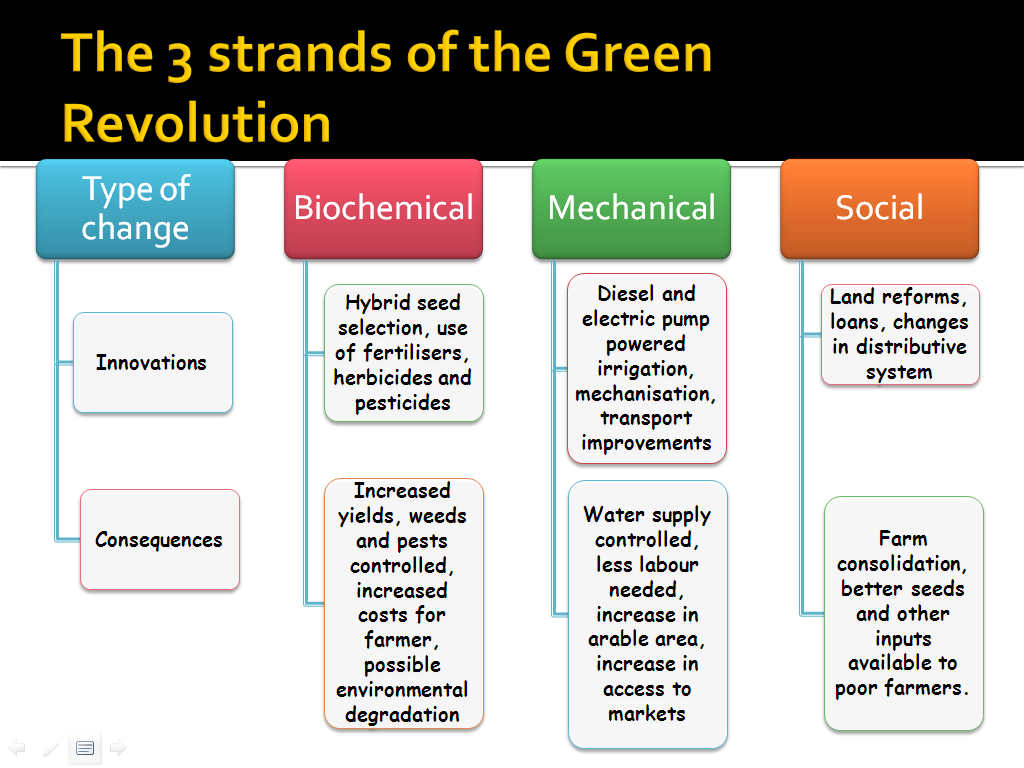
    • High Yielding Varieties (HYVs): These are the genetically modified seed which can yield 2 to 3 times more than normal crop.
      • They are dwarf variety with dense canopy and needs grater amount of water, use of chemical fertilizer, protection from pest and weeds as it very tender and fragile.
      • It also requires on farm activities like soil preparation. It has short generation period and leads to greater production in short period of time.
    • Irrigation facilities: The net irrigated area in 1960 was only 30 million hectare and it was a daunting task to extend irrigation to rest of India.
    • Credit Requirements: Green Revolution required a good network of rural credit and micro financing for supporting the needs of farmers.
    • Commercialization of agriculture: Introduction of Minimum Support Prices for crops gave farmers extra reason to grow more crops.
    • Farm Mechanization: It was required for increasing the crop production.
    • Command Area Development Program (CADP): CADP was introduced in 1974. It consisted of two methods:
      • On farm development activities: It includes construction of agricultural channels, ploughing, leveling, budding etc.
      • Off farm development activities: It includes construction of roads, rural connectivity, marketing, transportation communication etc.
    • Use of chemical fertilizer: Indian soil is deficient in Nitrogen so NPK fertilizers were used with standard ratio of 4:2:1 but the actual ratio used was 3:8:1.
    • Use of insecticide, Pesticide, weedicide
    • Rural electrification: It was the precondition for increasing farm mechanization practices.
    • Land holding and land reforms: Land holding refers to consolidation of land and land reforms involves various steps such as abolition of intermediaries, abolition of Zamindari, tenancy reforms etc.
    • Important Crops in the Revolution:
      • Main crops were Wheat, Rice, Jowar, Bajra and Maize.
      • Non-food grains were excluded from the ambit of the new strategy.
      • Wheat remained the mainstay of the Green Revolution for years.

    Phases of Green Revolution in India

    (1) First Phase of Green Revolution (1965-66 to 1980)

    • India was in ardent need of immediate food supply and self sufficiency in food grain production. Wheat revolution was successful in various 3rd world countries like Mexico, Egypt, etc.
    • The first phase of green revolution was not only crop specific but also region specific because- 
      1. The agriculture infrastructure was well developed in Punjab while Haryana and Western Uttar Pradesh took advantage of its vicinity where irrigation facility could be easily extended.
      2. This region was free from natural hazards.
    • This phase stared with IADP and IAAP program on experimental basis but main initiative was the HYV program during the Annual Plan of 1965-66.
    • In 1974 with Command Area Development Program, Green Revolution was reemphasized.
    • The food production in 1950-51 was merely 25 MT and it was 33 MT in 1965-66. In 1980 it jumped to 100 MT which was three times increase in a span of 10 years.
    • It was more centralized towards wheat production which was increased by 2.5 times in 5 years. This was termed as Green Revolution.
    • This provided India with self sufficiency in food grain production and the incidences of malnutrition, famine, poverty, starvation were mitigated. India was successful in coming out of the Begging Bowl image.
    Phase to Dominated by extensive agriculture. Reforms in the form of land grant and land reforms. Phase to Productivity enhancement measures through green revolution technologies. Phase till now. Attempted liberalization of agriculture.

    (2) Second Phase of Green Revolution (1980-1991)

    • During the 6th and 7th plan, wet agriculture (mainly rice) was targeted.
    • During the first phase, rice production was increase merely 1.5 times. The regions having rainfall more than 100 cm like West Bengal, Bihar, Eastern Uttar Pradesh, Assam, Coastal plains were targeted.
    • It met with partial success and Krishna-Godavari delta and Cauvery basin yielded the coveted results. West Bengal and Bihar also showed increased productivity.
    • The full potential of productivity in rice was however not realized due to institutional factors like land reforms, tenancy etc.
    • The traditional outlook of farmers was also a major limiting factor in the success of Second phase of Green revolution.

    (3) Third Phase of Green Revolution (1991-2003)

    • During the 8th and 9th plan, dry land agriculture was targeted and HYV was introduced in cotton, oilseeds, pulses, millets etc. This met with partial success.
    • Integrated Watershed Management Programme was initiated to improve the conditions in sub- humid and semi-arid regions of India.
    • However, it was not very successful except in the Narmada – Tapi doab and the Tungbhadra basin and also the Bhima – Krishna basin.
    • After the end of 9th plan, there was a paradigm shift in approach of the govt policies. 
    • The ecological repercussion in the green revolution areas led to relatively new concept of balanced Agriculture growth based on agricultural ecology, conversation method and sustainable development (10th plan).
    • The entire agricultural sector was targeted and it is known as the Rainbow Revolution.
    • The process of Rainbow Revolution had affiliated in 1980’s with Yellow revolution (oilseeds), Blue Revolution, White Revolution (milk earlier in 1970’s), Brown Revolution (fertilizers) and Silver revolution (poultry).
    • In the 11th plan, the idea has been further elevated to sustainable agriculture with balanced growth referred to as inclusive growth.
    Allocation of the harvested area under cereal production

    Impact of Green Revolution in India

    • Tremendous Increase in Crop Produce: It resulted in a grain output of 131 million tonnes in the year 1978-79 and established India as one of the world’s biggest agricultural producers.
    • Reduced Import of Food-Grains: India became self-sufficient in food-grains and had sufficient stock in the central pool, even, at times, India was in a position to export food-grains.
      • The per capita net availability of food-grains has also increased.
    • Benefits to the Farmers: The introduction of the Green Revolution helped the farmers in raising their level of income.
      • Farmers ploughed back their surplus income for improving agricultural productivity.
      • The big farmers were particularly benefited by this revolution by investing large amounts of money in various inputs like HYV seeds, fertilizers, machines, etc. It also promoted capitalist farming.
      • Green Revolution gave rise to capitalistic farming practices in India.
      • Surplus was generated in agriculture which led to its commercialization.
    • Industrial Growth: The Revolution brought about large scale farm mechanization which created demand for different types of machines like tractors, harvesters, threshers, combines, diesel engines, electric motors, pumping sets, etc.
      • Besides, demand for chemical fertilizers, pesticides, insecticides, weedicides, etc. also increased considerably.
      • Several agricultural products were also used as raw materials in various industries known as agro based industries.
      • Development of agro-processing industries, food-processing industries led to industrialization of tier – II/III towns. It led to higher rate of urbanization.
    • Rural Employment: There was an appreciable increase in the demand for labour force due to multiple cropping and use of fertilizers.
      • The Green Revolution created plenty of jobs not only for agricultural workers but also industrial workers by creating related facilities such as factories and hydroelectric power stations.
      • Green Revolution led to the removal of hunger and famine.
      • Green Revolution led to the development of rural infrastructure which was a pre condition to Green Revolution.

    Negative Effects of Green Revolution in India

    • Focus on limited food-grains: Although all food-grains including wheat, rice, jowar, bajra and maize have gained from the revolution, other crops such as coarse cereals, pulses and oilseeds were left out of the ambit of the revolution.
      • Major commercial crops like cotton, jute, tea and sugarcane were also left almost untouched by the Green Revolution.
    • Limited Coverage of HYVP: High Yielding Variety Programme (HYVP) was restricted to only five crops: Wheat, Rice, Jowar, Bajra and Maize.
    • Economic Effects
      • Inter – personal disparity emerged which led to differences between people due to difference in earning at different places.
      • Inter – regional disparity emerged due to difference in crop production e.g. West UP vs. East UP.
      • Inter – state disparity emerged, for e.g. in 1960 Punjab and Bihar, both states contributed same in terms of crop production but due to Green Revolution there became a huge gap in crop production between the two states by 1990.
      • Due to increase in informal credit services labors and cultivators got into the vicious cycle of debt – trap.
    • Excessive Usage of Chemicals: The Green Revolution resulted in a large-scale use of pesticides and synthetic nitrogen fertilisers for improved irrigation projects and crop varieties.
      • However, little or no efforts were made to educate farmers about the high risk associated with the intensive use of pesticides.
      • This causes more harm than good to crops and also becomes a cause for environment and soil pollution.
    • Increased Water Consumption: The crops introduced during the green revolution were water-intensive crops.
    • Impacts on Soil and Crop Production: Repeated crop cycle in order to ensure increased crop production depleted the soil’s nutrients.
      • To meet the needs of new kinds of seeds, farmers increased fertilizer usage.
      • The pH level of the soil increased due to the usage of these alkaline chemicals.
      • Toxic chemicals in the soil destroyed beneficial pathogens, which further led to the decline in the yield.
    • Social Effects
      • Increased rural landlessness, smaller marginal farmers were rendered landless and became agricultural labourers which led to rural handicapness and health hazards.
      • Greater unemployment due to mechanisation.
      • Patriarchy was strengthened, female discrimination, female foeticide, dowry increased.
    • Health Hazards: The large-scale use of chemical fertilizers and pesticides such as Phosphamidon, Methomyl, Phorate, Triazophos and Monocrotophos resulted in resulted in a number of critical health illnesses including cancer, renal failure, stillborn babies and birth defects.

    Conclusion

    • Green Revolution in India was directed towards food sufficiency for the country. The goal has been achieved. Thus it requires sustainable agricultural pattern.
    • Also, much wider area could be brought under the Green Revolution and instead of Green Revolution it can be transformed into evergreen Revolution.
    • It represented the successful adaptation and transfer of the same scientific revolution in agriculture that the industrial countries had already appropriated for themselves.
    • However, lesser heed was paid to factors other than ensuring food security such as environment, the poor farmers and their education about the know-how of such chemicals.
    • As a way forward, the policymakers must target the poor more precisely to ensure that they receive greater direct benefits from new technologies and those technologies will also need to be more environmentally sustainable.

    Try this question for mains:

    Q.  In spite of having several achievements, the green revolution has several defects. Examine

    FAQs

    Who started the Green Revolution in India?
    The Green Revolution in India was primarily initiated by Dr. M.S. Swaminathan and supported by the Indian government, which adopted various agricultural policies and investments.

    How is the Green Revolution relevant for UPSC?
    The Green Revolution is an essential subject in the UPSC syllabus, covering aspects like its history, impact, and policies related to agricultural development in India. Understanding this movement is crucial for aspiring civil servants.

    What was the impact of the Green Revolution in India?
    The Green Revolution significantly increased food production, reduced famine risk, and improved farmers’ incomes. However, it also led to environmental concerns, such as soil degradation and increased pesticide use.


    UPSC 2022 countdown has begun! Get your personal guidance plan now! (Click here)

  • Meeting Link Inside, Register & Join||What are the 5 Ways to Remain Consistent in your UPSC Preparation?|| Brainstorm with IPS Officer Shubham Nagargoje|| Free Q&A Webinar, Open for All, Limited Slots

    Meeting Link Inside, Register & Join||What are the 5 Ways to Remain Consistent in your UPSC Preparation?|| Brainstorm with IPS Officer Shubham Nagargoje|| Free Q&A Webinar, Open for All, Limited Slots

    Team is inviting you to a scheduled Zoom meeting.

    Ask me Anything Session with Shubham Nagargoje (IPS, AIR 453) CSE 2020
    Date & Time: Dec 6, 2021 @07:00 PM (start logging in by 06:45 PM) India

    Join Zoom Meeting
    https://zoom.us/j/99069125449pwd=MExEMm1Fb1lXRk91V2cyT3RTYXVXUT09

    Meeting ID: 990 6912 5449
    Passcode: 331985

    Success isn’t always because of greatness. It’s about consistency. Consistent hard work leads to success. Greatness will come.” – Dwayne Johnson.

    IPS Officer Shubham Nagargoje lived by this saying during his entire UPSC and RBI Grade B preparation of three years. Hence, failing to clear the UPSC Prelims twice didn’t deter him. He finally got appointment letters both as an RBI Grade B officer and an IPS officer. His joy knew no bounds and the very first thing he did upon hearing the news was hug his roommate and cry tears of joy. Shubham’s inclination in civil service motivated him to reject the former for the latter.

    Free Open for All, Q&A Webinar with Shubham Nagargoje IPS

    As UPSC-CSE aspirants, most of us would have faced the issue of consistency — we achieve our targets for the first month, but soon afterward our preparation (best known to us) fizzles out. Before we know, we would have gone months together without studying due to which we would give the upcoming UPSC exams a miss. This invariably delays the prospects of selection by a year or more.

    But what exactly is consistency? It appears to be a very common word just like ‘sorry’ and ‘thank you’ that everyone throws around. How does it feel to follow consistent life like other UPSC toppers? Consistency in UPSC parlance involves two aspects — being regular and being steadfast. It’s the willpower to read the current affairs in the morning, read the prelims portions in the afternoon, study for your Optional subject in the evening and round it off with a Mains subject at night. It’s the ability to not skip prelims and mains test series on the weekends. And it’s about making time to revise your notes once a week. Even if you miss one of these aspects, you are not true to your preparation.

    Does this sound difficult? Then attend the Ask Me Anything Session with Shubham Nagargoje to understand the five ways you can keep yourself consistent aka motivated for the upcoming UPSC CSE 2021 Mains and UPSC CSE 2022 Prelims exam.

    It’s absolutely free for anyone to attend but due to a fixed duration of 1 hour, we are only having limited slots. So kindly register for the webinar by filling this form right now.

    Key Takeaways of the Free Q&A Webinar with Shubham Nagargoje IPS

    1. Consistency according to Shubham. What did it mean to him?

    2. Day 01 v/s Day 365. How regular studies made him more intellectual, mentally strong and increased his confidence in mastering the topics?

    3. Mistakes aspirants make in the name of consistency. For example, why studying one book for the entire day is a bad idea?

    4. The right approach to Dynamic Prelims. What are the changes Shubham made in his 3rd attempt which helped him clear Prelims?

    5. Acing group studies for UPSC. How did Shubham successfully prepare with his four friends because of which all of them cleared Prelims and Mains?

    6. The time-management technique which helped Shubham stay focused. What were the distractions in Shubham’s preparation and how did he conquer them?

    7. What to write in DAF and what not to. How did Shubham research on his DAF because of which he was able to give a convincing interview?

    8. Navigating through study breaks. How long should a study break be and how to get back to study mode?

    9. Ideal hobbies for UPSC Aspirants. What are the hobbies you should cultivate now that can be a refreshing break for you?

    10. Other Government Exams. What are the other government exams you can study along with UPSC which has a similar syllabus but lesser competition?

    Webinar Details

    If you want to improve your preparation for UPSC, then do attend this webinar by IPS officer Shubham. Registration is free but limited due to the number of questions we can accommodate in the one-hour session. So fill the form below and confirm your attendance ASAP!

    Date: 6 December 2021 (Monday)

    Time: 7 P.M

  • Registration Closing in 1 Hour ||Free Q&A Webinar with Shubham Nagargoje IPS, Open for All, Limited Slots|| What are the 5 Ways to Remain Consistent in your UPSC Preparation?

    Registration Closing in 1 Hour ||Free Q&A Webinar with Shubham Nagargoje IPS, Open for All, Limited Slots|| What are the 5 Ways to Remain Consistent in your UPSC Preparation?

    Success isn’t always because of greatness. It’s about consistency. Consistent hard work leads to success. Greatness will come.” – Dwayne Johnson.

    IPS Officer Shubham Nagargoje lived by this saying during his entire UPSC and RBI Grade B preparation of three years. Hence, failing to clear the UPSC Prelims twice didn’t deter him. He finally got appointment letters both as an RBI Grade B officer and an IPS officer. His joy knew no bounds and the very first thing he did upon hearing the news was hug his roommate and cry tears of joy. Shubham’s inclination in civil service motivated him to reject the former for the latter.

    Free Open for All, Q&A Webinar with Shubham Nagargoje IPS

    As UPSC-CSE aspirants, most of us would have faced the issue of consistency — we achieve our targets for the first month, but soon afterward our preparation (best known to us) fizzles out. Before we know, we would have gone months together without studying due to which we would give the upcoming UPSC exams a miss. This invariably delays the prospects of selection by a year or more.

    But what exactly is consistency? It appears to be a very common word just like ‘sorry’ and ‘thank you’ that everyone throws around. How does it feel to follow consistent life like other UPSC toppers? Consistency in UPSC parlance involves two aspects — being regular and being steadfast. It’s the willpower to read the current affairs in the morning, read the prelims portions in the afternoon, study for your Optional subject in the evening and round it off with a Mains subject at night. It’s the ability to not skip prelims and mains test series on the weekends. And it’s about making time to revise your notes once a week. Even if you miss one of these aspects, you are not true to your preparation.

    Does this sound difficult? Then attend the Ask Me Anything Session with Shubham Nagargoje to understand the five ways you can keep yourself consistent aka motivated for the upcoming UPSC CSE 2021 Mains and UPSC CSE 2022 Prelims exam.

    It’s absolutely free for anyone to attend but due to a fixed duration of 1 hour, we are only having limited slots. So kindly register for the webinar by filling this form right now.

    Key Takeaways of the Free Q&A Webinar with Shubham Nagargoje IPS

    1. Consistency according to Shubham. What did it mean to him?

    2. Day 01 v/s Day 365. How regular studies made him more intellectual, mentally strong and increased his confidence in mastering the topics?

    3. Mistakes aspirants make in the name of consistency. For example, why studying one book for the entire day is a bad idea?

    4. The right approach to Dynamic Prelims. What are the changes Shubham made in his 3rd attempt which helped him clear Prelims?

    5. Acing group studies for UPSC. How did Shubham successfully prepare with his four friends because of which all of them cleared Prelims and Mains?

    6. The time-management technique which helped Shubham stay focused. What were the distractions in Shubham’s preparation and how did he conquer them?

    7. What to write in DAF and what not to. How did Shubham research on his DAF because of which he was able to give a convincing interview?

    8. Navigating through study breaks. How long should a study break be and how to get back to study mode?

    9. Ideal hobbies for UPSC Aspirants. What are the hobbies you should cultivate now that can be a refreshing break for you?

    10. Other Government Exams. What are the other government exams you can study along with UPSC which has a similar syllabus but lesser competition?

    Webinar Details

    If you want to improve your preparation for UPSC, then do attend this webinar by IPS officer Shubham. Registration is free but limited due to the number of questions we can accommodate in the one-hour session. So fill the form below and confirm your attendance ASAP!

    Date: 6 December 2021 (Monday)

    Time: 7 P.M

  • 6th December 2021| Daily Answer Writing Enhancement(AWE)

    Topics for Today’s questions:

    GS-1    Role of women and women’s organization

    GS-2    Issues relating to development and management of Social Sector/Services relating to Health, Education, Human Resources.

    GS-3    Major crops-cropping patterns in various parts of the country, – different types of irrigation and irrigation systems storage, transport and marketing of agricultural produce and issues and related constraints; e-technology in the aid of farmers.

    GS-4    Public/Civil service values and Ethics in Public administration: Accountability and ethical governance; strengthening of ethical and moral values in governance; ethical issues in international relations and funding; corporate governance

    Questions:

    Question 1)


    Q.1 It has been observed by some that emergence of a distinct “female vote bank” has made political parties and leaders take women related issues seriously. Critically examine in the context of electoral mobilisation in India in the recent times. (10 Marks)


    Question 2)

    Q.2 What are the parameters used in the National Institutional Ranking Framework? What are the issues with the ranking of State-run higher education institutions (HEIs) together with centrally funded institutions under the National Institutional Ranking Framework? (10 Marks)

    Question 3)

    Q.3 The purpose of the green revolution varied from the purpose of the white revolution. In the context of this, examine how the lessons from the white revolution can be applied as the government seeks to increase the income of the farmers. (10 Marks)

    Question 4)  

    Q.4 Of all the aspects of international politics nothing has aroused more controversy than foreign aid. Do you think international aid is a form of neo-colonialism or is it just solidarity with the poor? (10 Marks)


    HOW TO ATTEMPT ANSWERS IN DAILY ANSWER WRITING ENHANCEMENT(AWE)?

    1. Daily 4 questions from General studies 1, 2, 3, and 4 will be provided to you.

    2. A Mentor’s Comment will be available for all answers. This can be used as a guidance tool but we encourage you to write original answers.

    3. You can write your answer on an A4 sheet and scan/click pictures of the same.

    4.  Upload the scanned answer in the comment section of the same question.

    5. Along with the scanned answer, please share your Razor payment ID, so that paid members are given priority.

    6. If you upload the answer on the same day like the answer of 11th  October is uploaded on 11th October then your answer will be checked within 72 hours. Also, reviews will be in the order of submission- First come first serve basis

    7. If you are writing answers late, for example, 11th October is uploaded on 13th October, then these answers will be evaluated as per the mentor’s schedule.

    8. We encourage you to write answers on the same day. However, if you are uploading an answer late then tag the mentor like @Staff so that the mentor is notified about your answer.

    *In case your answer is not reviewed, reply to your answer saying *NOT CHECKED*. 

    For the philosophy of AWE and payment: 

  • Starting Today @ 7PM ||What are the 5 Ways to Remain Consistent in your UPSC Preparation?|| Brainstorm with IPS Officer Shubham Nagargoje|| Free Q&A Webinar, Open for All, Limited Slots|| Register Now

    Starting Today @ 7PM ||What are the 5 Ways to Remain Consistent in your UPSC Preparation?|| Brainstorm with IPS Officer Shubham Nagargoje|| Free Q&A Webinar, Open for All, Limited Slots|| Register Now

    Success isn’t always because of greatness. It’s about consistency. Consistent hard work leads to success. Greatness will come.” – Dwayne Johnson.

    IPS Officer Shubham Nagargoje lived by this saying during his entire UPSC and RBI Grade B preparation of three years. Hence, failing to clear the UPSC Prelims twice didn’t deter him. He finally got appointment letters both as an RBI Grade B officer and an IPS officer. His joy knew no bounds and the very first thing he did upon hearing the news was hug his roommate and cry tears of joy. Shubham’s inclination in civil service motivated him to reject the former for the latter.

    Free Open for All, Q&A Webinar with Shubham Nagargoje IPS

    As UPSC-CSE aspirants, most of us would have faced the issue of consistency — we achieve our targets for the first month, but soon afterward our preparation (best known to us) fizzles out. Before we know, we would have gone months together without studying due to which we would give the upcoming UPSC exams a miss. This invariably delays the prospects of selection by a year or more.

    But what exactly is consistency? It appears to be a very common word just like ‘sorry’ and ‘thank you’ that everyone throws around. How does it feel to follow consistent life like other UPSC toppers? Consistency in UPSC parlance involves two aspects — being regular and being steadfast. It’s the willpower to read the current affairs in the morning, read the prelims portions in the afternoon, study for your Optional subject in the evening and round it off with a Mains subject at night. It’s the ability to not skip prelims and mains test series on the weekends. And it’s about making time to revise your notes once a week. Even if you miss one of these aspects, you are not true to your preparation.

    Does this sound difficult? Then attend the Ask Me Anything Session with Shubham Nagargoje to understand the five ways you can keep yourself consistent aka motivated for the upcoming UPSC CSE 2021 Mains and UPSC CSE 2022 Prelims exam.

    It’s absolutely free for anyone to attend but due to a fixed duration of 1 hour, we are only having limited slots. So kindly register for the webinar by filling this form right now.

    Key Takeaways of the Free Q&A Webinar with Shubham Nagargoje IPS

    1. Consistency according to Shubham. What did it mean to him?

    2. Day 01 v/s Day 365. How regular studies made him more intellectual, mentally strong and increased his confidence in mastering the topics?

    3. Mistakes aspirants make in the name of consistency. For example, why studying one book for the entire day is a bad idea?

    4. The right approach to Dynamic Prelims. What are the changes Shubham made in his 3rd attempt which helped him clear Prelims?

    5. Acing group studies for UPSC. How did Shubham successfully prepare with his four friends because of which all of them cleared Prelims and Mains?

    6. The time-management technique which helped Shubham stay focused. What were the distractions in Shubham’s preparation and how did he conquer them?

    7. What to write in DAF and what not to. How did Shubham research on his DAF because of which he was able to give a convincing interview?

    8. Navigating through study breaks. How long should a study break be and how to get back to study mode?

    9. Ideal hobbies for UPSC Aspirants. What are the hobbies you should cultivate now that can be a refreshing break for you?

    10. Other Government Exams. What are the other government exams you can study along with UPSC which has a similar syllabus but lesser competition?

    Webinar Details

    If you want to improve your preparation for UPSC, then do attend this webinar by IPS officer Shubham. Registration is free but limited due to the number of questions we can accommodate in the one-hour session. So fill the form below and confirm your attendance ASAP!

    Date: 6 December 2021 (Monday)

    Time: 7 P.M