💥Join UPSC 2027,2028 Mentorship (July Batch) + XFactor Notes & Microthemes PDF

Author: Urmila Singh

  • Nikaalo Prelims Spotlight || External Sectors, Schemes- Socio economic Development, Poverty and Planning

    Dear Aspirants,

    This Spotlight is a part of our Mission Nikaalo Prelims-2023.

    You can check the broad timetable of Nikaalo Prelims here

    Session Details

    YouTube LIVE with Parth sir – 1 PM  – Prelims Spotlight Session

    Evening 04 PM  – Daily Mini Tests

    Telegram LIVE with Sukanya ma’am – 06 PM  – Current Affairs Session

    Join our Official telegram channel for Study material and Daily Sessions Here


    3rd May 2023

    External Sectors of India 

    All economic activities of an economy which take place in foreign currency fall in the external sector such as balanced of payment, export, import, foreign investment, external debt, current account, capital account, exchange rates etc.

    FOREX RESERVES

    Foreign exchange reserves are assets denominated in a foreign currency that are held on reserve by a central bank. These may include foreign currencies, bonds, treasury bills and other government securities.

    Forex Reserves Consist of:

    • Bank deposits

    • Gold

    • Special drawing rights (SDRS)

    • Reserve tranche position (RTP)

    • Foreign currency assets (FCA)

    • Government securities

    SDR

    • SDR is an international reserve asset, created by the IMF in 1969.

    • Value of the SDR is based on a basket of five currencies- Dollar, Euro, Renminbi, Yen, and Pound Sterling.

    • It is neither a currency nor a claim on the IMF. Rather, it is a potential claim on the freely usable currencies of IMF members.

    EXCHANGE RATE

    Exchange rate is Price at which one currency is converted into or exchanged for another currency.

    Various Exchange rates mechanism:

    FIXED EXCHANGE RATE

    FLOATING EXCHANGE RATE

    MANAGED FLOATING RATE

    Complete intervention of Authority (government or central bank) in determination of the currency exchange rate.

    Market forces(demand and supply) determine the value of currency

    No role of authority

    Exchange rate is largely determined by market forces.

    In crisis, central banks may intervene to stabilize the exchange rate

    NEER vs REER

    Nominal Effective Exchange Rate (NEER)

    Real Effective Exchange Rate (REER)

    Weighted average of bilateral nominal exchange rates of the home currency in terms of foreign currencies

    Weighted average of nominal exchange rates, adjusted for inflation.

    It is the exchange rate of one currency against a basket of currencies, weighted according to trade with each country (not adjusted for inflation).

    Is calculated on the basis of NEER.

    Captures inflation differentials between country and its major trading partners and reflects the degree of external competitiveness

    CURRENCY CONVERTIBILITY

    Currency convertibility is the ease with which the currency of a country can be freely converted into any other foreign currency or gold at market determined exchange rate.

    Partial Convertibility:

    • Portion allowed by the government which can be converted into foreign currency with least restrictions.

    • Union Budget for 1992-93, introduced it on current account under Liberalized Exchange Rate Management System (LERMS)

    • Also known as Dual exchange system.

    • Presently partial convertibility still operational on capital account.

    Full Convertibility:

    • Freedom to convert domestic currency into any foreign currency and vice versa without any regulatory intervention.

    • Dual exchange rate system got automatically abolished and LERMS was now based upon the open market exchange.

    • In 1994, the Government of India declared full convertibility of Rupee on Current account.

    Tarapore Committee I (1997) and II (2006):

    • Constituted by the RBI for suggesting a roadmap on full convertibility of Rupee on Capital Account.

    Advantages of capital account convertibility:

    • Availability of large funds
    • Reduction in cost of capital.
    • Greater financial competitiveness.
    • Increase in FII/FPI flow.

    BALANCE OF PAYMENT

    A systematic record of all economic transactions between the residents of one country with the residents of the other country in a financial year.

    It consists of balance of trade, balance of current account and capital account.

    Balance of trade: Difference between the monetary value of a nation’s exports and imports over a certain time period.

    Balance of payments divides transactions in two accounts:

    Current account

    Capital account

    Current Account

    Invisible

    Visible

    Goods(+)

    Services [+)

    Income

    1. Dividend

    2. Interest

    3. Profit

    Transfer [+]

    1. Gift

    2. Donation

    3. Remittance

    Capital account [+]

    Investment [+]

    1.Sovereign 2.Commercial

    NRI account [+]

    1. Gift

    2.Donation 3.Remittance

    Loan (+)

    1 FDI 2. FII/FPI


    CURRENT ACCOUNT

    CAPITAL ACCOUNT

    Meaning

    • Records imports and exports of visible and invisibles

    • Short term implication transactions

    • Covers only earnings and spending.

    • Excludes any borrowings and lending.

    • Shows capital expenditure and income for country

    • Long term implication transactions

    • Only includes borrowings and lending by a country

    Components

    • Visible trade(Export and Import of goods-Merchandise transactions )

    • Invisible trade(Export and Import of services)

    • Unilateral transactions

    • Direct Investment (FDI)

    • Portfolio Investment (FPI)

    • Loans / External commercial borrowing (ECB)

    • Non-resident’s investment in Bank, Insurance, Pension schemes.

    • RBI’s foreign exchange reserve

    Deficit (CAD)

    • If the value of the goods and services imported exceeds the value of those exported.

    • Current Account deficit = Trade gap(export – import) + Net current transfers (foreign aid) + Net factor income (Interest, Dividend)

    • When more money is flowing out of a country to acquire assets and rights abroad

    Surplus

    • If the value of the goods and services exported exceeds the value of those imported.

    • Money is flowing into the country, but these inflows reflect changes in the ownership of national assets by way of sale or borrowing.

    Convertibility

    • Current account convertibility relates to the removal of restrictions on payments relating to the international exchange of goals, services and factor incomes.

    • Capital account convertibility refers to a liberalization of a country’s capital transactions such as loans and investment.

    Current status

    • Allowed Full convertibility

    • Only Partial convertibility

    EXTERNAL DEBT

    Part of a country s debt which has been borrowed from foreign creditors which includes private commercial banks, international financial institutions such as the World Bank, International Monetary Fund (IMF), and sovereign governments.

    Types of external debts:

    Short term debt: Maturity period 1 year or less

    Long term debt: Maturity period more than 1 year

    Sovereign debt : Bonds issued by the national government in any foreign currency to generate funds to meet its financial expenses.

    Schemes- Socio economic Development, Poverty and Planning

    Refer to the schemes compilation.

     
  • Nikaalo Prelims Spotlight || RBI, Inflation and Monetary Policy, Money Market and Capital Market


    Dear Aspirants,

    This Spotlight is a part of our Mission Nikaalo Prelims-2023.

    You can check the broad timetable of Nikaalo Prelims here

    Session Details

    YouTube LIVE with Parth sir – 7 PM  – Prelims Spotlight Session

    Evening 04 PM  – Daily Mini Tests

    Join our Official telegram channel for Study material and Daily Sessions Here


    1st May 2023

    Inflation

    Understanding Inflation

    Inflation: Inflation is when the overall general price level of goods and services in an economy is increasing. As a consequence, the purchasing power of the people are falling. 

    Inflation Rate: Inflation Rate is the percentage change in the price level from the previous period. 

    Inflation Rate= {(Price in year 2 – Price in year 1)/ Price in year 1} *100

    Whole sale Price Index: WPI is used to monitor the cost of goods and services bought by producer and firms rather than final consumers. The WPI inflation captures price changes at the factory/wholesale level.

    GDP Deflator: GDP Deflator is the ratio of nominal GDP to real GDP. The nominal GDP is measured at the current prices whereas the real GDP is measured at the base year prices. 

    The Difference

    Consumer Price Index GDP Deflator
    CPI reflects the price of goods and services bought by the final consumers. GDP deflator reflects the price of all the goods and services produced domestically.
    Example: Suppose the price of a satellite to be launch by ISRO increases. Even though the satellite is part of the GDP of India, but it is not a part of normal CPI index, since we don’t consume satellite. The price rise of the ISRO satellite will be reflected in GDP deflator.
    Similarly, India produces some crude oil, but most of the oil/petroleum is imported from the West Asia, as a result, when the price of oil/petroleum product changes, it is reflected in CPI basket as petroleum products constitute a larger share in CPI. The price change of oil products is not reflected much in the GDP deflator since we do not produce much crude oil.
    The CPI compares the price of a fixed basket of goods and services to the price of the basket in the base year. The GDP deflator compares the price of currently produced goods and services to the price of the same goods and services in the base year. Thus, the group of goods and services used to compute the GDP deflator changes automatically over time.

    Producer Price Index

    PPI measures the average change in the sale price of goods and services either as they leave the place of production or as they enter the place of production. Moreover, PPI includes services also.

    The PPI measure the price changes from the perspective of the seller and differs from CPI which measures price changes from buyer perspective.

    Causes of Inflation

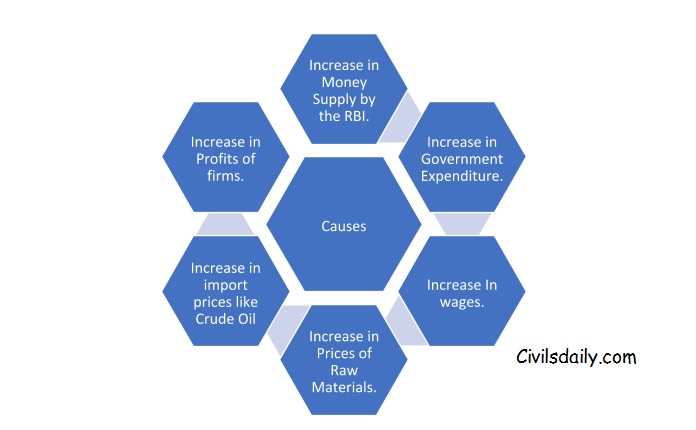
    Inflation is mainly caused either by demand Pull factors or Cost Push factors. Apart from demand and supply factors, Inflation sometimes is also caused by structural bottlenecks and policies of the government and the central banks. Therefore, the major causes of Inflation are:

    • Demand Pull Factors (when Aggregate Demand exceeds Aggregate Supply at Full employment level).
    • Cost Push Factors (when Aggregate supply increases due to increase in the cost of production while Aggregate demand remains the same).
    • Structural Bottlenecks (Agriculture Prices fluctuations, Weak Infrastructure etc.)
    • Monetary Policy Intervention by the Central Banks.
    • Expansionary Fiscal Policy by the Government.

    Demand and Supply factors can be further sub divided into the following:

    Inflationary Gap: the Inflationary gap is a situation which arises when Aggregate demand in an economy exceeds the Aggregate supply at the full employment level.

    Deflationary Gap: Deflationary Gap is a situation which arises when Aggregate demand in the economy falls short of Aggregate Supply at the full employment level.

    Stagflation:  The falling growth along with rising prices makes cost push inflation more dangerous than the demand-pull inflation. The situation of rising prices along with falling growth and employment is called as stagflation.

    Hyperinflation: Hyperinflation is a situation when inflation rises at an extremely faster rate. The rate of inflation can increase from 50 times to 300 times. The major causes of the hyperinflation are; government issuing too much currency to finance its deficits; wars and political instabilities and unexpected increase in people’s anticipation of future inflation.

    Structural Inflation

    • Structuralist Inflation is another form of Inflation mostly prevalent in the Developing and Low-Income Countries.
    • The Structural school argues that inflation in the developing countries are mainly due to the weak structure of their economies.

    Deflation: Deflation is when the overall price level in the economy falls for a period of time.Deflation is when, for instance, the price of a basket of goods has fallen from Rs 100 to Rs 80. It’s the reduction in overall prices of goods.

    Disinflation: Disinflation is a situation in which the rate of inflation falls over a period of time. Remember the difference; disinflation is when the inflation rate is falling from say 5% to 3%.

    Headline versus Core Inflation

    The headline inflation measure demonstrates overall inflation in the economy. Conversely, the core inflation measures exclude the prices of highly volatile food and fuel components from the inflation index.

    Core inflation excludes the highly volatile food and fuel components and therefore represents the underlying trend inflation. 

    Banking and Monetary Policy

    What is monetary policy?

    As the name suggests it is policy formulated by monetary authority i.e. central bank which happens to be RBI in case of India.

    It deals with monetary i.e money matters i.e. affects money supply in the economy.

    Eg. CRR,SLR,OMO,REPO etc

    What is fiscal policy then?

    It is formulated by finance ministry i.e. government. It deals with fiscal matters i.e. matters related to government revenues and expenditure.

    Revenue matters- tax policies, non tax matters such as divestment, raising of loans, service charge etc

    Expenditure matters– subsidies, salaries, pensions, money spent on creation of capital assets such as roads, bridges etc.

    Monetary policy and fiscal policy together deal with inflation.


    Let us now understand how RBI formulates monetary policy to control inflation

    It’s clear from what we have learnt so far that to control inflation, RBI will have to decrease money supply or increase cost of fund so that people do not demand goods and services.

    Tools available with RBI


    1. Quantitative tools or general tools- they affect money supply in entire economy- housing, automobile, manufacturing, agriculture- everything.

    They are of two types

    1. Cash Reserve Ratio (CRR)– as the name suggests, banks have to keep this proportion as cash with the RBI. Bank cannot lend it to anyone. Bank earns no interest rate or profit on this.Bank cannot lend it to anyone. 
    2. Statutory Liquidity Ratio (SLR)-  As the name indicates banks have to set aside this much money into liquid assets such as gold or RBI approved securities mostly government securities. Banks earn interest on securities but as yield on govt securities is much lower banks earn that much less interest.

    RBI Tools for Controlling Credit/Money Supply

    Broadly speaking, there are two types of methods of controlling credit.

    Measure of Money Supply in India

    M1 M2 M3 M4
    It is also known as Narrow Money. It is a broader concept of the money supply. It is also known as Broad Money. M4 includes all items of M3 along with total deposits of post office saving accounts.
    M1= C+DD+OD

    C= Currency with Public.

    DD= Demand Deposit with the public in the Banks.

    OD= Other Deposits held by the public with RBI.

    M2= M1 + Saving deposits with the post office saving banks.

    M1 is distinguished from M2 because the post office saving deposits are not as liquid as Bank deposits.

    M3 = M1+ Time Deposits with the Bank.

    Time deposits serve as a store of wealth and represent a saving of the people and are not as liquid as they cannot be withdrawn through cheques or ATMs as compared to money deposited in Demand deposits.

    M4= M3+Total Deposits with Post Office Saving Organisations.

    M4 however, excludes National Saving Certificates of Post Offices.

    It is the most liquid form of the money supply.   M3 is the most popular and essential measure of the money supply. The monetary committee headed by late Prof Sukhamoy Chakravarty recommended its use for monetary planning in the economy. M3 is also called Aggregate Monetary Resource  


    FINANCIAL MARKETS

    • Financial Markets refers to the system consisting of financial institutions, financial instruments, regulatory bodies and organisations
    •  It facilitates flow of debt and equity capital.
    • Financial Institutions (Banks), Development financial Institutions (NABARD, SIDBI, IDBI etc.) and Non-Banking Financial Institutions form Financial Institutions. Ø Financial Instruments are shares, bonds, debentures etc.

    Financial markets consist of two major segments:

    (l) Money Market: the market for short term funds;

    (2) Capital Market: the market for long and medium term funds.

    MONEY MARKET

    According to the RBI, “The money market is the centre for dealing mainly of short character, in monetary assets; it meets the short term requirements of borrowers and provides liquidity or cash to the lenders.

    It is a place where short term surplus investible funds at the disposal of financial and other institutions and individuals are bid by borrowers, again comprising institutions and individuals and also by the government.

    Functions of Money Market

    • To maintain monetary equilibrium: It means to keep a balance between the demand for and supply of money for short term monetary transactions.
    • To promote economic growth: Money market can do this by making funds available to various units in the economy such as agriculture, small scale industries, etc.
    • To provide help to Trade and Industry: Money market provides adequate finance to trade and industry. Similarly it also provides facility of discounting bills of exchange for trade and industry.
    • To help in implementing Monetary Policy: It provides a mechanism for an effective implementation of the monetary policy.
    • To help in Capital Formation: Money market makes available investment avenues for short term period. It helps in generating savings and investments in the economy.
    • Money market provides non-inflationary sources of finance to government.

    Instruments of money market

    Treasury Bills: They are promissory notes issued by the RBI on behalf of the government as a short term liability and sold to banks and to the public. The maturity period ranges from 14 to 364 days. They are the negotiable instruments, i.e. they are freely transferable. No interest is paid on such bills but they are issued at a discount on their face value.

    Commercial Bills: They are also called Trade Bills or Bills of Exchange. Commercial bills are drawn by one business firm to another in lieu of credit transaction. It is a written acknowledgement of debt by the maker directing to pay a specified sum of money to a particular person. They are short-term instruments generally issued for a period of 90 days. These are freely marketable. Banks provide working capital finance to firms by purchasing the commercial bills at a discount; this is called ‘discounting of bills’.

    Commercial Paper (CP): The CP was introduced in 1990 on the recommendation of the Vaghul Committee. A commercial paper is an unsecured promissory note issued by corporate with net worth of atleast Rs 5 crore to the banks for short term loans. These are issued at discount on face value for a period of 14 days to 12 months. These are issued in multiples of Rs 1 lakh subject to a minimum of Rs 25 lakh.

    Certificate of Deposit (CD): The CD was introduced in 1989 on the recommendation of the Vaghul Committee. These are issued by banks against deposits kept by individuals and institutions for a period of 15 days to 3 years. These are similar to Fixed Deposits but are negotiable and tradable. These are issued in multiples of Rs. 1 lakh subject to a minimum of Rs25 lakh.

    CAPITAL MARKET

    The capital market is the market, for medium and long term funds. It consists of all the financial institutions, organizations and instruments which deal in lending and borrowing transaction of over one year maturity.

    It is of following two types:

    Primary Market

    Secondary Market

    It issues security for the first time. Example- Initial public offer and follow on public offer.

    Existing securities are bought and sold.

    Firms issue shares to public.

    One investor sells it to another investor.

    Price is fixed by the firms.

    Price is fixed on the basis of demand and supply.

    Firms raise money for long-term investment.

    Companies benefit from the secondary markets.

    There is no specific geographical location.

    There is no specific geographical location.

    SEBI is the regulator for this market.

    SEBI is the regulator for this market as well.

    GILT-EDGED MARKET

     The Gilt-edged market refers to the market for government and semi government securities, backed by the RBI.

    It is known so because the government securities do not suffer from the risk of default and are highly liquid.

    The RBI is the sole supplier of such securities. These are demanded by commercial banks, insurance companies, provident funds and mutual funds.

    The gilt-edged market may be divided into two parts- the Treasury bill market and the government bond market. Treasury bills are issued to meet short-term needs for funds of the government, while government bonds are issued to finance long-term developmental expenditure. 


  • Nikaalo Prelims Spotlight || Pattern of Economic Indicators & Fiscal Policy


    Dear Aspirants,

    This Spotlight is a part of our Mission Nikaalo Prelims-2023.

    You can check the broad timetable of Nikaalo Prelims here

    Session Details

    YouTube LIVE with Parth sir – 7 PM  – Prelims Spotlight Session

    Evening 04 PM  – Daily Mini Tests

    Join our Official telegram channel for Study material and Daily Sessions Here


    1st May 2023

    Patterns of Economic Indicators

    An economic indicator is a statistic about an economic activity. Economic indicators allow analysis of economic performance and predictions of future performance. One application of economic indicators is the study of business cycles.

    NATIONAL INCOME
    • National Income is the total value of all final goods and services produced by the country in certain year. The growth of National Income helps to know the progress of the country.
    • In other words, the total amount of income accruing to a country from economic activities in a year’s time is known as national income.
    • National Income includes payments made to all resources in the form of wages, interest, rent and profits.
    NATIONAL INCOME ACCOUNTING (NIA)
    • National Income Accounting is a method or technique used to measure the economic activity in the national economy as a whole.
    • It is the bookkeeping system which measures the level of economic activity in a given time period
    • NIA sets rules and definition to measure aggregate economic activity and tries to summarise the performance of the economy
    Indicators: GDP
    • Gross Domestic Product is the market value of all the goods and services produced within the domestic territory of a country during a specified time period, usually one year.
    • Accounting Year = Fiscal Year; for India it is 1st of April to 31st of March (next year)
    • Will include the income generated by MNCs in India

    Domestic Territory = Political frontiers of the country including its territorial waters+ Embassies/Consulates + Military Establishments of the country abroad + Ships/Aircrafts/Fishing Vessels/Oil Rigs belonging to the residents of the country

    GDP does not include :
    • Capital goods (e.g. machinery) are included in GDP, but intermediate goods (e.g. raw materials) are not.
    • Intermediate goods and services are not included to avoid double counting.
    • Same good can be final (you consuming milk ) or intermediate (milk in the restaurant) depending on the usage.
    GROWTH RATE &GDP DEFLATOR
    • Growth Rate (%) = [GDP (Present year – Last Year) / Last Year] x 100
    • But, quantitatively the production may not have improved (From 1 kg garlics to 2 kg garlics), and only because of inflation in the prices (₹ 10/kg garlic to ₹ 100/kg) the growth rate may be appear high.
    • Therefore (to remove the inflation impact on growth rate), we must select a base year, and convert the current prices to constant prices.
    • The ratio of these GDPs is called ‘GDP deflator’, it presents a picture of inflation like CPI and WPI but, unlike CPI & WPI it’s not based on a fixed basket of commodities.
    • These figures are revised as the new data arrives / previous data is cross verified & corrected.
    GDP AND NATIONAL INCOME
    Gross National Income (GNI)
    • According to OECDà GNI as GDP + NET receipts from abroad (wages, interest, profit, rent) plus net taxes & subsidies receivable from abroad. Here, ‘Wages and salaries’ from abroad = ‘Guest’ workers who reside abroad for less than 12 months and whose centre of economic interest remains in their home country
    National Disposable Income
    • National Disposable Income= NNP + Other Current Transfers from rest of the world (remittances, gift, donations etc.)National Disposable Income gives an idea of what is the maximum amount of goods and services the domestic economy has at its disposal.
    Personal Disposable Income
    • Personal Income – Personal Tax Payments (e.g. income tax) – Non-tax Payments (e.g. fines)

    Fiscal Policy

    What is Fiscal Policy? Fiscal Policy deals with the revenue and expenditure policy of the Govt. The word fiscal has been derived from the word ‘fisk’ which means public treasury or Govt funds.

    Objectives of Fiscal Policy

    The following are the objectives of the Fiscal Policy:

    1. Higher Economic Growth
    2. Price Stability
    3. Reduction in Inequality

    What are the components of Fiscal Policy?

    There are three components of the Fiscal Policy of India:

    1. Government Receipts
    2. Government Expenditure
    3. Public Debt

    Government Receipts

    The categorisation of the government receipts is given below:

    1. Revenue Receipt
      • Tax Revenue
        • Direct Tax
        • Indirect Tax
      • Non-Tax Revenue
        • Fees
        • License and Permits
        • Fines and Penalties, etc
    2. Capital Receipt
      • Loans Recovery
      • Disinvestments
      • Borrowing and other liabilities

    Government Expenditure

    There are two classifications of public expenditure:

    1. Revenue Expenditure – It is a recurring expenditure:
      • Interest Payments
      • Defence Expenses
      • Salaries to Central Government employees, etc are examples of  revenue expenditure
    2. Capital Expenditure – It is a non-recurring expenditure
      • Loans repayments
      • Loans to public enterprises, etc.