💥Join UPSC 2027,2028 Mentorship (July Batch) + XFactor Notes & Microthemes PDF

Category: Burning Issues

  • Under Pressure, Underperforming, Undone : What’s Breaking Our Brightest ?

    Under Pressure, Underperforming, Undone : What’s Breaking Our Brightest ?

    N4S:
    UPSC often picks such topics not just for data recall but to test empathy, societal understanding, and connection between systems — as seen in the 2023 GS1 question on suicides among young women. Where aspirants usually falter is in treating these as ‘soft’ topics, often lacking structure or specific multi-level analysis. This article changes that. It dives deep into real causes like academic pressure, social media, and stigma (see: “Immediate Triggers”, “Stigmatization”), and ties them with structural flaws like poor mental health infrastructure and societal taboos (“At Institutional Level”, “At Societal Level”). The piece doesn’t stop at problems. It shows state-level best practices (like Kerala’s 2013 policy or Tamil Nadu’s “Mano Amma”), making your answers richer and anchored in reality. One very special feature is how this article connects mental health to constitutional rights and social justice — like linking suicide decriminalization with the Mental Healthcare Act, 2017 and discrimination with SC/ST atrocities. It also humanizes the issue by opening with lived tragedies, making it hard to read without feeling the weight of the problem. This emotional-societal-policy thread is what UPSC expects, and this article delivers.

    This article explores India’s growing mental health crisis, especially among the youth, by connecting personal, social, and systemic factors. UPSC often frames such issues to test empathy, governance insight, and constitutional understanding, as seen in the 2023 GS1 question on suicides among young women.

    Aspirants often treat these topics as emotional rather than structural. This article goes deeper. It examines immediate triggers like academic stress and social media, and links them with larger issues such as poor mental health infrastructure and social stigma. It highlights policy efforts like Kerala’s 2013 framework and Tamil Nadu’s Mano Amma initiative. A key strength is how it ties mental health to constitutional rights, decriminalisation under the Mental Healthcare Act, and social justice. This layered approach helps aspirants write more grounded and impactful answers.

    PYQ ANCHORING

    1. GS 1: Explain why suicide among young women is increasing in Indian Society. [2023]

    MICROTHEME:  Women and Associated concerns

    Two bright students. Two lives lost. And one powerful reminder from the Supreme Court — even the prestige of IIT-Delhi can’t be a shield against justice. The 2023 suicides of two students from SC/ST communities have cracked open a painful truth: our top institutions are silently breeding mental health crises.

    Behind the glowing resumes and cutthroat competition, many students are battling pressure, isolation, and stigma — alone and unheard.

    So, the questions to ponder over are: What’s really happening inside our most celebrated classrooms? Are we ignoring the emotional toll in the race for excellence? And how long will brilliance be measured by burnout?

    FACTORS CONTRIBUTING TO MENTAL HEALTH PROBLEMS AMONG STUDENTS//MAINS

    CategoryDetailsExamples / Research
    Immediate Triggers / Precipitating FactorsSudden adverse life events such as exam failure, financial loss, grief, or public humiliation. These can precipitate mental breakdowns or suicidal ideation.Suicides in IITs and Kota due to failure or pressure; reports of self-harm after results announcements.
    Influence of Social MediaExcessive or passive use of social media is linked to poor sleep quality, cyberbullying, low self-esteem, and FOMO (fear of missing out), increasing anxiety and depression.A 2018 British study (University of Glasgow) found a link between disrupted sleep from social media and depression.
    Social Isolation & LonelinessLoneliness may stem from dysfunctional family relationships, lack of peer support, bullying, and confusion around gender identity or puberty-related changes.Adolescents facing gender dysphoria or from broken families often report higher rates of anxiety and depression.
    Academic Pressure & Parental ExpectationsConstant pressure to perform, intense competition, and the fear of letting down parents who have made financial sacrifices can result in burnout, anxiety, and depression.High suicide rates reported in Kota coaching centers due to overwhelming academic expectations.
    Predisposing Biological FactorsGenetic predispositions (e.g., family history of depression or suicide), neurochemical imbalances, and chronic illnesses can heighten vulnerability.Studies show impulsivity and mental disorders are higher in students with family history of mental illness.
    Personality & Disability FactorsTraits like perfectionism, impulsivity, and poor coping mechanisms; physical disabilities may lead to social exclusion or frustration.Students with learning disabilities are more prone to depression due to lack of understanding and peer rejection.
    StigmatizationFear of judgment or being labeled prevents students from seeking timely help. This allows issues to worsen before intervention.Studies find stigma is a major reason students avoid counseling even when services are available.

    ROLE OF SOCIAL PREJUDICES AND TABOO IN MENTAL HEALTH

    • At individual level- The stress to cope up with the present day materialism, consumerism has resulted in higher levels of depression and associated issues like high blood pressure, heart issues etc. According to a Lancet study, between 1990 to 2017, one in seven people from India have suffered from mental illness ranging from depression, anxiety to severe conditions such as schizophrenia.
    • At family level- Change in the family structure, rise of nuclear families and individualism has impacted traditional family support resulting in isolation and a lack of emotional support during difficult times.. 
    • At societal levels- 
      •  Conforming to the  social norms(‘Log kya kahenge’ approach)associated with mental illness prevents people from seeking help. 
      •  Society in general has stereotyped views about mental illness and how it affects people. Many people believe that people with mental ill health are violent and dangerous, when in fact they are more at risk of being attacked or harming themselves than harming other people.
      • Further, Social discrimination as seen in recent events like mob lynching, beating of Dalit youth for keeping moustache impact the mental health of marginalised sections of society due to rise in fear and anxiety.
    • At institutional level-
      • Violations of human rights have been reported in mental asylums and also at homes and places of traditional healing.  In India, mental hospitals still practice certain obscure practices that violate human rights.  Further poor infrastructure such as closed structures, a lack of maintenance, unclean toilets and sleeping areas etc clearly violate the basic human right to a life with dignity and add to the stigma. For example, Erwadi Tragedy: In 2001, 28 patients who were chained at a home for mentally-ill people died after a fire that engulfed the home in Erwadi village in the Ramanathapuram district (Tamil Nadu).
      • The situation is exacerbated by the media. Media reports often link mental illness with violence, or portray people with mental health problems as dangerous, criminal, evil, or very disabled and unable to live normal, fulfilled lives.
    • On vulnerable sections:
      • Impact on Women- Gender inequality and patriarchy coupled with Illiteracy, poverty and lack of awareness restricts the access to mental healthcare and leads to deterioration of mental health of women. 
      • Impact on elderly- Lack of family support , changing patterns of relationships i.e movement from joint to nuclear families and social stigma associated with mental health leads to depression, stress and leads to rise in suicides among elderly. 
      • Impact on children- Increased competition, peer pressure and exposure to indecent content on social media has increased the stress and depression levels among children.

    COMMITTEES THAT SHAPED INDIA’S MENTAL HEALTH FRAMEWORK//PRELIMS

    While mental health in India remained under the radar for decades, a series of expert committees quietly laid the groundwork for reform. From decriminalizing suicide to building community-based care, these government-appointed panels have shaped policy, law, and public health strategies over time. 

    YearCommittee / ReportPurpose / FocusKey Recommendations
    2009–2013Mental Health Care Bill Drafting CommitteeDrafting of the Mental Healthcare Act, 2017Right to mental healthcare, Advance Directives, decriminalization of suicide, creation of Mental Health Review Boards
    2011Keshav Desiraju CommitteeReforming the National Mental Health Programme (NMHP)Strengthen DMHP, community-based care, train general healthcare providers, integrate mental health into primary care
    2014National Mental Health Policy GroupFormulating the National Mental Health PolicyRights-based approach, inclusive care for vulnerable populations, decentralization, inter-sectoral collaboration
    2021–22NITI Aayog Health Reforms CommitteeBroader health sector reform with mental health focusIncrease funding, digitize mental health services, recognize mental health under NCDs, national mental health data surveys
    2022Parliamentary Standing Committee on Health & WelfareReview of mental health care systems and implementation of MHCAMental health literacy in schools, integration with Ayushman Bharat, more professionals, inclusion in national health indicators

    State-Level Best Practices in Mental Health Care

    StateInitiativeKey Features / Impact
    KeralaMental Health Policy (2013)First state to launch a dedicated mental health policy Emphasizes community-based care and integration with primary health services
    Tamil Nadu“Mano Amma” SchemeProvides free psychiatric treatment Includes free medicines, counseling, and awareness through public hospitals
    Maharashtra“Mansapurti Yojana”Organizes mental health camps in rural areas Focuses on outreach, early detection, and referrals via local health workers

    WAY FORWARD: MORE SUNLIGHT. MORE CANDOR. NO SHAME.

    1. Individual Level

    • Speak Up: Share personal stories to normalize mental health conversations.
    • Connect: Build peer-support networks for listening and healing.

    2. Society Level

    • Break the Taboo: Run awareness campaigns across media.
    • Family First: Encourage open dialogue in homes and communities.

    3. Vulnerable Sections

    • Empower the Marginalized: Enforce SC/ST (PoA) Act, ensure financial and legal support for women and minorities.

    4. Students

    • Start Early: Add mental health to school curricula.
    • Counsel Proactively: Regular sessions in schools, colleges, and workplaces.

    5. Infrastructure

    • Upgrade & Expand: Strengthen psychiatric departments under NMHP.
    • Close the Gap: Train more psychiatrists—India needs 10x the current number.

    6. Legal Implementation

    • Enforce the Law: Roll out Mental Health Care Act effectively—focus on rights, access, and autonomy.

    7. Community-Led Solutions

    • Scale Models Like Atmiyata: Train local volunteers for frontline mental care.

    #BACK2BASICS:Legislative Framework of Mental Health in India

    India’s approach to mental health has evolved significantly—from custodial care under colonial laws to a rights-based framework focused on dignity, autonomy, and inclusion.


    1. The Indian Lunacy Act, 1912

    • Colonial-era law based on the British Lunacy Act of 1890.
    • Focused on custodial care and institutionalization of the mentally ill.
    • Prioritized public safety over individual rights.
    • Eventually repealed due to being outdated and stigmatizing.

    2. Mental Health Act, 1987

    • Replaced the 1912 Act.
    • Aimed to regulate admission and treatment of mentally ill persons in psychiatric hospitals.
    • Key Features:
      • Introduced the term “mental illness” instead of “lunacy.”
      • Provided for the setting up of Mental Health Authorities at central and state levels.
      • Focus remained on institutional care, with limited emphasis on rights or community-based treatment.
    • Criticized for lacking alignment with international human rights standards (like the UNCRPD).

    3. Mental Healthcare Act, 2017 (In force since May 29, 2018)

    • Landmark rights-based legislation aligned with the UN Convention on the Rights of Persons with Disabilities (UNCRPD).
    • Repealed the 1987 Act.

    Key Provisions:

    • Right to Access Mental Healthcare: Every person has the right to affordable, quality mental health services.
    • Decriminalization of Suicide: Suicide attempts are presumed to be due to severe stress; individuals are to be provided care, not punishment (Section 115).
    • Advance Directives: Individuals can decide how they want to be treated in the event of mental illness.
    • Nominated Representative: A person of choice can be appointed to take decisions during a mental health crisis.
    • Mental Health Review Boards: Established to protect rights and review decisions related to admissions and treatment.
    • Free Services for the Poor: Mental health services are to be provided free of cost for persons below the poverty line, even in private establishments (if funded by the government).
    • Integration with General Healthcare: Mandates mental health services at all levels — from primary to tertiary care.

    4. Related Legislation Supporting Mental Health Rights

    • Rights of Persons with Disabilities (RPWD) Act, 2016: Recognizes mental illness as a specified disability and ensures equality and non-discrimination in education, employment, and public life.
    • Protection of Children from Sexual Offences (POCSO) Act, 2012: Mandates psychological support for child survivors.
    • SC/ST (Prevention of Atrocities) Act, 1989: Offers protective provisions for marginalized communities facing mental trauma due to caste-based violence.

    India’s mental health legislative framework has shifted from institutional control to individual empowerment and dignity. The Mental Healthcare Act, 2017 is a progressive leap forward, but its effective implementation remains the real challenge.

    MOCK DROP

    Despite increasing awareness, suicide continues to be a leading cause of death in India, especially among the youth. Examine the role of mental health infrastructure, societal attitudes, and policy implementation in addressing this crisis. Suggest a multi-pronged strategy to reduce suicide rates in the country.

  • India-UK FTA

    India-UK FTA

    India and the United Kingdom (UK) announced the conclusion of a Free Trade Agreement (FTA) after three years of formal talks. Both countries also agreed to negotiate a reciprocal Double Contributions Convention (DCC).

    DCC is a type of Social Security Agreement. o It will support business and trade by ensuring that employees moving between both countries and their employers, will only be liable to pay social security contributions in one country at a time.  It will include employees temporarily working in the other country for up to 3 years.

    Key Highlights of the India-UK Free Trade Agreement (FTA)

    The India-UK FTA brings several direct and indirect benefits, making it a win-win for both countries and unlocking new opportunities.

    BenefitDescriptionExample
    Enhanced Market AccessIndia gains zero-duty access to UK markets for industrial and agricultural goods; UK exporters get reduced tariffs in India.Indian processed foods earlier faced 10–12% tariffs — now duty-free in the UK. Tariffs on British whiskey reduced from 150% to 40% over 10 years.
    Boost to Key Domestic SectorsLabour-intensive Indian sectors like textiles, apparel, toys, and footwear benefit; UK gains in automobiles and spirits.Indian apparel now gets zero-tariff access to UK. Tariffs on British cars slashed from 100% to 10%.
    Job Creation & Economic GrowthTrade expansion leads to employment generation and investment in both countries.India’s textile sector, employing 45+ million people, can boost jobs through increased exports.
    Diversification of Trade PartnersIndia reduces dependency on US/EU; UK diversifies beyond EU post-Brexit.India currently holds just 1.8% share in UK imports — FTA targets major increase.
    Foundation for Future FTAsSets a model for India’s trade negotiations with other major economies like the EU and US.Learnings from tariff cuts and ESG compliance can aid future deals with EU/US.

    Key Indian Beneficiaries of the India-UK FTA

    Following are the sectors that expect to gain directly from the new trade agreement.

    • Engineering Export Sector: Expects exports to double due to tariff elimination. EEPC projects $7.55 billion by 2029-30.
    • Textile & Apparel Industry: Gains edge over Bangladesh/Vietnam with zero-duty access.
    • Gems & Jewellery Sector: Duty-free exports boost margins on gold and diamond products.
    • IT & Professional Services: Easier professional mobility and recognition of qualifications.
    • Indian Employers in the U.K.: Save on social security costs for Indian talent on temporary duty.

    Concerns of Indian Farmers Regarding the FTA

    While industry celebrates, farmers have voiced legitimate concerns about import competition.

    • Threat from Cheaper Agri-Imports: U.K. lamb, salmon, and dairy may undercut Indian produce. Eg: Lower-cost U.K. lamb hits local meat producers.
    • Low-Income Farming Risk: Indian small-scale farmers can’t compete with subsidised imports. Eg: Marginal farmers vulnerable to price crashes.
    • Lack of Safeguards: No quotas or countervailing duties announced. Eg: Sudden import surges could hurt local markets.
    • High Production Costs in India: Indian farmers face higher input costs which makes their products less competitive.
    • Absence of Adjustment Mechanisms: No phased liberalization or protection clauses to give farmers adjustment time.

    Implications of the India-UK FTA on India’s future FTAs

    The India-UK FTA could serve as a template and test case for future negotiations.

    • Template for Future FTAs: May influence India’s trade talks with EU and U.S. Eg: Liberalisation on 85% of U.K. imports could raise similar asks.
    • Sensitive Sector Precedents: Agriculture and alcohol tariff cuts may open the door for more. Eg: U.S. bourbon or EU wine exporters may demand similar access.
    • Manufacturing Sector Pressure: Greater market openness requires stronger industrial policies. Eg: Indian manufacturing, already weak globally, may face exposure.
    • Model for Services Negotiations: The services component may guide India’s future demands in professional mobility.
    • Balancing Atmanirbhar Bharat Goals: India must ensure that opening trade does not contradict its domestic self-reliance agenda.

    Way Forward

    Targeted reforms and long-term strategies are needed to make Indian textiles globally competitive, sustainable, and future-ready.

    • Reform Tax Structure & Boost Incentives: Rationalize the GST structure to eliminate the inverted duty issue and offer production-linked incentives (PLI) for MMF textiles to enhance global competitiveness.
    • Invest in R&D and Modern Manufacturing: Encourage investment in high-performance MMF fabric production, innovation, and compliance infrastructure to meet international standards in technical textiles and sustainability.
    • Develop Global Design Ecosystem: Build strong global collaborations with design houses and brands to integrate India into high-end global supply chains.
    • Expand Export Promotion Councils’ Role: Strengthen market intelligence, branding, and global promotion efforts through institutional support.
    • Enhance Logistics & Supply Chain Efficiency: Improve port, road, and air connectivity to reduce lead times and ensure timely deliveries to global clients.

    India’s FTA Experience

    Over the past three decades, India has signed several Free Trade Agreements with both regional and bilateral partners. However, the results have been mixed, with some gains in exports but also rising trade deficits and limited gains in services.

    What HappenedWhat It Means Example
    India started signing FTAs in the 1990sAs India opened up its economy, it also began signing free trade agreements to boost trade and investment.The first FTA was signed with Sri Lanka in 1998.
    Export growth to FTA partnersIndia’s exports grew by 13.4% for manufactured goods and 10.9% overall from 1993 to 2018.Exports to ASEAN, Korea, Japan increased — but so did imports.
    Growth not solely due to FTAsThe rise in exports also happened with countries without FTAs, so FTAs can’t take all the credit.Export trends were similar for both FTA and non-FTA partners.
    SAFTA performed wellIndia’s trade surplus with SAFTA countries (South Asia) grew massively, meaning India sold more than it bought.Surplus rose from $4B in 2005-06 to $21B in 2018-19; biggest gains with Nepal and Bangladesh.
    Rising trade deficit with some FTA partnersIndia started importing more than exporting from countries like ASEAN, Japan, and South Korea.Deficit with ASEAN rose from $8B in 2009-10 to $22B in 2018-19.
    FTAs underused by Indian exportersMany Indian businesses don’t use the FTA benefits due to lack of awareness or complex paperwork.Only 5–25% of eligible trade goes through the FTA route (very low).
    Weak export growth in value-added sectorsSectors where India could earn more (like leather, textiles, chemicals) didn’t benefit much from FTAs.In 13 out of 21 sectors under the India-ASEAN FTA, trade balance worsened.
    FTAs cover only a small chunk of tradeIndia’s FTAs account for just about 15% of its total global trade — not enough to shift the big picture.So even good or bad FTA outcomes don’t drastically change India’s overall trade.

    Problems in India’s FTAs

    While FTAs are designed to boost trade, India’s actual experience highlights several structural and negotiating weaknesses that reduce their effectiveness.

    What’s Going WrongWhat It Means Example 
    Unfair tariff dealsIndia ended up cutting import duties way more than it was required to, while others didn’t match up.India agreed to cut 74–86% of tariffs in FTAs, while under WTO it only needed to cut 2%.
    Non-tariff barriersEven though tariffs are removed, Indian goods still face hidden restrictions like tough quality checks or complex import rules abroad.Japan and other partners use strict standards or permits that block Indian goods.
    Difficult to use FTAsExporters find the paperwork, rules, and benefits too complicated or not worth the trouble.Complex “rules of origin” and low cost savings make many exporters avoid using FTAs.
    No services coverageIndia is strong in services (like IT, finance), but many FTAs don’t allow Indian professionals to easily work abroad.No MRAs – an Indian doctor or engineer may not be recognized in partner countries.
    India’s own internal issuesHigh transport costs, power shortages, and weak infrastructure make Indian products expensive and less competitive.Exporters can’t meet delivery timelines or pricing benchmarks.
    FTA misuse by othersSome countries route goods through FTA partners to bypass duties unfairly.Copper imports falsely routed through Sri Lanka to claim benefits.
    India seen as ‘protectionist’Policies like Atmanirbhar Bharat and import restrictions make India appear closed off to free trade.Other countries hesitate to sign or renegotiate FTAs with India.
    Spaghetti Bowl EffectToo many overlapping FTAs cause confusion, conflicting rules, and slow down trade.India has separate FTAs with Malaysia and Singapore while also part of India-ASEAN CECA — this creates a tangled mess.
    Slow pace of FTA talksIndia takes too long to close trade deals compared to others.Vietnam signed an FTA with the EU, but India-EU FTA talks have been dragging since 2007.
  • Fishing Sector in India: Blue economy or Bleeding economy ?

    Fishing Sector in India: Blue economy or Bleeding economy ?

    N4S

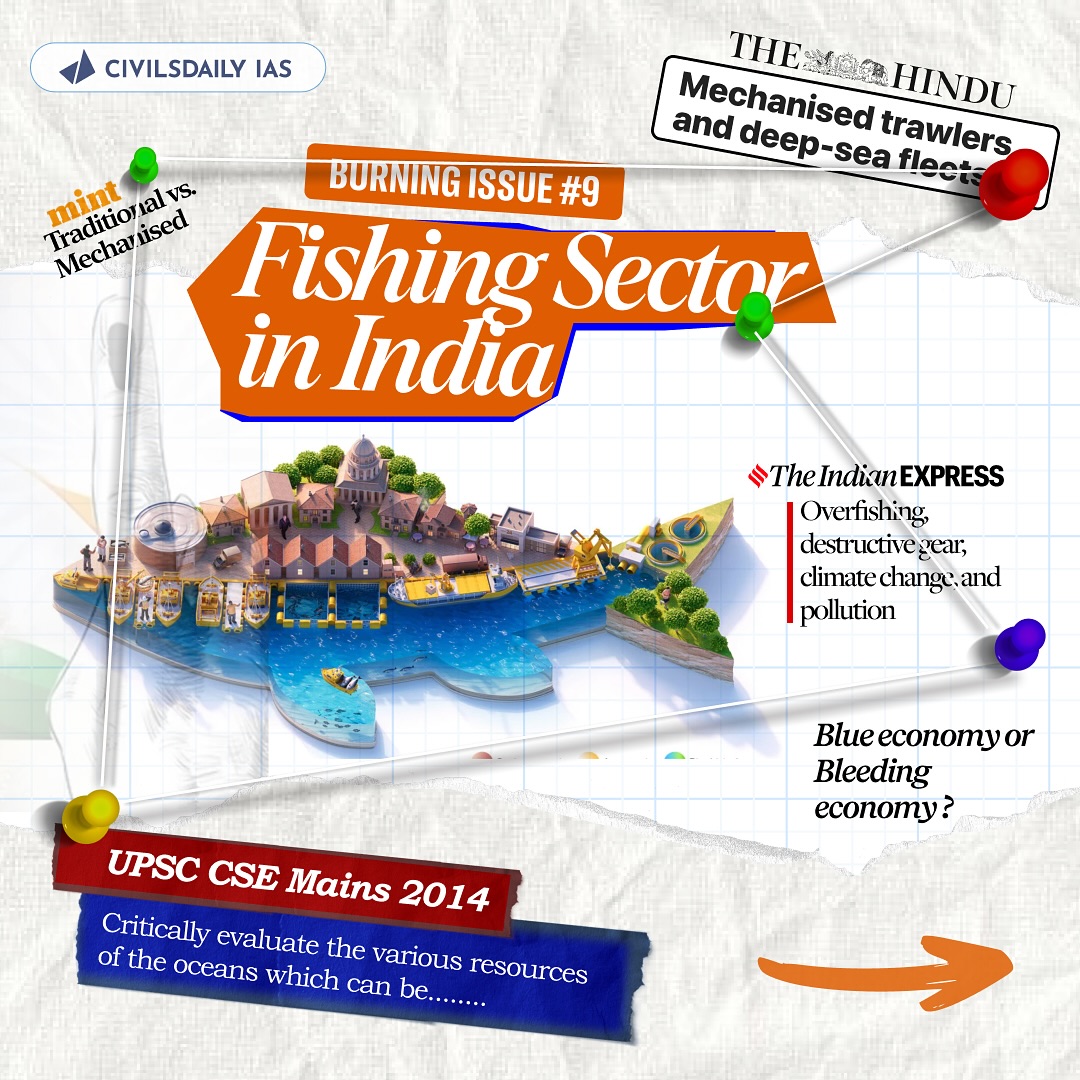
    Fish wealth, fisher woes, and fixing India’s sea crisis in one sweep. UPSC loves to frame such topics as big, open questions that fuse resources with equity, just like the 2014 ocean‑resources essay: expect a prompt asking whether India’s “Blue Economy” can grow without sinking small fishers, pulling material straight from “Traditional vs Mechanised: An Unequal Sea.” Many aspirants stumble because they only count tonnes of catch or exports and forget people and ecology, so answers feel lopsided; they skip numbers like a trawler’s 500 kg haul versus a canoe’s 50 kg (see table in that subhead) or miss the warning on juvenile bycatch under “Ecological Tipping Points.” This article patches those gaps by giving ready links—showing how gear conflict, climate shifts, and subsidy skew fit the bigger GS syllabus. It also slips quick fixes you can quote, like Kerala’s monsoon bans and mangrove planting in Andhra (see “Learning from the Coastline: Local Solutions”). The coolest part is the heads‑up that the Blue Economy can be a “Bleeding Economy” if policy backs only ports and trawlers—an angle that turns a fact‑sheet answer into a sharp critique.

    PYQ ANCHORING

    GS 1:  Critically evaluate the various resources of the oceans which can be harnessed to meet the resource crisis in the world. [2014]

    GS 3:  Livestock rearing has a big potential for providing non-farm employment and income in rural areas. Discuss suggesting suitable measures to promote this sectors in India,[2015]

    MICROTHEMES: Natural resources Potential,  Non-Farm Activities (Live stock)

    From the Matsya Avatar rescuing sages during the great flood to fishermen guiding sages in search of wisdom, India’s epics and Puranas are rich with reverence for the sea and those who live by it. Yet today, the very communities once revered in myth — India’s traditional fisherfolk — are caught in a real-world crisis. While the marine fisheries sector boasts 3–4 million tonnes of annual catch, this apparent success hides a storm: vanishing fish stocks, rising coastal inequality, and ecological collapse.

    Is the ocean still a source of sustenance — or a battleground of exploitation? Can small-scale fishers survive in a market tilted toward industrial trawlers? And will India’s coastal legacy endure — or be lost beneath unsustainable waves?

    Traditional vs. Mechanised: An Unequal Sea

    India’s coastal waters are not just biologically rich — they are socially contested. What was once a largely community-driven livelihood is now increasingly dominated by industrial-scale players. Mechanised trawlers and deep-sea fleets, backed by capital and technology, have begun to outfish, outcompete, and outmuscle traditional fisherfolk. This has created not just ecological stress but a stark divide in access, income, and dignity. The table below captures how this unequal sea is shaping India’s coastal crisis.

    IssueHow It Creates InequalityExamples / Evidence
    Gear and Technology DivideMechanised trawlers use high-powered engines, sonar, and LED lights to fish deeper and faster, while traditional fishers rely on canoes or small boats. This leads to unequal catch volumes.In Tamil Nadu and Gujarat, a mechanised boat may return with 500–1,000 kg of catch per day, compared to 10–50 kg by a traditional canoe.
    Zone ViolationsTrawlers often illegally fish in nearshore waters (within 5–10 km), violating zones reserved for artisanal fishers, depleting their catch and damaging nets.Kerala and Odisha report frequent gear conflict cases, where trawlers trespass into artisanal zones, leading to physical confrontations and net loss worth lakhs.
    Overfishing and BycatchTrawlers sweep large areas indiscriminately, including juvenile and non-target species, reducing long-term availability for small fishers who rely on selective fishing.Studies from Andhra Pradesh show juvenile catch ratio exceeding 30% in mechanised fishing, threatening future stock regeneration.
    Market CaptureMechanised operators dominate cold storage, transport, and auctions, forcing traditional fishers to sell catch at low rates or depend on middlemen.In Visakhapatnam, large traders often fix prices in advance, leaving small fishers without bargaining power despite rising input costs.
    Subsidy SkewGovernment fuel subsidies, loans, and harbour infrastructure disproportionately benefit mechanised operators, while small-scale fishers receive limited gear support.Mechanised boats receive diesel subsidies, while traditional fishers must bear rising fuel and maintenance costs without commensurate support.

    Ecological Tipping Points


    India’s coastal waters are nearing an ecological breaking point. Overfishing, destructive gear, climate change, and pollution are not just reducing fish stocks — they’re unraveling marine ecosystems. From shrinking fish sizes to coral bleaching and habitat collapse, the signals are unmistakable. These tipping points threaten not just biodiversity, but the food security and livelihoods of millions who depend on the sea.


    Ecological PressureImpact on Marine EcosystemsExamples / Evidence
    OverfishingReduces fish populations below recovery levels, disrupts food chains, and affects breeding cycles.In the Bay of Bengal, species like hilsa and mackerel show signs of collapse due to overharvesting, especially during spawning seasons.
    Bottom TrawlingDestroys seabed habitats, including corals and benthic organisms; causes long-term loss of biodiversity.In Tamil Nadu and Andhra Pradesh, trawl nets drag across 70%+ of shallow seafloor, wiping out breeding habitats of shrimp and demersal fish.
    Bycatch and Juvenile FishingNon-target species — including endangered turtles and juveniles — are caught and discarded, undermining ecological balance.Studies show up to 30–40% of marine catch in Indian trawlers is bycatch, including threatened species like olive ridley turtles (Orissa coast).
    Climate ChangeRising ocean temperatures, acidification, and sea-level rise alter fish migration, breeding, and survival.On the west coast, Indian oil sardines are migrating northward due to warming seas; coral bleaching reported in Lakshadweep and Gulf of Mannar.
    Pollution and Dead ZonesNutrient runoff and plastic waste degrade water quality and create hypoxic zones, reducing marine life density.The Chilika Lake outlet and Gujarat coast show early signs of oxygen-depleted dead zones due to industrial and agricultural discharge.

    Blue Economy or Bleeding Economy? //MAINS


    India’s ambitious push for a Blue Economy — harnessing ocean resources for economic growth — promises jobs, sustainability, and prosperity. But on the ground, a key question emerges: is this vision inclusive and ecological, or is it extractive and elite-driven, widening inequalities and degrading fragile marine systems? The answer lies in how policies are designed, and who they really serve.


    Government Strategy / SchemeIntended GoalsCritical Assessment
    Blue Economy Policy Framework (Draft, 2021)Promote sustainable use of marine resources across sectors like fisheries, energy, tourism, and shipping.While it promises community participation and sustainability, it lacks binding safeguards for small fishers. No legal guarantees to protect artisanal access to fishing zones.
    Pradhan Mantri Matsya Sampada Yojana (PMMSY)Double fisheries exports, enhance infrastructure, and boost incomes of fishers through ₹20,000+ crore investment.Benefits skewed toward export-focused aquaculture, mechanised fleets, and cold-chain players. Traditional fishers often struggle to access subsidies or loans.
    Sagarmala ProjectExpand port-led development and create coastal economic zones (CEZs).Critics warn of large-scale displacement of coastal communities and habitat destruction. Many CEZs lack proper environmental and social impact assessments.
    Deep Ocean Mission (2021)Invest ₹4,000 crore over 5 years in seabed mining, marine biodiversity, and climate studies.Focus on deep-sea mining raises alarm over ecological risks. Indigenous fishing communities fear exclusion from decision-making on ocean governance.
    Fisheries and Aquaculture Infrastructure Development Fund (FIDF)Finance infrastructure (harbours, cold storage, processing units) to modernise fisheries.Infrastructure often benefits exporters and large players. Traditional fisherfolk still lack access to cold storage or modern boats.
    Coastal Regulation Zone (CRZ) NotificationsProtect ecologically sensitive zones while allowing livelihood activities.Successive amendments (e.g., CRZ 2019) have diluted protections, allowing real estate, tourism, and port projects near coastlines, undermining sustainability.

    Learning from the Coastline: Local Solutions

    Initiative / ModelWhat It DoesWhere / Impact
    Kerala’s Fisheries Co-operativesDemocratically managed fisher co-ops ensure fair pricing, gear access, and representation in policy. They also promote savings and insurance for fishers.Kerala has over 600 active marine co-operatives, supporting 90,000+ members. Helps small fishers counter market capture by exporters and middlemen.
    Seasonal Fishing BansGovernment-imposed monsoon bans allow fish stocks to regenerate. Widely respected by traditional fishers.Tamil Nadu, Karnataka, and West Bengal implement 45–61 day bans annually. Studies show improved catch volumes post-ban seasons.
    Community Quotas & LicensingLocal bodies issue limited fishing rights to prevent overfishing and resolve gear conflicts. Supports equity and sustainability.Maharashtra piloted village-level licence caps in Ratnagiri; helped reduce inter-gear tension and over-extraction in nearshore waters.
    Co-management CommitteesFishers, scientists, and officials jointly manage resources, enforce seasonal rules, and monitor stocks.Odisha’s Chilika Lake Fisheries Federation blends local knowledge with scientific input. Reduced illegal fishing, improved prawn and fish yields.
    Mangrove & Habitat RestorationFishers and women’s collectives lead mangrove planting, reef protection, and turtle conservation to revive breeding grounds.In Andhra Pradesh’s Krishna delta, women’s SHGs replanted over 50,000 mangroves, helping reduce cyclone impacts and boost fish catch.

    State of India’s Fishing

    In India, marine fish production has stabilized at around 3.7 million tons per annum, as per the Ministry of Fisheries, Animal Husbandry and Dairying (2023). Despite this, widespread poverty, ecological degradation, and regulatory fragmentation persist. Urban biodiversity is equally imperiled: the Forest Survey of India (2023) pegs average green cover in major Indian cities at just 10.26%, with Chennai and Hyderabad losing over 4 square kilometers of forest cover in just two years.

    India’s fisheries sector is a vital economic and nutritional pillar:

    1. Contribution to Economy: It contributes 1.1% to national GDP and over 7% to agricultural GDP (MoF, 2024–25).
    2. Production: India is the second-largest fish producer globally and the fourth-largest exporter (FAO 2022), producing ~14.1 million tons annually (marine and inland combined). Marine fisheries, contribute approximately 4.12 million metric tons (MMT) to the total fish production. Inland fisheries and aquaculture, account for about 12.12 MMT, making up over 75% of the total fish production.
    3. Employment: Provides livelihoods to over 28 million people, directly and indirectly, of which ~16 million are in the marine sector (NITI Aayog, 2023).
    4. Coastline: India’s coastline stretches 11,098 km, housing 3,688 marine fishing villages and 1,914 landing centres.
    5. Exports: Marine product exports were worth ₹63,969 crore in 2023–24, with frozen shrimp alone contributing 40% (MPEDA data). The sector has witnessed significant growth, with seafood exports valued at ₹60,000 crore in 2023–24. Schemes like PM Matsya Sampada Yojana (PMMSY) (budget ₹20,050 crore) aim to double exports, enhance fish production to 22 million tonnes by 2024–25, and create 55 lakh jobs.

    Issue of Overfishing

    Overfishing poses a significant threat to India’s marine ecosystems and the livelihoods dependent on them. The Central Marine Fisheries Research Institute (CMFRI) reported in 2022 that over 4% of India’s fish stocks are currently facing overfishing, while 8.2% have already been overfished.

    1. Overcapitalization: Mechanized vessels dominate the catch—90% of fishers are small-scale, but they capture just 10% of the harvest.
    2. Juvenile Fishing: Widespread use of small mesh (<25mm) nets results in juvenile fish mortality; e.g., over 10 kg of bycatch for every 1 kg of shrimp in trawlers (Arabian Sea study, 2024).
    3. Biodiversity Loss: Multi-species bycatch harms reef systems and trophic balance, making recovery from stock collapses difficult or irreversible.
    4. Historical Collapses: Canada’s cod fishery crash (1992) and the Pacific sardine collapse (1967–86) show how mismanagement can destroy entire economies.
    5. Fishmeal Industry Distortion: The FMFO sector, feeding on juvenile bycatch, converts edible protein into export-based aquafeed, creating perverse market incentives. Fragmented regulation further exacerbates the crisis. Each coastal state has its own Marine Fisheries Regulation Act (MFRA), leading to inconsistent enforcement and fish laundering across borders.

    Significance of the Fishing Sector for India

    1. Livelihood Security: The fisheries sector provides direct employment to over 4 million marine fishers, primarily from marginalized coastal communities. Overall, it supports 28 million livelihoods across fishing, processing, and marketing (NITI Aayog, PMF IAS).
      Example: In Odisha, the Chilika Lake fishing community depends almost entirely on estuarine fisheries for daily income.
    2. Food and Nutritional Security: Fish is a key source of affordable protein and omega-3 fatty acids, vital for states with low animal protein intake. It is often referred to as “Rich Food for Poor People” for its accessibility and nutrition (PMF IAS). Example: In West Bengal, fish forms a dietary staple, especially among rural populations with limited protein options.
    3. Export Revenue and Foreign Exchange: Seafood exports were valued at ₹60,000 crore (~$8 billion) in 2023–24, making fisheries a crucial contributor to India’s foreign exchange reserves (MPEDA, PIB).
      Example: India is the world’s largest exporter of frozen shrimp, with the USA and China being top importers.
    4. Regional Development: Coastal states like Kerala, Andhra Pradesh, and Gujarat rely heavily on fisheries-based microeconomies that sustain local employment and trade. Fisheries infrastructure boosts regional GDP and livelihoods. Example: The port city of Veraval in Gujarat thrives as a hub for marine exports and fish processing units.
    5. Gender Role: Women constitute around 56% of the post-harvest fisheries workforce, playing key roles in drying, processing, and marketing of fish (PMF IAS). Empowering them boosts family incomes and local entrepreneurship. Example: In Tamil Nadu, women-run self-help groups manage fish drying yards and retail networks in coastal villages.
    6. Climate Mitigation: Sustainable marine ecosystems like mangroves and seagrasses act as major carbon sinks, capable of sequestering 10 times more carbon than terrestrial forests (ResearchGate).
      Example: The Sundarbans mangroves not only support biodiversity but also offset significant carbon emissions.
    7. Blue Economy Potential: According to NITI Aayog and the Ministry of Earth Sciences, India’s Blue Economy could contribute $1 trillion to GDP by 2030, with fisheries being a core pillar.
      Example: The Sagarmala project integrates fisheries into port-led development for coastal economic upliftment.
    8. Cultural and Indigenous Identity: Fishing sustains traditional knowledge systems, indigenous livelihoods, and community-based conservation practices that preserve biodiversity.
      Example: The ‘Sasi’ fishing method in Kerala, passed down generations, emphasizes harmony with nature and selective harvesting.

    Challenges to Sustainable Fishing

    1. Overfishing and Stock Depletion: Around 30% of India’s marine fish stocks are overexploited (CMFRI, 2022), driven by indiscriminate trawling, juvenile fishing, and weak monitoring. This threatens long-term sustainability and biodiversity.
      Example: Sardine and mackerel stocks along the southwest coast have shown sharp declines due to excessive harvest pressure.
    2. Climate Change Impacts: Rising sea surface temperatures, ocean acidification, and changing currents are disrupting fish breeding patterns, altering migratory routes, and intensifying cyclonic events (IPCC AR6, WMO).
      Example: Cyclone Amphan in 2020 displaced thousands of fishers in West Bengal and Odisha, impacting fishing seasons.
    3. Pollution and Habitat Destruction: Marine plastic, oil spills, untreated sewage, and coastal construction degrade coral reefs, mangroves, and estuaries—critical breeding grounds for fish.
      Example: The Ennore Creek in Chennai has suffered massive ecological damage due to industrial effluents and fly ash dumping.
    4. Socio-economic Disparities: Though 90% of the fishing population comprises small-scale fishers, they land less than 10% of the total catch and suffer from market exclusion, debt, and poverty.
      Example: In Maharashtra’s Raigad district, mechanised boats dominate markets, leaving artisanal fishers with minimal income.
    5. Illegal, Unreported, and Unregulated (IUU) Fishing: IUU fishing causes massive ecological and economic loss, estimated to reduce global catches by 11–26 million tonnes annually (FAO, 2022), and undermines regulatory efforts.
      Example: In India’s east coast, foreign vessels are often found trawling in Indian waters without permits, flouting marine laws.
    6. Inadequate Infrastructure: Deficits in cold storage, processing units, landing centres, and transport networks result in post-harvest losses of up to 20-25% in marine fish (MoFPI, 2023).
      Example: In Kerala, small harbours without ice plants force fishers to sell fresh catch at reduced rates to middlemen.
    7. Policy and Regulatory Gaps: The Marine Fishing Regulation Acts (MFRAs) differ across coastal states, enabling regulatory evasion; fish banned in one state can be legally landed in another.
      Example: Juvenile threadfin bream protected in Kerala is frequently sold legally in Tamil Nadu, undermining conservation gains.
    8. Data Deficiencies and Scientific Gaps: Decisions on catch limits and fishing licenses are often based on historical rights or vessel size, not robust stock assessments, leading to unsustainable practices.
      Example: India lacks a nationwide real-time fishery database, unlike New Zealand’s QMS-based management system.

    Way Forward

    1. Enact a National Fisheries Law
      Unify fragmented state Marine Fishing Regulation Acts (MFRAs) into a central framework with standard rules on Minimum Legal Size (MLS), gear restrictions, and closed seasons.
      Example: Resolve enforcement gaps in overlapping waters like Kerala–Tamil Nadu.
    2. Introduce Quota-Based Fisheries Management
      Pilot science-driven catch quotas and tradable fishing rights for key species, inspired by global models.
      Example: New Zealand’s hoki QMS curbed overfishing while preserving livelihoods.
    3. Ban Destructive Fishing Gear
      Mandate use of Turtle Excluder Devices (TEDs), LED lights, and selective nets to reduce bycatch and protect endangered species.
      Example: Odisha’s TED adoption lowered turtle deaths significantly.
    4. Regulate FMFO (Fishmeal & Fish Oil) Industry
      Cap bycatch diverted to FMFO, promote nutrition-first use, and incentivize plant-based aquafeeds.
      Example: Kerala’s pilot linked low-value catch to local school meal programs.
    5. Scale Up Community Co-Management
      Empower fisher cooperatives and panchayats to co-govern Marine Protected Areas (MPAs) with real authority and funding.
      Example: Chilika Lake model improved yields and curbed illegal fishing.
    6. Invest in Ecological Restoration
      Fund coastal wetland and estuary regeneration to boost biodiversity and climate resilience.
      Example: Chennai’s Pallikaranai marshland revival restored bird habitats and flood control.

    #BACK2BASICS: The State of India’s Fishing Sector: Promise, Pressure, and Paradox //PRELIMS

    A Sector on the Brink

    India’s marine fish production has stabilized at around 3.7 million tonnes annually (MoFAHD, 2023). Yet, beneath this apparent success lies an ecological and social crisis: overfishing, habitat loss, poverty, and regulatory fragmentation persist. Urban ecology fares no better — the Forest Survey of India (2023) reports average green cover in major cities at just 10.26%, with Chennai and Hyderabad losing over 4 sq. km of forest in just two years.


    Why Fisheries Matter

    DimensionKey Contributions & Examples
    Economic EngineContributes 1.1% to GDP and over 7% to agricultural GDP (MoF, 2024–25). India ranks 2nd in global fish production (~14.1 million tonnes total; marine: 4.12 MMT, inland: 12.12 MMT).
    Livelihood ProviderSupports 28 million livelihoods, with 16 million in marine fisheries (NITI Aayog). In Odisha, Chilika Lake fishers rely entirely on estuarine fishing.
    Export PowerhouseExports valued at ₹63,969 crore (2023–24). Frozen shrimp alone forms 40%, making India the top global exporter.
    Regional Growth DriverCoastal states like Kerala, AP, Gujarat benefit from port-led fisheries infrastructure. Example: Veraval thrives on marine exports and fish processing.
    Nutrition and Food SecurityFish is affordable protein — “rich food for poor people.” In West Bengal, fish is a daily staple for low-income rural families.
    Women’s Workforce RoleWomen form 56% of post-harvest workers, managing drying, processing, marketing. Example: Tamil Nadu’s women-run SHGs operate retail networks.
    Climate MitigationCoastal ecosystems like mangroves and seagrasses sequester up to 10x more carbon than forests. Example: Sundarbans play a dual role in biodiversity and carbon offsetting.
    Cultural IdentityFishing sustains indigenous practices and community conservation. Example: Kerala’s ‘Sasi’ method promotes selective, sustainable harvesting.
    Blue Economy PotentialProjected to contribute $1 trillion to GDP by 2030 (MoES). Schemes like Sagarmala integrate fisheries into port-based economic growth.

    Overfishing: The Silent Crisis

    According to CMFRI (2022):

    • 4% of India’s fish stocks are actively overfished
    • 8.2% are already overexploited
    DriverImpactExample
    Overcapitalisation90% of fishers are small-scale but catch <10% of total harvest.Mechanised vessels dominate markets across the western coast.
    Juvenile FishingSub-25mm nets cause early stock depletion.Trawlers in Arabian Sea: 10 kg bycatch per 1 kg shrimp (2024).
    Biodiversity CollapseMulti-species bycatch disrupts reef systems and food chains.Reef degradation in Gulf of Mannar linked to trawl fishing.
    Global Warning SignsCollapses like Canada’s cod (1992) show irreversible ecosystem loss.Historical evidence warns of repeatable patterns.
    FMFO DistortionFishmeal and fish oil (FMFO) industry creates perverse incentives — turning edible fish into aquafeed.Kerala’s bycatch is diverted to FMFO instead of food markets.

    Challenges to Sustainable Fishing

    ChallengeImpactExample
    Stock Depletion~30% of marine stocks are overfished (CMFRI).Sardine/mackerel decline along southwest coast.
    Climate ChangeWarmer waters, ocean acidification, erratic migration.Cyclone Amphan (2020) displaced fishers and disrupted breeding cycles.
    PollutionPlastics, oil spills, sewage damage breeding grounds.Ennore Creek, Chennai: severe degradation from fly ash.
    Socio-economic Inequality90% of fishers are small-scale but lack market power.Raigad, Maharashtra: mechanised boats monopolise landings.
    IUU FishingReduces global catch by 11–26 million tonnes (FAO, 2022).Foreign vessels trawling illegally off India’s east coast.
    Poor InfrastructureUp to 25% post-harvest loss due to weak cold chains.Kerala harbours lack ice plants and processing centres.
    Policy FragmentationEach state has a different MFRA, leading to fish laundering.Juvenile threadfin bream banned in Kerala, sold in TN.
    Data GapsCatch limits based on boat size, not science.India lacks real-time national fishery database, unlike NZ’s QMS.

    Conclusion

    India’s fishing sector sits at the intersection of livelihood, nutrition, biodiversity, and climate resilience — yet faces existential risks. It is time to pivot from volume-focused extraction to science-led, community-driven, and sustainability-based management. The ocean is not just an economic frontier; it is a public trust that must be governed with equity, wisdom, and urgency.

    SMASH MAINS MOCK DROP

    Examine the role of political and bureaucratic leadership in public policy formulation in India. How can greater citizen participation improve the effectiveness of policy outcomes?

  • Environmental Governance in India: Has the EIA Framework Delivered?

    N4S

    Court verdict ends post‑facto clearances, pushing India toward greener growth. UPSC likes to wrap this theme inside a rights question, much like 2015’s Diwali‑crackers case on Article 21; it will ask how judgments such as “Why the Supreme Court Struck Down Post‑Facto Environmental Clearances” reshape governance and balance growth with the right to life. Students often list data on bad air but forget to link it to constitutional hooks or to the broken approval chain flagged under “Institutional and Systemic Challenges,” so answers feel like fact dumps. This article fixes those gaps by walking you through each link in the chain: it shows the EIA gap (“EIA process was undermined”), the legal anchor (“Alembic Pharma 2020”), and the economic cost of inaction (pollution drains 1.3 % of GDP). The result is ready material to weave law, economics, and policy into one clear argument. The standout feature? The table in “Significance of the Verdict” turns big legal ideas into everyday stakes—health, jobs, global image—so readers can lift exact impacts (over 100 mining projects lose their shield) straight into a mains answer without sounding abstract.

    PYQ ANCHORING

    GS2:  Does the right to clean environment entail legal regulations on burning crackers during Diwali? Discuss in the light of Article 21 of the Indian Constitution and Judgement(s) of the Apex Court in this regard.[2015]

    MICROTHEMES:  Fundamental Rights

    India may be the world’s fifth-largest economy, but it’s choking on its own growth. Fourteen of the 20 most polluted cities are in India (IQAir, 2023), with Delhi’s AQI regularly shooting past 400 in winter — turning the air into poison. Pollution isn’t just a health disaster; it’s an economic one too. The Economic Survey (2022–23) says pollution-linked diseases drain 1.3% of India’s GDP every year. The World Bank pegs the broader cost of environmental damage at a staggering $80 billion annually.

    Against this grim backdrop, the Supreme Court’s May 16, 2025 verdict struck down the Centre’s move to allow post-facto environmental clearances — calling them “illegal.” It’s a strong reminder that you can’t legalise damage and then pretend it’s green growth.

    But the real questions include: Is judicial action enough to plug the holes in environmental governance? And most importantly — who should be held accountable when pollution becomes policy?

    Why the Supreme Court Struck Down Post-Facto Environmental Clearances

    India’s top court has drawn a clear line: you can’t break environmental laws first and ask for permission later. In a major ruling on May 16, 2025, the Supreme Court junked the Centre’s 2017 notification and 2021 Office Memorandum that allowed retrospective environmental clearances — essentially giving legal cover to projects that had already violated the law.

    The Legal Logic Behind the Verdict

    1. EIA Process Was Undermined: The 2006 Environmental Impact Assessment (EIA) rules demand clearance before a project begins. Granting it after the fact guts the whole point — public consultation, screening, and review are meaningless if damage is already done.
    2. Past Judgments Already Said No: In Alembic Pharma (2020) and Common Cause (2017), the Court made it clear — post-facto clearances go against environmental law and the precautionary principle.
    3. Violation of Article 21: The right to a clean and healthy environment is part of your right to life. The Court said that letting polluters off the hook like this tramples that right.
    4. Centre’s U-turns: The government first called the 2017 move a one-time fix — then extended it in 2021 and gave cover to over 100 violators, including big mining firms. The Court called it out for “going out of its way to protect polluters.”

    The Constitutional Backbone of the Judgment

    1. Article 21: The Court slammed the idea that pollution control can be an afterthought. Right to life includes the right to breathe clean air — not beg for it after damage is done.
    2. Articles 48A & 51A(g): Both the State and citizens are constitutionally bound to protect the environment. The Centre’s conduct violated this duty.
    3. Article 14: By giving violators a free pass, the government penalized those who actually followed the law. That’s inequality, plain and simple.
    4. Judicial Pragmatism (Article 142): While the Court struck down future misuse, it allowed already-granted clearances to stand temporarily — showing it wasn’t out to create chaos, but restore balance.
    5. Environmental Law Anchors: From the Polluter Pays Principle to Precautionary Principle, the Court reaffirmed that these aren’t abstract ideals — they’re enforceable tools of justice.

    This judgment wasn’t just a legal cleanup — it was a loud and clear reminder that sustainable development can’t be built on shortcuts, broken laws, or bureaucratic excuses.

    Significance of the Verdict

    Impact AreaWhat ChangedSignificance
    1. Rule of Law RestoredPost-facto approvals declared illegal.The Court revived core environmental principles like precaution, public trust, and inter-generational equity. Think of cases like Sterlite or Goa mining — now back under legal scrutiny.
    2. EIA Process StrengthenedPrior clearance is now non-negotiable.This puts public hearings and local community consent back at the center of project approvals — not just rubber stamps.
    3. Govt Accountability UpheldCentre was called out for shielding violators.Regulatory bodies like the MoEF&CC can’t act like industry lobbyists anymore. Constitutional duties under Articles 48A & 51A(g) must be followed.
    4. Real Impact on Key SectorsMining, cement, steel & real estate lose the post-facto shield.Over 100 shady projects (coal, iron ore etc.) now face real scrutiny. No more amnesties for environmental violations.
    5. Health & Justice SpotlightedRight to clean air & water tied to Article 21.1.6 million pollution-linked deaths (Lancet, 2019) can’t be ignored. This is as much about people’s rights as it is about forests and rivers.
    6. Growth RedefinedVerdict supports green over greedy.With 5.7% of GDP lost to environmental damage (World Bank), this ruling pushes for sustainable economic planning instead of short-term loot.
    7. Boost to Global CredibilityAligns India with SDGs, Rio, and Paris targets.From EPI’s worst rank (180/180) to climate leadership — this ruling helps repair India’s environmental image on global platforms.
    8. People + Judiciary = ChangeCivil society warnings echoed in Court.Groups like CSE and Parliamentary panels had flagged this long ago. The ruling shows what’s possible when watchdogs and the bench work together.

    Institutional and Systemic Challenges in Implementing the Supreme Court Ruling//MAINS

    1. Regulatory Capacity Deficits
      Pollution Control Boards (PCBs) suffer from chronic under-resourcing, limited autonomy, and susceptibility to regulatory capture. The CAG (2022) found that nearly 40% of Environmental Clearance (EC) conditions were inadequately monitored.
    2. Institutional Fragmentation
      Overlapping mandates between the Ministry of Environment, Forest and Climate Change (MoEF&CC), National Green Tribunal (NGT), and State Pollution Control Boards (SPCBs) create operational ambiguities, as illustrated by the response failures in the Vizag LG Polymers gas leak case.
    3. Inadequate Sanctioning Mechanisms
      The Environment Protection Act, 1986 provides weak deterrents—maximum penalties often capped at ₹1 lakh—rendering enforcement ineffective. Between 2017–2021, more than 55 industrial projects were regularized without due environmental diligence.
    4. Erosion of Participatory Governance
      Mechanisms like public consultations—integral to Environmental Impact Assessments (EIAs)—are frequently bypassed or tokenized, particularly in ecologically sensitive and tribal areas. The draft EIA 2020 proposed extensive exemptions, undermining procedural fairness.
    5. Transparency and Data Gaps
      Lack of real-time, publicly accessible environmental monitoring data hinders accountability and weakens both civil society oversight and institutional response systems.
    6. Policy Conflict: Economic Growth vs Environmental Safeguards
      The prioritization of “Ease of Doing Business” has often resulted in the dilution of environmental norms, with the draft EIA 2020 perceived as promoting extractive industrialism at the cost of ecological sustainability.
    7. Federal Asymmetry and Norm Evasion
      State governments, citing developmental prerogatives, have at times circumvented central environmental norms—as seen in infrastructure and mining approvals in Andhra Pradesh and Odisha—posing challenges to regulatory uniformity.
    8. Judicial and Administrative Delay
      Environmental litigation is characterized by procedural lags, reducing the efficacy of redress mechanisms. NGT rulings, such as in the Bellandur Lake pollution case, face prolonged enforcement timelines, undermining legal deterrence.

    Role of Judiciary in Shaping India’s Environmental Jurisprudence

    In India, the judiciary has emerged as a vital guardian of the environment, often stepping in where executive agencies falter. Through its interpretations of the Constitution, especially Article 21 (Right to Life), the Supreme Court and High Courts have expanded the scope of environmental protection, introducing doctrines like the “Polluter Pays Principle,” the “Precautionary Principle,” and “Public Trust Doctrine.” These interventions have helped create a robust framework of environmental jurisprudence, even in the absence of stringent legislative mechanisms. Here’s how the judiciary has played a transformative role:


    Judicial RoleExplanationLandmark Examples
    Expanding Right to Life (Article 21)Interpreted ‘life’ to include clean air, safe water, and ecological balance.Subhash Kumar v. State of Bihar (1991); M.C. Mehta v. Union of India (1987)
    Polluter Pays PrincipleMakes polluters financially liable for the damage they cause to the environment.Indian Council for Enviro-Legal Action v. Union of India (1996)
    Precautionary PrinciplePrevents irreversible environmental harm even in cases of scientific uncertainty.Vellore Citizens Welfare Forum v. Union of India (1996)
    Public Trust DoctrineTreats natural resources as collective property under state stewardship.M.C. Mehta v. Kamal Nath (1997)
    Enforcement through PILsCitizens and NGOs can approach courts directly for environmental justice.Rural Litigation and Entitlement Kendra v. State of UP (1985)
    Institutional/Policy ImpactJudicial orders led to new institutions like the National Green Tribunal (NGT) and schemes like Ganga Action Plan revamp.Constitution of NGT (2010) post M.C. Mehta cases; SC push for Namami Gange
    Striking Down Executive OverreachReined in arbitrary government orders that diluted environmental norms.SC Verdict on Post-Facto Clearances (2025); T.N. Godavarman case (Forest Bench)


    The Indian judiciary has not only upheld but enriched environmental governance by interpreting constitutional rights dynamically and stepping in as an institutional watchdog. From cleaning rivers to regulating polluting industries, courts have played an indispensable role. Yet, as judicial activism fills governance gaps, it also raises questions about institutional overreach and the need for stronger executive enforcement mechanisms.

    Environmental Clearances in India: A Mixed Report Card

    Environmental Clearance (EC) was institutionalized through the EIA Notification, 1994, and later strengthened in 2006. While the system was created to ensure that development does not come at the cost of ecology, its implementation in India reveals a complex picture—marked by achievements, serious shortcomings, and institutional contradictions.


    Achievements

    1. Legal Framework and Institutional Structure in Place
      India has a codified, layered EC process: Screening → Scoping → Public Consultation → Appraisal.
      Example: The Coastal Road Project in Mumbai was stopped mid-way until CRZ (Coastal Regulation Zone) clearance was obtained, showing procedural enforcement.
    2. Empowerment of Civil Society
      The mandatory public consultation stage allows civil society and local communities to register their objections.
      Example: In Vedanta’s Niyamgiri Bauxite mining case, the tribal community’s opposition led to the cancellation of EC—one of the strongest examples of public participation shaping outcomes.
    3. Digital Initiatives like PARIVESH Portal
      Launched by MoEF&CC, it enables online submission, monitoring, and clearance tracking, improving transparency.
      Example: Real-time status updates for developers and public under the Single Window System.
    4. Judicial Oversight
      Courts have intervened to check misuse of EC.
      Example: In Alembic Pharmaceuticals (2020) and Common Cause (2017), the Supreme Court ruled that post-facto clearances are illegal.

    Shortcomings

    1. Rampant Use of Post-Facto Clearances
      Projects started illegally and were later regularized, violating the very essence of EC.
      Example: Over 100 mining and industrial projects were retrospectively approved between 2017 and 2021, including polluting mines in Jharkhand and Odisha.
    2. Weak Enforcement and Monitoring
      Even when ECs are granted, compliance with conditions is poorly tracked.
      Example: CAG Report (2022) found that 40% of projects were not monitored post-clearance.
    3. Erosion of Public Consultation
      Public hearings are often rushed, poorly advertised, or bypassed in “strategic” projects.
      Example: The EIA 2020 Draft attempted to dilute public hearings for many categories, leading to massive protests and expert criticism.
    4. Conflict Between Growth and Ecology
      The EC process is often subordinated to “ease of doing business” goals.
      Example: The Char Dham Highway project in Uttarakhand bypassed several environmental concerns in the name of national security, despite clear evidence of ecological fragility.
    5. Institutional Capture and Conflict of Interest
      Expert Appraisal Committees (EACs) are often accused of being too lenient or industry-friendly.
      Example: A study by CPR (Centre for Policy Research) showed that 90% of all projects seeking clearance between 2014–2019 were approved.

     Mixed/Contextual Realities

    1. State-Centre Friction
      Environmental norms are often diluted at the state level for political or economic reasons.
      Example: Several states bypass central regulations using state-level environment impact authorities, especially for small-scale mining.
    2. Ecological vs. Livelihood Dilemmas
      In ecologically sensitive zones, people’s immediate economic needs sometimes conflict with long-term sustainability.
      Example: Brick kilns in Bihar and stone crushers in Himachal Pradesh provide local employment but worsen air quality.

    Way Forward

    1. Codify a Strong EIA Law
      Finalize a clear, participatory EIA law that mandates early community input and bans post-facto clearances. Learn from Canada’s Impact Assessment Act, where public voice is part of project design.
    2. Fix Pollution Control Boards
      Grant independence, hire real experts (ecologists, health economists), and boost funding. ₹900 crore isn’t enough for enforcement in a country this size.
    3. Track in Real Time
      Make CEMS and satellite tools mandatory to monitor emissions and land use. Use platforms like PARIVESH and upcoming tools like NASA-ISRO’s NISAR to catch violations early.
    4. Put People First
      Make public hearings legally binding, held in local languages, and allow mobile-based complaints. This follows the spirit of the Aarhus Convention on public access and rights.
    5. Make Polluters Pay
      Amend the Environment Act to impose high fines and jail time for repeat offenders. UK-style liability laws force polluters to restore what they damage.
    6. Green the Judiciary
      Create fast-track environmental courts and train judges in ecological law. This will speed up stalled cases like the Bellandur Lake pollution mess.
    7. Link Budget to Green Action
      Tie budget allocations to environmental performance. Encourage green investments using bonds and tax breaks like the EU’s Green Deal playbook.
    8. Follow Global Best Practices
      Align with UNEP’s Rule of Law framework and draw lessons from US EPA and NEPA for stricter checks and rapid clean-up of damage.

    #BACK2BASICS: Environmental Clearance (EC)//PRELIMS

    Environmental Clearance (EC) is the official go-ahead from the Government—specifically the Ministry of Environment, Forest and Climate Change (MoEF&CC)—that a proposed project is environmentally safe to begin. It ensures that industrial, infrastructure, or mining activities do not harm the environment or local communities before they even start.

    In simpler terms, you can’t build a factory, dam, mine, or highway until you’ve proved that the project won’t damage forests, pollute rivers, displace people unfairly, or disturb fragile ecosystems.


    Why is it Needed?

    Projects like thermal power plants, cement factories, mining operations, highways, and airports can have massive environmental and social impacts. EC acts like a green gatekeeper, ensuring:

    • Sustainability in development
    • Legal compliance with India’s environmental laws
    • Protection of local communities, especially tribal, rural, and ecologically vulnerable groups

    Legal Backbone: EIA Notification, 2006

    The Environmental Impact Assessment (EIA) Notification of 2006 (under the Environment Protection Act, 1986) governs the entire EC process. It breaks down the clearance into a structured four-stage process, making it scientific, participatory, and rule-based.


    The 4-Stage EC Process:

    StageWhat HappensWhy It Matters
    1. ScreeningDetermines if the project needs detailed environmental scrutiny (based on size, type, and location).Filters out minor/harmless projects from full EIA.
    2. ScopingExpert Appraisal Committee (EAC) sets the terms of reference for environmental studies.Ensures the EIA study focuses on real, project-specific risks (e.g., groundwater, deforestation).
    3. Public ConsultationLocal people and civil society groups give feedback, concerns, or objections in public hearings.Builds trust, improves transparency, and empowers communities.
    4. AppraisalBased on the EIA report and public feedback, the EAC makes a recommendation to grant or reject clearance.Final gatekeeping: ensures all voices and data are considered.
  • India–Bangladesh Trade and the China Factor: Is There Room for Strategic Balance ?

    India–Bangladesh Trade and the China Factor: Is There Room for Strategic Balance ?

    N4S

    India‑Bangladesh ties shift from warmth to worry, trade to tension, diplomacy to dilemmas. UPSC usually throws a big‑picture question that links neighbourhood politics with wider security, just as it asked in 2017 about China’s trade surplus turning into military clout; a similar mains prompt could use “The 2025 Flashpoint: From Cooperation to Confrontation” to test how you weigh trade bans against strategic fallout. Many aspirants stumble because they list facts but miss the chain of cause‑and‑effect across subheads like “Key Aspects of India‑Bangladesh Trade Relations” and “Impact of Geopolitical Issues on India’s Trade with Neighbours,” leaving answers scattered and shallow. This article fixes that by walking you through the logic—first it shows why Dhaka’s China tilt alarms Delhi (see “Geopolitical Realignment Toward China and Pakistan”), then it maps the spill‑over into anti‑India sentiment and Northeast security worries (under “Implications for India”). The most special part is its blueprint for solutions in “Using Multi‑Vector Diplomacy to Reset India‑Bangladesh Ties,” which turns theory into ready‑to‑use policy ideas—like pairing UPI payments with border haats or talking to both BNP and grass‑roots groups—so you can plug gaps that UPSC loves to probe.

    PYQ ANCHORING

    GS 2:  ‘China is using its economic relations and positive trade surplus as tools to develop potential military power status in Asia’, In the light of this statement, discuss its impact on India as her neighbor.[2017]

    MICROTHEMES: Groupings involving Immediate and Extended neighbours

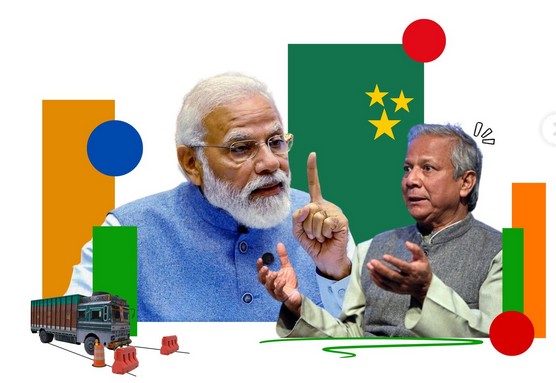
    India and Bangladesh have historically shared a strong and multifaceted relationship, particularly flourishing since the Awami League came to power under Sheikh Hasina in 2009. This partnership has brought political goodwill, strategic cooperation, and deep economic ties. India became Bangladesh’s second-largest trading partner, exporting machinery, vehicles, and raw materials, while importing garments, fish, and jute products from its neighbour.

    Beyond trade, the two countries collaborated on key infrastructure and connectivity projects such as the Akhaura–Agartala rail link, the India-Bangladesh power grid, the Maitree Setu bridge, and cross-border energy pipelines. These projects not only enhanced economic integration but also helped stabilise India’s Northeast by improving connectivity and fostering people-to-people ties.

    The 2025 Flashpoint: From Cooperation to Confrontation

    In 2025, the bilateral relationship took a sharp turn when India imposed trade restrictions on Bangladeshi goods, notably readymade garments. This marked a clear shift from cooperation to confrontation, triggered by growing unease over Bangladesh’s internal political developments and its external alignments.

    Three key developments prompted India’s reaction:

    1. Geopolitical Realignment Toward China and Pakistan:
    The interim Bangladeshi government, led by Mohammed Yunus, has been perceived by India as pivoting towards China and Pakistan. A notable flashpoint was Yunus’s invitation to China to access India’s Northeast through Bangladesh—a move seen in Delhi as a direct challenge to India’s strategic interests.

    2. Provocative Comments About Northeast India:
    Yunus described India’s Northeast as “landlocked” and implied that Bangladesh served as its essential gateway. This narrative was interpreted as undermining Indian sovereignty and portraying Bangladesh as a leverage-holding power over a geopolitically sensitive region.

    3. Democratic Backsliding in Dhaka:
    India was also alarmed by domestic political developments. The interim regime banned the Awami League and indefinitely postponed elections—moves that India saw as undemocratic. The trade restrictions were also intended as a signal of disapproval and an assertion of normative pressure.

    Implications for India: More Than Just Trade

    The diplomatic rupture has wider ramifications for India:

    1. Rising Anti-India Sentiment in Bangladesh:
    Trade restrictions may be perceived within Bangladesh as punitive and politically motivated, potentially fuelling anti-India rhetoric, particularly among nationalist and radical segments.

    2. Security Instability in the Northeast:
    Any political or economic instability in Bangladesh could spill over into Indian territory in the form of refugee influx, cross-border tension, or even radicalisation in sensitive areas like Assam and Tripura.

    3. Loss of Diplomatic Influence:
    By limiting economic engagement, India also risks reducing its soft power and losing valuable diplomatic space. In a region where influence often rides on connectivity and aid, such restrictions can narrow India’s options for dialogue.

    Key Aspects of India-Bangladesh Trade Relations// PRELIMS

    1. Trade & Economic Exchange

    • In 2023–24, bilateral trade stood at $14.01 billion.
    • India’s main exports: electricity, cotton yarn, refined petroleum.
    • Bangladesh’s top exports: garments (e.g., men’s suits), textile scraps, and even some aircraft components.
    • Both countries view each other as critical trade partners.

    2. Investment & Infrastructure

    • Indian investments in Bangladesh are steadily growing, especially in energy and infrastructure.
    • Initiatives like the Protocol on Inland Waterways Trade and Transit (PIWTT) and access to Chittagong and Mongla Ports are enhancing regional connectivity.

    3. Security & Strategic Cooperation

    • Joint efforts include managing borders, tackling cross-border crime, and regular military exercises like SAMPRITI and MILAN.
    • Both nations align on sub-regional maritime goals, including Indo-Pacific cooperation and ocean economy development.

    4. Cultural & People-to-People Ties

    • Institutions like the Indira Gandhi Cultural Centre and Indian Cultural Centre in Dhaka promote cultural and educational exchange.

    5. Emerging Trends

    • Trade and investment are on a steady rise, deepening economic interdependence.
    • This growing interlinkage contributes to shared prosperity and regional stability.

    Impact of Geopolitical Issues on India’s Trade with Neighbours

    India’s trade with its neighbours is deeply intertwined with regional geopolitics. While geography offers natural trade advantages, political tensions often override economic logic. Border disputes, shifting alliances, and domestic instability in neighbouring countries routinely disrupt trade flows, stall infrastructure projects, and limit market access. The following table highlights how geopolitical issues have directly impacted India’s trade with each of its key neighbours.

    NeighbourGeopolitical IssueHow Trade is AffectedExample
    ChinaBorder tensions (e.g. Galwan clash, 2020), trust deficitRise in tariffs, curbs on Chinese investments, non-tariff barriersPost-Galwan, India banned 200+ Chinese apps, restricted Chinese firms in infrastructure and telecom sectors. Imports slowed, especially in electronics and machinery.
    PakistanCross-border terrorism, Pulwama attack, no MFN statusComplete trade suspension; loss of cross-border trade routesAfter Pulwama (2019), India withdrew MFN status and imposed 200% duty; Pakistan responded by suspending all trade ties.
    BangladeshShift in foreign policy, tilt towards China, election-related tensionsImposition of trade restrictions, loss of access routesIn 2025, India restricted readymade garment imports over Dhaka’s perceived China tilt and comments on Northeast India.
    NepalMap dispute (Kalapani-Lipulekh), growing Chinese presenceStrain on bilateral infrastructure and logistics cooperation2020 map row led to tensions; projects like India-Nepal railway and hydro deals slowed; pro-China tilt in Kathmandu affected trust.
    Sri LankaChinese debt trap diplomacy, strategic port control (Hambantota)Reduced Indian influence in maritime trade routes, delay in key Indian projectsChinese control of Hambantota port raised Indian security concerns; India lost competitive edge in some logistics and energy projects.
    MyanmarPolitical instability post-coup, Chinese influenceConnectivity projects disrupted; security risks for trade corridorsIndia’s Kaladan Multi-Modal Transit project slowed down; insurgency spillovers affected border trade via Mizoram and Manipur.
    AfghanistanTaliban takeover, lack of direct land access via PakistanIndia lost major export market; stalled infrastructure and trade dealsAfter 2021 Taliban takeover, Indian wheat and pharma exports halted; access blocked as Pakistan denied land route.

    Need Of Multi-Vector Diplomacy For India //MAINS

    Multi-vector diplomacy simply means not putting all your eggs in one basket when dealing with another country. Instead of relying on just one type of connection (like only government-to-government talks or only trade), you build many kinds of relationships at the same time — with:

    • Government (ruling and opposition),
    • Businesses and traders,
    • People and culture,
    • Universities and tech sectors,
    • Media, youth, and civil society.

    So, even if one door closes, you still have other doors open to keep the relationship strong.

    India‘s Experience with Multi Vector diplomacy

    India has repeatedly practised “multi-vector diplomacy,” using several parallel channels (security, economy, technology, people-to-people) and partnering with rival blocs at the same time. Below are headline-worthy examples from the last few years.

    What India DidWhy It Counts as Multi-Vector
    Kept the Russia lifeline open—cheap oil, strategic trade- even while deepening its “Comprehensive Global Strategic Partnership” with the United States (iCET tech pact, critical-minerals supply chains, joint fighter-jet engines).Shows India’s willingness to ring-fence energy & defence ties with Moscow while courting U.S. tech and investment—two opposite “vectors” managed simultaneously.
    Sits in the Quad and hosts the Shanghai Cooperation Organisation (SCO).Quad summits (2021-24) shape Indo-Pacific rules with the U.S., Japan & Australia.India chaired the 2023 SCO summit—an organisation led by China & Russia—and refused to sign the BRI clause while pushing digital payments and counter-terror statements.Demonstrates the “two chairs, one table” tactic—maritime security with the West, continental security with Eurasia—without choosing sides.
    Championed BRICS expansion in 2023 & 2024 and launched the Voice of Global South Summits during its G-20 presidency.Runs with a China- and Russia-heavy club (BRICS) while positioning itself as spokesperson for 100+ developing countries—two very different coalitions, one Indian bridge.
    Middle-East balancing act:Joined the I2U2 mini-lateral (India, Israel, UAE, U.S.) on food & green-energy corridors.Votes variously at the U.N.—backing a Gaza cease-fire in Dec 2023, abstaining on an HRC arms-embargo vote in Apr 2024—while remaining a top defence-tech partner of Israel.Keeps defence tech flowing from Israel, gains Gulf capital for food-energy projects, and preserves goodwill in the Arab street—three vectors in one theatre.
    Crisis-manager in Sri Lanka—co-chaired the Paris creditors’ platform with Japan & France, gave ~$4 billion credit lines, and rolled out UPI digital payments there.Engages finance (debt relief), development (credit & fuel), and fintech (UPI link)—showing how India mixes soft-power tools with hard cash to keep China at bay.
    Signed on to the India–Middle East–Europe Economic Corridor (IMEC) while still pushing the older International North-South Transport Corridor (via Iran-Russia).Bets on both a U.S./Saudi-led supply route and an Iran-Russia route, diversifying geography as well as partners.

    Using Multi-Vector Diplomacy to Reset India-Bangladesh Ties

    VectorWhat India Should DoWhy It Works
    Political EngagementEngage not just the ruling party (Awami League), but also BNP, emerging parties, reformist groups, and local influencers.Prevents over-dependence on one regime and ensures continuity in ties despite leadership changes.
    People-to-People TiesScale up border haats, youth exchanges, cultural scholarships, tourism, and education links.Builds public goodwill, which cushions political friction and generates long-term trust.
    Trade + Transit + TechBundle trade deals with digital payments (UPI), logistics upgrades, and cross-border power grid projects.Deepens economic interdependence, making disruption costly for both sides.
    Soft Power DiplomacyOffer India’s digital stack, language training, medical support, media collaboration, and disaster management capacity.Offers Bangladesh value China can’t replicate—culturally aligned, people-centric development tools.
    Regional MultilateralismUse BBIN, BIMSTEC and SAARC-like forums to promote joint projects and regional rules.Shifts the conversation from bilateral blame-games to shared regional goals and norms.

    When a relationship feels stuck, don’t push harder in one direction—open more lanes. Multi-vector diplomacy gives India the tools to engage with Bangladesh across society, not just state, ensuring that ties are resilient, not reactive.

    Conclusion

    Geography may make neighbours, but smart diplomacy makes them partners. India’s trade with its neighbours has often been hostage to shifting politics, border tensions, and third-party influence. To insulate economic ties from such volatility, India must adopt a broader, multi-vector diplomatic approach—engaging not just governments but also opposition parties, civil society, and regional platforms. In a geopolitically sensitive neighbourhood, resilience in trade will come not from rigid alliances but from flexible, layered diplomacy.

    #BACK2BASICS: India–Bangladesh Relations: A Test Case of Neighbourhood Diplomacy

    India and Bangladesh share more than a 4,000-km border — they share history, culture, rivers, language, and bloodshed during the 1971 Liberation War. Since then, the relationship has been described as both “tested” and “transformational.” While cooperation has grown in trade, connectivity, and security, sensitive issues like migration, water-sharing, and border tensions continue to stir political emotions on both sides.


    Key Pillars of the Relationship

    AreaCooperation/Developments
    Historical TiesIndia supported Bangladesh’s independence in 1971, hosting over 10 million refugees and intervening militarily.
    Trade & Economic CooperationIndia is Bangladesh’s second-largest trade partner. Bangladesh is India’s biggest trade partner in South Asia. Trade crossed $18 billion (2022).
    Connectivity & InfrastructureProjects like BBIN (Bangladesh-Bhutan-India-Nepal), cross-border railways (Kolkata–Khulna), and waterways revive pre-Partition connectivity.
    Energy CooperationIndia supplies 1,160 MW electricity to Bangladesh. Adani’s power export deal, and a growing clean energy focus signal deeper energy diplomacy.
    Security & CounterterrorismBangladesh has cracked down on anti-India insurgents. Joint efforts on border management, terror control, and intelligence-sharing have improved.
    Cultural & People-to-People TiesExchange of language, films, tourism, and festivals reinforces soft power and cultural proximity.

    Irritants & Contentious Issues

    IssueExplanation
    Teesta Water SharingLong-pending treaty over sharing Teesta river water is stalled due to opposition from West Bengal government.
    Illegal MigrationAssam and border states raise concerns over illegal migration; politicised in domestic Indian politics, especially around NRC-CAA debates.
    Border KillingsDespite coordination, incidents of civilian killings by BSF remain a sore point. India claims anti-smuggling action; Bangladesh calls for restraint.
    China FactorBangladesh has growing defence and infrastructure ties with China, creating strategic anxiety for India.
    Rohingya IssueBangladesh seeks stronger Indian support for Rohingya repatriation from its territory to Myanmar. India walks a fine line to balance regional ties.

     Recent High Points

    • Maitri Setu (Friendship Bridge) opened in Tripura to boost Northeast–Bangladesh connectivity.
    • CEPA (Comprehensive Economic Partnership Agreement) discussions underway for deeper trade integration.
    • Joint River Commission revived; cooperation on over 50 shared rivers being negotiated.
    • India supplied COVID vaccines under Vaccine Maitri and extended credit lines for infrastructure projects.

    Way Forward

    1. Finalise Teesta and other water-sharing deals transparently and equitably.
    2. Expand regional trade zones and speed up CEPA to deepen economic interdependence.
    3. Engage Bangladesh more actively in BIMSTEC and Indo-Pacific strategies.
    4. Jointly tackle border crimes through tech-based surveillance and people-friendly protocols.
    5. Respect domestic political sensitivities, particularly in West Bengal and Dhaka, to avoid diplomatic frictions.
    6. Counterbalance China’s influence through timely delivery of projects and concessional funding.

    Conclusion

    India–Bangladesh relations represent the most stable and promising bilateral equation in South Asia, but they require constant nurturing. From liberation partners to strategic partners, the two countries have come a long way — and with political will, they can emerge as a model for regional cooperation in a turbulent neighbourhood.

    SMASH MAINS MOCK DROP

    In the context of recent downturns in India–Bangladesh relations, critically analyse how India’s trade policy and geopolitical responses to shifting alignments in its neighbourhood can either deepen regional stability or fuel strategic anxieties. Can multi-vector diplomacy offer a sustainable path forward?

  • Economic Impact of Freebies : Can India Afford Them ?

    Economic Impact of Freebies : Can India Afford Them ?

    PYQ ANCHORING:

    GS 2: In the light of recent controversy regarding the use of Electronic Voting Ma chines (EVM), what are the challenges before the Election Commission of India to ensure the trustworthiness of elections in India? [2018]

    MICROTHEMES: Elections

    The Supreme Court of India has expressed concerns about the increasing trend of political parties offering free goods and services to voters before elections. It questioned whether such practices are creating a culture of dependency and discouraging people from working.

    Freebie Culture

    A freebie refers to any item or service given to people at no cost. The Reserve Bank of India (RBI) defines freebies as government welfare measures provided free of charge, such as free electricity, water, public transport, farm loan waivers, and subsidies.

    Key Concerns Raised by the Supreme Court

    IssueExplanationExample
    Encouraging UnemploymentFree ration and direct cash transfers may reduce the motivation to seek jobs, shrinking the labor force.Some reports suggest that in states with extensive welfare schemes, fewer people are looking for work.
    Misallocation of ResourcesFunds meant for essential services like public infrastructure and government salaries are being diverted to fund freebies.In some states, delays in government employee salaries have been reported due to excessive welfare spending.
    Fiscal BurdenExcessive subsidies can push states into financial distress.In Punjab, subsidies consume 16% of total revenue, raising concerns about economic sustainability.
    Political ManipulationOffering freebies during elections can unfairly influence voter decisions, affecting free and fair elections.The court warned against using welfare schemes as an election strategy rather than a genuine development tool.
    Welfare MeasuresFreebies
    Essential for maintaining the dignity of life, such as healthcare, education, and social protection.Mass distribution of non-merit goods, draining government revenue.
    Aim to accelerate human development and contribute to economic growth.Reduce incentives for work and distort the economic balance.
    Example: Public Distribution System (PDS), State support for education and health.Example: Free distribution of laptops, scooters, household appliances.

    Past Supreme Court Observations on Freebies

    • 2013 Subramaniam Balaji Case: The top Court ruled that such matters fell within the domain of legislative policy and were beyond judicial scrutiny.
      • It further underscored that such expenditures could neither be deemed unlawful nor characterised as a “corrupt practice,” particularly since they sought to advance the Directive Principles of State Policy.
    • 2021 Expert Panel Proposal: The SC proposed an expert panel including NITI Aayog, RBI, and political representatives to examine the issue, but no concrete action followed.
    • 2022 Election Freebies Review: The SC flagged concerns over political parties announcing unsustainable schemes without clarity on funding sources.

    Advocacy for Freebies

    Key BenefitsExplanationExamples
    Poverty Alleviation & Social ProtectionFree welfare initiatives help the underprivileged escape extreme deprivation.Free food distribution during COVID-19 benefited 800 million people; schemes for free housing, toilets, and healthcare improve living conditions.
    Improving Infrastructure & Living StandardsFree electricity, water, and sanitation enhance quality of life.Multi-Dimensional Poverty Index reports show improvement; free electricity for Punjab farmers addresses socio-economic inequalities.
    Boosting Human DevelopmentFree education, mid-day meals, and healthcare improve literacy, nutrition, and well-being.Better access to basic services leads to healthier, more productive citizens.
    Economic Stimulus & Workforce ParticipationWelfare schemes increase financial independence and consumer spending, stimulating economic growth.Free public transport for women boosts workforce participation; subsidies enhance purchasing power.
    Social Equity & Political StabilityReducing income disparities helps prevent social unrest and strengthens democratic engagement.Political parties justify freebies as essential for public welfare and governance.
    Constitutional Backing (DPSP)The State can provide welfare benefits within its economic capacity.SC in the Subramaniam Balaji Case upheld Tamil Nadu’s laptop and TV distribution under Directive Principles of State Policy.
    Immediate Relief in CrisisFreebies are crucial during emergencies like pandemics, natural disasters, and riots.Free COVID-19 vaccinations helped tackle the pandemic.
    Encouraging Sustainable Development & Self-SufficiencyTargeted subsidies for renewable energy promote long-term sustainability.Short-term relief allows beneficiaries to invest in education and employment, fostering self-reliance.

    Recent Examples of Freebies in India

    • Delhi’s Free Electricity Scheme: The AAP government’s policy of providing free power up to 200 units has led to financial stress on DISCOMs.
      • The Policy is promised to be continued by the newly elected party.
    • Maharashtra election Freebie Frenzy: A fierce battle of freebies  was seen between the parties  during the Maharashtra assembly poll
    • Punjab’s Free Electricity to Farmers: Contributing to groundwater depletion and financial mismanagement.
    • Karnataka’s ‘Gruha Lakshmi’ Scheme: Providing ₹2,000 per month to women heads of families, increasing fiscal deficit.
    • Tamil Nadu’s Free Laptop Distribution: While aimed at digital literacy, many beneficiaries sold their laptops for cash, defeating the purpose.
    • Rajasthan’s Free Mobile Scheme: The government’s ₹1,200 crore initiative for women has raised concerns about sustainability.

    Challenges of Excessive Freebies in India

    1. Fiscal Strain – Rising welfare expenditures are pushing states toward financial distress.
      • Punjab, Jharkhand, and Rajasthan are struggling to manage their budgets.
      • NITI Aayog’s Fiscal Health Index 2025 ranked Punjab last among 18 major states due to its growing reliance on external debt.
    2. Dependency Mindset – Long-term freebie schemes discourage people from actively seeking employment.
      • Maharashtra is facing labor shortages as entitlement programs reduce the motivation to work.
    3. Cascading Effect – One state’s freebie policies often influence others, increasing overall financial burden.
      • Rajasthan announced 150 units of free electricity in its 2025-26 budget, following Delhi’s lead.
    4. Distorted Economic Priorities – Freebie spending diverts funds from essential infrastructure.
      • Karnataka spent thousands of crores on election promises, leaving insufficient funds for critical projects.
    5. Environmental Consequences – Some welfare policies have harmful ecological impacts.
      • Free electricity for farmers in Punjab and Haryana has led to excessive groundwater exploitation.

    Way Forward

    1. Stronger Laws & Policies – The government should amend election laws (Representation of the People Act – RPA) to regulate promises made by political parties. Parties should also be required to clearly explain how they will fund their schemes.
    2. Better Budget Control – States should set a limit on freebies, capping them at 1% of their total economy (GSDP) or tax revenues. Freebies should not push states into a financial crisis by exceeding the limits set by the Finance Commission.
    3. Empowering the Election Commission (ECI) – The ECI should have the power to regulate election manifestos and stop unrealistic promises.
    4. A Model Manifesto should be introduced to ensure transparency and prevent misleading commitments.
    5. Making Voters Aware – People should ask political parties how they plan to fund freebies. Governments should focus more on long-term development rather than short-term election strategies.
    6. Understanding the Difference Between Subsidies & Freebies – Unlike freebies, subsidies help in development by filling gaps in key sectors.
    7. Example: Subsidies for solar panels help promote clean energy and economic growth, whereas giving away things for free without a long-term goal can create dependency.

    #BACK2BASICS: Lessons from Freebies and Socialist Experiments Across the World

    Key IssueExplanationExamples
    Economic Collapse Due to Excessive FreebiesOver-reliance on freebies led to mass dependency and economic downfall.Venezuela’s free food, transport, and services resulted in a non-productive population, causing economic collapse around 2000.
    Stagnation and Lack of ProgressExcessive state-controlled welfare limits economic growth and innovation.Cuba’s outdated infrastructure and restricted technological access stem from government-controlled welfare and lack of competitive markets.
    Authoritarian Control Through WelfareWelfare can be used to suppress economic freedom and private sector growth.North Korea provides basic necessities but restricts political and economic freedoms, leading to extreme poverty.
    Socialist Models with Capitalist AdaptationsCombining socialism with market-driven policies can sustain economic growth.China integrates state control with capitalist expansion, driving economic development while avoiding complete dependency.
    Judicial Limitations on Excessive WelfareCourts have ruled against excessive welfare that does not serve a clear public purpose.U.S. courts in Coates vs. Campbell and Roberts vs. Hopwood (1925) restricted state expenditure on non-essential welfare.
  • India’s Development Paradox: Growth Without Fairness ?

    India’s Development Paradox: Growth Without Fairness ?

    N4S: India’s human development story: progress, paradoxes, and inclusive AI crossroads. UPSC usually frames these themes as broad, thought‑provoking mains questions that fuse data with ethics—think GS 1 (2023) on “human development versus economic growth” and GS 3 (2014) on “capitalism and inclusive growth.” Aspirants often stumble because they quote HDI numbers but miss deeper threads such as widening gaps shown under “Persistent and Widening Inequalities,” or they forget to interlink technology with equity outlined in “Human Development in the Age of AI.” This article fixes those blind spots by walking you through each phase in “Evolution of Human Development in India,” backing every claim with crisp figures (life expectancy 72 years; top 1 % owns 40 % wealth) and ready‑to‑lift policy nuggets (“Aspirational Districts Programme,” “Ayushman Bharat,” “BharatNet”). The most special bit is the fresh “AI Can Worsen Inequality” lens, which shows exactly how algorithmic bias or English‑heavy datasets can derail progress—and also hands you counter‑ideas for answers (e.g., inclusive AI skilling pilots in Tamil Nadu). So, while reading these tight subheads and bracketed examples, you will find the perfect bridge between hard data and big‑picture analysis that the UPSC examiner secretly wants.

    PYQ ANCHORING

    GS 1:  Why did human development fail to keep pace with economic development in India? [2023]

    GS 3: Capitalism has guided the world economy to unprecedented prosperity. How ever, it often encourages shortsightedness and contributes to wide disparities between the rich and the poor. In this light, would it be correct to believe and adopt capitalism driving inclusive growth in India? Discuss.[2014]

    MICROTHEMES: Population and associated issues, Inclusive Growth

    Human development, as defined by UNDP, is about more than income — it’s about expanding people’s real freedoms, choices, and capabilities. India has made visible progress: in the 2025 Human Development Report, it climbed to rank 130, with rising life expectancy, education years, and per capita income.

    But behind this progress lies a growing paradox — while national averages improve, inequality deepens. The top 1% of Indians now control over 40% of the country’s wealth (Oxfam, 2023), while millions still lack access to quality education, healthcare, and digital infrastructure.

    Is India growing, but not developing equally? Can rising HDI numbers mask falling social mobility? And in the age of AI and acceleration, who is being left behind?

    Evolution of Human Development in India

    PhaseKey FeaturesMilestones & Initiatives
    Post-Independence (1950s–1980s)Focus on building a welfare state with state-led planning and social justice.Community development programs, expansion of primary healthcare, emphasis on universal education.
    Economic Liberalisation Era (1991–2010)Shift towards growth-led development; human development linked to market reforms.Rise in income levels, investment in private education/health, National Rural Health Mission (NRHM, 2005).
    Rights-Based Approach (2005–2015)Introduction of legal entitlements to welfare and human development.Right to Education (RTE), MGNREGA, Food Security Act, expansion of school enrolment.
    Digital Public Goods & Targeted Delivery (2015–Present)Use of technology to improve reach and efficiency of welfare delivery.Aadhaar, UPI, Ayushman Bharat, Jan Dhan Yojana, e-Shram, rise in life expectancy (72 years), and school years (13 years – HDR 2025).
    Human Capital Push with Future-Readiness (Ongoing)Focus on skilling, education reform, and tech-based learning.National Education Policy (NEP) 2020, Skill India, PMKVY, National Digital Health Mission.

    India in HDR 2025: Growth, Development, and Inequality

    1. Improvement in Human Development Index (HDI)

    • India’s HDI Rank (2023): Improved from 133 to 130 out of 193 countries.
    • HDI Score: Increased from 0.676 to 0.685, placing India in the medium human development category.
    • Key drivers of improvement:
      • Life expectancy: Now at 72 years (up from 58.6 in 1990).
      • Mean years of schooling: Increased to 13 years (reflecting gains in education).
      • Gross National Income (GNI) per capita (PPP): Rose to USD 9,046.

    2. Persistent and Widening Inequalities

    • Income Inequality: Remains stark — top 1% owns over 40% of national wealth (Oxfam, 2023), while a large share of the population lacks access to basic services.
    • Gender Gaps: Women continue to face limited access to AI-driven tools and job opportunities, despite equal qualifications — reinforcing the existing development divide.
    • Regional Disparities: Southern and western states perform much better on HDI indicators compared to eastern and northeastern regions.
    • Digital Divide: Access to AI, internet, and tech-skilling is heavily skewed toward urban, male, and English-speaking populations — risking exclusion of large segments from AI-enabled growth.

    3. Human Development in the Age of AI: A Double-Edged Sword

    • AI as a tool of empowerment: India is positioning itself as an AI hub, with growing innovation and talent.
    • But… HDR 2025 warns that without inclusive policies, AI may deepen existing inequalities:
      • Those without access to education or digital tools risk being left behind.
      • AI models trained on data from high-HDI countries may not align with India’s social realities.
      • Youth, women, and informal workers are especially vulnerable to automation without adequate skilling.

    Major Inequality Challenges in India // MAINS

    The Human Development Report (HDR) 2025 shines a spotlight on India’s central paradox: while the country’s Human Development Index (HDI) has improved — now ranked 130 out of 193 countries — the benefits of progress remain unequally shared. The report notes that inequality alone reduces India’s HDI by nearly 30.7%, exposing how top-heavy economic growth masks deep divides in wealth, education, gender, geography, and access to technology.

    The table below breaks down these inequality challenges across key dimensions, supported by data and policy examples from HDR 2025 and official Indian sources like PLFS, NFHS, and the Economic Survey.

    Inequality TypeNature and PersistenceExamples / Policy Responses
    Income inequalityIndia’s HDI is reduced by ~30.7% due to inequality (HDR 2025). The top 1% and 10% command a lion’s share of income, while poverty reduction hasn’t translated into equitable growth. Wealth remains tightly concentrated.Gini coefficient fell from ~0.472 (2014–15) to ~0.402 (2022–23) (SBI). 82 million filed income tax returns by 2023. Policies like MGNREGA, Jan-Dhan Yojana, LPG subsidies, and universal DBT target income gaps from below. Progressive taxation and expanded PDS also play redistributive roles.
    Regional disparityStark east–west and rural–urban divides persist. Sikkim’s per capita income in 2024 is 3× the national average, while Bihar’s is just one-third. Health, education, and infrastructure outcomes mirror these gaps.The Aspirational Districts Programme (NITI Aayog) focuses on lagging districts. Increased Finance Commission devolution to poorer states, infrastructure schemes (PMGSY, rural electrification), and targeted Smart Cities in Tier-2/3 towns aim to reduce disparities.
    Gender gapsDespite better schooling and health outcomes, female labour force participation remains abysmal (20–25%). Women continue to face wage gaps, limited asset ownership, and underrepresentation in leadership.Beti Bachao Beti Padhao, Janani Suraksha Yojana, Ujjwala Yojana, and scholarships for girls target education and health. One-third reservation for women in legislatures (2023 amendment), Maternity Benefit Act, and Mudra loans for SHGs aim to economically and politically empower women.
    Caste & social inequalitiesScheduled Castes, Scheduled Tribes, and OBCs lag in health, literacy, and jobs. PLFS (2023–24) shows only ~32.2% SC women work, compared to ~46.7% ST women. Social stigma and exclusion remain barriers to equality.Constitutionally mandated reservations in education and public employment (SC: 15%, ST: 7.5%, OBC: 27%). Special schemes like SCSP/TSP budgets, scholarships, skill training, and PM Adi Adarsh Gram Yojana. Anti-discrimination protection via SC/ST Act.
    Digital divide95.2% of villages have 3G/4G, but digital use remains urban-heavy. Rural tele-density is ~59% vs urban ~134%. Gender, income, and education affect digital access. The divide hampers e-services, education, and financial inclusion.Under Digital India, BharatNet has fiber-enabled over 2.13 lakh gram panchayats. Internet users rose from ~252 million (2014) to ~954 million (2024). Programs like PM-WANI, Common Service Centres, eGramSWARAJ, and start-up incentives for smaller towns aim to bridge the gap.

    How AI Can Worsen Inequality in India

    Area of ConcernHow AI Exacerbates InequalityExamples / India Context
    Access to OpportunityAI tools (e.g., in education, hiring, healthcare) often require digital access, literacy, and connectivity — all of which are skewed toward urban, male, upper-income users.AI-driven skilling platforms benefit tech-savvy students, but large sections of rural India (especially women, SC/ST groups) lack smartphones, stable internet, or training (HDR 2025).
    Job DisplacementAI and automation threaten low-skill, repetitive jobs (e.g., in BPOs, logistics, retail), which are a major source of employment for the lower middle class and urban poor.India’s ITES and service sectors, employing lakhs in entry-level roles, may see significant automation without corresponding reskilling programs.
    Algorithmic BiasAI trained on global/narrow datasets may misinterpret Indian names, dialects, behaviors — leading to unfair screening in jobs, credit, or welfare.Reports show AI-based job shortlisting in private firms discriminating against non-English resumes or women candidates. Biases against SC/ST names in financial screening tools also feared.
    Language and Regional ExclusionMost AI models are English-trained, underrepresenting India’s vast linguistic and cultural diversity. This limits usability for non-English users.Chatbots, health apps, and educational AI tools often lack voice/text support for major Indian languages like Bhojpuri, Santali, or Manipuri.
    Widening Education DivideAI-powered adaptive learning and test-prep benefit urban private school students but bypass government school systems still lacking basic tech infrastructure.AI tools like Khan Academy and Byju’s serve paying users. Meanwhile, 60%+ government schools still lack computers or internet (U-DISE, 2022–23).

    Way Forward

    • Recommit to universal, quality public services — health, education, social protection.
    • Invest in AI for development, not just for growth — make it inclusive and accountable.
    • Bridge regional and rural-urban divides through targeted resource transfers.
    • Empower local governance and decentralised planning.
    • Align budgeting with human development priorities (Green/SDG budgeting).

    #BACK2BASICS: About Human Development Index (HDI) and Human Development Report (HDR)// PRELIMS

    The HDI, introduced in the UNDP’s 1990 Human Development Report, is a composite index measuring average achievement in three key dimensions:

    1. Health – measured by life expectancy at birth.
    2. Education – measured by mean years of schooling and expected years of schooling.
    3. Standard of Living – measured by Gross National Income (GNI) per capita (PPP $).

    The HDI serves as a multi-dimensional alternative to GDP, emphasizing “human well-being” over mere economic output. The HDR is an annual flagship publication by UNDP that evaluates progress on HDI and related indices like the Gender Inequality Index (GII) and Multidimensional Poverty Index (MPI). It offers an analytical snapshot of development progress and inequality, and in 2025, focuses on the transformative power and risks of Artificial Intelligence (AI) in shaping human progress.

    Key Highlights from HDR 2025: India’s Human Development at a Crossroads

    1. What the Data Shows

    AreaKey Finding
    HDI RankIndia improved from 133 (2022) to 130 (2023) among 193 countries; HDI value rose from 0.676 to 0.685, approaching the “High Human Development” threshold (0.700).
    Life ExpectancyReached a record 72 years — up from 67.7 (2022), and a significant leap from 58.6 in 1990.
    EducationExpected years of schooling rose to 13 years, mean years to 6.9 — reflecting the impact of RTE Act, NEP 2020, and Samagra Shiksha Abhiyan.
    Income GrowthGNI per capita (PPP) jumped to $9,046, up 4× since 1990 ($2,167).
    Poverty Reduction135 million people exited multidimensional poverty between 2015–16 and 2019–21 (NITI Aayog MPI).
    Gender InequalityGDI at 0.874; India ranks 102nd on the Gender Inequality Index (GII) — highlighting continued gender gaps.
    AI CapacityIndia hosts 20% of global AI researchers — up from nearly 0% in 2019; also leads in self-reported AI skills.
    Inequality ImpactIndia’s HDI drops to 0.475 when adjusted for inequality — a 30.7% loss, among the highest globally.

    2. Why HDI Matters for India

    • Beyond GDP: Offers a multidimensional lens to assess real human well-being — vital for India’s $5 trillion economy vision.
    • SDG Alignment: HDI overlaps with SDGs on health, education, equity (Goals 1, 3, 4, 5, 10).
    • Policy Targeting: MPI helps pinpoint sectoral gaps for more precise interventions.
    • Gender Lens: Tracks women-centric development under the G20 theme of Women-Led Development.
    • Human Capital Planning: Links education, skills, and health to economic productivity.
    • Centre–State Competition: Enables HDI-linked rankings, fostering cooperative federalism (e.g., NITI’s Human Development Dashboard).
    • Global Image: HDI performance influences investment, credit ratings, and soft power.
    • AI & Inclusion: Brings AI into the HDI conversation, pushing for inclusive digital development.
    • Framework for Redistribution: Anchors debates on taxation, welfare, and inequality correction.

    3. India’s Human Development Initiatives

    • Health & Nutrition: Ayushman Bharat, Poshan Abhiyaan improved healthcare access and outcomes.
    • Education: NEP 2020, RTE Act drive universal, inclusive education.
    • Livelihood & Finance: MGNREGA, Jan Dhan Yojana provide income security and financial inclusion.
    • AI for Development: States like Tamil Nadu and Telangana deploy AI for skilling; UNDP supports inclusive AI training.
    • Digital Infrastructure: IndiaAI Mission, Aadhaar, UPI, DigiLocker, and BharatNet scale digital access.
    • Monitoring Progress: SDG India Index tracks HDI-aligned goals; AI for Good and GPAI link India to global standards.

    4. Persistent Challenges

    • High Inequality Drag: India loses 30.7% of its HDI due to inequality — one of South Asia’s worst.
    • Gender Gaps Persist: Women’s FLFPR rose to 41.7% (2023–24), but gaps in income, literacy, and leadership remain.
    • Learning Outcomes Lag: ASER reports low comprehension despite high enrolment.
    • Jobless Growth: Over 90% of India’s workforce remains in the informal sector (PLFS).
    • Urban–Rural Divide: Disparities in basic services, infrastructure, and access continue.
    • Digital Divide: Uneven access to devices and AI skews tech-driven benefits.
    • Weak Health Systems: Doctor–population ratio below WHO norms; large inter-state gaps.
    • Slow Progress Pace: Global and Indian HDI growth rates are among the lowest since 1990.
    • Global Comparison: India still trails BRICS peers — Brazil (89), China (75), Russia (59).

    SMASH MAINS MOCK DROP

    India’s rising Human Development Index masks deep-rooted structural inequalities in income, gender, and digital access. In the context of the 2025 Human Development Report, critically examine how technology—particularly Artificial Intelligence—can both bridge and widen these gaps. Suggest policy measures to ensure inclusive human development in the digital age.

  • AI is a tool, not a Master: Who Decides ?

    AI is a tool, not a Master: Who Decides ?

    N4S:

    This article maps AI’s promises, pitfalls, ethics and India‑specific policy pathways. UPSC tends to wrap this theme in open‑ended, multi‑layered mains prompts—one year it focuses on sectoral impact and privacy (GS 3 2023), the next on ethical dilemmas in governance (GS 4 2024)—so the examiner expects you to juggle tech facts with values and Indian policy. Many aspirants slip because they parrot definitions of Artificial Intelligence but can’t weave age‑specific stakes from “AI and Age Cohorts in India,” ignore power shifts flagged in “AI’s Expanding Role: From Support System to Decision‑Maker,” or forget to anchor answers in domestic rules like “Policy and Ethics for Human‑Centric AI in India.” This article fixes those gaps by giving plug‑and‑play illustrations (AI tutors translating into 22 languages for rural kids; Google Health AI reading X‑rays; Delhi High Court saying AI can’t decide parole), pairing each with matching ethical or regulatory hooks, and ending with a ready blueprint for laws, audits, and citizen opt‑outs. The standout feature is its age‑cohort matrix: it zeros in on children, youth, workers, and the elderly in parallel, letting you lift tailor‑made examples for any angle the paper throws.

    PYQ ANCHORING

    1. GS 3:Introduce the concept of Artificial Intelligence (AI). How does AI help clinical diagnosis? Do you perceive any threat to privacy of the individual in the use of AI in the healthcare? [2023]
    2. GS 4: The application of Artificial Intelligence as a dependable source of input for ad ministrative rational decision-making is a debatable issue. Critically examine the statement from the ethical point of view.[2024]

    MICROTHEMES: Artificial Intelligence, Applied Ethics

    Human agency — the power to make free, informed choices — is the backbone of dignity and democracy. But in the age of Artificial Intelligence, that agency stands at a crossroads. AI now shapes how we learn, work, heal, and even vote. It promises precision, efficiency, and reach — yet it also risks turning people into mere data trails and automated outcomes.

    As the Human Development Report 2025 warns, AI must augment human freedom, not silently erode it. The real question isn’t whether AI is good or bad — it’s who it’s working for. Are we building AI to serve human choices — or are we quietly rewiring ourselves to fit the logic of machines?

    AI and Age Cohorts in India

     Children (0–14 years)

    OpportunitiesPresent Problems
    1. AI tutors can adapt to each child’s level, making learning more inclusive (e.g., vernacular platforms translating content into 22+ Indian languages).1. Over 60% of rural schoolchildren lack consistent internet/device access for AI-based learning (ASER Report, 2023).
    2. SMS-based or low-data AI tools can help underprivileged kids catch up in basic math and language (e.g., Google’s Read Along app for rural users).2. Screen overuse is linked to reduced attention and emotional regulation in children under 10 (HDR 2025; AIIMS mental health survey, 2022).
    3. AI can create safe, filtered educational videos for children (e.g., YouTube Kids’ restricted mode).3. Unregulated AI-generated content has been used to create deepfake videos of minors (HDR 2025).
    4. AI tools can detect and flag harmful online content, protecting children from abuse (e.g., Microsoft’s Project Artemis).4. India lacks a robust system to monitor and respond to AI-facilitated child exploitation online (only 6 cybercrime units focus on child abuse – NCRB, 2022).
    5. AI can support early learning even in tribal/rural belts where teacher shortages exist (e.g., AI-powered tablets used in Jharkhand pilot programs).5. Most AI tools are English-centric and ignore regional dialects, leaving large populations behind (India has 120+ spoken languages).

    Youth (15–24 years)

    OpportunitiesPresent Problems 
    1. AI can personalize skill development (e.g., AI-based coding platforms used in Atal Innovation Labs across India).1. 30% of college students in Tier-2 cities report lack of access to quality tech tools (AICTE survey, 2023).
    2. AI-backed learning platforms can adapt to each student’s pace and language (e.g., Khan Academy in Hindi).2. 1 in 3 teenagers feel social media worsens anxiety or self-esteem due to AI-generated content feeds (HDR 2025).
    3. Entry-level workers benefit from AI-based support systems (e.g., call center trainees improved by 14% in task resolution using AI assist – HDR 2025).3. Most online AI training is concentrated in metros; rural youth miss out on upskilling (NITI Aayog Digital Skills Report, 2022).
    4. Youth can use AI for civic participation, storytelling, or activism (e.g., AI-based media projects in colleges).4. High misinformation exposure due to AI-curated social media; 45% of youth admit they can’t tell fake news from real (PRS Youth & Tech Study, 2023).
    5. AI can help youth find jobs via better matching and interview prep (e.g., LinkedIn AI features for resume review).5. AI platforms often reinforce bias in job screening (e.g., non-English resumes flagged more often – Harvard-IDinsight India study, 2021).

    Working-Age Adults (25–59 years)

    Opportunities (with examples)Present Problems (with data/examples)
    1. AI tools can increase productivity in jobs like analytics, customer support, and logistics (e.g., Wipro’s AI-based productivity suite).1. 44% of Indian workers fear being replaced by AI, especially in mid-skill roles (PwC Future of Work survey, 2023).
    2. AI-enabled upskilling platforms (e.g., Coursera, Skill India Digital) can help workers shift to new roles.2. Less than 10% of India’s workforce has received any formal digital or AI-based training (IndiaSkills Report, 2023).
    3. AI can automate paperwork and repetitive tasks, freeing workers to focus on creative or decision-based work (e.g., TCS automating HR workflows).3. Workers in small firms often face AI-based surveillance without consent or understanding (HDR 2025; reports from garment and delivery sectors).
    4. Farmers and small entrepreneurs can use AI tools for weather forecasting, pricing, and crop planning (e.g., Microsoft’s AI Sowing App in Andhra Pradesh).4. Informal workers (93% of India’s workforce) often lack access to smartphones or awareness about AI tools.
    5. AI can support mental health monitoring in workplaces (e.g., AI chatbots like Wysa in Indian corporate wellness programs).5. Indian workers report increased stress due to AI-based performance monitoring systems (e.g., delivery apps with algorithmic deadlines – Labour Ministry, 2022).

     Elderly (60+ years)

    Opportunities (with examples)Present Problems (with data/examples)
    1. AI health tools can monitor chronic conditions remotely (e.g., wearable BP monitors linked to AI dashboards).1. Over 66% of Indian seniors say they find digital tools confusing or untrustworthy (HelpAge India Survey, 2022).
    2. Telehealth in local languages via AI can help seniors in remote areas consult doctors (e.g., eSanjeevani AI pilots).2. Many elderly still lack smartphones or live alone without digital support (Census 2011: 20 million elderly live alone).
    3. AI voice assistants (e.g., Alexa in Hindi) can help with reminders, news, and companionship.3. Seniors often report feeling more isolated when human caregivers are replaced by tech (HDR 2025).
    4. AI can help predict early signs of illnesses like Alzheimer’s through speech or behavior tracking.4. Most health AI tools aren’t tailored for elder-specific needs (font size, voice clarity, regional preferences).
    5. Community-based AI training (e.g., digital literacy camps run by NGOs) can improve confidence and inclusion.5. Lack of government-run AI training programs for seniors means the digital divide widens with age.

    AI’s Expanding Role: From Support System to Decision-Maker //MAINS

    Artificial Intelligence has quietly outgrown its role as a behind-the-scenes assistant. No longer limited to data crunching or recommendations, AI now actively influences, automates, and in some cases, replaces human decision-making. Whether in classrooms, clinics, or courtrooms, algorithms are shaping choices that were once purely human. This shift marks a profound change — from AI as a tool we control, to AI as a force we must increasingly negotiate with.


    Understanding the Shift in AI’s Role

    SectorWhat AI Does NowWhat That Means
    HealthcareAI triages patients, reads X-rays, and suggests diagnoses (e.g., Google Health AI tools)Doctors may rely on AI inputs before making treatment decisions — it’s not just support, it’s guidance.
    Hiring & HRAI screens CVs, shortlists candidates, and even assesses facial expressions in interviewsEmployers may never see a candidate the algorithm filters out. AI shapes who gets a shot.
    EducationAdaptive platforms adjust what students see next, based on performance (e.g., Byju’s, Khan Academy)Teachers increasingly follow AI cues, altering the curriculum journey for each child.
    Justice & PolicingIn some countries, AI helps predict crime hotspots or recidivism risks (e.g., COMPAS in the U.S.)Raises ethical flags — AI can influence bail, sentencing, and policing focus.
    Finance & CreditAI assesses loan applications, flags fraud, and scores creditworthiness (e.g., SBI’s AI-backed lending tools)People’s financial futures can hinge on opaque algorithmic scores — often with no recourse.

    The shift isn’t just technological — it’s political and ethical. The more AI shapes core life decisions, the more we need to ask: who programs the program, and who remains accountable when it fails?

    AI and Human Development

    AI has the power to enhance human agency — giving people more control, access, and ability to make informed choices. But it also holds the potential to erode that same agency through manipulation, opacity, and overreach. The HDR 2025 makes it clear: AI must be designed to empower, not overpower. Below is a dual lens on how AI can both build and break our freedom to choose.


    How AI Can Enhance Human Development

    AspectHow It EmpowersExamples
    Personalisation with AutonomyAI customizes services like learning or healthcare without taking over decisions.AI-based learning platforms like Khan Academy adapt to a student’s pace while allowing manual override.
    Assistive TechnologiesEmpowers people with disabilities to communicate, navigate, or learn independently.AI speech-to-text tools and smart prosthetics (e.g., Google’s Project Relate for speech impairment).
    Access to InformationBreaks language and literacy barriers; simplifies complex content.Google Translate, ChatGPT in local languages, and news summarisation tools (Koo AI news in Indian languages).
    Human-in-the-Loop SystemsKeeps humans involved in key decisions, reducing blind reliance on AI.AI in radiology suggests possible diagnoses, but doctors make the final call.
    Context-Aware Decision SupportProvides data-driven insights while respecting social or cultural context.AI-assisted farming apps offering region-specific crop advice (e.g., Kisan Suvidha).

    Threats to Human Development from AI

    IssueHow It Undermines ChoiceExamples
    Algorithmic Bias & Black BoxesDecisions become unexplainable and unfair, leaving users powerless.Loan rejection or job shortlisting based on biased datasets (e.g., Amazon’s AI recruiting tool scrapped for gender bias).
    Data ColonialismAI reflects elite/global north values, ignoring local realities or ethics.Most large language models (LLMs) are trained on Western data; few understand Indian dialects or social contexts.
    Overdependence on AIPeople lose decision-making confidence, deferring too much to tech.Over-reliance on GPS weakens spatial memory; patients self-diagnosing from AI health bots.
    Surveillance & NudgingAI manipulates behavior via targeted ads, notifications, or content shaping.Cambridge Analytica scandal where voter behavior was influenced using personal data.
    Automation AnxietyFear of being replaced reduces motivation and mental well-being.In sectors like retail or customer support, AI adoption sparks job insecurity and resistance.


    India’s Strategy for an AI Future

    As AI becomes deeply embedded in how Indians learn, earn, and live, its design and deployment must be guided by ethics, not just efficiency. For India — a diverse, democratic, and data-rich country — the stakes are higher: AI must be accountable, inclusive, and people-first. Policies must ensure that AI enhances human dignity, not replaces it. Here’s how India can align its AI growth with ethical foundations and constitutional values.

    Policy and Ethics for Human-Centric AI in India

    Focus AreaWhat India Must DoExamples from Indian Context
    Ethical AI FrameworksBuild binding standards around fairness, explainability, and accountability. Avoid black-box algorithms, especially in public services.NITI Aayog’s #ResponsibleAI draft lays groundwork, but India still lacks a comprehensive AI ethics law.
    Regulation for EmpowermentEnsure laws protect human decision-making in sensitive sectors like health, law, and education. AI should assist, not replace, doctors, judges, or teachers.Delhi High Court recently ruled that AI can’t determine parole or judicial outcomes — human discretion is essential.
    Transparency & Public ParticipationMandate public review of government AI projects. People have the right to know how AI affects them and offer feedback before rollout.Lack of consultation on facial recognition systems (like in Hyderabad) triggered privacy concerns.
    Data SovereigntyCreate safeguards to ensure Indian data is used for Indian interests, respecting user consent and national control.India’s Digital Personal Data Protection Act (2023) is a first step; more is needed to regulate how global AI firms use Indian datasets.
    Inclusive DesignInvolve marginalised communities in AI development to avoid bias and exclusion. AI should reflect India’s languages, values, and diversity.Most AI tools still lack voice/language support for large parts of rural and tribal India (e.g., Santali, Bhojpuri, etc.).

    Way Forward

    1. Legislate a Comprehensive Ethical AI Law
      Enact binding legal standards ensuring transparency, fairness, explainability, and redress in all AI systems — especially in healthcare, education, welfare, and law enforcement.
    2. Make Algorithmic Decisions Contestable
      Ensure that every citizen has the right to question, appeal, or opt out of AI-based decisions — from loan rejections to exam scoring or government benefits.
    3. Mandate Public Consultation for Public AI Projects
      Require pre-implementation audits and citizen consultations for AI use in policing, surveillance, welfare delivery, and education.
    4. Establish an Independent AI Ethics Commission
      Set up a statutory body to monitor AI deployment across sectors, audit for bias, and certify algorithms — similar to the role of SEBI in financial regulation.
    5. Prioritise Vernacular and Inclusive AI Design
      Incentivize the creation of AI tools in Indian languages, tailored for rural and underrepresented users — with accessible interfaces for the disabled, elderly, and low-literacy populations.

    #BACK2BASICS: INDIA’S AI REGULATION FRAMEWORK // pRELIMS

    1. Policy Foundation: NITI Aayog’s Responsible AI Approach

    • NITI Aayog published two key papers (2020–21) on Responsible AI.
    • Emphasises five key principles: safety and reliability, equality, inclusivity and non-discrimination, privacy and security, transparency and accountability.
    • Focus areas include promoting ethical AI, identifying sectoral use-cases (like healthcare, education, agriculture), and enhancing public trust.
    • However, this framework is advisory in nature and not legally binding.

    2. Data Governance Law: Digital Personal Data Protection Act, 2023

    • India’s first comprehensive data protection law.
    • Governs how personal data is collected, processed, and stored by digital entities, including AI systems.
    • Introduces concepts like consent, data fiduciaries, and lawful use of data.
    • Limitations: Does not cover non-personal data or algorithmic bias, explainability, or accountability directly.

    3. Ministry-Led Initiatives: MeitY and IndiaAI

    • The Ministry of Electronics and IT (MeitY) is the nodal agency for AI strategy and deployment.
    • Launched the IndiaAI program to build AI infrastructure, promote innovation, and drive skilling.
    • Draft National Data Governance Framework Policy (2022) aims to make anonymised non-personal data available for innovation.
    • Supports public–private partnerships, startup funding, and computing access for AI development.

    4. Sector-Specific AI Oversight

    SectorOversight Approach
    FinanceRBI regulates AI applications in banking, fintech, credit scoring, and algorithmic trading.
    HealthcareNational Health Authority (NHA) uses AI for diagnostics and patient management under Ayushman Bharat. Ethical safeguards evolving.
    Policing and JusticeFacial recognition, predictive policing, and surveillance tools used at state and central levels, but lack standardised AI-specific regulation.
    EducationEdTech platforms use AI for personalised learning, but are currently unregulated in terms of ethical AI use.

    5. Judicial Observations

    • Courts have begun addressing ethical concerns around AI:
      • Delhi High Court (2023) held that AI tools cannot replace judicial reasoning in decisions like parole or bail.
      • Supreme Court has raised concerns about AI-enabled surveillance and its impact on privacy.
    • There is no binding jurisprudence yet, but increasing judicial scrutiny signals growing concern.

    6. Current Gaps and Regulatory Needs

    • No dedicated AI law or regulatory authority.
    • Lack of mandatory algorithm audits, bias mitigation, explainability requirements, and redress mechanisms.
    • No legal provision for the right to explanation or human oversight in automated decision-making.
    • No registry or audit framework for public-sector AI deployment.

    7. Proposed and Emerging Directions

    • Multiple policy bodies and parliamentary committees have called for:
      • A dedicated AI Regulation Bill to classify AI applications by risk (e.g., low, high, prohibited).
      • An independent AI Ethics and Accountability Authority.
      • Mandatory impact assessments before deploying AI in sensitive areas like health, policing, or education.
      • Clear user rights such as opt-out options and the right to contest automated decisions.

    8. Global Alignment and Engagement

    • India is participating in international efforts such as:
      • Global Partnership on AI (GPAI)
      • OECD AI Principles
      • G20 discussions on AI safety and regulation
    • India advocates for a development-first, sovereignty-focused model of AI regulation rather than adopting restrictive Western templates.

    SMASH MAINS MOCK DROP

    Artificial Intelligence is moving from being a support tool to becoming a decision-maker in sectors like governance, healthcare, and law enforcement. Critically examine the opportunities and ethical challenges this shift presents for a democratic society like India.

  • Revamping Logistics : What’s Holding Back India’s Story ?

    Revamping Logistics : What’s Holding Back India’s Story ?

    N4S: 

    Big on plans, slow in delivery—India’s logistics is at crossroads.The UPSC often uses large themes like inclusive growth or economic competitiveness to ask specific questions where aspirants must connect the dots. The 2021 question—“Investment in infrastructure is essential for inclusive growth”—is a classic example. Here, aspirants struggle because they either write only about roads and ports, or only about inclusion. They miss real sectors like logistics that tie both together.This article fixes that gap. It brings India’s logistics story to life—with examples, figures, and insights that help you write sharper, richer answers. It moves beyond buzzwords like PM Gati Shakti and explains why India still spends 14–18% of its GDP on logistics, while countries like China spend less than 10%. You’ll find crisp subheads like ‘Fragmented Supply Chains’, ‘Underutilized Rail & Waterways’, and ‘Poor Warehousing Infrastructure’ that break down complex problems with real examples (e.g. “Delhi to Chennai by truck takes 6–7 days; by train, it’s 40% cheaper and faster”). 

    This article explores India’s logistics sector and its crucial role in infrastructure-led inclusive growth, a theme UPSC often tests as seen in the 2021 question on investment in infrastructure. Aspirants usually focus only on roads or inclusion, missing how logistics connects both.

    The article bridges that gap with data and practical insights. It explains why India’s logistics costs remain high at 14 to 18 percent of GDP, compared to China’s under 10 percent. Subheads like ‘Fragmented Supply Chains’ and ‘Underutilized Rail and Waterways’ help break down challenges using real examples, such as the cost and time differences between road and rail. This approach equips aspirants to write answers that are structured, fact-based, and policy-aware.

    PYQ ANCHORING

    1. GS 3: Investment in infrastructure is essential for a more rapid and inclusive economic growth. Discuss in the light of India’s experience. [2021]

    MICROTHEME: Inclusive Growth X Infra structure

    India’s logistics sector has been the elephant in the room—too big to ignore, yet too sluggish to reform. Despite the hype around highways, digital dashboards, and multimodal dreams, the ground reality remains grim: moving goods across India still costs nearly twice as much as it should. With logistics guzzling 14–18% of our GDP, inefficiency isn’t just a flaw—it’s a full-blown crisis.Yes, the buzzwords are flying—PM Gati Shakti, green logistics, tech integration—but why hasn’t it translated into leaner, faster, and cheaper movement? Is policy outpacing execution? Or is the system simply too broken to fix overnight?

    Reasons for high logistics cost in India

    CauseExplanationSpecific Example
    1. Overdependence on Road TransportRoads handle ~60% of freight, which is less fuel-efficient and costlier than rail or waterways.A truck journey from Delhi to Chennai takes 6–7 days with high fuel and toll costs, while a freight train can cover it in 2–3 days at ~40% lower cost.
    2. Fragmented Supply ChainThousands of small logistics providers operate in silos, lacking coordination.A small Kirana store in Kanpur may use 3–4 different vendors (transport, warehousing, packaging) leading to redundant costs and poor inventory tracking.
    3. Underdeveloped Rail and Water FreightRail is cost-effective but underused; waterways are still in nascent stages.Rail freight share has fallen below 30% vs. China’s 47%; Jal Marg Vikas Project on Ganga still covers limited stretch between Varanasi–Haldia.
    4. Inefficient Modal MixLack of integration between road, rail, air, and water increases logistics cost and time.In Maharashtra, onions are transported only by road to Kolkata due to absence of a nearby multi-modal logistics park.
    5. Poor Warehousing InfrastructureWarehouses are small, scattered, and lack tech integration, especially for cold storage.In Bihar, 30% of fruits and vegetables perish due to lack of cold chain warehouses, leading to waste and inflated retail prices.
    6. Regulatory BottlenecksDelays from road taxes, permits, and legacy systems despite GST.A truck carrying goods from Uttar Pradesh to Assam still undergoes multiple state-level checks, delaying shipments by 1–2 days.
    7. Last-Mile Delivery ChallengesDense cities, poor road networks, and inadequate EV infrastructure inflate last-mile costs.In Bengaluru, last-mile delivery for e-commerce is 20–25% of total logistics cost due to traffic and address mapping issues.
    8. Lack of Digitization and Real-Time TrackingManual processes dominate among small operators; limited tech adoption.A small fleet operator in Rajasthan uses handwritten ledgers and has no GPS or route optimization, causing fuel waste and delivery delays.
    9. Skilling GapsShortage of trained drivers, warehouse handlers, and logistics professionals.A CII report (2023) noted that 30% of trucks remain idle due to unavailability of trained commercial drivers in Punjab and Haryana.

    State of India’s Logistics Sector

    India’s logistics sector includes everything that helps move goods—by road, rail, air, and waterways. It also covers warehousing, supply chain management, and services like packaging and cold storage. In short, it’s the invisible network that keeps India’s economy moving.

    • A Big Chunk of the Economy: The logistics sector contributes around 13–14% to India’s GDP (NCAER, 2021–22).
    • Massive Employment Generator: It gives jobs to over 22 million people in areas like transport, warehousing, packaging, and logistics services (CII, 2024).
    • High Cost Burden: Logistics eats up 14–18% of India’s GDP, much higher than the global average of 8–10%.
    • Private Investment on the Rise: In just the first half of 2024, 66% of total private equity investments (led by giants like KKR and Abu Dhabi Investment Authority) went into logistics. Reliance Logistics alone raised $1.54 billion.
    • Warehousing Boom: Warehousing space absorption jumped by 25% YoY in 2024.
    • Environmental Impact: The sector contributes about 13.5% of India’s total greenhouse gas emissions—mostly from road transport (IEA, 2023).
    • Third-Party Logistics (3PL): Rapid growth due to booming e-commerce, quick commerce (Q-commerce), and manufacturing.

    Logistics in India: Where Ambitious Policies Fall Short

    1. Fragmented Implementation across Ministries

    ProblemAssessmentExample
    Multiple ministries handled roads, railways, shipping, and commerce independently with poor coordination.Led to delays, duplication, and piecemeal infrastructure instead of integrated logistics.The Dedicated Freight Corridors (DFC) took over a decade, partly due to lack of alignment between Railways and state governments on land acquisition.

    2. Focus on Physical Infrastructure, Not End-to-End Integration

    ProblemAssessmentExample
    Past efforts prioritized building roads, rails, or ports individually.But without warehousing, digital tracking, and multi-modal linkages, overall logistics efficiency remained low.National Highway expansions (e.g. NH-44) improved road capacity, but warehouses near key junctions (like Nagpur) remained underdeveloped and disconnected.

    3. Underutilization of Inland Waterways and Rail Freight

    ProblemAssessmentExample
    Despite policies like Sagarmala and Jal Marg Vikas, modal shift didn’t happen.Investors remained hesitant due to poor first-mile/last-mile connectivity and shallow river depths.On NW-1 (Ganga), despite trial cargo runs between Varanasi and Haldia, steady cargo movement remains <5% of targets (Inland Waterways Authority, 2023).

    4. Lack of Skilled Manpower and Logistics Professionals

    ProblemAssessmentExample
    Most policies ignored capacity building and skilling.This resulted in untrained truck drivers, inefficient warehouse staff, and poor service quality.National Skill Development Corporation (NSDC) identified a shortage of 3 lakh+ trained logistics workers in 2022, but training centers failed to scale in Tier 2–3 cities.

    5. Slow Tech Adoption and Poor Digitization

    ProblemAssessmentExample
    Logistics tech platforms were fragmented and adopted only by large players.Small operators lacked access or awareness, and digital public infrastructure wasn’t integrated.The e-LogS platform launched by DPIIT failed to see mass adoption due to poor onboarding support for MSMEs in states like Jharkhand and Odisha.

    6. Ineffective Monitoring and Outcome Measurement

    ProblemAssessmentExample
    Most policies lacked clearly defined KPIs or timelines.Monitoring was input-focused (e.g., kms built) rather than on logistics cost, speed, or carbon impact.Under Bharatmala, while targets were met for highway length, logistics cost (14–18% of GDP) remained unchanged for 5+ years (Economic Survey 2023).

    7. State-Centre Coordination Challenges

    ProblemAssessmentExample
    Logistics being a cross-sectoral and partly state subject led to friction in land acquisition and planning.States often had their own warehousing or industrial park schemes that didn’t align with central plans.In Tamil Nadu, the state’s logistics parks near Sriperumbudur were planned independently, missing integration with PM Gati Shakti’s multi-modal vision.

    INVESTMENT IN LOGISTICS FOR INCLUSIVE GROWTH

    India’s ambition to become a $5 trillion economy hinges significantly on its ability to move goods and services efficiently. Logistics — the backbone of commerce — connects production with consumption, rural areas with urban markets, and MSMEs with global value chains. Over the years, inadequate logistics infrastructure has imposed high transaction costs and time delays. Recent initiatives are attempting to fix this. But for growth to be both rapid and inclusive, logistics investment must be smart, integrated, and equitable.

    PointWhy It Aids InclusionExample
    1. Connects remote and rural areas to mainstream marketsReduces isolation, enables producers to access better prices and opportunitiesCold chains in North East help tribal farmers sell perishable produce in metros
    2. Supports small farmers and MSMEsEnables small producers to scale and compete by reducing costs and delaysRural food processing units in Bihar use logistics parks to access national markets
    3. Generates employment across skill levelsProvides jobs in transportation, warehousing, packaging, delivery — especially for youth and migrantsE-commerce logistics (like Flipkart’s Ekart) hires thousands from semi-urban areas
    4. Reduces regional disparitiesInfrastructure corridors bring investments and development to lagging statesBharatmala roads improve connectivity in backward districts of Odisha and Chhattisgarh
    5. Improves access to essential servicesEnsures timely delivery of food, medicines, fertilizers to underserved populationsJan Aushadhi and PDS logistics ensure medicine and grain delivery in tribal belts
    6. Encourages women’s participationWarehousing, packaging, and e-commerce delivery hubs create job avenues for womenAmazon’s women-only delivery stations in Gujarat and Tamil Nadu
    7. Enables social protection and crisis responseRapid logistics improves disaster response and delivery of aidPMGKAY food grains reached interior villages during COVID due to logistics coordination
    8. Formalizes the informal sectorInvestments in digital logistics platforms integrate small players into the formal economyONDC enables kirana stores in small towns to reach national buyers

    Way Forward

    The Road Ahead for India’s Logistics Sector

    1. Use More Rail and Water, Less Road:Shift heavy cargo to rail and rivers to cut costs.
      Ex: Fully use Eastern & Western freight corridors and Ganga waterway.
    2. Go Digital for Smarter Movement:Expand real-time tracking and single-window systems.
      Ex: Connect private logistics apps with the government’s ULIP platform.
    3. Skill the Workforce at Scale: Train youth in logistics tech, cold chains, EV delivery.
      Ex: Set up training hubs in smaller cities like Indore and Patna.
    4. Push for Green Logistics: Support electric trucks and solar-powered warehouses.
      Ex: Replicate Delhi–Jaipur electric freight corridor model.
    5. Fix Urban Goods Movement: Plan city freight better with low-emission zones and hubs.
      Ex: Build mini freight hubs in cities like Pune and Bengaluru.
    6. Let Private Players Innovate: Open up data and support startups with ideas.
      Ex: Let firms like Shiprocket use Gati Shakti maps to improve delivery.

    #BACK2BASICS: 

    Strategic Significance of Logistics Secor

    1. Boosts Economic Growth & Global Competitiveness

    If India brings down its logistics costs by even 1% of GDP, it could save $15 billion (McKinsey). The sector underpins programs like Make in India, Ease of Doing Business, and export competitiveness.

    2. Powers Infrastructure & Urbanization

    Major hubs like Mumbai, Chennai, NCR, and Pune are becoming high-efficiency logistics centers. Meanwhile, Tier-2/3 cities like Patna, Lucknow, and Coimbatore are emerging in warehousing and cold storage.

    3. Creates Jobs & Upskills Youth

    With 22 million people already employed, the sector has huge potential for new jobs. The 2025 Union Budget has announced five National Centres of Excellence for skilling youth in logistics and warehousing.

    4. Critical for Climate Action

    Decarbonizing logistics is vital if India wants to hit its Net Zero by 2070 target. That means cutting emissions from trucks, warehouses, and outdated logistics networks.

    5. Supports Every Key Sector

    Whether it’s e-commerce, agriculture (cold chains), pharma, or retail—logistics is the backbone that connects producers to markets.

    6. Drives Inclusive Development

    Logistics networks improve rural access, help MSMEs reach markets, and connect remote regions to the national economy—supporting the goal of a Viksit Bharat by 2047.

    7. Strengthens India’s Geopolitical Hand

    Projects like the Delhi–Mumbai Industrial Corridor and Sagarmala enhance India’s geo-economic leverage. A resilient logistics network is also key to supply chain security and national defense.

    LOGISTICS SECTOR INITIATIVES

    1. PM Gati Shakti (2021)

    A digital platform for coordinated infrastructure planning across ministries. The 2025 Budget made this data available to private companies to boost planning and reduce delays.

    2. National Logistics Policy (2022)

    Targets lowering logistics costs to under 10% of GDP. Focuses on multi-modal transport, digital systems, skilling, and green logistics.

    3. Multi-modal Logistics Parks (MMLPs)

    Over 35 planned under a public-private partnership (PPP) model. These integrate road, rail, air, and waterways to make transport smoother and greener.

    4. Green Freight Initiatives

    Includes electric highways (e.g., Delhi–Jaipur), solar-powered warehouses, and EV-based last-mile delivery. There’s also support for biofuels, LNG ships, and even hydrogen-powered transport.

    5. Logistics Skilling Hubs

    Five Centres of Excellence for training youth in logistics announced in Budget 2025, with support from both government and private players.

    6. Sagarmala & Bharatmala Projects

    Improving port and road connectivity to reduce transit times and logistics costs by up to 25%.

    7. Dedicated Freight Corridors (DFCs)

    New freight rail lines (Delhi–Mumbai and Punjab–Bengal) that move cargo off highways, reducing road congestion and carbon emissions.

    8. Inland Waterways Push

    India plans to triple river cargo traffic by 2030, with the Ganga and Brahmaputra already under development (Jal Marg Vikas Project).

  • Beyond Symbolism: Did Operation Sindoor Truly Validate Indigenous Defence?

    Beyond Symbolism: Did Operation Sindoor Truly Validate Indigenous Defence?
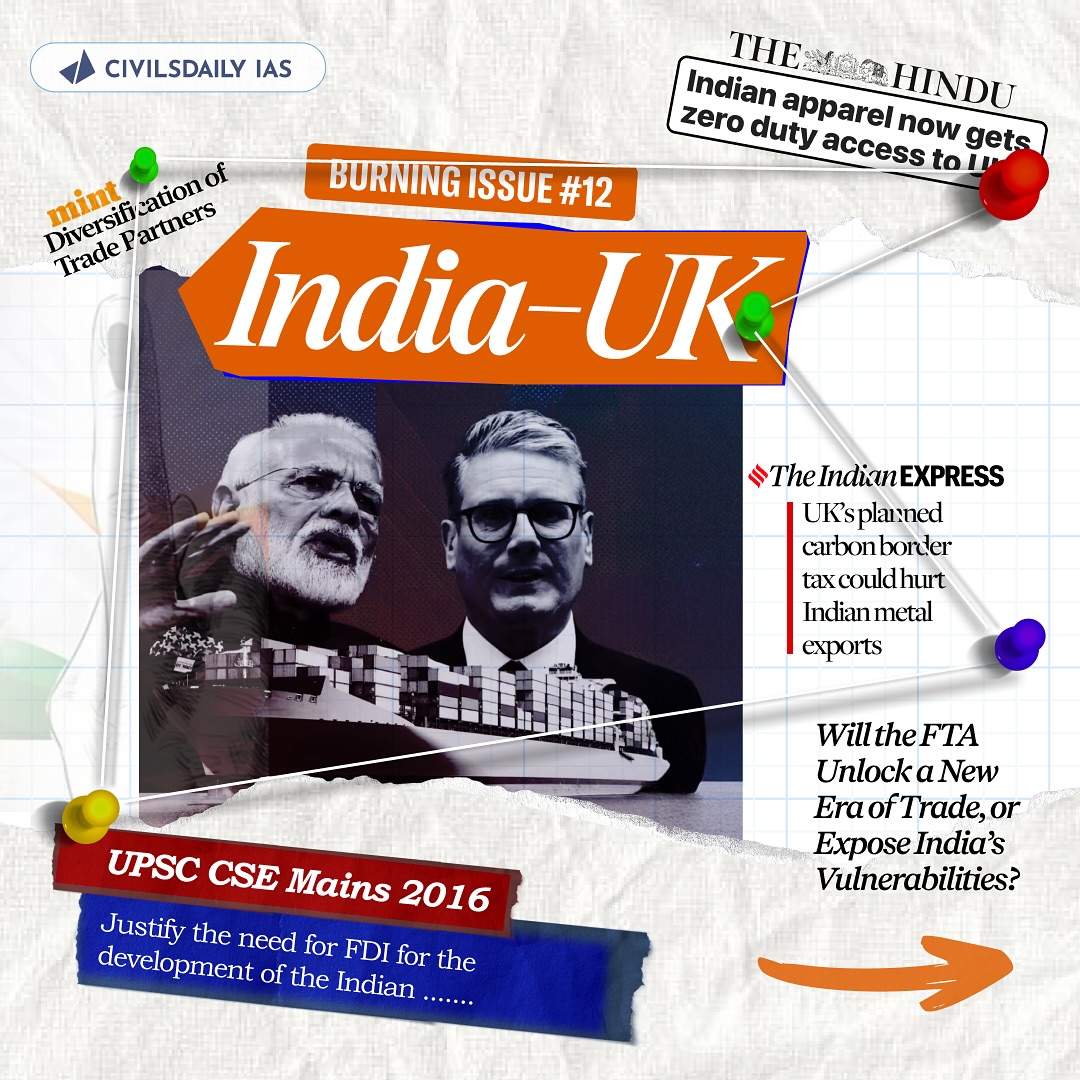
    N4S: This article shows how indigenous tech in Operation Sindoor helped neutralise threats while signalling India’s growing self-reliance. Using the operation as an anchor, it analyses the full supply chain, key reforms since Independence, systemic challenges, and what India must do next to become a defence manufacturing powerhouse. UPSC usually doesn’t ask straight questions like “What is Make in India in defence?” Instead, it frames analytical questions like the one in GS Paper 3 (2020) on security threats and the role of forces—testing your ability to link defence capabilities, policy, and geopolitical threats. Aspirants often falter by mugging schemes without connecting them to real operations, institutional structures, or the larger strategy. This article helps fill that gap. It offers layered understanding—from Operation Sindoor’s field-level tech usage to the Defence Acquisition Procedure 2020—backed with examples and committee insights.

    PYQ ANCHORING

    GS 3: Analyze internal security threats and transborder crimes along Myanmar, Ban gladesh and Pakistan borders including Line of Control (LoC). Also discuss the role played by various security forces in this regard. [2020]

    MICROTHEME: Security Forces and their Mandates

    Operation Sindoor marked a defining moment for Make in India, demonstrating India’s precision strike capabilities powered by homegrown defence technologies. This operation was a powerful proof of concept for the Make in India and Atmanirbhar Bharat initiatives.But how far has India truly come in closing the technological gaps in defence? What structural changes are still needed to ensure that indigenous innovation becomes the backbone of our military strength? And can India balance rapid modernization with strategic self-reliance to emerge as a global defence powerhouse?

    Operation Sindoor: A Defining Moment for Atmanirbhar Bharat in Defence

    Operation Sindoor was more than a military success—it was a powerful demonstration of India’s growing self-reliance in defence. This operation showcased how the vision of Atmanirbhar Bharat is transforming the nation’s defence capabilities by the following ways: 

    1. Indigenous Air Defence Systems: Shielding the Nation: Indian-developed systems like the Akash Surface-to-Air Missile and the SAMAR Air Defence System played a pivotal role in neutralizing over 600 hostile drones and missiles during the operation. These systems, developed by Indian public and private sector entities, proved their effectiveness in real combat scenarios, underscoring India’s capability to produce advanced defence technologies domestically. 

    2. Precision Strikes with Indigenous Drones: Private sector companies such as Tata Advanced Systems and Paras Defence supplied loitering munitions and swarm drones that were instrumental in executing precise strikes on terrorist infrastructure. These platforms, developed under the ‘Make in India’ initiative, enabled India to conduct operations with minimal collateral damage, highlighting the strategic advantage of homegrown technology.

    3. Government Initiatives Fueling Innovation: Programs like iDEX (Innovations for Defence Excellence) and SRIJAN have been instrumental in fostering innovation within the private sector. These initiatives provided the necessary support and incentives for companies to develop and deploy indigenous solutions, accelerating India’s journey towards defence self-reliance.

    4. Validation of ‘Made-in-India’ Weaponry: The successful deployment of indigenous weapons during Operation Sindoor has validated their reliability and effectiveness. This success not only boosts domestic confidence but also enhances India’s reputation as a global hub for defence manufacturing. 

    5. Strategic Integration Across Forces: The seamless integration of indigenous technologies across the Army, Navy, and Air Force during the operation demonstrated the strategic advantage of a unified, self-reliant defence ecosystem. This integration ensures coordinated responses and enhances operational efficiency.

    6. Boosting Defence Exports: Operation Sindoor has paved the way for increased defence exports. The successful use of indigenous equipment has positioned India as a reliable supplier of advanced military technologies, with defence exports reaching ₹23,000 crore in FY25 and projected to touch ₹50,000 crore by 2029.

    India’s Defence Industry Ecosystem

    ComponentKey Stakeholders/EntitiesRole in the Supply Chain
    1. Government Bodies & Policymakers– Ministry of Defence (MoD) – Defence Acquisition Council (DAC) – Dept. of Defence Production (DDP)Policy formulation, procurement approvals, funding, and regulation
    2. Public Sector Units (PSUs)– HAL, BEL, BEML, MDL, GRSE, GSL, etc. – Corporatised Ordnance FactoriesSystem integration and manufacturing of major platforms (aircraft, tanks, ships, electronics)
    3. R&D Institutions– DRDO and its labs – Academic partnerships (IITs, NITs) – iDEXIndigenous research, technology development, incubation of startups and innovation
    4. Private Sector Companies– Tata Advanced Systems, L&T Defence, Mahindra Defence, Adani DefenceDesign, production, and technology partnerships for defence systems and components
    5. MSMEs & Startups– Small and Medium Enterprises across India – Funded under iDEX and Make in India schemesPrecision manufacturing, sub-component supply, electronics, and rapid innovation
    6. Foreign OEMs & Partners– Boeing, Lockheed Martin, Airbus, Rafael, etc.Technology transfer, joint ventures, FDI, and fulfilling offset obligations
    7. Regulatory & Quality Agencies– Directorate General of Quality Assurance (DGQA) – Licensing AuthoritiesQuality testing, standardisation, regulatory compliance for defence production
    8. Armed Forces (End-Users)– Indian Army – Indian Navy – Indian Air ForceRequirement specification, field trials, operational feedback for continuous improvement and deployment readiness

    India’s Defence Indigenisation: Evolution Over the Years

    1. Post-Independence Phase (1947–1980s): Import Dependence with State-Led Production

    • After 1947, India relied heavily on imports to meet its defence needs.
    • The government established defence public sector undertakings (DPSUs) like HAL (1940), BEL (1954), BEML, and DRDO (1958) to kickstart indigenous production.
    • Focus remained on license production (e.g., MiG-21 from USSR) rather than original design.
    • The military-civilian research disconnect and lack of private sector involvement slowed innovation.

    2. The Self-Reliance Push (1980s–1990s): Limited Technological Gains

    • Indigenous projects like the Light Combat Aircraft (Tejas) and Arjun tank were launched, but saw major delays.
    • Import dependence continued, particularly for high-tech equipment.
    • The Defence Procurement Procedure (DPP) was introduced in 1992 to formalise acquisitions but still favoured foreign vendors.

    3. Opening Up & Strategic Partnerships (2000s–2010s): Private Sector Enters

    • Post-Kargil Review Committee, India recognised the need for self-sufficiency in critical systems.
    • The 2001 policy opened defence production to the private sector and allowed 26% FDI (now up to 74% under automatic route).
    • Defence offsets were introduced in 2005 to encourage local production.
    • However, execution lagged due to bureaucratic hurdles and lack of synergy.

    4. Make in India & Beyond (2014 onwards): Reforms, Modernisation, and Innovation

    • Under the ‘Make in India’ initiative, defence became a focus sector.
    • Policy measures included:
      • Creation of Defence Corridors in UP and Tamil Nadu.
      • Launch of Innovations for Defence Excellence (iDEX) to support startups and MSMEs.
      • Negative import list (now Positive Indigenisation List) of defence items to boost local procurement.
      • Push for DRDO–private sector collaborations and corporatisation of Ordnance Factory Board (OFB).
    • Flagship projects like INS Vikrant, Tejas Mk1A, Dhanush artillery, and AK-203 (with Russian collaboration) symbolise indigenisation progress.

    5. Present & Emerging Trends

    • India is now among the top 25 arms exporters, with key exports to Southeast Asia and Africa.
    • The Defence Acquisition Procedure (DAP) 2020 promotes indigenous content across categories.
    • Stronger emphasis on dual-use technologies, AI in defence, cyber warfare tools, and space militarisation.The aim is to transform India from the world’s largest arms importer to a global hub of defence manufacturing.

    Challenges of defence indigenisation//MAINS

    Each stakeholder in the defence indigenisation chain faces specific pain points—from policy bottlenecks to technological dependence, funding gaps, and trust issues between the military and manufacturers. These must be systematically addressed to achieve true Atmanirbharta in defence.

    ComponentChallengesExample
    1. Government Bodies & PolicymakersBureaucratic delays in approvals, frequent policy changes, and slow implementation of procurement reforms.Despite multiple reforms, procurement under the Defence Procurement Procedure (DPP) often sees long delays—e.g., the Rafale deal took over a decade to finalise.
    2. Public Sector Units (PSUs)Low productivity, limited innovation, and over-dependence on DRDO/IPR transfers. Slow to adopt modern production systems.HAL delayed the delivery of Tejas Mk-1, impacting Air Force induction timelines and operational preparedness.
    3. R&D Institutions (DRDO & others)Time and cost overruns, limited coordination with users, and weak integration with industry.DRDO’s Arjun Tank project took over 30 years, and was only partially accepted by the Army due to performance and logistical concerns.
    4. Private Sector CompaniesLimited access to defence contracts, technology, and design IP. Often lack level-playing field vis-à-vis PSUs.L&T and Tata have developed major naval platforms, but frequently lose major contracts to shipyards like MDL due to preferential treatment.
    5. MSMEs & StartupsLack of working capital, complex compliance norms, and delays in payment from DPSUs.Many MSMEs supplying parts to BEL or HAL face delays of over 6–12 months in payments, affecting sustainability.
    6. Foreign OEMs & PartnersReluctance to transfer core technologies, offset implementation delays, and strategic trust issues.Several foreign OEMs fulfill offset obligations via services or non-critical components; core tech transfer often avoided (e.g., no engine tech with Rafale).
    7. Regulatory & Quality AgenciesCumbersome quality assurance, lack of automation, and inconsistent standards across labs and factories.DGQA processes often delay final product acceptance; Indian Army has complained about long wait times in artillery trials.
    8. Armed Forces (End Users)Changing specifications, lack of alignment with R&D timelines, and preference for proven imports.The Army’s frequent upgrades to requirements delayed Future Infantry Combat Vehicle (FICV) development despite years of DRDO effort.

    Systemic Challenges

    1. Technology & Capability Gaps

    • Still Dependent on Imports: Even today, over one-third of our defence buys come from abroad due to a lack of domestic high-tech capability.
    • Slow Innovation in R&D: Barely 4% of the defence budget goes into research. This holds back growth in key areas like AI, hypersonic tech, and quantum systems.

    2. Delays & Inefficiencies

    • Bureaucratic Red Tape: The procurement process is slow and clunky—equipment approvals take time, affecting how fast our forces modernize.
    • Indigenous Projects Take Too Long: Homegrown defence projects like the Light Combat Aircraft (LCA) have taken decades, leaving gaps in capability.

    3. Ecosystem Imbalance

    • Public Sector Dominance: PSUs still dominate; private players face limited access and contribute only around 21% to total production.
    • Weak Public–Private Collaboration: There’s little synergy between state-run units and private defence manufacturers.

    4. Global & Strategic Setbacks

    • Struggles in Exporting Arms: While exports are improving, India still finds it hard to compete globally with giants like the US and Russia.
    • Cyber & EW Gaps: India lacks cutting-edge capabilities in cybersecurity and electronic warfare, making its systems vulnerable.

    5. Strategic & Policy Hurdles

    • No Fully Integrated Defence Strategy: The Army, Navy, and Air Force still don’t work closely enough—joint commands are delayed.
    • Internal Security Takes Focus Away: Resources often get pulled toward handling terrorism and insurgency, slowing defence modernization.
    • Indigenisation Policy Gaps: Despite mandates, real localisation is tricky—supply chains are global, and it’s hard to measure true ‘Made in India’ content.

    Way Forward

    1. Boost Indigenous Tech: Invest more in R&D and support startups to develop advanced defence technologies like AMCA, hypersonics, and AI systems.
    2. Simplify Procurement: Speed up and digitize procurement, prioritize “Buy Indian,” and ease export approvals to grow domestic industry and global sales.
    3. Enhance Collaboration: Promote strong partnerships between public sector units, private companies, and academia for faster innovation.
    4. Build Skills & Infrastructure: Develop specialised defence training and upgrade manufacturing with advanced technologies and Defence Industrial Corridors.
    5. Strengthen Cybersecurity: Create a dedicated Cyber Command and use AI to defend against modern digital threats.
    6. Integrate Forces & Policies: Implement joint theatre commands and ensure consistent policies and funding for strategic growth and readiness.

    #BACK2BASICS: Key Committees Shaping Defence Indigenisation in India: A Chronological Overview

    Here’s a list of 8 important committees on defence indigenisation in India, arranged chronologically:

    YearCommittee NamePurpose / Focus
    1959Sinha CommitteeEarly focus on defence production and self-reliance
    1998Kalam CommitteeStrengthening indigenous R&D and reducing import dependence
    2004Naresh Chandra Task ForceReforming DRDO and DPSUs; enhancing private sector participation
    2007Subrahmanyam CommitteeDefence production and technology acquisition
    2016Shekatkar CommitteeEnhancing defence procurement efficiency and budget optimization
    2017Shyam Saran CommitteePromoting ‘Make in India’ in defence and boosting R&D
    2018Kalyani CommitteeEncouraging private sector in defence production
    2020Defence Acquisition Council (DAC) ReformsIndigenous content mandates and procurement process reforms

    Major Defence Indigenisation Reforms in India //PRELIMS

    YearReform/PolicyDescription & Impact
    Before 2000Procurement Process OverviewBefore 2000, India’s defence procurement was largely import-dependent, with minimal emphasis on indigenous manufacturing. The process was slow, bureaucratic, and focused mainly on acquiring ready-made foreign equipment. Indigenous industry played a marginal role, and there was little policy push to promote domestic capabilities or private sector participation. The Defence Research and Development Organisation (DRDO) handled most R&D but faced challenges in timely delivery and commercialization.
    2001Defence Procurement Procedure (DPP) 2001Introduced for the first time, this procedure categorized procurement into “Buy Indian,” “Buy and Make (Indian),” and “Buy (Global).” It aimed to prioritize indigenous manufacturing, encourage technology transfer, and create a structured framework for acquisitions. This marked the first policy-level recognition of the importance of self-reliance.
    2007Defence Production PolicyThis policy explicitly focused on increasing the indigenous content in defence products. It aimed to build domestic production capacity, reduce imports, and foster R&D collaboration between public and private sectors. However, implementation was slow, and private sector involvement remained limited.
    2016Make in India Defence InitiativeLaunched as part of the broader Make in India campaign, this initiative specifically targeted defence manufacturing. It encouraged private sector participation, startups, and MSMEs, and promoted innovation through frameworks like Innovations for Defence Excellence (iDEX). The policy also sought to reduce import dependence and boost exports.
    2017DPP Revision 2017The Defence Procurement Procedure was revised to give even greater priority to indigenous products. It simplified approval processes, provided preference to Indian vendors, and introduced better mechanisms for offset management (where foreign suppliers invest in India). These reforms helped speed up procurement and incentivize domestic manufacturing.
    2018Defence Production and Export Promotion Policy (DPEPP) 2018DPEPP set ambitious targets to increase indigenous defence production to 70% and double defence exports to $5 billion by 2025. It aimed to create a robust defence industrial ecosystem, boost private sector and MSME involvement, and promote exports through government support and export incentives.
    2019Atmanirbhar Bharat Abhiyaan (Self-Reliant India Mission)Announced amid rising global uncertainties, this mission placed self-reliance at the core of India’s defence strategy. It focused on reducing import dependency, easing technology transfers, boosting indigenous R&D, and creating a globally competitive defence manufacturing base. Several measures to fast-track approvals and enhance funding for innovation were introduced.
    2020Defence Acquisition Procedure (DAP) 2020The updated acquisition procedure further streamlined procurement processes, expanded categories of indigenous procurement, and improved transparency. It also emphasized empowering startups and MSMEs by simplifying participation rules, aiming to make defence manufacturing more inclusive and innovation-driven.
    2021Defence Production and Export Promotion Policy (DPEPP) 2.0Building on the 2018 policy, DPEPP 2.0 reinforced incentives for defence manufacturing and exports. It focused on deepening technology development, fostering innovation ecosystems, and promoting global partnerships. The policy stressed research collaboration, increased funding for innovation, and set higher export targets.

    Summary:

    Before 2000: Defence procurement was import-heavy, bureaucratic, and limited to public sector dominance, with minimal private sector involvement.

    Since 2001: India has progressively reformed its defence policies to promote indigenous production, ease procurement, foster private sector participation, and build a globally competitive defence ecosystem. Initiatives like Make in India, Atmanirbhar Bharat, and Defence Production Policies have been key milestones in reducing import dependency and boosting defence exports.

    SMASH MAINS MOCK DROP

    Operation Sindoor marks a shift from defence dependence to indigenous dominance. In this context, critically examine India’s progress in defence indigenisation. What are the structural challenges that still hinder self-reliance in defence manufacturing?