💥Join UPSC 2027,2028 Mentorship (July Batch) + XFactor Notes & Microthemes PDF

Category: Ranker Webinars

  • 11th January 2021| Daily Answer Writing Enhancement

    Important Announcement:  Topics to be covered on 12th January

    GS-1 Salient features of Indian Society, Diversity of India. 

    GS-4 Case Studies.

    Question 1)

    Discuss in what way trade monopoly of East India Company was weakened by different Charter Acts passed by the British Parliament. 10 marks

    Question 2)

    No country has progressed without investing in the social sector. In the post-pandemic world, India needs to chart the plan to invest more in the sector. In light of this, examine the challenges in the social sector and suggest the ways to deal with them. 10 marks

    Question 3)

    What are the various factors that played role in increasing the financial inclusion in India. Also, examine the various role Payment Banks could play in furthering the goal of financial inclusion and what are the issues faced by Payment Banks. 10 marks

    Question 4)  

    In recent months, there have been multiple incidents of COVID deaths in the government hospitals due to the lack of ICU availability and ventilators. Despite the existence of laws, rules and vigilance mechanisms why do such tragedies occur? Analyse and suggest remedies for improving the probity in hospital administration. 10 marks

    Reviews will be provided in a week. (In the order of submission- First come first serve basis). In case the answer is submitted late the review period may get extended to two weeks.

    *In case your answer is not reviewed in a week, reply to your answer saying *NOT CHECKED*. If Parth Sir’s tag is available then tag him.

    For the philosophy of AWE and payment, check  here: Click2Join

  • Decimate Prelims 2021 launched | Register here for the IAS Open Tests – First on 17th Jan

    Decimate Prelims 2021 launched | Register here for the IAS Open Tests – First on 17th Jan

    Click here to enroll for Decimate Prelims 2021

    Click here to register for the free Decimate Prelims Open Test 1

    UPSC prelims 2020 was a watershed moment. It brought a big change to the nature as well as the way in which questions are asked in IAS prelims.

    UPSC is evolving, are you? Bury the old ways of IAS Prelims preparation.

    No more is it just about studying and giving tests. Your preparation has to be planned, measurable, and effective. Keeping all these in mind we’re launching Decimate Prelims 2021 to help you adapt and rise up to the level expected by UPSC.

    But before that you need to answer to the question- Are you preparing in the right direction for IAS pre-2021? Check your current preparedness with Decimate Prelims Open Tests 2021.

    There will be three Open Tests, scheduled on 17th Jan, 24th Jan, and 31st Jan 2021, before the start of our DECIMATE PRELIMS 2021 program.

    Details and Instructions for the open test:

    1. Register here for the Decimate Prelims open tests
    2. The first test will go live at 10 am on 17th Jan 2021 (on the same link as given in point 1).
    3. These are full-length tests- 100 questions, 2hrs
    4. Mode- Online, in English
    5. All India Ranking will be released on 18th Jan 
    6. Test solutions and explanations will be emailed to you.
    7. Test discussions will take place on Habitat on 18th Jan 2021.

    Decimate Prelims 2021

    2+ yrs Current affairs, Habitat sessions, Test seriesMentorship

    What is Decimate Prelims 2021?

    Click here to enroll for Decimate Prelims 2021

    It is a holistically designed crash course for the UPSC IAS prelims exam. To make it more efficient and outcome-oriented we’ve integrated it with Habitat.

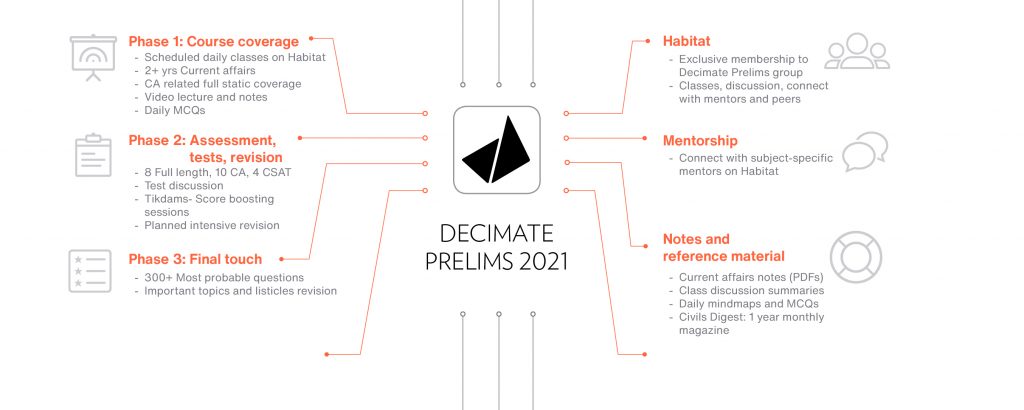
    Decimate Prelims 2021 @ Habitat is a three-phased program that ensures full coverage of current affairs syllabus, related static parts, tests, intensive discussions, and revision.

    We’re going more intensive and comprehensive to make sure that you comfortably go beyond 130+ marks and literally decimate prelims.

    UPSC is evolving, are you? Bury the old ways of IAS Prelims preparation.

    How daily Habitat classes will be held?

    Since we’re going to be comprehensive and effective, we’ve planned Habitat classes twice a day (2+2 hrs/day) as per a schedule.

    Forenoon session: 10am – 12:30pm

    You’ll be provided with the base notes and reading material beforehand. In the Habitat class the focus will be on:

    1. Explanation and conceptual clarity.
    2. Making linkages with static part.
    3. Relevance of the topic or its components for the prelims exam.
    4. The kind of questions that could be asked from a particular topic.
    5. Things you need to focus on and the things you can avoid.

    You’ll get a video summary lecture of this discussion covering the most important and relevant aspects of the topic.

    A discussion session on Habitat

    Evening session: 7pm – 9pm

    In the second session, we’ll be focussing on the application and utilization of the information part:

    1. Doubts resolution
    2. Daily mini-tests (MCQs) based on day’s discussions
    3. Explanation, discussion, and Tikdams
    4. Revision of the day’s topics

    After this session, you’ll be provided with the PDFs of mini-tests, notes for the next session, and reference material (if required).

    Habitat sessions will continue till Prelims 2021 in the next two phases as well.

    MCQ discussion on Habitat

    Decimate Prelims 2021 progression

    Phase 1: Course coverage- 7 weeks

    In the first 50 days, we are going to cover 2+ yrs current affairs, associated static topics, and prelims worthy issues. These will be covered in 4+ hours daily classes on Habitat.

    1. Notes and Habitat video lectures

    Crisp but comprehensive notes are going to cover these current affairs on a preliminary level. These will be followed by discussion sessions on Habitat.

    2. Daily Habitat classes

    Habitat classes will be conducted by the subject-specific mentors twice a day. Here in the first session, you’ll be having an in-depth discussion and analysis of the scheduled topics. Why a particular topic is important and how it could be asked in prelims will be discussed. In the second session of Habitat class, you’ll be attempting MCQs, resolving doubts, and revising.

    By the end of the discussion, you will be provided with video summary lectures, MCQs, mindmaps, and reference material, etc.

    Phase 2: Tests and Assessment, Discussion, Tikdams- Till May

    In the second phase of Decimate Prelims 2021, we’re going to focus on the application of information; testing and evaluation; doubts resolution and course correction; and learning smart ways of attempting the paper through Tikdams sessions.

    1. Test series and discussions

    Since learning must be accompanied by regular assessment, Decimate Prelims includes 8 Full-Length tests, 10 Current affairs tests, and 4 CSAT tests. These are high-quality tests covering the most relevant issues for IAS prelims 2021.

    Tests will be followed by discussion and analysis on Habitat will help in finding out the mistakes you are committing to and how to address them in a most effective manner.

    2. Tikdams and Score boosting sessions

    We’ve perfected Tikdams or the art of intelligent elimination. It has the potential of raising your score by 30 marks or more. Score boosting sessions, in this phase, will prepare you and enhance your ability to perform under pressure (& lack of information). 

    3. Revision and discussion

    We’re going to have scheduled revision and doubt resolution sessions on Habitat. These 4+hrs sessions will ensure thorough coverage of the IAS Prelims syllabus.

    Phase 3: Probable questions discussion, intensive revision – till prelims

    We’ll be providing 300+ most probable topics to you and will be having a discussion session on Habitat around these topics.

    Moreover, intensive revision based on listicles, reports, and important topics will continue till your prelims.

    Mentorship

    Mentorship is an important component of Decimate Prelims 2021. It is essential for guiding your preparation towards the most effective path so that you can make the most out of this program.

    On Habitat, you will get mentorship by subject-specific mentors and teachers. You can reach out to them whenever you want and get your doubts resolved as soon as you get them.

    Notes and study material

    As mentioned above high-quality PDF notes of current affairs, daily MCQs, discussion summaries, etc. are going to be provided. You’ll also be getting an annual subscription to Civils Digest, our monthly magazine.

    Other reference material, listicles, etc. will be provided as and when required.

    Program inclusion:

    1. Daily Habitat classes: 4+ hrs
    2. Comprehensive Current Affairs coverage
      • 2+ years Prelims worth issues and topics
      • CA associated static topics
      • Video lectures/summaries.
    3. Exclusive membership to Habitat group
    4. Test series with doubt resolution discussions
      • 8 Full-Length Tests
      • 10 Current Affairs Tests
      • 4 CSAT 
    5. Mentorship 
      • Connect with subject-specific mentors on Habitat
    6. Score Booster sessions (Tikdams)
      • Habitat sessions in the second phase
      • Video summary lectures
    7. Notes and study material
      • High-quality current affairs notes (PDF)
      • Daily discussion summaries, mindmaps, and MCQs
      • Civils Digest: Monthly magazine

    Click here to enroll for Decimate Prelims 2021

  • 8th January 2021| Daily Answer Writing Enhancement

    Important Announcement:  Topics to be covered on 11th January

    GS-1 Indian National Movement.

    GS-4 Codes of Ethics, Codes of Conduct and Citizen’s Charters.

    Question 1)

    Analyse in what way redefining urban areas can have far-reaching impact on ease of living and economic development of the people in the country. 10 marks

    Question 2)

    Various states have been responding to sexual violence by harsher punitive measures. Tackling the problem of sexual violence need more than harsher punishments. In light of this, examine the issues with depending on the punitive measures and suggest the ways to deal with the problem. 10 marks

    Question 3)

    Of late, the Indian Navy has been on the drive to increase maritime domain awareness in the Indian Ocean. This could help India in generating cooperative synergies in the neighbourhood and beyond while detecting the movement of hostile elements. 10 marks

    Question 4)  

    “Good governance and anti-corruption measures as central to its poverty alleviation mission.” Discuss. 10 marks

    Reviews will be provided in a week. (In the order of submission- First come first serve basis). In case the answer is submitted late the review period may get extended to two weeks.

    *In case your answer is not reviewed in a week, reply to your answer saying *NOT CHECKED*. If Parth Sir’s tag is available then tag him.

    For the philosophy of AWE and payment, check  here: Click2Join

  • 6th January 2021| Daily Answer Writing Enhancement

    Important Announcement:  Topics to be covered on 7th January

    GS-1 Modern Indian history from about the middle of the eighteenth century until the present- significant events, personalities, issues. 

    GS-4 Ethics and Human Interface.

    Question 1)

    Describe the concept of Role and Role Conflict. Discuss the nature and extent of role conflict among working women in India. 10 marks

    Question 2)

    As India looks for a productive tenure at the UNSC, five objectives present themselves. Examine the objectives that India should pursue to achieve in its stint as the UNSC member. 10 marks

    Question 3)

    What India needs is low-input, high-output agriculture. This cannot be achieved without science and technology. In light of this, explore the areas in which India needs to focus on to exploit the technology to make its agriculture productive. 10 marks

    Question 4)  

    Discuss Kautilya’s philosophical basis of governance. 10 marks

    Reviews will be provided in a week. (In the order of submission- First come first serve basis). In case the answer is submitted late the review period may get extended to two weeks.

    *In case your answer is not reviewed in a week, reply to your answer saying *NOT CHECKED*. If Parth Sir’s tag is available then tag him.

    For the philosophy of AWE and payment, check  here: Click2Join

  • 5th January 2021| Daily Answer Writing Enhancement

    Important Announcement:  Topics to be covered on 6th January

    GS-1 Role of women and women’s organization.

    GS-4 Contributions of moral thinkers and philosophers from India and world. 

    Question 1)

    Elucidate the main aspects of the policy of Dhamma as propounded by Ashoka and to what extent are they relevant to present-day India. 10 marks

    Question 2)

    Changing geopolitical realities will change the U.S.’s approach to India which offers both the countries an opportunity for cooperation in dealing with common concerns and furthering their trade and strategic ties. Comment. 10 marks

    Question 3)

    What is the significance of disclosure about the use of patent by licensee/patentee in India. How changes in rules about the disclosure could affect compulsory licensing regime in India? 10 marks

    Question 4)  

    What do you understand by Aptitude? How is it different from Intelligence? Explain. 10 marks

    Reviews will be provided in a week. (In the order of submission- First come first serve basis). In case the answer is submitted late the review period may get extended to two weeks.

    *In case your answer is not reviewed in a week, reply to your answer saying *NOT CHECKED*. If Parth Sir’s tag is available then tag him.

    For the philosophy of AWE and payment, check  here: Click2Join

  • UPSC CSE 2019 Reserve List released | Check your name here

    Dear students

    UPSC has just now released the Consolidated Reserve list containing names of 89 candidates who had appeared for UPSC CSE 2019.

    Click here to download and view the list

    The Reserve List of Civil Services Examination, 2019 is subject to changes, if any, that may be necessitated by the orders pending before courts.


    How to prepare for 2021 Prelims: Fill Samanvaya form

    Talk to senior mentors from Civilsdaily. Fill the Samanvaya form for IAS 2021 and IAS 2022 given below. We will call you within 24 hours.

    Fill up the following details in Samanvaya form given below to schedule a free one-on-one mentorship session with senior mentors from Civilsdaily. We’ll call you within 24 hours.

    Civilsdaily Samanvaya 1-on-1 Mentorship Form

  • 4th January 2021| Daily Answer Writing Enhancement

    Important Announcement:  Topics to be covered on 5th January

    GS-1 Salient aspects of Art and Culture.

    GS-4 Aptitude.

    Question 1)

    Discuss the contributions of social reformers of 19th century in the making of modern India. 10 marks

    Question 2)

    What are the challenges in the regulation of higher education in the country? How National Education Policy 2020 seeks to deal with the issue? 10 marks

    Question 3)

    Examine the implications of creation of Theatre Commands. What are the challenges in its creation. 10 marks

    Question 4)  

    What factors affect the formation of a person’s attitude towards social problems? In our society, contrasting attitudes are prevalent in many social problems. What contrasting attitudes do you notice about the caste system in our society? How do you explain the existence of these contrasting attitudes. 10 marks

    Reviews will be provided in a week. (In the order of submission- First come first serve basis). In case the answer is submitted late the review period may get extended to two weeks.

    *In case your answer is not reviewed in a week, reply to your answer saying *NOT CHECKED*. If Parth Sir’s tag is available then tag him.

    For the philosophy of AWE and payment, check  here: Click2Join

  • How to crack IAS 2021?| Also, things you need sorted before starting preparation for IAS 2022 | Fill Samanvaya-1 on 1 session with senior mentors

    How to crack IAS 2021?| Also, things you need sorted before starting preparation for IAS 2022 | Fill Samanvaya-1 on 1 session with senior mentors

    A well-informed start is always a good start.

    Talk to senior mentors from Civilsdaily: Click here and fill Samanvaya form for IAS 2021 and IAS 2022. (also provided at the bottom of this post).


    What is the best strategy for IAS 2021 and 2022 exams? How to start preparation? What does UPSC expect? How to cover the syllabus? How to connect current affairs with static? When to start answer writing? How to plan a daily schedule and then follow it..

    There are a number of similar questions that you must be facing. IAS preparation is not just about memorizing and information gathering. Before you start you need to get answers to these questions. (Read below about our three-tiered mentoring)

    More than 10.5 lakh applied, but only 796 are going to clear IAS 2020. It is going to be much more challenging in 2021 and 2022.

    We’ve had a discussion with 1800 aspirants who failed in Prelims 2020. Many had taken multiple attempts before that.

    Lack of direction, no guidance, inability to make required necessary changes in their preparation, and an absence of a well-defined strategy were issues common to all. (What issues are you facing? tell us)

    Prelims 2020 in many ways was a watershed moment for IAS aspirants. It has highlighted the changing nature of UPSC and to be successful you need to adapt to the expectations of UPSC and adopt a new approach.

    For 2021 aspirants, your preparation should be highly outcome-oriented (enabling you to fetch more marks). Every action of yours must be very objectively defined, every step as a part of your strategy. Whatever you are learning must be utilizable in the exam (both pre and mains). Your preparation should have an element of measurability.

    Moreover, you need to balance both Prelims and Mains on one hand and current-static-optional on the other. Fill Samanvaya form to know how it should be done.

    It’s about how ‘you’ should be doing it instead of how someone else did it. That is the ‘elephant in the room’.

    All this stands true for 2022 aspirants as well. This is the right time to start preparation.

    Fill Samanvaya form given at the bottom of this post.

    Broadly, six factors determine your success in cracking this prestigious IAS exam and the most important being understanding the expectations of UPSC and according to that planning and strategizing; other being, Learning – Knowledge and information; Analyzing – making linkages, connections, etc.; Executing and utilizing information; and Constant course correction – because mistakes are inevitable, need to rectify them asap. Get these in order before you start for IAS 2021/22.

    But how to do that? Read below how our three-tiered mentoring will help.

    Talk to senior mentors from Civilsdaily: Click here and fill Samanvaya form for IAS 2021/22


    Integrate them in your preparation. We’ll tell you how to do it.

    Talk to senior mentors from Civilsdaily: Click here and fill Samanvaya form for IAS 2021-22


    This is where our 3 tier mentoring comes in:

    1. First step starts with this Samanvaya call: Once you fill in the form, our senior mentors will have a 1-to-1 detailed discussion (on-call) with you to understand your prep level, working/ study constraints, current strategies, and create a step by step plan for next week, next month and so on.

    2. You are given access to our invite-only chat platform, Habitat where you can connect with mentors, ask your daily doubts, discuss your test-prep questions and have real-time live sessions on news and op-eds, and find your optional groups.

    How to prepare for upsc 2021? Strategy for upsc 2021?
Answer writing for 2020
    Daily target monitoring.

    3. The third and the most personalized tier is the dedicated 1 on 1 mentor allotment who stays with you through the course of your UPSC preparation – always-on chat and on scheduled calls to help you assess, evaluate, and chart the next milestone of your IAS 2021/2022 journey.

    Let’s talk. Fill this Samanvaya form (click here)

    (Civilsdaily’s mentor will call you within 24 hours.)


    Who are you?

    1. Working Junta? If you are preparing for IAS 2021/2022 and working simultaneously, we can help you strategize and decipher the IAS exam and design a timetable that fits right in your hectic schedule.
    2. First-time prep? If you are in the last year of college or thinking of dropping a year and preparing for IAS 2021/2022 full time, we’ll help you pick the right books and craft a practical & personal strategy.
    3. Have appeared before? and weren’t successful. We’ll help you identify your mistakes, rectify them for the necessary course correction. Let this be your final and successful attempt.

    You just have to take 5 minutes out and fill this form: Samanvaya For IAS 2021/2022

    Once done, we will call you within 24 hours or so.

    How to prepare for upsc 2021? Strategy for upsc 2021?
Answer writing for 2020
Abhishek Saraf rank 8 Civilsdaily
    Abhishek has benefited from Civilsdaily’s approach.

    Talk to senior mentors from Civilsdaily: Click here and fill Samanvaya form for IAS 2021-22

    How to prepare for upsc 2021? Strategy for upsc 2021?
Answer writing for 2020
    Daily target monitoring

    These are some of the images from Habitat, our learning platform. It is one of the ways we monitor your progress.

    Talk to senior mentors from Civilsdaily: Click here and fill Samanvaya form for IAS 2021-22


    Our rankers in 2019

    Civilsdaily’s Hall of Fame.
    Fill up the following details in Samanvaya form given below to schedule a free one-on-one mentorship session with senior mentors from Civilsdaily. We’ll call you within 24 hours.

    Civilsdaily Samanvaya 1-On-1 Mentorship Form

    Field will not be visible to web visitor
  • Recap: Minimum Support Price

    Minimum Support Price (MSP) is the assured price at which foodgrains are procured from farmers by the central and state governments and their agencies, for central pool of foodgrains. The central pool is used for providing foodgrains under the Public Distribution System (PDS) and other welfare schemes, and also kept as reserve in the form of buffer stock.  However, in the past few months, there have been demands to extend MSP to private trade as well and guarantee MSP to farmers on all kinds of trade.

    Is MSP applicable for all crops?

    The central government notifies MSP for 23 crops every year before the Kharif and Rabi seasons based on the recommendations of the Commission for Agricultural Costs and Prices, an attached office of the Ministry of Agriculture and Farmers’ Welfare. These crops include foodgrains such as cereals, coarse grains, and pulses.  However, public procurement is largely limited to a few foodgrains such as paddy (rice), wheat, and, to a limited extent, pulses.

    Since rice and wheat are the primary foodgrains distributed under PDS and stored for food security, their procurement level is considerably high. 

    How does procurement vary across states?

    The procurement of foodgrains is largely concentrated in a few states.  Three states (Madhya Pradesh, Punjab, and Haryana) producing 46% of the wheat in the country account for 85% of its procurement.   For rice, six states (Punjab, Telangana, Andhra Pradesh, Chhattisgarh, Odisha, and Haryana) with 40% of the production have 74% share in procurement. 

    The rice and wheat focus

    • Procurement of marketed surplus of paddy (rice) and wheat at Minimum Support Price (MSP) completely insulated farmers against any price or market risks. It also ensured a reasonably stable flow of income from these two crops.
    • Over time, the technological advantage of rice and wheat over other competing crops further increased as public sector agriculture research and development allocated their best resources and scientific manpower to these two crops.
    • Other public and private investments in water and land and input subsidies were the other favourable factors.
    • Thus, wheat in rabi and paddy in Kharif turned out to be the best in terms of productivity, income, price and yield risk and ease of cultivation among all the field crops (cereals, pulses, oilseeds).

    85% wheat procurement is from three states (2019-20)

    76% of the rice procured comes from six states (2019-20)

    Punjab, Haryana vs. States

    The region comprising Punjab, Haryana and western Uttar Pradesh, was an early adopter of Green Revolution technology. It was also a major beneficiary of various policies adopted to spread modern agriculture technology in the country.

    • High productivity, assured MSP which is often above open market price, free power, and fertilizer subsidy underlie the higher income per unit area from wheat and paddy cultivation.
    • Land-labour ratio is also very favourable in Punjab when compared to other States; on an average, a farmer owns and cultivates 2.14 hectares net sown area as against 1.42 hectares in Haryana and 1.17 hectares at the national level.
    • An estimate of income (derived from National Accounts Statistics) shows that all agriculture activities taken together to generate an annual net income of ₹5.31 lakh per cultivator in Punjab; it is ₹3.44 lakh in Haryana while the all-India average is ₹1.7 lakh (reference year, 2017-18).

    How has MSP affected the cropping pattern?

    According to the central government’s procurement policy, the objective of public procurement is to ensure that farmers get remunerative prices for their produce and do not have to resort to distress sale.  If farmers get a better price in comparison to MSP, they are free to sell their produce in the open market.  The Economic Survey 2019-20 observed that the regular increase in MSP is seen by farmers as a signal to opt for crops which have an assured procurement system (for example, rice and wheat).  

    Declining Incomes

    • Loss of growth momentum in the income from the agriculture sector, which has fallen to 1% in Haryana and 0.6% in Punjab after 2011-12.
    • With the productivity of rice and wheat reaching a plateau, there is pressure to seek an increase in MSP to increase income. However, demand and supply do not favour an increase in MSP in real terms.
    • In India, the per capita intake of rice and wheat is declining and consumers’ preference is shifting towards other foods.
    • The average spending by urban consumers is more on beverage and spices than on all cereals. On the supply side, rice production is rising at the rate of 14% per year in Madhya Pradesh, 10% in Jharkhand and 7% in Bihar.

    Issues related to procurement

    • Limited procurement in different regions.
    • MSP leading to farmer preference for the production of few crops like wheat and rice.
    • The growing rice production will further increase pressure on the procurement and buffer stock of rice. Rice and wheat procurement in the country has more than doubled after 2006-07 and buffer stocks have swelled to an all-time high.
    • The country does not find an easy way to dispose of such large stocks and they are creating stress on the fiscal resources of the government.
    • Procurement of almost the entire market arrivals of rice and wheat at MSP for more than 50 years has affected the entrepreneurial skills of farmers to sell their produce in a competitive market where prices are determined by demand and supply and competition.

    Environmental issues, unemployment

    • The biggest casualty of paddy cultivation and the policy of free power for pumping out groundwater for irrigation is the depletion of groundwater resources.
    • In the last decade, the water table has shown a decline in 84% observation wells in Punjab and 75% in Haryana.
    • In the last couple of years, the burning of paddy stubble and straw has become another serious environmental and health hazard in the whole region.
    • Another rather more serious challenge for the two States is to provide attractive employment to rural youths. Most of the farm work in these two States is undertaken by migrant labour.

    Is MSP mandatory for private trade as well in some states?

    MSP is not mandatory for purchase of foodgrains by private traders or companies.  It acts as a reference price at which the government and its agencies procure certain foodgrains from farmers.

    In September 2020, the central government enacted a new farm law which allows anyone with a PAN card to buy farmers’ produce in the ‘trade area’ outside the markets notified or run by the state Agricultural Produce Marketing Committees (APMCs).  Buyers do not need to get a license from the state government or APMC, or pay any tax to them for such purchase in the ‘trade area’.  These changes in regulations raised concerns regarding the kind of protections available to farmers in the ‘trade area’ outside APMC markets, particularly in terms of the price discovery and payment.  

    In October 2020, Punjab passed a Bill in response to the central farm law to prohibit purchase of paddy and wheat below MSP. Any person or company compelling or pressurising farmers to sell below MSP will be punished with a minimum of three-year imprisonment and a fine. 

    Similarly, in November 2020, Rajasthan passed a Bill to declare those contract farming agreements as invalid where the purchase is done below MSP.   Any person or company compelling or pressurising farmers to enter into such an invalid contract will be punished with 3 to 7 years of imprisonment, or a fine of minimum five lakh rupees, or both.   Both these Bills have not been enacted yet as they are awaiting the Governors’ assent.

    Way forward

    • The solution to the ecological, environmental and economic challenges facing agriculture in the traditional Green Revolution States is not in legalizing MSP but to shift from MSP crops to high-value crops and in the promotion of non-farm activities.
    • Rather than focusing on a few enterprises, Punjab and Haryana should look at a large number of area-specific enterprises to avoid gluts.
    • This will require a mechanism to cover price and market risks. Farmers’ groups and farmer producer organizations can play a significant role in the direct marketing of their produce.

    To encourage crop diversification and thereby reduce the consumption of water, some state governments are taking measures to incentivise farmers to shift away from paddy and wheat.  For example, Haryana has launched a scheme in 2020 to provide Rs 7,000 per acre to those farmers who will use more than 50% of their paddy area (as per the area sown in 2019-20) for other crops.  The farmers can grow maize, bajra, pulses, or cotton in such diversified area.  Further, the crop produce grown in such diversified area under the scheme will be procured by the state government at MSP.

    • Both Punjab and Haryana need to promote economic activities with strong links with agriculture tailored to State specificities.
    • Some options for this are: promotion of food processing in formal and informal sectors; a big push to post-harvest value addition and modern value chains; a network of agro- and agri-input industries; high-tech agriculture; and a direct link of production and producers to consumers and consumers without involving intermediaries.
    • The traditional Green Revolution States of Punjab and Haryana would need to shed “business as usual” approach and embrace an innovative development strategy in agriculture and non-agriculture to secure and improve the future of farming and rural youth.

    References:-

    https://www.thehindu.com/opinion/lead/punjab-haryana-need-to-look-beyond-msp-crops/article33339838.ece
    https://www.prsindia.org/theprsblog/examining-urban-local-governance-india-through-case-bengaluru