Should you be worried about CSAT? Even though CSAT is qualifying in nature you can’t ignore it. There have been students who were scoring exceptionally well in GS paper 1 but failed to clear 33% mark in CSAT.
The primary reason for this is the lack of practice and conceptual clarity. Moreover, there is a pattern in the CSAT paper that could be deciphered and utilized to qualify this paper comfortably.
If you are already on Habitat, you don’t need to register again. Discussions will take place in the General group. See you at 5:00 pm. Others follow these steps:
Reviews will be provided in a week. (In the order of submission- First come first serve basis). In case the answer is submitted late the review period may get extended to two weeks.
*In case your answer is not reviewed in a week, reply to your answer saying *NOT CHECKED*. If Parth Sir’s tag is available then tag him.
For the philosophy of AWE and payment, check here: Click2Join
You don’t have much time (just 9 months now!) if you want to see your name in the final list of 2021.
Moreover, it should take just one attempt to clear this exam. Any further attempt, if you’re taking, should only be to improve your rank. (Civilsdaily has 70+ selections in 2019)
But most can’t. They keep missing out on a number of things, year after year. You don’t want to get stuck in this loop.
We had a discussion with around 1500 students who were not able to clear prelims even after more than 2 attempts. Some were stuck on mains.
Just making a workable strategy or covering the syllabus only is not enough.
Broadly, five factors determine your success in cracking this prestigious IAS exam: Planning and strategizing– the first step; Learning – Knowledge and information; Analyzing – making linkages, connections, etc.; Executing and utilizing information; and Constant course correction – because mistakes are inevitable, need to rectify them asap.
Failing to tackle any one of them, feeds into a vicious cycle. Without guidance or mentoring, understanding where the problem lies in and how to rectify it becomes problematic.
This is where our 3 tier mentoring comes in:
1. First step starts with this Samanvayacall:Once you fill in the form, our senior mentors get on a 30-40 minute call with you to understand your prep level, working/ study constraints, current strategies, and create a step by step plan for next week, next month and so on.
2. You are given access to our invite-only chat platform, Habitat where you can ask your daily doubts, discuss your test-prep questions and have real-time, live sessions on news and op-eds, and find your optional groups.
Daily target monitoring.
3. The third and the most personalized tier is the 1 on 1 mentor allotment who stays with you through the course of your UPSC preparation – always-on chat and on scheduled calls to help you assess, evaluate, and chart the next milestone of your IAS 2021 journey.
(Civilsdaily’s mentor will call you within 24 hours.)
Who are you?
Working Junta? If you are preparing for IAS 2021 and working simultaneously, we can help you strategize and decipher the IAS exam and design a timetable that fits right in your hectic schedule.
First-time prep? If you are in the last year of college or thinking of dropping a year and preparing for IAS 2021 full time, we can help you pick the right books and craft a practical & personalstrategy.
If you are already on Habitat, you don’t need to register again. Discussion by Zeeshan sir and Ishika ma’am will take place in General group. There is a separate Ethics group for discussion by Sukanya ma’am. See you at 7:30 pm today. Others follow these steps:
Reviews will be provided in a week. (In the order of submission- First come first serve basis). In case the answer is submitted late the review period may get extended to two weeks.
*In case your answer is not reviewed in a week, reply to your answer saying *NOT CHECKED*. If Parth Sir’s tag is available then tag him.
For the philosophy of AWE and payment, check here: Click2Join
If you are already on Habitat, you don’t need to register again. Discussions will take place on General group. See you at 8:00 pm today. Others follow these steps:
Ask your doubts in the comments below. You can call us at 8929987787.
What is Ethics Masterclass?
Ethics Masterclass is a mentor-driven holistic course for GS Paper 4, i.e. Ethics, Integrity, and Aptitude, by Civilsdaily.
Why Ethics Masterclass?
Paper 4 aka Ethics is the most dynamic General studies paper out of the lot. There is no “ONE WAY approach” in ethics. This is an effort to combine the Habitat discussion session with Video lectures to provide a complete learning experience. A focused, personalized, and Mentor guided approach will ensure a disciplined and holistic preparation.
VIDEO LECTURES
Structured video lectures of Paper 4 for a concrete understanding of the syllabus. Our novel methodology accompanied by an in-depth explanation ensures comprehensive coverage of every topic in the syllabus. Added to this, we have made sure to add that extra element of fun.
DOUBT AND DISCUSSION SESSION
A schedule is created where dedicated days are kept to discuss your doubts regarding each lecture. So, cover the part of the lecture video for the day and clear your doubts the same day. In addition to that, It also provides an opportunity to carry advanced discussion sessions focused on video lectures. This is additional to the basic level discussion on the Ethics group.
MINI-TESTS
A mini test on the weekend will help to bring together the ideas and concepts learned throughout the week. This is the perfect icing on the cake! Get personalized reviews on your answers by Sukanya ma’am to understand how you can improve and score better.
Questions framed are from the most important UPSC relevant themes and papers are based on the latest pattern of UPSC. Get model answers cover all the aspects of a question and providing enriching points to the student.
CASE STUDIES DISCUSSION
Scoring in case studies translates into a good score in paper 4. Learn the tips and tricks to master Section B of the ethics paper with discussions and practice questions.
CIVILSDAILY’S HANDHOLDING
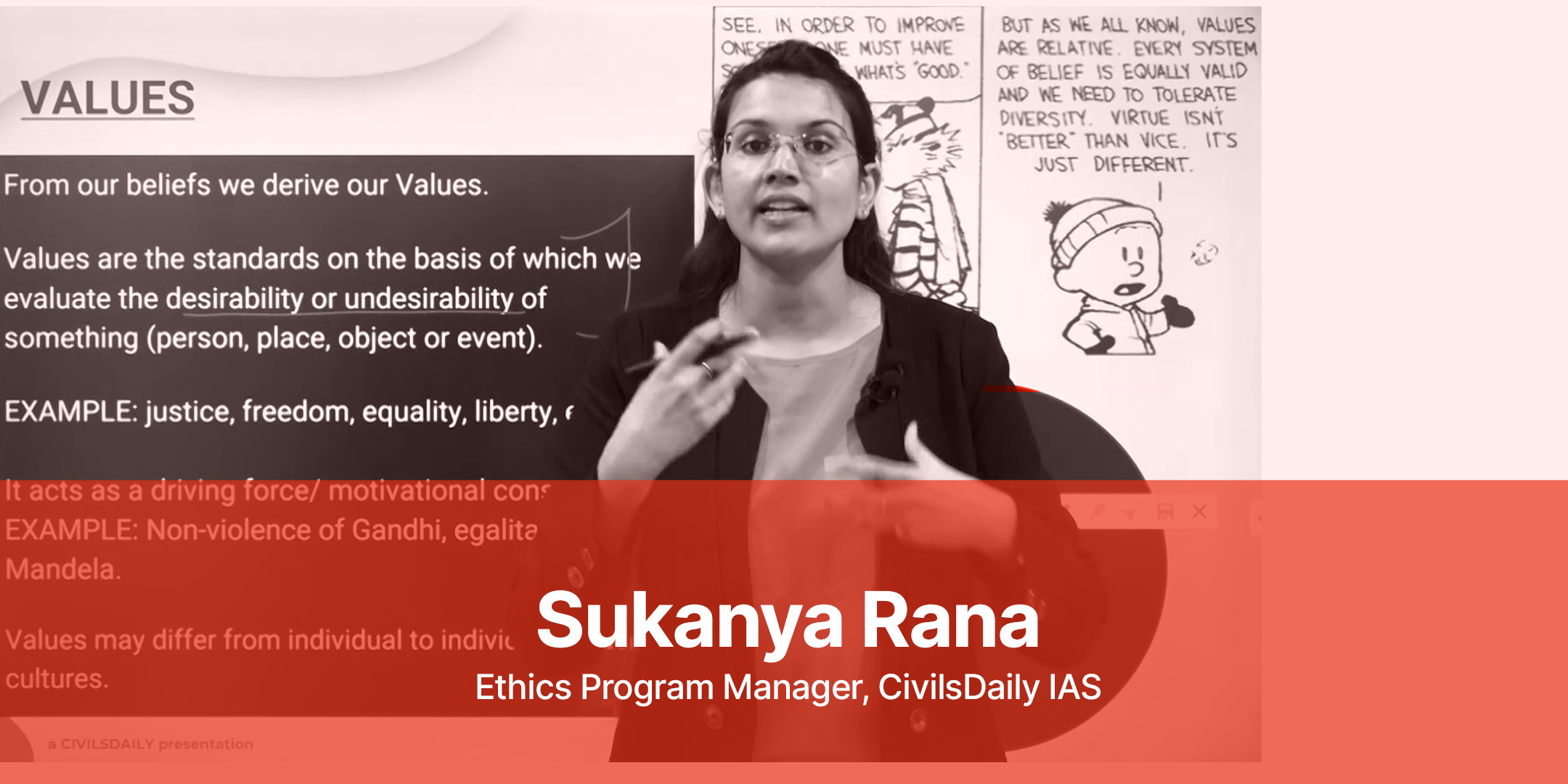
You’ll be given membership to an exclusive group on Civilsdaily’s Habitat. The group will be headed by Sukanya ma’am herself. From doubt resolution, discussion, personalized review of the mini test copies will be done by Sukanya ma’am only. Here you can directly connect with ma’am.
Ethics discussion on Habitat (For Masterclass a new and exclusive channel on Habitat will be formed)
Habitat is where everything comes together learning, doubt clearing, mentor’s support, and a focused community. You’re going to learn and discuss it like never before.
How will your queries be resolved?
The moment you have a query, you post it in the group. At 11 PM, 3 AM, doesn’t matter. No need to schedule a call, or drop an email. Just drop a chat. Once our team is up, it will be resolved.
More often than not, your peers will take part in your doubt discussions adding a lot of value.
Besides doubts, what else is there on Habitat?
An ecosystem for co-learning and active learning.
A highly motivated community to bring flexibility and consistency to your preparation.
Program inclusion
Comprehensive Video Lectures covering Paper 4
6 Mini test with dedicated days for test discussion
Personalized review and discussion of test copy by Sukanya ma’am
Membership of Ethics group (exclusive) on Civilsdaily’s Habitat
Planned case studies discussion
Doubt resolution session on every lecture on Habitat
Reviews will be provided in a week. (In the order of submission- First come first serve basis). In case the answer is submitted late the review period may get extended to two weeks.
*In case your answer is not reviewed in a week, reply to your answer saying *NOT CHECKED*. If Parth Sir’s tag is available then tag him.
For the philosophy of AWE and payment, check here: Click2Join
Reviews will be provided in a week. (In the order of submission- First come first serve basis). In case the answer is submitted late the review period may get extended to two weeks.
*In case your answer is not reviewed in a week, reply to your answer saying *NOT CHECKED*. If Parth Sir’s tag is available then tag him.
For the philosophy of AWE and payment, check here: Click2Join
The first full syllabus FLT is live and many have already attempted it. Today we will be having a discussion-cum-doubt solving session on an exclusive group (link shared via email) on Civildaily’s Habitat.
This discussion will be followed by Score Boosting Discussion by Zeeshan sir from 8:00 pm, and revision/doubt solving sessions by Ishika ma’am from 9:00 pm on Habitat’s General group.
If you are yet to attempt the first full syllabus test you can access the saved discussions later and ask doubts any time you want.
About Nikaalo Prelims 2020 FLTs
Based on Zeeshan sir’s Score Boosting Techniques discussions on Civilsdaily’s Habitat in the past few days, we have updated and redesigned Nikaalo Prelims FLTs.
There are 4 Full Syllabus, full-length tests. These tests are essential. Each test will be discussed on Habitat. Other than these we’re providing 4 theme-based revision tests and 3 CSAT tests.
Based on the UPSC paper our FLTs will rigorously test your preparedness and point out weak areas. It will give you the necessary reflection, direction, and confidence for the actual battle.
Prepared by our team, these papers closely resemble an actual UPSC paper.
All important and probable questions for UPSC Pre 2020 are going to be covered in our tests.
They will cover – Union Budget, Economic Survey, India Yearbook, Schemes, Acts, Organisations and Institutions (national and international).
Covering this part is a pain. We know. But there is no other way. We will help.
Around 50-55 questions are expected in the UPSC Prelims from these sections. Preparedness in this section will ensure your success in prelims. It can actually decide if you are writing Mains 2020 or not.


 Click here to fill the form: Samanvaya for IAS 2021