💥Join UPSC 2027,2028 Mentorship (July Batch) + XFactor Notes & Microthemes PDF

Category: Ranker Webinars

  • 5 phased time management for UPSC 2024 (March’23 to May’24) | LIVE Workshop + QnA session with Prabhat sir, AIR 377, IRPS | Get FREE Strategic package on registration

    5 phased time management for UPSC 2024 (March’23 to May’24) | LIVE Workshop + QnA session with Prabhat sir, AIR 377, IRPS | Get FREE Strategic package on registration

    12th March 2023 (Sunday), 7:30 P.M | 15 Months to UPSC 2024 divided into 5 phases for a holistic UPSC preparation.

    Most of the UPSC-CSE toppers like Satyam Gandhi (AIR 10), Ria Dabi (AIR 15), Yash Jaluka (AIR 4), Mamta Yadav (AIR 5) and Shashwat Tripurari (AIR 19) cleared the exam as fresh graduates in their very first attempt. How were they able to do it?

    If you watch their strategy videos, you can find a common pattern — they started 12-24 months in advance before the exam.

    One of the benefits of starting your preparation early is the time you would get to revise, practice test series, make improvements, enhance the quality of your knowledge and answers, and get four steps ahead of the competition.

    However, what’s the best way to prepare, if you aren’t a fan of making mistakes and figuring it out along the way? We understand how annoying it might be for you if you were to study in a certain way for months together and then realize that it doesn’t align with the UPSC-CSE way of doing things.

    An ideal prep is divided into five phases and spread across 14-15 months? Prabhat sir, an IRPS officer who secured AIR 377 in UPSC 2019, is conducting a special workshop on time management & strategy for UPSC 2024.

    Block this time:

    12th March 2023 (Sunday), 7:30 P.M

    What you should expect in 1-1 LIVE with Prabhat sir?

    The workshop will cover a five-phased time management strategy that will help you plan and utilize your time effectively in the next 15 months leading up to UPSC 2024. Prabhat will share his own experience of preparing for the exam while managing his job and personal life. He will also provide practical tips on how to prioritize your studies, make the most of your free time, and avoid burnout.

    1. The first phase – Studying the Core Subjects. How to read every topic in the syllabus from 2-3 sources in the first reading and prepare a 1-2 page notes? And in your second reading, stick to only one source while using your notes as reference.

    2. The second phase – Studying Mains Specific Subjects & Optional. How to follow the ritual of reading, writing summaries and answering topic-wise previous year questions?

    3. Discussing 2-3 Revision Strategies which you can follow. Why should you not go more than 20 days without revision?

    4. Live demonstration of making the perfect notes. How to not copy line-by-line of everything you read & only note down the 5 dimensions of a topic?

    5. Why is the third phase of preparation the shortest of all? What should you ideally do after completing the Prelims and Mains subjects?

    6. About the fourth phase. How to improve your accuracy 3 months before the Prelims exams?

    5. The last phase. What must be done 3 months before the Mains exams?

    6. Including statistics and relevant data. What are the subject-wise important committee reports you should read?

    7. Three readings per subject. How do you study during each revision phase?


    CivilsDaily’s FREE Webinar package

    Post-webinar we will share important PDFs, timetable framework, and notes.

    Other than this a strategy package will be emailed to you.


    What The Hindu opined about Civilsdaily Mentorship

    best coaching for upsc in delhi

    Register FREE for a 1-1 LIVE UPSC Masterclass by IRPS, Prabhat sir

  • Nikaalo Prelims Spotlight || Inflation, Banking and Monetary Policy

    Dear Aspirants,

    This Spotlight is a part of our Mission Nikaalo Prelims-2023.

    You can check the broad timetable of Nikaalo Prelims here

    Session Details

    YouTube LIVE with Parth sir – 1 PM  – Prelims Spotlight Session

    Evening 04 PM  – Daily Mini Tests

    Telegram LIVE with Sukanya ma’am – 06 PM  – Current Affairs Session

    Join our Official telegram channel for Study material and Daily Sessions Here


    10th Mar 2023

    Inflation, Banking and Monetary Policy

    Inflation

    Understanding Inflation

    Inflation: Inflation is when the overall general price level of goods and services in an economy is increasing. As a consequence, the purchasing power of the people are falling. 

    Inflation Rate: Inflation Rate is the percentage change in the price level from the previous period. 

    Inflation Rate= {(Price in year 2 – Price in year 1)/ Price in year 1} *100

    Whole sale Price Index: WPI is used to monitor the cost of goods and services bought by producer and firms rather than final consumers. The WPI inflation captures price changes at the factory/wholesale level.

    GDP Deflator: GDP Deflator is the ratio of nominal GDP to real GDP. The nominal GDP is measured at the current prices whereas the real GDP is measured at the base year prices. 

    The Difference

    Consumer Price Index GDP Deflator
    CPI reflects the price of goods and services bought by the final consumers. GDP deflator reflects the price of all the goods and services produced domestically.
    Example: Suppose the price of a satellite to be launch by ISRO increases. Even though the satellite is part of the GDP of India, but it is not a part of normal CPI index, since we don’t consume satellite. The price rise of the ISRO satellite will be reflected in GDP deflator.
    Similarly, India produces some crude oil, but most of the oil/petroleum is imported from the West Asia, as a result, when the price of oil/petroleum product changes, it is reflected in CPI basket as petroleum products constitute a larger share in CPI. The price change of oil products is not reflected much in the GDP deflator since we do not produce much crude oil.
    The CPI compares the price of a fixed basket of goods and services to the price of the basket in the base year. The GDP deflator compares the price of currently produced goods and services to the price of the same goods and services in the base year. Thus, the group of goods and services used to compute the GDP deflator changes automatically over time.

    Producer Price Index

    PPI measures the average change in the sale price of goods and services either as they leave the place of production or as they enter the place of production. Moreover, PPI includes services also.

    The PPI measure the price changes from the perspective of the seller and differs from CPI which measures price changes from buyer perspective.

    Causes of Inflation

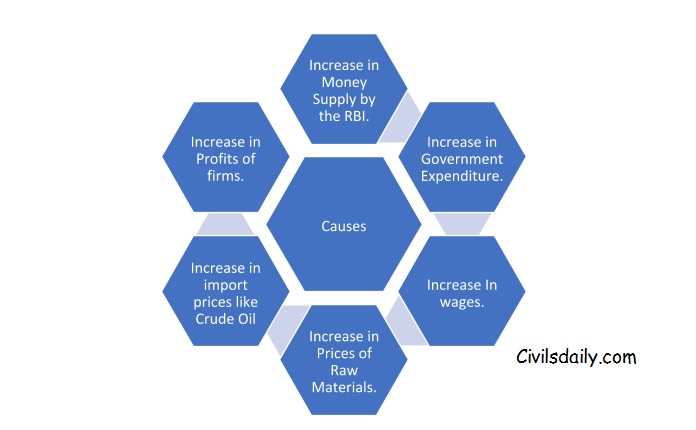
    Inflation is mainly caused either by demand Pull factors or Cost Push factors. Apart from demand and supply factors, Inflation sometimes is also caused by structural bottlenecks and policies of the government and the central banks. Therefore, the major causes of Inflation are:

    • Demand Pull Factors (when Aggregate Demand exceeds Aggregate Supply at Full employment level).
    • Cost Push Factors (when Aggregate supply increases due to increase in the cost of production while Aggregate demand remains the same).
    • Structural Bottlenecks (Agriculture Prices fluctuations, Weak Infrastructure etc.)
    • Monetary Policy Intervention by the Central Banks.
    • Expansionary Fiscal Policy by the Government.

    Demand and Supply factors can be further sub divided into the following:


    Inflationary Gap: the Inflationary gap is a situation which arises when Aggregate demand in an economy exceeds the Aggregate supply at the full employment level.

    Deflationary Gap: Deflationary Gap is a situation which arises when Aggregate demand in the economy falls short of Aggregate Supply at the full employment level.


    Stagflation:  The falling growth along with rising prices makes cost push inflation more dangerous than the demand-pull inflation. The situation of rising prices along with falling growth and employment is called as stagflation.

    Hyperinflation: Hyperinflation is a situation when inflation rises at an extremely faster rate. The rate of inflation can increase from 50 times to 300 times. The major causes of the hyperinflation are; government issuing too much currency to finance its deficits; wars and political instabilities and unexpected increase in people’s anticipation of future inflation.

    Structural Inflation

    • Structuralist Inflation is another form of Inflation mostly prevalent in the Developing and Low-Income Countries.
    • The Structural school argues that inflation in the developing countries are mainly due to the weak structure of their economies.

    Deflation: Deflation is when the overall price level in the economy falls for a period of time.Deflation is when, for instance, the price of a basket of goods has fallen from Rs 100 to Rs 80. It’s the reduction in overall prices of goods.

    Disinflation: Disinflation is a situation in which the rate of inflation falls over a period of time. Remember the difference; disinflation is when the inflation rate is falling from say 5% to 3%.

    Headline versus Core Inflation

    The headline inflation measure demonstrates overall inflation in the economy. Conversely, the core inflation measures exclude the prices of highly volatile food and fuel components from the inflation index.

    Core inflation excludes the highly volatile food and fuel components and therefore represents the underlying trend inflation. 


    Banking and Monetary Policy

    What is monetary policy?

    As the name suggests it is policy formulated by monetary authority i.e. central bank which happens to be RBI in case of India.

    It deals with monetary i.e money matters i.e. affects money supply in the economy.

    Eg. CRR,SLR,OMO,REPO etc

    What is fiscal policy then?

    It is formulated by finance ministry i.e. government. It deals with fiscal matters i.e. matters related to government revenues and expenditure.

    Revenue matters- tax policies, non tax matters such as divestment, raising of loans, service charge etc

    Expenditure matters– subsidies, salaries, pensions, money spent on creation of capital assets such as roads, bridges etc.

    Monetary policy and fiscal policy together deal with inflation.


    Let us now understand how RBI formulates monetary policy to control inflation

    It’s clear from what we have learnt so far that to control inflation, RBI will have to decrease money supply or increase cost of fund so that people do not demand goods and services.

    Tools available with RBI


    1. Quantitative tools or general tools- they affect money supply in entire economy- housing, automobile, manufacturing, agriculture- everything.

    They are of two types

    1. Cash Reserve Ratio (CRR)– as the name suggests, banks have to keep this proportion as cash with the RBI. Bank cannot lend it to anyone. Bank earns no interest rate or profit on this.Bank cannot lend it to anyone. 
    2. Statutory Liquidity Ratio (SLR)-  As the name indicates banks have to set aside this much money into liquid assets such as gold or RBI approved securities mostly government securities. Banks earn interest on securities but as yield on govt securities is much lower banks earn that much less interest.

    RBI Tools for Controlling Credit/Money Supply

    Broadly speaking, there are two types of methods of controlling credit.


    Measure of Money Supply in India

    M1 M2 M3 M4
    It is also known as Narrow Money. It is a broader concept of the money supply. It is also known as Broad Money. M4 includes all items of M3 along with total deposits of post office saving accounts.
    M1= C+DD+OD


    C= Currency with Public.

    DD= Demand Deposit with the public in the Banks.

    OD= Other Deposits held by the public with RBI.

    M2= M1 + Saving deposits with the post office saving banks.


    M1 is distinguished from M2 because the post office saving deposits are not as liquid as Bank deposits.

    M3 = M1+ Time Deposits with the Bank.


    Time deposits serve as a store of wealth and represent a saving of the people and are not as liquid as they cannot be withdrawn through cheques or ATMs as compared to money deposited in Demand deposits.

    M4= M3+Total Deposits with Post Office Saving Organisations.


    M4 however, excludes National Saving Certificates of Post Offices.

    It is the most liquid form of the money supply.   M3 is the most popular and essential measure of the money supply. The monetary committee headed by late Prof Sukhamoy Chakravarty recommended its use for monetary planning in the economy. M3 is also called Aggregate Monetary Resource  


  • [Sansad TV] Drones in Defence Sector

    [Sansad TV] Drones in Defence Sector

    In this edition of ‘The Defenders” experts discuss the importance of drones in the Indian defence sector, Indian drone policy and its implications.

    Context

    • As the role of unmanned aerial vehicles (UAVs) continues to grow in all sectors of society, new applications for drones in security and defence continue to emerge.
    • While the possibilities presented by drones in the theatre of war have already been explored, more research is now being undertaken into their potential for improving security.

    What are Drones?

    • Drones, also known as UAVs are aircraft that are flown without a human pilot on board.
    • They can be controlled remotely by a human operator or can be programmed to fly autonomously using onboard computers and sensors.
    • Drones come in a variety of shapes and sizes, ranging from small, hand-held models to larger, more complex aircraft capable of carrying payloads such as cameras, sensors, and weapons.
    • They can be powered by various sources, including electricity, gas, or other fuels, depending on their size and purpose.

    What are the types of Military Drones?

    drone

    There are a few different types of drones used in militaries around the world:

    1. Fixed-wing: They are the fastest military UAV currently deployed worldwide. These drones are designed to take off and land like aeroplanes, using wings instead of rotors for lift.
    2. Single-rotor: They look similar to helicopters and are more durable than other drones. While they can be more efficient than different types of drones, they require more maintenance.
    3. Multirotor: These drones are the most straightforward option that provides the best control over positioning and framing. Because of this, they are the best choice for surveillance and reconnaissance.

    How are Drones changing military warfare?

    Drones have improved military capabilities around the world in many ways. It will also continue to change military warfare through the following:

    • Better Reconnaissance, Surveillance, and Target Acquisition (RSTA): Drones provide real-time information on targets’ positions, terrain, and enemy movements to commanders on the ground.
    • Reduced Cost: Drones are cheaper than conventional aircraft in terms of both price and maintenance.
    • Crew safety: Because drones are unmanned, they also reduce the risk of pilots being injured mid-flight.
    • Faster deployment: Compared to conventional aircraft, drones are faster and easier to deploy. They are easier to operate and don’t need training as extensive as most aircraft. Many drones don’t need a runway, and other types can easily fit in a backpack.
    • Increased flexibility: While the military-industrial complex has developed technology that prioritizes this need, drones are the best example. On top of this, drones can even be fully automated.
    • Improved Situational Awareness: Drones can provide military commanders with real-time video and other intelligence data, giving them a better understanding of the battlefield and enemy movements.

    Combat importance of drones

    As a result, more military forces are looking to use drones to increase their combat and surveillance capacity. These are the most common roles UAVs fulfil:

    • Reconnaissance: Drones can conduct surveillance missions by hovering over an area for an extended period.
    • Command and Control: Drones can relay crucial information on enemy movements, locations, and positions of strategic targets. This information allows commanders to be more efficient and make better decisions when in the field.
    • Combat and Combat Support: Unmanned vehicles play a huge role in performing combat and combat support missions. Built-in targeting software allows operators to hit their targets with greater precision and accuracy.
    • Targeted strikes: UAVs can be used for target practice or for training exercises by operators to improve their accuracy. Drones’ built-in targeting software is customizable to detect and respond to targets automatically.
    • Logistics:  Drones can be used as military-industrial couriers and assist in delivering valuable supplies and equipment. They can also help evacuate injured personnel.
    • Search and Rescue: Drones can be equipped with thermal imaging cameras and other sensors to aid in search and rescue operations, helping to locate lost or injured personnel.
    • Drones as Target Decoys: There are times when a defense strategy may require using drones as target decoys to mislead its opponents and launch an attack from another direction.

    Drone regulation in India

    These rules are built on the premise of trust, self-certification, and non-intrusive monitoring. The policy is designed to usher in an era of super-normal growth while balancing safety and security considerations.

    drone

    Significant applications of Drone Technology

    Drones are a transformative technology. They have been and can be used in various areas such as:

    • Land mapping: The drone technology in the SVAMITVA scheme has helped about half a million village residents to get their property cards by mapping out the areas.
    • Emergency response: Drones are significant for the agencies such as the fire and emergency services wherever human intervention is not safe. It can perfectly save human efforts during disaster management.
    • Distant and remote delivery purposes: Recently, the Ministry of Civil Aviation has approved a project with the Telangana government for using drone technology to deliver vaccines in remote areas.
    • Agriculture: In the agriculture sector, micronutrients, and hazardous pesticides can be spread with the help of drones. It can also be used for performing surveys for identifying the challenges faced by the farmers.
    • E- Commerce: Drones offer a perfect and cost-effective solution for delivery of products by e-com facilitators.
    • Monitoring: The railways are using drones for track monitoring. Telecom companies are using drones for monitoring the tower.
    • Security and defence: Drone system can be used as a symmetric weapon against terrorist attacks. They can be integrated into the national airspace system.

    Threats posed by Drones

    drone

    The operation of drones without any adequate legal backing can pose several security threats.

    • Espionage: Drones can be stealthily used for spying purposes.
    • Terror sponsoring: Procurement of combat drones by non-state actors poses serious threats.
    • Stealth in warfare: Drones can easily escape security checks due to its compact size.
    • Easy available weapons: Given the easy availability of advanced technology to the common man at a reduced cost and the proliferation of information via the Internet, this threat will invariably grow.
    • Destruction of security apparatus: They can be put to destructive use, to slam into critical targets, destroy infrastructure and so on.
    • Smuggling of arms: Incidents of arms being dropped by drones are also there such as the recent Jammu drone attacks.

    Why are drones such stealthy?

    • Radar complicacies: Conventional air defense systems are less effective against drones and military radars are designed to track larger, fast-moving aircraft and cannot always pick up small, slow, low-flying drones.
    • Feasibility of securitization: It is not cost effective to use expensive anti-aircraft systems to shoot down these drones, which are typically cheap and can be easily devised.
    • Eyespoting not possible every time: Currently, border forces in India largely use eyesight to spot drones and then shoot them down. Drones can be easily disguised as bird or any other un-identified flying object.

    India’s vulnerability: Terror sponsoring neighborhood

    • India is always subjected to continuous threats of cross-border terrorism, drug trafficking and arms trafficking from Pakistan. 
    • Sighting of drones near the India-Pakistan border and the Line of Control has been frequent these days. 
    • We often get to hear news about Punjab Police seizing drones that dropped arms consignment, and narcotic drug supplies from Pakistan.
    • There were many drone-dropped arms consignments seized by the Indian police and security forces.

    Way forward

    • As technology advances, security architects and countries have taken cognizance of this fact and are working on the technological as well as policy fronts to counter it.
    • The Defence Research and Development Organisation (DRDO) has developed a detect-and-destroy technology for drones, but it is not yet into mass production.
    • GPS technology can be imbibed and be inbuilt in drones so that they cannot enter in non flying area.
    • For installations such as oil refineries, power stations or military station a ‘mid segment model’ that includes primary and passive detection and soft kill options can be adopted.

    Conclusion

    • Modern drones, in the hands of terrorists, could cause considerable panic and damage if not countered adequately.
    • Though drones pose a sub-tactical threat, it requires a strategic response. Entire threat perception has to be relooked.
    • It is essential to ensure that the security measures are set up in time so as to avoid any untoward occurrence or a major catastrophe.

    Are you an IAS Worthy Aspirant? Get a reality check with the All India Smash UPSC Scholarship Test

    Get upto 100% Scholarship | 900 Registration till now | Only 100 Slots Left

  • How to start answer writing FROM SCRATCH for UPSC Mains 2024? 10 Best practices our MEP program students followed | LIVE 1-1 Masterclass by Sukanya Ma’am | FREE Strategic Package on registration

    How to start answer writing FROM SCRATCH for UPSC Mains 2024? 10 Best practices our MEP program students followed | LIVE 1-1 Masterclass by Sukanya Ma’am | FREE Strategic Package on registration

    How to start answer writing FROM SCRATCH for UPSC & State PSC Mains 2024?

    According to Dr. Vishwa Shah, “Success does not lie in Results but Efforts, Being the best is not so important, Doing the best is all that matters..”

    When she notices a large number of aspirants around her who are anxious, nervous, or panicked, she joined Civilsdaily’s MEP Program and owned a compact experience and overall strategies which helped her to clear UPSC Mains twice (2020,2022) and cracked GPSC in her 1st attempt (2021) with a Rank of 98. Currently, she is a Probationary Deputy Superintendent of Police.

    Dr. Visha Shah

    According to her, starting answer writing early is the only reality and unavoidable truth behind sure success. However, focusing on small improvements, habits, and changes will eventually lead to bigger things.

    Even with numerous things pending, you can still pass the UPSC and State PSC exams if you prepare in an organized, measured, and progressive manner. Nobody goes into this exam fully prepared. It all depends on how you write it down.

    As a responsible Mentor cum teacher of many students like Dr. Vishwa Shah, Sukanya Ma’am (MEP Program Head) is conducting a FREE LIVE webinar to understand How to start answer writing FROM SCRATCH for UPSC/State PSC Mains 2024

    Date & Time: 11th March 2023 (Saturday), 8:30 P.M

    Ma’am will demonstrate LIVE How to start answer writing FROM SCRATCH for UPSC Mains 2024. She will also discuss, how to enjoy and learn answers writing for the UPSC Mains examination when it can be very confusing and stressful for other candidates.

    What you should expect in 1-1 LIVE with Sukanya Ma’am?

    • What are the 10 best practices my ranker students follow when they start from scratch?
    • Why it’s the very right time to start answer writing for UPSC mains 2024?
    • What are the benefits of attempting more mock tests for the UPSC Mains exam?
    • How state services also need more expertise in answer writing
    • How to connect current affairs and how to insert examples, and illustrations in your answers?
    • How to approach current affairs charged questions in UPSC Mains?
    • How frequently should you practice answer writing for UPSC Mains to become mains writing savvy in a very short time?
    • What are the 753 Rules for Mains answer writing that every topper follows in their preparation phase?

    The workshop will be an opportunity for UPSC & State PSC aspirants for 2023 exam and 2024, who want to clear the Mains exam in just one attempt, to learn from the best and gain a competitive edge in their preparation for the exam.

    The Practical LIVE session will focus on the importance of the Mains exam strategy, covering a wide range of topics such as time management, and effective Answer writing techniques to clear the UPSC Mains exam.


    CivilsDaily’s FREE Webinar package

    Post-webinar we will share important PDFs, timetable framework, and notes.

    Other than this a strategy package will be emailed to you.


    What The Hindu opined about Civilsdaily Mentorship

    best coaching for upsc in delhi

    Register FREE for a 1-1 LIVE UPSC Masterclass by Sukanya Rana Ma’am, CD Mains Program Head.

  • Nikaalo Prelims Spotlight || National Income, Inclusive Growth and other Social Sectors related Schemes

    Dear Aspirants,

    This Spotlight is a part of our Mission Nikaalo Prelims-2023.

    You can check the broad timetable of Nikaalo Prelims here

    Session Details

    YouTube LIVE with Parth sir – 1 PM  – Prelims Spotlight Session

    Evening 04 PM  – Daily Mini Tests

    Telegram LIVE with Sukanya ma’am – 06 PM  – Current Affairs Session

    Join our Official telegram channel for Study material and Daily Sessions Here


    9th Mar 2023

    National income, inclusive growth and other social sector related schemes 

    National Income

    National income accounting refers to the set of methods and principles that are used by the government for measuring production and income, or in other words economic activity of a country in a given time period.

    The various measures of determining national income are GDP (Gross Domestic Product), GNP (Gross National Product), and NNP (Net National Product) along with other measures such as personal income and disposable income.

    National income accounting equation is an equation that shows the relationship between income and expense of an economy and other categories. It is represented by the following equation:

    Y = C + I + G + (X – M)

    Where

    Y = National income

    C = Personal consumption expenditure

    I = Private investment

    G = Government spending

    X = Net exports

    M = Imports

    The most important metrics that are determined by national income accounting are GDP, GNP, NNP, disposable income, and personal income.

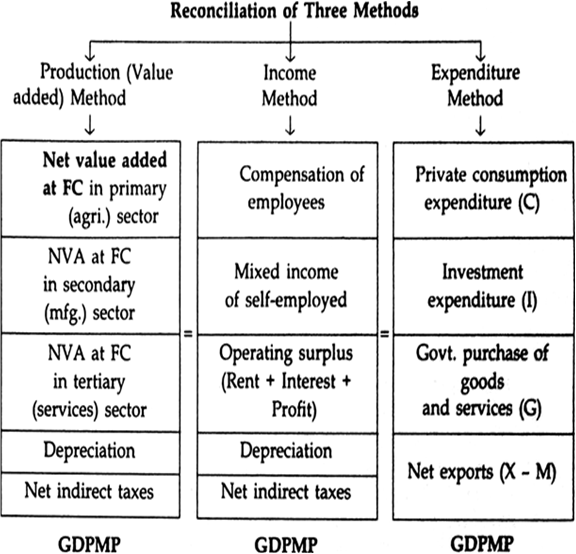
    Methods of measuring National income

    How is equality of three methods? Reconcile three methods of measuring  national income. from Economics National Income Accounting Class 12 Haryana  Board - English Medium


    Issues associated with National Income accounting in India

    (A) Problems in Income Method:

    • Owner-occupied Houses
    • Self-employed Persons
    • Goods meant for Self-consumption
    • Wages and Salaries paid in Kind

    (B) Problems in Product Method:

    • Services of Housewives
    • Intermediate and Final Goods
    • Second-hand Goods and Assets
    • Illegal Activities
    • Consumers’ Service
    • Capital Gains
    • Inventory Changes
    • Depreciation
    • Price Changes

    (C) Problems in Expenditure Method:

    • Government Services
    • Transfer Payments
    • Durable-use Consumers’ Goods
    • Public Expenditure

    Inclusive growth

    • As per OECD (Organisation for Economic Co-operation and Development), inclusive growth is economic growth that is distributed fairly across society and creates opportunities for all.
    • UNDP has described inclusive growth as “the process and the outcome where all groups of people have participated in growth and have benefited equitably from it”.
    • It lessens the fast growth rate of poverty in a country and upsurges the participation of people into the development of the country.

    Salient Features of Inclusive Growth

    • Address the constraints of the excluded and marginalised.
    • Participation from all sections of society
    • Reduction in disparities among per capita incomes between different sectors and sections of society.
    • Non – discriminatory
    • Higher potential of poverty reduction
    • Ensure access of people to basic infrastructure and basic services/capabilities such as basic health and education.
    • Include poor, lagging socio – economic groups and lagging regions as well as they are partners in this growth.

    Dimensions of Inclusive Growth

    1. Equality
    2. Good Governance
    3. Decentralization
    4. Accountability and Transparency
    5. Sustainability
    • Financial Sustainability
    • Social Sustainability
    • Environment Sustainability

    Social Sector related schemes

    The list of schemes can be found here

    https://www.civilsdaily.com/type/govt-schemes/


  • Mastering the science of METHODICAL PYQ ANALYSIS to predict UPSC Prelims questions for 2023 & 2024 Exams | LIVE 1-1 Masterclass by Zeeshan sir | FREE Strategic Package on registration

    Mastering the science of METHODICAL PYQ ANALYSIS to predict UPSC Prelims questions for 2023 & 2024 Exams | LIVE 1-1 Masterclass by Zeeshan sir | FREE Strategic Package on registration

    Concluded Successfully

    Register for Recorded video of UPSC Workshop for UPSC 2023 & 2024 | Make your UPSC Prelims 2023/2024 Prep effective and result oriented


    UPSC has been termed very often as Unpredictable Public Service Commission due to its tendency of shocking aspirants year after year. But do you know there UPSC Prelims questions can be actually predicted?

    Zeeshan sir shared a video recently in which he demonstrated how through methodical PYQ analysis one can predict at least 1/3rd of the paper and themes that will be asked in the paper.

    https://youtu.be/Ori9XcksfEM

    Most of the UPSC aspirants, especially those who are freshers and going to sit for UPSC Prelims 2023 and 2024, have reached out to us for help in Mastering the science of METHODICAL PYQ ANALYSIS to predict UPSC Prelims questions. So we’re going to conduct a detailed Practical LIVE video tutorial to help you choose the right way to analyze PYQs just after finishing the 1st reading!

    Zeeshan sir will demonstrate LIVE how he used the power of METHODICAL PYQ ANALYSIS to predict around 42 questions in UPSC Prelims 2022. And Mastering these techniques, you can predict even more questions for the UPSC Prelims 2024.

    What you should expect in Zeeshan Sir’s LIVE session?

    • What is the science of METHODICAL PYQ ANALYSIS to predict UPSC Prelims questions and What 10 things you must master to secure prelims 2023?
    • How to start analyzing PYQ just after understanding the syllabus and 1st reading of static subjects for UPSC-CSE 2024?
    • What is/are the best sources to read, learn and analyze PYQs?
    • How can you definitely get at least 1/3rd questions/MCQs as per your analysis?
    • Most Authenticate and important UPSC Prelims Hack.
    • How to fill critical gaps in your Prelims preparation?
    • Avoiding pitfalls in your preparation, especially 2.5 months before prelims.
    • Solve Prelims MCQs with elimination techniques
    • How and what topics of current affairs you must revise before the very eve Prelims?

    CivilsDaily’s FREE Webinar package

    Post-webinar we will share important PDFs, timetable framework, and notes.

    Other than this a strategy package will be emailed to you.


    What The Hindu opined about Civilsdaily Mentorship

    best coaching for upsc in delhi

    Register FREE for Recorded video for UPSC Workshop by Zeeshan Hashmi, Senior IAS Faculty, Civilsdaily

  • Celebrating Holi with Civilsdaily | 30% OFF on UPSC programs | Hurry! The offer ends on 9th March

    Celebrating Holi with Civilsdaily | 30% OFF on UPSC programs | Hurry! The offer ends on 9th March

    Call directly and avail 50% discount at +91 7303316700

    Hello, UPSC aspirants!

    Are you ready to add some color to your UPSC preparation journey? Because we sure are! As the festival of Holi approaches, we at CivilsDaily IAS want to make your celebrations even more colorful.

    As a token of appreciation for being a part of our learner’s community and to mark the occasion, we are offering upto 30% off on all UPSC programs including IAS Foundation programs (10% flat on Dominate Prelims 2023 program)

    Whether you’re a UPSC beginner, a veteran, or an aspirant trying to improve your rank, we have something for everyone. And with the added benefit of the discount, now is the perfect time to gear your preparation in the right direction.

    But wait, there’s more! if we could have added a pack of organic, eco-friendly Holi colors we would have, but, let us sweeten the deal. If you refer a friend to our courses, you both get an additional 10% off on your enrollment. It’s a win-win situation!

    In conclusion, let’s make this Holi a memorable one by not only celebrating with colors but also by taking a step toward achieving our career goals. With our UPSC courses and this special offer, you can have a colorful, joyous, and fruitful journey toward Indian administrative services.

    Wishing you all a Happy Holi! May your lives be filled with colors, laughter, and success.


    • 🎁30% flat discount on IAS 2023-2024 programs
    • ✌️10% flat OFF on Dominate Prelims program
    • Additional 10% OFF if you enroll with your friend

    Limited time offer: 7th to 9th March 2023

    Call directly and avail 50% discount at +91 7303316700


  • Nikaalo Prelims Spotlight || Important Constitutional Amendements, Recent Acts passed

    Dear Aspirants,

    This Spotlight is a part of our Mission Nikaalo Prelims-2023.

    You can check the broad timetable of Nikaalo Prelims here

    Session Details

    YouTube LIVE with Parth sir – 1 PM  – Prelims Spotlight Session

    Evening 04 PM  – Daily Mini Tests

    Telegram LIVE with Sukanya ma’am – 06 PM  – Current Affairs Session

    Join our Official telegram channel for Study material and Daily Sessions Here


    7h Mar 2023

    Important Constitutional amendments 

    Following Are The Major Amendments Made In The Constitution

    First Amendment Act, 1951

    1. It empowers the states to make socio-economic justice with socially and economically backward classes.
    2. It was aimed at land reforms and Zamindari abolition.
    3. Added the ninth schedule to protect anti-zamindari laws from judicial review.
    4. Added public order, friendly relations with foreign states, and incitement to an offense as the additional grounds for reasonable restrictions on the freedom of speech and expression. It also made it justiciable.
    5. It provided that state trading and nationalization of any business would not be considered against the right to trade or business.

    Fourth Amendment Act, 1955

    1. Empowered state to nationalize any trade.
    2. Provided that the compensation amount given by the state for the acquisition of property, can not be challenged in court on the grounds of insufficiency.
    3. Added more laws in the ninth schedule and expanded the scope of article 31 (C).

    Seventh Amendment Act, 1956

    1. Reorganized the Indian states as 14 states and 6 UTs. Abolished the old A, B, C, and D categorization of states.
    2. Provided the common high court for two or more states, and extended the jurisdiction of HC to UTs. Also provided additional acting judges to HC

    Ninth Amendment Act, 1960

    1. Provided for the cession of the Indian territory named Berubari Union ( West Bengal) to Pakistan as a commitment made under the Indo-Pakistan Agreement (1958). (The amendment was made for the reason that, under article 3, the parliament can alter the area of a state, however, it does not include the cession of Indian territory to a foreign state. It can only be done by amending the constitution itself.)

    Tenth Amendment Act, 1961

    Acquired the Dadra, Nagar and Haveli as a Union Territory from Portugal.

    Eleventh Amendment Act, 1961

    1. Provided the new procedure of election for the vice president by introducing an electoral college.
    2. Also clear that any vacancy in the appropriate electoral college would not be the reason to challenge the election of the President or vice president.

    Twelfth Amendment Act, 1962

    Added Goa, Daman and Diu to the Indian Union.

    Thirteenth Amendment Act, 1962

    Made Nagaland a state and provided special provisions for it.

    Fourteenth Amendment Act, 1962

    1. Added Puducherry to the Indian Union.
    2. The Union Territories of Himachal Pradesh, Manipur, Tripura, Goa, Daman and Diu, and Puducherry are provided with legislatures and a council of ministers.

    Seventeenth Amendment Act, 1964

    1. Made fair compensation (based on market value) compulsory for the state for the acquisition of privately cultivated land.
    2. Added 44 other Acts in the Ninth Schedule.

    Eighteenth Amendment Act, 1966

    1. provided that the Parliament can form a new state by uniting a part of a state or a union territory to another state or union territory.
    2. Created Punjab and Haryana as new states.

    Twenty-First Amendment Act, 1967

    Added Sindhi as the 15th language in the Eighth Schedule.

    Twenty Fourth Amendment Act, 1971

    This Amendment Act was brought in the aftermath of the Golaknath case (1967) in which the Supreme Court held that the Parliament could not take away any fundamental rights through the constitutional amendment.

    1. It made it clear that the parliament has the power to amend any part of the constitution including article 13 by using article 368.
    2. Made it obligatory for the President to give assent to a Constitutional Amendment Bill.

    Twenty-Fifth Amendment Act, 1971

    1. Curtailed the fundamental right to property.
    2. It made it clear that a law made to fulfill the provisions of the Directive Principles contained under Article 39 (b) or (c) cannot be challenged on the ground it violates the fundamental rights given in Articles 14, 19, and 31.

    Twenty-Sixth Amendment Act, 1971

    It removes the privy purses and privileges of the former monarchical rulers of princely states.

    Thirty First Amendment Act, 1973

    Reason for the Amendment:

    1. An increase in the population of India was revealed in the Census of 1971.
    2. Increased the number of Lok Sabha seats from 525 to 545.

    Thirty-Third Amendment Act, 1974

    It changed Articles 101 and 190 and provided that The Chairman/Speaker of the house can reject the resignation of MP if he found it ingenuine or non-voluntary.


    Thirty-Fifth Amendment Act, 1974

    1. It changed the protectorate status of Sikkim and assigned it a status of an associate state of the Indian Union.
    2. The Tenth Schedule was added to fix the terms and conditions of such engagement of Sikkim with the Indian Union.

    Thirty-Sixth Amendment Act, 1975

    Gave a full-fledged State status to Sikkim and repealed the Tenth Schedule.

    Thirty-Eighth Amendment Act, 1975

    1. Provided that the declaration of emergency by the President can not be challenged in a court of law.
    2. Provided that the promulgation of ordinances by the President, governors, and administrators of Union territories can not be challenged in a court of law.
    3. Provided that the President could declare different proclamations of national emergency on different grounds simultaneously.

    Forty-second Amendment Act, 1976

    It is also known as the ‘ Mini-constitution’, as it made very comprehensive changes to the constitution of India.

    1. It amended the preamble and added the words – socialist, secular, and integrity.
    2. Added Fundamental Duties for the citizens by including new Part IV A.
    3. Exclusively made cabinet advice binding on the president.
    4. By adding Part XIV A, it provided for administrative tribunals and tribunals for other matters
    5. It froze the seats for the Lok Sabha and state legislative assemblies census till 2001, on the basis of 1971.
    6. Restricted the judicial review for the constitutional amendment act.
    7. Limited the power of judicial review and writ jurisdiction of the Supreme Court and high courts.
    8. Increased the tenure of Lok Sabha and state legislative assemblies from 5 to 6 years.
    9. Included new Directive Principles – (a) equal justice and free legal aid, (b) participation of workers in the management of industries, and (c) protection of the environment, forests, and wildlife.
    10. Provided the proclamation of national emergency now for a part of the territory of India.
    11. Raised the one-time duration of the President’s rule in a state from earlier 6 months to one year.
    12. Created the All-India Judicial Service.

    Forty-four Amendment Act, 1978

    This was also the comprehensive amendment which was mainly brought to undo the actions of the 42nd amendment. It also introduced some important provisions.

    1. Changed the term of the Lok Sabha and the state legislative assemblies again to the original 5 years.
    2. Provided the president can send back the advice of the cabinet for reconsideration.
    3. changed the phrase “internal disturbance” with “armed rebellion” as a ground to proclaim a national emergency.
    4. Removed the right to property from the list of Fundamental Rights and provided it only as a legal right.
    5. Provided that fundamental rights under articles 20-21 can not be suspended during a national emergency.

    Fifty-second Amendment Act, 1985

    The Tenth schedule was added as a measure to the anti-defection issues.

    Sixty-First Amendment Act, 1989

    The legal voting age changed from 21 to 18 years for Lok Sabha as well as Legislative Assemblies.

    Sixty-ninth Amendment Act 1991

    1. It provided a special status to Delhi as the ‘National Capital Territory of Delhi.’
    2. Provided a legislative assembly and the council of ministers for Delhi.

    Seventy-first Amendment Act 1992

    Added Konkani, Manipuri, and Nepali languages in the Eighth Schedule.

    Seventy-Third Amendment Act 1992

    1. Provided constitutional status for the Panchayati Raj institutions.
    2. Added Part-IX and 11th Schedule

    Seventy-fourth Amendment Act 1992

    1. Provided constitutional status for the Urban local bodies.
    2. Part IX-A and the 12th Schedule were added.

    Eighty-sixth Amendment Act 2002

    1. Provided the Right to Education as a fundamental right (part III of the Constitution).
    2. The new article inserted Article 21A which made free and compulsory education for children between 6-14 years.
    3. Added a new Fundamental Duty under Article 51 A.

    Eighty-eighth Amendment Act 2003

    Provided Service Tax under Article 268-A – which was levied by Union and collected and appropriated by the Union as well as the States.

    Ninety-second Amendment Act 2003

    Added Bodo, Dogri (Dongri), Maithili, and Santhali in the Eighth schedule

    Ninety-fifth Amendment Act 2009

    Provided for the extended reservation for the SCs and STs and special representation to the Anglo-Indian community in the Lok Sabha and the state legislative assemblies for ten more years (Article 334).

    Ninety-seventh Amendment Act 2011

    1. Part IX-B added to the constitution for cooperative societies and made it a constitutional right.
    2. The right to form cooperative societies became a fundamental right under Article 19.
    3. Article 43-B was inserted as a DPSP to promote cooperative societies.

    101st Amendment Act, 2016

    Provided for Goods and Service Tax (GST).

    102nd Amendment Act, 2018

    The National Commission for Backward Classes (NCBC) became a constitutional body.

    103rd Amendment Act, 2019

    Granted 10% Reservation for Economically Weaker Sections of citizens of classes other than the classes mentioned in clauses (4) and (5) of Article 15

    104th Amendment Act, 2020

    Changed the reservation of seats for SCs and STs in the Lok Sabha and state assemblies from Seventy years to Eighty.

    Ended the reservation of seats for the Anglo-Indian community in the Lok Sabha and state assemblies.

    Recent Acts passed

    1. New Delhi International Arbitration Centre
    (Amendment) Act, 2022
     
    2. Energy Conservation (Amendment) Act, 2022
     
    3. Wildlife Protection (Amendment) Act, 2022
     
    4. Constitution (Scheduled Tribes) Order (Second
    Amendment) Act, 2022
     
    5. Central Universities (Amendment) Act, 2022
     
    6. Delhi Municipal Corporation (Amendment)
    Act, 2022
     
    7. Criminal Procedure (Identification) Act, 2022
     
    8. Chartered Accountants, the Cost and Works
    Accountants and the Company Secretaries (Amendment) Act, 2022
     
    9. Constitution (Scheduled Tribes) Order (Amendment)
    Act, 2022
     
    10. National Anti-Doping Act, 2022
     
    11. Weapons of Mass Destruction and their Delivery Systems (Prohibition of Unlawful Activities) Amendment Act, 2022
     
    12. Indian Antarctic Act, 2022
     
    13. Family Courts (Amendment) Act, 2022
     
    14. Constitution (Scheduled Castes and Scheduled Tribes)
    Orders (Amendment) Act, 2022
     
    15. Constitution (Scheduled Tribes) Order (Fourth
    Amendment) Act, 2022.
     
    Refer website https://prsindia.org/acts/parliament?title=&year=2022 to read more about the acts passed in 2022 and 2023.


  • (Get recorded videos) 3-Day UPSC workshop: 5-phased UPSC schedule management, Methodical Prelims MCQ analysis, and Mains Answer writing from Level ‘0’ | Register 1-1 LIVE With UPSC ranker and Senior IAS mentors | FREE Strategic Package on registration

    (Get recorded videos) 3-Day UPSC workshop: 5-phased UPSC schedule management, Methodical Prelims MCQ analysis, and Mains Answer writing from Level ‘0’ | Register 1-1 LIVE With UPSC ranker and Senior IAS mentors | FREE Strategic Package on registration

    3-Day UPSC Workshop for UPSC 2023 & 2024 | Make your UPSC Prep effective and result oriented


    UPSC aspirants, gear up for the MEGA session this coming weekend. We have 3-Day UPSC Workshop in which we will have senior IAS mentors and Rankers to help you learn essential UPSC skills.

    It is not the lack of resources or time but a glaring gap in the ability to apply the resources to your prep. Doesn’t matter if you are a beginner or a veteran, this is a session you can’t afford to miss.

    Be it answer writing, time-management and target setting, MCQ and PYQ analysis there is a way to it, a skill, that could be learned, practiced and perfected.

    This 3-day Workshop is for both UPSC 2023 and 2024 candidates. It’s a special workshop to focus on introspecting & improving that lead to progress.


    Day 1Mastering the science of METHODICAL PYQ ANALYSIS to predict UPSC Prelims questions

    By Zeeshan Hashmi, Senior IAS mentor, Civilsdaily

    10th March 2023 (Friday), 7:30 P.M

    Zeeshan sir will demonstrate LIVE how he used the power of METHODICAL PYQ ANALYSIS to predict around 45 questions in UPSC Prelims 2023. And Mastering these techniques, you can predict even more questions for the UPSC Prelims 2024.

    Zeeshan sir will also discuss with a LIVE example for 2024 candidates how to start PYQ analysis just after the first reading of static subjects.

    What you should expect on Day 1?

    • What is the science of METHODICAL PYQ ANALYSIS to predict UPSC Prelims questions and What 10 things you must master to secure prelims 2023?
    • How to start analyzing PYQ just after understanding the syllabus and 1st reading of static subjects for UPSC-CSE 2024?
    • Most Authenticate and important UPSC Prelims Hack.
    • How to fill critical gaps in your Prelims preparation?
    • Avoiding pitfalls in your preparation, especially 2.5 months before prelims.
    • Solve Prelims MCQs with elimination techniques
    • How and what topics of current affairs you must revise before the very eve Prelims?

    Day 2How to start answer writing FROM SCRATCH for UPSC Mains 2024?

    By Sukanya Rana, Mains Program Head, Civilsdaily

    11th March 2023 (Saturday), 7:30 P.M

    Sukanya Ma’am will demonstrate LIVE How to start answer writing FROM SCRATCH for UPSC Mains 2024. She will also discuss, how to enjoy and learn answers writing for the UPSC Mains examination when it can be very confusing and stressful for other candidates.

    What you should expect on Day 2?

    • What are the 10 best practices my ranker students follow when they start from scratch?
    • Why it’s the very right time to start answer writing for UPSC mains 2024?
    • How to connect current affairs and how to insert examples, and illustrations in your answers?
    • How to approach current affairs charged questions in UPSC Mains?
    • How frequently should you practice answer writing for UPSC Mains to become mains writing savvy in a very short time?
    • What are the 753 Rules for Mains answer writing that every topper follows in their preparation phase?

    Day 3How to divide your UPSC 2024 prep into 5 phases? 

    By Prabhat sir, IRPS, Super Mentor of Civilsdaily

    12th March 2023 (Sunday), 7:30 P.M

    Prabhat sir will discuss what do UPSC Preparation phases mean. And how all UPSC rankers divide their Preparation into 7 different phases to break the syllabus into small chunks and simplify dealing with Prelims IQ, Notes making and answer writing for mains, and grasping the current affairs.

    The session is extremely important for all, especially who are starting for UPSC 2024 and have almost 1.3 months in their hand.

    What you should expect on Day 3?

    • If you divide your preparation into small chunks, it will be as simple as water to tackle the syllabus connecting with current affairs. So, how to do it?
    • How to start preparing for Prelims from scratch if you haven’t started yet?
    • What are the 5 different phases of UPSC Preparation?
    • How does every Preparation phase help you get an extra edge and extra marks in UPSC Prelims, Mains, and Interviews?

    The workshop will be an opportunity for UPSC aspirants for UPSC Prelims 2023 exam and UPSC 2024, who want to clear the exam in just one attempt, to learn from the best and gain a competitive edge in their preparation for the exam.

    The workshop will focus on the importance of strategy, covering a wide range of topics such as time management, effective study techniques, and methods for developing a winning strategy to clear the UPSC exam.


    CivilsDaily’s FREE Webinar package

    Post-webinar we will share important PDFs, timetable framework, and notes.

    Other than this a strategy package will be emailed to you.


    What The Hindu opined about Civilsdaily Mentorship

    best coaching for upsc in delhi

    Register FREE for 3 Days UPSC Workshop by UPSC Ranker, Sukanya Rana Ma’am, CD Mains Program Head, Zeeshan Hashmi, Senior IAS Faculty, Civilsdaily

  • UPSC Current Affairs program to ensure a Top 50 rank| Samachar Manthan new batches launched for UPSC 2023 and 2024

    UPSC Current Affairs program to ensure a Top 50 rank| Samachar Manthan new batches launched for UPSC 2023 and 2024

    If you’re a UPSC aspirant struggling to wrap your head around current affairs, this is for you.


    Are you tired of drowning in a sea of relevant and not-so-relevant news articles while preparing for the UPSC exam? Not knowing where to focus your attention and always struggling to find a way to sift through the endless news and make sense of what’s really important for the UPSC exam?

    Well, it’s time to say goodbye to the confusion, unawareness, and ignorance surrounding current affairs. Say hello to Samachar Manthan, a program that will help you build a solid command of your newspaper reading and current affairs analyzing skills.

    We’ve just launched a new batch of Samachar Manthan

    Yes, you heard that right. Our flagship program is back, and it’s better than ever before. We’ve got a whole new team of UPSC current affairs experts led by Sajal sir, senior mentors, fresh perspectives, and a ton of exciting new features to make your current affairs preparation journey smoother and more enjoyable.

    Here’s what you can expect from our new batch:

    • A comprehensive weekly lecture series covering all the relevant current affairs topics, with a focus on interlinkages and analysis
    • A set of the most well-designed and comprehensive notes you’ll find anywhere
    • A weekly mains test with 10 questions to help you develop your writing skills and learn how to be precise
    • Answer review to help you master the art of answer writing, with a set of 20 answer writing techniques that are the industry standard
    • Monthly prelims tests with 100 questions that cover all the important terms in the news, and help you develop the Tikdam technique of smart guessing
    • And last but not least, membership to the exclusive Samachar Manthan group, where you can ask us anything, anytime, and get access to 24×7 Q&A, discussion, and mentorship.

    Let’s talk results

    • 85% of UPSC 2022 Prelims and Mains Questions were from CivilsDaily’s Current Affairs Test Series
    • 100+ rankers vouch for the efficacy of Samachar Manthan, a result-oriented Current Affairs program

    Samachar Manthan registered the highest turnout of UPSC rankers from any Current Affairs program available in the market

    And if that’s not convincing enough, just watch the video below of AIR 2 Jagrati Awasthi, 49 Abhijit Ray, and many more, who will vouch for the efficacy of Samachar Manthan.

    Schedule a FREE call to know how to cover the current affairs backlog for UPSC 2023 Prelims. We will be sharing a personalized strategy and timetable for you as per your UPSC preparation situation.

    Schedule a FREE call to know how to make current Affairs your strength


    Click here for Samachar Manthan Yearly for UPSC CSE 2024

    But wait, there’s more! If you sign up now, you’ll get access to a ton of bonus features, including:

    • Weekly current affairs quizzes to help you test your knowledge and retention abilities
    • Expert guidance on how to interlink current affairs with the static syllabus
    • Tips and tricks to help you cover current affairs more efficiently, without sacrificing your overall preparation schedule
    • And so much more!

    To ensure an integrated preparation and a syllabus-centric approach to current affairs, Samachar Manthan, CivilsDaily’s flagship Current Affairs program for the UPSC-CSE exam has launched two new batches:

    1. Special Batch 3 for UPSC 2023 aspirants (click) this will also focus on Current Affairs backlog coverage for UPSC Prelims 2023
    2. Samachar Manthan new batch for UPSC 2024 aspirants (click)

    Samachar Manthan Batch 3 for UPSC CSE 2023

    This is going to be a special batch as the focus would be on two things:

    1. Covering the backlog from June 2022 to the current month along with answer writing and note making.
    2. Side by side continuing and covering the current issues for Prelims 2023 and then Mains 2023.

    Because Samachar Manthan is a weekly current affairs program, we will design it for you to cover multiple weeks of current affairs in a single week. For example, Week 1 (the first weeks of June 2022) will be paired with SM Week 39. (current weeks).

    Schedule a FREE call to know how to cover the current affairs backlog for UPSC 2023 Prelims & Mains.

    We will be sharing a personalized strategy and timetable for you as per your UPSC preparation situation.

    Samachar Manthan Yearly for UPSC CSE 2024

    This will be the full-fledged batch of UPSC 2024 aspirants that will continue till Mains.


    This is what our students have to say about Samachar Manthan, Sajal Sir & other faculties.

    Feedback from our students.

    Our ex-students are now rankers.

    Check out Shahansha’s excerpt on how he cleared UPSC 2020:

    https://youtu.be/6WA8nhi9g8I

    Read more of topper’s testimonials (click here)

    Schedule a FREE call to know how to cover the current affairs backlog for UPSC 2023 & 2024. We will be sharing a personalized strategy and timetable for you as per your UPSC preparation situation.