I remember how lost I felt during the long grind, too many sources, scattered notes, and no system to turn study hours into marks. What finally changed everything for me was a simple, repeatable system that most rankers use quietly. In this live session I will share that entire system, the routines, the note architecture, and the test feedback loop I used to convert effort into rank.
Kanishka Arora, UPSC CSE 2024 Ranker
What I will cover (practical, no fluff):
The ranker mindset, the small daily habits that compound into big score gains.
The unseen system, a weekly routine that balances reading, notes, answer writing and revision without burning out.
Note architecture that helps you write better answers, how to make one pagers that serve Prelims recall and Mains depth.
A tight test feedback loop, how many mocks to take, what metrics to measure, and how to fix mistakes so marks actually improve.
Current affairs the ranker way, how to filter and link 3–4 stories per week to use across GS papers and Essay.
Concrete templates and examples from my prep, a sample one pager, a corrected mock answer, and a 7-day routine you can start tomorrow.
Why attend this session:
Stop collecting material randomly and start using a system that produces marks.
Get a compact routine that works for working aspirants and college students alike.
Walk away with concrete templates for notes, mocks and answer checking you can implement immediately.
It will be a 45 minute session, post which we will open up the floor for all kinds of queries which a beginner must have. No questions are taboo and Kanishka Ma’am is known to be patiently solving all your doubts.
Join us for a Zoom session on 22th Nov at 7 PM. This session is a must attend for you If you are attempting UPSC for the first time or have attempted earlier and now preparing for 2026/2027, then it is going to be a valuable session for you too.
See you in the session”
Register for the session for a complete in-depth UPSC Prep
(Don’t wait—the next webinar/session won’t be until End Nov’25)
These masterclasses are packed with value. They are conducted in private with a closed community. We rarely open these webinars for everyone for free. This time we are keeping it for 300 seats only.
A Structured, High-Discipline Initiative for Serious Aspirants Preparing For Mains’26
We are looking for a small group of serious aspirants preparing for Mains 2026, who have already covered the basics but are still not able to translate their preparation into consistent, high-quality answer writing. We specifically want to work with aspirants who have studied sincerely, have gone through standard GS material, and yet find themselves unable to produce structured, exam-ready answers across all four GS papers.
The objective of this 75-day initiative is simple: to help you build the discipline, structure and consistency needed to cross the 450+ mark in General Studies.
If you are preparing for Mains 2026 and you already have your basics in place, the next 75 days can define your entire attempt. The purpose of this programme is simple: to put you through a disciplined, carefully sequenced routine that builds your Mains answer-writing ability, improves content depth, and gets you exam-ready.
Over the past few years, we have seen a clear pattern in our results. Many of our top performers including those who secured ranks in earlier attempts and again found themselves in the Top 100 in 2024 were students who engaged in sustained, high-quality answer writing with us. When students combine disciplined practice with guided improvement, their scores in General Studies rise sharply.
We have tested and refined our approach quietly over the years. We are convinced that with the right direction, the right mindset, the right daily effort securing a top rank is not only possible but predictable. The purpose of the Smash Mains 75-Day Plan is to help you achieve exactly that by building the foundation for a top score in General Studies.
This programme is designed to help you cultivate mains exam skills, in a systematic manner, over 75 disciplined days. If you are willing to work every single day, follow the schedule, write answers, and internalise feedback, this plan will help you move from scattered preparation to targeted performance in Mains 2026.
Most aspirants know the syllabus. Many even write answers. But very few achieve consistency, structure, and exam-relevant content across all four GS papers.
The aim of this initiative is to fix exactly that.
Over the next 75 days, you will:
cover each GS theme with intent
focus on high-probability areas
write regularly
get feedback that actually tells you what to change
learn to present answers the UPSC way
and most importantly, build the discipline to sustain this till the exam
How the Plan is Structured
The entire duration is broken down into subject-wise blocks, each with microthemes. Every day has a purpose, either content building, answer writing, or revision.
A broad schedule looks like this:
Polity – 10 Days
Governance – 6 Days
Society & Social Justice – 10 Days
International Relations – 6 Days
Economy – 9 Days
Agriculture – 6 Days
Internal Security – 6 Days
Ethics – 12 Days
Geography + Disaster Management – 10 Days
Mode : Offline (Delhi & Pune), Online
What the Programme Gives You
A complete 75-day timetable
Microtheme wise coverage for all GS papers
Mock questions based on UPSC’s evolving pattern
Model answers showing structure + value addition
Mentorship for improvement
Full-length mocks at strategic points
Revision loops built into the plan
A realistic chance at scoring 450+ in GS
6 Pillars of Smash Mains
Mentorship:
Focus on developing your unique style rather than copying top scorers or model answers.
Post-test mentor calls prioritize improvement areas for future tests, with question-level evaluation.
Mentors stay updated on evolving UPSC standards and guide students based on their writing style.
Question Framing:
Each question is designed to align with emerging UPSC trends and maximize hit-ratio.
Focus on repeating themes (e.g., in Art and Culture) to prepare students for probable questions.
Questions follow a balanced distribution that mirrors UPSC’s subject-wise weightage.
Detailed questions ensure that the theme and demand align with UPSC standards.
Answer Writing Frameworks:
Answer writing should stay aligned with the theme and demand of the question.
Use of structured frameworks like DAE (Dimension-Argument-Example) to make arguments more powerful.
Focus on coherence, enriched introductions, well-structured body content, and thoughtful conclusions.
Answer Evaluation:
Civilsdaily’s evaluation ensures consistent scoring across evaluators, reflecting true progress.
Feedback is structured and geared towards improving question comprehension and presentation.
Beyond simple marks, evaluators focus on theme demand and writing improvements.
Model Answers:
Model answers go beyond basic requirements, offering enriched study content.
Includes data, reports, and examples with clear structure (Introduction, Body, Conclusion).
Specialized questions for nuanced topics help students practice effectively for the exam.
X-Factor Notes:
Smash Mains provides a structured approach to building notes aligned with the Mains syllabus.
Notes cover all keywords from the syllabus, based on PYQs, ensuring relevance for the exam.
Regular guidance on note-making ensures better preparation and higher scores in Mains.
Smash 2025 FLT 05 Q8. Empowerment of tribal communities requires shifting from top-down policies to bottom-up participation. Examine the extent to which current governance models enable this shift.
PYQ Q. Given the diversities among tribal communities in India, in which specific contexts should they be considered as a single category? (2022)
Tribal communities (8.6% of India’s population, Census 2011) live in resource-rich but economically poor regions. Post-independence, much of India’s developmental trajectory has led to tribal displacement, making rehabilitation the dominant state response.
Tribal Development in India: Displacement and Rehabilitation
Displacement
Large Dams & Irrigation Projects – Submergence of tribal villages. Eg– Sardar Sarovar Dam displaced ~40,000 families in Madhya Pradesh, Gujarat, Maharashtra.
Mining & Industrial Projects – Resource-rich tribal belts face land alienation. Eg– Niyamgiri Hills mining (Odisha) threatened Dongria Kondhs; coal mining in Chhattisgarh displaced Gond tribals.
Wildlife & Conservation Policies – Eviction from forests under protected areas. Eg– Tiger Reserves like Kanha, Simlipal, Nagarhole forced relocation of tribal hamlets.
Urban Expansion & Infrastructure – Highways, SEZs, power plants displace tribal settlements. Eg– POSCO steel project (Odisha) displaced betel farmers, many from tribal backgrounds.
Environmental Projects – Afforestation under CAMPA led to occupation of FRA land. Eg– Chhattisgarh protests (2021) against afforestation on tribal cultivable land.
Rehabilitation
Compensation Packages – Land-for-land or cash payments. Eg– Narmada Rehabilitation Policy promised land to displaced families (though implementation was uneven).
National Rehabilitation & Resettlement Policy (2007) – Guidelines for humane resettlement, skill training, housing, and livelihood restoration.
Forest Rights Act (2006) – Recognition of individual and community rights over forest land. Eg– Dongria Kondhs protected rights against Vedanta mining in Niyamgiri.
Livelihood Support – Skill-building, agricultural land allocation, and jobs in development projects. Eg– Coal India’s policy of providing employment to one family member of displaced.
Social Infrastructure – Resettlement colonies with housing, schools, healthcare. Eg– Resettlement under R&R for Tehri Dam included townships with basic amenities.
Beyond Displacement and Rehabilitation: Towards Empowerment
Guiding Philosophy: Nehru’s Tribal Panchsheel Policy – Principles included: respect for tribal culture, development along tribal genius, training in self-governance, not over-administering, and building confidence in tribals.
Constitutional Safeguards – Fifth & Sixth Schedules provide self-governance, autonomy in tribal regions.
Legal Empowerment
PESA Act, 1996 empowers Gram Sabhas in Scheduled Areas to decide on resources and projects.
Forest Rights Act, 2006 secures land and community forest rights.
Socio-Economic Development Schemes – Vanbandhu Kalyan Yojana, TRIFED for minor forest produce, Eklavya Model Residential Schools for education.
Cultural Preservation- Eg– Warli painting (Maharashtra), Gond art (Madhya Pradesh) supported under TRIFED.
Health & Nutrition Focus – Eg– Poshan Abhiyaan with special focus on tribal districts.
Political Representation – Eg– ST reservation in Lok Sabha and State Assemblies; 50% seats in some Panchayats reserved for women, including tribal women.
Way Forward
Livelihood Diversification – Promote eco-friendly livelihoods such as bamboo, lac, honey, eco-tourism, minor forest produce with MSP and market linkages through TRIFED.
Inclusive Development Planning – Institutionalize Free, Prior and Informed Consent (FPIC) in all projects affecting tribal areas, ensuring genuine participation.
Climate & Resilience Building – Make tribal communities partners in afforestation, watershed management, and renewable energy projects, linking them with green jobs.
Cultural Tourism Corridors – Develop tribal heritage circuits (like Bastar, Nagaland, Meghalaya) to generate revenue while preserving identity.
Xaxa Committee on Tribal Development (2014) – Recommended protection against alienation, better health and education delivery, and promotion of tribal languages in schooling.
N.C. Saxena Committee on Forest Rights Act (2010) – Recommended simplified claim verification, community forest management, and avoiding forced evictions.
Tribal development in India must move from a “reactive approach of rehabilitation” to a “proactive model of empowerment”. As Verrier Elwin argued, true tribal development means protecting roots while expanding wings.
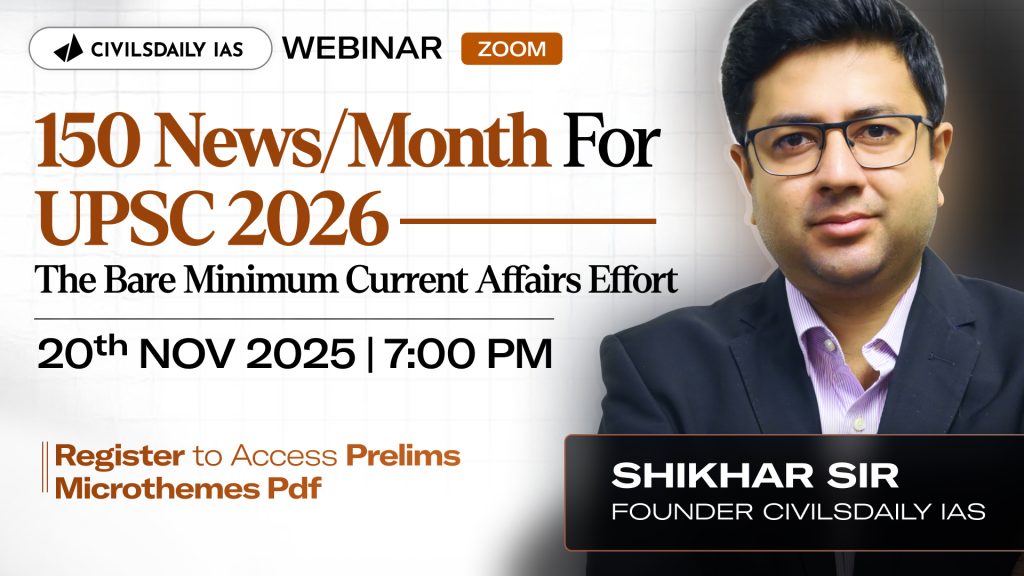
Every UPSC aspirant knows that Current Affairs can make or break their preparation, yet most aspirants spend hours every day consuming content without direction. The truth is, you don’t need more sources, you need better filtering and integration.
In this session, I will show you how 150 well curated news items a month are enough to cover the entire UPSC spectrum, from Prelims to Mains to Essays, if approached the right way.
This is not about reading everything under the sun. It’s about mastering the art of selective depth.
Shikhar Sir, Founder Civilsdaily IAS
What I will cover (practical, no fluff):
1. The 150 Rule for UPSC 2026
How just 5 carefully analysed news pieces a day can help you outperform those reading 20.
How to identify themes instead of chasing daily headlines.
How to separate “exam relevant” from “information overload.”
2. Turning News into Notes, Not Noise
The 3 step note making process to convert news into microtheme notes.
How to link every important news item to GS papers, PYQs, and Mains ready ideas.
Real examples of how rankers turn single articles into 3–4 answer writing points.
3. Current Affairs Integration Across Prelims & Mains
How to map factual news for Prelims and analytical issues for Mains.
How to connect editorials, schemes, and data into one cohesive theme bank.
The “Microtheme Loop” by using one topic across GS 2, GS 3, and Essay.
4. The Civilsdaily Way — Smart Coverage, Smart Revision
How our editorial curation brings UPSC relevance to every story.
Building revision friendly monthly compilations without burnout.
How to ensure recall in the final 60 days before Prelims 2026.
5. Avoiding the Common Current Affairs Traps
Wasting hours on random telegram PDFs and YouTube summaries.
Ignoring conceptual linkages between subjects.
Not revising or integrating notes into mocks and writing practice.
Why attend this session:
• To learn a structured, exam oriented approach to Current Affairs.
• To make your preparation sustainable, high output, low effort.
• To understand how toppers manage both static and current effortlessly.
• To access a smart Current Affairs plan with Prelims-Mains integration.
It will be a 45 minute session, post which we will open up the floor for all kinds of queries which a beginner must have. No questions are taboo and Shikhar sir is known to be patiently solving all your doubts.
Join us for a Zoom session on 20th Nov at 7 PM. This session is a must attend for you If you are attempting UPSC for the first time or have attempted earlier and now preparing for 2026/2027, then it is going to be a valuable session for you too.
See you in the session”
Register for the session for a complete in-depth UPSC Prep
(Don’t wait—the next webinar/session won’t be until End Nov’25)
These masterclasses are packed with value. They are conducted in private with a closed community. We rarely open these webinars for everyone for free. This time we are keeping it for 300 seats only.
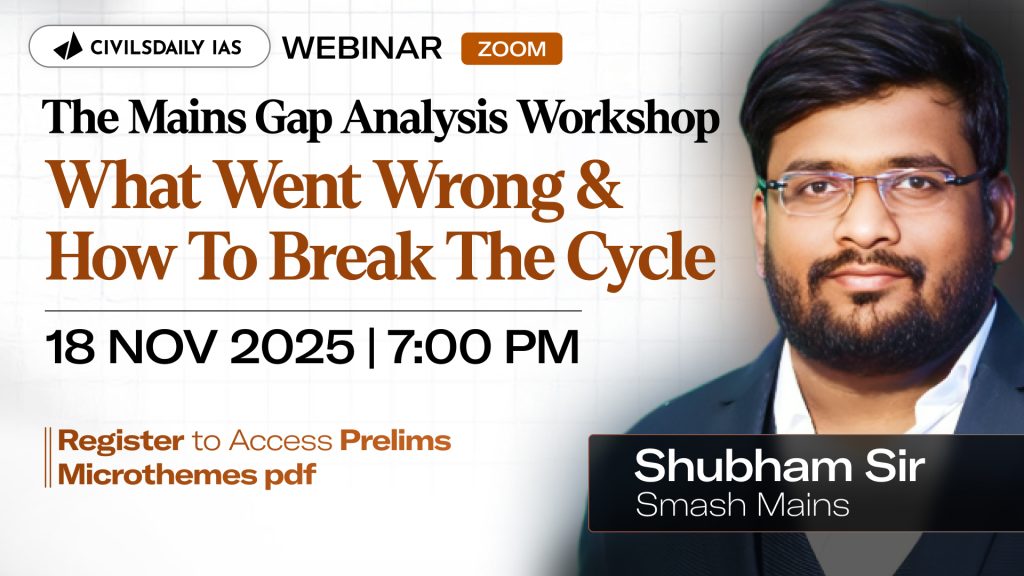
If you have ever walked out of the UPSC Mains hall thinking, “I wrote well, why didn’t I score?” this workshop is for you.
The truth is, between what you study and what UPSC rewards, there is a gap, and most aspirants don’t even know it exists. This session will help you diagnose that gap and build a clear, actionable plan to fix it before Mains 2026.
Shubham Sir, Civilsdaily IAS
What I will cover (practical, no fluff):
1. The Real Reason You are Not Scoring Despite Knowing the Content
Why knowledge alone doesn’t translate into marks.
The difference between answer writing and mark fetching writing.
Common mindset traps that prevent improvement despite years of effort.
2. Identifying Your Unique Gaps Through Mains Analysis
How to do a realistic audit of your last Mains attempt (or mock performance).
How toppers use the question paper lens to self assess better.
Recognising patterns in low scoring answers, structure, examples, directive handling, or linkage issues.
3. Breaking the Cycle: Moving From Writing More to Writing Right
The step by step method to fix one flaw at a time instead of starting over.
How to convert feedback into measurable improvement.
The art of internalising directives like Critically Examine or Discuss.
4. Using Microthemes to Strengthen Your Answer Framework
How to build microtheme-wise notes that reflect PYQ learning.
Using current affairs and reports to enrich your content bank.
How to revise, recall, and reproduce in exam conditions, the 3R model.
5. Live Discussion: Real Answer Copies and Improvement Blueprint
I will walk you through actual aspirant copies to show where marks are lost.
How to rework one answer to turn it from 4/10 to 7/10.
How to create your personalised Mains improvement plan for 2026.
Why attend this session:
• To understand why your preparation plateaued and how to reignite progress.
• To learn how toppers analyse their own answers and evolve with each test.
• To convert your effort into consistent marks across GS papers.
• To stop repeating the same prep cycle and finally break through the 400+ barrier.
It will be a 45 minute session, post which we will open up the floor for all kinds of queries which a beginner must have. No questions are taboo and Shubham sir is known to be patiently solving all your doubts.
Join us for a Zoom session on 18th Nov at 7 PM. This session is a must attend for you If you are attempting UPSC for the first time or have attempted earlier and now preparing for 2026/2027, then it is going to be a valuable session for you too.
See you in the session”
Register for the session for a complete in-depth UPSC Prep
(Don’t wait—the next webinar/session won’t be until End Nov’25)
These masterclasses are packed with value. They are conducted in private with a closed community. We rarely open these webinars for everyone for free. This time we are keeping it for 300 seats only.
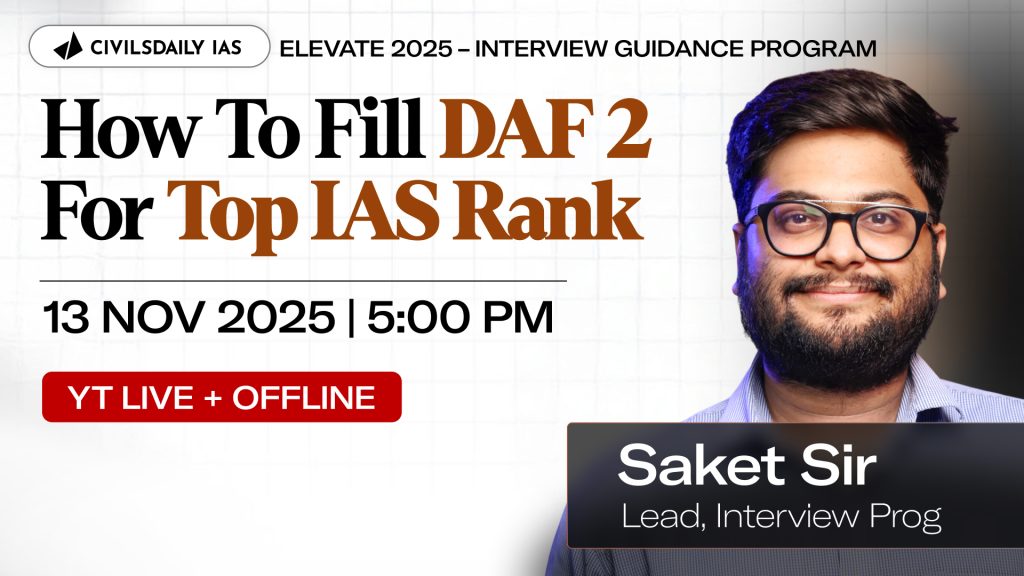
Your DAF 2 isn’t just a form, it is the blueprint of your UPSC Interview. Every line, every word you write here decides the kind of questions you will face, the perception you create, and how well you can control your interview. If you have cleared Mains, this session is non negotiable. Because 90% of aspirants unknowingly create blindspots in their DAF 2 that cost them 15–25 marks in the interview.
Saket Sir, Civilsdaily IAS
What I will cover (practical, no fluff):
1. The Real Purpose of DAF 2
What UPSC really wants to learn about you from each column.
How to turn your DAF from a questionnaire into a personality map.
Common mistakes aspirants make while filling academic details, hobbies, and service preferences.
2. Identifying and Fixing “Blindspots” in Your DAF
What kind of questions your form can trigger, both positive and risky ones.
How to anticipate and prepare questions before the board asks them.
Real examples of DAF 2s that impressed the panel (and the ones that didn’t).
3. How to Make Every Entry Work in Your Favour
Turning optional subject, hobbies, and service preferences into strong talking points.
How to align your background with national issues and governance themes.
The art of creating “DAF stories” that reflect depth, empathy, and awareness.
4. Controlling Your Interview Narrative
How to use your DAF to steer the conversation toward your strengths.
Understanding the psychology of board members and how they read your DAF.
Why DAF 2 is your chance to define your unique personality profile.
5. Real Case Insights from UPSC 2023–2024 Interviews
How successful candidates used DAF cues to score above 190+.
Instances where minor form details triggered major questions.
How to balance confidence, humility, and depth through your form entries.
Why attend this session:
• To ensure your DAF 2 becomes your strongest ally, not a weakness.
• To learn how to fill each section with clarity, precision, and strategy.
• To identify blindspots that could lead to tricky or unanswerable questions.
• To understand how the Interview Board reads your personality before even meeting you.
It will be a 45 minute session, post which we will open up the floor for all kinds of queries which a beginner must have. No questions are taboo and Saket Sir is known to be patiently solving all your doubts.
Join us for a YT session on 13th Nov at 5 PM. This session is a must attend for you If you are attempting UPSC Interview 2025
See you in the session”
Register for the session for a complete in-depth UPSC Prep
(Don’t wait—the next webinar/session won’t be until End Nov’25)
These masterclasses are packed with value. They are conducted in private with a closed community. We rarely open these webinars for everyone for free. This time we are keeping it for 300 seats only.
It’s a moment of immense pride for us. We will not just share the names and numbers. We will walk you through each student’s journey: how their days, months looked like. the number of calls made, the milestones achieved, and the challenges they overcame.
I failed UPSC five times before I found what actually works. In my final attempt, I changed how I studied, how I wrote, and how I reviewed myself, and that made all the difference. If you are preparing for 2026 and feel stuck, this session is for you.
Shivali Thakur, UPSC CSE 2024 Ranker
What I will cover (practical, no fluff):
What went wrong in my first five attempts: over reading, scattered notes, late answer writing, weak revision, and poor test analysis.
What finally worked in the last attempt: a realistic timetable, PYQ led notes, directive focused answer writing, and a strict review loop.
Current affairs the right way: theme folders, limited sources, weekly consolidation, and how I used them in answers.
Answer writing for marks: handling directives (discuss/analyse/evaluate), structuring 10/15/20 markers, and adding value without fluff.
Mock tests to real marks: how I analysed GS, Essay, and Optional tests, what I changed week to week.
Mindset & routine: study like a professional, habits, energy management, and how I recovered from bad days.
Optional & Essay: building depth, two good essays reliably, and linking static + current with examples.
Why attend this session:
• To stop repeating the same mistakes every attempt.
• To learn a prep method you can sustain for months.
• To see exactly how to convert reading into marks.
• To get a simple, executable plan for the upcoming days.
It will be a 45 minute session, post which we will open up the floor for all kinds of queries which a beginner must have. No questions are taboo and Shivali Ma’am is known to be patiently solving all your doubts.
Join us for a Zoom session on 12th Nov at 7 PM. This session is a must attend for you If you are attempting UPSC for the first time or have attempted earlier and now preparing for 2026/2027, then it is going to be a valuable session for you too.
See you in the session”
Register for the session for a complete in-depth UPSC Prep
(Don’t wait—the next webinar/session won’t be until End Nov’25)
These masterclasses are packed with value. They are conducted in private with a closed community. We rarely open these webinars for everyone for free. This time we are keeping it for 300 seats only.
Why Civilsdaily’s UPSC Mentorship Program Is Unique? UAP is NOT your regular course. This isn’t just a program, it’s an ecosystem built to deliver ranks. The core of UAP is – Fault Finding & Course Correction. While other mentorships feel like blackboxes-random calls, vague advice, zero accountability & mere doubt solving-ours is a precision system built to spot your faults and fix them fast. No fluff, no guesswork. Real mentorship means real corrections.
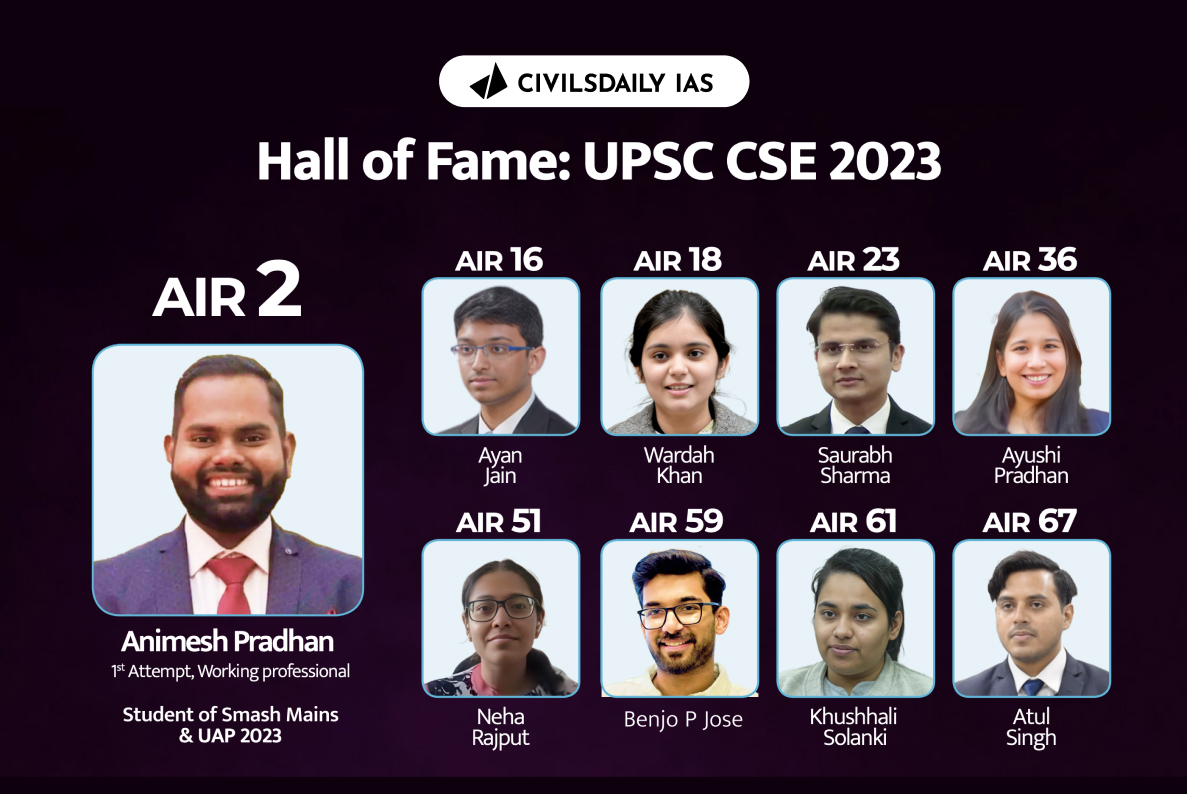
We follow 5 steps: The Approach → Weekly Targets → Note-Building → Testing → Test Discussions. Every step sharpens you. Every step pulls you closer to the list. From crafting your strategy to squeezing out every last mark in Mains, UAP goes all in. In 2023, AIR 2 came from UAP. Many cleared in their first attempt. Others cracked it in their final shot.
What’s common? Grind, Focus, Clarity, and UAP. This alone is a strong enough reason why UAP is a unique program.
The heart of the Civilsdaily is the Ultimate Assessment Program (UAP). For years, aspirants have enrolled here because they couldn’t find such depth and passion towards quality content and Mentorship anywhere. Their search for Mentorship inevitably ends at Civilsdaily.
What You Need to Crack UPSC-CSE in One Attempt
To succeed in UPSC-CSE in a single attempt, it’s essential to have a well-structured, strategic approach. Here’s a breakdown of the key program inclusions that will help you achieve that:
Goal Setting: The Foundation of Preparation Every month, you’ll have a clear timeline of what needs to be covered and by when. This ensures consistent progress, avoids burnout, and keeps you on the right track throughout your preparation.
Assessment-Based Approach A comprehensive strategy that focuses on covering the entire syllabus in the shortest time possible, while still allowing room for multiple revisions. This approach ensures you stay on top of every subject while reinforcing your understanding.
Concise & Comprehensive Notes Access to crisp, ranker-recommended notes on relevant micro themes, based on trends from previous years’ questions (PYQs). These notes will help you focus on high-priority topics without getting overwhelmed.
Practical & Effective Revision Strategy A tailored revision plan focused on one goal: qualifying both Prelims and Mains. This strategy ensures you’re not just learning but retaining information effectively for the exams.
Mastering the Theme & Demand of Mains Questions Understand how to approach Mains questions with the right “Theme-Demand” analysis. Build a ready reference of “Intro-Body-Conclusion” structures for repeated themes, helping you develop muscle memory for answering questions efficiently.
Sharp Feedback from Mentors Consistent, detailed feedback on every mock test you attempt for Prelims and Mains. The goal is to make all your mistakes during the mocks, so you go into the final exam fully prepared and confident.
By mastering these elements, you’ll build the skills, mindset, and preparation necessary to clear UPSC-CSE in one attempt.
Schedule a 1-1 call with Civilsdaily’s Mentorfor focused UPSC Prep
Secondly, Let’s Understand Why Traditional Methods Fall Short
Relying solely on traditional methods attending 1:many classes, reading model answers, and taking a few mock tests-often creates the illusion that this is the core of Prelims and Mains preparation. In reality, these approaches make up only about 10% of a comprehensive strategy. When your goal is to secure a rank in the least number of attempts, the stakes are even higher. Here’s how UAP Mentorship elevates your preparation to the next level:
Personalized Study Plan: Sit down with a mentor to craft a detailed, fortnightly study schedule that covers the syllabus systematically. After each cycle, attempt a mock test to evaluate your progress and identify areas for improvement.
Expert Feedback: Practicing mocks is great, but imagine receiving sharp, actionable feedback from a mentor who has guided toppers like AIR 2, 22, 48, and others. Learn how to gain those crucial extra marks for each question and unlock the X-factor in your preparation.
Mapping Mains Themes: Solving Prelims and Mains PYQs is just the beginning. With UAP, you’ll work with mentors to map the UPSC syllabus onto key Mains themes, using PYQs to prioritize your revision efforts efficiently.
Crafting Concise Notes: Already created your Mains revision notes? Let’s take it further by refining them into concise one-pagers for each theme, complete with updated examples and multiple dimensions for deeper understanding.
Actionable Evaluation: Receiving an evaluated mock test copy is crucial-but what’s next? With UAP, we provide clear, actionable points to work on before you attempt your next mock, ensuring continuous improvement.
If you’re relying on outdated methods, UAP Mentorship might not be for you. But if you’ve tried those approaches and seen their limitations, now’s the time to level up. Apply for UAP Mentorship and experience the difference in your UPSC preparation journey.
What is the Ultimate Assessment Program (UAP)?
UAP is far from your typical course-it’s a complete ecosystem designed to handle every aspect of your UPSC preparation, from refining your strategy to significantly boosting your rank. In 2023, AIR 2 was one of the top ranks produced by UAP, alongside several other rankers. Many of these aspirants cleared the exam in their first attempt, while others succeeded in their final or second-to-last attempts.
These aspirants not only cleared Prelims with ease but also scored 400+ marks in their GS Mains papers. If your goal is to secure a top rank-be it IAS, IPS, or IFS-scoring 400+ in Mains is essential. To make your rank “interview-proof,” you should aim for nothing less than 450+. This is where UAP truly stands out.
UAP cuts through the overwhelming chaos of conventional preparation, bringing intense focus and clarity to your journey. With UAP, you’re not just preparing for an exam-you’re setting yourself up for success. The result? Your name on the final list next year.
Our program goes beyond generic study plans and superficial guidance. We believe that every aspirant is unique, and so are the challenges they face. Our mentorship is focused on providing personalized support that ensures you remain focused, disciplined, and efficient in your preparation.
Three Pillars of UAP
1. Mentorship:
Each student will be assigned a dedicated mentor who will track your progress, understand your strengths and weaknesses, and design a roadmap specific to your needs. Your mentor will provide continuous monitoring, regular check-ins, and feedback, helping you stay on track with your goals. Whether it’s time management, overcoming distractions, or mastering specific subjects, our mentors will be there to guide you.
Year-long Mentorship that’s all encompassing
Ensure you hit your next milestone
Subject strategy, target setting – providing base schedule.
Post test discussion
Phases of Mentorship
One-on-one mentor calls every week to provide the target and planner for the first 2 months. Mentor calls will thereafter be held every 10 days after that.
Weekly Report Card
Macro-strategy & macro targets for every three months
Test-related 1-on-1 detail disucssion.
Philosophy: Every Student Is A Batch
2. Core Programs:
Five Core Programs that are industry standards in themselves:
Samachar Manthan
Prelims Test Series
Mains Test Series
Essay Test Series
Dominate Prelims Crash Course
3. Pre-Acceleration Phase
We combine the knowledge and best practices from all rankers and present the learning in the prep acceleration sessions. This includes
ܳDedicated Monthly CA Test: Focus on Risk-Taking, Logical Problem Solving
Monthly CA Magazines (News, Op-Ed,PIB, Govt. Reports)
ܳDetailed Explainations
ܳAll India Rankings
2. Samachar Manthan:
Civilsdaily is renowned for its Samachar Manthan Program, an intensive current affairs initiative that will ensure you are fully prepared to tackle the dynamic aspects of the UPSC syllabus. With expert analysis, structured explanations, and discussions on major national and international issues, you’ll be equipped to handle both Prelims and Mains questions related to current affairs with confidence.
ܳ Weekly News Analysis (Video + Notes)
ܳ Mains Level Q&A Evaluation To Compliment The Lectures
ܳ Checked Copy Discussion On Phone/In-Person
3. Mains TS
Mock tests are crucial for success, and our test series is designed to simulate the actual exam environment. From day one, you’ll have access to a structured test series, including:
With detailed feedback on every answer you write, ensuring you develop a strong, exam-oriented answer writing style.
Custom Test Plans tailored to your progress, providing just the right amount of challenge to improve performance steadily.
Civilsdaily’s 1.5-Year Mentorship Program for UPSC CSE 2026 is your ticket to success in this prestigious exam. Limited seats are available, ensuring each student gets personalized attention and mentorship. Enroll today to kickstart your journey toward becoming a future civil servant.
Schedule a 1-1 call with Civilsdaily’s Mentorfor focused UPSC Prep
When I started preparing for UPSC, I thought good content was enough.
It took me three attempts to realise, everyone has the same content. What separates a 380 scorer in Mains from a 480 scorer is something invisible on the surface but deeply felt by the examiner, the ‘X-Factor.’
This session is about that missing layer, what rankers do differently when they make notes, structure answers, and express ideas.
Lakshay Aggarwal, UPSC CSE 2024 Ranker
What I will cover (practical, no fluff):
1. What the ‘X-Factor’ really means in UPSC Mains It’s not decoration, fancy language, or adding random quotes. It’s how you think, structure, and express your understanding of the issue in UPSC’s own analytical tone.
2. How to build ‘X-Factor’ in your notes
Turning static content into dynamic insights
Integrating microthemes, PYQs, and current affairs
Making one pager notes that capture cause, consequence, and way forward
How I built my Mains ready notes, with examples from my GS2 and GS3 notebooks
3. How to show ‘X-Factor’ in answers
Crafting introductions that anchor context instantly
Using transitions to maintain flow between sub parts
Writing conclusions that summarise, not repeat
Smart value addition, examples, data, and schemes used with precision, not overload
4. Answer structure that appeals to examiners How to convert an ordinary paragraph answer into one that reads like it belongs to a future officer.
5. Mistakes that kill your ‘X-Factor’
Over dependence on notes
Copy pasting topper formats without understanding
Lack of continuity between GS papers and Essay
Ignoring tone, balance, and originality
6. My approach that worked in the final attempt
How I reduced my study material but increased retention
How I structured weekly answer writing
The review feedback that changed my score trajectory
Why attend this session:
• To understand what actually gets rewarded in Mains evaluation • To learn a practical way to elevate your notes and answers in 30–45 days • To stop writing generic, one dimensional answers • To build a personal style in your answers, the X-Factor that makes your paper stand out
It will be a 45 minute session, post which we will open up the floor for all kinds of queries which a beginner must have. No questions are taboo and Lakshay sir is known to be patiently solving all your doubts.
Join us for a Zoom session on 07th Nov at 7 PM. This session is a must attend for you If you are attempting UPSC for the first time or have attempted earlier and now preparing for 2026/2027, then it is going to be a valuable session for you too.
See you in the session”
Register for the session for a complete in-depth UPSC Prep
(Don’t wait—the next webinar/session won’t be until Mid Nov’25)
These masterclasses are packed with value. They are conducted in private with a closed community. We rarely open these webinars for everyone for free. This time we are keeping it for 300 seats only.