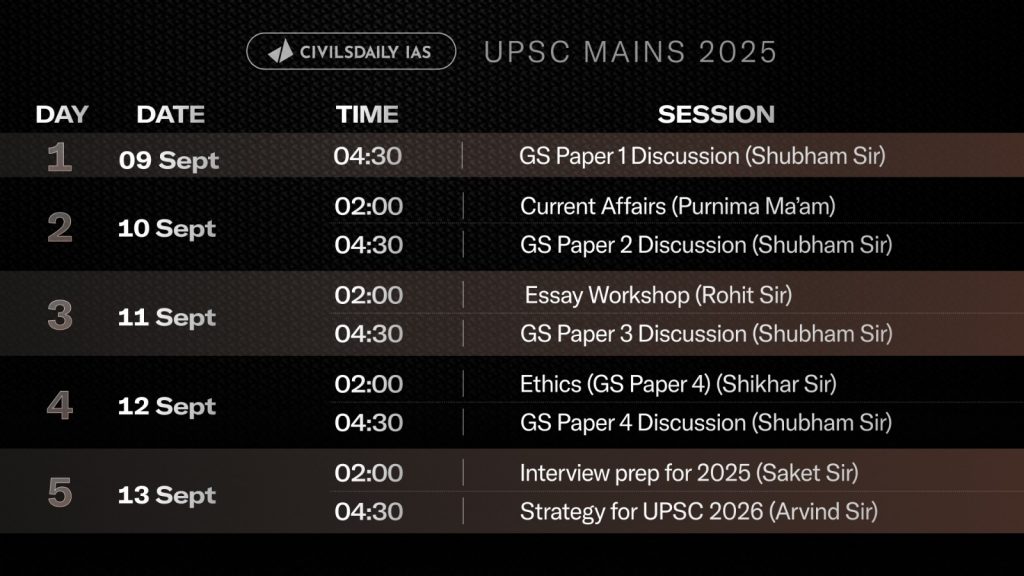
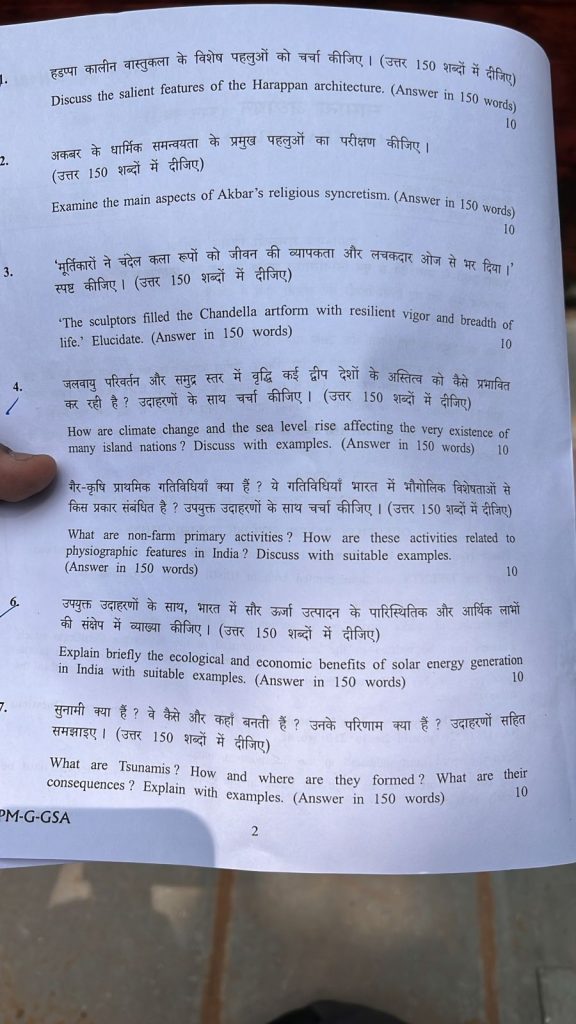
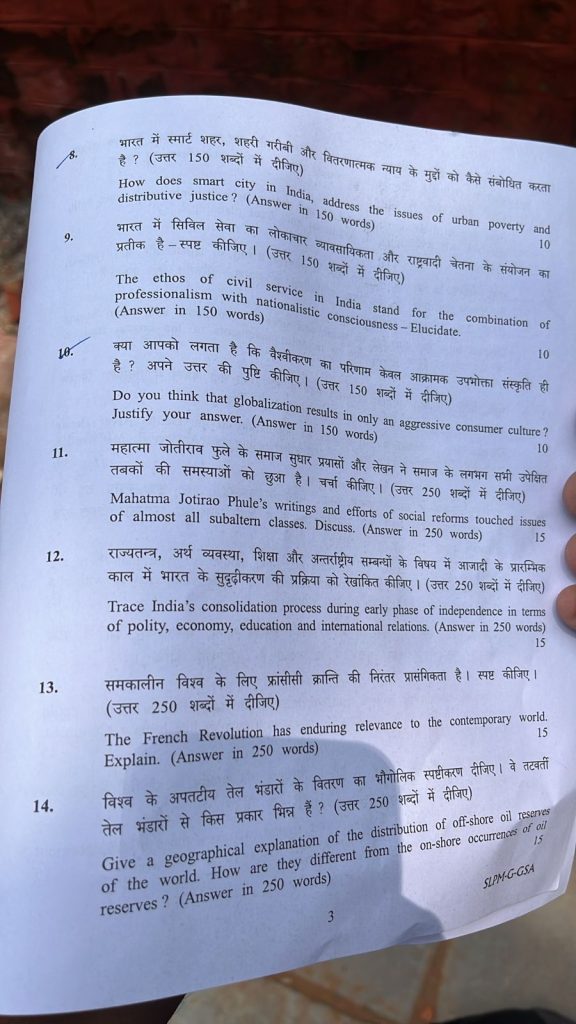
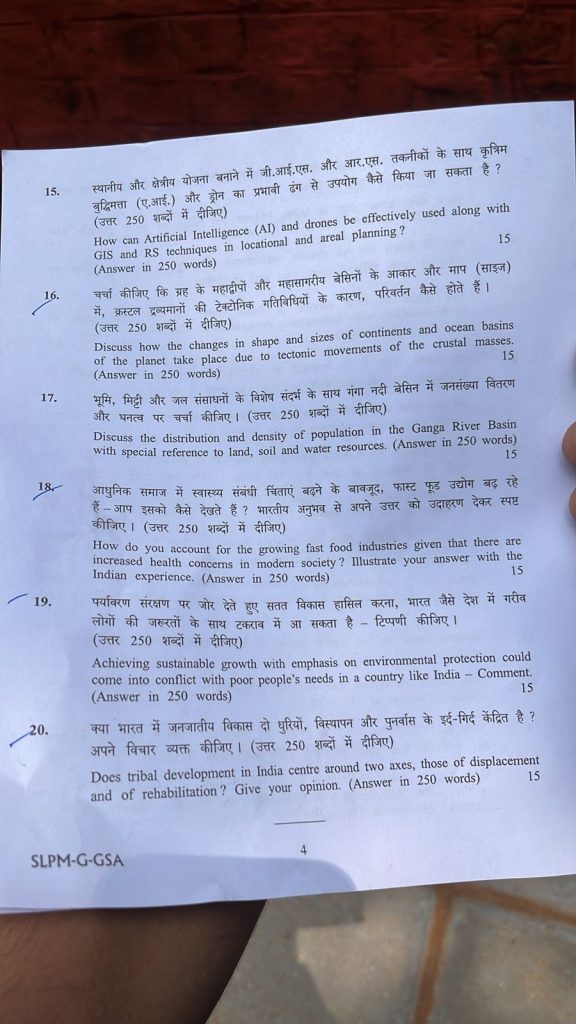
💥Join UPSC 2027,2028 Mentorship (July Batch) + XFactor Notes & Microthemes PDF

Category: Ranker Webinars

  • 🔴[UPSC Webinar for UPSC 2026 &2027] By Prayas Sir, Senior Mentor, Civilsdaily IAS| The UPSC Mid-Prep Crisis | How To Recover If You are Already Behind | Join on 23rd September at 6PM

    Register for the session


    Read about Webinar

    “Every year around this time, I meet aspirants stuck in what I call the mid prep crisis. The syllabus feels endless, notes keep piling up, optionals are untouched, and there is no serious test practice. If this sounds like you, you are not alone. The key is learning how to recover and reset

    Prayas Sir, Senior Mentor, Civilsdaily IAS

    What the mid-prep crisis looks like:
    • Over-ambitious planning that leads to schedules collapsing.
    • Passive preparation where you keep reading but retain nothing.
    • Fear of optionals which keeps getting pushed for later.
    • Current affairs backlog that creates a cycle of guilt around newspapers.
    • No feedback loop, which means you are essentially studying blind.

    What I will cover live:
    • How to reset your plan when you feel you are already behind.
    • Ways to turn passive reading into active recall and answer writing.
    • A method to integrate current affairs without drowning in backlog.
    • A framework to balance GS, Optional, Essay, and Prelims.
    • A practical recovery roadmap for the next three to four months.

    Why you should attend:
    The mid prep crisis is common, but it does not have to end your attempt. With the right fixes, you can still make UPSC 2026 or 2027 your successful year.

    Join me on 23rd Sept at 6:00 PM, live on YouTube. In one session, I will help you rebuild your preparation and move forward with confidence.

    Join us, for a 45 minute live Youtube session on 23rd Sept at 6PM.

    See you in masterclass.


    It will be a 45 minute session, post which we will open up the floor for all kinds of queries which a beginner must have. No questions are taboo and Prayas Sir is known to be patiently solving all your doubts.

    Join us for a Youtube session on 23rd Sept at 6 PM. This session is a must-attend for you If you are attempting UPSC for the first time or have attempted earlier and now preparing for next year, then it is going to be a valuable session for you too.

    See you in the session”

    Register for the session for a complete in-depth UPSC Prep


    In this Civilsdaily masterclass, you will get:

    1. A 45-minute deep dive on how to plan your UPSC strategy from the start to the end.
    2. How do first-attempt IAS Rankers get the most out of their one year prep?
    3. Insider tips that only the top IAS and IPS rankers know and apply to get rank.

    By the end, you’ll have razor-sharp clarity and a clear path to crack UPSC with confidence and near-perfect certainty. 

    Join UPSC session on 23rd Sept, at 6 PM

    (Don’t wait—the next webinar/session won’t be until Oct’25)


    These masterclasses are packed with value. They are conducted in private with a closed community. We rarely open these webinars for everyone for free. This time we are keeping it for 300 seats only.

    Ready to attend the UPSC Webinar?


    Not sure yet?

    We recommend you register here. It takes less than 10 seconds to register.

    • No spam! Once in a while, we’ll only send you high-quality exam-related content. 
    • We will inform you about the upcoming Masterclasses that might benefit you.
    • You can demand one free mentorship call from verified Civilsdaily mentors. 
    • You can always choose to unsubscribe. 
  • 🔴[UPSC Ranker Webinar] By IRPFS, Tamanna Dua, LSR & Cambridge| How to Prepare for UPSC 2026/27 with College & Job | Join on 21st September at 7PM

    🔴[UPSC Ranker Webinar] By IRPFS, Tamanna Dua, LSR & Cambridge| How to Prepare for UPSC 2026/27 with College & Job | Join on 21st September at 7PM

    Register for the session


    Read about Webinar

    I am Tamanna Dua, IRPFS. I cleared UPSC while juggling academics and work. If you plan it right, you don’t have to choose between your degree/job and this exam.

    What I will cover live:
    •Study plan that fits real life: classes, shifts, commute, family time.
    •Weekly rhythm: what to do Mon to Fri vs weekend; how to recover after bad weeks.
    •Micro goals for big results: PYQs, micro themes, targeted notes.
    •Resources without clutter: how many sources, what to drop, how to revise fast.
    •Accountability & burnout control: simple tracking, rest days, staying consistent.

    What you will take away:
    •A 12 week starter plan for 2026/27.
    •A micro theme checklist and a one pager notes format.
    •A clear view of what to stop doing to save time.

    Who should attend:
    •College students targeting 2026/27.
    •Working aspirants who need a realistic, sustainable plan.
    •Anyone stuck between too many resources and too little time.

    Join us, for a 45 minute live Zoom session on 21st Sept at 7 PM.

    See you in masterclass.


    It will be a 45 minute webinar, post which we will open up the floor for all kinds of queries which a beginner must have. No questions are taboo and Tamanna Ma’am is known to be patiently solving all your doubts.

    Join us for a Zoom session on 21st Sept at 7 PM. This session is a must-attend for you If you are attempting UPSC for the first time or have attempted earlier and now preparing for next year, then it is going to be a valuable session for you too.

    See you in the session”

    Register for the session for a complete in-depth UPSC Prep


    In this Civilsdaily masterclass, you will get:

    1. A 45-minute deep dive on how to plan your UPSC strategy from the start to the end.
    2. How do first-attempt IAS Rankers get the most out of their one year prep?
    3. Insider tips that only the top IAS and IPS rankers know and apply to get rank.

    By the end, you’ll have razor-sharp clarity and a clear path to crack UPSC with confidence and near-perfect certainty. 

    Join UPSC session on 21st Sept, at 7 PM

    (Don’t wait—the next webinar won’t be until Oct’25)


    These masterclasses are packed with value. They are conducted in private with a closed community. We rarely open these webinars for everyone for free. This time we are keeping it for 300 seats only.

    Ready to attend the UPSC Webinar?


    Not sure yet?

    We recommend you register here. It takes less than 10 seconds to register.

    • No spam! Once in a while, we’ll only send you high-quality exam-related content. 
    • We will inform you about the upcoming Masterclasses that might benefit you.
    • You can demand one free mentorship call from verified Civilsdaily mentors. 
    • You can always choose to unsubscribe. 
  • 🔴Smash Conclave 2025 UPSC Mains Analysis and 2026 Strategy

    🔴Smash Conclave 2025 UPSC Mains Analysis and 2026 Strategy


    Schedule

    Dissecting the 2025 papers for UPSC Civil Services Examination (CSE) reveals several key focus areas and strategic insights for preparation in 2026.

    This is exactly what we will be doing in the upcoming sessions.

    By the end, you’ll have razor-sharp clarity and a clear path to crack UPSC with confidence and near-perfect certainty. 

    These masterclasses are packed with value. They are conducted in private with a closed community. We rarely open these webinars for everyone for free. This time we are keeping it for 300 seats only.

    Ready to attend the UPSC Webinar?


  • UPSC Mains 2025 GS Paper 1 (23rd August 2025)- Ratio, Model Answers

    Whatsapp for Inquiry: https://shorturl.at/1eRHN

    On 23rd August 2025, UPSC conducted the UPSC Mains GS Paper 1 Exam 2025 and the PDF for the same is available here to download. Rest of the UPSC Mains Question Paper 2025 will be available here in PDF format for aspirants once the exam is over. The UPSC Mains 2025 is scheduled to be held from August 22 to 31, 2025.

    The initial reaction video is as follows.


    Join our official Telegram Group

    Explore our network of trails that lead through a variety of woodland habitats and observe the diverse flora that call this area home.


  • UPSC Mains 2025 Essay Paper(22nd August 2025)- Ratio, Model Answers

    Whatsapp for Inquiry: https://shorturl.at/1eRHN

    The Essay Paper is the 1st paper of the UPSC Civil Services Mains Examination 2025. It has officially begun on 22nd August 2025. This paper is a decisive factor in determining ranks, carrying 250 marks.
    Candidates must write two essays – one from each section – each worth 125 marks.

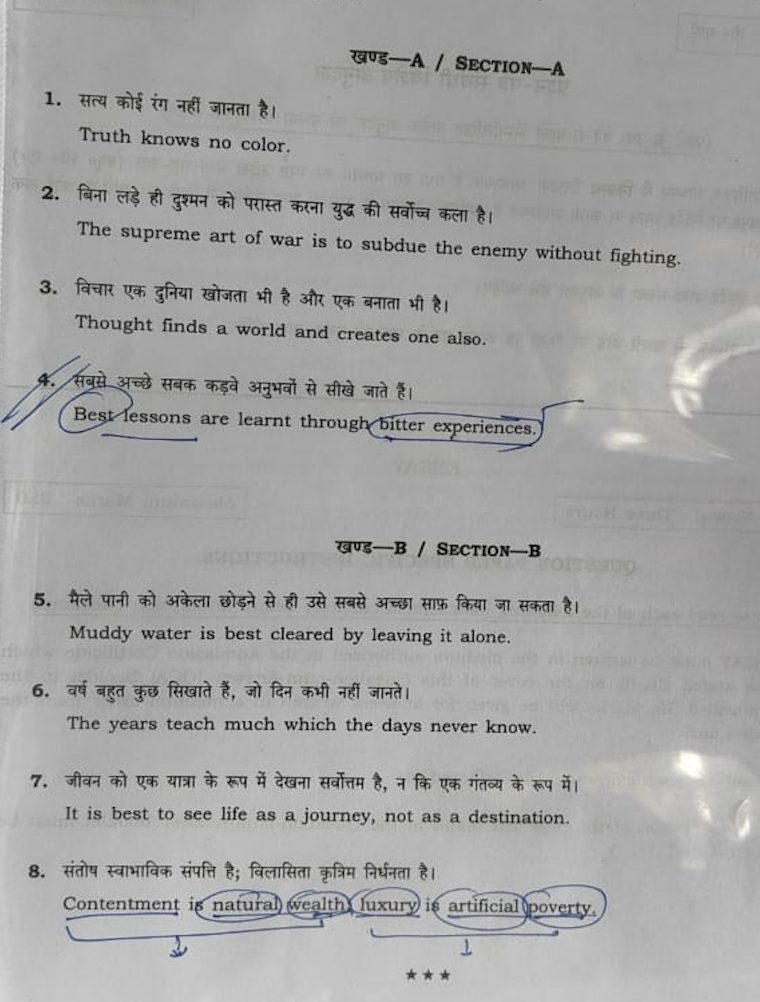
    Year-on-year, the complexity of the papers has been increasing. You no longer have questions on women empowerment, education – all those predictable topics. Philosophical and Abstract Topics are becoming more common and require a radical approach rather than memorizing the frameworks.

    खण्ड—A / SECTION—A

    1. सत्य को रंग नहीं जाता है।
      Truth knows no color.
    2. बिना लड़े ही दुश्मन को परास्त करना युद्ध की सर्वोच्च कला है।
      The supreme art of war is to subdue the enemy without fighting.
    3. विचार एक दुनिया खोजता भी है और एक बनाता भी है।
      Thought finds a world and creates one also.
    4. अच्छे सबक कड़वे अनुभवों से सीखे जाते हैं।
      Best lessons are learnt through bitter experiences.

    खण्ड—B / SECTION—B

    1. मैला पानी को अकेला छोड़ने से ही उसे सबसे अच्छा साफ किया जा सकता है।
      Muddy water is best cleared by leaving it alone.
    2. वर्ष बहुत कुछ सिखाते हैं, जो दिन कभी नहीं जानते।
      The years teach much which the days never know.
    3. जीवन को एक यात्रा के रूप में देखना सर्वोत्तम है, न कि एक गंतव्य के रूप में।
      It is best to see life as a journey, not as a destination.
    4. संतोष प्राकृतिक संपत्ति है; विलासिता कृत्रिम निर्धनता है।
      Contentment is natural wealth, luxury is artificial poverty.

    Join our official Telegram Group

    Explore our network of trails that lead through a variety of woodland habitats and observe the diverse flora that call this area home.


  • 🔴[UPSC Ranker Webinar] By IAS, Archit Dongre, AIR 3, (UPSC’24) || All India Smash Mains Open Test | GS 1–4 Discussion| Join on 09th August At 7 PM

    🔴[UPSC Ranker Webinar] By IAS, Archit Dongre, AIR 3, (UPSC’24) || All India Smash Mains Open Test | GS 1–4 Discussion| Join on 09th August At 7 PM

    Register for the session


    Read about Webinar

    Most aspirants write answers thinking they have nailed it, only to realise the examiner saw it very differently. The cost? Another year lost, despite hard work.

    I am Archit Dongre, AIR 3 UPSC CSE 2024. Having been on both sides, an aspirant who struggled and a topper who finally cracked it, I know the exact gaps that stop even the most sincere candidates from reaching their potential. Without knowing how to balance content, structure, depth, and relevance across GS 1–4, you risk repeating the same mistakes in the real exam.

    This All India Smash Mains Open Test discussion isn’t just about reviewing questions, it is about dissecting why some answers score and others don’t, even when both look good on paper. I will walk you through topper level approaches, the hidden “X-factor” elements, and how to consistently integrate them into your writing under exam pressure.

    If you are serious about improving your marks in Mains 2026, this is your chance to learn directly from my test copies, strategies, and mindset. Don’t leave your performance to guesswork, let us bridge that gap together.

    Join us, for a 45 minute live Zoom session on 09th Aug at 7 PM.

    See you in masterclass.


    It will be a 45 minute webinar, post which we will open up the floor for all kinds of queries which a beginner must have. No questions are taboo and Archit Sir is known to be patiently solving all your doubts.

    Join us for a Zoom session on 09th Aug at 7 PM. This session is a must-attend for you If you are attempting UPSC for the first time or have attempted earlier and now preparing for next year, then it is going to be a valuable session for you too.

    See you in the session”

    Register for the session for a complete in-depth UPSC Prep


    In this Civilsdaily masterclass, you will get:

    1. A 45-minute deep dive on how to plan your UPSC strategy from the start to the end.
    2. How do first-attempt IAS Rankers get the most out of their one year prep?
    3. Insider tips that only the top IAS and IPS rankers know and apply to get rank.

    By the end, you’ll have razor-sharp clarity and a clear path to crack UPSC with confidence and near-perfect certainty. 

    Join UPSC session on 09th Aug, at 7 PM

    (Don’t wait—the next webinar won’t be until Sep’25)


    These masterclasses are packed with value. They are conducted in private with a closed community. We rarely open these webinars for everyone for free. This time we are keeping it for 300 seats only.

    Ready to attend the UPSC Webinar?


    Not sure yet?

    We recommend you register here. It takes less than 10 seconds to register.

    • No spam! Once in a while, we’ll only send you high-quality exam-related content. 
    • We will inform you about the upcoming Masterclasses that might benefit you.
    • You can demand one free mentorship call from verified Civilsdaily mentors. 
    • You can always choose to unsubscribe. 
  • 🔴[UPSC Ranker Webinar] By Archit Dongre, AIR 3, UPSC CSE 24 || 10 Reasons why aspirants with Strategy, Content & Mentorship fail UPSC exam | Join on 25th July At 7 PM

    🔴[UPSC Ranker Webinar] By Archit Dongre, AIR 3, UPSC CSE 24 || 10 Reasons why aspirants with Strategy, Content & Mentorship fail UPSC exam | Join on 25th July At 7 PM

    Register for the session on holistic UPSC 2026/27 Prep


    Read about The UPSC 2026/27 Strategy & Prep Webinar

    “Hard work doesn’t always pay off, unless it is aligned with a smart strategy.”

    Every year, thousands of serious aspirants write UPSC CSE with months of planning, handwritten notes, hours of mentorship calls, and a fully loaded timetable. Still, they didn’t make it to the final list. The heartbreaking part? Most don’t even realise why they are failing. It’s not because they didn’t work hard, it’s because they didn’t work right.

    This webinar is a not to be missed session because Archit Dongre, AIR 3 in UPSC CSE 2024, will show 10 most common reasons why well prepared aspirants still fail. He will talk about blindspots that toppers consciously avoid, like revision fatigue, mock fatigue, scattered value addition, and lack of adaptive feedback.

    If you are putting in the hours but not seeing the returns, this is your moment to reflect. Join Archit on 25th July at 7PM if you are serious about UPSC 2026 and 2027.

    Join us, for a 45 minute live Zoom session on 25th July at 7 PM.

    See you in masterclass.


    It will be a 45 minute webinar, post which we will open up the floor for all kinds of queries which a beginner must have. No questions are taboo and Archit Sir is known to be patiently solving all your doubts.

    Join us for a Zoom session on 25th July at 7 PM. This session is a must-attend for you If you are attempting UPSC for the first time or have attempted earlier and now preparing for next year, then it is going to be a valuable session for you too.

    See you in the session”

    Register for the session for a complete in-depth UPSC Prep


    In this Civilsdaily masterclass, you will get:

    1. A 45-minute deep dive on how to plan your UPSC strategy from the start to the end.
    2. How do first-attempt IAS Rankers get the most out of their one year prep?
    3. Insider tips that only the top IAS and IPS rankers know and apply to get rank.

    By the end, you’ll have razor-sharp clarity and a clear path to crack UPSC with confidence and near-perfect certainty. 

    Join UPSC session on 25th July, at 7 PM

    (Don’t wait—the next webinar won’t be until August’25)


    These masterclasses are packed with value. They are conducted in private with a closed community. We rarely open these webinars for everyone for free. This time we are keeping it for 300 seats only.

    Ready to attend the UPSC Webinar?


    Not sure yet?

    We recommend you register here. It takes less than 10 seconds to register.

    • No spam! Once in a while, we’ll only send you high-quality exam-related content. 
    • We will inform you about the upcoming Masterclasses that might benefit you.
    • You can demand one free mentorship call from verified Civilsdaily mentors. 
    • You can always choose to unsubscribe. 
  • [UPSC Mains 2025] Registration Open: All India Smash Mains Open Test 2025

    [UPSC Mains 2025] Registration Open: All India Smash Mains Open Test 2025

    All India Smash Mains Open Test 2025 Dates and Schedule

    Register For All India Smash Mains Open Test 2025

    Civilsdaily’s All India Smash Mains Open Test 2025 is Civilsdaily’s national-level UPSC Mains simulation designed to help aspirants experience the actual pressure, pace, and performance demands of the UPSC Mains Examination. Built to mirror the real exam in structure and intensity, it gives aspirants a clear reality check before the actual test.

    Through these tests, aspirants get to refine their answer writing, manage time efficiently, and sharpen their thinking under exam-like conditions. Smash Mains isn’t just about testing knowledge. It’s about fine-tuning your strategy, stamina, and structure.

    Success in UPSC Mains is not just about content; it’s about how well you express that content in a structured, crisp, and impactful manner. Civilsdaily understands this. Smash Mains focuses on real-time answer writing practice and strategic exam simulation, not passive preparation.

    Conducted in both Offline (Delhi and Pune) and Online (Live on Zoom) mode, Smash Mains gives aspirants the opportunity to test themselves against all Mains 2025 aspirants across India, helping them recalibrate their preparation with actionable insights and feedback.

    Test Format & Schedule –

    Papers Covered, Date, Time

    1 Aug: Essay | 09:00am-12:00pm

    2 Aug: GS 1 | 09:00am-12:00pm

    2 Aug: GS 2 | 02:30pm-05:00pm

    3 Aug: GS 3 | 09:00am-12:00pm

    3 Aug: GS 4 | 02:30pm-05:00pm

    Format: Full-length Mains mock tests

    Mode : Offline (Delhi & Pune), Online (Live on Zoom)

    Smash Mains: Key Highlights

    1.⁠ ⁠Your Score Benchmarked Against Real UPSC Toppers + All India Percentile Ranking
    Aspirants will receive their percentile and rank based on national participation. See exactly where you stand among serious UPSC competitors.

    2.⁠ ⁠360° Evaluation of Answers
    Each paper undergoes holistic evaluation with attention to content depth, structure, clarity, and presentation. Expect detailed scorecards for General Studies and Essay papers.

    3.⁠ ⁠Actionable Feedback & Writing Enhancement
    Our expert mentors offer focused reviews that help you:

    • A. Spot conceptual gaps
    • B. Improve answer structure
    • C. Strengthen argumentation and flow using theme and demand approach
    • D. Polish language and articulation

    4. Full Syllabus Coverage
    Smash Mains covers the entire UPSC Mains syllabus, with a curated set of questions that test conceptual clarity, current affairs integration, and interdisciplinary approach.

    5.⁠ ⁠Live Discussions & Strategy Sessions
    Each paper will be followed by mentor-led discussions and strategy breakdowns to help aspirants understand ideal approaches, common pitfalls, and high-impact improvements.

    Why Smash Mains Is a Must-Take

    1.⁠ ⁠Real exam simulation to prepare mentally and strategically
    2.⁠ ⁠⁠National benchmarking of performance
    3.⁠ ⁠⁠Personalized guidance from top mentors
    4.⁠ ⁠⁠Answer writing mastery before the actual Mains
    5.⁠ ⁠⁠Enhanced confidence and exam readiness

    Register For All India Smash Mains Open Test 2025

  • 🔴[UPSC Ranker Webinar] By Lavanya Gaur, AIR 57, UPSC CSE 24 On How to tackle tricky GS 2 questions using the Theme-Demand Approach? | Join on 23rd July At 7 PM

    🔴[UPSC Ranker Webinar] By Lavanya Gaur, AIR 57, UPSC CSE 24 On How to tackle tricky GS 2 questions using the Theme-Demand Approach? | Join on 23rd July At 7 PM

    Register for the session on holistic UPSC Mains Prep


    Read about The UPSC Mains Strategy & Prep Webinar

    GS2 is not about what you know. It is about what you understand, and how you apply it.

    If you are approaching GS2 like GS1, listing facts, citing committees, and hoping something sticks, you are likely to lose 20–30 crucial marks. Marks that could keep you out of the final list.

    Why? Because GS2 demands interpretation, linkage, and a clear way forward, not just static recall. This is exactly why you shouldn’t miss this webinar.

    Lavanya Gaur (AIR 57, UPSC CSE 2024) will walk you through how to Identify the theme behind a question, Decode its demand, and Structure answers that reflect awareness, analysis, and administrative maturity.

    Join the masterclass on 23rd July at 7 PM and learn how to apply the Theme–Demand Approach to write GS2 answers that truly stand out, just like Lavanya did.

    Join us, for a 45 minute live Zoom session on 23rd July at 7 PM.

    See you in masterclass


    It will be a 45 minute webinar, post which we will open up the floor for all kinds of queries which a beginner must have. No questions are taboo and Lavanya Mam is known to be patiently solving all your doubts.

    Join us for a Zoom session on 23rd July at 7 PM. This session is a must-attend for you If you are attempting UPSC for the first time or have attempted earlier and now preparing for next year, then it is going to be a valuable session for you too.

    See you in the session”

    Register for the session for a complete in-depth UPSC Mains Prep


    In this Civilsdaily masterclass, you will get:

    1. A 45-minute deep dive on how to plan your UPSC strategy from the start to the end.
    2. How do first-attempt IAS Rankers get the most out of their one year prep?
    3. Insider tips that only the top IAS and IPS rankers know and apply to get rank.

    By the end, you’ll have razor-sharp clarity and a clear path to crack UPSC with confidence and near-perfect certainty. 

    Join UPSC session on 23rd July, at 7 PM

    (Don’t wait—the next webinar won’t be until August’25)


    These masterclasses are packed with value. They are conducted in private with a closed community. We rarely open these webinars for everyone for free. This time we are keeping it for 300 seats only.

    Ready to attend the UPSC Webinar?


    Not sure yet?

    We recommend you register here. It takes less than 10 seconds to register.

    • No spam! Once in a while, we’ll only send you high-quality exam-related content. 
    • We will inform you about the upcoming Masterclasses that might benefit you.
    • You can demand one free mentorship call from verified Civilsdaily mentors. 
    • You can always choose to unsubscribe. 
  • Detention of non-citizens: Is Proof of Identity a Privilege ?

    Detention of non-citizens: Is Proof of Identity a Privilege ?

    N4S: “When identity becomes a burden, not a right.” That’s the core message of this article. UPSC often frames questions on such topics through the lens of Fundamental Rights, constitutional morality, or state vs individual debates. For instance, the 2015 question on the right to a clean environment during Diwali used Article 21 to anchor a contemporary issue. Similarly, detention and citizenship in Assam can be asked through Article 21 (life and liberty), Article 22 (procedural safeguards), or Article 14 (equality). Many aspirants falter because they either stick to legal jargon without connecting to ground realities, or they narrate facts without showing how it affects real lives or violates constitutional values. This article helps bridge that gap. It does not just list laws and events but humanises them. When it says detention “detains rights” (see ‘Impact on Detainees’ section), it moves from abstract policy to lived experience. The example of a woman being excluded due to spelling errors (“Rahima Khatun” vs “Rahima Khatoon”) underlines how a minor glitch can alter one’s life — making your answer come alive. A very special feature of this article is how it connects macro-constitutional ideals with micro-level injustices (like in the section ‘Marginalisation of Vulnerable Groups’ and ‘Loss of Records due to Floods’). 

    PYQ ANCHORING

    GS 2:  Does the right to clean environment entail legal regulations on burning crackers during Diwali? Discuss in the light of Article 21 of the Indian Constitution and Judgement(s) of the Apex Court in this regard. [2015]

    MICROTHEMESFundamental Rights

    Assam’s immigration detention system, initially designed to manage undocumented migration, has become a symbol of bureaucratic overreach and human suffering. Far from being just an administrative process, it has trapped thousands—many of them poor, marginalised, and paperless—in a cycle of fear, uncertainty, and indefinite confinement. At its core, this regime doesn’t just detain people—it detains rights, raising urgent alarms about India’s constitutional promises of liberty, dignity, and fair procedure.

    How can a democracy justify indefinite detention without trial? What happens when proof of identity becomes a privilege? And can a nation uphold its Constitution while turning detention into default?

    ‘Proof of Identity’ : India & Assam

    In India, the proof of identity system is largely document-based and applies to citizens for various purposes — accessing government schemes, voting, banking, travel, etc. There is no single universal ID that conclusively establishes citizenship; instead, a mix of documents are used to prove identity, address, and date of birth.

    Common Identity Documents in India:

    • Aadhaar Card – Biometrics-based ID issued by UIDAI; proves identity and address, not citizenship.
    • Voter ID (EPIC) – Issued by the Election Commission; used to prove Indian citizenship for electoral purposes.
    • Passport – Issued by the Ministry of External Affairs; considered proof of citizenship.
    • PAN Card – Primarily for income tax; proves identity, not citizenship.
    • Birth Certificate, School Certificates, and Government Service Records – Used to prove date/place of birth and lineage.
    • Ration Card, Driving Licence, etc. – Often used for address and family-based identification.

    Most of these documents are accepted in a presumptive and inclusive way, meaning people are generally presumed to be citizens unless proven otherwise.

    How is Assam Different?

    Assam operates under a distinct and exclusionary framework due to its unique history of migration and the NRC (National Register of Citizens) process. Here, the burden of proving citizenship is far higher, more complex, and often punitive in nature.

    Key Differences in Assam:

    1. Legacy Data Requirement: Individuals must prove that they or their ancestors were in Assam before March 24, 1971 (as per the Assam Accord). Requires linking one’s name to pre-1971 documents (like 1951 NRC or 1971 electoral rolls), a huge burden in a state prone to floods and displacement.
    2. Family Tree Verification: People must prove lineage through official documents — often not available for women, orphans, or displaced persons. Minor spelling errors (e.g., “Rahima Khatun” vs. “Rahima Khatoon”) can lead to exclusion.
    3. Foreigners Tribunals (FTs): Individuals suspected of being illegal immigrants may be summoned by FTs to prove citizenship. Even if one has Aadhaar or Voter ID, it may not be accepted as conclusive proof.
    4. Presumption of Illegality: Unlike the rest of India, in Assam, individuals are presumed to be foreigners until proven otherwise, reversing the usual principle of natural justice.
    5. Detention and Exclusion: Failure to prove identity/citizenship can lead to detention in designated centres and loss of legal rights.

    While most Indians rely on flexible, inclusive identity documentation for everyday life, Assam applies a rigid, high-stakes system focused on citizenship verification, rooted in historical anxieties over migration. This makes identity not a tool for inclusion, but a test of belonging — often with life-altering consequences.

    Issues in  NRC Process

    The NRC (National Register of Citizens) process in Assam, intended to identify illegal migrants, has been mired in controversy due to deep procedural and structural flaws. While the goal was to create a fair and accurate record of legal residents, the implementation raised serious humanitarian and constitutional concerns. The process disproportionately affected the poor, rural, and marginalized communities—often not because they were illegal immigrants, but because they lacked paperwork, faced systemic disadvantages, or encountered bureaucratic opacity. The table below highlights key issues that plagued the NRC process, undermining both its credibility and fairness.

    FactorExplanationExample
    Stringent Documentation RequirementsProof of ancestry before March 24, 1971 required.Rural residents lacked land/birth records due to illiteracy or displacement.
    Loss of RecordsFloods and natural disasters destroyed old documents.Many families in flood-prone Assam lost records multiple times.
    Minor DiscrepanciesDifferences in names/spelling across documents led to exclusion.“Rafiqul” vs “Rafiqul Islam” flagged as suspicious.
    Marginalisation of Vulnerable GroupsAffected women, Bengali Muslims, and tribal groups disproportionately.Women lacked independent lineage proof due to patriarchal norms.
    Opaque and Unfair Tribunal ProceduresNo transparency or meaningful opportunity to appeal decisions.People declared foreigners without notice or hearing.

    Impact on Detainees

    Threat to Liberty & Well-beingConstitutional Principles AffectedExamples
    1. Indefinite detention without trialArticle 21 – Right to Life and Personal LibertyMany declared foreigners have been held in detention for years without deportation or conviction.
    2. Detention of Indian citizens due to document issuesArticle 14 – Right to Equality before LawPoor, illiterate individuals lacking documents are more likely to be wrongfully detained.
    3. Poor living conditions in detention centresArticle 21 – Dignity as part of Right to LifeReports reveal lack of medical care, overcrowding, and denial of basic needs in detention facilities.
    4. No legal aid or fair representationArticle 22 – Protection against arbitrary arrest and detentionMany accused of being foreigners are tried in quasi-judicial Foreigners Tribunals without proper legal help.
    5. Disproportionate impact on marginalized groupsArticle 15 – Non-discrimination on grounds of religion, caste, etc.Bengali Hindus and Muslims are most affected, raising concerns of discriminatory implementation.
    6. Uncertainty, fear and mental health traumaDirective Principles – Human dignity and social justice (Article 39A)Even children of detainees suffer from trauma, education loss, and social stigma.

    Constitutional Violations Under Article 21 and 22

    ProvisionViolationExample
    Article 21: Right to Life and Personal LibertyDetention without fair legal basis undermines personal liberty.Innocent individuals held for years without real deportation prospects.
    Article 22: Procedural SafeguardsLack of information on grounds of detention; no legal aid.Detainees often unaware of reasons or denied timely counsel.
    Detention Without Trial or ConvictionLaw allows detention mainly through judicial process, not executive action.People detained by quasi-judicial tribunals despite no criminal charge.
    No Legitimate Preventive PurposePreventive detention requires imminent threat, not document issues.Detentions continue even when deportation is not feasible.
    Executive OverreachDetentions ordered by executive/tribunals without judicial oversight.Judiciary bypassed, undermining rule of law and access to remedy.

    Way Forward for Reforming India’s Detention Regime

    India’s detention regime urgently requires a rights-based, rule-of-law-oriented overhaul. The following steps offer a tight and actionable path forward:

    1. Enact a Comprehensive Law: India needs a dedicated and codified immigration and detention law that clearly defines grounds for detention, outlines procedures, provides safeguards, and distinguishes between illegal immigrants, stateless persons, and asylum seekers.
    2. Reform Foreigners Tribunals: Make Foreigners Tribunals more transparent and accountable by ensuring judicial oversight, standardized procedures, and access to free legal aid. Appeals must be allowed before a competent and impartial authority.
    3. Cap Detention Periods: Introduce a legally mandated, time-bound limit on administrative detention — for example, six months — beyond which individuals must be released if deportation is not feasible.
    4. Develop Alternatives to Detention: Shift towards community-based monitoring, reporting obligations, or bail systems for those not posing security risks, especially families, the elderly, and children.
    5. Ensure Humane Conditions: Detention centres must comply with basic human rights standards, including access to healthcare, clean living spaces, and education for children. Independent bodies should regularly audit these facilities.
    6. Address Statelessness and Identity Gaps: Formulate a clear national protocol for dealing with stateless persons and those excluded from citizenship due to documentation gaps, in line with international principles.
    7. Protect the Vulnerable: Women, children, and marginalised communities require special procedural protections during verification and detention processes to avoid systemic injustice.
    8. Establish Parliamentary Oversight: Institutionalise regular reporting to Parliament or a standing committee on the number of detainees, conditions in centres, and legal outcomes to ensure transparency and accountability.

    Only by combining legal clarity, administrative fairness, and humane treatment can India reconcile its immigration control with constitutional values and international obligations.

    #BACK2BASICS: Detention Regime in India

    India’s detention regime refers to the legal and administrative framework under which individuals are detained — either as foreigners or under preventive detention laws — without regular criminal trial. It is especially relevant in the context of immigration enforcement and national security.


    1. Detention under Foreigners Act, 1946

    • Who can be detained?
      Foreigners who are:
      • Overstaying visas
      • Entering illegally
      • Declared as “foreigners” by a Foreigners Tribunal (particularly in Assam)
    • Legal Basis:
      The Foreigners Act, 1946 empowers the government to detain and deport any foreign national without a criminal conviction.
    • Purpose:
      Detention is considered administrative, not punitive — aimed at deportation.

    2. Detention in the Context of NRC (National Register of Citizens) in Assam

    • Special Case:
      People excluded from the NRC and declared as “foreigners” by Foreigners Tribunals may be detained.
    • Problem:
      Many of those detained:
      • Were Indian citizens wrongfully excluded
      • Had no country to be deported to (e.g., stateless)
    • Detention Centres:
      Special prisons within jails, and standalone facilities, such as the large centre in Goalpara (Assam).

    3. Preventive Detention under Indian Constitution

    • Constitutional Provision:
      Article 22(3)–(7) allows preventive detention in the interest of:
      • National security
      • Public order
      • Foreign affairs
      • Maintenance of essential supplies
    • Laws Allowing Preventive Detention:
      • NSA (National Security Act), 1980
      • COFEPOSA (for economic offences)
      • J&K PSA (Public Safety Act)
    • Safeguards:
      • Detention beyond 3 months requires advisory board approval.
      • Detainee may not be told full grounds of arrest if it’s against public interest.

    4. Detention of Refugees and Asylum Seekers

    • India is not a signatory to the 1951 UN Refugee Convention.
    • Refugees like Rohingyas and undocumented migrants may be detained as illegal foreigners.
    • Detention is not governed by a uniform refugee law — policies vary by government orders.

    5. Key Concerns with India’s Detention Regime

    IssueExplanation
    Lack of Legal AidMany detainees cannot access lawyers or understand the legal process.
    Indefinite DetentionWithout bilateral agreements, deportation is impossible — leading to endless jailing.
    Poor Detention ConditionsOvercrowding, lack of medical care, and absence of facilities for women/children.
    Statelessness RiskMany excluded individuals have no citizenship anywhere.
    Arbitrary and DisproportionateMinor documentary issues lead to grave consequences, violating natural justice.

    India’s detention regime, particularly in Assam, raises serious human rights, constitutional, and due process concerns. While the state has a right to control illegal immigration and ensure national security, the current system lacks transparency, uniform safeguards, and accountability, making it vulnerable to misuse and injustice — especially for the poor and marginalised.

    Chronology of NRC (National Register of Citizens) in Assam

    Year/PeriodEvent/Development
    1951 – The First NRCAfter India’s first Census, the NRC was created in Assam to record who was living there legally. It wasn’t updated thereafter — it stayed frozen in time.
    1971 – Bangladesh Liberation WarWar in East Pakistan (now Bangladesh) led to a massive refugee influx into Assam. This caused tensions over identity, jobs, and land among locals.
    1979–1985 – Assam AgitationA mass movement led by student bodies like AASU demanded the identification and deportation of “illegal foreigners” (mainly from Bangladesh).
    1985 – Assam Accord SignedThe Centre and protest leaders signed the Assam Accord. It set March 24, 1971, as the cut-off date for identifying foreigners and promised an NRC update.
    2005–2013 – NRC Update Gains SteamNRC update efforts revived under Congress and BJP. Pilot projects began but stopped due to violence. In 2013, the Supreme Court took charge of the process.
    2015 – NRC Update Process Officially BeginsPeople in Assam had to prove that they or their ancestors were in India before March 24, 1971, using documents like land records and voter lists.
    2018 – Draft NRC ReleasedThe first draft excluded over 40 lakh people, leading to panic, confusion, and widespread controversy.
    2019 – Final NRC PublishedOn August 31, 2019, the final NRC was released, excluding 19.06 lakh people. Appeals were to be made in Foreigners Tribunals. Many were dissatisfied with the list.
    Post-2019 – What Now?The NRC hasn’t been officially notified. The Assam government rejected it, and it may be rechecked or redone. Excluded individuals face legal uncertainty and fear.

    SMASH MAINS MOCK DROP

    In the context of the NRC process in Assam, examine how document-based identity verification challenges the constitutional promises of liberty, equality, and due process. Suggest a rights-based framework to reconcile immigration control with fundamental rights.”