💥Join UPSC 2027,2028 Mentorship (August Batch) + XFactor Notes & Microthemes PDF

Distribution: weekly

  • New Palm Species ‘Phoenix roxburghii’ discovered

    Why in the News?

    A palm specie ‘Phoenix roxburghii’ first described in the 17th-century botanical treatise Hortus Malabaricus has been recently confirmed.

    About Phoenix roxburghii:

    • Origin: Named after William Roxburgh, regarded as the father of Indian Botany.
    • Distribution: Found along India’s eastern coast, Bangladesh, Gujarat, Rajasthan, and Pakistan.
    • Height: Grows up to 12–16 metres, taller than Phoenix sylvestris.
    • Distinct Features:
      • Solitary trunk
      • Larger leaves and leaflets
      • Musty-scented staminate flowers
      • Large, obovoid orange-yellow fruits

    Back2Basics: India’s Oil Palm Scenario

    • National Mission on Edible Oils – Oil Palm (NMEO-OP) (2021): Centrally sponsored, aims to boost domestic crude palm oil (CPO) production and reduce import dependence.
    • Targets:
      • Expand area to 10 lakh ha by 2025–26.
      • Raise production from 0.27 lakh tonnes (2019–20) to 11.2 lakh tonnes (2025–26), further to 28 lakh tonnes (2029–30).
    • Support Mechanisms: Viability Price (VP), Direct Benefit Transfer (DBT), planting subsidy (₹29,000/ha), and special aid for NE & Andaman regions.
    • Cultivation States: Andhra Pradesh, Telangana, and Kerala (98% of output); others include Karnataka, Tamil Nadu, Odisha, Gujarat, and NE states.
    • Potential vs Current: 28 lakh ha potential; only 3.7 lakh ha cultivated.
    • Imports: India is the world’s largest palm oil importer (9.2 million tonnes in 2023–24). Palm oil forms 60% of edible oil imports, sourced mainly from Indonesia, Malaysia, and Thailand.
    • Unique Advantage: Palm oil yields are 5× higher than traditional oilseeds.
    [UPSC 2021] With reference to ‘palm oil,’ consider the following statements:

    1. The palm oil tree is native to Southeast Asia.

    2. Palm oil is a raw material for some industries producing lipstick and perfumes.

    3. Palm oil can be used to produce biodiesel.

    Which of the statements given above are correct?

    Options: (a) 1 and 2 only (b) 2 and 3 only* (c) 1 and 3 only (d) 1, 2, and 3


  • Scientists turn E. Coli Bacteria into a Bio-Sensor

    Why in the News?

    Researchers from UK and China have developed a bioelectronic device where genetically engineered E. Coli bacteria act as self-powered chemical bio-sensor.

    About Escherichia coli (E. coli) Bacteria:

    • Overview: Gram-negative, rod-shaped bacterium that inhabits the lower intestine of warm-blooded animals.
    • Family: Belongs to the Enterobacteriaceae family.
    • Harmless vs Pathogenic: Most strains are harmless, but some (e.g., E. coli O157:H7) cause severe foodborne illness, diarrhoea, and kidney complications.
    • Gut Role: Contributes to vitamin K synthesis and maintains gut microbiota balance.
    • Transmission: Pathogenic strains spread via contaminated food, water, or direct contact, leading to outbreaks.
    • Diagnostic Importance: Presence in water is a key indicator of faecal contamination.

    Bio-Sensors Generated Using E. coli

    • Innovation: Genetically engineered E. coli used as self-powered chemical biosensors.
    • Mechanism: Detect compounds, process signals, and produce electrical outputs compatible with low-cost electronics.
    • Modules:
      • Sensing Module: Detects target molecules.
      • Processing Module: Amplifies or modifies signals.
      • Output Module: Produces phenazines measurable via electrochemistry.
    • Applications:
      • Detected arabinose (plant sugar) within 2 hours.
      • Detected mercury ions in water at trace levels (below WHO safety limits) within 3 hours.
      • Demonstrated an “AND” logic gate, producing signals only when two molecules were present together.
    • Significance:
      • Cheaper, programmable, and robust alternative to enzyme-based biosensors.
      • Potential in environmental monitoring, water safety, medical diagnostics, and bioelectronics.
    [UPSC 2010] Which bacterial strain, developed from natural isolated by genetic manipulations, can be used for treating oil spills?

    (a) Agrodbacterium

    (b) Clostridium

    (c) Nitrosomonas

    (d) Pseudomonas*


  • In news: Gugga Naumi Festival

    Why in the News?

    The Gugga Naumi festival was widely celebrated across northern states of India on 17th August.

    About Gugga Naumi Festival:

    • Festival: Folk religious celebration in Rajasthan, Haryana, Punjab, Jammu & Kashmir, Uttar Pradesh, and northern states.
    • Timing: Observed on the ninth day of Krishna Paksha in Bhadrapad month, usually after Janmashtami.
    • Deity: Dedicated to Gugga (Gugga Pir / Gugga Zahir Pir / Guaaji), a Chauhan Rajput prince believed to control snakes.
    • Tradition: Reflects syncretic worship by Hindus and Muslims, showcasing folk religiosity beyond formal religion.

    Key Features:

    • Duration: Begins on Rakhi and lasts nine days, with pilgrimages to Gugga Medi village in Hanumangarh, Rajasthan.
    • Rituals: Garudas (snake charmers and healers) carry Gugga Pir’s Chahad (standard).
    • Devotion: Pir ke Sole (songs) sung, fairs organised at shrines (Marhis).
    • Depiction: Gugga shown riding a blue horse, with blue and yellow flags.
    • Belief: Worshipped by mothers for children’s health, and by barren women for fertility blessings.
    [UPSC 2018] Consider the following pairs: Tradition State

    1. Chapchar Kut festival — Mizoram

    2. Khongjom Parba ballad — Manipur

    3. Thong-To dance — Sikkim

    Which of the pairs given above is/are correct?

    (a) 1 only (b) 1 and 2* (c) 3 only (d) 2 and 3


  • Chalkiness in Rice and the Genetic Breakthrough

    Why in the News?

    Recently, Chinese scientists identified a key gene, Chalk9, that controls chalkiness in rice, offering a breakthrough for crop improvement.

    About Chalk9 Gene in Rice:

    • Overview: Chalk9 is a gene found on chromosome 9 of rice.
    • Function: Encodes the enzyme E3 ubiquitin ligase, which regulates protein degradation.
    • Target Protein: Acts on OsEBP89, a regulator of starch-synthesis genes Wx and SSP.
    • Chalk9-L Variant: Promotes OsEBP89 degradation → prevents excess starch accumulation → results in low chalkiness and translucent grains.
    • Chalk9-H Variant: Fails to degrade OsEBP89 efficiently → leads to starch buildup → high chalkiness and brittle grains.

    Significance:

    • Grain Quality: Chalkiness lowers milling recovery and reduces rice’s commercial value.
    • Genetic Solution: Discovery of Chalk9 offers a direct genetic tool to reduce chalkiness.
    • Breeding Advantage: Rice breeding programs can introduce Chalk9-L to produce premium low-chalk rice.
    • Economic Impact: Improves farmer income and enhances food security.
    • Consumer Preference: Meets demand for better quality, translucent rice varieties.
    [UPSC 2022] Consider the following statements: DNA Barcoding can be a tool to :

    1. assess the age of a plant or animal. 2. distinguish among species that look alike. 3. identify undesirable animal or plant materials in processed foods.

    Which of the statements given above is/are correct?

    Options: (a) 1 only (b) 3 only (c) 1 and 2 (d) 2 and 3*


  • MIT Research of Ionic Liquids (ILs)

    Why in the News?

    MIT-led research suggests life may not need liquid water; ionic liquids (salts that stay liquid below 100°C) could support life on rocky super-Earths with volcanic activity and little water.

    About Ionic Liquids (ILs):

    • Overview: Salts in liquid form below 100°C, composed entirely of ions.
    • Properties: Non-volatile, non-flammable, thermally stable, and tunable as hydrophobic or hydrophilic.
    • Structure: Unlike water (neutral molecules), ILs consist of ions and ion pairs.
    • Electrochemical Use: Excellent electrolytes with broad electrochemical windows.
    • Applications: Used in synthesis, catalysis, electrochemistry, extraction, biotechnology, and as green alternatives to volatile solvents.

    Breakthrough Findings of MIT Study:

    • Life Without Water: Experiments showed life could potentially survive using ILs as solvents instead of water.
    • Natural Formation: Sulfuric acid mixed with nitrogen compounds can naturally form ILs.
    • Exoplanet Link: Such ILs may exist on rocky super-Earths with volcanic activity and thin atmospheres.
    • Venus Research Origin: Discovery emerged from studying Venus, where sulfuric acid clouds interact with organic molecules to form ILs.
    • Biological Relevance: ILs can provide stable environments for biomolecules, supporting metabolism.

    Significance of the Study:

    • Habitability Expansion: Broadens habitability definition beyond water-based models.
    • Biosignatures: Suggests new chemical markers for exoplanet life detection.
    • Venus Missions: Strengthens rationale for Venus’s exploration targeting IL-based chemistry.
    • Wider Habitable Zones: Implies more planets could host life than previously thought.
    [UPSC 2015] The term ‘Goldilocks Zone’ is often seen in the news in the context of:

    (a) the limits of habitable zone above the surface of the Earth

    (b) regions inside the Earth where shale gas is available

    (c) search for the Earth-like planets in outer space*

    (d) search for meteorites containing precious metals


  • Supreme Court interventions in Civil–Criminal overlap Cases

    Why in the News?

    In August 2025, the Supreme Court intervened twice to prevent the misuse of criminal proceedings in essentially civil disputes.

    About Civil and Criminal Cases:

    • Civil cases involve disputes between individuals or organisations and are mostly governed by Code of Civil Procedure, 1908 (CPC). The aim is to resolve rights and duties, usually through compensation (damages) or injunctions. Examples: property disputes, contract breaches, divorce, custody, money recovery.
    • Criminal cases involve offences against the state or society. The objective is punishment and deterrence. Initiated by the state prosecutor. Examples: theft, cheating, assault, murder.
    • Burden of proof:
      • Civil cases: Decided on a preponderance of probabilities (more likely than not).
      • Criminal cases: Guilt must be proven beyond reasonable doubt.
    • Dual Cases: Some acts can give rise to both civil and criminal liability. For dual proceedings, there must be proof of criminal intent before entering the commercial or personal relationship.
    • Timelines: Data from the National Judicial Data Grid (2025) shows civil cases are slower (avg. 4.91 years) compared to many criminal cases (70% disposed within a year).

    Recent Supreme Court Actions:

    • Rajasthan plywood dispute case (Aug 13, 2025): SC held there was no criminal breach of trust in a simple sale transaction. Denial of pre-arrest bail by the High Court was overturned.
    • Allahabad HC case (Aug 4, 2025): SC criticised a judge for allowing criminal proceedings in a business transaction dispute, calling it a “mockery of justice”. The judge was temporarily barred from handling criminal cases, later reinstated after CJI intervention.
      • The SC clarified that civil disputes cannot be turned into criminal prosecutions unless fraud or criminal intent is clearly shown.
    [UPSC 2016] With reference to the ‘Gram Nyayalaya Act’, which of the following statements is/are correct?

    1. As per the Act, Gram Nyayalayas can hear only civil cases and not criminal cases.

    2. The Act allows local social activists as mediators/reconciliators.

    Options: (a) 1 only (b) 2 only* (c) Both 1 and 2 (d) Neither 1 nor 2


  • In news: British Conquest of Sindh

    Why in the News?

    The British conquest of Sindh in the 1840s was a key step in colonial expansion, reminding us that regions like Sindh, Punjab, and Bengal came under British rule long before the 1947 partition of India and Pakistan.

    British Conquest of Sindh:

    • Sindh was annexed by the British in 1843 after the battles of Miani and Dubbo.
    • The resistance was led by Hosh Muhammad Sheedi, a general of the Talpur army and member of the African-origin Siddi community.
    • His defiance symbolised the first major armed resistance to British expansion in northwest India.

    Political Background in Sindh:

    • Kalhora Dynasty (1701–1779): Founded by Mian Yar Muhammad Kalhoro, recognised by Mughals; ruled northern and central Sindh. Prosperous period but weakened by internal disputes.
    • Talpur Dynasty (1779–1843): Baloch Talpurs overthrew Kalhoras; consolidated Sindh under clan rule at Hyderabad and Khairpur.
    • Geopolitical Context: Sindh lay at the crossroads of British–French–Russian rivalry (The Great Game). Britain feared Russian advances through Iran and Afghanistan.
    • British Entry: East India Company forced treaties on Talpurs; captured Karachi (1839) after bombarding Manora fort.

    British Advance and the Fall of Sindh:

    • Battle of Miani (17 Feb 1843): British under Sir Charles Napier defeated Mir Nasir Khan Talpur near Hyderabad.
    • Battle of Dubbo (24 Mar 1843): Hosh Muhammad Sheedi allied with Mir Sher Muhammad Talpur of Mirpur Khas. Sheedi raised the war cry “Marvesoon par Sindh na desoon” (I may die but will not give up Sindh). He was killed in action.
    • British Annexation: After Dubbo, Sindh was annexed into the Bombay Presidency. Talpur rule ended.
    • Aftermath: Within a decade, Punjab too was annexed (1849), bringing all of northwest India under British rule.

    Legacy of Hosh Muhammad Sheedi:

    • Born into the household of Talpur rulers; of African-Siddi descent.
    • Valour acknowledged by both Indian and British chroniclers.
    • Became a folk hero of Sindh, remembered by Hindus and Muslims alike.
    • His legacy is central to the cultural memory of Sindh and highlights the role of the Siddi community in resisting colonialism.
    [UPSC 2007] The ruler of which one of the following States was removed from power by the British on the pretext of misgovernance?

    Options: (a) Awadh* (b) Jhansi (c) French (d) Satara


  • IBC Amendment Bill, 2025

    Why in the News?

    The Insolvency and Bankruptcy Code (Amendment) Bill, 2025 was introduced in the Lok Sabha by Finance Minister to streamline insolvency, cut tribunal delays, and add new tools like creditor-led resolution and cross-border insolvency.

    About the Insolvency and Bankruptcy Code (IBC), 2016:

    • IBC is India’s bankruptcy law, covering corporate persons, partnership firms, and individuals.
    • Insolvency: Liabilities exceed assets; entity cannot meet obligations.
    • Bankruptcy: Legal declaration of inability to pay debts.
    • Objective: Time-bound, creditor-driven resolution to improve recovery and business confidence.
    • Regulating Authority: Insolvency and Bankruptcy Board of India (IBBI), a statutory body with members from Ministry of Finance, Ministry of Corporate Affairs, and Reserve Bank of India.
    • Adjudicating Authority:
      • National Company Law Tribunal (NCLT) for companies/LLPs.
      • Debt Recovery Tribunal (DRT) for individuals and partnership firms.

    Key Amendments Proposed in IBC (2025):

    • Creditor-Initiated Insolvency Resolution Process (CIIRP): Out-of-court creditor resolutions with NCLT approval; faster timelines and promoter involvement.
    • Group Insolvency: Joint proceedings for related companies to preserve asset value and cut costs (e.g., Videocon Group case).
    • Cross-Border Insolvency: Framework to handle overseas assets and debts, allowing Indian lenders access to foreign assets.
    • Pre-Packaged Insolvency (PPIRP): Faster, affordable restructuring route for Micro, Small, and Medium Enterprises (MSMEs) while operations continue.
    • Other Reforms: Segregated asset sales, more NCLT benches (now 16), extended claim timelines, sector-specific provisions, and debtor audits.

    Achievements of IBC:

    • Debt Resolution: Resolved ₹3.16 lakh crore in 808 cases since 2016 (CRISIL data).
    • Recovery Rate: Average recovery of 32% of admitted claims, 169% of liquidation value.
    • Comparison: Outperformed earlier mechanisms (DRT, SARFAESI Act, Lok Adalat) which achieved only 5–20% recovery.
    • Deterrence: Borrowers pre-settled ₹9 lakh crore debt to avoid IBC proceedings.
    • Large NPAs: Addressed RBI’s “Dirty Dozen” cases like Bhushan Steel, Essar Steel, Jaypee Infratech.


    [UPSC 2017] Which of the following statements best describes the term ‘Scheme for Sustainable Structuring of Stressed Assets (S4A)’, recently seen in the news?

    Options: (a) It is a procedure for considering ecological costs of developmental schemes formulated by the Government.

    (b) It is a scheme of RBI for reworking the financial structure of big corporate entities facing genuine difficulties.

    (c) It is a disinvestment plan of the Government regarding Central Public Sector Undertakings.

    (d) It is an important provision in ‘The Insolvency and Bankruptcy Code’ recently implemented by the Government. *


  • Red Fort as the Venue for Independence Day

    Why in the News?

    On August 15, 2025, Prime Minister delivered the longest Independence Day speech (103 minutes) from the Red Fort, continuing a tradition started by Jawaharlal Nehru in 1947.

    The fort’s choice as the venue reflects its historic role as Delhi’s seat of power and symbol of sovereignty.

    About the Red Fort:

    • Construction: Built in 1648 by Mughal Emperor Shah Jahan as the palace fort of Shahjahanabad, his new capital.
    • Material: Enclosed by massive red sandstone walls with royal pavilions and apartments.
    • Water Feature: Contained the Nahr-i-Behisht (“Stream of Paradise”), a continuous water channel.
    • Architectural Value: Prime example of Mughal architecture, blending Islamic traditions with Indian craftsmanship.
    • Recognition: Declared a UNESCO World Heritage Site in 2007.

    Historical Significance of Delhi and Red Fort:

    • Delhi’s Role: Seat of power for nearly a thousand years, regarded as “capital of all Hindustan” by Babur.
    • Shahjahanabad: Inaugurated in 1648 with the Red Fort at its centre.
    • Symbol of Sovereignty: Even after Mughal decline, Delhi remained central; East India Company minted coins in the emperor’s name.

    1857 Revolt and British Authority:

    • Revolt Centre: Bahadur Shah Zafar was declared leader by sepoys in Delhi.
    • Aftermath: Fall of Delhi ended Mughal rule; Zafar was exiled.
    • Fort Damage: British converted Red Fort into a military garrison, destroying ~80% of interiors.
    • Imperial Authority: Delhi Durbars (1877, 1903, 1911) asserted British control before capital shifted from Calcutta to Delhi in 1911.

    Significance of Red Fort for Independence Day:

    • INA Trials: Held in Red Fort in 1946, igniting nationalist fervour.
    • 1947 Ceremony: Jawaharlal Nehru hoisted the national flag on 15 August 1947 and gave the first Independence Day address.
    • Tradition: Since then, every Prime Minister hoists the flag and addresses the nation from its ramparts.
    • Symbolism: Site once stamped with colonial dominance, now reclaimed as a symbol of India’s sovereignty.
    [UPSC 2021] What was the exact constitutional status of India on 26th January, 1950?

    Options: (a) A democratic Republic (b) A Sovereign Democratic Republic* (c) A Sovereign Secular Democratic Republic (d) A Sovereign Socialist Secular Democratic Republic


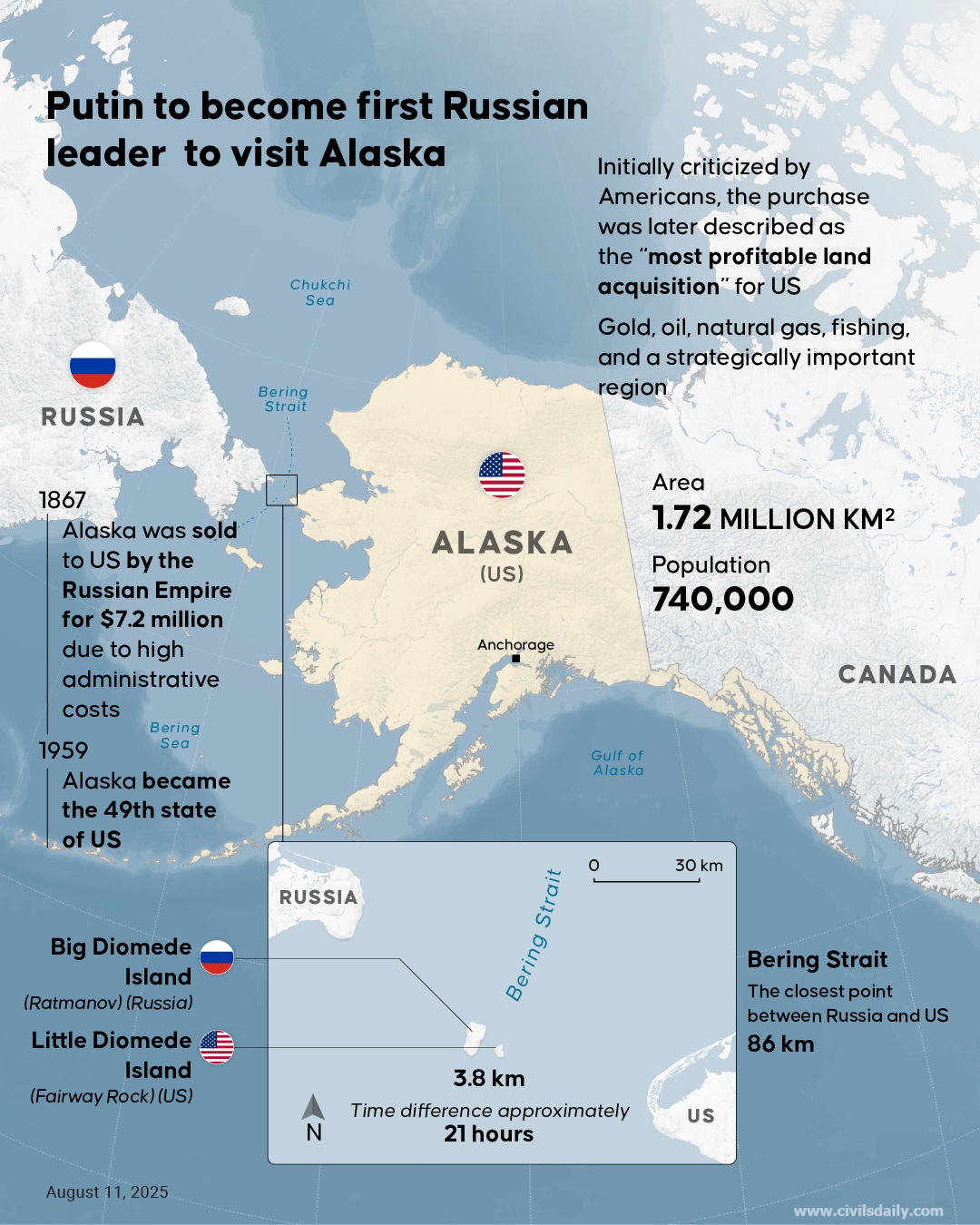
  • Russia’s Sale of Alaska to US

    Why in the News?

    United States President Donald Trump and his Russian counterpart Vladimir Putin are set to meet in Anchorage, Alaska to discuss how to end the war in Ukraine.

    Russia's Sale of Alaska to US

    About Alaska:

    • Acquisition: Largest U.S. state; Purchased from Russia in 1867 for $7.2 million.
    • Mountains: Includes Alaska Range with Mount Denali (20,310 ft), the highest peak in North America.
    • Geography: Brooks Range separates central Alaska from the Arctic far north.
    • Tundra: Northern regions feature vast tundra, permafrost, and Arctic coastal plains.
    • Glaciers: Hosts 100,000+ glaciers, including Bering Glacier, the largest in North America.
    • Forests: About 5% glacier ice, with extensive boreal and temperate rainforests in the south.
    • Volcanoes: More than 70 active volcanoes in Aleutians and Alaska Peninsula.
    • Seismic Activity: Located on the circum-Pacific seismic belt, prone to powerful quakes (e.g., 1964 Alaska earthquake).
    • Water Resources: Contains 3 million+ lakes and 3,000+ rivers, among the most water-rich regions globally.
    • Peninsulas: Includes Alaska Peninsula, Kenai Peninsula, and Seward Peninsula (linked to ancient Bering land bridge).

    Why did Russia sell Alaska to the US?

    • After the Crimean War (1853–56), Russia was financially strained and needed funds.
    • Alaska was seen as a remote, unprofitable liability with declining fur trade.
    • Russia feared Britain might seize Alaska easily from nearby Canada in a future war.
    • Selling it to the United States ensured goodwill and balanced British power.
    • The $7.2 million sale (1867) turned a weakly defended outpost into cash for reforms.

    Geopolitical Significance of Alaska:

    • Natural Resources: Rich in oil, gas (e.g., Prudhoe Bay discovery, 1968), fisheries, and minerals vital for U.S. energy security.
    • Shipping Routes: Offers access to Arctic Sea routes, increasingly navigable due to climate change.
    • Strategic Gateway: Provides access to the Arctic and Pacific, enhancing U.S. naval and air capabilities.
    • Defense Value: Proximity to Russia made it critical in the Cold War and remains vital in Arctic competition.
    • Military Presence: Hosts major U.S. bases and radar systems for missile defense and surveillance.
    • Arctic Council Role: Strengthens U.S. claims in polar governance and Arctic Council negotiations.
    • Scientific Hub: Serves as a center for climate, seismic, and polar ecosystem research.
    [UPSC 2025] Consider the following statements:

    I. Anadyr in Siberia and Nome in Alaska are a few kilometers from each other, but when people are waking up and getting set for breakfast in these cities, it would be different days.

    II. When it is Monday in Anadyr, it is Tuesday in Nome.

    Which of the statements given above is/are correct?

    (a) I only * (b) II only (c) Both I and II (d) Neither I nor II