💥Join UPSC 2027,2028 Mentorship (August Batch) + XFactor Notes & Microthemes PDF

Distribution: weekly

  • Debunking the myth of job creation

    Why in the News?

    The government has recently approved the Employment Linked Incentive (ELI) Scheme as one of the largest fiscal commitments towards employment generation in recent years. The scale of underemployment in India is striking, over 53% of graduates are working in semi-skilled jobs and 46% of low-skill workers earn less than ₹1 lakh a year raising questions about whether such a scheme can genuinely address unemployment or will deepen structural inequalities.

    Significance of ELI Scheme:

    1. Government Approval: Cleared on July 1, 2025, with ₹99,446 crore outlay.
    2. Primary Aim: Provide fiscal incentives to employers for job creation, especially in manufacturing.
    3. Significance: Represents one of the largest government-led employment incentive packages in India.

    Issues with the ELI Scheme’s design:

    1. Employer-Centric Approach: Focuses on incentivising employers rather than directly empowering workers.
    2. Capital-Labour Asymmetry: Risks strengthening employer bargaining power while leaving workers vulnerable.
    3. Exclusion of Informal Sector: 90% of India’s workforce, largely informal, is excluded as the scheme prioritises EPFO-registered firms.
    4. Underprepared Workforce: Only 4.9% of youth have received formal vocational training, creating a mismatch between jobs and skills.

    Skill Mismatch and Underemployment Trends in India:

    1. Low Skill Utilisation: Only 8.25% of graduates work in jobs matching their qualifications.
    2. High Underemployment: 53% of graduates and 36% of postgraduates in semi-skilled or elementary roles.
    3. Wage Disparity: 46% of low-skilled workers earn < ₹1 lakh/year, while only 4.2% of specialised graduates earn ₹4–8 lakh/year.
    4. Inefficient Education-to-Employment Pipeline: Shows systemic disconnect between education system and industry needs.

    Sectoral Imbalance and Employment Implications:

    1. Manufacturing Bias: Targets manufacturing despite its declining employment elasticity.
    2. Employment Share: Manufacturing employs <13% of total workforce, while agriculture and services employ ~70%.
    3. Potential Marginalisation: Rural youth, women, and informal workers, largely in low-skill services/agriculture, risk being left out.
    4. Automation Pressure: Capital-intensive manufacturing growth reduces labour absorption.

    Risks to Job Quality and Employment Sustainability:

    1. Disguised Unemployment: May encourage enterprises to relabel old jobs as new to claim subsidies.
    2. Structural Inequality: Channels fiscal benefits to already formalised enterprises.
    3. Bypassing Informal Workforce: Misses the majority of new labour market entrants in the informal sector.
    4. Stagnant Productivity: Without skill investment, job creation may remain low-quality.

    Policy Alternatives for Equitable Employment Generation:

    1. Investment in Skilling: Strengthen vocational training to prepare low-skilled workers
    2. Education Reforms: Align curricula with industry demands
    3. Social Security Inclusion: Extend benefits to informal workers for equity
    4. Shift to Long-Term Strategy: Focus on productivity, job quality, and labour rights rather than short-term headcount increases.

    Conclusion

    The ELI Scheme reflects a high-investment, employer-focused strategy that risks deepening existing inequalities in India’s labour market. Without addressing the skill mismatch, informal sector exclusion, and sectoral imbalances, the scheme may generate headcount without creating sustainable livelihoods. A shift towards worker-centric, skill-driven, and socially inclusive employment policies is essential to ensure equitable economic growth.

    Value Addition

    Economic Survey 2024–25

    • Key Insight: Reveals that only 8.25% of graduates are in jobs matching their qualifications, with 53% of graduates underemployed in semi-skilled or elementary roles.
    • Relevance: Strengthens arguments on the education–employment disconnect and the urgent need for targeted skilling reforms.
    • Application: Can be quoted in answers on unemployment, skill development, or human capital formation.

    Dual Labour Market Theory

    • Concept: The labour market is split into two segments, formal (primary) with stable jobs, better wages, and benefits; and informal (secondary) with insecure, low-paid work and no social protection.
    • Relevance to ELI Scheme: The scheme’s EPFO-based targeting inherently supports the formal sector while neglecting the 90% informal workforce, deepening this divide.
    • Application: Useful in analysing structural inequality in employment policies.

    Employment Elasticity

    • Definition: The responsiveness of employment growth to GDP growth.
    • India’s Case: Manufacturing’s employment elasticity is declining due to automation and capital-intensive processes.
    • Relevance to ELI Scheme: Explains why heavy focus on manufacturing may not yield proportional employment gains.
    • Application: Adds depth when evaluating sectoral choices in employment policy.

    ILO’s “Decent Work” Agenda

    • Framework: Promotes productive employment, rights at work, social protection, and social dialogue.
    • Relevance: The ELI Scheme lacks strong components on worker rights, social protection for informal workers, or job quality improvement — thereby falling short of ILO’s standards.
    • Application: Ideal for international comparison in labour policy answers.

    Disguised Unemployment

    • Definition: A situation where more workers are employed than necessary, resulting in negligible or zero marginal productivity.
    • Indian Context: Common in agriculture and informal services.
    • Relevance to ELI Scheme: Risk of enterprises relabeling existing jobs as new to claim subsidies, creating apparent employment without productivity gains.
    • Application: Can be linked to inefficiencies in job creation schemes and low productivity traps.

    Mapping Microthemes:

    GS Paper Theme Micro Theme Example from Article
    GS Paper III Economy Employment generation policies ₹99,446 crore ELI Scheme
    GS Paper III Economy Formal–informal sector divide 90% informal workforce excluded
    GS Paper III Economy Skill mismatch & underemployment 8.25% graduates in matching jobs
    GS Paper III Economy Sectoral imbalance Manufacturing bias despite low share in jobs
    GS Paper II Governance Policy design flaws Employer-centric incentives

    Practice Mains Question

    1. Critically evaluate the Employment Linked Incentive (ELI) Scheme in the context of India’s structural labour market challenges. Suggest policy measures to ensure equitable and sustainable employment growth. (250 words)

    PYQ Linkage:

    [UPSC 2014] “While we flaunt India’s demographic dividend, we ignore the dropping rates of employability.” What are we missing while doing so? Where will the jobs that India desperately needs come from? Explain.

    Linkage: Address the role of skilling in tackling unemployment, evaluate gaps in current initiatives, and connect with how ELI Scheme mirrors or misses these elements. The PMKVY question emphasises the necessity of industry-relevant skills for employment generation. The ELI Scheme, while aiming at job creation, lacks a robust skilling component, risking the same shortcomings seen in earlier programmes like PMKVY.


  • Removal of High Court Judges

    Why in the News?

    Lok Sabha Speaker has initiated removal proceedings against a Judge of the Allahabad High Court by admitting a motion signed by 146 members and forming a three-member inquiry committee.

    About Appointment of High Court Judges:

    • Constitutional Basis: Article 217 of the Constitution of India.
    • Appointing Authority: President of India, in consultation with the Chief Justice of India (CJI), Governor of the concerned State, and Chief Justice of the concerned High Court.
    • Collegium System: The proposal is initiated by the High Court’s Chief Justice, forwarded through the Chief Minister and Governor, and decided by the CJI along with the two senior-most judges of the Supreme Court.
    • Chief Justice Posting Policy: Chief Justices are appointed from outside the State to ensure impartiality.
    • Transfers: The CJI and senior-most judges of the Supreme Court decide transfers to maintain judicial independence.

    Removal Process:

    • Grounds: Proved misbehaviour or incapacity.
    • Procedure: Impeachment process under Articles 124(4) and 217, and Section 3(2) of the Judges (Inquiry) Act, 1968.
    • Initiation: Motion signed by at least 100 Lok Sabha MPs or 50 Rajya Sabha MPs.
    • Inquiry: 3-member committee comprising a Supreme Court judge, a Chief Justice of a High Court, and a distinguished jurist investigates the charges.
    • Voting Requirement: Two-thirds majority in both Houses of Parliament for removal.
    • In-House Mechanism: CJI can initiate internal inquiries and advise resignation in serious cases.

    Other Notable Cases:

    • Justice V. Ramaswami (1993): Faced impeachment for financial misconduct; motion failed in Lok Sabha.
    • Justice Soumitra Sen (2011): Resigned after Rajya Sabha voted for removal over fund misappropriation.
    • Justice K. Veeraswamy: Corruption case remained unresolved until his death.
    • Justice Shamit Mukherjee (2003), Justice Nirmal Yadav (2008), Justice S.N. Shukla (2017): Faced criminal charges for corruption after in-house inquiries.
    [UPSC 2007] Consider the following statements:

    1. The mode of removal of a Judge of a High Court in India is the same as that of the removal of a Judge of the Supreme Court.

    2. After retirement from office, a permanent Judge of a High Court cannot plead or act in any court or before any authority in India.

    Which of the statements given above is/are correct?

    Options: (a) 1 only * (b) 2 only (c) Both 1 and 2 (d) Neither 1 nor 2


  • Dhiri Bull Fighting Festival of Goa

    Why in the News?

    Many legislators of the Goa Assembly across party lines demanded the legalisation of Dhiri Bull Fighting in Goa.

    About Dhiri Bull Fighting:

    • Overview: Goan sport where two bulls lock horns in paddy fields or grounds.
    • Cultural Link: Associated with post-harvest feasts and church celebrations.
    • Nature of Contest: Bulls push until one retreats; no matadors or killing involved.
    • Event: Bulls given unique names, treated like local icons.
    • Betting: High-stakes wagers involve locals and Goan diaspora.

    Recent Controversy:

    • Legal Ban: Banned in 1997 under Prevention of Cruelty to Animals Act after a fatality.
    • Judicial Position: Supreme Court upheld the ban; events continue secretly.
    • Political Push: Lawmakers (2024–25) seek legalisation for cultural/tourism value.
    • Proposed Model: Advocates want regulated events, citing Jallikattu’s example.
  • [pib] State Health Regulatory Excellence Index (SHRESTH)

    Why in the News?

    The Union Health Ministry has launched the State Health Regulatory Excellence Index (SHRESTH), a first-of-its-kind national framework to benchmark and strengthen state drug regulatory systems.

    About State Health Regulatory Excellence Index (SHRESTH):

    • Purpose: National initiative by Union Health Ministry to benchmark and strengthen state drug regulatory systems.
    • Developer: Designed by Central Drugs Standard Control Organization (CDSCO).
    • Objective:  To benchmark and improve the performance of state-level drug regulatory authorities across India through a transparent, data-driven framework.
    • Method: Uses a transparent, data-driven framework and acts as a virtual gap assessment tool for maturity certification.

    Key Features:

    • State Categories: Manufacturing states assessed on 27 indices; distribution-focused states/UTs assessed on 23 indices.
    • Evaluation Themes: Human resources, infrastructure, licensing, surveillance, and responsiveness.
    • Data Submission: Monthly metric data submitted by the 25th; scores shared on the 1st of the next month.
    • Performance Benchmarking: Rankings encourage cross-learning and adoption of best practices.
    • Capacity Building: Workshops, joint trainings, and regulatory audits to strengthen state systems.
    • Digital Integration: Dashboards like Not of Standard Quality (NSQ) for real-time monitoring.
    • Global Standards: Supports India’s goal to meet WHO-equivalent medicine quality norms, building on WHO Maturity Level-3 vaccine status.
    [UPSC 2023] Consider the following statements:

    Statement-I: India’s public sector health care system largely focuses on curative care with limited preventive, promotive and rehabiliative care.

    Statement-II: Under India’s decentralized approach to health care delivery, the States are primarily responsible for organizing health services.

    Which one of the following is correct in respect of the above statements?

    Options: (a) Both Statement-I and Statement-II are correct and Statement-II is the correct explanation for Statement-I

    (b) Both Statement-I and Statement-II are correct and Statement-II is not the correct explanation for Statement-I *

    (c) Statement-I is correct but Statement-II is incorrect

    (d) Statement-I is incorrect but Statement-II is correct


  • Section 152 of the Bharatiya Nyaya Sanhita (BNS)

    Why in the News?

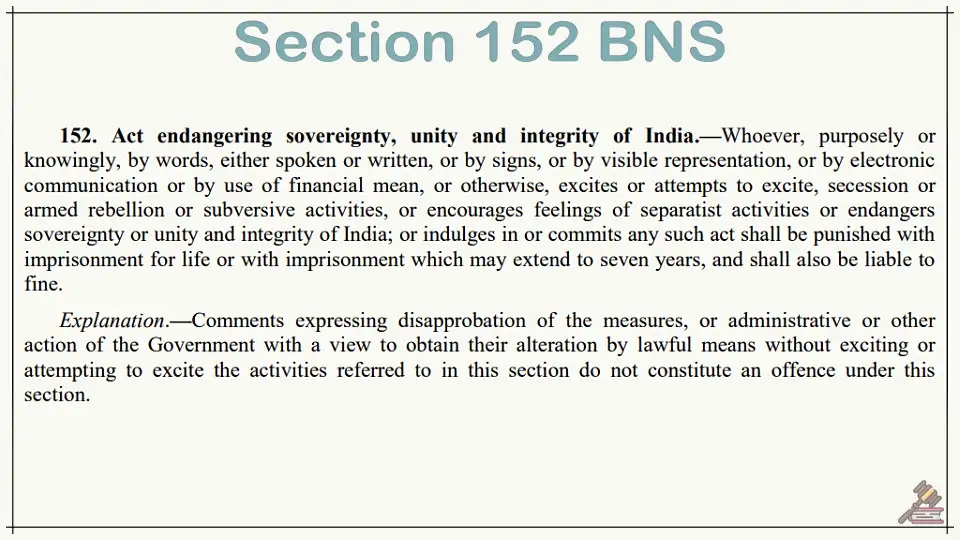
    The Supreme Court has raised a key question—whether the “potentiality of abuse” of Section 152 of the Bharatiya Nyaya Sanhita (BNS), which punishes acts endangering the sovereignty, unity, and integrity of India, could be a ground to declare the provision unconstitutional.

    Section 152 of the Bharatiya Nyaya Sanhita (BNS)

    About Section 152 BNS:

    • Deals with: Acts endangering sovereignty, unity, and integrity of India.
    • Origin: Introduced in the Bharatiya Nyaya Sanhita, 2023, effective 1 July 2024, replacing Section 124A IPC (sedition).
    • Scope: Criminalises purposeful or knowing acts that:
      • Excite secession, armed rebellion, or subversive activities.
      • Encourage separatist feelings.
      • Endanger sovereignty, unity, or integrity of India.
    • Means Covered: Words (spoken/written), signs, visible representation, electronic communication, financial means, or any other method.
    • Punishment: Life imprisonment or imprisonment up to 7 years + fine.
    • Nature of Offence: Cognizable, non-bailable, triable by Court of Session.
    • Exception Clause: Lawful criticism of government measures to seek change—without inciting rebellion/secession—is not an offence.
    • Key Difference from Section 124A IPC: Focus shifted from “disaffection against Government” to direct threats against the nation’s unity and sovereignty, with explicit recognition of digital-era methods.

    Issues with Section 152 BNS:

    • Potential for Misuse: Broad and subjective terms like “endangering sovereignty” can be stretched to target political dissent, journalism, and activism.
    • Vagueness: Undefined concepts (e.g., “sovereignty” in context of speech) create uncertainty, enabling arbitrary interpretation by authorities.
    • Similarity to Sedition Law: Despite rewording, its core effect mirrors Section 124A IPC, which is under constitutional challenge for curbing free speech.
    • Chilling Effect on Free Speech: Risk of self-censorship among journalists, activists, and citizens due to fear of prosecution.
    • High Punishment and Cognizability: Harsh penalties combined with arrest without warrant heighten scope for harassment before judicial scrutiny.
    • Digital Surveillance Concerns: Explicit coverage of electronic communication and financial means may widen investigative reach into personal digital activities.
    • Judicial Burden: Courts will need to repeatedly interpret the law to balance Article 19(1)(a) freedom of speech with state security.
    [UPSC 2025] Sedition has become my religion” was the famous statement given by Gandhiji at the time of:

    (a) the Champaran Satyagraha (b) publicly violating Salt Law at Dandi* (c) attending the Second Round Table Conference in London (d) the launch of the Quit India Movement


  • India Semiconductor Mission (ISM)

    Why in the News?

    The Union Cabinet has approved four new projects under the India Semiconductor Mission (ISM), adding to the country’s push for a robust semiconductor and display manufacturing ecosystem.

    About India Semiconductor Mission (ISM):

    • Overview: Launched in 2021; Operates under the Ministry of Electronics and Information Technology (MeitY)
    • Purpose: Develop a sustainable semiconductor and display manufacturing ecosystem in India.
    • Scope: Supports the entire value chain — from chip design to fabrication, assembly, testing, packaging, and display manufacturing.
    • Administrative Role: Receives and evaluates applications for schemes under the Semicon India Programme and engages with industry stakeholders to attract investment.

    Key Components:

    • Semiconductor Fabs Scheme: Fiscal support for setting up semiconductor wafer fabrication plants in India.
    • Display Fabs Scheme: Incentives for manufacturing TFT LCD and AMOLED display panels.
    • Compound Semiconductors / Silicon Photonics / Sensors Fab & ATMP/OSAT Scheme: Support for advanced semiconductor technologies and packaging facilities.
    • Design Linked Incentive (DLI) Scheme: Incentives and infrastructure support for IC, SoC, chipset, and semiconductor-linked design projects; administered by CDAC; includes support for startups.
    • Modernisation of Semi-Conductor Laboratory (SCL), Mohali: Upgrading as a brownfield fab.
    • Comprehensive Coverage: Includes manufacturing, R&D, packaging, and design support.
    [UPSC 2012] Recently there has been a concern over the short supply of a group of elements called rare earth metals. Why?

    1. China, which is the largest producer of these elements, has imposed some restrictions on their export.

    2. Other than China, Australia, Canada, Chile, these elements are not found in any country.

    3. Rare earth metals are essential for the manufacture of various kinds of electronic items and there is growing demand for these elements.

    Select the correct answer using the code given below:

    Options: (a)  1 only (b) 2 and 3 only (c) 1 and 3 only * (d) 1, 2 and 3


  • Muon g-2 Experiment

    Why in the News?

    Scientists at Fermilab in the USA have made an ultra-precise measurement of the muon’s magnetic behaviour, a finding that could hint at new physics beyond current laws.

    Muon g-2 Experiment

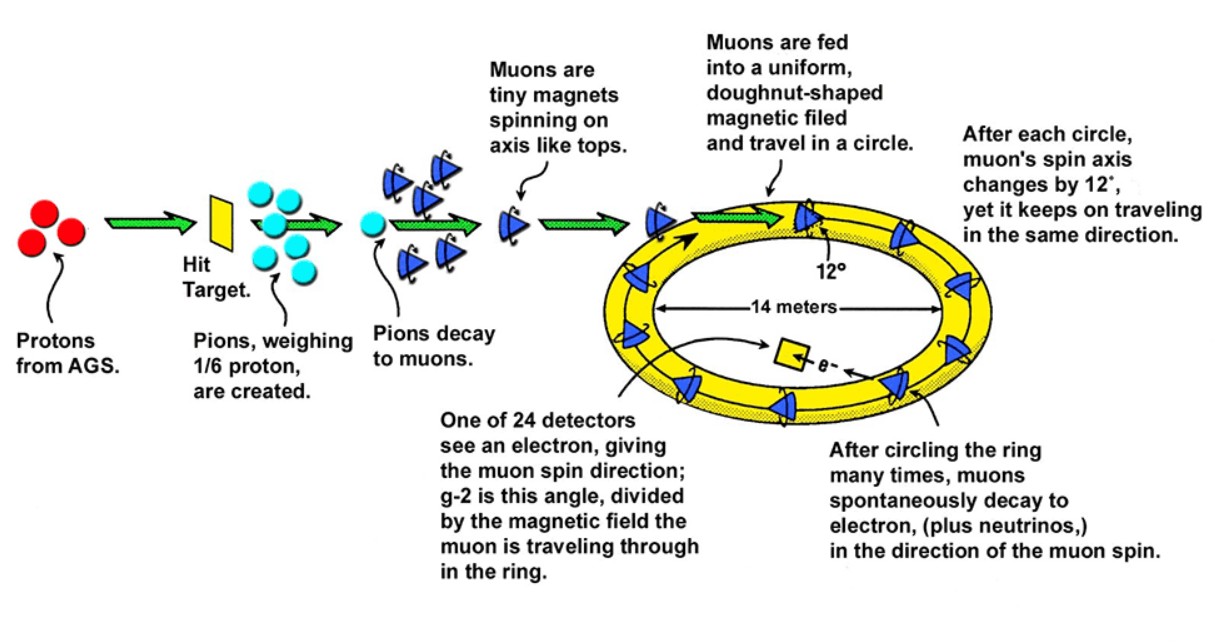
    Understanding Muon and G-2:

    • Overview: A muon is a subatomic particle like an electron but about 200 times heavier.
    • Behaviour: It has spin, making it act like a tiny magnet.
    • g-Factor: The magnet’s strength is measured by the g-factor. In simple theory, g = 2, but quantum effects make it slightly different — this difference is called g-2 (g minus 2).
    • Physics Relevance: Measuring g-2 can reveal unknown forces or particles beyond the Standard Model.

    The Fermilab Breakthrough:

    • Precision Record: Fermilab (USA) measured muon’s g-2 to an accuracy of 0.127 parts per million — comparable to detecting a 4-gram change on a 4-tonne elephant.
    • Method: Muons were sent into a large magnetic ring, measuring the gap between spin rate and orbital rate.
    • Results: Matches earlier experiments; disagreement with theory depends on calculation method used.
    • Next Steps: Japan’s upcoming experiment will independently test results.

    Significance:

    • Potential New Physics: If the gap is real, it may signal undiscovered forces or particles.
    • Refining Theory: If not, calculations will improve, sharpening known physics.
    • Broader Impact: Advances precision science and deepens global understanding of fundamental physics.
    • Lesson: Ultra-precise measurements can uncover hidden truths about nature.
    [UPSC 2013] The efforts to detect the existence of Higgs boson particle have become frequent news in the recent past. What is/are the importance/importances of discovering this particle?

    1. It will enable us to under-stand as to why elementary particles have mass.

    2. It will enable us in the near future to develop the technology of transferring matter from one point to another without traversing the physical space between them.

    3. It will enable us to create better fuels for nuclear fission.

    Select the correct answer using the codes given below.

    Options: (a) 1 only* (b) 2 and 3 only (c) 1 and 3 only (d) 1, 2 and 3


  • [pib] MSS+ Technology in Road Construction

    Why in the News?

    The CSIR–Central Road Research Institute, New Delhi, has developed MSS+ (Modified Mix Seal Surfacing Plus) technology for eco-friendly, durable, and low-cost road surfacing.

    About MSS+ Technology:

    • Developer: Council of Scientific & Industrial Research – Central Road Research Institute (CSIR–CRRI), New Delhi.
    • Year of Development: 2021 (in collaboration with J.M.V.D. Industries).
    • Pilot Project: First road in Uttar Pradesh built near Lucknow in 2022; Used for 202 km of roads under Pradhan Mantri Gram Sadak Yojana (PMGSY) in 2025.
    • Composition: Crushed natural aggregate, customised modified bitumen emulsion, mineral admixture.
    • Preparation: Mix made at ambient temperature, eliminating heating of aggregate or bitumen.
    • Laying: 25–30 mm thickness using conventional asphalt pavers.

    Benefits Offered:

    • Eco-Friendly: No thermal process → significantly reduces carbon emissions.
    • Durable: Provides strong wearing course, enhanced skid resistance, and prevents water infiltration.
    • Cost-Effective: Reduced energy requirement lowers construction costs.
    • All-Weather Use: Can be laid in varied weather conditions due to ambient temperature application.
    [UPSC 2020] In rural road construction, the use of which of the following is preferred for ensuring environmental sustainability or to reduce carbon footprint?

    1. Copper slag 2. Cold mix asphalt technology 3. Geotextiles 4. Hot mix asphalt technology 5. Portland cement

    Select the correct answer using the code given below:

    Options: (a) 1, 2 and 3 only * (b) 2, 3 and 4 only (c) 4 and 5 only (d) 1 and 5 only


  • Third United Nations Conference on Landlocked Developing Countries (LLDC3)

    Why in the News?

    The 3rd UN Conference on Landlocked Developing Countries (LLDC3) in Awaza, Turkmenistan, adopted the Awaza Declaration to boost investment, address challenges, and promote sustainable growth in 32 landlocked nations.

    Third United Nations Conference on Landlocked Developing Countries (LLDC3)

    About Landlocked Developing Countries (LLDCs):

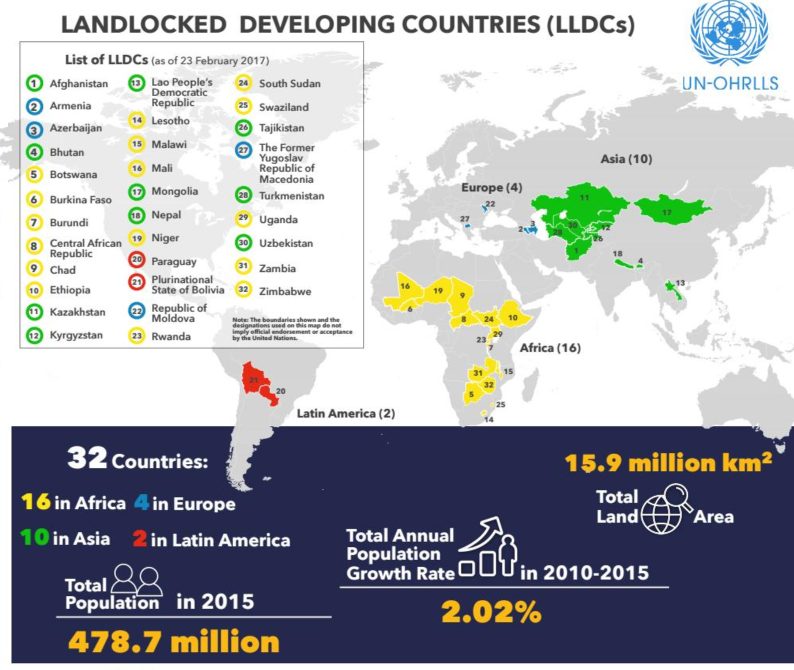
    • Overview: 32 UN-recognized countries with no direct access to the sea, collectively home to over 600 million people.
    • List of LLDCs:
      1. Africa: Botswana, Burkina Faso, Burundi, Central African Republic, Chad, Eswatini, Ethiopia, Lesotho, Malawi, Mali, Niger, Rwanda, South Sudan, Uganda, Zambia, Zimbabwe.
      2. Asia: Afghanistan, Bhutan, Kazakhstan, Kyrgyzstan, Lao People’s Democratic Republic, Mongolia, Nepal, Tajikistan, Turkmenistan, Uzbekistan.
      3. Europe: Armenia, Azerbaijan, North Macedonia, Moldova, Serbia.
      4. South America: Bolivia, Paraguay.
    • Challenges:
      • Dependence on transit countries for global market access.
      • Higher trade and transport costs (often twice those of coastal countries).
      • Limited connectivity, slower growth, and vulnerability to climate impacts.
    • Past Conferences:
      • 2003 (Almaty) – Almaty Programme of Action.
      • 2014 (Vienna) – Vienna Programme of Action (2014–2024).
      • 2025 (Awaza) – Awaza Programme of Action (2024–2034).

    Structure and Functioning:

    • LLDC Conferences: Held every 10 years to review progress and set a new action framework.
    • Awaza Programme of Action (2024–2034) – Priority Areas:
      • Structural transformation, science, technology, and innovation.
      • Trade facilitation and regional integration.
      • Transit, transport, and connectivity.
      • Climate resilience and adaptation.
      • Monitoring and implementation.
    • Stakeholder Participation:
      • UN member states, transit countries, donor agencies, NGOs, private sector, and academia.
    • Mechanisms:
      • UN-wide monitoring framework covering 323 initiatives.
      • Partnerships for infrastructure and digital connectivity.
      • Climate Negotiating Group under UNFCCC for LLDC-specific challenges.
    [UPSC 2013] Which one of the following countries is landlocked?

    Options:  (a) Bolivia* (b) Peru (c) Suriname (d) Uruguay


  • In news: Dardanelles Strait

    Why in the News?

    The Dardanelles Strait in northwestern Turkey has been temporarily closed to maritime traffic due to forest fires near Canakkale, prompting evacuations and firefighting operations.

    About Dardanelles Strait:

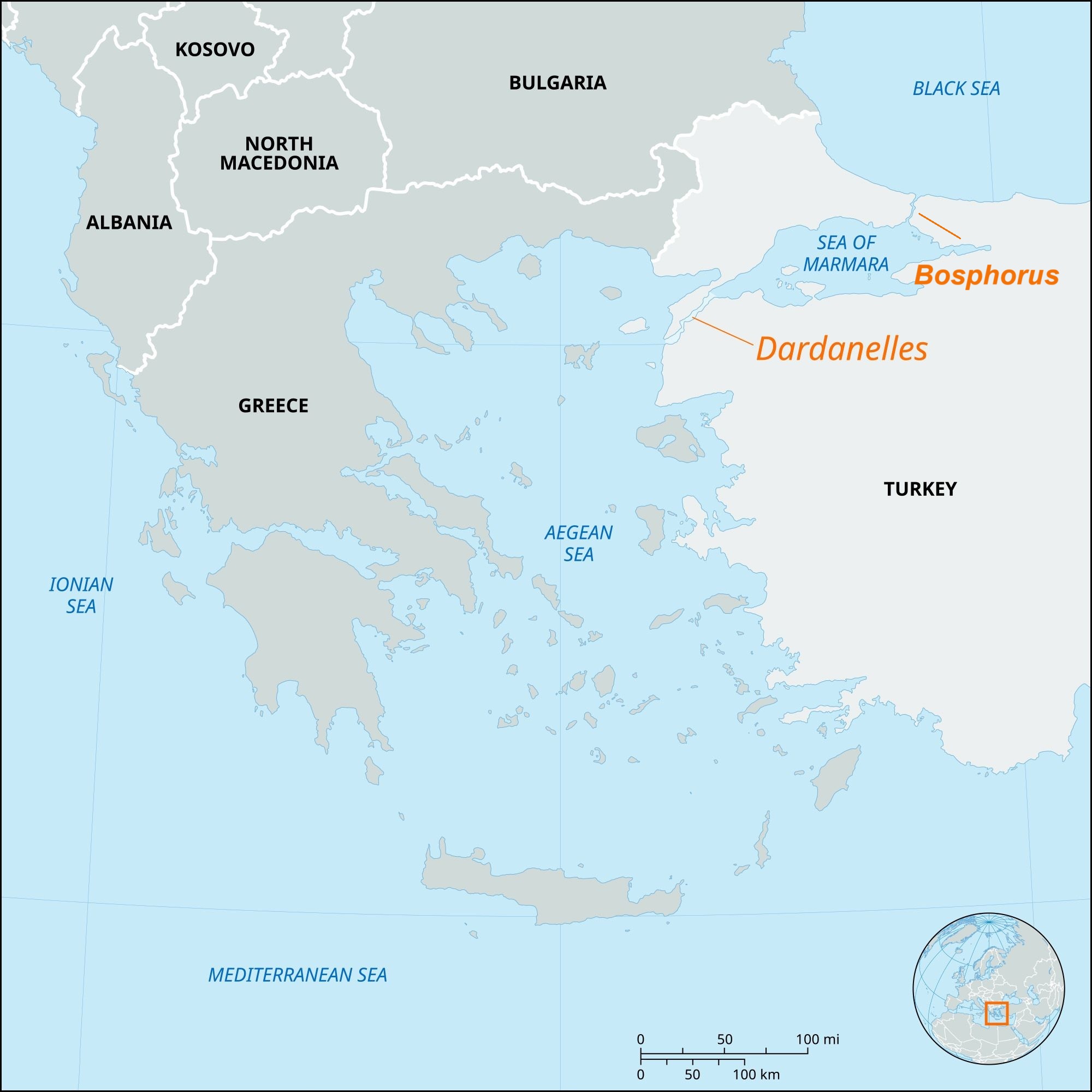
    • Location: Northwestern Turkey; separates Gallipoli Peninsula (Europe) from Troad/Biga Peninsula (Asia).
    • Connection: Links Aegean Sea → Sea of Marmara → Bosporus → Black Sea.
    • Dimensions: Length 61 km, width 1.2–6.5 km, average depth 55 m, max depth 103 m.
    • Historical Name: Hellespont, named after mythical princess Helle; current name from ancient city of Dardanus.
    • Currents: Surface current flows from Sea of Marmara to Aegean; saline undercurrent in reverse.
    • Ports: Gallipoli, Eceabat, Çanakkale.

    Strategic & Economic Importance:

    • Part of Turkish Straits system with Bosporus; only maritime link between Black Sea and Mediterranean.
    • Critical for Black Sea nations’ trade (Russia, Ukraine, Bulgaria, etc.).
    • Major route for grain, oil, energy shipments from Black Sea region to global markets.
    • Governed by Montreux Convention (1936) for warship passage.
    • Vital for NATO naval strategy and maritime security.
    [UPSC 2008] Through which one of the following Straits does a tunnel connect the United Kingdom and France?

    Options: (a) Davis Strait (b) Denmark Strait (c) Strait of Dover* (d) Strait of Gibraltar