💥Join UPSC 2027,2028 Mentorship (August Batch) + XFactor Notes & Microthemes PDF

Distribution: weekly

  • [2nd August 2025] The Hindu Op-ed: What has been missed is India’s digital sovereignty

    PYQ Relevance:

    [UPSC 2024] Right to privacy is intrinsic to life and personal liberty and is inherently protected under Article 21 of the Constitution. Explain. In this reference discuss the law relating to D.N.A. testing of a child in the womb to establish its paternity.

    Linkage: The article highlights that data is the “digital era’s most valuable resource” and that compromising its control, including individual data, poses “serious security risks” and affects national competitive advantage. Safeguarding personal data is a crucial component of asserting digital sovereignty.


    Mentor’s Comment:  The India–UK FTA, recently finalised, is hailed as a “gold standard” but raises concerns over digital sovereignty. India conceded access to source code and government data, weakening regulatory control and AI innovation leverage. The deal also marks a shift from India’s previous global stand on data localisation, contrasting positions taken even by countries like the US.

    Today’s editorial analyses the concerns over digital sovereignty in the India-UK FTA. This topic is important for GS Paper II (International Relations) in the UPSC mains exam.

    _

    Let’s learn!

    Why in the News?

    The India–United Kingdom Free Trade Agreement (FTA), officially called the Comprehensive Economic and Trade Agreement (CETA), is in the news because of a significant debate over its provisions for the digital sector and digital sovereignty.

    What digital issues arise from the India-UK FTA?

    • Unrestricted Use of Public Data: UK firms gain equal access to Indian public datasets, affecting domestic innovation potential. Eg: British companies can commercially exploit Indian transport or agricultural data.
    • Weakened Data Localization Autonomy: India must engage in consultations before enacting data rules, reducing flexibility.  
    • No Safeguards for Critical Infrastructure: The deal doesn’t exempt sensitive sectors from source code restrictions. Eg: India can’t review software running in strategic areas like nuclear power plants.
    • Lack of Coherent Digital Trade Policy: Commitments were made without a clear digital governance framework. Eg: Digital clauses went unchallenged, unlike the agricultural sector, which had strong negotiation backing.
    • Restricted Source Code Access: India is barred from demanding source code or algorithms, limiting oversight.

    What is Source Code?

    Source code is the original set of instructions written by a programmer in a human-readable programming language (like Python, Java, or C++) that defines how a software program works.

    How does source code access loss affect India’s digital control?

    • Weakens Cyber Sovereignty: Without access to source code, India cannot verify or modify software behavior, increasing reliance on foreign tech. Foreign telecom equipment may have backdoors compromising national security.
    •  Inhibits Regulatory Oversight: Lack of access hinders the ability of Indian regulators to audit algorithms or ensure compliance with local laws. Eg: India can’t fully inspect e-commerce platforms’ pricing algorithms for anti-competitive behavior.
    • Compromises Data Privacy & Security: Source code opacity prevents India from detecting data leaks or unauthorized data transfers.

    Why is a digital policy crucial for India’s trade interests?

    • Ensures Data Sovereignty: A strong policy helps India control how data is stored and used globally. Eg: Prevents sensitive health data from being transferred without oversight.
    • Protects Domestic Industry: Clear rules support Indian startups against unfair access by global players. Eg: Limits foreign firms from exploiting local e-commerce data.
    • Strengthens Negotiation Power: Defined digital laws give India leverage in FTA talks. Eg: Helps resist pressure to allow free cross-border data flow in trade deals.
    • Secures National Interests: Policy enables checks on cybersecurity threats and foreign surveillance. Eg: Restricts flow of defence-related digital information.
    • Boosts Digital Economy: Promotes data-driven innovation and economic growth through regulation. Eg: Encourages investment in Indian cloud services by assuring legal clarity.

    Way forward: 

    • Reassess Digital Commitments: Review FTA clauses that compromise digital sovereignty and seek renegotiation if needed.
    • Strengthen Data Protection Laws: Enforce robust data localisation and privacy regulations to safeguard national interest.
    • Ensure Source Code Access: Mandate conditional access to critical software for security audits and public interest.
    • Promote Indigenous Tech: Invest in local AI and digital infrastructure to reduce foreign dependency.
    • Align Trade with Policy: Harmonise trade agreements with India’s long-term digital and strategic goals.

  • 71st National Film Awards announced

    Why in the News?

    The Ministry of Information and Broadcasting has announced the 71st National Film Awards.

    About National Film Awards:

    • Establishment: Instituted in 1954, administered by the Directorate of Film Festivals (DoFF) under the Ministry of Information and Broadcasting, Government of India.
    • Purpose:
      • To encourage the production of films of aesthetic and technical excellence.
      • Promote films that reflect the cultural and social fabric of India.
      • Recognize and reward cinematic achievements across languages and formats.
    • Award Components:
      • Swarna Kamal (Golden Lotus): Includes medallion, certificate, and cash prize. Given in top categories.
      • Rajat Kamal (Silver Lotus): Awarded in various other categories.
    • Main Categories:
      • Feature Films: For artistic and technical excellence across Indian languages.
      • Non-Feature Films: For documentaries, shorts, and socially relevant content.
      • Best Writing on Cinema: For books and critics advancing understanding of cinema.
    • Eligibility Criteria:
      • Films must be produced in India.
      • Makers must be Indian nationals.
      • Must be certified by CBFC between Jan 1 and Dec 31.
      • Foreign co-productions have specific eligibility conditions.
    • Jury and Selection:
      • Independent juries for each category.
      • No governmental or commercial influence in the selection process.

    About Dadasaheb Phalke Award:

    • Part of NFA.
    • India’s highest cinematic honour.
    • Instituted in 1969 to commemorate Dhundiraj Govind Phalke, India’s first filmmaker.
    • Consists of:
      • Swarna Kamal
      • ₹10 lakh cash prize
      • Certificate, silk roll, and shawl
    • First recipient: Devika Rani Roerich


  • Age Cap for Surrogacy in India

    Why in the News?

    The Supreme Court of India has reserved its judgment (i.e. final decision is pending) in a set of petitions challenging the age-related eligibility criteria under the Surrogacy (Regulation) Act, 2021.

    These cases involve couples who had initiated the surrogacy process prior to the enactment of the law on January 25, 2022, but are now disqualified due to the new age limits.

    About the Surrogacy (Regulation) Act, 2021

    • Objective: To regulate surrogacy in India, prohibit commercial surrogacy, and promote ethical, altruistic surrogacy based on medical necessity.
    • Scope:

    Key Provisions:

    • Type Permitted: Only altruistic surrogacy (unpaid surrogate mother) is allowed; commercial surrogacy is banned.
    • Eligibility Criteria for Intending Couples:
      • Legally married for at least 5 years.
      • Woman must be 23–50 years of age; man must be 26–55 years.
      • Must not have any living biological, adopted, or surrogate child.
    • Eligibility for Single Women:
      • Only widows or divorcees between 35–45 years are eligible.
      • Unmarried women are not eligible (currently under challenge).
    • Surrogate Mother Criteria:
      • Must be a close relative, married, and have at least one biological child.
      • Age: 25–35 years.
    • Certification Requirement: A Certificate of Essentiality is required, including:
      • Proof of infertility
      • Court order for parentage and custody
      • Insurance for the surrogate mother
    • Penalties: Commercial surrogacy invites imprisonment (up to 10 years) and fines (up to ₹10 lakh).
    • Regulatory Structure:
      • National Surrogacy Board at the central level.
      • State Surrogacy Boards at the state level.

    Issues Highlighted by the Supreme Court:

    • No Transitional Provision: The Act lacks a grandfather clause to protect couples who began the surrogacy process (e.g., embryo freezing) before the law came into effect in January 2022.
    • Rigid Age Limits: The court questioned the fairness of disqualifying couples solely on age grounds, especially when natural pregnancies at older ages are not prohibited.
    • Violation of Fundamental Rights: Petitioners argued the age restrictions violate Article 14 (equality before law) and Article 21 (right to reproductive autonomy and personal liberty).
    • Exclusion of Unmarried Women: The law permits only widows or divorcees (35–45 years) to pursue surrogacy, which the court noted may be arbitrary and discriminatory.
    • Law’s Intent vs. Impact: The court stressed that while the law aims to prevent commercial surrogacy, it should not unreasonably prevent genuine intending parents from having children.
    [UPSC 2020] In the context of recent advances in human reproductive technology, “Pronuclear Transfer” is used for:

    Options: (a) fertilization of egg in vitro by the donor sperm (b) genetic modification of sperm producing cells (c) development of stem cells into functional embryos (d) prevention of mitochondrial diseases in offspring*


  • What is Darwin Tree of Life (DToL) Project?

    Why in the News?

    Researchers in Britain & Ireland are aiming to sequence all animals, fungi and plants under the Darwin Tree of Life (DToL) Project.

    About Darwin Tree of Life (DToL) Project:

    • Objective: To sequence the genomes of all ~70,000 known eukaryotic species (whose cells contain a nucleus and other membrane-bound organelles) found in Britain and Ireland.
    • Initiated: In 2019 as a UK–Ireland contribution to the Earth BioGenome Project.
    • Geographic Focus: Great Britain and Ireland, chosen for their well-documented and accessible biodiversity.

    Key Features:

    • Phases:
      • Pilot Phase (2019–2022): Focused on collecting 8,000 species; targeted 2,000 genome assemblies.
      • As of 2025: ~8,000 species collected; over 2,000 genomes sequenced.
    • Approach:
      • Systematic specimen collection and species verification.
      • High-quality genome sequencing using advanced tools and curated pipelines.
    • Public Access: All genome data is released openly via the DToL portal and public archives.
    • Scientific Significance:
      • Enhances understanding of evolution, adaptation, and species relationships.
      • Supports conservation efforts amid growing biodiversity threats.
    • Applications: Informs conservation biology, medicine, agriculture, and climate adaptation.
    [UPSC 2011] At present, scientists can determine the arrangement or relative positions of genes or DNA sequences on a chromosome. How does this knowledge benefit us?

    1. It is possible to know the pedigree of livestock.

    2. It is possible to understand the causes of all human diseases.

    3. It is possible to develop disease-resistant animal breeds.

    Options: (a) 1 and 2 only (b) 2 only (c) 1 and 3 only* (d) 1, 2 and 3


  • Patalpani-Kalakund Heritage Railway

    Why in the News?

    The 155-year-old Patalpani–Kalakund heritage train services has resumed after a temporary halt.

    About the Patalpani–Kalakund Heritage Line:

    • Route: 9.5 km metre-gauge section between Patalpani and Kalakund in Madhya Pradesh.
    • Section: Part of the Dr. Ambedkar Nagar (Mhow)–Khandwa route.
    • Restoration Year: Revived in 2018 as a heritage line after being excluded from gauge conversion due to difficult terrain.
    • Operational Details:
      • Average speed: 5–10 km/h.
      • Features scenic gorges, tunnels, embankments, Patalpani waterfall, and natural springs.
    • Historical Origins:
      • Proposed by Maharaja Tukoji Rao Holkar II in 1870.
      • First constructed as part of Holkar State Railways, completed in 1878.
      • Became part of Rajputana–Malwa Railway in 1881–82.
    • Cultural Significance:
      • Patalpani station named after Tantia Bhil, a tribal revolutionary.
      • Kalakund station named after a local sweet delicacy.

    Other Heritage Railways of India:

    Name & Route Details
    Darjeeling Himalayan Railway
    • Location: West Bengal
    • UNESCO Status: World Heritage Site (1999)
    • Built: 1879–81
    • Highlights: Batasia Loop, zigzags, colonial-era steam engines
    • Route: New Jalpaiguri to Darjeeling (88 km, narrow gauge)
    Nilgiri Mountain Railway
    • Location: Tamil Nadu
    • UNESCO Status: World Heritage Site (2005)
    • Highlights: Only rack-and-pinion railway in India, steep climbs, vintage locomotives
    • Route: Mettupalayam to Ooty (46 km, metre gauge)
    Kalka–Shimla Railway
    • Location: Himachal Pradesh
    • UNESCO Status: World Heritage Site (2008)
    • Built: 1898–1903
    • Highlights: 102 tunnels, 800+ bridges; access to British summer capital
    • Route: Kalka to Shimla (96 km, narrow gauge)
    Matheran Hill Railway
    • Location: Maharashtra
    • UNESCO Status: Tentative World Heritage Site
    • Built: 1907
    • Highlights: Zigzags, tight curves, eco-sensitive, vehicle-free destination
    • Route: Neral to Matheran (21 km, narrow gauge)
    Kangra Valley Railway
    • Location: Himachal Pradesh
    • UNESCO Status: Tentative World Heritage Site
    • Highlights: 971 bridges, 2 tunnels; scenic Dhauladhar views, access to ancient temples
    • Route: Pathankot to Joginder Nagar (163 km, narrow gauge)


    [UPSC 2009] Recently, which one of the following was included in the UNESCO’s World Heritage list?

    Options: (a) Dilwara Temple (b) Kalka-Shimla Railway* (c) Bhiterkanika Mangrove Area (d) Vishakhapatnam to Araku Valley railway line


  • Piprahwa Relics of Buddha

    Why in the News?

    The Union Culture Ministry has successfully retrieved the sacred ‘Piprahwa’ Buddhist relics, which were set to be auctioned in Hong Kong.

    Piprahwa Relics of Buddha

    About the Piprahwa Relics:

    • Discovery: Unearthed in 1898 by William Claxton Peppe, a British engineer, at Piprahwa (Siddharthnagar, Uttar Pradesh), near the Nepal border.

    • Historical Significance: Identified as ancient Kapilavastu, capital of the Shakya republic, where Prince Siddhartha (Buddha) lived before renunciation.

    • Findings at the Site: A buried stupa yielded a large stone coffer containing:

      • Bone fragments believed to be Buddha’s relics
      • Caskets made of soapstone and crystal
      • A sandstone coffer
      • Over 1,800 ornaments: pearls, rubies, sapphires, gold sheets
    • Legal Custody:

      • The British Crown claimed the relics under the Indian Treasure Trove Act, 1878.
      • Most artifacts were transferred to the Indian Museum, Kolkata.

    Stupas with Buddha’s Relics:

    • After the Buddha’s death (Mahaparinirvana), his cremated relics were divided among 8 kingdoms and a Brahmin named Drona, who coordinated their distribution.
    • Each recipient built a Stupa to enshrine their share of the relics, creating important pilgrimage sites and early centers of Buddhist worship.
    • The 9 stupas were located in Rajagriha, Vaishali, Kapilavastu, Allakappa, Ramagrama, Vethadipa, Pava, Kushinagar, and Pippalivana.
    • Emperor Ashoka (3rd century BCE) redistributed the relics from these stupas into thousands of new stupas across his empire.
    • The stupa at Ramagrama is unique because it is believed to remain untouched and still holds the original relics.
    • A typical early Buddhist stupa included a hemispherical mound (anda), a square railing (harmika), a central pillar (yashti) with umbrellas (chatra), and a path for circumambulation (pradakshinapatha).
    [UPSC 2023] With reference to ancient India, consider the following statements:

    1. The concept of Stupa is Buddhist in origin.

    2. Stupa was generally a repository of relics.

    3. Stupa was a votive and commemorative structure in Buddhist tradition. How many of the statements given above are correct?

    Options: (a) Only one (b) Only two* (c) All three (d) None


  • [1st August 2025] The Hindu Op-ed: Why the world needs better green technologies

    PYQ Relevance:

    [UPSC 2024] The world is facing an acute shortage of clean and safe freshwater. What are the alternative technologies which can solve this crisis? Briefly discuss any three such technologies citing their key merits and demerits.

    Linkage: This question directly related to “alternative technologies” to address a critical global environmental and resource crisis (freshwater scarcity). This aligns with the broader theme that the world needs better and diverse green technologies to tackle urgent environmental problems and ensure resource self-sufficiency, as emphasized in the context of energy innovation.


    Mentor’s Comment: As the push for sustainable energy intensifies, concerns are rising over the efficiency limits of widely used silicon photovoltaics. With the growing need for green hydrogen and land constraints, experts are questioning whether next-gen solar technologies offer better solutions. India must invest in efficient, diverse, and scalable innovations to meet climate goals and ensure energy self-sufficiency.

    Today’s editorial analyses the concerns that are rising over the efficiency limits of widely used silicon photovoltaics. This topic is important for GS Paper III (Environment) in the UPSC mains exam.

    _

    Let’s learn!

    Why in the News?

    Recently, as the global need for clean energy has increased and countries aim to fulfill their climate promises, silicon solar panels have become the most popular choice, changing the look of places from city rooftops to large solar farms in villages.

    What limits silicon photovoltaics in meeting India’s climate goals?

    • Low Energy Efficiency: Silicon solar panels have an in-field efficiency of only 15–18%, meaning a significant portion of solar energy is not converted into electricity. Eg: In Rajasthan, more panels are required to meet energy demand, increasing cost and land use due to low conversion efficiency.
    • High Land Requirement: Due to their low efficiency, silicon panels need a larger surface area to generate the same output compared to newer technologies. Eg: The Rewa Solar Park in Madhya Pradesh covers over 1,500 hectares, reducing land availability for agriculture and conservation.
    • Slow Climate Impact: Despite growing solar capacity, CO₂ levels have risen from 350 ppm in 1990 to ~425 ppm in 2025, indicating renewables are not scaling fast enough. Eg: Even after installing 4.45 TWh of renewable energy by 2024, India remains behind on its climate targets.
    • Environmental Footprint of Manufacturing: The production of silicon panels involves high energy use and toxic chemicals, partially offsetting their green benefits. Eg: Most panels are imported from China, where coal-powered factories dominate, adding to indirect emissions.
    • Incompatibility with Advanced Applications: Silicon PVs are less suitable for high-efficiency applications like green hydrogen production, which needs more consistent, high-output energy. Eg: In pilot projects in Gujarat, using silicon panels reduces the overall efficiency of green hydrogen production due to energy losses.

    Why rethink electrolysis-based green hydrogen?

    • High Energy Consumption: Electrolysis requires more energy to produce green hydrogen than the energy hydrogen provides when used, making the process energy-inefficient. Eg: In India’s pilot projects in Ladakh, the high electricity input from solar panels results in low net energy gain, raising concerns about economic viability.
    • Storage and Transportation Challenges: Hydrogen has very low density, making it difficult and expensive to store and transport, often requiring high-pressure tanks or cryogenic conditions. Eg: In hydrogen mobility projects, such as those in Delhi, leakage and compression issues have hampered safe and cost-effective deployment.
    • Compounding Energy Losses in Conversion: Using green hydrogen to produce green ammonia or methanol, and then extracting hydrogen back, leads to multiple stages of energy loss. Eg: In proposed export hubs like Vizag, converting hydrogen to ammonia for shipping and then reconverting it abroad reduces overall energy efficiency.

    How do land and efficiency issues impact India’s solar push?

    • Low Efficiency Increases Land Requirement: Silicon solar panels with 15–18% efficiency require larger surface areas to generate the same energy as advanced solar technologies. Eg: In Rajasthan’s Bhadla Solar Park, vast desert land is used to compensate for low panel efficiency, which limits deployment in land-constrained states.
    • Urbanisation Limits Land Availability: Rapid urban expansion and the need to conserve green zones reduce the availability of suitable land for large-scale solar projects. Eg: In Mumbai’s metropolitan region, limited open space has pushed the focus toward rooftop solar, which has its own technical and regulatory hurdles.
    • Hinders Achievement of Renewable Energy Targets: The inefficient land-to-energy ratio slows down the pace of solar capacity expansion, affecting progress toward India’s net-zero commitments. Eg: In Tamil Nadu, where land is both fertile and scarce, competing demands between agriculture and solar installations have delayed key solar proposals.

    What role can artificial photosynthesis play in renewable energy?

    • Direct Conversion of Sunlight into Fuel: Artificial photosynthesis (APS) mimics natural photosynthesis to convert sunlight, water, and CO₂directly into fuels like green methanol or hydrogen, offering a clean, efficient alternative to traditional energy-intensive processes.
    • Bypasses Inefficiencies in Current Technologies: APS has the potential to eliminate multiple energy-loss steps such as electrolysis, storage, and reconversion, thereby enhancing the overall energy efficiency of renewable fuel production systems.

    Why invest in next-gen renewable tech like RFNBO? (Way forward)

    • Enhances Energy Independence: Renewable Fuels of Non-Biological Origin (RFNBO) can reduce India’s heavy reliance on imported fossil fuels (currently ~85%), promoting energy self-sufficiency in a geopolitically volatile world.
    • Supports Diverse and Efficient Decarbonisation: RFNBO technologies enable the production of cleaner fuels like green hydrogen, ammonia, and methanol using renewable electricity, offering higher efficiency and adaptability for industrial and transport sectors.
    • Future-Proofing India’s Energy Strategy: Investing in RFNBO ensures India is aligned with global clean energy innovations, allowing it to meet net-zero targets and remain competitive in emerging green fuel markets.
  • The Maldives: A brief history of the nation and its ties with India

    Why in the News?

    Recently, Prime Minister Narendra Modi’s two-day state visit to the Maldives (July 2025) marked a significant reset in bilateral ties after months of strain following the election of President Mohamed Muizzu, who had earlier run on an ‘India Out’ platform.

    What caused the India-Maldives ties reset under Muizzu?

    • Troop Withdrawal & Civilian Substitution: President Muizzu demanded the removal of Indian military personnel, citing sovereignty. India responded by replacing them with civilian technical staff 
    • High-Level Diplomatic Engagements: Muizzu visited New Delhi in October 2024, signaling openness to dialogue.Indian PM reciprocated with a state visit to Male in July 2025, the first by a foreign Head of State under Muizzu.  
    • Economic Support & Debt Relief: India extended budgetary support and credit lines, easing Maldives’ financial burden. Eg: A ₹4,850 crore Line of Credit and 40% debt repayment reduction in 2025.
    • Softening of Rhetoric & Public Signals: President Muizzu acknowledged historical ties, calling the Indian Ocean a testament to shared heritage. This marked a shift from his earlier India-Out campaign tone.
    • Launch of Institutional Mechanisms: Announcement of India-Maldives Parliamentary Friendship Group and FTA discussions in 2025.

    How has India ensured the Maldives’ security?

    • Military Intervention in Crisis: In 1988, India launched Operation Cactus to foil a coup attempt, securing the capital and leadership.
    • Bilateral Defence Cooperation:  The DOSTI maritime exercise, started in 1991, strengthens Coast Guard coordination.
    • Strategic Presence and Infrastructure Support: India maintained a defensive presence (now civilian) and supported surveillance capabilities like helped set up coastal radar systems.
    • Humanitarian and Disaster Relief Operations: India has provided quick assistance during natural disasters, showcasing readiness and goodwill. India provided critical aid to Maldives after the 2004 Indian Ocean tsunami.
    • Regional Security Engagements: Maldives is a key member of the Colombo Security Conclave, focusing on counter-terrorism and maritime security.

    Why is the Maldives vital for India amid China’s presence?

    • Strategic Location in the Indian Ocean: The Maldives lies along key international shipping lanes, making it critical for India’s maritime security and energy supply routes. Eg: Over 80% of India’s energy imports pass close to the Maldives archipelago, near the Eight Degree Channel.
    • Countering China’s Expanding Influence: China’s increasing investments and debt diplomacy in Maldives threaten to shift the regional balance. Eg: The Sinamale Bridge, built with Chinese funding, raised concerns over strategic dependence.
    • Ensuring Regional Stability and Security Cooperation: Maldives’ support is essential for coordinated patrols, anti-terrorism, and anti-piracy efforts.

    Way forward: 

    • Strengthen People-to-People Ties and Institutional Dialogue: Promote educational, cultural, and tourism exchanges while deepening parliamentary and civil service cooperationto build long-term goodwill and trust.
    • Enhance Transparent and Sustainable Development Partnerships: Focus on jointly planned, community-driven projects with clear benefits to Maldivian citizens, countering external influence through mutual respect and shared values.

    Mains PYQ:

    [UPSC 2024] Discuss the geopolitical and geostrategic importance of Maldives for India with a focus on global trade and energy flows. Further also discuss how this relationship affects India’s maritime security and regional stability amidst international competition?


    Linkage: The article talk about the Maldives’ geographical location in the northern Indian Ocean and its historical and ongoing ties with India. It also highlights India’s concerns about “growing Chinese influence in the region”, which directly relates to “international competition” and its impact on “regional stability.” The question also touches upon “global trade and energy flows” and “maritime security,” which are intrinsic to the strategic importance of an island nation like Maldives.

  • IMF releases World Economic Outlook (WEO)

    Why in the News?

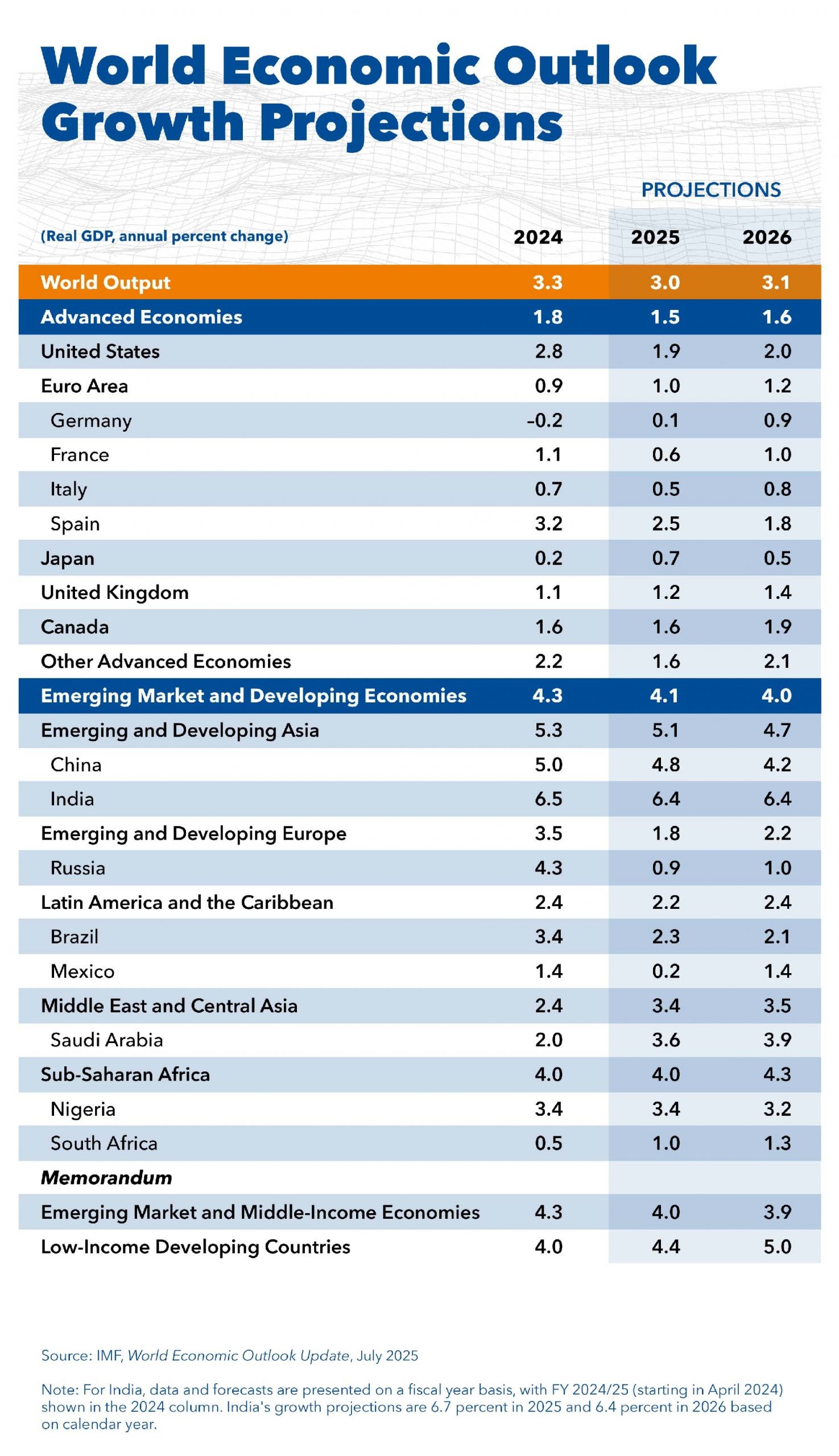
    The International Monetary Fund (IMF) has released the July 2025 update to its World Economic Outlook (WEO).

    IMF releases World Economic Outlook (WEO)

    About World Economic Outlook (WEO):

    • Published By: International Monetary Fund (IMF)
    • Frequency: Biannual (April, October) + updates in January and July
    • Purpose: Provides global forecasts on GDP, inflation, trade, and policy trends
    • Data Sources: IMF consultations with member nations and internal models
    • Audience: Governments, institutions, investors, researchers
    • July 2025 Update Title: “Global Economy: Tenuous Resilience amid Persistent Uncertainty”

    Key Highlights – July 2025 Update:

    • Global Growth Projections:
      • 2025: 3.0% (↑ from 2.8% in April)
      • 2026: 3.1% (↑ from 3.0%)
    • Despite multiple shocks—COVID-19, the Ukraine war, tariff increases—global growth continues.
      However, resilience remains fragile due to:

      • US–China tariff tensions and rising protectionism
      • Conflicts in Ukraine and the Middle East
      • High public debt in advanced economies is raising interest rates
    • Country Forecasts for 2025:  United States: 1.9%,  China: 4.8% (↑ from 4.0%),  Euro Area: 1.0%,  Germany: 0.1%,  United Kingdom: 1.2%,  Japan: 0.7%,  Russia: 0.9%,  Pakistan: 2.7%.

    India – The Bright Spot:

    • Growth Rate: 2023: 9.2%;  2024: 6.5%;  2025: 6.4% (strongest among major economies).
    • Drivers of Growth:
      • Robust domestic demand
      • Strong services and manufacturing output
      • Effective inflation and monetary policy management
    • Strategic Position:
      • Set to overtake several advanced economies in GDP size
      • Viewed globally as a “bright spot” amid persistent uncertainties
    [UPSC 2014] Which of the following organisations brings out the publication known as ‘World Economic Outlook?

    Options: (a) The International Monetary Fund * (b)The United Nations Development Programme (c) The World Economic Forum (d) The World Bank


  • What are Skill Impact Bonds (SIB)?

    Why in the News?

    Skill Impact Bonds (SIB) were recently highlighted by the Skill Development Ministry.

    About the Skill Impact Bond:

    • Launched: November 2021
    • Nature: India’s first Development Impact Bond (DIB) focused on employment-linked skill development
    • Lead Agency: National Skill Development Corporation (NSDC), under the Ministry of Skill Development and Entrepreneurship
    • Collaborators: British Asian Trust, HSBC India, Michael & Susan Dell Foundation
    • Target: Train and place 50,000 youth over 4 years, with 62% women participation
    • How it Works:
      • Risk Investors: Provide upfront capital to training providers
      • Training Providers: Deliver skill training and ensure job placements
      • Outcome Funders: Repay investors only if job outcomes are achieved
      • Evaluators: Independently assess outcomes via CATI surveys and document verification

    Key Features:

    • Outcome-Focused Approach: Measures success by certification, placement, and 3-month retention, not just enrolment
    • Eligibility Criteria:
      • Age: 18–40 years; Education: Undergraduate or below
      • Status: Unemployed or earning below ₹15,000/month, or household income below ₹25,000/month
    • Sectoral Coverage: Retail, Healthcare, Apparel, Logistics, Information Technology & IT-enabled Services, Banking, Financial Services & Insurance.
    • Women-Focused Design: Ensures 62% female participation to bridge the gender employment gap
    [UPSC 2018] With reference to Pradhan Mantri Kaushal Vikas Yojana, consider the following statements:

    1. It is the flagship scheme of the Ministry of Labour and Employment.

    2. It, among other things, will also impart training in soft skills, entrepreneurship, financial and digital literacy.

    3. It aims to align the competencies of the unregulated workforce of the country to the National Skill Qualification Framework.

    Which of the statements given above is/are correct?

    Options: (a) 1 and 3 only (b) 2 only (c) 2 and 3 only* (d) 1, 2 and 3