💥Join UPSC 2027,2028 Mentorship (August Batch) + XFactor Notes & Microthemes PDF

Distribution: weekly

  • Adopt formalisation to power productivity growth 

    Why in the News?

    India’s manufacturing sector is facing renewed scrutiny due to the rising contractualisation of labour, which has grown from 20% in 1999-2000 to 40.7% in 2022-23, according to the Annual Survey of Industries

    What drives the rise of contract labour in formal manufacturing?

    • Cost Minimization: Employers hire contract workers to reduce wage bills and avoid social security contributions. Eg: In large firms, contract workers often earn up to 31% less than regular employees.
    • Bypassing Labour Laws: Contracting allows firms to circumvent regulations under the Industrial Disputes Act, 1947, such as rules on retrenchment and notice period.  
    • Operational Flexibility: Firms use contract labour to scale up or down quickly with demand without long-term obligations. Eg: Seasonal industries like textiles use short-term contract workers during peak export periods.
    • Third-Party Shielding: Outsourcing through contractors protects the principal employer from legal accountability for employment terms. Eg: Automobile assembly lines often outsource non-core work to manpower agencies.
    • Sector-Wide Trend Across Sizes: The rise in contract labour is not limited to small firms; it extends to large and capital-intensive industries. Eg: Between 2000 and 2022, contract labour share doubled from 20% to 40.7% across all industries.

    Why does contract labour hurt long-term productivity?

    • Low Skill Development: Contract workers are rarely given training or upskilling opportunities, limiting their efficiency and innovation. Eg: In India’s electronics manufacturing sector, companies like Dixon Technologies rely heavily on contract labour, leading to a shortage of skilled technicians for precision assembly.
    • High Attrition and Turnover: Contract workers frequently change jobs due to lack of job security, resulting in loss of institutional knowledge. Eg: In food processing units in Punjab, annual turnover among contract workers exceeds 70%, disrupting workflow continuity.
    • Reduced Worker Motivation: Absence of benefits like promotion, pension, or medical cover leads to low morale and reduced effort. Eg: In government-run power plants, studies have shown that contract workers contribute less to maintenance efficiency than permanent staff, affecting overall plant performance.
    • Weak Industrial Relations: Contract workers are often excluded from grievance redressal mechanisms or unions, increasing workplace tensions and risking disruptions. Eg: Maruti Suzuki’s Manesar plant witnessed violent unrest in 2012, partly attributed to discontent between permanent and contract workers.
    • Quality Compromise and Rework: Contract workers may lack the ownership mindset, resulting in errors and product rework, which lowers productivity. Eg: In garment export hubs like Tiruppur, repeated quality rejections from overseas buyers have been traced to inconsistent output from untrained contract labour.
    • Wage and cost gaps act as a disincentive
      • Unequal pay for equal work: Contract workers often earn much less than permanent workers for doing the same job, violating fairness.
        Eg: In PSUs like ONGC, contract workers earn up to 50% less than permanent employees for the same technical work.
      • Avoidance of social security: Employers save costs by not contributing to Provident Fund, gratuity, or health benefits, increasing worker insecurity.
        Eg: A CAG audit of private thermal power plants found 30–40% labour cost savings due to evasion of statutory benefits.

    What are the existing policy?

    • Contract Labour (Regulation and Abolition) Act, 1970: This law aims to regulate the employment of contract labour in certain establishments and abolish it in specific cases where work is perennial in nature. However, enforcement is weak, and many employers bypass provisions through sub-contracting.
    • Code on Occupational Safety, Health and Working Conditions (OSH Code), 2020: Consolidates 13 labour laws, including those related to health, safety, and working conditions of workers (including contract labour). It mandates registration of establishments and welfare facilities, but monitoring and implementation remain inconsistent.
    • Fixed Term Employment (FTE) provision under the Industrial Relations Code, 2020: Legalises short-term employment contracts with a provision for equal pay for equal work. But in practice, social security benefits and job security are often denied to such workers.

    Way forward: 

    • Ensure Universal Social Protection: Extend mandatory social security coverage (e.g., ESIC, EPF) to all contract and gig workers, with portable benefits and employer accountability, regardless of tenure or contract type.
    • Improve Legal Enforcement and Transparency: Strengthen labour law enforcement through digital compliance portals, randomised inspections, and public disclosure of contract employment data to prevent misuse and promote accountability.

    Mains PYQ:

    [UPSC 2024] Discuss the merits and demerits of the four ‘Labour Codes’ in the context of labour market reforms in India. What has been the progress so far in this regard?
    Linkage: The article talks about the “labour code on industrial relations” introduced in 2020 which is related to the demand of the question. This code, awaiting implementation, aims to provide greater flexibility in hiring and firing by allowing firms to directly hire non-regular workers on fixed-term contracts without third-party contractors. However, it also seeks to curb exploitation by mandating basic statutory employment benefits.
  • In news: Kyoto Protocol

    Why in the News?

    Vijai Sharma, a 1974-batch IAS officer and architect of India’s climate diplomacy, who helped shape the Kyoto Protocol for safeguarding the interests of developing countries like India, has passed away.

    About Kyoto Protocol:

    • Adopted: 11 December 1997 (UNFCCC COP-3, Kyoto, Japan); Came into Force: 16 February 2005
    • Legal Status: Legally binding on developed (Annex I) countries
    • Parent Treaty: United Nations Framework Convention on Climate Change (1992)
    • Objective: Reduce greenhouse gas emissions and address climate change
    • Principle: Common but Differentiated Responsibilities and Respective Capabilities (CBDR-RC)
    • Parties: 192 ratified; key non-parties include United States and Canada

    Key Features:

    • Emission Targets:
      • Annex B nations to cut emissions by 5% below 1990 levels (2008–2012)
      • Doha Amendment (2012): 18% cut for 2013–2020
    • Greenhouse Gases Covered:
      • Carbon dioxide, Methane, Nitrous oxide, Hydrofluorocarbons, Perfluorocarbons, Sulfur hexafluoride
    • Market Mechanisms:
      • Clean Development Mechanism (CDM): Carbon credits via projects in developing nations
      • Joint Implementation (JI): Emission reduction between Annex I countries
      • International Emissions Trading: Trade surplus emission units
    • Monitoring and Enforcement:
      • Mandatory reporting and independent verification
      • Compliance Committee oversight
      • Land Use, Land-Use Change and Forestry (LULUCF) included; aviation/shipping excluded
    • Equity Element:
      • No binding targets for developing nations like India and China
      • Developed nations held accountable for historical emissions

    Vijai Sharma’s Contributions:

    • Climate Negotiations Leader: India’s chief negotiator (1995–2001), led G77+China, defended equity and exemptions for developing nations
    • Policy Architect: Helped shape CDM governance, promoted India’s clean-tech access
    • Environmental Reformer: As Environment Secretary (2008–2010), improved clearance processes
    • Legacy: Called “Sir Humphrey Sharma” for his sharp wit and bureaucratic skill; key figure in India’s Kyoto-era climate diplomacy
    [UPSC 2016] Consider the following pairs:

    Terms sometimes seen in the news : Their origin

    1. Annex-I Countries : Cartagena Protocol

    2. Certified Emissions Reductions : Nagoya Protocol

    3. Clean Development Mechanisms : Kyoto Protocol

    Which of the pairs given above is/are correctly matched?

    Options: (a) 1 and 2 only (b) 2 and 3 only (c) 3 only* (d) 1, 2 and 3


  • NASA-ISRO Synthetic Aperture Radar (NISAR)

    Why in the News?

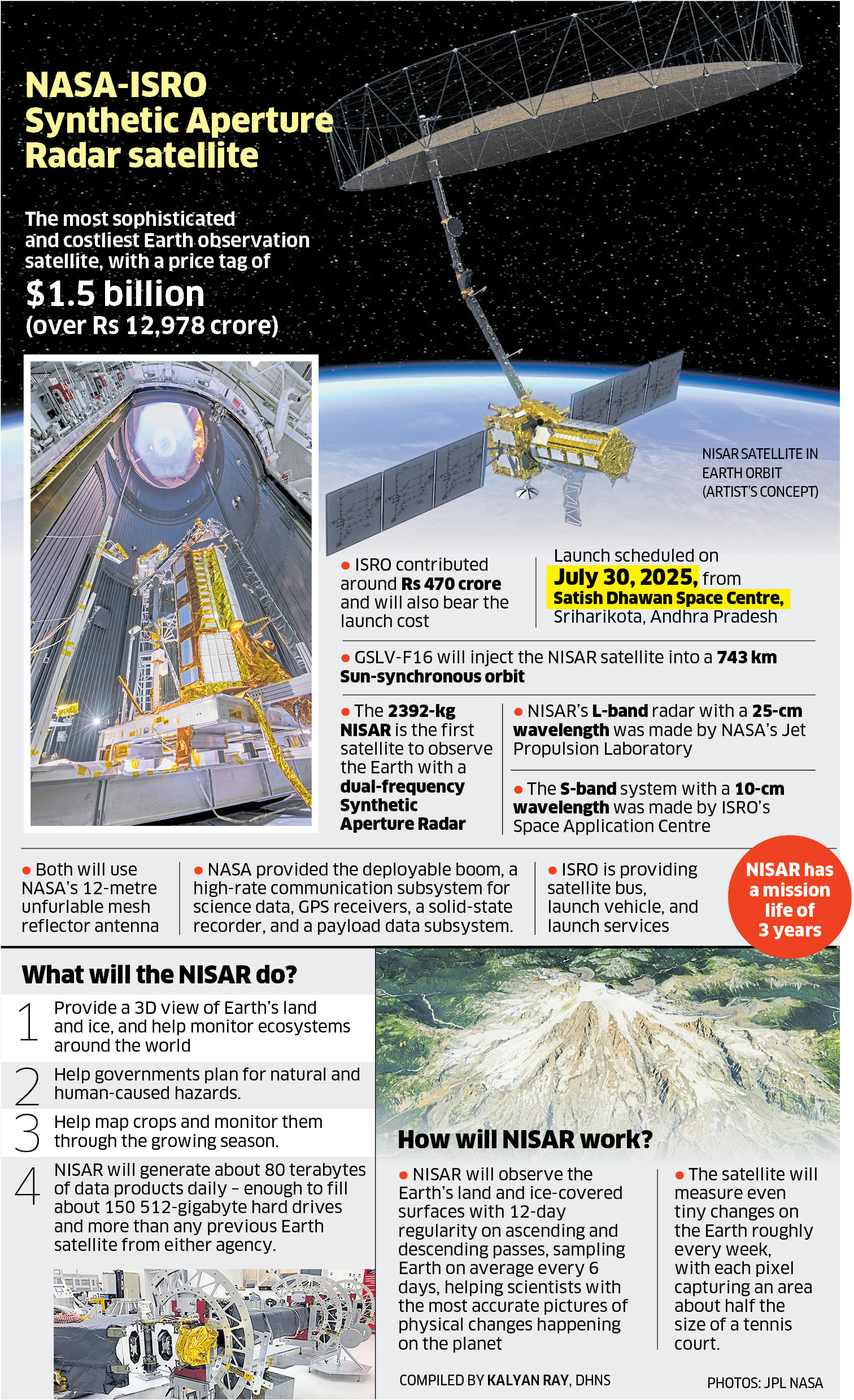
    The NASA-ISRO Synthetic Aperture Radar (NISAR) has been successfully launched from Sriharikota using GSLV Mk-II.

    NASA-ISRO Synthetic Aperture Radar (NISAR)

    About NISAR (NASA–ISRO Synthetic Aperture Radar):

    • Launch Vehicle: GSLV Mk-II | Launch Site: Sriharikota, India
    • Mission Life: 3 years (planned); 5+ years (design)
    • Orbit: Sun-synchronous polar orbit at 747 km with 98.4° inclination
    • Objective: High-precision monitoring of Earth’s surface changes—tectonics, agriculture, ecosystems, ice, floods, and landslides
    • Data Access: Free and near real-time; disaster maps delivered in under 5 hours
    • Hardware Contributions:
      • NASA: L-band SAR, 12m antenna, avionics
      • ISRO: S-band SAR, satellite bus, launch services
    • Development and Collaboration:
      • Initial Concept: 2007 (NASA); ISRO joined in 2012
      • Formal Agreement: 2014
      • Investment: NASA – ~$1.16 billion; ISRO – ~$90 million

    Key Features of NISAR:

    • What is Synthetic Aperture Radar (SAR)?
      • Operates day/night, all-weather
      • Simulates large radar antenna via motion
      • Penetrates clouds, vegetation, and soil
    • Dual-Band SAR:
      • L-band SAR (1.257 GHz):
        • Deeper penetration; ideal for forests, tectonic shifts, permafrost
      • S-band SAR (3.2 GHz):
        • Surface details; supports agriculture, flood mapping, biomass tracking
    • Radar Antenna:
      • 12-meter deployable mesh reflector
      • Resolution: 3–10 m spatial; cm-level vertical
      • Swath Width: 240 km
    • Imaging Frequency:
      • Global land/ice coverage every 12 days
      • Less frequent in polar zones
    • Data Output: Generates 80 TB/day (3x current Earth observatories):
      • Biomass and cropland maps
      • High-resolution flood and infrastructure data

    Applications and Impact:

    • Disaster Relief: Before-and-after imagery for planning
    • Climate Monitoring: Glacier melt, forest degradation
    • Agriculture: Crop health, rotation, food security
    • Infrastructure: Detects land subsidence (dams, cities)
    • Strategic Value:
      • Most powerful Earth-observing radar satellite
      • First with dual SAR payload
      • Strengthens India–US space partnership (Artemis, human spaceflight)
    [UPSC 2010] Question: In the context of space technology, what is Bhuvan, recently in the news ?

    Options: (a) A mini satellite launched by ISRO for promoting the distance education in India (b) The name given to the next Moon Impact Probe, for Chandrayaan-II (c) A geoportal of ISRO with 3D imaging capabilities of India* (d) A space telescope developed by  India


  • Five years of National Education Policy (2020)

    Why in the News?

    It has been five years since the introduction of the National Education Policy (NEP) 2020 which replaced the 1986 National Policy on Education.

    About the National Education Policy, 2020:

    • Origin: Drafted by a committee chaired by Dr. K. Kasturirangan under the Ministry of Education.
    • 5 Core Pillars: Based on Access, Equity, Quality, Affordability, and Accountability.
    • Vision: Seeks to build a knowledge society by unlocking every learner’s potential.
    • Global Link: Aligned with the UN Sustainable Development Goal (SDG) 4 (Education for All).

    Key Provisions:

    • [A] School Education:
      • Curriculum Structure: Introduces 5+3+3+4 design (Foundational to Secondary), replacing 10+2.
      • ECCE Focus: Early Childhood Care and Education via Jaadui Pitara kits and play-based learning.
      • Vocational Training: Begins from Grade 6 with internships.
      • Basic Literacy & Numeracy: Achieved through National Initiative for Proficiency in Reading with Understanding and Numeracy.
      • Language Medium: Emphasis on mother tongue/regional language up to Grade 5.
      • Assessment Reform: Launch of Performance Assessment, Review and Analysis of Knowledge for Holistic Development (PARAKH) as a national evaluation centre.
    • [B] Higher Education:
      • Four-Year Degree: Multidisciplinary courses with multiple exit points.
      • Credit Bank: Academic Bank of Credit ensures credit mobility across institutions.
      • Research Boost: National Research Foundation supports innovation and research.
      • Single Regulator: Higher Education Commission of India proposed (pending law) to replace multiple bodies.
      • Language Promotion: Establishment of Indian Institute of Translation and Interpretation for Indian languages.

    Implementation Initiatives:

    • Foundational Mission: NIPUN Bharat aims to achieve basic literacy and numeracy by Class 3.
    • Unified Credit System: Rollout of Academic Bank of Credit and National Credit Framework.
    • Common Entrance: Common University Entrance Test introduced for fair UG admissions.
    • Early Prep: Vidya Pravesh – a 3-month play-based module for Grade 1 entrants.
    • Tech Education in Regional Languages: Promoted by the All-India Council for Technical Education.
    • Digital Backbone: National Digital Education Architecture launched to support e-learning.
    • SAFAL Assessments: Structured competency-based testing in Grades 3, 5, and 8 by Central Board of Secondary Education.

    Key Achievements:

    • Curriculum and Textbooks: NCERT released new content for Classes 1–8.
    • ECCE Adoption: Early childhood curriculum implemented in several states.
    • Language Expansion: Regional language instruction expanded at foundational levels.
    • Academic Flexibility: Credit-based transfer systems in use via Academic Bank of Credit and National Credit Framework.
    • Global Presence: Indian Institutes such as Indian Institute of Technology (Zanzibar) and Indian Institute of Management (Dubai) now abroad.
    • International Collaboration: Foreign universities invited to set up campuses under new regulations.
    [UPSC 2016] “SWAYAM’, an initiative of the Government of India, aims at

    Options:

    (a) promoting the Self-Help Groups in rural areas

    (b) providing financial and technical assistance to young start-up entrepreneurs

    (c) promoting the education and health of adolescent girls

    (d) providing affordable and quality education to the citizens for free*


  • Pralay Missile 

    Why in the News?

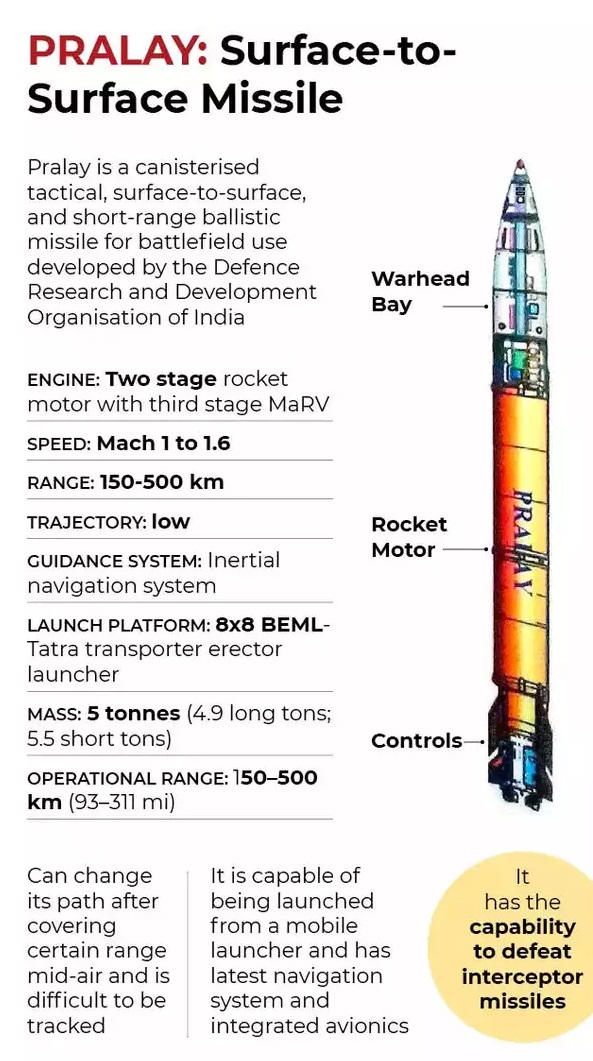
    The Defence Research and Development Organisation (DRDO) successfully conducted two consecutive test flights of the Pralay missile from the Dr. A.P.J. Abdul Kalam Island off Odisha’s coast.

    Pralay Missile 

    About Pralay Missile:

    • Developer: Defence Research and Development Organisation (DRDO), led by Research Centre Imarat (RCI) with Indian industry support.
    • Purpose: Tactical surface-to-surface missile for precision strikes along sensitive borders like the Line of Actual Control (LAC) and Line of Control (LoC).
    • Role: Enhances India’s conventional deterrence in short-range battlefield operations.
    • Targets: Designed to destroy high-value assets—radars, command centers, airstrips, and military infrastructure.

    Key Features:

    • Type: Quasi-ballistic surface-to-surface missile
    • Range: 150–500 km
    • Payload: 500–1,000 kg (conventional warheads)
    • Propulsion: Solid-propellant rocket motor
    • Launcher: Mobile platform for rapid deployment
    • Guidance: Advanced inertial navigation with <10 m Circular Error Probable (CEP)
    • Terminal Speed: Up to Mach 6.1
    • Maneuverability: Capable of mid-air trajectory changes to evade interception
    [UPSC 2023]  Consider the following statements:

    1. Ballistic missiles are jet-propelled at subsonic speeds throughout their fights, while cruise missiles are rocket-powered only in the initial phase of flight. 2. Agni-V is a medium-range supersonic cruise missile, while BrahMos is a solid-fuelled intercontinental ballistic missile.

    Which of the statements given above is/are correct?

    Options: (a) 1 only (b) 2 only (c) Both 1 and 2 (d) Neither 1 nor 2*


  • National Population Register (NPR)

    Why in the News?

    The Government of India recently clarified in the Lok Sabha that no final decision has been taken regarding the updation of the National Population Register (NPR) during the upcoming Population Census 2027.

    What is the National Population Register (NPR)?

    • Overview: NPR is a register of “usual residents” in India—individuals who have lived in an area for 6 months or intend to stay for the next 6 months.
    • Conducted by: Office of the Registrar General of India (RGI), Ministry of Home Affairs.
    • Legal Basis: Prepared under the Citizenship Act, 1955 and Citizenship Rules, 2003.
    • Mandatory Nature: Registration in NPR is compulsory for all usual residents.
    • Exclusion: Assam is excluded as it has completed the National Register of Citizens (NRC) process.
    • Historical Background:
      • First Created: In 2010 during the House Listing phase of Census 2011.
      • Updated: Again in 2015–16 via door-to-door survey.
      • Database Size: Contains data of around 119 crore residents.
      • Aadhaar Link: Biometric data collection is linked to Aadhaar; however, ration card data collection was dropped in the 2020 plan.
      • Current Status: NPR update plans (2020) are on hold. NPR’s priority has reduced due to Aadhaar’s expanded utility in benefit delivery.
    • Scope and Data Collected:
      • Coverage Levels: Conducted at local, sub-district, district, state, and national levels.
      • Demographic Data: Includes name, age, gender, relationship, marital status, etc.
      • Biometric Data: Sourced via Aadhaar enrolment—fingerprints, iris scan, and photo.

    NPR vs National Register of Citizens (NRC):

    Feature National Population Register (NPR) National Register of Citizens (NRC)
    Purpose Record of all usual residents Register of Indian citizens
    Coverage Includes citizens and non-citizens Only Indian citizens
    Legal Basis Citizenship Act, 1955 & Rules (2003) Citizenship Rules (2003)
    Primary Use Welfare schemes, demographic data Citizenship verification
    Mandatory? Yes Not uniformly across India


    [UPSC 2009] Consider the following statements:

    1. Between Census 1951 and Census 2001, the density of the population of India has increased more than three times.

    2. Between Census 1951 and Census 2001, the annual growth rate (exponential) of the population of India has doubled.

    Which of the statements given above is/are correct?

    Options: (a) 1 only (b) 2 only (c) Both 1 and 2 (d) Neither 1 nor 2*


  • Sundarbans set to become India’s Second-Largest TR

    Why in the News?

    The proposal to expand the Sundarbans Tiger Reserve by 1,100 sq km has received clearance from the National Tiger Conservation Authority (NTCA) and awaits approval from National Board for Wildlife (NBWL).

    Sundarbans set to become India’s Second-Largest TR

    About Sundarbans Tiger Reserve (STR):

    • Location: Situated in South and North 24-Parganas districts, West Bengal; lies at the southern tip of the Gangetic Delta.
    • Area: Presently 2,585.89 sq km; expansion to 3,629.57 sq km under proposal.
    • Status: Notified as a Tiger Reserve, National Park, Biosphere Reserve; part of the UNESCO World Heritage Site.
    • Unique Feature: World’s only mangrove forest with a viable tiger population.
    • Tiger Count: Over 100 tigers – 80 in core area, 21 in adjoining forests.
    • Landscape: Interconnected estuaries, tidal creeks, and 105 mangrove-covered islands.
    • Flora: Dominated by mangrove species like Avicennia, Rhizophora, Heritiera.
    • Fauna: Includes Royal Bengal Tigers, Fishing Cats, Estuarine Crocodiles, Irrawaddy Dolphins, King Cobras, and endangered reptiles and birds.
    • Boundaries:
      • East: Bangladesh border (Raimangal, Harinbhanga rivers)
      • South: Bay of Bengal
      • North/West: Matla, Bidya, Gomdi Rivers

    Back2Basics: Tiger Reserves in India

    • Overview: A Tiger Reserve is a legally notified area under the Wildlife (Protection) Act, 1972 for the conservation of tigers and biodiversity.
    • Governing Authority: National Tiger Conservation Authority (NTCA), Ministry of Environment, Forest and Climate Change.
    • Origin: Initiated under Project Tiger, launched in 1973.
    • Structure:
      • Core Zone: Highly protected; no human activity allowed; declared as National Park or Sanctuary.
      • Buffer Zone: Surrounds core; allows regulated human use and supports conservation-compatible livelihoods.

    Tiger Reserve Landscape in India (as of 2025):

    • Total Reserves: 58 (up from 46 in 2014)
    • Largest Reserve: Nagarjunasagar-Srisailam, Andhra Pradesh – 3,727.82 sq km
    • Oldest Reserve: Corbett Tiger Reserve, Uttarakhand – established in 1973
    • Newest Reserves: Guru Ghasidas (Chhattisgarh), Ranipur (Uttar Pradesh), Ramgarh Vishdhari (Rajasthan)
    • Top State: Madhya Pradesh – 7 Tiger Reserves
    • Tiger Density: Bandipur TR > Corbett TR > Kaziranga TR (148, 18.6 tigers/sq. km.)
    • Global Tiger Day: Celebrated on 29th July every year


    [UPSC 2020] Among the following Tiger Reserves, which one has the largest area under “Critical Tiger Habitat”?”

    Options: (a) Corbett (b) Ranthambore (c) Nagarjunsagar-Srisailam* (d) Sunderbans


  • Lessons from past The Chola legacy includes good governance, not just grand temples

    Why in the News?

    Prime Minister Narendra Modi’s visit to Tamil Nadu during the Aadi Thiruvathirai festival at Gangaikonda Cholapuram drew attention due to its subtle political messaging and focus on the legacy of the Chola dynasty, especially Rajendra Chola I.

    How can the Chola administration guide modern local governance?

    • Land and Revenue Management: They conducted detailed land surveys and classified land for fair taxation. Eg: Modern use of digital land records and GIS mapping can improve urban planning and property tax collection.
    • Sustainable Infrastructure: Built durable public works with advanced engineering. Eg: The Brihadisvara Temple shows disaster-resilient design, relevant for today’s urban infrastructure.
    • Grassroots Democratic Traditions: The Chola Sabhas and Ur assemblies practiced local self-governance, aligning with the 73rd and 74th Constitutional Amendments on decentralisation.
    • Efficient Local Administration: Chola-era institutions handled tax collection, infrastructure upkeep, and dispute resolution, offering a model for accountable and participatory governance today.

    Why is Chola water management relevant today?

    • Sustainable Water Use: The Cholas built tanks, canals, and reservoirs for rainwater harvesting and year-round irrigation. Eg: Tamil Nadu can adopt tank rehabilitation for climate-resilient agriculture.
    • Integrated River Management: They managed the Cauvery delta through coordinated water channel planning. Eg: Programs like Namami Gange can apply holistic watershed development inspired by Chola methods.
    • Community-led Water Governance: Local communities maintained water systems, ensuring efficiency and accountability. Eg: Panchayati Raj Institutions can empower village water user associations for decentralised water management.

    What can temple architecture teach about seismic safety?

    • Broad Base & Tapering Design: Chola temples had a wide foundation and pyramid-like structure to distribute weight and resist earthquakes. Eg: Brihadisvara Temple has survived centuries of seismic activity.
    • Interlocking Stone Technique: Used granite blocks without mortar, allowing flexible movement during tremors. Eg: Airavatesvara Temple stones fit precisely, boosting durability.
    • Seismic-Sensitive Construction: Built with awareness of local geology and fault lines for quake resilience. Eg: Southern temples remain structurally stable despite past earthquakes.

    How does invoking the Chola legacy shape modern politics?

    • Cultural Nationalism & Historical Pride: Celebrating the Chola dynasty boosts national pride and showcases India’s ancient global influence. Eg: Leaders highlight Chola maritime trade and temple architecture to project a strong civilisational legacy.
    • Regional Outreach & Political Messaging: Invoking Chola heritage appeals to Tamil identity, aiding political connect with southern states. Eg: PM’s visit to Gangaikonda Cholapuram during Aadi Thiruvathirai signaled a move to gain regional goodwill.

    Conclusion: The legacy of the Chola dynasty offers enduring lessons for contemporary India across governance, infrastructure, water management, architecture, and politics. Their grassroots democratic institutions, efficient local administration, and innovative land and water management practices provide a valuable blueprint for strengthening decentralised governance, promoting sustainable development, and enhancing climate resilience.

    Mains PYQ:

    [UPSC 2022] Discuss the main contributions of Gupta period and Chola period to Indian heritage and culture.

    Linkage: This question is directly related to your query as it broadly asks about the “main contributions” of the Chola period to “Indian heritage and culture.” This scope allows for a comprehensive discussion that goes beyond just art and architecture (grand temples).  It provides an opportunity to elaborate on the administrative acumen of the Cholas, their water management systems, tax and land revenue collection, and democratic processes, which are highlighted in the sources as significant “mundane facets…of modern relevance” and key aspects of their legacy.

  • Divya Deshmukh becomes new Chess World Champion

    Why in the News?

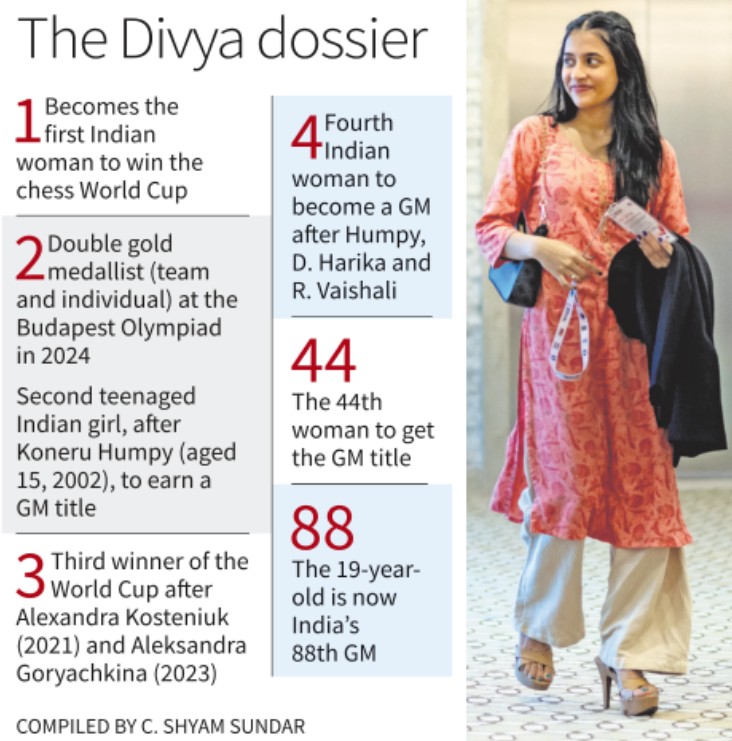
    Divya Deshmukh made history by becoming India’s first Women’s World Cup Champion and only the fourth Indian woman Grandmaster, defeating Koneru Humpy in the final at Batumi, Georgia.

    Divya Deshmukh becomes new Chess World Champion

    Major Achievements of Divya Deshmukh:

    • 2025: Won the FIDE Women’s World Cup, defeating Koneru Humpy. Became India’s 4th woman Grandmaster.
    • 2024: U-20 Girls’ World Champion
    • 2023: Asian Women’s Champion
    • 2022: Indian Women’s National Champion
    • Olympiad: Key contributor to India’s gold in 2025 Chess Olympiad (Budapest).
    • 2013: Became India’s youngest Woman FIDE Master (WFM) at age 7.

    About the FIDE World Chess Championship System:

    • FIDE (Fédération Internationale des Échecs): Global chess body founded in 1924; headquartered in Switzerland.
    • World Championship Format: Played over 14 classical games. A player must score 7.5 points to win.
    • Tiebreaker: If the match ends 7–7, rapid and blitz games are used.
    • Qualification Path:
      • Zonal and Continental Championships
      • FIDE World Cup (knockout)
      • Candidates Tournament (top player faces reigning champion)
    • Special Championships:
      • Women’s World Championship
      • Junior and Youth Championships
      • World Rapid & Blitz Championships

    Key FIDE Events and Titles:

    • FIDE World Cup: Knockout format; major path to the Candidates.
    • FIDE Women’s World Cup: Equivalent format for top female players.
    • Title Hierarchy:
      • Grandmaster (GM) – highest title
      • International Master (IM)
      • FIDE Master (FM)
      • Candidate Master (CM)
      • Women’s Titles: Woman Grandmaster (WGM), Woman International Master (WIM), etc.
    [UPSC 2024] Consider the following statements:

    I. In the finals of the 45th Chess Olympiad held in 2024, Gukesh Dommaraju became the world’s youngest winner after defeating the Russian player Ian Nepomniachtchi.

    II. Abhimanyu Mishra, an American chess player, holds the record of becoming world’s youngest ever Grandmaster.

    Which of the statements given above is/are correct?

    Options: (a) I only (b) II only * (c) Both I and II (d) Neither I nor II


  • Amrit Bharat Station Scheme (ABSS)

    Why in the News?

    PM recently stated that 77 stations in Tamil Nadu are being redeveloped under the Amrit Bharat Station Scheme (ABSS), positioning the state as a hub for railway transformation.

    About the Amrit Bharat Station Scheme (ABSS):

    • Launch: 2022 by the Ministry of Railways.
    • Goal: Modernise and develop railway stations through phased, long-term upgrades.
    • Master Plans: Each station gets a tailored roadmap for future improvements.
    • Focus Areas: Multimodal integration, seamless passenger movement, and upgraded amenities.
    • National Significance: Integral to India’s infrastructure push under the Viksit Bharat vision.

    Key Features of ABSS:

    • Passenger Comfort: Larger waiting halls, clean toilets, executive lounges, lifts, escalators, free Wi-Fi, and business-meeting zones.
    • Accessibility & Connectivity: Expanded circulating areas, barrier-free access for persons with disabilities, and smooth links to other transport modes.
    • Aesthetic Upgrades: Modern façades, clear signage, landscaping, and consistently clean premises.
    • Technology & Information: Digital displays, real-time train info, and self-service e-ticketing kiosks.
    • Sustainability: Energy-efficient systems, green-building elements, and water-conservation measures.
    • Customised Development: Station facilities scaled to local footfall and needs—no one-size-fits-all approach.
    [UPSC 2024] Consider the following statements:

    I. Indian Railways have prepared a National Rail Plan (NRP) to create a future ready railway system by 2028. II. ‘Kavach’ is an Automatic Train Protection system developed in collaboration with Germany. III. ‘Kavach’ system consists of RFID tags fitted on track in station section.

    Which of the statements given above are not correct?

    (a) I and II only (b) II and III only (c) I and III only (d) I, II and III*