💥Join UPSC 2027,2028 Mentorship (August Batch) + XFactor Notes & Microthemes PDF

Distribution: weekly

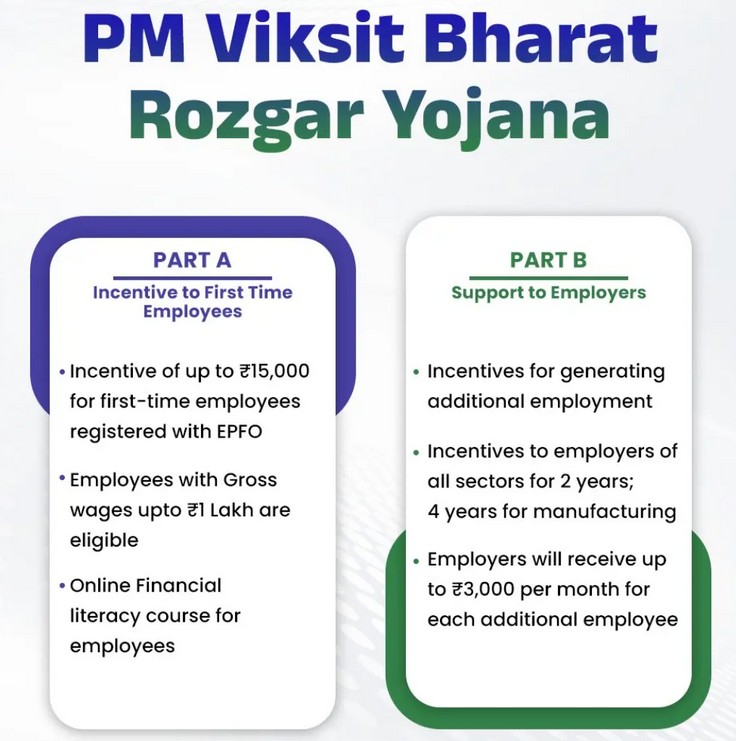
  • [pib] PM Viksit Bharat Rozgar Yojana (PM-VBRY)

    Why in the News?

    The Employment Linked Incentive (ELI) Scheme has been officially launched as the PM Viksit Bharat Rozgar Yojana (PM-VBRY), effective from 1st August 2025.

    About PM Viksit Bharat Rozgar Yojana (PM-VBRY):

    • Objective: Promote formal employment and inclusive job creation.
    • Outlay: ₹99,446 crore (Aug 2025 – July 2027).
    • Aim:  3.5 crore new jobs, including 1.92 crore first-time entrants into the workforce.
    • Focus: Expanding EPFO coverage and supporting Viksit Bharat vision.
    • Sectoral Coverage: Open to all sectors, with special focus on manufacturing for long-term growth.

    PM Viksit Bharat Rozgar Yojana (PM-VBRY)

    Key Features:

    1. Incentives for Employees
      • Eligible: First-time EPFO-registered workers earning ≤ ₹1 lakh/month.
      • Benefit: 1-month EPF wage (max ₹15,000) in two parts — after 6 and 12 months.
      • Condition: Completion of a financial literacy programme; Part of the amount is locked in a savings scheme.
    1. Incentives for Employers
      • Applies to: New hires with salary ≤ ₹1 lakh/month.
      • Minimum hires: 2 (if firm <50 employees), 5 (if ≥50).
    • Incentive per employee/month:
      • ₹1,000 (wages ≤ ₹10,000)
      • ₹2,000 (₹10,001–₹20,000)
      • ₹3,000 (₹20,001–₹1 lakh)
    • Manufacturing sector: Extended benefits for 3rd & 4th years.
    1. Payment Mechanism
    • To employees: Direct Benefit Transfer via Aadhaar-based system.
    • To employers: Paid to PAN-linked bank accounts.
    [UPSC 2024] With reference to the Pradhan Mantri Shram Yogi Maan-dhan (PM-SYM) Yojana, consider the following statements:

    1. The entry age group for enrolment in the scheme is 21 to 40 years

    2. Age specific contribution shall be made by the beneficiary

    3. Each subscriber under the scheme shall receive a minimum pension of ₹ 3,000 per month after attaining the age of 60 years

    4. Family pension is applicable to the spouse and unmarried daughters

    Options: (a) 1 and 4 (b) 2 and 3* (c) 2 only (d) 1,2 and 4


  • Ramsar COP15 opens in Zimbabwe

    Why in the News?

    Delegates from 172 countries convened in Victoria Falls, Zimbabwe, for the 15th Meeting of the Conference of the Contracting Parties (COP15) to the Ramsar Convention on Wetlands.

    Highlights of Ramsar COP15

    • Theme: Protecting Wetlands for Our Common Future
    • Host Nation: Zimbabwe (holds presidency of the Ramsar Convention for 3 years)
    • Expected Outcome: Adoption of the Victoria Falls Declaration, a global framework to protect wetlands

    About the Ramsar Convention:

    • Adopted on: 2 February 1971, in Ramsar, Iran.
    • Objective: Conserve and ensure the wise use of wetlands globally.
    • Key Functions:
      • Identify wetlands of international importance.
      • Promote sustainable management practices.
      • Foster international cooperation in wetland conservation.
    • Governing Body:
      • Conference of the Contracting Parties (COP) meets every 3 years.
      • Reviews implementation, adopts site designations, budgets, and policy actions.
      • Includes member + non-member states, IGOs, and NGOs as observers.

    Criteria for Ramsar Site Designation:

    A wetland must meet at least one of the following 9 criteria:

    1. Unique or rare wetland type.
    2. Habitat for endangered, vulnerable, or endemic species.
    3. Crucial for migratory waterbirds.
    4. High ecological, hydrological, or biodiversity value.
    5. Supports ecosystem services (e.g., flood control, water purification).
    6. Provides cultural or spiritual value.
    7. Serves sustainable community livelihoods.
    8. Holds scientific or educational importance.
    9. Requires global cooperation due to threats.

    India and the Ramsar Convention:

    • Joined on: 1 February 1982.
    • First Ramsar Site: Chilika Lake (Odisha), 1981.
    • As of July 2025:
      • Total sites: 91
      • Total area: ~13.58 lakh hectares
      • % of India’s wetland area under Ramsar: ~10%
    • Top States: Tamil Nadu: 20 sites (highest); Uttar Pradesh: 10 sites
    • Note: India has never chaired a Ramsar COP session.

    Global Snapshot and Other Facts:

    • Total Members: 171 countries.
    • Leading Countries:
      • United Kingdom: 175 sites (most)
      • Mexico: 142 sites
      • Bolivia: Largest area (~1.48 lakh sq. km under protection)
    • World Wetlands Day: Celebrated on 2 February annually.
    • Montreux Record: Register for Ramsar sites under serious threat needing urgent conservation.
    [UPSC 2019] Consider the following statements:

    1. Under Ramsar Convention, it is mandatory on the part of the Government of India to protect and conserve all the wetlands in the territory of India.

    2. The Wetlands (Conservation and Management) Rules, 2010 were framed by the Government of India based on the recommendations of Ramsar Convention.

    3. These Rules also encompass the drainage area or catchment regions of the wetlands as determined by the authority.

    Which of the statements given above is / are correct?

    Options: (a) 1 and 2 only (b) 2 and 3 only (c) 3 only* (d) 1, 2 and 3


  • UAV Launched Precision Guided Missile (ULPGM)-V3

    Why in the News?

    DRDO has successfully test-fired the UAV-Launched Precision Guided Missile (ULPGM)-V3.

    UAV Launched Precision Guided Missile (ULPGM)-V3

    About ULPGM-V3:

    • Overview: It is a fire-and-forget air-to-surface missile developed by Defence Research and Development Organisation (DRDO).
    • Variants: It is an upgraded version of V1 and V2, with improved range, autonomy, and targeting precision.
    • Development: Collaboration by Adani Defence, Bharat Dynamics, Newspace Research Technologies, and over 30 Indian MSMEs/startups.

    Key Features:

    • Weight: 12.5 kg
    • Range: 10 km (day), 2.5 km (night)
    • Accuracy: Passive homing infrared with HD dual-channel accuracy (~10 cm)
    • Warhead Options: Anti-armour, penetration-cum-blast, pre-fragmentation
    • Guidance: Fully autonomous with two-way datalink for mid-course updates
    • Environment: Operates in plains and high-altitude regions, day and night
    [UPSC 2025] With reference to Unmanned Aerial Vehicles (UAVs), consider the following statements:

    I. All types of UAVs can do vertical landing. II. All types of UAVs can do automated hovering. III. All types of UAVs can use battery only as a source of power supply.

    Which of the statements given above are correct?

    (a) Only one (b) Only two (c) All the three (d) None *


  • Clean house: On India’s septic tank desludging

    Why in the News?

    Recently, a social audit tabled in Parliament revealed 150 hazardous cleaning deaths in 2022–23, exposing unsafe outsourcing, poor implementation of safety laws, and inadequate funding under schemes like NAMASTE. Despite Supreme Court orders and successful models in states like Odisha and Tamil Nadu, enforcement and mechanisation remain critically lacking nationwide.

    Why has manual scavenging persisted despite laws and schemes like NAMASTE?

    • Weak Enforcement of Legal Provisions and Court Orders: Despite the Prohibition of Employment as Manual Scavengers and their Rehabilitation Act, 2013 and Supreme Court directions to cancel offending contracts and penalise principal employers, enforcement remains minimal. Eg: In 2024, Parliament revealed that 150 workers died in 2022–23 due to hazardous cleaning.
    • Poor Implementation and Underfunding of Schemes: Schemes like NAMASTE are hindered by insufficient financial support, poor outreach, and lack of protective equipment or training. Eg: Of the 57,758 workers involved in hazardous cleaning, only 16,791 received PPE kits, and a mere ₹14 crore had been released under NAMASTE—inadequate for mechanisation in even one major city.
    • Obscured Employer Liability through Subcontracting: The use of contractual and ‘loaned’ labour allows government and private employers to avoid responsibility for worker safety. Eg: A social audit tabled in Parliament found that out of 54 hazardous cleaning deaths, only five workers were on government payroll, while others were ‘loaned’ to private contractors, making accountability unclear.

    How have Odisha and Tamil Nadu offered viable alternatives to manual scavenging?

    • Odisha has ensured identified sanitation workers are equipped with PPE kits and have access to mechanised desludging vehicles, reducing the need for manual entry.
      Eg: Workers now use vacuum trucks for sewer cleaning instead of entering toxic manholes, improving safety and dignity.
    • Tamil Nadu has piloted robotic interventions to eliminate manual scavenging in urban areas.
      Eg: In Chennai, sewer robots have been deployed to clean over 5,000 manholes, showcasing how technology and political will can prevent hazardous practices.

    How does the lack of rural data hinder sanitation worker reforms?

    • Exclusion from Mechanisation Schemes: Without reliable data on rural sanitation workers, schemes like NAMASTE do not extend their benefits (e.g. robotic cleaning or desludging machines) to villages. Eg: In many gram panchayats of Bihar, manual pit cleaning is still done without equipment as workers remain unregistered and thus unaccounted for in policy rollouts.
    • No Health or Safety Monitoring: The lack of worker enumeration means occupational health risks go unnoticed, and safety training or PPE kitsare not distributed in rural regions. Eg: In Chhattisgarh’s rural blocks, no health cards or protective equipment have been distributed to sanitation workers, exposing them to toxic gases and infections.
    • Obstructs Legal Accountability and Compensation: If workers are not documented, accidental deaths are often unreported or misclassified, preventing compensation to families and accountability for employers. Eg: In a 2023 case in Madhya Pradesh, a worker died while cleaning a septic tank, but due to lack of registration, the case was recorded as a general accident, not as a violation of the Manual Scavenging Act.

    What are the steps taken by the Indian Government?

    • Legislation and Legal Ban: The Prohibition of Employment as Manual Scavengers and their Rehabilitation Act, 2013 bans manual scavenging and mandates identification and rehabilitation of affected workers.
    • NAMASTE Scheme (2023): The National Action for Mechanised Sanitation Ecosystem (NAMASTE) scheme promotes mechanised cleaning, provides training, PPE kits, and financial support to sanitation workers.
    • Welfare and Skill Development Initiatives: The government has launched surveys, provided one-time cash assistance, health insurance under Ayushman Bharat, and livelihood loans to support entrepreneurship among workers.

    What reforms can ensure safety and rehabilitation for workers?

    • Mandatory Mechanisation and Licensing: Urban local bodies should mandate mechanised sewer cleaning, make it a licensed profession, and classify manual cleaning without valid certification as a cognisable offence. This will ensure accountability and eliminate unsafe practices.
    • Rehabilitation Through Financial and Social Support: Provide sanitation workers with housing, education scholarships, health cards, and loans to operate mechanised equipment. These should be linked to guaranteed municipal contracts, enabling long-term economic and social upliftment.

    Mains PYQ:

    [UPSC 2024] Poverty and malnutrition create a vicious cycle, adversely affecting human capital formation. What steps can be taken to break the cycle?

    Linkage: Manual scavenging represents an extreme form of poverty and human capital degradation. This article mentions that “Two-thirds of validated workers are also Dalits, yet rehabilitation packages rarely include housing or scholarships that might help families exit contemptible occupations”. This question allows for a discussion of how ending such hazardous labor and providing meaningful rehabilitation can break this vicious cycle.

  • AdFalciVax Vaccine for Malaria

    Why in the News?

    The Indian Council of Medical Research (ICMR) has introduced AdFalciVax, a new malaria vaccine candidate targeting Plasmodium falciparum.

    About AdFalciVax

    • Developer: Indian Council of Medical Research (ICMR); private partners will handle trials and manufacturing.
    • Vaccine Type: Chimeric recombinant vaccine targeting Plasmodium falciparum, the deadliest malaria parasite.
    • Technology:
      • Circumsporozoite Protein (CSP): Offers direct protection to the vaccinated individual.
      • Pro6C Protein: A hybrid of Pfs230 and Pfs48/45 that blocks transmission via mosquitoes.
    • Key Advantages
      • Dual Benefit: Provides personal protection and reduces community transmission.
      • Full-length CSP: Promotes a stronger and longer immune response compared to current vaccines.
      • High Efficacy in Animals: Over 90% protection in animal models (human trials pending).
      • Stability: Contains alum as an adjuvant — safe, effective, and stable at room temperature for 9 months.

    Malaria Control in India:

    • Progress:
      • Malaria deaths reduced from 1,151 in 1995 to 83 in 2022 (National Vector Borne Disease Control Programme).
      • World Health Organization estimates are higher (5,511 deaths in 2022).
    • Current Limitation: India’s dominant malaria strain is Plasmodium vivax, which AdFalciVax does not target.


    [UPSC 2010] Widespread resistance of malarial parasite to drugs like chloroquine has prompted attempts to develop a malarial vaccine to combat malaria. Why is it difficult to develop an effective malaria vaccine ?

    (a) Malaria is caused by several species of Plasmodium*

    (b) Man does not develop, immunity to malaria during natural infection

    (c) Vaccines can be developed only against bacteria

    (d) Man is only an intermediate host not the definitive host.


  • Financial Inclusion Index, 2025

    Why in the News?

    The Reserve Bank of India (RBI) has announced that the Financial Inclusion Index (FI-Index) for Financial Year (FY) 2025 has risen to 67.0, up from 64.2 in FY 2024.

    About Financial Inclusion Index (FI-Index):

    • Developer: Created by the Reserve Bank of India to assess the extent of financial inclusion in India.
    • First Release: Published in August 2021 for the financial year ending March 2021.
    • Coverage: Encompasses five key sectors—banking, investments, insurance, postal services, and pensions.
    • Scoring Scale: Ranges from 0 (total exclusion) to 100 (full inclusion).
    • Update Cycle: Updated annually in July; cumulative index with NO base year.
    • Indicators: Based on 97 indicators across all five sectors to ensure comprehensive assessment.
    • Key Parameters:
      1. Access (35%): Measures availability of financial infrastructure like bank branches, automated teller machines, and postal outlets.
      2. Usage (45%): Tracks frequency of use of services like savings, loans, insurance, and pension schemes.
      3. Quality (20%): Assesses financial literacy, consumer protection, equity, and service reliability.

    India’s Performance Over the Years:

    • March 2017: Index at 43.4, reflecting the initial phase of inclusion efforts.
    • March 2021: Rose to 53.9, due to the expansion of banking and digital infrastructure.
    • March 2024: Improved to 64.2, with broader access and increased adoption of financial services.
    • March 2025: Reached 67.0, driven by digital transactions, better service quality, and financial literacy campaigns.
    [UPSC 2016] The establishment of ‘Payment Banks’ is being allowed in India to promote financial inclusion. Which of the following statements is/are correct in this context?

    1. Mobile telephone companies and supermarket chains that are owned and controlled by residents are eligible to be promoters of Payment Banks

    2. Payment Banks can issue both credit cards and debit cards

    3. Payment Banks cannot undertake lending activities

    Options: (a) 1 and 2 only (b) 1 and 3 only* (c) 2 only (d) 1, 2 and 3


  • India ranks 77th in Henley Passport Index, 2025

    Why in the News?

    India has improved its global mobility ranking, moving up eight places to 77th in the Henley Passport Index 2025, up from 85th in 2024.

    About Henley Passport Index, 2025

    • Overview: A global ranking of passports based on the number of destinations accessible without a prior visa.
    • Compiled by: Published by Henley & Partners using data from the International Air Transport Association (IATA).
    • Coverage: Includes 227 travel destinations and is updated quarterly.
    • Purpose: Reflects changes in global mobility, international relations, and travel freedoms.

    Global Scenario (2025 Rankings):

    • 1st Rank: Singapore – Visa-free access to 193 destinations.
    • 2nd Rank: Japan and South Korea – Access to 190 destinations.
    • 3rd Rank (tie): Germany, France, Italy, Spain, Finland, Denmark, Ireland – Access to 189 destinations.
    • United States: Fell to 10th rank – Access to 182 destinations.
    • Overall Trend:
      • Asian and European passports dominate top positions.
      • Countries with restrictive or unstable foreign policies rank lower.

    India’s Achievements:

    • 2025 Rank: 77th, up from 85th in 2024 – an 8-place improvement.
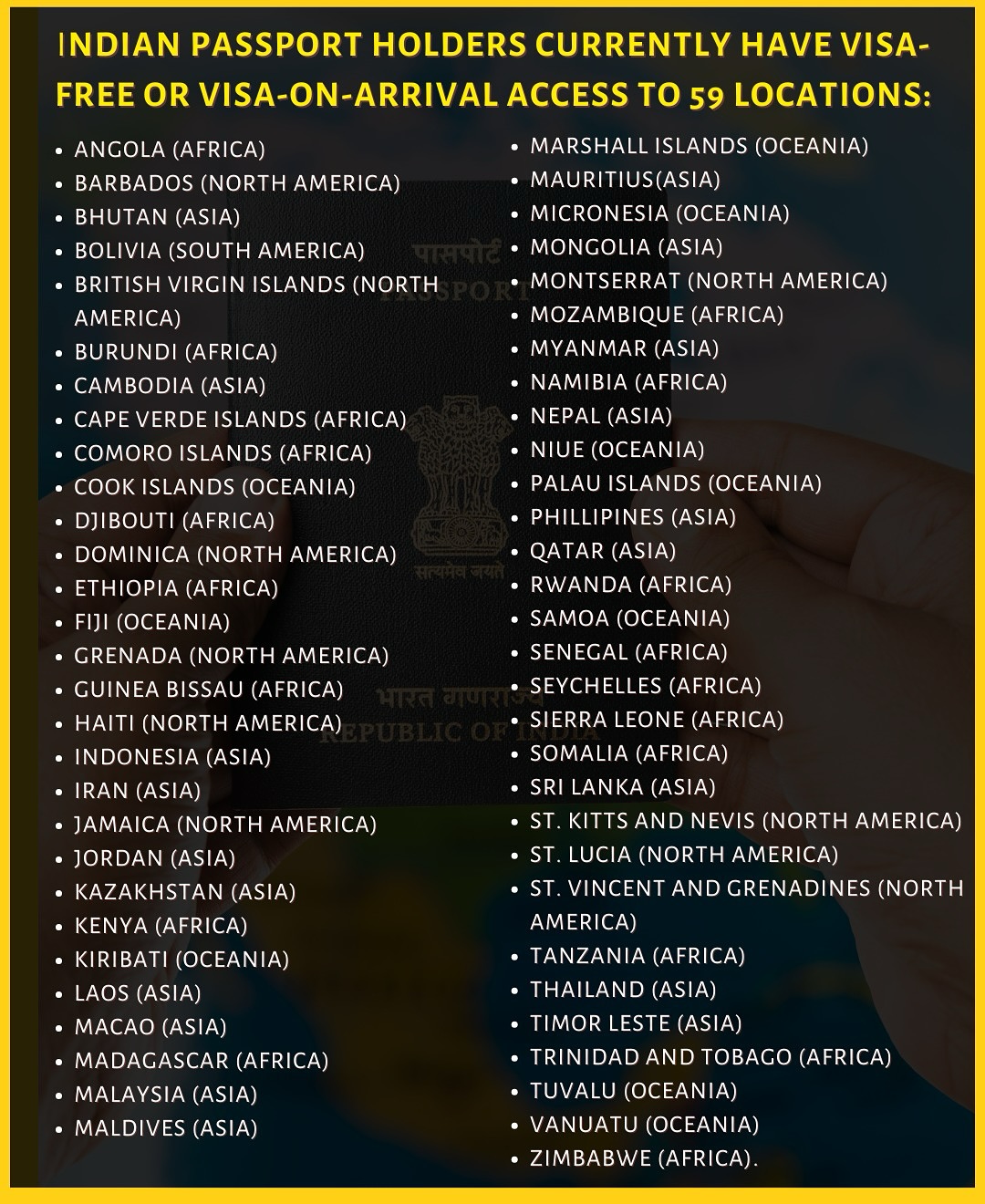
    • Access Level: Indian passport holders have visa-free or visa-on-arrival access to 59 countries.
    • New Additions: Philippines, Sri Lanka.
    • Context:
      • Despite gaining access to only two new countries, India’s rank rose significantly due to global reshuffling.
      • This marks a recovery from a 5-place drop in 2024, indicating improved travel diplomacy.

    India ranks 77th in Henley Passport Index, 2025

    [UPSC 2011] In terms of economy, the visit by foreign nationals to witness the XIX Commonwealth Games in India amounted to-

    Options: (a) Export (b) Import (c) Production (d) Consumption


  • Tribes in news: Khasi

    Why in the News?

    The Meghalaya High Court heard a PIL against the Khasi Lineage Act (preserves Khasi matrilineal traditions) for allegedly denying ST certificates to those with paternal surnames.

    Tribes in news: Khasi

    About Khasi Tribe:

    • Region: Indigenous to Meghalaya, Northeast India.
    • Linguistic Family: Belong to the Austroasiatic language group.
    • Language: Speak Khasi language, written in the Roman script, with several dialects.
    • Religion: Follow Niam Khasi (traditional animist faith); many are also Christians.
    • Mythical Origin: Believe in Ki Hynniew Trep – the seven ancestral clans who descended from heaven.
    • Cultural Identity: Strong emphasis on nature worship, oral traditions, and clan-based social structure.

    Special Customs and Traditions:

    • Inheritance System: Follows matrilineal inheritance – property and surname pass from mother to daughter.
    • Post-Marital Residence: Follow matrilocality, where the husband lives in the wife’s household.
    • Heir Designation: The Ka Khadduh (youngest daughter) is the custodian of family property and ancestral duties.
    • Marriage Rules: Practice clan exogamymarriage within the same clan is prohibited to avoid incest.
    • Village Governance: Administered through Dorbar Shnong (village councils) and led by Syiem (traditional chiefs).
    • Major Festivals:
      • Shad Suk Mynsiem – A thanksgiving and harvest dance.
      • Shad Nongkrem – A royal ritual dance for communal prosperity.
    • Traditional Attire:
      • Women wear the Jainsem (a draped dress with silver jewelry).
      • Men wear tunic-style garments and ceremonial headgear.
    • Spiritual Practices: Emphasize ancestor veneration and worship of natural elements like stones, rivers, and groves.
    [UPSC 2014] With reference to ‘Changpa’ community of India, consider the following statements:

    1. They live mainly in the State of Uttarakhand. 2. They rear the Pashmina goats that yield a fine wool. 3. They are kept in the category of Scheduled Tribes.

    Which of the statements given above is/are correct?

    Options: (a) 1 only (b) 2 and 3 only* (c) 3 only (d) 1, 2 and 3


  • Coral Loss in Lakshadweep

    Why in the News?

    A 24-year-long study conducted by the Nature Conservation Foundation reveals that coral cover in Lakshadweep has declined by 50% since 1998.

    Coral Decline in Lakshadweep: Key Highlights

    • Study Duration: Based on a 24-year study (1998–2022).
    • Findings: 50% decline in live coral cover—from 37.2% to 19.6%.
    • Main Cause: Repeated marine heatwaves linked to climate change.
    • Study Locations: Monitored across Agatti, Kadmat, and Kavaratti atolls.
    • Response Clusters: Six coral groups identified based on:
      • Depth and wave exposure
      • Heat resistance and recovery patterns
    • Recovery Timeline: Requires at least 6 years without bleaching for healthy regeneration.

    Back2Basics: Corals and Coral Bleaching:

    • About: Corals are colonies of tiny animals called polyps, which build calcium carbonate skeletons.
    • Symbiotic Algae: Host zooxanthellae, microscopic algae that provide nutrients via photosynthesis.
    • Coral Types:
      • Hard Corals: Form reef structures (e.g., brain coral, staghorn coral).
      • Soft Corals: Flexible, grow on reef surfaces but do not build reefs.
    • Habitat Requirements:
      • Water Quality: Must be clean and low in sediment.
      • Temperature Range: Prefer 20–21°C.
      • Depth: Typically found in waters less than 90 metres deep.
      • Salinity: Optimal range is 27–30 parts per thousand (ppt).
      • Ocean Currents: Require nutrient-rich water flow.
    • Coral Bleaching:
      • Cause: Triggered by heat stress, pollution, or acidification, which drive algae out.
      • Effect: Coral turns white due to loss of algae; Loses its main food source. Dies if stress persists for long periods.
    [UPSC 2022] “Biorock Technology” is talked about in which one of the following situations?

    Options: (a) Restoration of damaged coral reefs * (b) Development of building materials using plant residues (c) Identification of areas for exploration/extraction of shale gas  (d) Providing salt licks for wild animals in forests


  • [24th July 2025] The Hindu Op-ed: Can Presidential Reference change a judgment?

    PYQ Relevance:

    [UPSC 2024] Explain the reasons for the growth of public interest litigation in India. As a result of it, has the Indian Supreme Court emerged as the world’s most powerful judiciary?

    Linkage: This question is about the power and role of the Supreme Court of India. It helps us understand how the Court gives advice to the President and what limits exist when it comes to reviewing or changing its past decisions.


    Mentor’s Comment: On July 22, 2025, the Supreme Court of India issued notices to the Union Government and all States on a Presidential Reference seeking clarity on whether the President and Governors can be judicially compelled to act within prescribed timelines on Bills passed by State legislatures. This comes in the wake of the Court’s April 8 judgment, which held that delays by Governors in granting assent to Bills are unconstitutional, and laid down judicially enforceable timelines for action. The Constitution Bench, led by Chief Justice B.R. Gavai, will hear the matter in detail around mid-August under Article 143(1), which allows the President to seek the Court’s advisory opinion on matters of public importance.

    Today’s editorial analyses the Presidential Reference seeking clarity on whether the President and Governors can be judicially compelled to act within prescribed timelines on Bills passed by State legislatures.. This topic is important for GS Paper II (Indian Polity) in the UPSC mains exam.

    _

    Let’s learn!

    Why in the News?

    Recently, the Supreme Court of India has asked the Union Government and all States to respond to a question raised by the President: Can the President and Governors be legally forced to take action within a fixed time on Bills passed by State Assemblies?

    What is Presidential Reference?

    Presidential Reference is a process under Article 143 of the Indian Constitution where the President of India seeks the Supreme Court’s advisory opinion on important questions of law or fact that are of public importance.

    Background:

    In 2024, President Droupadi Murmu invoked Article 143(1) to ask the Supreme Court whether binding timelines can be imposed on the President and Governors to act on Bills passed by State Legislatures — especially in light of delays in assent or return of Bills, such as those witnessed in Tamil Nadu and Punjab.

    What is the significance of Article 143(1) in constitutional interpretation in the context of Presidential Reference?

    • Presidential Power to Seek Advice: Article 143(1) empowers the President of India to seek the Supreme Court’s advisory opinion on questions of law or matters of public importance. Eg: In the Berubari Union case (1960), the President referred a question about the transfer of territory to Pakistan.
    • Advisory Role of the Supreme Court: The Supreme Court’s opinion is not binding, but carries high persuasive value in future interpretations and policy decisions. Eg: The Court’s opinion on the Ayodhya land issue (1993) was declined, as the reference was seen to violate secularism.
    • Clarifies Constitutional Dilemmas: Helps resolve grey areas in constitutional practice without formal litigation, especially in cases involving federal disputes or institutional responsibilities. Eg: The 2024 Presidential Reference seeks clarity on whether the SC can set timelines for Governors or the President in assenting to Bills.

    Why did Tamil Nadu’s plea over the Governor’s inaction raise constitutional concerns?

    • Delay Violates Constitutional Mandate: The Governor’s inaction on State Bills breaches Article 200, which requires prompt decision assent, reservation, or withholding on legislative proposals.
    • Threatens Federalism and State Autonomy: Prolonged inaction undermines the authority of the elected State government, disrupting the federal balance enshrined in the Constitution.
    • Triggers Judicial and Political Tensions: Such inaction forces judicial intervention, leading to constitutional ambiguity and disputes over the separation of powers between constitutional offices.

    How did the April 8 SC verdict reshape the Centre-State power balance?

    • Fixed a Time Limit for Governors’ Decisions: The Supreme Court ruled that Governors must act on Bills “as soon as possible”, preventing indefinite delays. Eg: In Tamil Nadu’s case, the Governor had withheld action on multiple Bills for months, leading to constitutional standoff.
    • Clarified Limits on Withholding Assent: The Court emphasized that Governors cannot sit on Bills indefinitely or reject them arbitrarily, reinforcing the legislative supremacy of elected State governments. Eg: The verdict curbed the misuse of Article 200 by Governors in opposition-ruled States.
    • Reinforced Cooperative Federalism: The judgment upheld that constitutional functionaries must act in harmony, ensuring Centre-State relations are based on trust and constitutional propriety. Eg: The verdict serves as a warning against politicized Governor roles that disrupt the federal structure.

    When can the Supreme Court refuse a Presidential Reference?

    • Lack of Public Importance: If the issue is not of sufficient public or constitutional importance, the Court may decline to give its opinion. Eg: Political or non-legal matters without broader legal impact.
    • Hypothetical or Vague Questions: The Court avoids answering abstract, premature, or unclear issues. Eg: In the Cauvery Water Disputes Tribunal case (1992), the Court refused as the matter was not ripe for consideration.
    • Risk of Judicial Overreach: If the reference could interfere with pending litigation, reopen settled judgments, or encroach on executive/legislative powers, the Court may refuse. Eg: Questions that challenge or revisit prior rulings.

    How does the non-binding nature of Article 143 opinions affect jurisprudence?

    • Encourages Deliberative Democracy: Since the opinion is not binding, it invites parliamentary debate and public discourse rather than closing the matter purely through judicial authority. Eg: After the SC’s advisory opinion in the In re Kerala Education Bill, 1957, political discussions shaped the final policy on minority education rights.
    • Enables Judicial Restraint in Political Questions: It allows the Court to share constitutional insight without overstepping into executive or legislative domains, maintaining the separation of powers. Eg: In the Ayodhya Reference case (1994), the SC declined to answer a politically loaded question, exercising restraint.
    • Promotes Flexibility in Constitutional Practice: Non-binding opinions allow the executive to consider but not be bound by the Court’s interpretation, creating space for evolving legal practices over time. Eg: The opinion in In re Cauvery Water Disputes Tribunal (1991) offered legal clarity, but the Centre retained room to manage interstate negotiations.

    Way forward: 

    • Make Advisory Opinions More Transparent and Accessible: Publish all Presidential References and advisory opinions in simple language to promote public understanding and ensure informed civic debate on constitutional matters.
    • Encourage Parliamentary Follow-Up: Parliament should deliberate on Supreme Court’s advisory views under Article 143(1) to align legislation or executive action with constitutional principles while respecting the non-binding nature of such opinions.