Under Article 201 of the Indian Constitution, the President gave assent to the ‘Uniform Civil Code Uttarakhand 2024’ Bill passed by the Uttarakhand Legislative Assembly, on March 11 2024.
What is the Uniform Civil Code?
The UCC is mentioned in Article 44 of the Constitution as part of the Directive Principles of State Policy, that the state should work to establish a uniform civil code for all citizens across India.
However, the Constitution’s framers left it to the government’s discretion to implement the UCC.
Goa is the only state in India with a UCC, following the Portuguese Civil Code of 1867.
What are the SC Observations?
The Supreme Court has emphasized the importance of Governors promptly acting on Bills sent to them for assent after passage by Legislative Assemblies.
Bills should be returned “as soon as possible” to prevent undue delay, with significant constitutional intent behind this directive.
Governor’s Power over State Bills
[I] Article 200:
Article 200 delineates the process for State Legislative Assembly-passed Bills to be presented to the Governor for assent.
The Governor holds the authority to either assent, withhold assent, or reserve the Bill for consideration by the President.
Additionally, the Governor possesses the prerogative to return the Bill to the House or Houses with a message requesting reconsideration.
[II] Article 201:
Article 201 stipulates the procedures concerning Bills reserved for the President’s consideration.
It allows the President to either assent to or withhold assent from the Bill.
If necessary, the President can direct the Governor to return the Bill to the State Legislature for reconsideration.
Governor’s Discretion
The Governor holds several options upon receiving a Bill:
Granting Assent.
Requesting the Assembly to reconsider specific provisions or the entire Bill.
Obligatory reservation for the President’s consideration, especially in cases posing a threat to the state high court or contravening constitutional provisions, DPSP, national interest, or Article 31A regarding compulsory property acquisition.
Although within the Governor’s authority, withholding assent is seldom practiced due to its contentious nature.
Committee Recommendations:
(1) Sarkaria Commission (1987):
It recommended that Governors exercise discretion in reserving Bills for Presidential consideration only in rare cases of unconstitutionality.
Bills should otherwise be processed as per ministerial advice, with a maximum six-month period for Presidential disposition.
(2) Punchhi Commission (2010):
It proposed a six-month timeframe for Governors to decide on Bills presented for assent, emphasizing timely decision-making.
Try this PYQ from CSE Prelims 2016:
Q.Consider the following statements:
The Chief Secretary in a State is appointed by the Governor of that State.
The Chief Secretary in a State has a fixed tenure.
Which of the statements given above is/are correct?
The Supreme Court halted the Assam government’s attempt to revoke a 26-year-old notification establishing the Pobitora Wildlife Sanctuary, home to a significant rhino population.
What was the reason behind this decision?
The Supreme Court asserted that withdrawing a notification for a wildlife sanctuary required permission from the National Board of Wildlife, and clarified its order does not impede actions to protect forest dwellers’ rights.
About Pobitora Wildlife Sanctuary
Pobitora Wildlife Sanctuary boasts the highest density of one-horned rhinos globally, second only to Kaziranga National Park in Assam. Often dubbed as ‘Mini Kaziranga,’ Pobitora shares a similar landscape and vegetation to its renowned counterpart.
The sanctuary shelters various endangered species, including one-horned rhinoceros, leopards, leopard cats, fishing cats, jungle cats, feral buffaloes, wild pigs, and Chinese pangolins.
Approximately 72% of Pobitora’s area comprises a wet savannah dominated by Arundo donax and Saccharum grasses, while the rest is covered by water bodies.
About One-Horned Rhino:
IUCN Red List Status: Vulnerable.
Habitat– Rhinos are mainly found in Assam, West Bengal and Uttar Pradesh.
Assam has an estimated 2,640 rhinos in four protected areas, i.e. Pabitora Wildlife Reserve, Rajiv Gandhi Orang National Park, Kaziranga National Park, and Manas National Park.
About 2,400 of them are in the Kaziranga National Park and Tiger Reserve (KNPTR).
Prelims Question:
Which wildlife sanctuary boasts the highest density of one-horned rhinos globally, second only to Kaziranga National Park in Assam?
a) Manas National Park
b) Pobitora Wildlife Sanctuary
c) Rajiv Gandhi Orang National Park
d) Jim Corbett National Park
[wpdiscuz-feedback id=”tqlc9hnh9p” question=”Please leave a feedback on this” opened=”1″]Post your answers here.[/wpdiscuz-feedback]
Mains: 1. Whether the National Commission for Scheduled Castes (NCSC) can enforce the implementation of constitutional reservation for the Scheduled Castes in the religious minority institutions? Examine (2018)
2. What are the two major legal initiatives by state since Independence, addressing discrimination against Scheduled Tribes (ST)? (2017)
3. Why are the tribals in India referred to as ‘the Scheduled Tribes’? Indicate the major provisions enshrined in the Constitution of India for their upliftment. (2016)
Prelims: Under the Indian Constitution, the Concentration of Wealth violates (2021) a) the Right to Equality b) the Directive Principles of State Policy c) the Right to Freedom d) the Concept of Welfare
From The Hindu
Note4Students:
Mains: Minority sections of the society and their Empowerment; Judiciary; State government;
Prelims: Fundamental rights; Important judgements by SC; State government;
Mentor comments: Recently, the case of ‘State of Punjab vs Davinder Singh’ revolves around the question of whether State governments can make sub-classifications within Scheduled Castes and Scheduled Tribes for public employment. The Supreme Court is set to deliver a judgment on this matter, addressing the issue of intra-group variances and the power of States to recognize them. We need to analyze this issue as it is sub-classified SC reservations which are leading to legal challenges and subsequent legislative actions.
Let’s learn.
—
Why in the News?
The SC is set to deliver a judgment on whether State governments can make sub-classifications within SCs and STs, addressing the varying levels of development and discrimination within these groups.
Context:
The ongoing case of State of Punjab v Davinder Singh has brought to light the complexities surrounding sub-classification within reserved categories.
The central question revolves around whether a group within a reserved category can be further sub-classified and granted reservations.
Proponentsargue that sub-classification is necessary to ensure adequate representation of the most disadvantaged groups, addressing the issue of backwardness within backwardness.
On the other hand, opponents contend that the existing reservation scheme already ensures adequate representation for historically disadvantaged groups, making sub-classification unnecessary.
JUDICIARY ON SUB-CATEGORIZATION WITHIN RESERVED CATEGORIES:
1) State of Punjab vs Davinder Singh case (1975):
– In 1975, the Government of Punjab issued a circular that reserved 50% of SC seats for Balmikis and Mazhabi Sikhs, leading to legal challenges culminating in the Supreme Court’s involvement.
– The case questions whether sub-classifications are constitutionally permissible within SCs and STs, challenging the notion that these groups are homogenous.
– The debate involves revisiting past judgments like E.V. Chinnaiah vs State of Andhra Pradesh, which prohibited sub-classifications within SCs but recognized such distinctions within Other Backward Classes (OBCs).
2) Indra Sawhney vs Union of India Case (1992):
– The SC cited its judgment which arose out of the Mandal Commission’s report. There, a nine-judge Bench had held that sub-classifications within socially and educationally backward classes (OBCs) for services under the government was permissible.
– The case introduced the concept of the “creamy layer,” excluding affluent sections within backward classes (limited it to not exceed 50%) from reservation benefits.
– The genesis of this debate dates back to 1980 when the Second Backward Classes Committee, chaired by BP Mandal, recommended 27% reservation for OBCs and 22.5% for Scheduled Castes.
3) About E.V. Chinnaiah vs State of Andhra Pradesh Case (2004):
– A five-judge Bench quashed the Andhra Pradesh Scheduled Castes (Rationalization of Reservations) Act, 2000. The Act was challenged before the High Court and later the Supreme Court, which declared it ‘ultra viresthe Constitution’ as it offended Article 341 of the Constitution.
– This provision allows the President of India to notify a list of SCs for each State, and stipulates that the list can only be modified by Parliament.
– The case prohibited sub-classifications within SCs as it was found to violate constitutional provisions but recognized such distinctions within Other Backward Classes (OBCs). It emphasized that SCs and STs are homogeneous groups incapable of further regrouping or classification.
– The Court found that the State government had no power to tinker with the list because it was clear on a bare reading of Article 341 that such authority vested only with Parliament.
What is the difference between a homogenous class and a sub-classification within reserved categories?
A homogenous class refers to a group that is considered uniform or undifferentiated, where all individuals within the group are treated equally.
The Sub-classification within reserved categories involves categorizing a larger group into smaller sub-groups based on specific criteria, allowing for differential treatment or preferences within the overall category.
The distinction lies in how individuals within a larger reserved category are treated – either uniformly as a single homogenous group or with differentiated preferences based on sub-classifications.
What are the arguments for and against sub-classification within reserved categories?
Arguments for Sub-classification:
Ensuring Adequate Representation: Proponents argue that sub-classification is necessary to ensure adequate representation of the most disadvantaged groups within reserved categories.
Tailoring Criteria for Sub-classification: The court needs to tailor criteria for sub-classification to prevent leaving out certain groups while granting benefits to the most backward.
State’s Ability to Identify Backwardness: The states needs to be best positioned to judge the backwardness of communities and should have the authority to create sub-classifications within reserved categories without violating constitutional provisions.
Arguments against Sub-classification:
Presumption of Backwardness: Opponents argue that while there is a presumption of backwardness with Scheduled Castes (SCs), individual castes within SCs cannot be considered separate classes under Article 16(4), suggesting that making laws for specific castes within SC lists could violate Article 16(2).
Violation of Equality Principle: Critics assert that sub-classification would violate the right to equality by treating communities within the category differently, potentially leading to discrimination based on caste, which is prohibited under Article 16(2).
Stigma and Exclusion: Those against sub-classification argue that if certain Scheduled Castes do not receive reservation benefits, they may be left with the stigma of being a Scheduled Caste without access to affirmative action measures, highlighting concerns about exclusion and inequality.
What are the challenges faced by Sub-Classifications within Reserved Categories in India?
Lack of Equal Opportunities: Articles 14 to 16 of the Constitution promises of substantive equality. The absence of sub-classification perpetuates inequality within reserved categories, hinders the framing of appropriate government policies.
Legal and Constitutional Complexities: The states face challenges as they lack legislative competence to create sub-classifications within reserved categories, raising questions about the constitutionality of such measures.
Addressing Backwardness: The issue of “backwardness within backwardness” has been acknowledged, emphasizing the need to address the most disadvantaged communities effectively.
Way Forward
Considering the above challenges, they highlight the complexities and nuances involved in addressing sub-classifications within reserved categories in India. Hence it is necessary to emphasize on careful consideration and legal clarity in policy-making and implementation. The SC’s decision in cases like ‘State of Punjab vs Davinder Singh’ will play a crucial role in shaping affirmative action discourse and addressing issues of social justice within reserved categories
India, previously categorized as an “electoral autocracy” in 2018, has further declined to become one of the “worst autocratizers,” according to the ‘Democracy Report 2024’ by the Gothenburg-based V-Dem (or Varieties of Democracy) Institute.
Key highlightson India
Deteriorating Status: India, previously downgraded to an electoral autocracy in 2018, has further declined to become “one of the worst autocratizers.”
Historical Comparison: India’s level of “liberal democracy” has regressed significantly, reaching levels last seen in 1975 during the state of emergency declared by Indira Gandhi.
Regime Classification: India falls into the category of electoral autocracy, characterized by multiparty elections alongside insufficient levels of freedom of expression and fair elections.
Erosion of Democratic Freedoms: The report highlights the gradual deterioration of freedom of expression, media independence, and attacks on civil society under the current government.
About the V-Dem Democracy Report
Publication: The V-Dem Institute releases the Democracy Report annually, offering insights into the state of democracy worldwide, focusing on democratization and autocratization.
Regime Classification: Countries are categorized into four regime types based on their scores in the Liberal Democratic Index (LDI), encompassing a spectrum from liberal democracy to closed autocracy.
What is Liberal Democratic Index (LDI)?
Comprehensive Assessment: The LDI evaluates both liberal (individual and minority rights) and electoral aspects (free and fair elections) of democracy.
Indicators: It comprises 71 indicators, encompassing the Liberal Component Index (LCI) and the Electoral Democracy Index (EDI), capturing various dimensions of democratic governance.
LCI: Measures aspects like protection of individual liberties and legislative constraints on the executive.
EDI: Considers indicators ensuring free and fair elections such as freedom of expression and association.
Components of the LDI include:
Egalitarian Component Index: Assesses the extent of equality among different social groups within a democracy.
Participatory Component Index: Evaluates the health of citizen groups and civil society organizations, indicating the degree of citizen engagement.
Deliberative Component Index: Gauges whether political decisions are driven by public reasoning focused on the common good or influenced by emotional appeals, solidarity attachments, or coercion.
Publication Schedule: The Democracy Report is typically published annually in March, presenting a comprehensive analysis of global democratic trends.
Key Findings from the Democracy Report 2024:
Collaborative Effort: The report is a collaborative endeavour involving 4,200 scholars from 180 countries, leveraging 31 million datasets spanning from 1789 to 2023 to assess the democratic status of 202 countries.
Global Trends:
Autocratization: In 2023, 42 countries, representing 35% of the world’s population, were undergoing autocratization.
Population in Autocracies: Currently, 71% of the world’s population, amounting to 5.7 billion people, resides in autocracies, marking a significant increase from 48% a decade ago.
Decline in Democracy: The level of democracy experienced by the average individual globally has regressed to 1985 levels, with Eastern Europe, South, and Central Asia experiencing the sharpest declines.
India recently achieved a significant milestone in its nuclear program with the loading of the core of the Prototype Fast Breeder Reactor (PFBR).
However, as India progresses towards energy independence, it faces the complex challenge of managing nuclear waste.
What is Nuclear Waste?
Composition: Nuclear waste comprises radioactive by-products generated during the fission process in nuclear reactors.
Radioactive Elements: These by-products include elements such as barium-144, krypton-89, and various isotopes of uranium and plutonium.
Nuclear Waste Handling Techniques
Spent Fuel Storage: Spent fuel, initially stored underwater for cooling, is later transferred to dry casks for long-term storage. This process is critical due to the high radioactivity of spent fuel. Ex.: The U.S. had 69,682 tonnes of spent fuel (as of 2015), Canada had 54,000 tonnes (2016), and Russia had 21,362 tonnes (2014).
Liquid Waste Treatment: Nuclear power plants have facilities to treat liquid waste, with some waste being discharged into the environment after treatment.
Vitrification: Liquid high-level waste is vitrified to form a stable glass for long-term storage.
Reprocessing: Reprocessing separates fissile material from non-fissile elements in spent fuel, allowing for the reuse of valuable materials. Ex.: India operates reprocessing plants in Trombay, Tarapur, and Kalpakkam.
Geological Disposal: Some experts advocate for burying nuclear waste deep underground in stable geological formations. Waste is sealed in containers and buried in granite or clay formations, away from human activity.
Challenges and Concerns
Environmental Risks: Improper waste management can lead to contamination of water resources and surrounding areas.
Ex.: The Asse II salt mine in Germany faced contamination concerns due to nuclear waste storage.
Safety Concerns: Accidents at nuclear waste storage sites highlight the need for stringent safety measures.
Ex.: The Waste Isolation Pilot Plant (WIPP) in the U.S. experienced an accident in 2014, releasing radioactive materials.
Cost Implications: Waste management accounts for a significant portion of the overall cost of nuclear energy production.
Cost Estimate: Waste management imposes a cost of $1.6-7.1 per MWh of nuclear energy.
India’s Nuclear Waste Management
On-Site Storage: Low and intermediate-level nuclear waste generated at power stations is treated and stored on-site. India’s PFBR project aims to address waste management challenges by utilizing fast breeder reactor technology.
IAEA Safeguards: India adheres to International Atomic Energy Agency (IAEA) safeguards, ensuring the safe and secure handling of nuclear materials and waste.
Challenges Ahead: The delayed commissioning of the PFBR suggests potential complications in managing spent fuel with different compositions.
Way Forward
Investment in Research: Continued investment in research and development of advanced waste treatment technologies can enhance efficiency and safety in nuclear waste management.
International Collaboration: Collaborating with international organizations and sharing best practices can provide valuable insights and expertise in addressing nuclear waste challenges.
Public Engagement: Engaging with stakeholders and the public to raise awareness about nuclear waste management and address concerns regarding safety and environmental impact is crucial.
Regulatory Framework: Strengthening regulatory frameworks and implementing robust safety standards can ensure compliance with international guidelines and safeguard against potential hazards.
Conclusion
As India advances its nuclear program, effective waste management strategies are crucial to mitigate environmental and safety risks.
Try this PYQ from CSE Prelims 2018:
Q.In the Indian context, what is the implication of ratifying the ‘Additional Protocol’ with the `International Atomic Energy Agency (IAEA)’?
(a) The civilian nuclear reactors come under IAEA safeguards.
(b) The military nuclear installations come under the inspection of IAEA.
(c) The country will have the privilege to buy uranium from the Nuclear Suppliers Group (NSG).
(d) The country automatically becomes a member of the NSG.
Prime Minister’s recent activities, commemorating the 94th anniversary of the Dandi March at the Sabarmati Ashram, mark a significant step towards the redevelopment and expansion of this historic site.
Ashrams Built by Mahatma Gandhi
Gandhi set up five settlements during his lifetime — two in South Africa (Phoenix Settlement in Natal, and Tolstoy Farm outside Johannesburg), where he lived from 1893 to 1914, and three in India, where he arrived in January 1915.
South Africa Settlements:
Phoenix Settlement in Natal: Founded in 1904, the Phoenix Settlement was established by Gandhi as a communal living space and center for social and political activism. It served as a hub for his Satyagraha campaigns against racial discrimination and injustice in South Africa.
Tolstoy Farm outside Johannesburg: Gandhi established Tolstoy Farm in 1910 as a self-sustaining community inspired by the teachings of Russian writer Leo Tolstoy. It served as a refuge for Indian immigrants and a base for organizing resistance against discriminatory laws.
Indian Settlements:
Ahmedabad Ashram (Kocharab Ashram): Gandhi’s first ashram in India was established in Kocharab, Ahmedabad, in 1915. It was initially a rented space and was later moved to a larger site on the banks of the Sabarmati River, becoming the Sabarmati Ashram.
Sabarmati Ashram: Read the article below.
Sevagram Ashram: Established in 1936 near Wardha in Maharashtra, Sevagram Ashram was Gandhi’s final residence in India. It was intended to be a model village based on principles of self-reliance, sustainability, and nonviolence. Gandhi spent the last years of his life here, engaging in various constructive programs and campaigns.
Try this PYQ from CSE Mains 2019:
Q. Many voices had strengthened and enriched the nationalist movement during the Gandhian Phase. Elaborate.
AboutSabarmati Ashram
Founded in 1917 by Mahatma Gandhi, the Sabarmati Ashram holds immense historical significance in India’s struggle for independence and Gandhian philosophy.
Situated on the western bank of the Sabarmati River, north of the village of Juna Vadaj in Ahmedabad, Gujarat, the ashram became a focal point for various movements and experiments led by Gandhi.
Key Movements and Initiatives
Champaran Satyagraha (1917): The ashram served as a base for Gandhi’s involvement in the Champaran Satyagraha, a movement against oppressive indigo planters in Bihar.
Khadi Movement (1918): Gandhi initiated the Khadi movement from Sabarmati Ashram, promoting the use of hand-spun cloth as a means to boycott foreign goods and promote self-reliance.
Ahmedabad Mill Strike (1918) and Kheda Satyagraha: Gandhi led the workers’ strike in Ahmedabad and the peasants’ movement in Kheda, both of which were pivotal in India’s struggle for independence.
Non-Cooperation Movement (1920): The ashram played a crucial role in Gandhi’s call for non-cooperation with British authorities, urging Indians to boycott British goods and institutions.
Dandi March (1930): One of the most iconic events in India’s freedom struggle, the Dandi March, commenced from Sabarmati Ashram. Gandhi, along with his followers, marched to Dandi to protest against the salt tax imposed by the British.
Philosophy and Ideals
Gandhi envisioned Sabarmati Ashram as a community based on principles of simplicity, self-reliance, and communal living.
He emphasized the importance of truth, non-violence (Ahimsa), and Satyagraha (nonviolent resistance) as tools for social and political change.
Activities and Structures
The ashram housed various facilities and structures, including:
Hriday Kunj: Gandhi’s residence at the ashram, where he lived with his wife Kasturba.
Gandhi Smarak Sangrahalaya: A museum dedicated to Gandhi’s life, showcasing his personal belongings, letters, and photographs.
Magan Niwas: A guesthouse for visitors and volunteers.
Vinoba-Mira Kutir: Residence of Vinoba Bhave and Mira Behn, Gandhian disciples.
Health ministers from 11 African nations grappling with the heaviest malaria burdens have recently signed the Yaounde Declaration.
What is Yaounde Declaration?
Details
Signed at
Yaoundé conference, hosted by WHO and the Government of Cameroon in Yaoundé, Cameroon (capital).
Participants
Ministers of Health, global malaria partners, funding agencies, scientists, civil society organizations, and other malaria stakeholders.
Signatory countries
Burkina Faso, Cameroon, the Democratic Republic of the Congo, Ghana, Mali, Mozambique, Niger, Nigeria, Sudan, Uganda, and Tanzania.
These countries collectively account for over 70% of the global malaria burden.
Pledges
Effective tackling of malaria threat in Africa, leading better and investing more money in fighting malaria, using new technology for data, etc.
Investing more in health infrastructure, personnel, and programs, collaborating across sectors, forming partnerships for funding, research, and innovation.
Showing strong commitment to quickly reducing malaria deaths and holding each other and their countries accountable for the commitments.
PYQ Relevance: Prelims: The Government of India has established NITI Aayog to replace the [UPSC CSE 2015] a) Human Rights Commission b) Finance Commission c) Law Commission d) Planning Commission
Mains: 1. How have the recommendations of the 14th Finance Commission of India enabled the States to improve their fiscal position? [UPSC CSE 2021]
2. How is the Finance Commission of India constituted? What do you know about the terms of reference of the recently constituted Finance Commission? Discuss. [UPSC CSE 2018]
3. Though the federal principle is dominant in our Constitution and that principle is one of its basic features, it is equally true that federalism under the Indian Constitution leans in favor of a strong Centre, a feature that militates against the concept of strong federalism. [UPSC CSE 2014]
From The Hindu
Note4Students:
Mains: Finance Commission;Centre-State relations;
Prelims: Recommendations by Finance Commission;
Mentor comments: The issue of declining shares of some States in central transfers, is particularly affecting southern States like Karnataka and Tamil Nadu, stems from factors like the income distance criterion and changes in population data used for calculations. The income distance criterion, which rewards states further from the highest income state, has led to losses for southern States. To address this issue, we need to reduce the weight of the income distance criterion and limiting cesses and surcharges of the Centre’s gross tax revenues. Overall, today’s debate is over central transfers who need to have a balanced approach that considers various criteria like income distance and population while ensuring equitable distribution among all states.
Let’s learn.
—
Why in the News?
The Southern States have been facing a decline in their share out of the resources transferred from the Centre to the States. Considering this situation, there are many issues that the Sixteenth Finance Commission will have to deal with.
Background:
The revenue sharing through the Finance Commission between Centre and the Southern States has fallen over the last two decades.
The share of states in combined revenue receipts rose but has since fallen, highlighting the need for fair distribution mechanisms.
Additionally, the shift in population data from 1971 to 2011 has impacted tax devolution, with some southern states feeling disadvantaged.
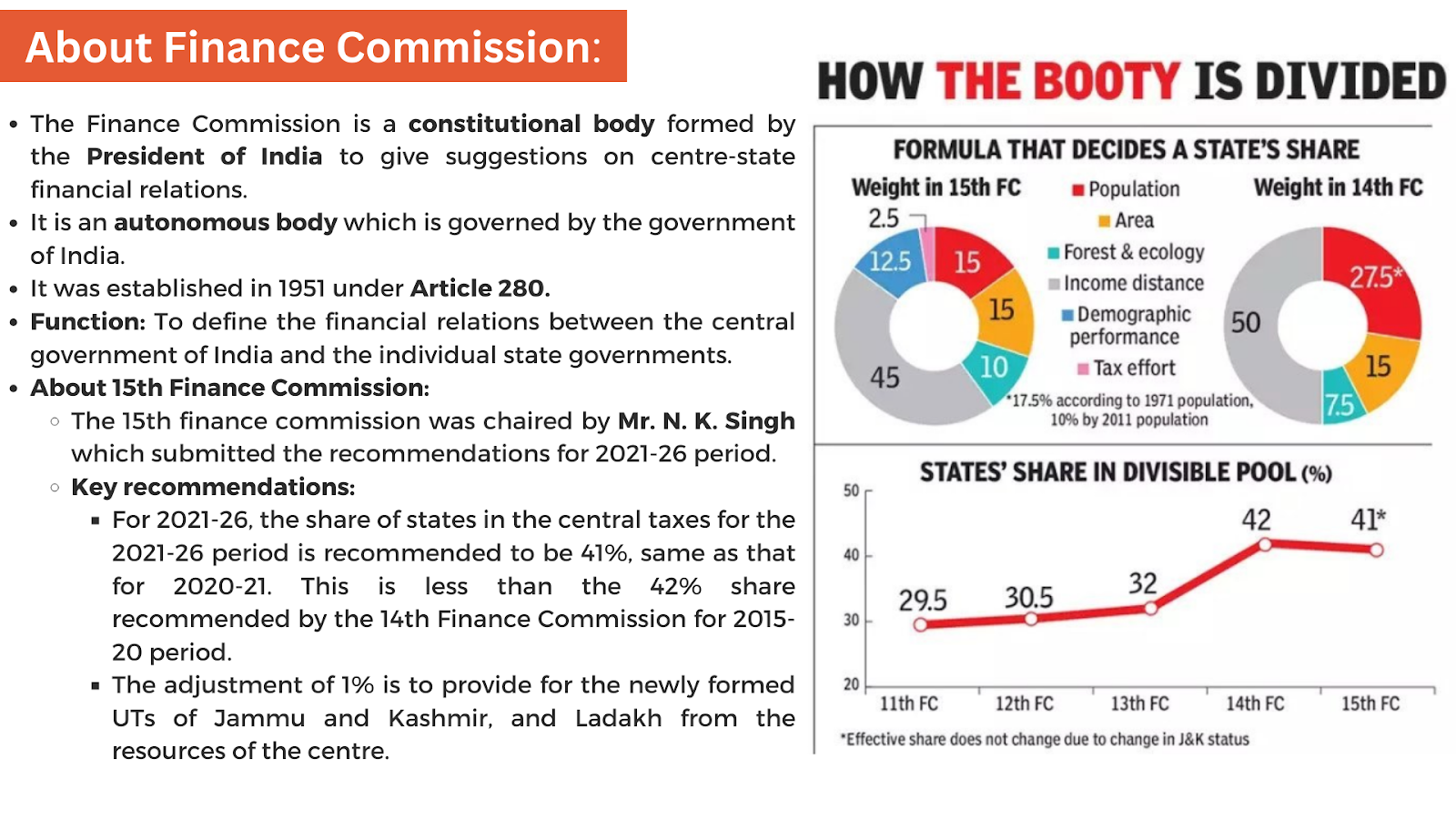
What is the income distance criterion and how does it affect state shares? The income distance criterion in the context of Finance Commission allocations is a measure of the distance between a state’s income and the state with the highest income, calculated based on the average per capita Gross State Domestic Product (GSDP). States with lower per capita income receive a higher share to ensure equity among states.
Significance of this criteria:
It remains crucial for ensuring fair distribution among states. It also plays a significant role in determining the distribution of union taxes to each state, with states further from the highest income state receiving a higher share.
What are the 3 major challenging observations in Centre-State Tax Devolution?
1) Issue of share with states in Tax Devolution:
Firstly, we need to look at which States have been gaining and which are losing their share over time; the criteria of horizontal distribution which has led to some States steadily losing their share; and what can be done to reverse this trend.
In Table 1, the shares of groups of States and those for selected States are shown, for the 12th FC to the 15th FC (final report).
Southern States have been on a steady fall in their share, from 19.785% to 15.800%. The northern and eastern States have also lost. The ‘gainer States’ were the hilly, central, and western States including Maharashtra.
The low-income States such as Bihar and Uttar Pradesh show, in terms of their overall share, a loss of 0.970% points and 1.325% points.
The main reason for the loss to the southern States due to the distance criterion amounted to 8.055% points, although the overall loss was much less at 3.985% points, implying that there was a gain under other criteria.
2) Issue over the Income Distance:
Inconsistency: Table 2 provides a list of the different criteria used by Finance Commissions, from the Twelfth to the Fifteenth.
Decreasing weight: The distance criterion has been accorded the highest weight amongst these criteria. Its weight was reduced from 50% to 47.5% by the 13th FC and further reduced to 45% by the 15th Fifteenth FC.
Hampering equalization: The above two observations challenge the Socio-economic justice principles which has always been regarded as a key principle in governing distribution.
3) Issue over the Population:
Data Updation issue: Until the Fourteenth Finance Commission, the data for the population in 1971 was used. For the Fifteenth Finance Commission, data for the population in 2011 was used.
Mismatched data: In order not to penalize States 15th FC showed better performance in reducing fertility rates, and the demographic change criterion was eventually introduced.
The joint impact of these two changes has been marginal for all groups of States. For Tamil Nadu, the joint impact was marginally positive.
Recommendation for Sixteenth Finance Commission:
Balanced allocation approach: Need to consider reducing the weight of the income distance criterion by 5% to 10% points. On Cesses and Surcharges: Need to evaluate and potentially impose an upper limit on cesses and surcharges to safeguard the divisible pool size and states’ revenue shares.
What steps need to be taken? (Way Forward)
Maintain Income Distance Criterion: The income distance criterion is essential for equitable distribution among states and should not be abandoned. We need to consider reducing its weightage while enhancing other criteria to balance allocations.
Manage Divisible Pool Size: We need to limit cesses and surcharges to 10% of the Centre’s gross tax revenues to prevent reducing the size of the divisible pool.The increase in states’ share from 32% to 42% by the Fourteenth Finance Commission should not be offset by additional levies.
Review Revenue Sharing Trends: Need to analyze the impact of changing criteria on state shares over time to ensure fair and balanced distribution. Further, we also need to address concerns raised by states experiencing declining shares due to existing allocation mechanisms.
India’s recent successful testing of an Agni-5 Missile equipped with Multiple Independently Targetable Re-entry Vehicle (MIRV) technology with multiple warhead capabilities, termed Mission Divyastra, marks a significant milestone in the nation’s defense capabilities.
What are Agni Missiles?
Agni missiles are long range, nuclear weapons capable surface to surface ballistic missile.
The first missile of the series, Agni-I was developed under the Integrated Guided Missile Development Program (IGMDP) and tested in 1989.
After its success, Agni missile program was separated from the IGMDP upon realizing its strategic importance.
It was designated as a special program in India’s defence budget and provided adequate funds for subsequent development.
Variants of Agni missiles
Agni I: It is a Medium Range Ballistic Missile with a Range of 700-800 km.
Agni II: It is also a Medium Range Ballistic Missile with a Range more than 2000 km.
Agni III: It is also an Inter-Medium Range Ballistic Missile with Range of more than 2,500 Km
Agni IV: It is also an Inter-Medium Range Ballistic Missile with Range is more than 3,500 km and can fire from a road mobile launcher.
Agni-V: Currently it is the longest of Agni series, an Inter-Continental Ballistic Missile (ICBM) with a range of over 5,000 km.
Agni- VI: The longest of the Agni series, an ICBM with a range of ICBM 11,000–12,000 km.
About Agni-5 Missiles
Indigenous Development: Agni missiles, developed by the Defence Research and Development Organisation (DRDO), have been integral to India’s defense arsenal since the early 1990s.
MIRV Technology: The latest variant of Agni incorporates Multiple Independently Targetable Re-entry Vehicle (MIRV) technology, a sophisticated capability possessed by only a handful of countries globally.
Developments in MIRV Technology
Targeting Versatility: MIRV technology enables a single missile to target multiple locations, potentially hundreds of kilometers apart, significantly enhancing its operational effectiveness.
Range and Strategic Focus: Agni, equipped with nuclear warheads, boasts a range exceeding 5,000 km, primarily aimed at countering threats from China.
Limited MIRV-Equipped Nations: Currently, major nations possessing MIRV-equipped missiles include the United States, Russia, China, France, and the United Kingdom, with emerging capabilities in Pakistan and Israel.
Complex Technology: Developing MIRV technology requires miniaturization of warheads, independent guidance systems, and sequential release mechanisms, making it a challenging endeavor.
Strategic Significance of the Mission Divyastra
Versatile Strike Capabilities: MIRV-equipped missiles enable simultaneous strikes on multiple targets, overwhelming enemy defenses and maximizing damage potential.
Deterrence and Defense Penetration: These missiles pose a significant challenge to missile defense systems, as multiple warheads with independent trajectories can thwart interception efforts.
Strategic Balance and Deterrence: For nations like India with a no-first-use policy, MIRV technology enhances the credibility of response strikes, serving as a potent deterrent against aggression.
Try this PYQ from CS Prelims 2014:
Which reference to Agni-IV Missile, which of the following statements is/are correct?
It is a surface-to-surface missile.
It is fuelled by liquid propellant only.
It can deliver one-tonne nuclear warheads about 7500 km away.
Select the correct answer using the code given below.
(a) 1 only
(b) 2 and 3 only
(c) 1 and 3 only
(d) 1, 2 and 3
[wpdiscuz-feedback id=”xa0gtk7839″ question=”Please leave a feedback on this” opened=”1″]Post your answers here.[/wpdiscuz-feedback][wpdiscuz-feedback id=”yhqrx9g6fd” question=”Please leave a feedback on this” opened=”1″][/wpdiscuz-feedback]
Nestled along the Deesa-Tharad highway in Gujarat’s Banaskantha district lies India’s pioneering gas-filling station, seemingly unremarkable at first glance.
However, this station, powered by cattle and buffalo dung, marks a significant leap in renewable energy innovation.
Fuel Production from Dung: A Technological Marvel
Innovative Concept: The ‘BioCNG’ outlet in Dama village of Deesa taluka stands as India’s sole gas-filling station utilizing cattle and buffalo dung.
Daily Operations: The outlet serves 90-100 vehicles daily, selling 550-600 kg of gas generated from 40 tonnes of dung processed at an adjacent plant.
Dung Utilization: Approximately 40,000 kg of dung are sourced daily from 2,700-2,800 animals belonging to 140-150 farmers residing within a 10 km radius of the plant.
Understanding the Dung-to-Fuel Process
Biogas Production: Fresh dung, rich in methane and water, undergoes anaerobic digestion in a sealed vessel, yielding raw biogas.
Purification Process: The raw biogas undergoes purification to remove impurities like CO2 and H2S, resulting in compressed biogas (CBG) suitable for vehicle use.
Production Output: From 40 tonnes of dung, the plant generates 2,000 cubic meters of raw biogas containing 55-60% methane, 35-45% CO2, and 1-2% hydrogen sulphide (H2S) and moisture.
Dual Benefits: Fuel and Fertilizer
Fuel Value: CBG is sold at the station for Rs 72/kg, offering a renewable and eco-friendly alternative to traditional fuels.
Fertilizer Production: The process also yields bio-fertilizer, enriching soil health and providing an additional income stream for farmers.
Fertilizer Sales: The Banaskantha Union markets 8,000-10,000 kg of bio-fertilizer daily, with phosphate-rich organic manure (PROM) fetching Rs 15-16/kg and compost Rs 8-10/kg.
Significance: Decentralized Model for Sustainable Agriculture
Community Involvement: The initiative engages local farmers, who supply dung to the plant, fostering community participation and economic empowerment.
Replicability and Scalability: The model holds potential for replication across districts and states, offering a scalable solution for energy and agricultural needs.
Investment Plans: The Banaskantha Union plans to commission four additional 100-tonnes capacity plants by 2025, with a total investment of Rs 230 crore.
Conclusion
The establishment of India’s first dung-based gas-filling station represents a significant stride towards renewable energy adoption and agricultural sustainability.
As technology continues to evolve, decentralized models like these hold promise for transforming rural economies while mitigating environmental impact.
With ongoing support and investment, such initiatives can pave the way for a greener and more resilient future.
Try this PYQ from CSE Prelims 2019:
Q.In the context of proposals to the use of hydrogen-enriched CNG (H-CNG) as fuel for buses in public transport, consider the following statements:
The main advantage of the use of H-CNG is the elimination of carbon monoxide emissions.
H-CNG as fuel reduces carbon dioxide and hydrocarbon emissions.
Hydrogen up to one-fifth by volume can be blended with CNG as fuel for buses.
H-CNG makes the fuel less expensive than CNG.
Which of the statements given above is/are correct?

![[13 March 2024] The Hindu Op-ed: Intra-group caste variances, equality and the Court’s gaze](https://d18x2uyjeekruj.cloudfront.net/wp-content/uploads/2024/03/Frame-2715-2-1568x882.jpg)


![[12 March 2024] The Hindu Op-ed: Central transfers — arresting the decline in shares of some States](https://d18x2uyjeekruj.cloudfront.net/wp-content/uploads/2024/03/Frame-2715-1-1568x882.jpg)