The RBI released the Inflation Expectations Survey of Households (IESH) for March 2022 on April 8. The survey results present interesting behavioural insights for public policy, particularly from a gender perspective.
Significance of inflation expectations
The impact of inflation — the overall increase in the prices in an economy — is felt by everyone.
High inflation adversely affects the poor.
Individuals, therefore, form expectations about how prices will behave in the future to take precautions.
If they anticipate high inflation, they negotiate wages or rents to compensate against a potential fall in their purchasing power.
Self-fulfilling: Increased wages increase the cost of production, making expectations self-fulfilling and, therefore, playing a pivotal role in determining inflation.
Anchoring inflation expectations: Central banks raise interest rates to ‘anchor’ high inflationary expectations when temporary price shocks, on account of drought or disruption in global supply chains, entail the risk of getting transmitted into actual inflation.
What shapes inflation expectations of individuals?
A recent study carried out by Acunto et al., 2020, validates that what agents frequently purchase, instead of those purchased infrequently, shape their perception of the general level of inflation.
Factors shaping individual’s perception: A significant factor shaping perceptions on inflation are the prices that individuals observe in their daily lives, originally posited by Robert Lucas in his seminal Islands model.
Therefore, generalising aggregate inflation expectations for making general views of prices in the economy could be misleading.
This insight has implications for gender-based differences in anticipating inflation in the future.
Existing literature shows that women have higher inflationary expectations compared to men.
However, a new study reveals that it is not the innate characteristics as much as the traditional gender roles that explain this divergence.
Natural experiments
To test its validity, trends of Inflation Expectations Survey of Households (IESH) before and after the lockdown period present itself as a crude ‘natural experiment’.
The authors hypothesise that if traditional gender roles are the primary reasons behind the gender inflation expectation gap, then the lockdown-imposed work-from-home (WFH) arrangements or loss of employment should contribute in closing this gap.
The logic: during the lockdown, people in urban areas lost jobs or remained at home, taking a relatively equal share in the frequent day-to-day purchases.
Two categories of occupations are studied here: homemakers (assumed to be dominated by women) and financial sector employees (assumed to be dominated by men).
Looking at the trends of the RBI surveys for the period between March 2018 and March 2020, homemakers report higher inflation expectations than financial sector employees.
However, this gap has narrowed over the last two years and has almost converged in March 2022.
A possible explanation of closing of the gap could be the gradual ‘experience effect’ of male-dominated financial sector employees.
Experience effect, contrary to Rational Expectations Theory that assumes individuals base their decisions on the information available to them, is based on the premise that actual personal experiences shape behaviour more than being informed about the outcome of the event.
Conclusion
Focus could be shifted more on the microfoundations — understanding macroeconomic outcomes by studying factors that shape individual behaviour and decision making — for making better policy decisions concerning macroeconomic phenomena.
The performance of the Insolvency and Bankruptcy Code (IBC) has been under intense scrutiny.
Basis for the criticism of IBC
The Code has been mainly criticised on three counts:
1] Delay in resolution: There are inordinate delays in the resolution procedure.
2] Liquidation: There have been more liquidations than resolutions.
3] Low recovery amount: The recovery amounts under IBC are not substantial, making it more of a talking point than an effective structural reform.
Is the criticism about the delay justified?
Assessing IBC based only on the average time taken to resolve successful cases does a substantial disservice to how much more efficient the IBC is compared to the previous regimes.
It is calculated by taking a simple average of time taken on each completed case.
This is one of the metrics used by the Insolvency and Bankruptcy Board of India (IBBI) to compare the IBC regime with the earlier Board of Industrial and Financial Reconstruction (BIFR) regime.
However, the performance of a bankruptcy resolution should ideally be evaluated along at least three dimensions:
The average time taken to resolve a case, the fraction of cases resolved within a given timeframe, and the recovery rate conditional on resolution.
Focusing on any single parameter may result in a gross under (over) estimation of the IBC’s (BIFR’s) performance.
By examining the fraction of cases that are resolved within a specific timeframe, we see that for any fraction of the total cases resolved under each scheme, the IBC took considerably less time than BIFR.
Total number of cases solved: Since its inception in 1987, the BIFR has resolved less than 3,500 cases while the IBC, since it was launched in 2016, resolved about 1,178 cases until it was suspended at the onset of the COVID pandemic.
Most analyses of IBC’s performance overlook the important fact that many of the legacy BIFR cases were subsumed by IBC, and these were often zombie firms that were kept alive due to massive evergreening of loans between 2008-2015.
Conclusion
The bottom line is straightforward: The IBC has significantly outperformed the earlier BIFR regime in terms of the speed of resolution.
The European Parliament and European Union (EU) Member States announced that they had reached a political agreement on the Digital Services Act (DSA).
What is DSA?
DSA is a landmark legislation to force big Internet companies to act against disinformation and illegal and harmful content, and to “provide better protection for Internet users and their fundamental rights”.
The Act, which is yet to become law, was proposed by the EU Commission (anti-trust) in December 2020.
As defined by the EU Commission, the DSA is “a set of common rules on intermediaries’ obligations and accountability across the single market”.
It seeks to ensure higher protection to all EU users, irrespective of their country.
The proposed Act will work in conjunction with the EU’s Digital Markets Act (DMA), which was approved last month.
Whom will the DSA apply?
Intermediaries: The DSA will tightly regulate the way intermediaries, especially large platforms such as Google, Facebook, and YouTube, function when it comes to moderating user content.
Abusive or illegal content: Instead of letting platforms decide how to deal with abusive or illegal content, the DSA will lay down specific rules and obligations for these companies to follow.
Ambit platforms: The legislation brings in its ambit platforms that provide Internet access, domain name registrars, hosting services such as cloud computing and web-hosting services.
Very large platforms: But more importantly, very large online platforms (VLOPs) and very large online search engines (VLOSEs) will face “more stringent requirements.”
45 million monthly users-base: Any service with more than 45 million monthly active users in the EU will fall into this category. Those with under 45 million monthly active users in the EU will be exempt from certain new obligations.
Key features
A wide range of proposals seeks to ensure that the negative social impact arising from many of the practices followed by the Internet giants is minimised or removed:
Faster removal of illicit content: Online platforms and intermediaries such as Facebook, Google, YouTube, etc will have to add “new procedures for faster removal” of content deemed illegal or harmful. This can vary according to the laws of each EU Member State.
Introduction of Trusted Flaggers: Users will be able to challenge these takedowns as well. Platforms will need to have a clear mechanism to help users flag content that is illegal. Platforms will have to cooperate with “trusted flaggers”.
Imposition of duty of care: Marketplaces such as Amazon will have to “impose a duty of care” on sellers who are using their platform to sell products online. They will have to “collect and display information on the products and services sold in order to ensure that consumers are properly informed.”
Annual audit of big platforms: The DSA adds an obligation for very large digital platforms and services to analyse systemic risks they create and to carry out risk reduction analysis. This audit for platforms like Google and Facebook will need to take place every year.
Promoting independent research: The Act proposes to allow independent vetted researchers to have access to public data from these platforms to carry out studies to understand these risks better.
Ban ‘Dark Patterns’ or “misleading interfaces: The DSA proposes to ban ‘Dark Patterns’ or “misleading interfaces” that are designed to trick users into doing something that they would not agree to otherwise.
Transparency of Algorithms: It also proposes “transparency measures for online platforms on a variety of issues, including on the algorithms used for recommending content or products to users”.
Easy cancellation of subscription: Finally, it says that cancelling a subscription should be as easy as subscribing.
Protection of minors: The law proposes stronger protection for minors, and aims to ban targeted advertising for them based on their personal data.
Crisis mechanism clause: This clause will make it “possible to analyse the impact of the activities of these platforms” on the crisis, and the Commission will decide the appropriate steps to be taken to ensure the fundamental rights of users are not violated.
Others: Companies will have to look at the risk of “dissemination of illegal content”, “adverse effects on fundamental rights”, “manipulation of services having an impact on democratic processes and public security”, “adverse effects on gender-based violence, and on minors and serious consequences for the physical or mental health of users.”
Bar over Social Media
It has been clarified that the platforms and other intermediaries will not be liable for the unlawful behaviour of users.
So, they still have ‘safe harbour’ in some sense.
However, if the platforms are “aware of illegal acts and fail to remove them, they will be liable for this user behaviour.
Small platforms, which remove any illegal content they detect, will not be liable.
Are there any such rules in India?
India last year brought the Information Technology (Intermediary Guidelines and Digital Media Ethics Code) Rules, 2021.
These rules make the social media intermediary and its executives liable if the company fails to carry out due diligence.
Rule 4 (a) states that significant social media intermediaries — such as Facebook or Google — must appoint a chief compliance officer (CCO), who could be booked if a tweet or post that violates local laws is not removed within the stipulated period.
India’s Rules also introduce the need to publish a monthly compliance report.
They include a clause on the need to trace the originator of a message — this provision has been challenged by WhatsApp in the Delhi High Court.
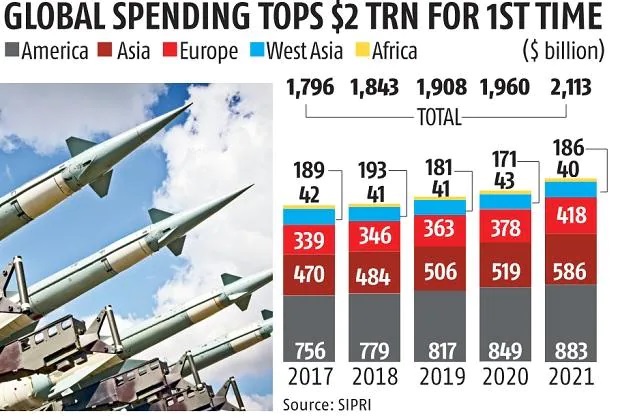
World military spending continued to grow in 2021, reaching a record $2.1 trillion despite the economic fallout of the pandemic, according to new data on global military spending published by the Stockholm International Peace Research Institute (SIPRI).
Top defence spenders in 2021
The five largest spenders in 2021 were the U.S., China, India, the U.K. and Russia, together accounting for 62% of expenditure.
The U.S. and China alone accounted for 52%.
India’s defence expenditure
India’s military spending of $76.6 billion ranked third highest in the world.
This was up by 0.9% from 2020 and by 33% from 2012.
Amid ongoing tensions and border disputes with China and Pakistan that occasionally spill over into armed clashes, India has prioritised the modernisation of its armed forces and self-reliance in arms production, the report said.
What about Russia and Ukraine?
Russia increased its military expenditure by 2.9% in 2021, to $65.9 billion, at a time when it was building up its forces along the Ukrainian border.
On Ukraine, the report remarked that as it had strengthened its defences against Russia, its military spending “has risen by 72% since the annexation of Crimea in 2014”.
Spending fell in 2021, to $5.9 billion, but still accounted for 3.2% of the country’s GDP.
Japan has recently described the Kuril Islands (which Japan calls the Northern Territories and Russia as the South Kurils) as being under Russia’s “illegal occupation”.
Note the Islands of Japan in North to South Direction: Hokkaido, Honshu , Shikoku, and Kyushu
What are the Kuril Islands/ Northern Territories?
These are a set of four islands situated between the Sea of Okhotsk and the Pacific Ocean near the north of Japan’s northernmost prefecture, Hokkaido.
Both Moscow and Tokyo claim sovereignty over them though the islands have been under Russian control since the end of World War II.
The Soviet Union had seized the islands at the end of World War II and by 1949 had expelled its Japanese residents.
Tokyo claims that the disputed islands have been part of Japan since the early 19th century.
Why in news?
This is the first time in about two decades that Japan has used this phrase to describe the dispute over the Kuril Islands.
Japan had been using softer language since 2003, saying that the dispute over the islands was the greatest concern in Russia-Japan bilateral ties.
What lies behind the dispute?
Japan’s sovereignty over the islands is confirmed by several treaties since 1855.
Russia, on the other hand, claims the Yalta Agreement (1945) and the Potsdam Declaration (1945) as proof of its sovereignty.
It argues that the San Francisco Treaty of 1951 is legal evidence that Japan had acknowledged Russian sovereignty over the islands.
Under Article 2 of the treaty, Japan had “renounced all right, title and claim to the Kuril Islands.”
However, Japan argues that the San Francisco Treaty cannot be used here as the Soviet Union never signed the peace treaty.
Continuing the WW2
In fact, Japan and Russia are technically still at war because they have not signed a peace treaty after World War II.
In 1956, during Japanese PM Ichiro Hatoyama’s visit to the Soviet Union, it was suggested that two of the four islands would be returned to Japan once a peace treaty was signed.
However, persisting differences prevented the signing of a peace treaty though the two countries signed the Japan-Soviet Joint Declaration, which restored diplomatic relations between the two nations.
The Soviet Union later hardened its position, even refusing to recognise that a territorial dispute existed with Japan.
It was only in 1991 during Mikhail Gorbachev’s visit to Japan that the USSR recognised that the islands were the subject of a territorial dispute.
Have there been attempts at resolution?
Since 1991, there have been many attempts to resolve the dispute and sign a peace treaty.
The most recent attempt was under PM Shinzo Abe when joint economic development of the disputed islands was explored.
In fact, both countries had agreed to have bilateral negotiations based on the 1956 Japan-Soviet Joint Declaration.
Russia was even willing to give back two islands, the Shikotan Island and the Habomai islets, to Japan after the conclusion of a peace treaty as per the 1956 declaration.
Japan’s attempt to improve ties with Russia was driven by its need to diversify energy sources and Russia by its need to diversify its basket of buyers and bring in foreign investments.
But nationalist sentiments on both sides prevented resolution of the dispute.
Implications for Japan
Soon after the Russian invasion of Ukraine, Japan made its unhappiness with Russia clear.
Japan has been among the most steadfast of Western allies in denouncing Russian aggression and punishing it with sanctions.
Japan has probably been spurred by its fears of a Russia-China alliance as Japan itself has territorial disputes and an uneasy history with China.
Secondly, Japan might have felt that this is a good opportunity to further isolate Russia and paint it as a “habitual offender” of international law.
Finally, Tokyo might have been prompted to take this position as it feels that the invasion of Ukraine proves that getting back the Kuril Islands is a lost cause.
The recent anti-encroachment drive in northwest Delhi’s violence-hit Jahangirpuri has become the latest flashpoint between political parties in the national capital.
The matter also reached the Supreme Court, which ordered a stay on the drive.
However, dissidents has now put questions over the legality of actions by municipal authorities and the manner in which certain structures were razed to the ground using bulldozers.
A close look at the pertinent legal provisions and constitutional principles involved in issues related to coercive processes against unauthorised constructions and encroachments may help putting the entire controversy in the right perspective:
What is Encroachment?
Encroachment is a real estate situation where a property owner violates contractual property rights by unlawfully entering, building, or extending structures onto Public Land without permission.
Structural encroachment occurs when a property owner unlawfully builds or extends structures on the Public Land.
Examples of Encroachment:
Unlawfully entering, trespassing, or walking through a property
Building a fence that goes past own property line
Extending structures or buildings onto the public domain (e.g., roads and sidewalks)
Non-government construction that overlaps govt property lines
Why encroachment is a problem?
Land is already a scarce commodity: Illicit occupation of public land puts stress on the already declining land resource availability.
Encroachment results in constriction of the public spaces: Road is narrowed down since it is occupied by structures supporting the livelihoods of the poor.
Public has the right of way: Pedestrians would suffer as people would have fewer spaces to walk. Encroachment on public roads increases the road traffic.
Maintenance of civic amenities becomes difficult: Severs, nullahs are chocked up due to encroachment. This creates sanitation and health crisis especially during monsoons.
Genesis of anti-encroachment drives in India
Anti-CAA protests: In 2019, after protests against the Citizenship Amendment Act (CAA) turned violent in Uttar Pradesh.
Compensation of public property damage: The CM ordered that compensation from property damage will be extracted from those who participated in the riots, to the tune of Rs 50 lakh.
Seizure of properties: He also announced that properties will be seized if people default on these payments.
How is Encroachment Demolition related to Rioting?
Prevention of Damage to Public Property Act, 1984: This is what governs actions taken against people convicted of rioting. However, this act levies a jail term and a fine on the offenders.
Assessment of damages caused: In 2009, the Supreme Court had said that respective high courts can appoint benches to adjudicate on damages during protests and riots.
Civil liability against damaging: In 2018, the Supreme Court had said that individuals will invite civil and criminal liability if found guilty of damaging public property.
What is the communal angle of recent demolition drive?
Ans. State-directed demolition of homes of the alleged rioters
The demolition drive was initiated by North Delhi Municipal Corporation (NDMC) to demolish the “illegal constructions” of the rioters in Jahangirpuri.
Communal violence had broken out in the area when a religious procession, which did not have police permission, clashed with minority community as it went alongside the place of worship.
This put a repulsive on other incidents, in Khargone in MP and Khambhat in Gujarat, where communal flare-ups were followed by the state-directed demolition of homes of the alleged rioters.
How did this intimidate minority groups?
Anti-encroachment drives in India are not new. What is new is that the current drives are outside the pale of the law.
Actions without notice: Irrespective of the legal status of the settlement, no public authority can demolish buildings without giving the affected parties a chance to be heard.
Bulldozing of petty areas: The bulldozer has now become a symbol of brute state power and a revolting mascot to intimidate minority groups in the country.
Collective punishment is state tyranny: It conveys the cynical use of brute state power for collective punishment undermining the basic tenets of criminal law.
Flawed binary of legality over illegality: The binary of slums settlements has very little meaning in Delhi, and much of urban India, since a majority of the residents appears to be of minority community.
Revengeful majoritarian justice: The demolition of homes and shops of alleged culprits of portrays the establishment as a bulldozer state that dispenses revengeful justice.
Public endorsement from the far-rights: Worryingly, the new rule of the bulldozer state seems to have some level of public endorsement.
Why impulsive encroachment demolition is a bad idea?
Issue of fair trial: From the legal perspective, the concept of a fair trial comes under question, since the government issued those notices before the people accused of participating in the riots were tried by any court.
Ambiguity of Public Property Act, 1984: Senior advocates thus said that such a decision is unconstitutional and has no backing from the law.
Curbing dissent: They also claimed seizure of property was being used as a means to curb peaceful dissent staged by certain communities.
Disregard for the due process of law: Such actions show a blatant disregard for the due process of law and established judicial precedents regarding evictions.
Arbitrary actions: Even before any charges are framed, the executive rather than the judiciary arbitrarily imposes a form of collective punishment upon a whole neighbourhood.
Creation of communal disharmony: Petitioners in the case claimed that the demolition drives were communal in nature since they were aimed at the localities of minority communities.
Larger impact: Rise of minority assertion
Marginalization and alienation: Minority community in India feels to be increasingly marginalized ever since the reigning in of the right-winged government. They have faced a spike in attacks, hate speech and harassment.
Demonizing the entire community: The modus operandi looks similar these days, i.e. to create an event of communal tension and clashes, declare names of rioters in a one-sided way, hence demonizing the community.
Rise in collective insecurity: Arbitrarily punitive demolition of this kind using a bulldozer as an extrajudicial threat or extrajudicial punishment is adding fuel to this temptation of insecurity.
Communal disharmony: Arbitrary state actions tends to divide people on religious lines– in most cases the minority and to win power on the basis of a religious identity.
Threats of radicalization: The poor and marginalized community is often vulnerable to the brisk of radicalization. There is a possibility of its inevitability.
Supreme Court rulings on removal of unauthorised constructions and encroachments
There has been a long line of cases underlining the significance of due process and adherence to the principle of natural justice where people are deprived of their rights to shelter or to earn a livelihood:
(1) Ahmedabad Municipal Corporation Vs Nawabkhan Gulabkhan and others (1977)
The top court held that while a notice may not be required in cases of encroachment of recent origin, if a municipal body allows settlement of encroachers for a long time, it must give a notice of reasonable time to such settlers.
If the encroachment is not removed within the specified time, it added, the competent authority would be at liberty to have it removed.
That would meet the fairness of procedure and principle of giving opportunity to remove the encroachment voluntarily by the encroachers.
The landmark verdict acknowledged the right to shelter and the right to earn livelihood as forming part of right to life under Article 21 of the Constitution.
The apex court rejected the plea of BMC that no notice need be given to slum dwellers since slums were sheer encroachments on public lands.
Removal of encroachmentswithout prior notice was arbitrary; the court held that such powers are designed to operate as an “exception” and not the “general rule.”
(3) MC Mehta Case (2006)
The Supreme Court was dealing with sealing of properties in Delhi on account of unauthorised use of properties (residential properties being used for commercial purposes).
It directed that the MCD would firstissue public notices in leading newspapers, asking violators to stop misuse of properties within the period of 30 days.
Official justification of the recent demolition drive
Anti-encroachment drives were long due: Officials claimed in court, that the demolitions were a part of anti-encroachment drives that had been planned in advance and were not specifically targeting the alleged rioters.
Discouraging the ever-increasing Slumization: The non-enforcement of strict regulations against encourages the public for encroachment hence the move was carried out.
No communal intent: The demolition drive in New Delhi has bulldozed all illicit constructions irrespective of the encroachers identity since the areas are inhabited by all communities.
Way Forward
Prevention of further encroachments: The local authorities and the state governments must become proactive in the prevention of encroachment of public lands.
Law abiding citizens: The citizens should abide by the rules and regulations and if they violate the rule of law, the violators should be penalized.
Due process of law must be held prime: Respecting the law of the land should be the norm and if there are any deviations the illegal structures should be bulldozed only after following due process of law.
Considering involuntary and forceful encroachments: The Supreme Court’s guidelines in the Olga Tellis judgment needs to be imbibed in true spirit.
Rehabilitation of slum-dwellers: and not the destruction of slums is the only way forward.
Conclusion
Slums and ‘unauthorised’ colonies like Jahangirpuri form the underbelly of India’s capital.
The city derives its energy from the thousands of informal workers living in these colonies.
It is high time the State recognizes their value and rights.
Over the last year, the World Health Organization (WHO) has been busy, in an unprecedented effort, to calculate the global death toll from COVID-19.
Revision of Covid-19 death toll by WHO
Globally from an estimated six million reported deaths, WHO now estimates these deaths to be closer to almost triple the number.
The new estimates also take into account formerly uncounted deaths, but also deaths resulting from the impact of COVID-19.
For example, millions who could not access care, i.e., diagnosis or treatment due to COVID-19 restrictions or from COVID-19 cases overwhelming health services.
India’s stand: India is in serious disagreement with the WHO-prepared COVID-19 mortality estimates.
The argument being made by India’s health establishment through a public clarification is that this is an overestimation, and the methodology employed is incorrect.
India’s Covid response
India’s COVID-19 response has been replete with delays and denials.
For instance, for the longest time that India’s COVID-19 number rose, the health establishment continued to insist that community transmission was not under way.
It took months and several lakh cases before they agreed that COVID-19 was finally in community transmission.
The devastation of the second wave showed how unprepared we were to combat the deadly Delta variant.
By the time the wave subsided, India’s population was devastated, and helpless, seeing dignity neither in disease nor in death.
Conclusion
The figures ratchet up not only issues of administrative but also moral accountability for governments that they have been previously side stepped.
After a gap of 15 months, the India-Sri Lanka Joint Working Group (JWG) on fisheries held its much-awaited deliberations (in virtual format) on March 25.
Background of the issue
As sections of fishermen from the Palk Bay bordering districts of Tamil Nadu continue to transgress the International Maritime Boundary Line (IMBL), cases of many of them getting arrested and their boats being impounded by the Sri Lankan authorities continue.
Apart from poaching in the territorial waters of Sri Lanka, the use of mechanised bottom trawlers is another issue that has become a bone of contention between the fishermen of the two countries; the dispute is not just between the two states.
Use of mechanised bottom trawlers: This method of fishing, which was once promoted by the authorities in India, is now seen as being extremely adverse to the marine ecology, and has been acknowledged so by India.
The actions of the Tamil Nadu fishermen adversely affect their counterparts in the Northern Province.
Reason for transgression: The fishermen of Tamil Nadu experience a genuine problem — the lack of fishing areas consequent to the demarcation of the IMBL in June 1974.
If they confine themselves to Indian waters, they find the area available for fishing full of rocks and coral reefs besides being shallow.
Under the Tamil Nadu Marine Fishing Regulation Act 1983, mechanised fishing boats can fish only beyond 3 NM from the coast.
This explains the trend of the fishermen having to cross the IMBL frequently.
Way forward
Transition to deep-sea fishing: While Indian fishermen can present a road map for their transition to deep sea fishing or alternative methods of fishing, the Sri Lankan side has to take a pragmatic view that the transition cannot happen abruptly.
In the meantime, India will have to modify its scheme on deep-sea fishing to accommodate the concerns of its fishermen, especially those from Ramanathapuram district, so that they take to deep-sea fishing without any reservation.
Alternative livelihood measures: There is a compelling need for the Central and State governments to implement in Tamil Nadu the Pradhan Mantri Matsya Sampada Yojana in a proactive manner.
The scheme, which was flagged off two years ago, covers alternative livelihood measures too including seaweed cultivation, open sea cage cultivation, and sea/ocean ranching.
During Mr. Jaishankar’s visit, India had signed a memorandum of understanding with Sri Lanka for the development of fisheries harbours.
This can be modified to include a scheme for deep-sea fishing to the fishermen of the North.
Joint research on fisheries: . It is a welcome development that the JWG has agreed to have joint research on fisheries, which should be commissioned at the earliest.
Institutional mechanism: Simultaneously, the two countries should explore the possibility of establishing a permanent multi-stakeholder institutional mechanism to regulate fishing activity in the region.
Using common thread of culture, language and religion: The people of the two countries in general and fisherfolk in particular have common threads of language, culture and religion, all of which can be used purposefully to resolve any dispute.
Conclusion
What everyone needs to remember is that the fisheries dispute is not an insurmountable problem. A number of options are available to make the Palk Bay not only free of troubles but also a model for collaborative endeavours in fishing.
The release of two new working papers, one from the World Bank and the other from the IMF, has led to a renewed debate on poverty in India.
A substantial decline in extreme poverty in India
Both papers claim that extreme poverty in the country, based on the international definition of $1.90 per capita per day (in purchasing power parity (PPP), has declined substantially.
The World Bank paper uses the Consumer Pyramid Household Surveys (CPHS) data to conclude that 10.2 per cent of the country’s population was at extreme poverty levels in 2019.
The IMF paper calculates poverty by using the NSO Consumer Expenditure Survey as the base and adjusts it for the direct effect of the massive food grain subsidy given under the National Food Security Act (NFSA, 2013) and PM Garib Kalyan Anna Yojana (PMGKAY) during the pandemic period.
It claims that extreme poverty has almost vanished – it was 0.77 per cent in 2019 and 0.86 per cent in 2020.
Another estimate of poverty by the NITI Aayog, the multi-dimensional poverty index (MPI), has put Indian poverty at 25 per cent in 2015 based on NFHS data.
How MPI is calculated?: This MPI is calculated using twelve key components from areas such as health and nutrition, education and standard of living.
How much should be the coverage under NFSA, 2013?
The offtake of grains under NFSA in FY20 was 56.1 million metric tonnes (MMT).
Following the outbreak of Covid-19, the government launched the Pradhan Mantri Garib Kalyan Anna Yojana (PMGKAY) in April 2020 to distribute 25 kg cereals per family per month in addition to food transfers under the NFSA.
That catapulted the offtake to 87.5 MMT (under PMGKAY and NFSA) in FY21.
The scheme continued in FY22, and the grain offtake touched 93.2 MMT.
Issues with the wide coverage
A further extension of free food on top of the NFSA allocations was uncalled for.
This will strain the fisc, reduce public investments and hamper potential job creation.
A look at the size of food freebies will help understand the gravity of this problem.
As of April 1, the Food Corporation of India’s wheat and rice stocks stood at 74 MMT against a buffer stock norm of 21 MMT – there is, therefore, an “excess stock” of 53 MMT.
The cost of excess stock: The economic cost of rice, as given by FCI, is Rs 3,7267.6/tonne and that of wheat is Rs 2,6838.4/tonne (2020/21).
The value of “excess stocks”, beyond the buffer norm, is, therefore, Rs 1.85 lakh crore — this, despite a total of 72.2 MMT grains distributed for free under the PMGKAY in FY21 and FY22.
Ballooning food subsidy: All this results in a ballooning food subsidy for FY 23, it is provisioned at Rs 2.06 lakh crore, for FY 23, it is provisioned at Rs 2.06 lakh crore.
But this amount is likely to go beyond Rs 2.8 lakh crore with the continuing distribution of free food under the PMGKAY.
This would amount to more than 10 per cent of the Centre’s net tax revenue (after deducting the states’ share).
Way forward
It is all the more important to change the current policy of free food given the massive leakages in the PDS.
As per the High-Level Committee on restructuring FCI, leakages were more than 40 per cent based on the NSSO data of 2011.
Ground reports suggest that these leakages hover around 30 per cent or so today.
Make PDS more targeted: In reforming this system of free food, wisdom lies in going back to the Antyodaya Anna Yojana (AAY).
Under AAy, the “antyodaya” households (the most poor category) get more rations (35 kg per household) at a higher subsidy (rice, for instance, at Rs 3/kg and wheat at Rs2/kg).
For the remaining below poverty line (BPL) families, the price charged was 50 per cent of the procurement price and for above poverty line families (APL), it was 90 per cent of the procurement price.
This will make PDS more targeted and lead to cost savings.
Use of technology: There could be some problems in identifying the poor. However, technology can help overcome this difficulty.
Option of cash transfer: This measure should be combined with giving people the option of receiving cash instead of providing grains to targeted beneficiaries.
The savings so generated from this reform can be ploughed back as investments in agri-R&D, rural infrastructure (irrigation, roads, markets) and innovations that will help create more jobs and reduce poverty on a sustainable basis.
Conclusion
The government needs to bite the bullet and emulate the Vajpayee government (which had introduced AAY) in using scarce resources more wisely.
A 37-year-old Constitution Bench judgment of the Supreme Court which held that pavement dwellers are different from trespassers. This may become a game-changer in the Jahangirpuri case.
What is the Olga Tellis judgment?
The judgment, Olga Tellis vs. Bombay Municipal Corporation, was given in 1985 by a five-judge Bench led by then Chief Justice of India Y.V. Chandrachud (F/O Justice D.Y Chandrachud).
It is agreed that pavement dwellers do occupy public spaces in an unauthorized manner.
Key takeaways of the Judgment
Opportunity to depart: The court maintained they should be given a chance to be heard and a reasonable opportunity to depart before force is used to expel them.
No use of force: The Supreme Court reasoned that eviction using unreasonable force, without giving them a chance to explain is unconstitutional.
Right to life: Pavement dwellers, too, have a right to life and dignity. The right to life included the right to livelihood. They earn a meagre livelihood by living and working on the footpaths.
No misuse of powers of eviction: A welfare state and its authorities should not use its powers of eviction as a means to deprive pavement dwellers of their livelihood.
What led to the judgment?
Sometime in 1981, the State of Maharashtra and the Bombay Municipal Corporation decided that pavement and slum dwellers in Bombay city should be evicted and “deported to their respective places of origin or places outside the city of Bombay.”
Some demolitions were carried out before the case was brought to the Bombay High Court by pavement dwellers, residents of slums across the city, NGOs and journalists.
While they conceded that they did not have “any fundamental right to put up huts on pavements or public roads”, the case came up before the Supreme Court on larger questions of law.
What were the questions discussed before the Supreme Court?
One of the main questions was whether eviction of a pavement dweller would amount to depriving him/her of their livelihood guaranteed under Article 21 of the Constitution.
The Article mandates that “no person shall be deprived of his life or personal liberty EXCEPTaccording to procedure established by law.”
The Constitution Bench was also asked to determine if provisions in the Bombay Municipal Corporation Act, 1888, allowing the removal of encroachments without prior notice, were arbitrary and unreasonable.
The Supreme Court also decided to examine the question whether it was constitutionally impermissible to characterise pavement dwellers as trespassers.
What was the State government’s defence?
The State government and the corporation countered that pavement dwellers should be estopped (estoppel is a judicial device whereby a court may prevent or “estop” a person from making assertions.
Estoppel may prevent someone from bringing a particular claim from contending that the shacks constructed by them on the pavements cannot be demolished because of their right to livelihood.
They cannot claim any fundamental right to encroach and put up huts on pavements or public roads over which the public has a ‘right of way.’
How did the Supreme Court rule?
The Bench threw out the government’s argument of estoppel, saying “there can be no estoppel against the Constitution.”
The court held that the right to life of pavement dwellers were at stake here.
The right to livelihood was an “integral component” of the right to life. They can come to court to assert their right.
If the right to livelihood is not treated as a part of the constitutional right to live, the easiest way of depriving a person of his right to life would be to deprive him of his means of livelihood to the point of abrogation.
Any aggrieved person can challenge the deprivation as offending the right to life.
Removal of encroachments without prior notice was arbitrary; the court held that such powers are designed to operate as an “exception” and not the “general rule.”
The procedure of eviction should lean in favour of procedural safeguards which follow the natural principles of justice like giving the other side an opportunity to be heard.
Finally, the court emphatically objected to authorities treating pavement dwellers as mere trespassers.
The encroachment committed are involuntary acts in the sense that those acts are compelled by inevitable circumstances and are not guided by choice.
Way ahead
It is not a free choice to exercise as to whether to commit an encroachment and if so, where.
Trespassers should not be evicted by using force greater than what is reasonable and appropriate.
He/she should be asked and given a reasonable opportunity to depart before force is used to expel him.