OpenAI has introduced OpenAI o1, the first in a series of advanced AI models under its ‘Project Strawberry’ initiative.
This new model is designed for tackling more complex tasks in science, coding, and maths.
About OpenAI o1
This model has been built to approach problems like humans, carefully considering various angles before arriving at an answer.
It improves its performance by learning from different perspectives and checking its output for errors.
In trials, the upcoming version of the o1 model performed on par with PhD students in areas like physics, chemistry, and biology, and excelled particularly in maths and coding.
For instance, it solved 83% of problems in a math contest, compared to earlier versions which solved just 13%.
In coding, the model ranked higher than 89% of participants.
Key Features and Offerings
OpenAI is also releasing OpenAI o1-Mini, an economical version designed for developers, offering similar reasoning capabilities at 80% lower cost compared to the o1-preview version.
The o1 model excels in generating and debuggingcomplex code and is expected to assist in software development, data analysis, and problem-solving tasks.
Safety Measures
OpenAI has introduced new training methods to ensure the safety of these models, improving their ability to follow safety guidelines and prevent AIjail-breaking.
Jailbreaking is a form of hacking that aims to bypass an AI model’s ethical safeguards and elicit prohibited information.
In safety tests, the new version scored 84/100, a significant improvement from the previous 22/100 score.
The company is collaborating with UK and US governments on AI safety and conducting red teaming to identify and address any weaknesses.
Q ‘Constitutional Morality’ is rooted in the Constitution itself and is founded on its essential facets. Explain the doctrine of ‘Constitutional Morality’ with the help of relevant judicial decisions.(UPSC IAS/2021)
Q Do you think that Constitution of India does not accept principle of strict separation of powers rather it is based on the principle of ‘checks and balance’? Explain. (UPSC IAS/2019)
Mentor’s Comment: Presently, in India the issue of punitive demolitions raises significant concerns regarding due process, human rights violations, and the arbitrary exercise of state power, as these actions often target vulnerable communities without legal justification or adherence to established judicial guidelines. In today’s editorial we will observe why the Supreme Court is considering to formulate pan-India guidelines aims to address these systemic issues by ensuring that demolitions occur only in exceptional circumstances, with proper legal procedures and protections for affected individuals.
_
Let’s learn!
Why in the News?
SC has called for suggestions to establish pan-India guidelines addressing extra-legal demolitions, due to the concerns over the arbitrary demolition of properties. It undermines the ‘right to housing’ of an individual and violates the Constitutional principles.
What are the arguments against the use of punitive demolitions?
Violation of Due Process: Demolitions are often carried out without following proper legal procedures and justification, undermining the rule of law. For example, Delhi’s Jahangirpuri case, incidents in Nuh (Haryana), and Khargone (Madhya Pradesh).
A person’s home cannot be demolished solely based on accusations against them or their family members, as this violates Fundamental Rights and due process.
Collective Punishment: Punitive demolitions often affect the individuals for actions they did not commit which is illegal under both national and international law.
This exacerbates social inequalities, leading to further marginalization of already vulnerable populations.
Human Rights Violations: Reports indicate that demolitions are often accompanied by police violence, which constitutes a violation of human rights and can lead to physical and psychological harm for affected individuals.
Political Manipulation: The use of demolitions as a form of political retribution or control undermines democratic principles and can be seen as a tactic to instill fear among communities, particularly in politically sensitive contexts.
What needs to be the Due Process in Legitimate Demolitions?
UN Guidelines: The United Nations Basic Principles and Guidelines on Development-based Evictions and Displacement (2019) provide humanitarian directives, yet court rulings have been inconsistent and piecemeal which needs a comprehensive approach.
Exceptional Circumstances: Demolitions should only occur in exceptional cases and must adhere strictly to established legal processes.
Need for Proposed Phased Procedures:
Pre-Demolition Phase: Provide a reasoned notice with details on land records and resettlement plans, allowing adequate time for responses.
During Demolition Phase: Requires the presence of neutral government officials during demolitions.
Rehabilitation Phase: Need to establish a swift mechanism for affected persons to challenge demolition decisions and seek remedies such as compensation and restitution.
Way Forward – Need to affix Personal Liability:
The widespread demolitions in India highlight a consistent lack of due process and disregard for judicial directives, necessitating the establishment of pan-India guidelines, increased sensitization of law enforcement, and the exploration of personal liability for officials who order forced evictions to ensure accountability and checks on their powers.
The Union Ministry dissolved the Standing Committee on Statistics (SCoS) headed by eminent economist and former chief statistician of the country Pronab Sen citing overlapping roles with the Steering Committee.
Why was the SCoS dissolved?
Overlapping Responsibilities: The primary reason cited for the dissolution of the SCoS was that its functions overlapped with those of the newly formed Steering Committee for National Sample Surveys.
Concerns Raised by Members: Members of the SCoS had consistently questioned the delay in conducting the census, which has been a critical source of data for policymakers.
Lack of Communication: Dr. Pronab Sen, the chair of the SCoS, noted that members were not provided with a specific reason for the committee’s dissolution, which raised concerns about transparency in the decision-making process.
What are the main roles of the new Steering Committee?
Advisory Role: The Steering Committee will advise the Ministry on survey methodologies, including aspects like sampling frames, design, and survey instruments, similar to the SCoS.
Finalizing Tabulation Plans: This will play a crucial role in finalizing the tabulation plans for various national sample surveys, ensuring that the data collected is organized and presented effectively.
Reviewing Methodologies: The committee will review subject results, methodologies, and questionnaires related to national sample surveys, maintaining the continuity of statistical rigor established by the SCoS.
Tenure and Composition: The Steering Committee consists of 17 members, including at least four members retained from the SCoS, and will serve a tenure of two years.
How do the SCoS and the Steering Committee differ?
Composition: The Steering Committee has a higher number of official members compared to the SCoS, which includes several non-official members. This shift may influence the dynamics and perspectives within the committee.
Mandate Overlap: While both committees have similar mandates regarding survey methodologies and data collection, the Steering Committee is positioned to focus more on the operational aspects of national sample surveys, potentially leading to a more streamlined approach.
Response to Criticism: The formation of the Steering Committee appears to be a response to criticisms of the statistical system in India, aiming to address survey-related issues more effectively than the SCoS could.
How does the SCoS’s dissolution impact statistical data quality?
Delay in Census Data: The dissolution of the SCoS amid ongoing delays in conducting the census raises concerns about the availability of reliable and updated data. The last census was conducted in 2011, and reliance on outdated data can negatively affect policy-making and the distribution of welfare benefits.
Quality of Administrative Data: Critics argue that administrative data, which the government has been relying on, may not accurately reflect the employment scenario, as it is often threshold-based and susceptible to manipulation. This could lead to a distorted view of the economic situation.
Need for Comprehensive Data: The census is crucial for providing comprehensive demographic, economic, and social data, which is essential for effective policy formulation. The absence of updated census data can hinder the government’s ability to address issues like employment, poverty, and social welfare effectively.
Way forward:
Reinstate Independent Oversight: Establish an independent statistical body with clear roles to ensure transparency, timely data collection, and oversight of key surveys like the census, addressing concerns of data reliability.
Modernize Data Collection: Leverage technology to streamline and accelerate the census and national surveys, ensuring that updated and accurate data is available for policy-making and welfare distribution.
The rise in jobless growth, driven by automation and AI, has led to growing inequality, prompting discussions on implementing Universal Basic Income (UBI) in many countries.
What does the ILO say on Inflation and unemployment in India?
The ILO reports that 83% of the unemployed population in India are youth, due to the rapidly changing economy influenced by automation and AI.
This trend has exacerbated income inequality, with a 1.6% drop in global labour income share between 2004 and 2024, significantly affecting developing nations like India.
The report indicates that persistent inflation and geopolitical tensions have led to aggressive monetary policies, which could further strain the labor market.
The ILO anticipates a slight increase in global unemployment in 2024, reflecting ongoing structural issues in labor markets.
What will be its implications on Indian growth and development?
Social Implications: Falling living standards and weak productivity due to automation could lead to greater inequality, undermining social justice efforts in India.
The ILO suggests that increasing unemployment and inflation could result in social unrest and political instability without effective social safety nets.
Political Implications: It makes it difficult for the decision making and governance due to the drop in global labour income, prompting India to increase budget allocations for welfare programs.
Economic Implications: The emphasis on generating employment in labor-intensive sectors is crucial. The government policies should prioritize job creation to counteract the effects of automation and ensure that growth benefits a broader segment of the population.
What are the safety nets for India?
Cash Transfer Schemes: Programs targeting farmers and women, as well as cash transfers for unemployed youth, represent existing safety nets that provide some level of income support.
Employment Guarantee Schemes: Initiatives like the Mahatma Gandhi National Rural Employment Guarantee Act (MGNREGA) aim to provide employment and income security to rural households, although funding and implementation have faced challenges.
Universal Basic Social Safety Nets: Experts suggest that rather than a full UBI, India should focus on enhancing existing social safety nets to ensure they are more universal and effective in addressing the needs of the unemployed and underemployed populations.
External Affairs Minister S. Jaishankar visited the replica of the East Gate of Sanchi’s Great Stupa in Berlin.
Aboutthe Great Stupa of Sanchi
Details
Establishment
Commissioned by Emperor Ashoka in the 3rd century BCE.
UNESCO World Heritage Site.
Purpose
Built to enshrine the relics of Buddha and symbolise the Buddhist faith.
Construction
Overseen by Ashoka’s wife, Devi, from Vidisha.
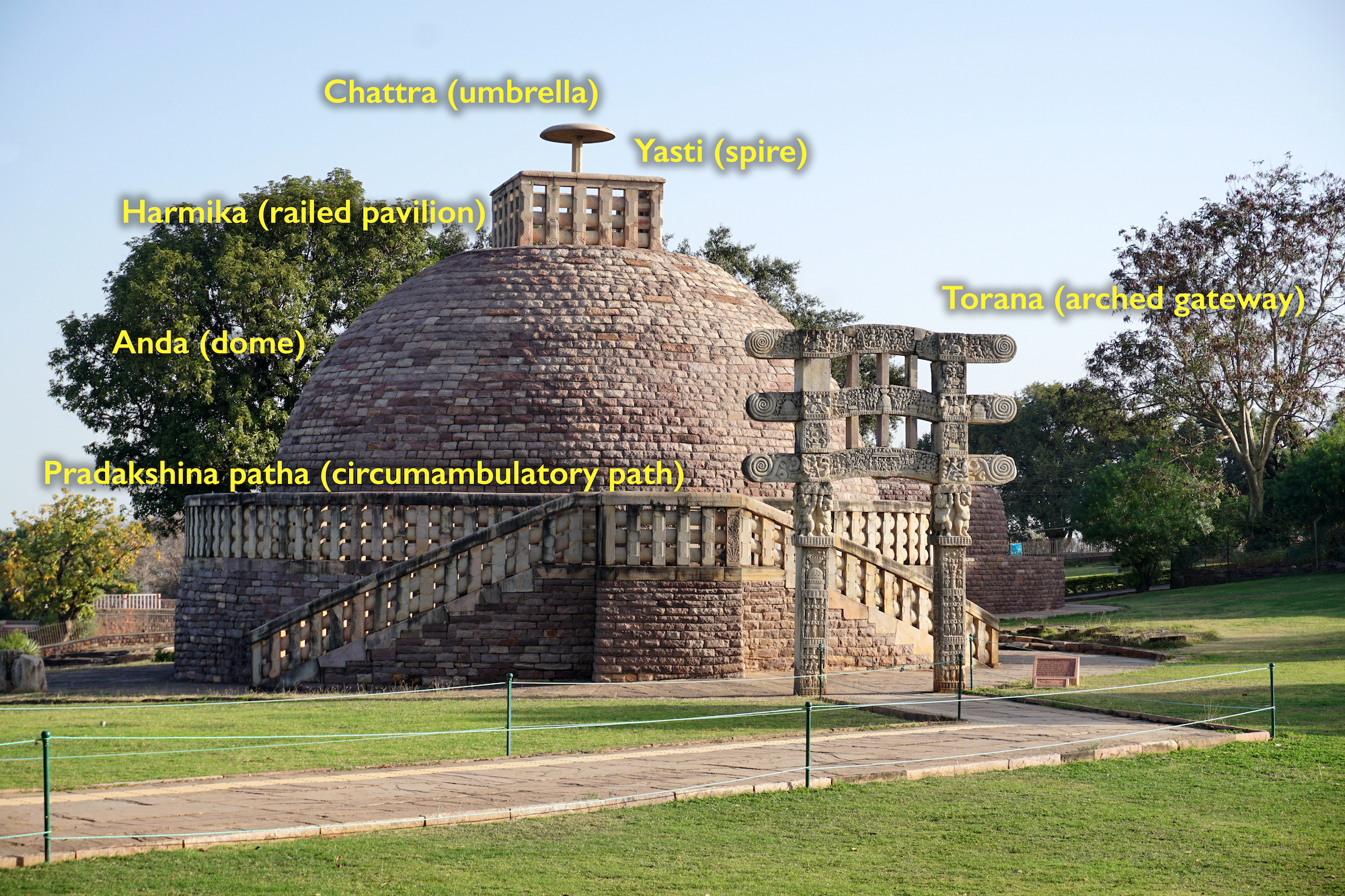
Stupa is a simple hemispherical structure crowned by a chhatra (parasol), symbolizing high rank.
Development of the Sanchi complex was supported by the mercantile community of Vidisha.
Design
Follows a simple hemispherical dome structure.
Later, in the 1st century BCE, under the Satavahana dynasty, 4 ornamental gateways (toranas) were added in four cardinal directions.
Toranas (Gateways)
Each torana consists of 2 pillars supporting 3 architraves, adorned with bas-reliefs depicting scenes from Buddha’s life, Jataka tales, and Buddhist symbols.
Artistic Features
The toranas are famous for their intricate carvings, depicting elephants, winged lions, peacocks, and shalabhanjikas (fertility symbols).
Symbolism
Upper architrave shows seven Manushi Buddhas (previous Buddhas), the middle depicts the Great Departure of Prince Siddhartha, and the lower shows Ashoka’s visit to the Bodhi tree.
Restoration
Rediscovered in 1818 by British officer Henry Taylor and restored by John Marshall (ASI director) in the early 1900s with financial aid from the Begums of Bhopal.
Replica of East Gate
A plaster cast of the East Gate was made in the 1860s by Henry Hardy Cole for the Victoria and Albert Museum.
A replica now stands in front of the Humboldt Forum Museum in Berlin.
PYQ:
[2013] Consider the following historical places:
1. Ajanta Caves
2. Lepakshi Temple
3. Sanchi Stupa
Which of the above places is / are also known for mural paintings?
(a) 1 only
(b) 1 and 2 only
(c) 1, 2 and 3
(d) None
[2016] Early Buddhist Stupa-art, while depicting folk motifs and narratives successfully expounds Buddhist ideals. Elucidate.
127th Anniversary of the Battle of Saragarhi was observed on September 12.
About the Battle of Saragarhi
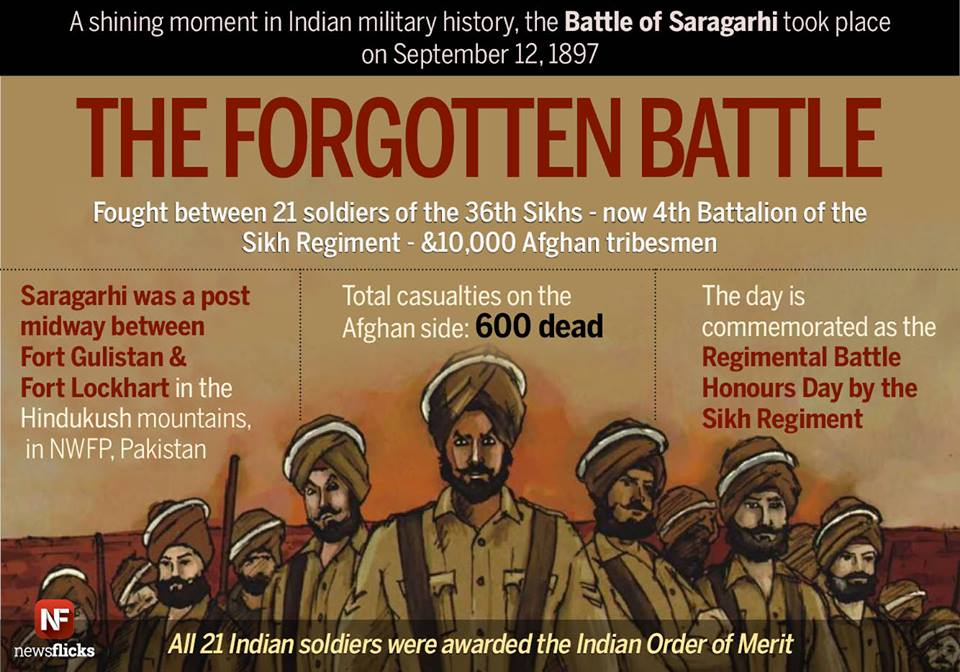
The Battle of Saragarhi occurred on September 12, 1897, between 21 Sikh soldiers of the then 36th Sikh Regiment and around 8,000 Afridi and Orakzai tribals.
The soldiers defended a communication post at Saragarhi, connecting Fort Lockhart and Fort Gulistan in the North West Frontier Province (now Pakistan).
Led by Havildar Ishar Singh, the Sikhs fought to the last man, marking one of the greatest last stands in military history.
Despite their bravery, the soldiers were eventually outnumbered and killed.
Their sacrifice gave the British time to strengthen positions at Fort Lockhart and Gulistan, halting enemy advances.
Implication of the Battle
The Sikh soldiers showed extraordinary courage, fighting against overwhelming odds.
The 21 soldiers killed around 200 militants and injured 600, holding the enemy for seven hours.
The British Government posthumously awarded all 21 soldiers the Indian Order of Merit.
The battle highlighted the importance of discipline, leadership, and sacrifice, and underscored the role of Sikh regiments in the British Indian Army.
PYQ:
[2020] Wellesley established the Fort William College at Calcutta because:
(a) He was asked by the Board of Directors at London to do so
(b) He wanted to revive interest in oriental learning in India
(c) He wanted to provide William Carey and his associates with employment
(d) He wanted to train British civilians for administrative purpose in India
Natural geographic separation is happening among Asiatic lion populations in Gujarat, and there is no immediate need to relocate them, says the director general of the International Big Cat Alliance.
About Asiatic Lion
Asiatic Lion, part of the Panthera Leo Leo subspecies, is found only in India, with a distinct belly skin fold.
Once spread across West Asia and India, now limited to Gir National Park, where the population increased in 2020.
Asiatic lions face threats from diseases, natural disasters, poaching and retaliation for livestock attacks.
They are classified as Endangered(IUCN), listed in CITESAppendix I, and protected under Schedule I of the Wildlife Protection Act.
The Asiatic Lion Conservation Project (2018-2021) aims for scientific management and community involvement.
About International Big Cat Alliance (IBCA)
Details
Objective
Protect and conserve 7 big cats: tiger, lion, leopard, snow leopard, puma, jaguar, and cheetah.
Initial Funding
₹150 crore from the Government of India for five years, with additional funding from global agencies.
Membership
Open to 96 range countries with natural big cat habitats.
Key Activities
Advocacy, knowledge sharing, capacity building, eco-tourism promotion, and resource mobilization.
Governance
General Assembly, elected Council, and Secretariat. Secretary General appointed by the Assembly.
Governance Framework
Based on the International Solar Alliance (ISA); finalized by the International Steering Committee.
India’s Role
India is home to 5 of the 7 big cats: tiger, lion, leopard, snow leopard, and cheetah.
India hosts about 70% of the world’s tiger population and has seen steady growth in its Asiatic lion population.
PYQ:
[2012] Consider the following:
Black-necked crane
Cheetah
Flying squirrel
Snow leopard
Which of the above are naturally found in India?
(a) 1, 2 and 3 only
(b) 1, 3 and 4 only
(c) 2 and 4 only
(d) 1, 2, 3 and 4
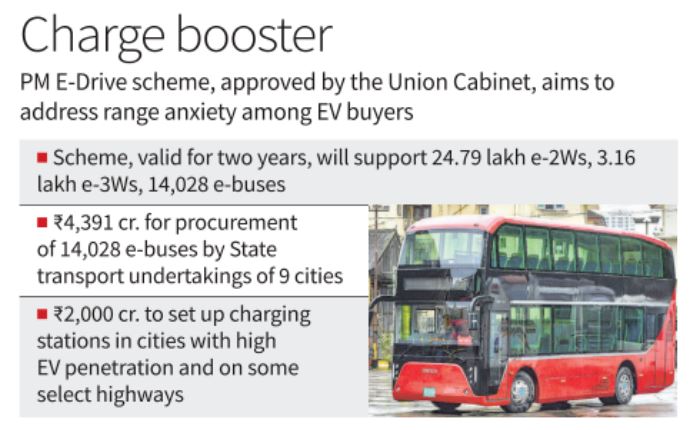
The Union Cabinet approved the PM Electric Drive Revolution in Innovative Vehicle Enhancement (PM E-Drive) Scheme with an outlay of ₹10,900 crore over two years.
About PM E-DRIVE Scheme:
Details
Name
PM Electric Drive Revolution in Innovative Vehicle Enhancement (PM E-DRIVE) Scheme
Total Outlay
₹10,900 crore for two years
Goal
Promote electric mobility, reduce pollution, and enhance fuel security
Reduce range anxiety by providing charging infrastructure in cities and highways.
Incentives
Direct subsidies for e-2Ws, e-3Ws, e-buses, e-ambulances, and e-trucks
Key Components
₹3,679 crore for demand incentives for e-2Ws, e-3Ws, e-ambulances, and e-trucks.
₹500 crore for e-ambulances.
₹4,391 crore for e-buses.
Other components:
E-Vouchers
Aadhaar-authenticated e-voucher for EV buyers;
Signed by both buyer and dealer for claiming incentives.
E-Bus Procurement
₹4,391 crore for 14,028 e-buses in 9 major cities (Delhi, Mumbai, Kolkata, Chennai, Ahmedabad, Surat, Bangalore, Pune, Hyderabad)
Charging Infrastructure
₹2,000 crore for 72,300 public EV charging stations, including fast chargers for e-4Ws, e-buses, e-2Ws, and e-3Ws
Incentivizing E-Trucks
₹500 crore tied to scrapping certificates from MoRTH-approved scrapping centres
Testing and Upgradation
₹780 crore for upgradation of MHI’s test agencies for green mobility technologies
PYQ:
[2019] How is efficient and affordable urban mass transport key to the rapid economic development in India?
External Affairs Minister S. Jaishankar, currently in Germany as part of a three-nation tour, met with German Foreign Minister Annalena Baerbock in Berlin. They discussed various defence topics, including Ukraine, Gaza, and the Indo-Pacific region.
Defence Partnership between India and Germany:
Late Engagement: Germany has been late in engaging India’s defence interests compared to France and the U.S., who have stronger partnerships with India.
Opportunity Post-Russia-Ukraine War: With Russia’s industrial capacity focused on the war, Germany sees an opportunity to enhance its defence exports to India.
German defence manufacturers like ThyssenKrupp Marine Systems are already involved in projects like submarine construction for the Indian Navy.
Technology Transfer: Technology transfer is a key condition for India’s defence partnerships, and Germany’s ability to meet this requirement could shape future cooperation.
Complementary Systems: Germany’s Eurofighter and its future replacement by U.S.-made F-35s highlight Germany’s readiness to integrate its defence systems with Western platforms, easing potential interoperability issues for India.
Exercise Tarang Shakti:
Tarang Shakti is one of the most extensive multilateral air exercises hosted by the Indian Air Force (IAF), showcasing India’s commitment to international defence cooperation.
This exercise marked the first time the German Luftwaffe (Air Force)participated in air sorties over Indian skies, symbolizing Germany’s growing defence ties with India.
It would become a biennial exercise, highlighting India’s intent to make such multinational military cooperation a regular feature.
Tarang Shakti was seen as a tryout for the larger Pacific Skies 24 air exercise involving France, Germany, and Spain, further emphasizing the Indo-Pacific’s growing military relevance.
Present Dilemma of China:
Germany’s Strategic Interest in the Indo-Pacific: China’s aggressive actions, such as building artificial islands in the South China Sea, pose a significant threat to regional stability, international shipping, and trade routes, which Germany heavily depends on.
Germany’s Balancing Act: While Germany has clear political positions against China’s actions in the Indo-Pacific, its economic dependence on China complicates the situation. Germany’s increasing defence presence in the region is partly aimed at ensuring free and secure shipping routes.
Europe’s Shift in Focus: Post Russia-Ukraine war, Europe, including Germany, is recalibrating its foreign policy towards the Indo-Pacific, recognizing the region as the future centre of global economic and geopolitical influence, which is driving greater German defence engagement in the region.
Way Forward:
Enhance Defence Collaboration: India and Germany should focus on deepening defense cooperation, particularly in areas like technology transfer, joint military exercises, and advanced systems integration to build long-term strategic partnerships.
Strengthen Indo-Pacific Engagement: Germany and India should align their Indo-Pacific strategies to ensure regional stability, emphasizing free trade routes and countering China’s assertiveness while balancing economic dependencies.
Mains PYQ:
Q To what extent can Germany be held responsible for causing the two World Wars? Discuss critically. (UPSC IAS/2015)
![[13th September 2024] The Hindu Op-ed: Putting the brakes on ‘bulldozer justice’](https://www.civilsdaily.com/wp-content/uploads/2024/09/13-SEP-1568x882.jpg)