The Union government has notified the constitution of the 23rd Law Commission of India with effect from September 1.
Terms of Reference of the 23rd Law Commission:
The 23rd Law Commission has been tasked with addressing similar objectives as previous Commissions, such as:
Identifying outdated laws that can be repealed.
Creating Standard Operating Procedures (SoP) for the periodic review of laws.
Identifying laws that are not in harmony with economic needs and suggesting amendments.
Like its predecessors, it will examine laws in light of the DPSP and suggest improvements or new legislation to fulfill the objectives outlined in the Preamble of the Constitution.
PM’s call for a uniform civil code reflects the need to implement, a Directive Principle outlined in the Constitution.
About the Law Commission of India:
Details
Nature
Non-statutory body periodically constituted by the Government of India. It is an Executive Body.
Establishment
First Commission during British India: Established in 1834 under the Charter Act of 1833, chaired by Lord Macaulay, Focused on the codification of laws like the Penal Code and Criminal Procedure Code.
First Commission in Independent India: Established in 1955, chaired by M. C. Setalvad, then Attorney-General of India.
Primary Role
Advises the Ministry of Law and Justice on legal reform and reviews existing laws to suggest improvements and draft new legislation.
Recommendations are advisory and NOT binding on the government.
Composition
Headed by a Chairperson (usually a retired Supreme Court Judge or Chief Justice of a High Court),
4 full-time members (including a Member-Secretary), ex-officio members (Secretaries of the Departments of Legal Affairs and Legislative Department), and
Up to 5 part-time members.
Tenure
3 years, with provisions for reconstitution or extension as required by the government.
Key Functions
• Undertakes legal research.
• Review existing laws for reforms.
• Recommends repeal of obsolete laws.
• Suggest amendments and new legislations.
• Examines laws that affect the poor and marginalized.
Notable Recommendations by 22nd law Commission
• Uniform Civil Code.
• Amendments to the sedition law.
• Repeal of obsolete laws.
• Gender equality in personal laws.
• Improvements in judicial administration.
Reports Submitted
Over 277 reports on various legal issues including the implementation of international conventions, compulsory registration of marriages, etc.
Recent Activity
The 22nd Law Commission is focusing on issues like the Uniform Civil Code and amendments to the sedition law (Section 124A), among other legislative reforms.
PYQ:
[2014] The power to increase the number of judges in the Supreme Court of India is vested in:
Q What are the salient features of the National Food Security Act, 2013? How has the Food Security Bill helped in eliminating hunger and malnutrition in India? (UPSC IAS/2021)
Q How far do you agree with the view that the focus on the lack of availability of food as the main cause of hunger takes the attention away from ineffective human development policies in India? (UPSC IAS/2018)
Q Food Security Bill is expected to eliminate hunger and malnutrition in India. Critically discuss various apprehensions in its effective implementation along with the concerns it has generated in WTO. (UPSC IAS/2013)
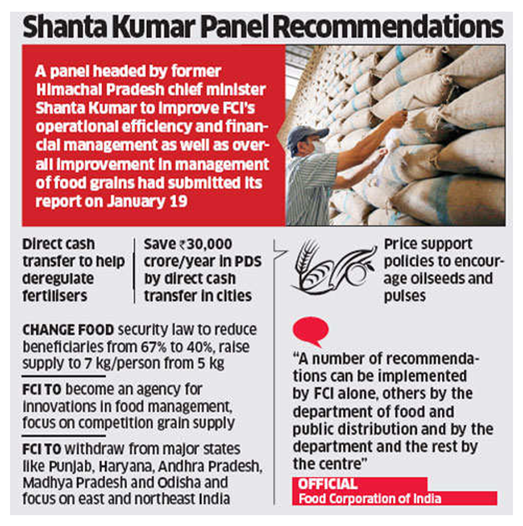
Mentor comment: A significant portion of the population lives below the poverty line, limiting access to nutritious food. Increasing population pressures food availability, despite a large agricultural workforce. While food production is sufficient, distribution is often inequitable, leading to shortages in certain regions. A substantial amount of food is lost during production, storage, and distribution, exacerbating scarcity. Problems in the Public Distribution System (PDS) include leakages, diversion of grains, and the presence of fake ration cards. In today’s editorial we will be addressing food security in India requires a multi-faceted approach, focusing on enhancing distribution systems and ensuring equitable access to food for all citizens.
_
Let’s learn!
Why in the News?
As per National Sample Survey (NSS) data, PDS leakages at the all-India level were 41.7% in 2011-12.
However, some states like Bihar, Chhattisgarh, and Odisha had initiated PDS reforms between 2004-05 and 2011-12, leading to reduced leakages.
About the National Food Security Act (NFSA) of 2013:
• The NFSA provides subsidized food grains to about two-thirds of India’s population. It provides food grains to two categories of beneficiaries: Antodaya Anna Yojana (AAY) households. Priority Households (PHH). (75% of rural and 50% of urban populations are eligible for these benefits.) • The NFSA requires state governments to set up grievance redressal mechanisms, including call centers, helplines, and nodal officers. Each district is also required to have a District Grievance Redressal Officer (DGRO). • Though the Indian Constitution does not have any explicit provision regarding the right to food, the fundamental right to life enshrined in Article 21, includes the Right to live with human dignity, which may include the right to food and other necessities. • Hence, this Act marked a shift in India’s approach to food security, moving from a welfare model to a rights-based model.
What are the issues around Public Distribution System (PDS) Leakages?
PDS leakages refer to the portion of rice and wheat released by the Food Corporation of India (FCI) that does not reach consumers.
Leakage Estimates and Comparison: National Sample Survey (NSS) – based estimates show higher leakages (54% in 2004-05, declining to 42% in 2011-12).
Indian Human Development Survey (IHDS)-based estimates indicate lower leakages (49% in 2004-05, declining to 32% in 2011-12) suggesting better performance in capturing actual PDS usage.
The IHDS is considered a more reliable source for PDS purchases compared to the NSS due to its focused methodology.
Expanded PDS by States: Some states provide PDS grain to non-NFSA beneficiaries, increasing the overall leakage estimate. (leakages estimated to be 22%)
Mismatch in Timing: NSS and FCI data operate on different reference years (agricultural year vs. financial year), which can affect the synchronization of data and lead to discrepancies in leakage estimates.
Measurement Errors: NSS data relies on a 30-day recall period for consumption, which may lead to under-reporting and measurement errors, potentially inflating leakage estimates.
Do you know why IHDS data is considered more reliable? • IHDS surveys are designed specifically to address human development issues. • IHDS employs a mixed recall period for consumption, which enhances accuracy in reporting. • IHDS can synchronize its data collection periods more effectively with the agricultural year, reducing mismatches.
Way Forward:
Although PDS is a vital social policy tool, it faces threats from experimental innovations like cash transfers and biometric authentication, which may undermine its effectiveness.
Instead of pursuing these measures, the government should focus on expediting the delayed Census to prevent the exclusion of over 100 million people and consider including more nutritious items like pulses and edible oil in the PDS.
President Droupadi Murmu unveiled the new flag and insignia of the Supreme Court of India during the National Conference of District Judiciary in New Delhi.
AboutNew Flag and Insignia of the Supreme Court of India:
Details
Designed by
National Institute of Fashion Technology (NIFT), Delhi
Flag Design
Blue flag featuring three symbols:
Ashoka Chakra (Symbol of India’s legal and cultural heritage)
Supreme Court Building (Represents the institution of justice in India)
Constitution of India (Highlights the role of the Supreme Court as the guardian of the Constitution)
Insignia
Includes the Sanskrit phrase “Yato Dharmastato Jayah“ inscribed in Devanagari script.
Translates to “Where there is Dharma, there is victory“, symbolizing the Supreme Court’s dedication to justice and righteousness.
Occurs 13 times in the epic the Mahabharata.
Flag Formats
Available in cross table flat, single table flag, pole flag, and wooden frame versions
PYQ:
[2023] Consider the following statements in respect of the National Flag of India according to the Flag Code of India, 2002:
Statement-I: One of the standard sizes of the National Flag of India is 600 mm * 400 mm.
Statement-II: The ratio of the length to the height (width) of the Flag shall be 3:2.
Which one of the following is correct in respect of the above statements?
a) Both Statement-I and Statement-II are correct and Statement-II is the correct explanation for Statement-I
b) Both Statement-I and Statement-II are correct and Statement II is not the correct explanation for Statement-I
c) Statement-I is correct but Statement-II is incorrect
d) Statement-I is incorrect but Statement-II is correct
The Union Ministry of Textiles has launched India’s first fashion forecasting initiative ‘VisioNxt’.
AboutVisioNxt Initiative
Details
Launched By
National Institute of Fashion Technology (NIFT) in collaboration with the Ministry of Textiles, Government of India.
Objective
To provide India-specific fashion trend insights and reduce dependence on global forecasting agencies.
Significance
India’s first initiative to integrate Artificial Intelligence (AI) and Emotional Intelligence (EI) to forecast fashion trends.
Key Features
Delivers localized fashion trend insights tailored for Indian designers, manufacturers, and retailers.
Provides forecasts reflecting India’s cultural diversity and socio-economic nuances.
Designed to support the Indian fashion and retail market with consumer-focused trend data.
AI Model Used
“DeepVision” – AI-based model that decodes Indian fashion patterns, analyzing attributes like style, color, and regional influences.
Accessibility
Bilingual resources (Hindi and English) through a web portal, making the insights accessible to a broader range of stakeholders in the Indian fashion industry.
Goal
To empower Indian fashion professionals with India-specific data, reducing reliance on international forecasting systems.
PYQ:
[2019] What makes the Indian society unique in sustaining its culture? Discuss.
The financial relationship between the Union and State governments in India is imbalanced, similar to other nations with a federal constitutional structure.
What is Vertical Fiscal Imbalance (VFI)?
Vertical fiscal imbalance (VFI) refers to the mismatch between the revenue-raising powers and expenditure responsibilities of different levels of government (between the Center and state) within a country.
Why should Vertical Fiscal Imbalance (VFI) be reduced?
Decentralization of Expenditure: States are responsible for 61% of the revenue expenditure, focusing on crucial sectors like health, education, and infrastructure, but they generate only 38% of the revenue.
This imbalance creates a dependency on central transfers, limiting the States’ fiscal autonomy.
Need Efficiency in Spending: Reducing VFI would provide states with more resources, allowing them to respond better to local needs and improve governance efficiency.
Need to strengthen Fiscal Federalism: A reduction in VFI promotes a healthier system of cooperative federalism, ensuring that states have adequate resources to carry out their constitutional responsibilities and meet the demands of their populations.
Need Preparedness for crises: VFI becomes more pronounced during crises (e.g., COVID-19), leading to fiscal stress for States. A more balanced fiscal arrangement ensures better crisis management at the sub-national level.
Present Scenario of VFI and Tax Devolution in India
VFI Extent: The 15th Finance Commission noted that despite States‘ heavy spending responsibilities, their revenue-raising powers are limited.
Tax Devolution Rates: The 14th and 15th FC recommended devolving 42% and 41%, however, estimates suggest that an average share of 48.94% was necessary between 2015-2023 to eliminate the VFI.
Exclusion of Cesses and Surcharges: The exclusion of cesses and surcharges from the divisible pool of taxes shortens the net proceeds. States argue this limits the resources available to them to meet their expenditure responsibilities.
Fiscal Responsibility: Despite the constraints, states have largely adhered to borrowing limits under fiscal responsibility legislation. However, states still struggle to meet their expenditure responsibilities, highlighting the need for greater financial support from the Centre.
Note: The Sixteenth Finance Commission was constituted on December 31 2023 with Dr. Arvind Panagariya as the Chairman. The 16th FC has been requested to make its report available by the 31st day of October 2025 covering 5 years commencing on the 1st day of April, 2026.
What should be the role objective of the 16th FC?
Increase Tax Devolution: Many States demand that tax devolution from the Union’s net proceeds should be raised to 50%. The 16th Finance Commission must consider raising the devolution rate to around 49% to address the VFI and ensure sufficient untied funds for States.
Address Cesses and Surcharges: The 16th Finance Commission should evaluate the exclusion of cesses and surcharges from the divisible pool.
Empower States with Fiscal Autonomy: The Commission’s objective should be to empower States with greater fiscal autonomy by ensuring adequate resources for them to perform their constitutional duties without undue dependence on the Centre.
Support Local Priorities: The Commission should aim to provide States with untied resources, enabling them to cater to jurisdictional needs and set priorities that align with their specific developmental challenges, ensuring a more responsive governance system.
India has invested approximately $75 billion in Africa, focused on energy assets and mining.
This includes reaching out to resource-rich countries in Africa and Latin America to negotiate access to critical mineral resources.
Recent Initiatives by the Indian Government:
Critical Mineral Mission (Union Budget 2024-25): This mission aimed at securing the supply of critical minerals crucial for India’s economic growth and green transition.
It focuses on expanding domestic production, recycling critical minerals, and incentivizing overseas acquisition.
Mines and Minerals (Development and Regulation) Amendment Bill, 2023: Removes six minerals from the atomic list, allowing private sector participation in their exploration.
This also supports India’s drive for self-reliance in critical minerals, such as lithium, cobalt, and rare earth elements.
Khanij Bidesh India Limited (KABIL): It was established in 2019 to secure overseas critical mineral assets. It Signed its first lithium exploration deal in Argentina in 2024, marking a significant step towards India’s goal of securing critical mineral supplies.
Africa’s significance in advancing Global and Indian Priorities
Critical Mineral Reserves: Africa holds 30% of the world’s critical mineral reserves, making it a crucial partner for India’s supply chain needs.
Existing Partnerships: India has strong political, economic, and historical ties with Africa, including a three-million-strong diaspora and $98 billion in bilateral trade (2022-23), with a focus on mining and mineral sectors.
India has already invested $75 billion in Africa, largely for energy asset acquisition.
African Green Mineral Strategy: African countries are moving towards minerals-based industrialization. Policies in Tanzania, Zimbabwe, and Namibia focus on value addition, offering India an opportunity to align its critical mineral strategy with Africa’s development goals
Major issues in Africa
Sudan and Syria Issue:
Humanitarian Crisis: Sudan’s crisis is particularly acute due to its strategic location and resource wealth, leading to a massive displacement crisis, with over 10 million people displaced since April 2023
Parallel Conflicts: Both Sudan and Syria have experienced severe internal conflicts driven by authoritarian regimes, regional power plays, and foreign interventions, leading to widespread human suffering and instability.
India’s Strategic Considerations:
Economic Interests: India’s trade with Sudan reached $2,034 million in 2022-23, with a significant trade surplus. India has also invested heavily in Sudan’s oil sector, with cumulative investments worth $2.3 billion.
Historical Ties: India has maintained strong people-to-people ties with Sudan, including educational exchanges and medical tourism. President A.P.J. Abdul Kalam’s visit in 2003 reinforced these relations.
Humanitarian and Diplomatic Engagement: India evacuated its nationals early in the conflict, but the ongoing crisis may require continued diplomatic and humanitarian engagement to protect its broader interests in the region.
Challenges of China-Africa Debt:
Chinese loans to African countries amounted to approximately $170 billion from 2000 to 2022. However, Chinese lenders represent only about 12% of Africa’s total public and private debt, indicating that China is not the primary creditor.
A significant portion of Chinese loans is not disclosed in sovereign debt records, complicating the understanding of Africa’s overall debt levels. This lack of transparency raises concerns about the sustainability of these debts.
Despite concerns over “debt trap diplomacy,” China is unlikely to forgive or cancel debts but may consider writing off smaller, interest-free loans.
China Domination:
China dominates the global critical mineral supply chain, particularly in cobalt mining in Africa (e.g., the Democratic Republic of Congo). China’s control poses significant risks for India, especially in terms of access and geopolitical influence.
Recently, China signed a $7 billion minerals-for-infrastructure deal, demonstrating its strategic approach to securing mineral resources in Africa.
What are the opportunities for the Indian Government? (Way forward)
Collaborating on Infrastructure and Technology: India can support Africa’s critical mineral sector by building mining-adjacent infrastructure (e.g., railways, power grids) and providing technological solutions through its tech start-ups to enhance mining exploration, extraction, and processing.
Strengthening Diplomatic and Economic Ties: Leveraging existing partnerships and India’s deep historical ties with Africa, the government can work with African nations on strategic projects and value addition initiatives, supporting both regions’ developmental goals.
Reducing Dependence on China: By engaging with African countries for critical minerals, India can diversify its supply chains, reducing the economic and geopolitical risks posed by China’s dominance in the global critical mineral market.
Due to the ongoing protest in Kolkata, the WB Assembly has unanimously passed a Bill mandating the death penalty for rape cases where victims die or are left in vegetative states.
Features of West Bengal’s Aparajita Bill:
Death Penalty: The Bill mandates the death penalty for individuals convicted of rape if the victim dies or is left in a permanent vegetative state. It also introduces the death penalty as the maximum punishment for all rape cases.
Amendments to Existing Laws: The Bill amends the Bharatiya Nyaya Sanhita, 2023, Bharatiya Nagarik Suraksha Sanhita, 2023, and the Protection of Children from Sexual Offences Act, 2012, to strengthen penalties for sexual offenses.
Special Task Force and Courts: It establishes a district-level Aparajita Task Force for investigating rape cases and mandates the creation of Special Courts to expedite trials, aiming to complete investigations within 21 days.
Increased Penalties for Repeat Offenders: The Bill enhances punishments for repeat offenders, replacing simple life imprisonment with rigorous life imprisonment.
Privacy Protections: It introduces penalties for unauthorized disclosure of a victim’s identity and for publishing information related to court proceedings in rape cases.
Focus on Speedy Justice: The Bill aims to reduce the time frame for investigations and trials, emphasizing a victim-centered approach to minimize trauma.
How Bengal’s Aparajita Bill differ from the Andhra Pradesh and Maharashtra laws?
Dimensions
West Bengal (Aparajita Bill)
Andhra Pradesh (Disha Bill)
Maharashtra (Shakti Bill)
Scope of Death Penalty
Death is mandatory in cases of rape leading to the victim’s death or vegetative state
Death penalty for the rape of minors below 16, gang rape, and repeat offenders
Similar to Andhra Pradesh, it introduced the death penalty for heinous cases, such as acid attacks and severe rape cases, but it also does not mandate death in all instances.
Special Institutions
Aparajita Task Forces and Special Courts in every district specifically for rape cases, ensuring expedited legal proceedings with strict timelines.
Propose Special Police Teams and Exclusive Special Courts for dealing with crimes against women, along with a registry for offenders.
Formation of special courts but also emphasizes digital cooperation
Timeframes for Legal Processes:
Investigation time is 21 days (extendable to 15 more), and trials must be completed within 30 days post-chargesheet.
Investigation time is seven days and mandates trials be completed within 21 days.
Completed within 15 working days after an FIR is filed, with an extension of up to 7 days if the investigating officer provides written reasons for the delay and the trial must be completed within 30 working days from the date of filing the charge sheet.
Amendments to POCSO
Introduces the death penalty for penetrative sexual assault under the POCSO Act.
Amended the POCSO Act to include death penalties, particularly for heinous offenses, but do not make it mandatory in all cases.
Same as Disha bill
Use of Digital Platforms
No available
No available
Unique features penalizing social media platforms and intermediaries that fail to provide requested data for investigations.
Why President’s Assent is essential?
Criminal law falls under the Concurrent List of the Indian Constitution, meaning both state and central legislatures can legislate on the subject. However, state laws require the President’s approval to take precedence over existing central laws.
Without presidential assent, the provisions of the Aparajita Bill, as well as those from Andhra Pradesh and Maharashtra, cannot be enforced, rendering them ineffective despite being passed by the respective state assemblies.
Conclusion:
The state should launch public awareness campaigns and involve stakeholders to build broad-based support, emphasizing the Bill’s objectives of enhancing victim protection and delivering speedy justice to encourage timely presidential approval.
The PM’s upcoming visit to Singapore offers a chance to reflect on the current state of the relationship. India-Singapore ties are dynamic, continually presenting new opportunities.
India-Singapore Bilateral Relations
Historical Ties: Diplomatic relations were established shortly after Singapore’s independence in 1965, with India being one of the first countries to recognize Singapore.
The relationship has evolved through high-level visits and collaborations, particularly since the 1990s.
Look East Policy: Singapore has been pivotal in India’s “Look East” policy initiated in the early 1990s, which aimed to strengthen economic and strategic ties with Southeast Asia.
Comprehensive Economic Cooperation Agreement (CECA): Signed in 2005, CECA has significantly enhanced trade and investment ties, making Singapore India’s largest ASEAN trading partner and a key foreign direct investment (FDI) source.
Defense and Security Cooperation: The bilateral relationship includes extensive defence cooperation, with joint military exercises and training, particularly in maritime security, reflecting shared strategic interests.
What is Singapore’s contribution to India’s Growth Story?
Economic Hub: Singapore is India’s largest trade partner in ASEAN. Singapore serves as a crucial gateway for Indian companies seeking to expand in Southeast Asia, providing a robust platform for trade and investment.
Largest Source of FDI: It is the leading source of FDI, among the largest sources of External Commercial Borrowings and Foreign Portfolio Investment, accounting for about 17% of total FDI inflows since 2000, with investments exceeding USD 136 billion over the last 22 years.
Knowledge exchange: Singapore’s status as a hub for Indian talent, especially from IITs and IIMs, facilitates knowledge exchange and enhances India’s capabilities in various sectors
Cultural Exchange: The strong cultural ties, supported by the Indian community in Singapore, have enriched bilateral relations. Ethnic Indians constitute approximately 9.1% of Singapore’s resident population.
How this relationship can achieve more considering the ASEAN region and Chinese dominance? (Way forward)
Strategic Partnership: The relationship can be further strengthened by enhancing strategic dialogues and collaborations in areas like security, technology, and sustainability, particularly in the context of the Indo-Pacific region.
Regional Connectivity: Initiatives like the Trilateral Highway, which aims to connect India with Myanmar and Thailand, can enhance regional connectivity and trade, positioning India and Singapore as central players in ASEAN.
Countering Chinese Influence: As China asserts its influence in the region, India and Singapore can collaborate more closely to address shared concerns, leveraging their partnership to promote stability and security in Southeast Asia.
Emerging Technologies: Focusing on emerging sectors such as semiconductors, green technologies, and electric mobility can open new avenues for cooperation, aligning with both nations’ goals for sustainable development.
Realizing the full potential of Union Budget 2024-25 health allocations depends on State-level factors, as states share costs and handle the implementation of Centrally Sponsored Schemes (CSS).
About the two major Centrally Sponsored initiatives
Pradhan Mantri Ayushman Bharat Health Infrastructure Mission (PM-ABHIM): Focuses on improving health infrastructure through health and wellness centres (AB-HWCs), block-level public health units (BPHUs), district public health laboratories (IDPHLs), and critical care hospital blocks (CCHBs).
Human Resources for Health and Medical Education (HRHME): Aims to boost medical personnel by building new medical, nursing, and paramedical colleges, increasing seats, and upgrading district hospitals to medical colleges.
Issue of Low Fund Utilization and Faculty Shortage:
Poor Fund Absorption in PM-ABHIM: Fund absorption has been poor, with only 29% used in 2022-23. The reasons are – complex execution structures, reliance on health grants from the 15th FC (only 45% utilized), and delays in construction due to rigid procedures.
Low Fund Utilization in HRHME: Utilization of funds in educational infrastructure was only around 25% of the budget estimates in both 2022-23 and 2023-24.
Shortage of teaching faculty: There is a significant shortage of teaching faculty in newly established medical institutions, with over 40% vacancies reported in 11 of the 18 All India Institutes of Medical Sciences.
For example, in Uttar Pradesh, 30% of teaching faculty positions were vacant in 2022 for government medical colleges established between 2019-21.
Lack of specialist positions: The shortage of specialists affects the establishment and upgrading of medical colleges and district hospitals, with more than a third of sanctioned specialist positions in urban CHCs and two-thirds in rural CHCs remaining vacant as of March 2022.
How can states work on Fiscal space? (Way forward)
Enhanced Budget Planning and Allocation: States should prioritize and allocate funds efficiently for health infrastructure and recurring costs.
Strengthening Revenue Generation: States can explore increasing their own revenue sources through improved tax collection, introducing new revenue streams, or enhancing public-private partnerships.
Optimizing Expenditure Management: Implementing better financial management practices, such as cost control measures, transparent procurement processes, and efficient use of existing resources, can help in managing and maximizing the impact of budget allocations for health infrastructure and services.
![[6th September 2024] The Hindu Op-ed: The Food Security Act has revamped the PDS](https://www.civilsdaily.com/wp-content/uploads/2024/09/6-SEP-1568x882.jpg)