💥Join UPSC 2027,2028 Mentorship (July Batch) + XFactor Notes & Microthemes PDF

Distribution: yearly

  • [4th September 2024] The Hindu Op-ed: A discourse on AI governance that India must shape

    PYQ Relevance:

    Q At the international level, the bilateral relations between most nations are governed by the policy of promoting one’s own national interest without any regard for the interest of other nations. This leads to conflicts and tensions between the nations. How can ethical consideration help resolve such tensions? Discuss with specific examples. (UPSC IAS/2015)

    Q “The emergence of the Fourth Industrial Revolution (Digital Revolution) has initiated e-Governance as an integral part of government”. Discuss. (UPSC IAS/2020)

    Q Describe the major outcomes of the 26th session of the Conference of the Parties (COP) to the United Nations Framework Convention on Climate Change (UNFCCC). What are the commitments made by India in this conference? (UPSC IAS/2021)

    Mentor comment: The United Nations is emerging as a central forum for establishing global AI standards, facilitating dialogue among diverse national interests, and promoting international cooperation. India has a long-standing strategic role at the UN and is involved in platforms like the G-20 and the Global Partnership on Artificial Intelligence (GPAI). India’s historical legacy of advocating the interests of the Global South, robust engagement at international fora, and lived experiences as a Global South country make it well-positioned to lead these conversations. In today’s Editorial we will have a look at India’s advocacy for a fair and inclusive AI governance framework is also crucial in the context of bipolar dynamics between the U.S. and China, where both countries are driving the AI governance discourse to advance their strategic interests.

    _

    Let’s learn!

    Why in the News?

    The Summit of the Future, taking place on September 22-23, 2024, will be a crucial event for global discussions on Artificial Intelligence (AI) governance. 

    • World leaders will gather under the United Nations during this summit to promote the Global Digital Compact (GDC).

    What are the main goals of the Global Digital Compact?

    It aims to establish a collaborative framework for addressing key digital challenges and promoting an inclusive digital future. Its main goals include:

    • Closing Digital Divides: Ensuring equitable access to digital technologies and accelerating progress towards the Sustainable Development Goals (SDGs).
    • Expanding Inclusion: Enhancing participation and benefits from the digital economy for all individuals.
    • Fostering a Safe Digital Space: Creating an open, secure environment that respects and promotes human rights.
    • Advancing Data Governance: Promoting responsible and equitable international governance of data.
    • Strengthening AI Governance: Enhancing international governance of emerging technologies, particularly artificial intelligence, to benefit humanity
    The present state of Geopolitical contestation

    The UN General Assembly has adopted two significant resolutions led by the U.S. and China regarding Artificial Intelligence (AI).

    U.S.-Led Resolution: Focuses on ‘Safe, Secure and Trustworthy AI for Sustainable Development’ which promotes a harmonized approach to AI governance, encouraging shared ethical principles and transparency standards. This aims to assert U.S. dominance in AI technology.

    China-Led Resolution: Emphasizes equitable benefits from AI, bridging the digital divide, and fostering an open business environment. This positions China as a key player in global trade and technology standards.

    What are the Challenges?

    • Wider gaps vs. Realm of AI: While developed countries have readily available resources, developing countries lack even the basic infrastructure, Internet access, and electricity which are absolute essentials for AI advancements.
      • This issue might be overlooked or simplified by developed economies.
    • Exacerbating Inequalities: Policies and Frameworks that fail to address the root issues faced by developing countries limit the effectiveness of global AI governance initiatives, and exacerbate existing inequalities.

    How can India leverage its historical legacy and advocacy for the Global South?

    • Engaging in Multilateral Platforms: Active participation in international forums, such as the United Nations and G-20, allows India to highlight the priorities of the Global South and shape the discourse around digital governance and AI to reflect these interests.
    • Building Coalitions: By forming alliances with other Global South nations, India can strengthen its voice in negotiations, ensuring that the concerns and perspectives of developing countries are represented in the GDC discussions.
    • Emphasizing Human-Centric Development: India can advocate for a GDC that prioritizes human rights and sustainable development, ensuring that digital policies promote social equity and economic justice for all.
    • Addressing Geopolitical Dynamics: With the current geopolitical contestation between major powers like the U.S. and China, India can position itself as a leader advocating for a balanced approach that considers the needs of the Global South, rather than allowing these powers to dominate the narrative.
    • Climate Justice Advocacy: India’s experience in international climate negotiations (during UNFCCC and CBDR) highlights its commitment to equity and justice, which can inform its approach to AI governance.

    Conclusion:

    India must underscore the importance of aligning AI development with democratic values and human rights, advocating for a collaborative approach that involves multiple stakeholders (South countries as well as North countries) to ensure that AI technologies benefit society as a whole while mitigating potential risks.
    https://www.thehindu.com/opinion/lead/a-discourse-on-ai-governance-that-india-must-shape/article68602063.ece

  • [pib] SCOMET List

    Why in the News?

    The Directorate General of Foreign Trade (DGFT), under the Ministry of Commerce & Industry, has released the updated SCOMET (Special Chemicals, Organisms, Materials, Equipment, and Technologies) list for the year 2024.

    What is the SCOMET List?

    Details
    Purpose To regulate the export of dual-use items that can be used for both civilian and military applications, particularly those that could contribute to the development of weapons of mass destruction (WMDs) and their delivery systems.
    Regulatory Authority Directorate General of Foreign Trade (DGFT), Ministry of Commerce and Industry, Government of India.
    Notification Notified by DGFT under Appendix 3 to Schedule 2 of the ITC (HS) Classification of Export and Import Items.
    Legal Framework Governed by Chapter IVA of the Foreign Trade (Development & Regulation) Act, 1992, as amended in 2010.

    This chapter provides the legal basis for export control of dual-use items and outlines penalties for non-compliance.

    Policy and Procedures Outlined in Chapter 10 of the Foreign Trade Policy (FTP) and the Handbook of Procedures (HBP) 2023.

    These documents provide the detailed procedure for licensing, application, and compliance for exporting SCOMET items.

    Categories The SCOMET List includes multiple categories:
    1. Category 0: Nuclear materials and nuclear-related dual-use items.
    2. Category 1: Toxic chemical agents and precursors.
    3. Category 2: Materials and materials processing equipment.
    4. Category 3: Electronics.
    5. Category 4: Computers.
    6. Category 5: Telecommunications and information security.
    7. Category 6: Sensors and lasers.
    8. Category 7: Navigation and avionics.
    9. Category 8: Marine.
    10. Category 9: Aerospace and propulsion.
    New Licensing Authority for Category 6 Department of Defence Production (DDP), Ministry of Defence is the new licensing authority for the export of items under Category 6 (Sensors and Lasers).
    Export Licensing Exporters must obtain a specific license from DGFT (or DDP for Category 6) to export SCOMET items.

    The licensing process includes a comprehensive review to ensure that exports do not contribute to the proliferation of WMDs or unauthorized military use.


  • Dealings at a China-Africa forum that India must track

    Why in the News?

    The 9th edition of the Forum on China-Africa Cooperation (FOCAC) is scheduled to be held in Beijing from 4th to 6th September, 2024.

    About the China-Africa Cooperation (FOCAC)

    The Forum on China-Africa Cooperation (FOCAC) was established in 2000 to enhance the strategic partnership between China and African nations. It serves as a platform for collective dialogue and cooperation in various sectors, including trade, investment, and development.

    Challenges of China-Africa Debt:

    • Chinese loans to African countries amounted to approximately $170 billion from 2000 to 2022. However, Chinese lenders represent only about 12% of Africa’s total public and private debt, indicating that China is not the primary creditor.
    • A significant portion of Chinese loans is not disclosed in sovereign debt records, complicating the understanding of Africa’s overall debt levels. This lack of transparency raises concerns about the sustainability of these debts.
    • Despite concerns over “debt trap diplomacy,” China is unlikely to forgive or cancel debts but may consider writing off smaller, interest-free loans.

    African Priorities at FOCAC 2024

    • Economic Goals: African nations are focusing on enhancing trade relations with China, with a modest goal of $300 billion in imports from Africa between 2022-2024. As of mid-2024, trade has reached $167 billion, primarily dominated by raw materials.
    • Agricultural Development: There is a pressing need to develop a sustainable agricultural industry in Africa. This includes improving the processing of agricultural commodities and leveraging the expertise of countries like China and India to enhance crop resilience and productivity.
    • Green Energy and Industrialization: African countries are advocating for the establishment of refining and processing hubs to increase the value added from their raw materials.

    What are the learnings that India can have?

    • Continuity in Engagement: India should emphasize consistent engagement with Africa, particularly by organizing the India-Africa Forum Summit (IAFS-IV) to capitalize on recent momentum, especially after the African Union’s inclusion in the G-20.
    • Support for Industrialization: Indian companies are encouraged to invest in higher value-added sectors in Africa, such as agriculture and pharmaceuticals, to foster local employment and market development.
    • Private Sector Participation: Greater involvement of the Indian private sector is essential, along with innovative financing solutions like public-private partnerships to support projects in Africa.
    • Digital and Financial Connectivity: Utilizing India’s digital stack and establishing rupee-based financial transactions can enhance connectivity and reduce forex risks for African nations.

    Conclusion: India should deepen its strategic partnerships with African nations by expanding bilateral and multilateral engagements, focusing on key sectors like healthcare, digital infrastructure, and renewable energy. Leveraging India’s experience in these areas can help address African development needs while enhancing India’s influence on the continent.

    Mains PYQ:

    Q Increasing interest of India in Africa has its pros and cons. Critically Examine. (UPSC IAS/2015)

  • On Germany’s electoral architecture 

    Why in the News?

    On July 30, Germany’s constitutional court approved downsizing the Bundestag, citing concerns over financial strain and efficiency due to its unprecedented 736 deputies.

    (Note: The Bundestag is the Lower house of Germany)

    Why has the German Constitutional Court upheld the move to downsize the lower house of parliament?

    • Constitutional Rationale: The court approved the plan to reduce the size of the Bundestag to improve its efficiency and reduce costs, as it had become the world’s largest elected assembly.
      • The court backed the government’s decision to limit the Bundestag to 630 members by removing “overhang” and “balance” seats, which had caused the number of legislators to grow significantly.
    • Legal Compliance: The court’s decision aligns with previous rulings that emphasized the need for electoral equality and the fair representation of political parties in the Bundestag, ensuring that the election system remains constitutionally valid.

    How does a mixed-member Proportional Representation system work?

    • Dual Voting System: In Germany, each voter casts two votes in federal elections:
      1. First Vote: Directly elects a candidate from a local constituency via the first-past-the-post method (299 seats).
      2. Second Vote: Chooses a political party, which determines the distribution of another 299 seats proportionally across Germany’s 16 regions.
    • Seat Allocation: The second vote is crucial as it determines the overall proportion of seats each party holds in the Bundestag. The final seat count for each party is based on a combination of directly elected candidates and the proportion of the second vote.
    • Overhang Seats: If a party wins more direct seats than the proportion of the second vote would allow, these extra seats are known as “overhang seats.” These were traditionally retained, leading to an increase in the total number of seats.

    How does a mixed-member Proportional Representation system work in India?

    • No MMP System in India: India does not use a mixed-member proportional representation system at the national level. The Indian electoral system primarily follows the first-past-the-post method, where the candidate with the most votes in each constituency wins a seat in the parliament.
    • Proportional Representation: In India, proportional representation (Single transferable) is used only in certain cases, such as elections to the Rajya Sabha (the upper house) and the President.

    Types of Proportional Representation:

    • Single Transferable Vote (STV): This system allows voters to rank candidates in order of preference. It is used to elect members of the Rajya Sabha (Council of States) and the President of India.
    • Party-List PR: In this system, voters cast their votes for a party rather than individual candidates. Seats are allocated to each party based on the proportion of votes they receive. A minimum threshold (usually between 3-5%) is often required for a party to gain representation, preventing excessive fragmentation in the legislature.
    • Mixed-Member Proportional Representation (MMP): This combines elements of FPTP and PR, allowing voters to cast two votes—one for a candidate and another for a party. This system aims to balance the benefits of direct representation with proportionality.

    What are balance or overhang seats and why were they deemed Unconstitutional?

    • Overhang Seats: These are additional seats that a party wins when it secures more direct constituency seats than it would be entitled to based on its second vote share. This situation arises due to the mixed-member proportional system.
    • Balance Seats: Introduced to maintain proportionality and fairness, balance seats are given to other parties to offset the overhang seats, ensuring that the overall seat distribution reflects the second vote shares accurately.
    • Unconstitutionality: In 2008, the German Constitutional Court ruled that the increasing number of overhang seats violated the principle of electoral equality. The recent judgment further upheld the move to eliminate these seats to simplify the electoral system and maintain fairness.

    Conclusion: Germany should swiftly implement the downsizing plan, ensuring that the transition to a 630-member Bundestag is smooth and transparent, with clear communication to the public and political parties.

    Mains PYQ:

    Q Critically examine the procedures through which the Presidents of India and France are elected. (UPSC IAS/2022)

  • Use of Regional Languages in High Courts remains limited

    Why in the News?

    A growing movement in India is advocating for use of regional languages in High Court proceedings to make justice more accessible to the common citizen.

    Current Scenario: Regional Languages in High Courts

    • Out of India’s 25 High Courts, only 4Rajasthan, Madhya Pradesh, Uttar Pradesh, and Bihar — are authorized to use Hindi in their proceedings and legal documents.
      • Bihar HC was the last High Court to receive authorization to use Hindi in 1972.
    • A litigant possesses the fundamental right to comprehend and engage in courtroom proceedings, under Article 19 and Article 21.
      • She/ He is entitled to present their case in a language they understand before the magistrate.
    • Additionally, the “Right to Justice” is explicitly recognized under Article 21 of the Constitution.
    • Despite these provisions, the use of regional languages in High Courts remains limited.

    Constitutional Provisions for Regional Languages in Judiciary:

    Provision Details
    Article 348(1) (a) Language of Proceedings
    • English is the official language for proceedings in the Supreme Court, High Courts, and specified tribunals.
    • All records and orders must be in English.
    Purpose Ensures uniformity and consistency in legal proceedings and documentation at the highest judicial levels.
    Scope Applies to the Supreme Court, High Courts, and all authorities mentioned in Article 323A or Article 323B.
    Article 348(2) Use of Other Languages
    • The President may authorize the use of Hindi or any other regional language in addition to English.
    • Authorization is subject to conditions specified by the President.
    Purpose Allows for regional languages to be used in judicial proceedings, making the system more accessible to non-English speakers.
    Scope Can be applied in the Supreme Court, High Courts, and other authorities as mentioned in Article 323A or Article 323B.


    PYQ:

    [2021] Which one of the following in Indian polity is an essential feature that indicates that it is federal in character?

    (a) The Independence of the judiciary is safeguarded.

    (b) The Union Legislature has elected representatives from constituent units.

    (c) The Union Cabinet can have elected representatives from regional parties.

    (d) The Fundamental Rights are enforceable by Courts of Law.

  • Rule 170 of Drugs and Cosmetics Act, 2018

    Why in the News?

    The Supreme Court has raised concerns over the AYUSH ministry’s notification, which advised state licensing authorities not to take action under Rule 170 of the Drugs and Cosmetics Act in the context of the ongoing case against Patanjali Ayurved.

    Rule 170 of the Drugs and Cosmetics Act, 2018:

    Details
    What is it? Rule 170 was introduced in 2018 to regulate the manufacture, storage, and sale of Ayurvedic, Siddha, and Unani medicines, focusing on controlling misleading advertisements in the AYUSH sector.
    Requirements • AYUSH drug manufacturers must obtain approval and a unique identification number from state licensing authorities before advertising their products.
    • Required documentation includes textual references, rationale, indications for use, and evidence of safety, effectiveness, and quality.
    Key Provisions
    • Prohibits advertisement of AYUSH products without prior state authority approval.
    • Advertisements may be rejected if they:
      – Lack of contact details of the manufacturer.
      – Contain obscene or vulgar content.
      – Promote products for enhancing sexual organs.
      – Feature endorsements from celebrities or government officials.
      – Refer to government organizations.
      – Convey false impressions or make misleading or exaggerated claims.
    Rationale Behind   • Introduced following a parliamentary standing committee’s concerns about misleading claims in the AYUSH sector.
    • Aims to ensure proactive measures by the AYUSH ministry against such advertisements.
    Challenges   • AYUSH drug manufacturers are required to obtain licenses from drug controllers similar to allopathic medicines.
    • Unlike allopathic drugs, AYUSH drugs do not need to undergo Phase I, II, or III trials for approval.


    PYQ:

    [2019] How is the Government of India protecting traditional knowledge of medicine from patenting by pharmaceutical companies?

  • What is Digital Agriculture Mission?

    Why in the News?

    The Union Cabinet has approved the “Digital Agriculture Mission” with a budget of ₹2,817 Crore, including ₹1,940 Crore as the central share.

    About Digital Agriculture Mission

    Category Details
    Historical Context Originally planned for the financial year 2021-22 but delayed due to the Covid-19 pandemic.

    Announced in the Union Budgets of 2023-24 and 2024-25.

    Funding Breakdown Total outlay: Rs 2,817 crore

    • Rs 1,940 crore from the Centre
    • Remaining amount from states and Union Territories (UTs)

    Objective To create Digital Public Infrastructure (DPI) in the agriculture sector, similar to other e-governance initiatives like Aadhaar, DigiLocker, eSign, UPI, and electronic health records.
    Major Components of DPI 1. AgriStack:
    – A comprehensive digital platform integrating various agricultural services.
    – Facilitates access to information, services, and benefits related to farming and agricultural practices.
    – Centralizes agricultural data to improve accessibility and efficiency.
    2. Krishi Decision Support System (DSS):
    – Provides data-driven insights and recommendations for farmers.
    – Assists in decision-making related to crop management, pest control, and resource optimization based on real-time data.
    – Utilizes advanced analytics to enhance productivity and mitigate risks.
    3. Soil Profile Maps:
    – Detailed digital maps on a 1:10,000 scale covering approximately 142 million hectares.
    – Provides comprehensive information about soil characteristics and health.
    – Supports precision agriculture by offering targeted soil data for optimal crop planning.
    Additional Component Digital General Crop Estimation Survey (DGCES):
    – A tech-based system to provide accurate estimates of agricultural production.
    – Aims to offer reliable data for policy decisions, agricultural planning, and resource allocation.
    Impact on Farmers The mission will enable farmers to access a range of digital services, improve decision-making through data analysis, enhance productivity with detailed soil information, and provide accurate crop estimations to better manage agricultural practices.
    Timeline Rolled out across the country over the next two years (until 2025-26).


    PYQ:

    [2020] In India, the term “Public Key Infrastructure” is used in the context of:

    (a) Digital security infrastructure

    (b) Food security infrastructure

    (c) Health care and education infrastructure

    (d) Telecommunication and transportation infrastructure

  • In news: Thanjavur Veena

    Why in the News?

    Thanjavur, Tamil Nadu, is renowned for making the Veena, the first musical instrument in India to receive a Geographical Indication (GI) tag.

    About Thanjavur Veena:

    Details
    Type Saraswati Veena (a classical stringed musical instrument)
    GI Tag Received in 2012.
    Crafting Materials Jackfruit wood, known for its resonance and tonal quality.
    Production Process – Wood is cut, carved, shaped, and assembled.
    – Takes 15-20 days to complete.
    – Involves three parts: resonator (kudam), neck (dandi), and tuning box.
    Other Types of Veena – Saraswati Veena (used in Carnatic classical music)
    – Rudra Veena and Vichitra Veena (used in Hindustani classical music)
    – Chitra Veena (used in Carnatic classical music)


    PYQ:

    [2021] With reference to India, the terms ‘Halbi, Ho and Kui’ pertain to​:

    (a) Dance forms of Northwest India​

    (b) Musical instruments​

    (c) Pre-historic cave paintings​

    (d) Tribal languages​

  • [pib] Measures taken by Govt. for LGBTQI+ Community

    Why in the News?

    The Department of Social Justice and Empowerment has invited inputs to ensure that policies and initiatives regarding the LGBTQI+ community are inclusive and effective.

    Who are the LGBTQ+?

    • It is an umbrella term used to refer to lesbian, gay, bisexual, transgender, queer and intersex.
    • LGBTQI+ people represent a subset of individuals among the broader category of sexual and gender diverse individuals.
    • Sexual orientation, gender identity and expression (SOGIE) is diverse and spans cultures across the world.

    Various policy initiatives for LGBTQI+ Community:

    Policy/Scheme Details
    Supreme Court Judgment on Section 377 (2018) Decriminalized consensual same-sex relations by ruling that Section 377 of the Indian Penal Code, which criminalized such acts, was unconstitutional.
    • Affirmed the right to privacy and equality, marking a historic victory for LGBTQI+ rights in India.
    Transgender Persons (Protection of Rights) Act (2019) • Grants legal recognition to transgender individuals, prohibits discrimination in education, employment, and healthcare, and mandates the establishment of a national and state-level transgender welfare board.
    • Ensures protection of transgender rights, and access to welfare benefits, and facilitates legal recognition and equality.
    National Portal for Transgender Persons (2020) • An online platform launched by the Ministry of Social Justice and Empowerment for applying for a transgender certificate and identity card.
    • Streamlines the legal recognition process, enabling transgender individuals to obtain official documentation more easily.
    SMILE Scheme (2021) • “Support for Marginalized Individuals for Livelihood and Enterprises” Central Sector scheme.
    • Provides financial assistance and support for the livelihood and enterprise development of marginalized individuals and beggars, including members of the LGBTQI+ community. 


    PYQ:

    [2023] Explain the constitutional perspectives of Gender Justice with the help of relevant Constitutional Provisions and case laws.

  • INS Arighat: India’s second nuclear sub

    Why in the News?

    India’s second nuclear submarine, the Arighaat, was officially commissioned into the Indian Navy in Visakhapatnam, following rigorous trials conducted over the past few months.

    Status of Navy’s Submarines in India: 

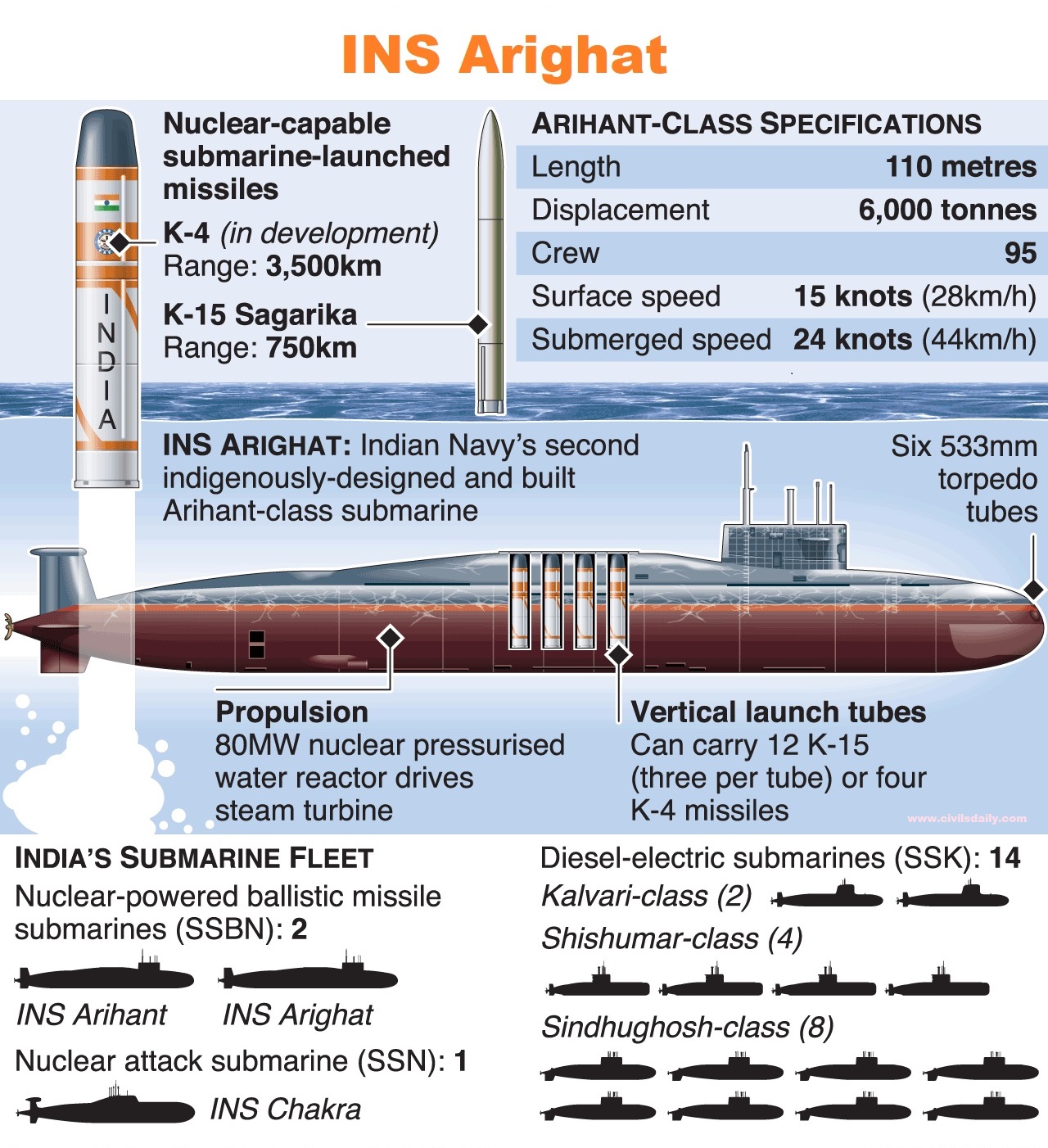
    • Current Fleet: The Indian Navy’s submarine fleet includes two nuclear-powered ballistic missile submarines (INS Arihant and INS Arighaat) and 16 conventional submarines. The Navy is also constructing two additional larger SSBNs.
    • Operational Readiness: The Navy is authorized to maintain a fleet of 18 submarines, but operational availability can be affected by maintenance and refitting schedules, with about 30% of the fleet typically under repair.

    About the newly inducted INS Arighaat

    • INS Arighaat is a 6,000-tonne Arihant-class ballistic missile submarine, which will join its predecessor, INS Arihant, as a vital component of India’s nuclear triad.
    • The submarine can carry up to 12 K-15 SLBMs with a range of approximately 750 km or four K-4 SLBMs exceeding 3,500 km.
      • It is powered by an 83 MW pressurized light-water nuclear reactor, allowing it to remain submerged for extended periods without surfacing compared to the diesel-electric submarine.
    • It will enhance India’s nuclear deterrence, support strategic balance in the region, and play a crucial role in national security.

    How does it significantly strengthen India’s nuclear triad?

    • Enhances Second-Strike Capability:  With two nuclear submarines now operational, India can maintain a constant presence of a submarine patrolling its waters, ready to launch a nuclear strike at short notice in retaliation.  
    • Expands Missile Reach: INS Arighaat is equipped with indigenously developed K-15 missiles with a range of over 700 km and long-lasting availability underwater due to a nuclear-powered engine without surfacing.
    • From the South China Sea, these submarines can potentially target locations in China, including its capital Beijing.  
    • Both of this major developments will provide India with a more balanced and robust nuclear deterrent capability across all three domains – land, air, and sea.

    Way forward: 

    • Indigenous Submarine Development: Accelerate the development and commissioning of indigenous SSBNs (Submersible Ship Ballistic Missile Nuclear) and advanced SLBMs (Submarine-Launched Ballistic Missiles) to further strengthen India’s strategic autonomy and ensure sustained deterrence capabilities.
    • Strategic Partnerships and Modernization: Enhance collaboration with global naval powers for technology transfers and expertise while modernizing the current submarine fleet to ensure continued operational readiness and address emerging maritime security challenges.

    Mains PYQ: 

    Q What are the maritime security challenges in India? Discuss the organisational, technical and procedural initiatives taken to improve maritime security. (UPSC IAS/2022)