💥Join UPSC 2027,2028 Mentorship (July Batch) + XFactor Notes & Microthemes PDF

Distribution: yearly

  • Anti-Defection Law: Features, limitations and reforms

    Why in the News?

    • Numerous examples in recent time exist in the history of Parliament and State Assemblies where MPs or MLAs have defected from their party.
      • These activities often led to the frequent falling of governments.

    What is Anti-Defection Law?

    • The 52nd Constitutional Amendment introduced the anti-defection law through the Tenth Schedule in 1985.
    • It aimed at tackling political defections destabilizing governments, especially after the 1967 general elections.
    • According to this Schedule, a member of the State Legislature or the House of Parliament who voluntarily resigns from their political party or abstains from voting in the House contrary to the party’s instruction may be removed from the House.
    • This voting instruction is issued by the party whip, a member of the parliamentary party nominated by the political party in the House.

    Process of Disqualification under Anti-Defection Law

    • Petition:
      • Any member of the House can initiate the process by filing a petition/complaint with the Speaker (Lok Sabha) or Chairman (Rajya Sabha) alleging defection by another member.
      • The Presiding Officer CANNOT initiate disqualification proceedings suo moto and can only act upon a formal complaint.
    • Deciding Authority:
      • The Speaker of Lok Sabha, the Chairman of Rajya Sabha, or the State Legislative Assembly decides disqualification petitions under the anti-defection law.
    • Timeframe:
      • The law does not specify a strict timeline for the decision, which has led to criticism due to potential delays.
    • Judicial Review:
      • The decision can be challenged in courts, ensuring a system of checks and balances.
      • The landmark judgment in Kihoto Hollohan vs. Zachillhu and Others (1992) upheld the constitutionality of the anti-defection law and affirmed that decisions regarding disqualification are subject to judicial review.
    • Exceptions:
      • No disqualification if 1/3rd members of the legislature party split to form a separate group (provision DELETED by the 91st Amendment in 2003).
      • Mergers of political parties are allowed when 2/3rd of the members of a legislative party agree to merge with another party.

    Three-Test Formula of the Supreme Court:

    • The Supreme Court in Sadiq Ali versus Election Commission of India (1971) laid down the three-test formula for recognizing the original political party:
    1. Test of Aims and Objectives of the party.
    2. Test of Party Constitution, which reflects inner-party democracy.
    3. Test of Majority in the legislative and organizational wings.

    Limitations of the Anti-Defection Law

    • Dictatorship of Party: The law has been criticized for undermining democratic principles by restricting legislators’ freedom of speech and making them more accountable to party leaders than their constituents.
    • Limited Political Choice: The law discriminates against independent members, disqualifying them immediately if they join a political party, while nominated members have a six-month grace period.
    • Partial Law: The law needs a more precise timeline for resolving defection cases. It allows large-group defections, fostering opportunistic mergers and “horse-trading”, destabilizing the political system.
    • Promotes Defection: It fails to address root causes like intra-party democracy, corruption, and electoral malpractices.

    Recommendations on Reforming the Law

    • Dinesh Goswami Committee (1990):
      • Disqualification should be limited to cases of voluntarily giving up membership or voting/abstention contrary to the party direction only in specific motions.
      • Decision on disqualification should be made by the President or Governor based on the advice of the Election Commission.
    • Law Commission of India (2015):
      • Proposed shifting the power to decide disqualification petitions from the Presiding Officer to the President or Governor based on the advice of the Election Commission.
    • Supreme Court in K. M. Singh v. Speaker of Manipur (2020):
      • Recommended transferring the Speaker’s decision-making authority over disqualification petitions to an independent tribunal presided over by judges.
    • Committee Led by Rahul Narwekar:
      • Announced by Lok Sabha Speaker Om Birla to review the nation’s anti-defection law.

    PYQ:

    [2022] With reference to anti-defection law in India, consider the following statements:

    1. The law specifies that a nominated legislator cannot join any political party within six months of being appointed to the House.
    2. The law does not provide any time-frame within which the presiding officer has to decide a defection case.

    Which of the statements given above is/are correct?

    (a) 1 only

    (b) 2 only

    (c) Both 1 and 2

    (d) Neither 1 nor 2

    [2013] The role of individual MPs (Members of Parliament) has diminished over the years and as a result healthy constructive debates on policy issues are not usually witnessed. How far can this be attributed to the anti-defection law, which was legislated but with a different intention?

  • The Waqf Board Amendment Bill 2024

    Why in the News?

    The government has introduced the Waqf Act Amendment Bill 2024, in order to improve administration and management of the Waqf properties.

    Aim: To address existing issues in the management and administration of Waqf properties, ensuring better transparency and efficiency.

    • It also seeks to improve the legal framework governing Waqf boards and their operations across India.

    Background:

    • The Waqf Board Amendment Bill 2024 proposes changes to the Waqf Act of 1995.
    • The Waqf Board Act, initially enacted in 1995, is a legal framework governing the administration of Waqf properties in India.
    • Waqf refers to the endowment of property for religious or charitable purposes, and the act outlines the structure, functions, and powers of Waqf boards responsible for managing these properties.
    • The Central Waqf Council is a statutory body that advises and oversees the functioning of state-level Waqf Boards in India, established under the Waqf Act.
    • Wakf board’s income is exempt from Income Tax but revenue generated from leasing of properties can be taxed under the service tax and GST laws.

     Features of the Proposed Bill:

    • Waqf Board will mandatorily have two Non-Muslim members.
    • District magistrates may be involved in overseeing waqf properties to ensure proper management. The survey is to be carried out by the district collector, not by Waqf.
    • Properties are to be registered through a Centralized Portal for better scrutiny. Properties already claimed by boards will undergo new verification processes to resolve disputes and prevent misuse.
    • Waqf will lose the right to decide whether any property is a Waqf Asset or not.

    Present Composition of Waqf Board

    Chairperson Leads the Board
    State government nominees Representatives appointed by the state. (The Waqf Board operates under the supervision of the state government as per the provision of the Wakf Act 1995).
    Legislators and parliamentarians State representatives from the Muslim community
    State Bar Council members Muslim Legal experts providing guidance
    Mutawalis Managers of waqf with an annual income of Rs 1 lakh and above
    Islamic scholars Religious experts contributing to decision-making


    Significance of the Waqf Board Amendment Bill 2024:

    The bill seeks to bring about significant administrative reforms and ensure more inclusive and efficient management of Waqf assets. Here are some of the significances of the Waqf Board Amendment Bill 2024:

    • Enhanced Transparency: The bill includes provisions to digitize records and create a centralized database. This will make it easier to track and manage Waqf properties, reducing the potential for fraud and mismanagement.
    • Improved Governance: Administrative reforms proposed in the bill by the government will lead to more professional and efficient management of Waqf properties. This could result in better utilization of these resources for charitable and religious purposes​.
    • Protection of Waqf Properties: The bill aims to protect Waqf properties by regulating leasing and preventing encroachments. Unauthorized use and exploitation of these properties will be prevented, ensuring they are used for their intended religious and charitable purposes.
    • Inclusion and Representation: Including Muslim women and non-Muslims in Waqf Boards is a step toward more inclusive governance, ensuring diverse perspectives in decision-making.
    • Efficient Dispute Resolution: The new dispute resolution mechanism will help in resolving conflicts related to Waqf properties more effectively, reducing the burden on regular courts and ensuring quicker justice​.


  • On doorstep delivery of alcohol       

    Why in the News?

    Delhi, Karnataka, Haryana, Punjab, Tamil Nadu, Goa, and Kerala are considering or have considered allowing doorstep delivery of alcohol through platforms such as Swiggy, BigBasket, and Zomato.

    Arguments in favour of Online Delivery of Alcohol:

    • Revenue Generation: Excise taxes on alcohol sales can help generate significant revenue for Central and State governments.
    • Reduce Drunk-Driving Incidents: Doorstep delivery can potentially reduce drunk-driving incidents and prevent road traffic crashes and injuries.
    • Access and Safety for Women:  Doorstep delivery may reduce on-premise violence against women and allow women to access alcohol without facing social stigma.

    Arguments against Online Delivery of Alcohol:

    • Economic Costs vs. Benefits: The costs due to alcohol use often exceed the economic benefits from alcohol sales.
    • Increased Consumption and Binge Drinking: The availability of alcohol on-demand can increase consumption, promote binge drinking, and lead to alcohol-related harms.
    • Public Health Concerns: Alcohol is associated with various health risks including cancers, mental illnesses, liver disease, and increased risk of inter-partner violence.

    Consumption of Liquor in India:

    • India is the sixth-largest alcohol market worldwide with $52 billion in revenue.
    • Per capita alcohol consumption has increased from 1.6 litres in 2003-2005 to 5.5 litres in 2016-2018.
    • According to a 2019 survey, there were about 16 crore alcohol users in India in 2018.
    • Of these, 5.7 crore frequently consumed alcohol leading to social or interpersonal problems, and 2.9 crore were dependent users requiring therapeutic intervention.

    Can such a system make it safer for women to access alcohol?

    • Doorstep delivery may help women access alcohol without dealing with social stigma.
    • There is some evidence that it could reduce on-premise violence against women, as seen in Kerala. However, domestic violence related to alcohol use is rampant, and the overall safety of women cannot be presumed.

    How should governments regulate liquor consumption? (Way forward)

    • Restrict Availability and Marketing: Implement policies to limit the availability and marketing of alcohol.
    • Higher Taxes: Increase taxes on alcohol to deter consumption and generate revenue.
    • Enforce Drunk-Driving Laws: Strengthen the enforcement of drunk-driving laws with stringent penalties.
    • Invest in Treatment Programs: Allocate funds for psychosocial treatments of alcohol-use disorders and mental health initiatives.
    • Monitor and Evaluate Impact: Governments should work with health departments to monitor and evaluate the impact of doorstep delivery on alcohol consumption and revise policies if necessary.
    • Uniform Policy Standards: Develop more uniform policy standards and ensure better implementation grounded in public health priorities over revenue generation.

    Mains question for practice:

    Q Analyze the trends in alcohol consumption in India over the past two decades. How has this trend impacted public health and social dynamics? 10M

  • [pib] PM marks 5 years of abrogation of Articles 370 and 35(A)

    Why in the News?

    The Prime Minister recalled the Parliament’s 5-year-old decision to abrogate Articles 370 and 35(A), calling it a watershed moment.

    About Articles 370 and 35(A) of the Indian Constitution

    [1] Article 370: 

    Description
    Provision Grants special autonomous status to the state of Jammu and Kashmir.
    Nature Initially intended as a temporary provision, subject to eventual change or abrogation.
    Powers of State Allowed J&K to have its own Constitution and autonomy over internal matters except defense, foreign affairs, finance, and communications.
    Presidential Order President of India could extend or modify the application of Indian laws to J&K with the concurrence of the state government.
    Autonomy Details Provides a degree of autonomy to the state and permits the state to give some special privileges to its “permanent residents”.
    Emergency Provisions Emergency provisions are not applicable to the state on the grounds of “internal disturbance” without the concurrence of the State.
    State Boundaries Name and boundaries of the State cannot be altered without the consent of its legislature.
    Separate Institutions State has its own constitution, a separate flag, and a separate penal code (Ranbir Penal Code).
    Assembly Duration Duration of the state’s Assembly is 6 years, unlike five in the rest of India.
    Parliamentary Jurisdiction
    • Indian Parliament can pass laws regarding J&K in the matters of defense, external affairs, and communication only.
    • Any other law formed by Union will only be applicable in J&K by presidential order if it concurs with the state assembly.
    Abolishment Condition President may, by public notification, declare that this Article shall cease to be operative but only on the recommendation of the Constituent Assembly of the State.
    Abolishment In August 5, 2019, through a Presidential Order and a resolution passed by the Indian Parliament.
    Impact of Abrogation
    • J&K’s special status was revoked.
    • It was reorganized into two Union Territories: Jammu and Kashmir, and Ladakh.


    [2] Article 35A:  

    Description
    Provision Empowers the J&K legislature to define permanent residents of the state and provide them with special rights and privileges.
    Insertion Added to the Constitution through a Presidential Order in 1954.
    Permanent Residents Defined by the state as those who were state subjects on May 14, 1954, or have been residents for 10 years, and lawfully acquired immovable property.
    Special Rights Permanent residents were given exclusive rights to employment under the state government, acquisition of immovable property in the state, and scholarships.
    Constitutionality Debate Debated on the grounds that it was not added via an amendment procedure.
    Criticism Criticized for being discriminatory and creating a sense of separation from the rest of India.
    Revocation Along with Article 370, Article 35A was effectively nullified on August 5, 2019.


    PYQ:

    [2016] To what extent is Article 370 of the Indian Constitution, bearing marginal note “Temporary provision with respect to the State of Jammu and Kashmir”, temporary? Discuss The future prospects of this provision in the context of Indian polity.

  • [pib] National Coastal Mission Scheme (NCM)

    Why in the News?

    The Ministry of Environment, Forest and Climate Change (MoEFCC) has expanded the National Coastal Mission Scheme (NCM) to address the challenges posed by rising sea levels.

    About National Coastal Mission Scheme (NCM)

    • The NCM was launched in July 2014.
    • It aims to address the climate change impact on coastal areas and ensure sustainable development of coastal regions.
    • It is part of India’s National Action Plan on Climate Change (NAPCC), focusing on sustainable development and climate resilience in coastal areas.
    • Key Areas:
      • Coastal protection
      • Conservation of coastal ecosystems
      • Development of sustainable livelihoods
      • Enhancing climate resilience
    • The MoEFCC, Government of India, is responsible for implementing the scheme.

    Key Strategies

    • Coastal Protection: Construction and maintenance of coastal protection infrastructure to prevent erosion and manage coastal disasters.
    • Ecosystem Conservation: Conservation and restoration of mangroves, coral reefs, and other critical coastal ecosystems.
    • Sustainable Livelihoods: Promotion of sustainable livelihoods for coastal communities through skill development and capacity building.
    • Climate Resilience: Improving the resilience of coastal communities and infrastructure to climate change impacts.

    Major Initiatives:

    1. Management Action Plan on Conservation of Mangroves and Coral Reefs
    2. Research & Development in Marine and Coastal ecosystem
    3. Sustainable Development of Beaches under Beach Environment & Aesthetic Management Service
    4. Capacity Building / Outreach Programme of Coastal States/UTs on conservation of marine and coastal ecosystem including beach cleaning drive.

    PYQ:

    [2022] Explain the causes and effects of coastal erosion in India. What are the available coastal management techniques for combating the hazard?

    [2011] The 2004 Tsunami made people realize that mangroves can serve as a reliable safety hedge against coastal calamities. How do mangroves function as a safety hedge?

    (a) The mangrove swamps separate the human settlements from the sea by a wide zone in which people neither live nor venture out.

    (b) The mangroves provide both food and medicines which people are in need of after any natural disaster.

    (c) The mangrove trees are tall with dense canopies and serve as an excellent shelter during a cyclone or tsunami.

    (d) The mangrove trees do not get uprooted by storms and tides because of their extensive roots.

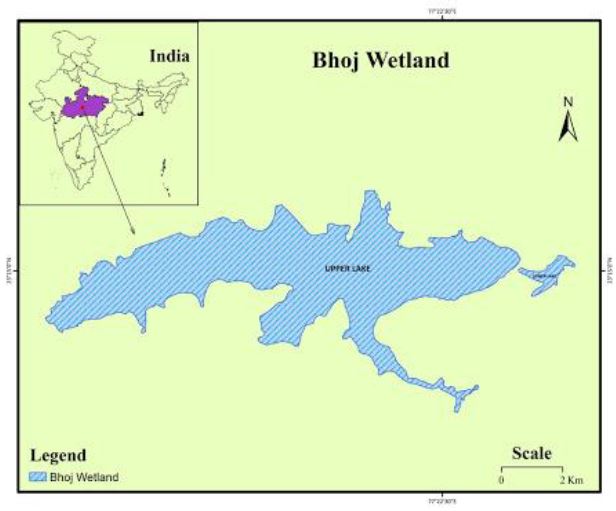
  • [pib] Bhoj Wetland

    Why in the News?

    The Madhya Pradesh State Wetland Authority has reported that Bhoj Wetland in Bhopal is not at risk of being removed from the Ramsar Convention List of important international wetlands.

    About Bhoj Wetland

    • Bhoj Wetland is located in the center of Bhopal district in Madhya Pradesh.
    • The wetland includes two man-made lakes: the upper lake and the lower lake.
    • Since August 2002, they have been recognized as a wetland of international importance under the Ramsar Convention.
    • The upper lake, created by King Bhoj in the 11th century, is one of the oldest large man-made lakes in central India.
      • It was formed by building an earthen dam across the Kolans River, which used to be a tributary of the Halali River.
      • Now, the upper part of the Kolans River and the Bhojtal drain into the Kaliasot River through a diversion channel.
      • Bhadbhada Dam, built in 1965, controls the outflow to the Kaliasot River.
    • The lower lake was created in 1794 by Nawab Chhote Khan to beautify the city.
      • It also has an earthen dam and drains into the Halali River through the lower part of the Kolans River, now called the Patra Drain.
      • Both the Kaliasot and Halali Rivers flow into the Betwa River.

    Significance of Bhoj Wetland

    • The upper lake provides 40% of Bhopal’s drinking water, while the lower lake supplies raw water and enhances the city’s beauty.
    • It supports over 700 species of plants and animals, including zooplankton and phytoplankton.
    • Both lakes are rich in biodiversity, supporting various fish species, birds, insects, reptiles, and amphibians.

    PYQ:

    [2018] Which one of the following is an artificial lake?

    (a) Kodaikanal (Tamil Nadu)

    (b) Kolleru (Andhra Pradesh)

    (c) Nainital (Uttarakhand)

    (d) Renuka (Himachal Pradesh)

  • [pib] Adopt a Heritage Scheme 2.0 

    Why in the News?

    Under the Adopt a Heritage Scheme 2.0, 19 MoUs have been signed so far covering a total of 66 monuments.

    About Adopt a Heritage Scheme 2.0 

    Aspect Details
    Revamped version of the original Adopt a Heritage Scheme.

    Launched in 2023.

    Legal Framework Defined as per the Ancient Monuments and Archaeological Sites and Remains Act (AMASR), 1958
    Application Process Stakeholders apply through a dedicated web portal listing available monuments for adoption
    Collaboration Encourages corporate stakeholders to contribute to monument preservation
    Term of Appointment Initially 5 years, extendable up to another five years
    Objective Foster collaboration for preservation of monuments for future generations
    Key Stakeholders Corporate stakeholders, Ministry of Tourism, Ministry of Culture, ASI, State/UT governments
    Program Goal Develop and maintain amenities at heritage sites
    Initial Scheme
    • Launch Date: 27 September 2017 (World Tourism Day) by the President of India.
    • Collaborators: Ministry of Tourism, Ministry of Culture, ASI, and State/UT governments.
    • Objective: Address challenges in operations and maintenance of heritage sites, develop mechanisms for amenities provision.
    • Monument Mitras: Agencies/Companies become ‘Monument Mitras’ through ‘Vision Bidding’.
    Note: Red Fort was the first monument to be adopted under the scheme by the Dalmia Bharat group in 2019.


    PYQ:

    [2018] Safeguarding the Indian Art Heritage is the need of the moment. Discuss.

  • Underwater mapping reveals insights into melting of ice shelves    

    Why in the News?

    New research has documented previously unseen shapes at the base of a West Antarctic ice shelf.  

    Base of a West Antarctic Ice Shelf

    • Basal Melt Dynamics: The base of West Antarctic ice shelves, including the Dotson Ice Shelf, experiences basal melt driven by warm ocean water. This process leads to thinning and hollows out cavities beneath the ice, reducing structural support for the grounded ice above.
    • Autonomous Underwater Vehicle (AUV) Research: Recent research utilized an AUV equipped with multibeam sonar to explore the topography of the basal melt cavity beneath the Dotson Ice Shelf, revealing previously unquantified melt mechanisms and unique formations at the ice shelf’s base.
      • Warm salty water, which is transported through ocean currents, significantly contributes to the melting of ice shelves. This bottom-up melting is critical to understanding the dynamics of ice loss and its implications for global sea level rise.
      • The AUV discovered tear-shaped indents and other unique shapes at the base of the ice shelf, indicating diverse melting patterns influenced by the flow of warm water.

    About the Dotson Ice Shelf (DIS) in Amundsen Sea

    • Dotson Ice Shelf is part of the West Antarctic ice sheet and is located next to Thwaites Glacier in the Amundsen Sea.
    • Thwaites Glacier is considered to have a potentially large impact on future sea level rise due to its size and location.

    Reasons behind ocean warming

    • Greenhouse Gas Emissions: Since the Industrial Revolution, human activities such as burning fossil fuels have significantly increased greenhouse gas (GHG) concentrations in the atmosphere, including carbon dioxide, methane, and nitrous oxide. These gases trap heat, leading to global warming.
    • Heat Absorption: The oceans have absorbed more than 93% of the excess heat from greenhouse gas emissions since the 1970s. This resulted in an average increase in ocean temperature of about 1°F (0.6°C) over the past century.
    • Impact of El Niño: The El Niño weather pattern, characterized by the abnormal warming of surface waters in the equatorial Pacific Ocean, contributes to both ocean warming and rising global surface temperatures.

    International Efforts and Agreements

    • The United Nations Framework Convention on Climate Change (UNFCCC) was signed by 166 countries in 1992, acknowledging humanity’s role in climate change.
    • The Paris Agreement, adopted in 2015, sets the international community the goal of limiting global warming to “well below” 2°C in this century.
    • The Green Climate Fund, established in 2010, aims to help developing countries adopt initiatives to combat climate change and deforestation

    Way forward: 

    • Enhanced Global Commitments: Nations need to reinforce their commitments under international agreements like the Paris Agreement. This includes setting more ambitious targets for reducing greenhouse gas emissions and adhering to these goals through stringent policies and regulations.
    • Funding and Technology Transfer: Developed countries should increase financial contributions to climate funds such as the Green Climate Fund to support mitigation and adaptation efforts in developing countries.

    Mains Question for practice: 

    Q Bring out the relationship between the shrinking Himalayan glaciers and the symptoms of climate change in the Indian sub-continent. (2014)

  • Kerala requests Centre to declare Wayanad landslide as a – ‘National Disaster’

    Why in the News?

    • The Kerala government has requested the Centre to declare the landslide in Vythiri taluk, Wayanad district, as a national disaster.
      • The Central government is considering the legality of declaring the landslide a national disaster.

    Wayanad Landslide: Destruction and Casualties

    • The landslide, triggered by heavy rain, devastated at least three villages.
    • Kerala’s official death toll stands at 221, with over 200 people still missing.
    • Rescue workers continue to retrieve bodies and body parts from the mud and debris.
    • Approximately 9,000 people displaced by the disaster have taken refuge in government-run relief camps in Wayanad.

    Defining a Disaster:

    • A natural disaster includes natural events like earthquakes, floods, landslides, cyclones, tsunamis, urban floods, and heatwaves.
    • Man-made disasters can include nuclear, biological, and chemical incidents.
    • According to the Disaster Management Act, 2005, a disaster is defined as:
      • A catastrophe, mishap, calamity, or grave occurrence in any area arising from natural or man-made causes.
      • It results in substantial loss of life or human suffering, damage to or destruction of property, or environmental degradation.
      • The damage must be of such a nature or magnitude that it is beyond the coping capacity of the affected community.

    Is there any provision to declare a ‘National Disaster/Calamity’? 

    • There is NO provision under the existing guidelines to declare any disaster, including floods, as a national calamity.
    • The guidelines do NOT contemplate declaring a disaster as a National Calamity.

    Attempts to Define National Calamity:

    • National Committee (2001):
      • Chaired by the then Prime Minister, the committee was tasked with defining parameters for a national calamity.
      • The committee did not suggest any fixed criteria for such a declaration.
    • 10th Finance Commission (1995-2000):
      • It proposed that a disaster be termed “a national calamity of rarest severity” if it affects one-third of a state’s population.
      • It did not define “calamity of rare severity” but suggested that each case be adjudged individually.

    Response to such calamities in India

    • When a calamity is declared as such, support is provided at the national level.
    • The Centre considers additional assistance from the NDRF.
    • A Calamity Relief Fund (CRF) is established, with the corpus shared 3:1 between the Centre and the state.
    • If resources in the CRF are insufficient, additional assistance is considered from the National Calamity Contingency Fund (NCCF), funded entirely by the Centre.
    • Relief measures can include the repayment of loans or the provision of fresh loans to affected individuals on concessional terms.

    PYQ:

    [2020] Discuss the recent measures initiated in disaster management by the Government of India departing from the earlier reactive approach.


    [2019] Vulnerability is an essential element for defining disaster impacts and its threat to people. How and in what ways can vulnerability to disasters be characterized? Discuss different types of vulnerability with reference to disasters.

  • [pib] INS SHALKI  

    Why in the News?

    • Indian Navy’s submarine INS Shalki, recently docked at Colombo Port on its two day visit to Sri Lanka.
      • This visit comes against the backdrop of China’s persistent attempts to enhance its strategic and military influence over the island nation.

    About INS SHALKI  

    • INS Shalki is a Shishumar class diesel-electric submarine, commissioned into the Indian Navy on 07 Feb 1992.
      • Shishumar class submarines are an Indian variant of the Type 209 submarines developed by the German yard Howaldtswerke-Deutsche Werft under the internal designation “Type 1500”.
    • This is the first ever submarine to be built in India.
    • It was constructed under licence by the Mazgaon Dock Limited, Mumbai.

    Significance of Sri Lanka Visit

    • India sends submarines to a handful of countries with whom it has close defence and strategic ties.
    • This is the third submarine to visit Sri Lanka after the visit of INS Vagir and INS Karanj in June 2023 and February 2024, respectively.
    • India has been expanding its defence and strategic ties with Sri Lanka amid concerns over China’s attempts to increase its military presence in the Indian Ocean.
    • Countering Chinese presence:
      • The docking of the Chinese missile and satellite tracking ship ‘Yuan Wang’ at Hambantota port in August 2022 had triggered a diplomatic row between India and Sri Lanka.
      • Another Chinese warship docked at the Colombo port in August last year.

    PYQ:

    [2017] Consider the following in respect of Indian Ocean Naval Symposium (IONS):

    1. Inaugural IONS was held in India in 2015 under the chairmanship of the Indian Navy.

    2. IONS is a voluntary initiative that seeks to increase maritime co-operation among navies of the littoral states of the Indian Ocean Region.

    Which of the statements given above is/are correct?

    (a) 1 only

    (b) 2 only

    (c) Both 1 and 2

    (d) Neither 1 nor 2