💥Join UPSC 2027,2028 Mentorship (July Batch) + XFactor Notes & Microthemes PDF

Distribution: yearly

  • Annapurti: The grain ATM

    annapurti

    Central Idea

    • The recent demonstration of the Automated Multi-Commodity Grain Dispensing Machine, Annapurti, during the ‘National Conference of Food Ministers of States/UTs,’ showcased an innovative solution developed by the World Food Programme (WFP) India.

    What is Annapurti?

    • Annapurti, also known as the Grain ATM, offers a fast, clean, and precise method of providing subsidized grains to beneficiaries through the Public Distribution System.
    • Developed by WFP India, it is an automated multi-commodity dispensing solution that ensures efficient access to commodities like rice, wheat, and grains.
    • Beneficiaries can securely access their entitlements through Annapurti following biometric authentication.

    Key Features

    • Annapurti offers 24×7 access to full entitlements, eliminating spillage, waste, and inaccurate weighing.
    • The machine can dispense one or two grain commodities, up to 50 kilograms, within five minutes, with a minimal error rate of 0.01 percent.

    Advantages and Potential Applications

    (1) Ensuring Food Security:

    • Annapurti has significant potential for food-based safety nets, ensuring beneficiaries receive their monthly subsidized grains promptly.
    • The machine’s precision and reliability prevent losses and ensure individuals receive their entitled portions.

    (2) Emergency Food Grain Distribution:

    • During emergencies, such as natural disasters or humanitarian crises, Annapurti can facilitate efficient and timely distribution of food grains to affected populations.
    • Its automated system streamlines the process, reducing dependency on manual labor and minimizing errors.

    (3) Market Access for Smallholder Farmers:

    • Annapurti can play a crucial role in expanding market access for smallholder farmers.
    • By offering a reliable and efficient distribution channel, farmers can sell their produce directly to Annapurti, ensuring fair prices and reducing intermediaries.

    Sustainable and Modular Design

    (1) Energy Efficiency:

    • Annapurti is designed to prioritize food security while ensuring efficient energy consumption.
    • With a consumption rate of only 0.6 Watt per hour, it offers an environmentally friendly solution.

    (2) Modular Design:

    • Annapurti’s modular design allows for flexibility and scalability based on available space.
    • The storage unit and components can be easily assembled and customized to suit different requirements.

    (3) Integration with Renewable Energy:

    • Annapurti can be integrated with solar panels, inverter batteries, and elevators for automatic refilling.
    • This integration enhances the sustainability of the system by reducing dependency on conventional energy sources.


  • SC Collegium proposes new CJs to 7 High Courts

    collegium

    Central Idea

    • The Supreme Court Collegium, led by Chief Justice of India D. Y. Chandrachud, has recommended new Chief Justices for seven major High Courts in India.
    • The recommendations focus on criteria such as seniority, regional representation, and gender diversity.

    What is Collegium System?

    • The Collegium of judges is the Indian Supreme Court’s invention.
    • It does not figure in the Constitution, which says judges of the Supreme Court and High Courts are appointed by the President and speaks of a process of consultation.
    • In effect, it is a system under which judges are appointed by an institution comprising judges.
    • After some judges were superseded in the appointment of the CJI in the 1970s, and attempts made subsequently to effect a mass transfer of High Court judges across the country.
    • Hence there was a perception that the independence of the judiciary was under threat. This resulted in a series of cases over the years.

    Evolution: The Judges Cases

    • First Judges Case (1981) ruled that the “consultation” with the CJI in the matter of appointments must be full and effective.
    • However, it rejected the idea that the CJI’s opinion, albeit carrying great weight, should have primacy.
    • Second Judges Case (1993) introduced the Collegium system, holding that “consultation” really meant “concurrence”.
    • It added that it was not the CJI’s individual opinion, but an institutional opinion formed in consultation with the two senior-most judges in the Supreme Court.
    • Third Judges Case (1998): On a Presidential Reference for its opinion, the Supreme Court, in the Third Judges Case (1998) expanded the Collegium to a five-member body, comprising the CJI and four of his senior-most colleagues.

    Functions of the Collegium

    (1) Appointment of CJI

    • The President of India appoints the CJI and other Supreme Court judges.
    • The outgoing CJI recommends his successor, and the appointment is typically made based on seniority, following the controversy of the 1970s.
    • The Union Law Minister forwards the recommendation to the Prime Minister, who then advises the President on the appointment.

    (2) Appointment of Other SC Judges

    • The proposal for appointing other judges to the Supreme Court is initiated by the CJI.
    • The CJI consults other members of the Collegium, as well as the senior-most judge from the High Court to which the recommended person belongs.
    • The opinions of the consultees must be recorded in writing and included in the file.
    • The Collegium sends the recommendation to the Law Minister, who forwards it to the Prime Minister for the President’s advice.

    (3) Appointment of High Court Judges

    • Chief Justices (CJs) of High Courts are appointed based on the policy of having Chief Justices from outside the respective states. The Collegium makes the final decision on their elevation.
    • The appointment of High Court judges is recommended by a Collegium consisting of the CJI and two senior-most judges.
    • The Chief Justice of the High Court concerned initiates the proposal in consultation with two senior-most colleagues.
    • The recommendation is then sent to the Chief Minister, who advises the Governor to forward the proposal to the Union Law Minister.

    (4) Transfer Recommendations by the Collegium

    • The Collegium is also responsible for recommending transfers of Chief Justices and other judges.
    • Article 222 of the Constitution allows for the transfer of judges from one High Court to another.
    • When a Chief Justice is transferred, a replacement must be simultaneously appointed for the concerned High Court. An acting Chief Justice can be appointed for a maximum of one month.
    • In transfer matters, the CJI’s opinion is determinative, and the consent of the judge being transferred is not required.
    • However, the CJI should consider the views of the Chief Justice of the concerned High Court and one or more Supreme Court judges who are in a position to provide their opinions.
    • All transfers must be made in the public interest, aiming for the betterment of the administration of justice.


  • What is High Seas Treaty?

    high seas treaty

    Central Idea

    • The Marine Biodiversity of Areas Beyond National Jurisdiction (BBNJ) or the High Seas Treaty was adopted by the UN on June 19.
    • It became the third agreement under UNCLOS, following the establishment of the International Seabed Authority (ISB) and the Fish Stocks Agreement (FSA).

    BBNJ/ High Seas Treaty

    • The idea of protecting the marine environment emerged in 2002, leading to the recognition of the need for an agreement in 2008.
    • In 2015, the UN General Assembly formed a Preparatory Committee to create the treaty.
    • Intergovernmental conferences (IGC) were held, resulting in the adoption of the treaty in 2023.
    • The treaty’s objective is to implement international regulations for the protection of marine life beyond national jurisdiction through international cooperation.

    Key Provisions of Treaty

    (1) Marine Protected Areas:

    • The treaty establishes marine protected areas to safeguard the oceans from human activities.
    • Decisions on protected areas require a “three-quarter majority vote” to prevent obstruction by a few parties.

    (2) Sharing Benefits from Marine Genetic Resources:

    • The treaty mandates sharing scientific information and monetary benefits through a “clear house mechanism.”
    • The mechanism ensures open access to information on marine protected areas, marine genetic resources, and area-based management tools.

    (3) Capacity Building and Marine Technology:

    • The treaty emphasizes capacity building and the use of marine technology for environmental impact assessment.
    • The Scientific and Technical Body will create standards and guidelines, assisting countries with limited capacity in carrying out assessments.

    Challenges and Controversies

    (1) Marine Genetic Resources:

    • The issue of sharing and exchanging information on marine genetic resources was a contentious point during negotiations.
    • Debates focused on monitoring information sharing and the potential hindrance to bioprospecting research.

    (2) Definition and Language:

    • The use of phrases like “promote” or “ensure” in different parts of the treaty, particularly regarding benefit sharing, sparked heated debates.

    (3) Adjacency Issue:

    • Negotiations were prolonged due to the need for provisions allowing coastal states to exercise sovereign rights over seabed and subsoil in areas beyond their jurisdiction.
    • The interests of landlocked and distant states further complicated decision-making.

    Opposition to the Treaty

    • Several developed countries opposed the treaty due to their support for private entities involved in advanced research and development of marine technology.
    • Russia and China also expressed reservations, with Russia ultimately withdrawing during the final stage of consensus building, arguing that the treaty lacks a balance between conservation and sustainability.

    Significance of the treaty

    (1) Environmental Preservation:

    • The High Seas Treaty is crucial for protecting marine biodiversity and addressing pressing issues such as overfishing and pollution.
    • It represents a significant step towards international cooperation in preserving the health and sustainability of our oceans.

    (2) Global Cooperation and Research:

    • The treaty promotes the sharing of scientific information and encourages collaboration among countries.
    • This will foster research initiatives and facilitate a better understanding of marine ecosystems, leading to more effective conservation measures.

    Conclusion

    • The adoption of the High Seas Treaty marks a significant milestone in international efforts to protect marine biodiversity beyond national jurisdictions.
    • While challenges and controversies prolonged the negotiation process, the treaty sets the stage for enhanced global cooperation and the implementation of regulations to safeguard our oceans for future generations.

    Back2Basics:

    International Seabed Authority (ISA) Fish Stocks Agreement (FSA)
    Purpose Regulate and manage activities in the international seabed and ocean floor beyond national jurisdiction Ensure the conservation and management of straddling fish stocks and highly migratory fish stocks
    Legal Framework Established by the United Nations Convention on the Law of the Sea (UNCLOS) International treaty adopted by the United Nations
    Established Date 1994 1995
    Resource Focus Non-living resources (seabed minerals) and living resources (deep-sea ecosystems) Fish stocks (shared resources occurring in EEZs and beyond national jurisdiction)
    Cooperation Emphasizes cooperation among states and establishment of Regional Fisheries Management Organizations (RFMOs) Promotes cooperation among states for sustainable fisheries management
    Conservation Manages resources for the benefit of humankind as a whole, adhering to the common heritage of mankind principle Aims to conserve and sustainably manage fish stocks for present and future generations
    Licensing Issues licenses and contracts for seabed mineral exploration and exploitation N/A (Focuses on the management and conservation of fish stocks)
    Data Collection Promotes scientific research and international cooperation in the deep seabed area Encourages data collection, reporting, and scientific assessment of fish stocks
    Dispute Settlement Provides mechanisms for dispute settlement and peaceful resolution of conflicts Includes provisions for dispute settlement and peaceful resolution of conflicts
    Membership Consists of member states and the European Union Open to states committed to sustainable fisheries management
    Headquarters Located in Kingston, Jamaica N/A (Operates under the United Nations framework)


  • Supreme Court asks NGO to move govt against Sarpanch-Patism

    sarpanch

    Central Idea

    • The Supreme Court of India has stated that the government, rather than the judiciary, should address the issue of men exerting power behind elected women who remain “faceless wives and daughters-in-law” in grassroots politics.
    • The court’s remarks came in response to a petition filed by an NGO which highlighted the phenomenon of unelected male relatives wielding political influence, undermining the spirit of women’s reservation in Panchayati Raj Institutions (PRIs).

    Women in PRIs: Legal Aspects

    (a) 73rd Constitutional Amendment Act, 1992:

    • Mandates 33.3% reservation for women in PRIs across the country.
    • Recognizes the Gram Sabha as the foundation of the Panchayat Raj System, empowering it to perform functions and exercise powers entrusted by the State Legislatures.
    • Some states have increased the reservation to 50%, including Andhra Pradesh, Chhattisgarh, Gujarat, Himachal Pradesh, Bihar, etc.
    • Out of the 30.41 lakh elected representatives in PRIs, 13.74 lakh (45.2%) are women.

    (b) Article 15(3) of the Constitution:

    • Empowers the State to make special provisions for women.
    • Allows the government to introduce measures to ensure gender equality and promote the interests of women.

    (c) Article 243D:

    • Provides for the reservation of one-third of the total number of seats and offices of Chairpersons in PRIs for women.
    • The reserved seats and offices are allocated through rotation to different constituencies within a Panchayat.
    • These reservations for women are in addition to the reservations for Scheduled Castes (SCs) and Scheduled Tribes (STs) in all three tiers of PRIs.

    (d) Intersectional Reservations:

    • The reservation of seats and offices for women in PRIs also falls within the overall reservations for Scheduled Castes (SCs) and Scheduled Tribes (STs) in all three tiers of PRIs.
    • This provision aims to address the intersecting disadvantages faced by women from marginalized communities.

    (e) Proposed 110th Constitution Amendment Bill:

    • Introduced in the Lok Sabha in 2009 to bring about 50% reservation for women in Panchayats across all states.
    • The bill aimed to increase the reservation beyond the existing 33.3% mandated by the 73rd Amendment Act.
    • Despite multiple tabled attempts, the bill was not passed into law.

    Proxy Sarpanchs in India

    • It is generally observed where an elected lady Sarpanch (the head of a Panchayat) delegates their powers and responsibilities to someone else, typically a family member or a trusted individual.
    • This proxy then acts as a representative or substitute for the Sarpanch in carrying out their duties.
    • Quite often, this delegation is forcefully acquired from women.

    Reasons behind Panchayat Pati syndrome

    • Gender Inequality: Deep-rooted gender inequalities prevalent in Indian society play a significant role in perpetuating the Panchayat Pati syndrome. Patriarchal norms and cultural beliefs that prioritize male authority and decision-making often restrict women’s agency and participation in public affairs.
    • Social Norms and Expectations: Traditional gender roles and societal expectations define women’s primary role as homemakers and caretakers. This perception often results in women being considered unfit or inexperienced in matters of governance
    • Lack of Awareness and Education: Limited access to education and awareness about women’s rights and the importance of their participation in local governance can contribute to the prevalence of Panchayat Pati. Lack of awareness among women themselves, as well as their families and communities, can lead to the perpetuation of discriminatory practices.
    • Male Domination and Resistance to Change: Male dominance in politics and resistance to gender equality can also contribute to the Panchayat Pati syndrome.
    • Political Dynamics and Power Struggles: In some cases, male family members or influential community leaders may strategically use the Panchayat Pati practice to retain power and influence. By controlling women’s decision-making, they can ensure their interests are protected and continue to exert control over the local governance processes.

    Impact of Panchayat Pati syndrome

          1. Economic Impact:

    • The practice of Panchayat Pati limits the active participation of women in decision-making processes within the panchayat.
    • This exclusion can hinder the effective utilization of resources and allocation of funds, potentially leading to suboptimal economic outcomes for the community.
    • Women’s perspectives and needs may not be adequately represented, and projects or initiatives that could benefit women, such as those related to education, healthcare, or livelihood opportunities, may not receive sufficient attention or support.

          2. Social Impact:

    • Panchayat Pati reinforces gender inequalities and perpetuates traditional gender roles within communities.
    • It hampers women’s ability to exercise agency and engage in community development activities. it diminishes their self-esteem and status within the community.

         3. Political Impact:

    • The practice of Panchayat Pati undermines the principles of democratic representation and participatory governance.
    • It restricts the political agency of women and denies them the opportunity to actively contribute to decision-making processes.
    • Women’s perspectives and priorities often differ from those of men, and their exclusion diminishes the diversity of voices and perspectives in local governance. This can lead to policy decisions that may not adequately address the needs and concerns of women and other marginalized groups.

    Court’s Response

    • Not an Executive Authority: The court acknowledged the issue but emphasized that it is not the role of the judiciary to create a spirit of empowerment.
    • Focus on women empowerment: The court pointed out that preventing influential individuals’ wives from contesting elections is not feasible, and empowering women requires an evolutionary process.
    • Government’s Responsibility: The court highlighted that the Ministry of Panchayati Raj should address the petitioner’s grievance and explore better mechanisms to implement the objectives of women’s reservation.
    • Expert Committee and Support Mechanism: The petitioner suggested the formation of an expert committee and the provision of the right support mechanism for women. However, the court deemed this an unrealistic expectation from the judiciary.

    Way forward

    • Engage Men as Allies: Promote male allies in supporting women’s representation in PRIs. Encourage men to actively advocate for gender equality, challenge patriarchal norms, and work towards creating a more inclusive and equitable political environment.
    • Capacity Building and Leadership Development: Provide training and capacity-building programs for women elected representatives in PRIs.
    • Political Awareness and Participation: Conduct awareness campaigns to educate women about their rights, the importance of political participation, and the impact of their involvement in PRIs.
    • Inter-Gender Dialogues: Organize inter-generational dialogues where older leaders and women can exchange knowledge, experiences, and perspectives. This can help bridge the generation gap, promote inter-generational collaboration, and strengthen the collective power of women in PRIs.

    Conclusion

    • It is the responsibility of the executive authority to find suitable solutions and ensure the effective implementation of women’s reservations in panchayat governance.

    Mains Mark enhancer: Successful Women Sarpanch in India

    • Kali Bein Panchayat, Punjab: Kali Bein Panchayat in Punjab gained recognition for its all-women panchayat led by Sarpanch Bibi Jagir Kaur. Under her leadership, the panchayat focused on various development initiatives, including infrastructure development, water conservation, and women empowerment programs.
    • Mawlynnong, Meghalaya: Mawlynnong, a village in Meghalaya, is known for its clean and well-maintained environment. The village achieved this feat under the leadership of women panchayat leaders who implemented strict cleanliness and waste management measures, making it one of the cleanest villages in Asia.
    • Devdungri, Rajasthan: Devdungri village in Rajasthan is an exemplary case of women’s leadership in panchayats. Women panchayat members successfully implemented initiatives to address issues such as child marriage, female foeticide, and women’s education. Their efforts resulted in significant positive changes in the community.


  • FinMin pushes for reforms to spur FDI inflows

    fdi

    Central Idea

    • The Finance Ministry of India emphasized the need to address challenges faced by global investors to facilitate Foreign Direct Investment (FDI) flows.
    • In this article, we delve into the factors affecting FDI inflows and propose measures to attract and sustain FDI in India.

    What is Foreign Direct Investment (FDI)?

    • FDI refers to the investment made by individuals, companies, or governments from one country into business interests located in another country.
    • It involves the direct ownership or control of assets in the foreign country, typically in the form of establishing new ventures, acquiring existing businesses, or creating strategic partnerships.

    Understanding FDI

    Imagine you have a successful toy manufacturing company based in Country A. You have been experiencing steady growth and want to expand your business operations to a new market in Country B. However, entering a foreign market can be challenging due to unfamiliarity with the local business environment, regulations, and market dynamics.

    To overcome these challenges, you decide to make a Foreign Direct Investment (FDI) in Country B. Instead of exporting toys from Country A to Country B, you establish a new manufacturing plant or acquire an existing toy company in Country B. By doing so, you gain direct ownership and control over the assets and operations in Country B.


    India’s FDI feats

    • In terms of investor countries of FDI Equity inflow, Singapore is at the top with 27%, followed by the US with 18% and Mauritius with 16% for the FY 2021-22.
    • Computer Software & Hardware’ has emerged as the top recipient sector of FDI Equity inflow during this period with around 25% share followed by Services Sector and Automobile Industry with 12% each.
    • With 53 % Karnataka has received the majority share of FDI equity in the `Computer Software & Hardware’ sector.

    FDI in India

    • Foreign investment was introduced in 1991 under Foreign Exchange Management Act (FEMA), driven by then FM Manmohan Singh.
    • Economic liberalisation started in India in the wake of the 1991 crisis and since then, FDI has steadily increased in the country.
    • India, today is a part of top 100-club on Ease of Doing Business (EoDB) and globally ranks number 1 in the Greenfield FDI ranking.

    There are two routes by which India gets FDI.

    1) Automatic route: By this route, FDI is allowed without prior approval by Government or RBI.

    2) Government route: Prior approval by the government is needed via this route. The application needs to be made through Foreign Investment Facilitation Portal, which will facilitate the single-window clearance of FDI application under Approval Route.

    • India imposes a cap on equity holding by foreign investors in various sectors, current FDI in aviation and insurance sectors is limited to a maximum of 49%.
    • In 2015 India overtook China and the US as the top destination for the Foreign Direct Investment.

    Sectors that come under the ‘100% Automatic Route’ category are

    • Agriculture & Animal Husbandry, Air-Transport Services (non-scheduled and other services under civil aviation sector)
    • Airports (Greenfield + Brownfield),
    • Asset Reconstruction Companies,
    • Auto-components, Automobiles,
    • Biotechnology (Greenfield),
    • Broadcast Content Services (Up-linking & down-linking of TV channels, Broadcasting Carriage Services,
    • Capital Goods, Cash & Carry Wholesale Trading (including sourcing from MSEs), Chemicals, Coal & Lignite, Construction Development,
    • Construction of Hospitals,
    • E-commerce Activities, Electronic Systems,
    • Food Processing, Gems & Jewellery, Healthcare, Industrial Parks, IT & BPM, Leather, Manufacturing, Mining & Exploration of metals & non-metal ores, Other Financial Services,
    • Pharmaceuticals, Plantation sector
    • Ports & Shipping, Railway Infrastructure, Renewable Energy, Roads & Highways,
    • Single Brand Retail Trading, Textiles & Garments,
    • Thermal Power,
    • Tourism & Hospitality and
    • White Label ATM Operations.

    Sectors that come under up to 100% Automatic Route’ category are

    • Infrastructure Company in the Securities Market: 49%
    • Insurance: up to 49%
    • Medical Devices: up to 100%
    • Pension: 49%
    • Petroleum Refining (By PSUs): 49%
    • Power Exchanges: 49%

    Sectors that come under the ‘up to 100% Government Route’ category are

    • Banking & Public sector: 20%
    • Broadcasting Content Services: 49%
    • Core Investment Company: 100%
    • Food Products Retail Trading: 100%
    • Mining & Minerals separations of titanium bearing minerals and ores: 100%
    • Multi-Brand Retail Trading: 51%
    • Print Media (publications/ printing of scientific and technical magazines/ specialty journals/ periodicals and facsimile edition of foreign newspapers): 100%
    • Print Media (publishing of newspaper, periodicals and Indian editions of foreign magazines dealing with news & current affairs): 26%
    • Satellite (Establishment and operations): 100%

    Prohibited Sectors

    There are a few industries where FDI is strictly prohibited under any route. These industries are

    • Atomic Energy Generation
    • Any Gambling or Betting businesses
    • Lotteries (online, private, government, etc.)
    • Investment in Chit Funds
    • Nidhi Company
    • Agricultural or Plantation Activities (although there are many exceptions like horticulture, fisheries, tea plantations, Pisciculture, animal husbandry, etc.)
    • Housing and Real Estate (except townships, commercial projects, etc.)
    • Trading in TDR’s
    • Cigars, Cigarettes, or any related tobacco industry

    Benefits offered by FDI

    • Employment generation: FDI boosts the manufacturing and services sector which results in the creation of jobs and helps to reduce unemployment rates in the country.
    • Economic growth: Increased employment translates to higher incomes and equips the population with more buying powers, boosting the overall economy of a country.
    • Human capital development: Skills that employees gain through training and experience can boost the education and human capital of a specific country. Through a ripple effect, it can train human resources in other sectors and companies.
    • Technology boost: The introduction of newer and enhanced technologies results in company’s distribution into the local economy, resulting in enhanced efficiency and effectiveness of the industry.
    • Increase in exports: Many goods produced by FDI have global markets, not solely domestic consumption. The creation of 100% export oriented units help to assist FDI investors in boosting exports from other countries.
    • Exchange rate stability: The flow of FDI into a country translates into a continuous flow of foreign exchange, helping a country’s Central Bank maintain a prosperous reserve of foreign exchange which results in stable exchange rates.
    • Improved Capital Flow: Inflow of capital is particularly beneficial for countries with limited domestic resources, as well as for nations with restricted opportunities to raise funds in global capital markets.
    • Creation of a Competitive Market: By facilitating the entry of foreign organizations into the domestic marketplace, FDI helps create a competitive environment, as well as break domestic monopolies.
    • Climate mitigation: The United Nations has also promoted the use of FDI around the globe to help combat climate change

    Factors Affecting recent FDI inflows

    (1) Inflationary Pressures and Tighter Monetary Policies

    • The dip in FDI inflows in 2022-23 can be attributed to inflationary pressures and tighter monetary policies.
    • Policymakers should address these factors to encourage a favorable investment climate.

    (2) Geopolitics vs. Geography

    • The Ministry highlights the influence of “political distance more than geographical distance” on FDI flows.
    • Geopolitical factors have dominated over traditional geographical considerations.

    (3) Global FDI Trends

    • Gross FDI flows declined by 16% in 2022, compared to the record high of $84.8 billion in 2021-22.
    • Net inflows experienced a sharper decline of 27.4%.
    • Similar trends were observed in emerging market economies, where net FDI inflows declined by 36% in 2022.

    Challenges for India’s Growth Outlook

    (1) External Sector Challenges:

    • The review identifies the external sector as a potential challenge for India’s growth in 2023-24.
    • Factors such as geopolitical stress, volatility in global financial systems, price corrections in global stock markets, El-Nino impact, and weak global demand could constrain growth.
    • Policymakers must closely monitor FDI data and undertake measures to facilitate FDI inflows.

    (2) Fragmentation of FDI Flows:

    • The Ministry highlights the phenomenon of “friend shoring,” wherein FDI is directed towards geopolitically aligned countries.
    • This has led to a fragmentation of FDI flows globally, as per research from the International Monetary Fund (IMF).
    • Additionally, inflows from foreign portfolio investors (FPIs) into Indian markets have become less volatile.

    Conclusion

    • To attract and sustain FDI inflows, India needs to address challenges related to inflation, monetary policies, geopolitical factors, and last-mile infrastructure.
    • Additionally, mitigating trade risks and fostering inclusive growth through job creation will contribute to a favorable investment climate.
  • Kanwar Yatra: What is it?

    kanwar yatra

    Central Idea: The Kanwar Yatra, a significant annual pilgrimage, commenced on July 4 and will continue until July 15.

    What is Kanwar Yatra?

    • This pilgrimage sees millions of devotees, known as Kanwariyas or Kriyas, undertaking a journey to collect water from the Ganga River and offer it to Lord Shiva.
    • The Kanwar Yatra symbolizes the unbreakable bond between devotees and Lord Shiva and is considered an act of faith and devotion.

    Mythological Origins of Kanwar Yatra

    • Samudra Manthan: Kanwar Yatra is believed to have originated from the mythological story of Samudra Manthan, where Lord Shiva consumed poison to save the world. To alleviate the effects of the poison, all the gods poured water from the Ganga River on Lord Shiva.
    • King Rama’s Offering: Another version suggests that the ritual of Kanwar Yatra began when King Ram offered water from the Ganga to a statue of Lord Shiva (shivalinga) in an earthen pot.

    Customs and Rituals Performed

    • Collection of Ganga Water: Devotees, dressed in saffron attire, embark on foot to collect water from the Ganga River at Haridwar, Gomukh, and Gangotri. They carry two earthen pots filled with water, hung on a decorated bamboo stick, which they balance on their shoulders.
    • Significance of Purity: Devotees consider it essential to keep the pots from touching the ground or getting contaminated by dust, as it may impure the sacred water.
    • Challenging Journey: Kanwariyas undertake the yatra barefoot, covering long distances in challenging terrains and extreme weather conditions.
  • Tomato Crop affected by different Mosiac Viruses

    tomato mosiac

    Central Idea

    • Tomato growers in Maharashtra and Karnataka have reported significant yield losses due to the impact of two different Mosiac Viruses.
    • The cucumber mosaic virus (CMV) has affected tomato crops in Maharashtra, while the tomato mosaic virus (ToMV) has been blamed for crop losses in Karnataka and other South Indian states.


    Cucumber Mosaic Virus (CMV)

    Tobacco Mosaic Virus (TMV)

    Target Plants Various plants, including cucumbers, tomatoes, peppers, lettuce, and ornamentals Plants in the Solanaceae family, including tobacco, tomatoes, peppers, etc.
    Transmission Aphids, seeds, mechanical contact, infected plant debris Direct contact, mechanical transmission, contaminated plant material
    Symptoms Mosaic patterns, yellowing, stunted growth, leaf curling, distorted fruits or flowers Mosaic patterns, yellowing, leaf curling, stunted growth
    Impact on Crops Reduced yield and quality Reduced yield, impact on flavor and quality
    Longevity Not specified Long-term viability in dried plant debris, tobacco products, contaminated surfaces
    Control Measures Vector control, seed selection, crop rotation Crop rotation, sanitation, virus-free seeds/seedlings, cultural practices
    Curability No cure, management focuses on prevention No cure, management focuses on prevention


    Impact on Tomato Crops

    • Symptoms of ToMV: Infected plants exhibit alternating yellowish and dark green areas, blisters on leaves, leaf distortion, twisting of younger leaves, necrotic spots on fruits, and reduced fruit setting.
    • Symptoms of CMV: Leaf distortion, with top and bottom leaves most affected, mosaic-like patterns of yellow and green spots in cucumber, fruit deformation, and reduced production in tomato.

    Control Measures

    • ToMV: Ensuring biosafety standards in nurseries, seed treatment, careful inspection of saplings before planting, continuous monitoring for infection, and removal of infected plants are crucial.
    • CMV: Due to its wide host range, controlling aphids becomes essential. Measures include spraying quick-acting insecticides or mineral oils, monitoring aphid migration, and clearing fields of weeds and plant material that may harbor the virus.


  • What is Ambergris?

    amber

    Central Idea

    • The discovery of a sperm whale carcass on the shore of the Canary Island of La Palma has led to an extraordinary find.
    • During the post-mortem examination, a pathologist found ambergris, a highly valuable substance often referred to as “floating gold,” stuck in the whale’s colon.
    • The estimated worth of the retrieved lump of ambergris is around €500,000 (Rs 4,47,62,500).

    What is Ambergris?

    • Origin: Ambergris is a waxy substance formed in the digestive system of protected sperm whales.
    • Formation: One theory suggests that ambergris is produced in the gastrointestinal tract of sperm whales to aid the passage of hard objects ingested during feeding.
    • Appearance and Odour: Freshly passed ambergris is light yellowish and fatty, but it ages and turns waxy, taking on red-brownish colors. It possesses a mild, earthy, sweet smell with hints of marine odor.

    Uses and Rarity of Ambergris

    • Perfume Industry: Traditionally, ambergris is used in the production of perfumes, adding a musky note.
    • Historical Uses: In the past, ambergris was utilized to flavor food, alcoholic beverages, and tobacco in certain cultures.
    • Rarity and Value: Ambergris is a scarce substance, contributing to its high demand and significant price in the international market.

    Legal Restrictions in India

    • Wildlife Protection Act: Sperm whales, the source of ambergris, are a protected species under Schedule 2 of the Wildlife Protection Act in India.
    • Illegal Possession and Trade: The possession and trade of ambergris and its by-products, including in India, are prohibited under the Wildlife Protection Act of 1972.
    • Smuggling and Trade Routes: Smuggling networks involved in ambergris trade often procure the substance from coastal areas in India and transport it through countries with comparatively less stringent sea trade regulations.
  • Cabinet clears Data Protection Bill

    data

    Central Idea

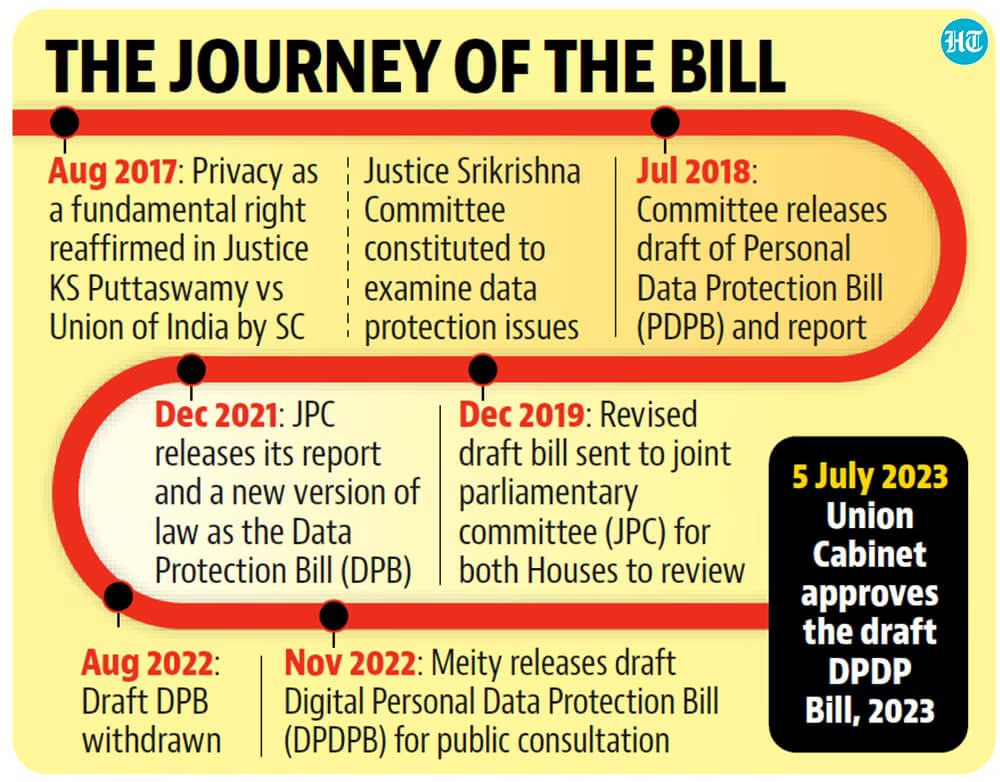
    • The Union Cabinet has granted clearance for the Digital Personal Data Protection (DPDP) Bill, which is set to be introduced in the upcoming Monsoon Session of Parliament.
    • This legislation aims to regulate the management of personal data of Indian residents, emphasizing explicit consent for data collection and usage.

    DPDP, Bill: Key Features and Concerns

    (A) Data Protection Norms and Consent

    • Data Protection Law: The DPDP Bill establishes norms for the management of personal data and mandates explicit consent from individuals whose data is collected and used.
    • Limited Transparency: More than 20,000 comments were received during the public consultation on the draft Bill, but these comments have not been made publicly available.
    • Minimal Changes: The final Bill, to be presented in Parliament, reportedly shows little deviation from the initial draft circulated for public consultation.

    (B) Data Protection Board and Grievance Redressal

    • Role of the Data Protection Board: The DPDP Bill enables individuals to lodge complaints with the Data Protection Board of India, consisting of government-appointed technical experts, in case of unauthorized data usage.
    • Investigation of Breaches: The Board will initiate an investigation into reported breaches of personal data.

    (C) Provisions and Penalties

    • EU Influence: The DPDP Bill draws inspiration from the EU’s General Data Protection Regulation, outlining practices for entities collecting personal data, storage, processing, and the rights of data subjects.
    • Voluntary Undertaking: Entities can admit a breach and pay a penalty as a mitigation measure to avoid court litigation.
    • Penalties and Fines: Penalties for breaches can reach up to ₹250 crore, with a possibility of upward revision to ₹500 crore. Individual offenses may attract fines starting from ₹10,000.
    • Data Protection Board’s Role: The Board will levy fines and penalties for breaches, with a maximum penalty of ₹500 crore for data breaches.

    (D) Exemptions and Concerns

    • Exemptions for Courts and Law Enforcement: The Bill exempts courts and law enforcement agencies from certain requirements when processing personal data for the prevention, detection, investigation, or prosecution of offenses.
    • Concerns over RTI Amendment: An amendment in the DPDP Bill raises concerns among Right to Information activists, as it may restrict the sharing of “personal information” by government departments, potentially impeding transparency and accountability.

    Potential Changes in the Final Draft

    • Cross-Border Data Flows: The approach to cross-border data transfers may shift from a ‘whitelisting’ approach to a ‘blacklisting’ mechanism.
    • Stricter Deemed Consent: The provision on “deemed consent” for private entities could be reworded to be more stringent, while government departments may assume consent for processing personal data in the interest of national security and public interest.

    International Comparisons

    data

    • Global Data Protection Laws: A significant number of countries have enacted data protection and privacy legislation, with the GDPR serving as a template for many jurisdictions.
    • EU, US, and China Models: The EU focuses on comprehensive data protection, the US emphasizes privacy as “liberty protection,” and China has introduced new laws on data privacy and security.

    Why discuss this yet again?

    • Previous Withdrawal: An earlier version of the data protection Bill was withdrawn from Parliament in 2021 due to pushback from various stakeholders.
    • International Relevance: The DPDP Bill’s implementation is crucial for India’s trade negotiations, particularly with regions like the European Union, which has comprehensive privacy laws under the General Data Protection Regulation (GDPR).

    Conclusion

    • The Bill marks a significant step toward safeguarding personal data in India.
    • The legislation introduces stricter norms for data collection and usage, emphasizing explicit consent and establishing penalties for breaches.
    • However, concerns have been raised regarding the limited transparency of the consultation process and potential exemptions that may impact transparency and accountability.


  • Iran dragged to International Court of Justice (ICJ)

    iran icj

    Central Idea

    • The UK, Canada, Sweden, and Ukraine have jointly initiated legal proceedings against Iran at the International Court of Justice, the highest court of the United Nations.
    • The case pertains to the tragic downing of a Ukrainian passenger jet in 2020, resulting in the loss of all 176 passengers and crew members.
    • Iran recently acquired the membership of SCO.

    About the International Court of Justice (ICJ)

    Establishment Also called World Court, was established in 1945.

    Began its operations in 1946.

    Located in The Hague, Netherlands.

    Purpose To settle legal disputes between member states and provide advisory opinions on legal questions referred to it by authorized UN organs and specialized agencies.
    Composition 15 judges elected by the UN General Assembly and the Security Council.

    Judges serve for a term of 9 years and can be re-elected.

    Judicial Independence Operates independently of the UN.

    Its decisions are binding on the parties involved in a dispute.

    Member states are obligated to comply with ICJ judgments.

    Jurisdiction Over cases submitted to it by sovereign states.

    Can only hear cases if both parties involved in the dispute have consented to its jurisdiction.

    Provides advisory opinions to UN organs and specialized agencies.

    Cases Disputes over territorial boundaries, maritime rights, human rights violations, interpretation of treaties, and state responsibility.

    It has jurisdiction over both contentious cases and advisory proceedings.

    Legal Systems Applies two primary sources of law:  International treaties and customary international law.

    Considers general principles of law and judicial decisions as subsidiary sources.

    Proceedings ICJ proceedings are public unless the court decides otherwise or the parties involved agree on privacy.
    Binding Nature of Judgments ICJ judgments are legally binding on the parties involved in a dispute.

    If a state fails to comply with a judgment, the matter can be brought to the attention of the UN Security Council for further action.

    Enforcement Mechanism ICJ lacks its own enforcement mechanism, and it relies on the voluntary compliance of states with its judgments.

    However, the UN Security Council has the power to take measures to enforce ICJ rulings.

    Accessibility Accessible to all member states of the UN.

    Non-member states can also become parties to cases.

    Tragedy and International Response

    • Flight PS752: Details of the Ukrainian passenger jet, which was en route from Tehran to Kyiv on January 8, 2020.
    • Shooting Down: The plane was shot down shortly after takeoff.
    • Nationalities: The victims included individuals from Canada, Sweden, Ukraine, the United Kingdom, Afghanistan, and Iran, spanning a wide age range.

    Iran’s Admission and Subsequent Actions

    • Failed Arbitration Request: Iran’s lack of response to arbitration request led to the filing of the case.
    • Initial Denials: Iran initially denied responsibility for the downing but later admitted that the Revolutionary Guard had mistakenly shot down the plane using two surface-to-air missiles.
    • Blaming the Operator: Iranian authorities attributed the incident to an air defense operator who allegedly mistook the Boeing 737-800 for an American cruise missile.
    • Judicial Response: An Iranian court sentenced an air defense commander to 13 years in prison for his alleged role in the downing.
    • Critique of the Trial: The countries filing the case criticized the prosecution, referring to it as a “sham and opaque trial.”

    Allegations against Iran  

    • Lack of Preventive Measures: The plaintiffs argue that Iran failed to take necessary measures to prevent the intentional commission of an offence.
    • Inadequate Investigation and Prosecution: Iran is accused of conducting an impartial, transparent, and fair criminal investigation, which is inconsistent with international law.
    • Destruction of Evidence: Allegations claim that Iran withheld or destroyed crucial evidence related to the incident.
    • Harassment of Families: Iran is accused of threatening and harassing the families of the victims who sought justice.
    • Failure to Report: Iran neglected to report crucial details of the incident to the International Civil Aviation Organization.