💥Join UPSC 2027,2028 Mentorship (July Batch) + XFactor Notes & Microthemes PDF

Distribution: yearly

  • In News: Great Barrier Reef

    Why in the News?

    The Great Barrier Reef is facing its sharpest coral decline in 40 years, with the 2024 mass bleaching—driven by climate change, cyclones, and coral predators—severely damaging large reef areas.
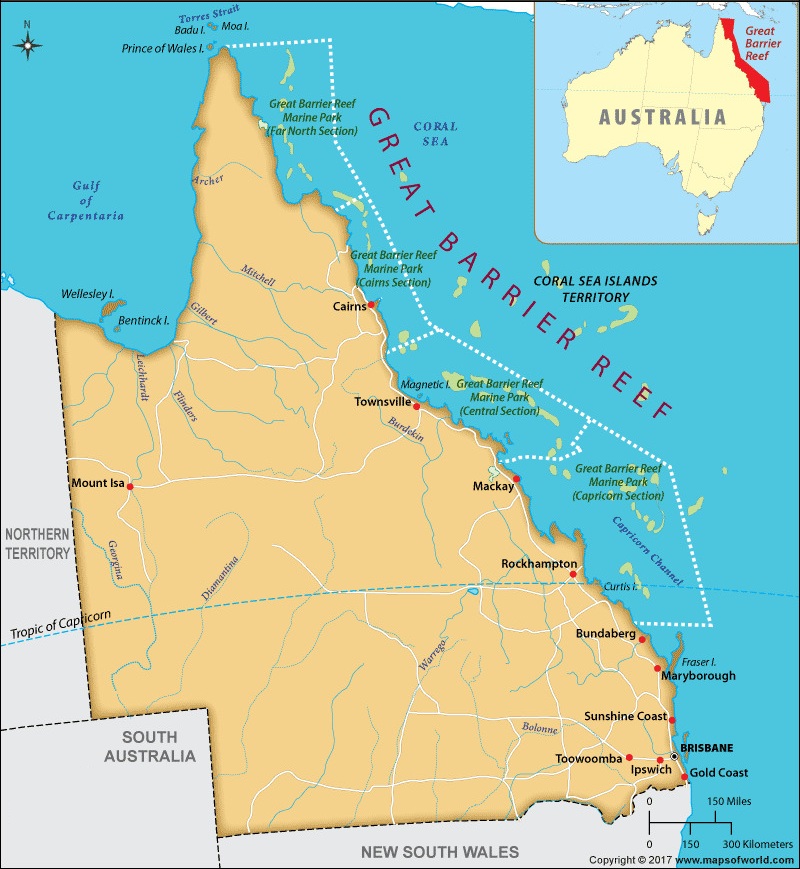
    In News: Great Barrier Reef

    About Great Barrier Reef:

    • Location: Coral Sea, off the northeast coast of Queensland, Australia.
    • Length & Area: Extends ~2,300 km; comprises ~3,000 reefs and 900 islands, covering ~350,000 square kilometers (about 10% of global coral reef ecosystems).
    • Biodiversity:
      • Hosts 400 coral species, 1,500 fish species, and 4,000 mollusk species.
      • Habitat for endangered species like the dugong and green turtle.
    • Reef Types: Includes platform reefs, wall reefs, and fringing reefs.
    • Protection Status:
      • Managed by the Great Barrier Reef Marine Park Authority.
      • Declared a United Nations Educational, Scientific and Cultural Organization (UNESCO) World Heritage Site in 1981.
    • Mass Bleaching Years: Notable events occurred in 1998, 2002, 2016, 2017, 2020, 2022, 2024, and 2025.

    Coral Decline and Bleaching Events:

    • Main Cause: Heat stress due to climate change, particularly during marine heatwaves.
    • 2024 Event: Fifth major bleaching since 2016; had the widest spatial impact recorded in the Australian Institute of Marine Science’s 39-year monitoring program.
    • Additional Damage: Cyclones (e.g., Cyclone Jasper) and flood plumes caused physical damage and freshwater stress.
    • Biological Threats: Crown-of-thorns starfish (COTS) outbreaks intensified coral predation, especially in the Swains sector.
    • 2025 Survey Findings:
      • 48% of 124 surveyed reefs showed coral decline.
      • Only 10% recorded an increase in coral cover.
    • Regional Impact: Southern Great Barrier Reef saw a 30.6% drop in hard coral cover—the sharpest annual decline ever recorded in that zone.
    [UPSC 2014] The scientific view is that the increase in global temperature should not exceed 2 0 C above pre-industrial level. If the global temperature increases beyond 30 C above the pre-industrial level, what can be its possible impact/impacts on the world?

    1. Terrestrial biosphere tends toward a net carbon source. 2. Widespread coral mortality will occur. 3. All the global wetlands will permanently disappear.  4. Cultivation of cereals will not be possible anywhere in the world. Select the correct answer using the code given below:

    Options: (a) 1 only (b) 1 and 2 only* (c) 2, 3 and 4 only (d) 1, 2, 3 and 4 only


  • Bacterial cause behind Mass Starfish Deaths

    Why in the News?

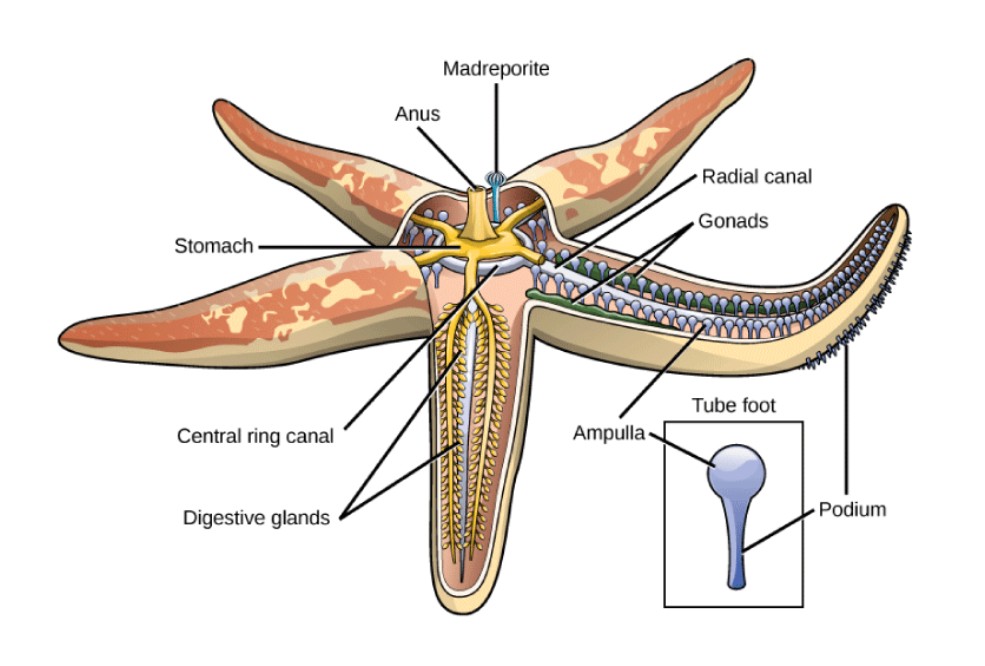
    Since 2013, over 5 billion starfish have died along North America’s Pacific coast due to a wasting disease now linked to Vibrio pectenicida, a cholera-related bacterium.

    Bacterial cause behind Mass Starfish Deaths

    About Starfish (Sea Stars):

    • Taxonomy: Belong to phylum Echinodermata; exclusively marine organisms.
    • Species: Brisingida, Forcipulatida, Velatida, Valvatida, Spinuloside
    • Body Structure:
      • Radial symmetry (adults), bilateral symmetry (larvae)
      • Calcareous exoskeleton for protection
      • Water vascular system for respiration and circulation
    • Unique Features:
      • Regeneration: Can regrow lost limbs
      • No blood or brain: Seawater circulates nutrients
      • Eyespots: At arm tips, help sense light
      • Tough skin: Made of calcium carbonate
    • Feeding: Carnivorous, detritivorous, and scavengers

    Reasons for Mass Deaths (2013–2025):

    • Causal Agent: Identified in 2025 as Vibrio pectenicida, a bacterium related to cholera-causing strains.
    • Symptoms: Limb detachment; Tissue disintegration; Melting into a pile of gunk.
    • Most Affected Species: Sunflower sea stars, which saw a 90% population decline.
    • Geographical Spread: Along the Pacific coast from Alaska to Mexico.
    • Ecological Consequences:
      • Starfish are keystone predators, especially of sea urchins.
      • Their decline led to urchin population explosions, which overgrazed kelp forests.
      • Resulted in biodiversity loss and reduced carbon sequestration.
    [UPSC 2012] Vultures which used to be very common in Indian countryside some years ago are rarely seen nowadays. This is attributed to:

    (a) the destruction of their nesting sites by new invasive species disease among them (b) a drug used by cattle owners for treating their diseased cattle persistent and fatal (c) scarcity of food available to them (d) a widespread, persistent and fatal disease among them


  • In news: Lalit Kala Akademi 

    Why in the News?

    The 64th National Exhibition of Art (NEA), organized by the Lalit Kala Akademi, India’s National Academy of Art, was inaugurated in New Delhi.

    About Lalit Kala Akademi:

    • Establishment: Located in New Delhi, as an autonomous organisation.
    • Inauguration: Launched on 5 August 1954 by Maulana Abul Kalam Azad, the then Minister for Education.
    • Legal Status: Granted statutory status in 1957 under the Societies Registration Act, 1860.
    • Funding: Supported by the Ministry of Culture, Government of India.
    • Structure: Operates through the General Council, Executive Board, and various Committees.
    • Regional Centres: Present in Chennai, Kolkata, Lucknow, Bhubaneswar, and Garhi (New Delhi).
    • Functions:
      • Scope of Work: Promotes modern, contemporary, folk, and tribal visual arts of India.
      • Art Collection: Maintains a permanent collection of Indian visual art.
      • International Role: Facilitates global cultural exchange through international cultural agreements.

    Key Events and Initiatives:

    • National Exhibition of Art: Annual flagship event since 1955, showcasing artists from across India.
    • 64th Edition (2025): Held from 5 August to 15 September at Kamani Auditorium and Lalit Kala Art Galleries, New Delhi.
    • Triennale India: Major international art exhibition featuring global artists.
    • Print Biennale India: Dedicated to printmaking; 3rd edition scheduled for 2025–26.
    • Artist Promotion: Provides platforms for both emerging and established artists; strengthens India’s soft power through cultural diplomacy.
    [UPSC 2009] Consider the following statements:

    1. The National School of Drama was set up by Sangeet Natak Akademi in 1959.

    2. The highest honour conferred by the Sahitya Akademi on a writer is by electing him its Fellow.

    Which of the statements given above is/are correct?

    (a) 1 only (b) 2 only  (c) Both 1 and 2*  (d) Neither 1 nor 2


  • Intermediate-Range Nuclear Forces (INF) Treaty

    Why in the News?

    Russia officially announced its exit from the 1987 Intermediate-Range Nuclear Forces (INF) Treaty, marking a pivotal moment in the dismantling of Cold War-era nuclear arms control architecture.

    What is the INF Treaty?

    • Signed In: 1987 by United States President Ronald Reagan and Soviet leader Mikhail Gorbachev.
    • Purpose: Banned ground-launched ballistic and cruise missiles with ranges between 500 and 5,500 kilometers.
    • Impact: Led to the elimination of 2,692 missiles by June 1, 1991.
    • Verification: Allowed on-site inspections, setting a benchmark for arms control agreements.
    • Scope: Covered both nuclear and conventional missile systems.
    • Significance: Became a key pillar of post-Cold War strategic stability.

    Why did Russia exit the Treaty?

    Implications:

    • Collapse of Arms Control: Removes a pillar of nuclear restraint.
    • Resurgence of Arms Race: Possible missile deployments in Europe & Asia-Pacific.
    • Regional Threats: NATO countries & East Asia more vulnerable.
    • Proliferation Risk: May embolden China, India, and others.
    [UPSC 2011] The “New START” treaty was in the news. What is this treaty?

    (a) It is a bilateral strategic nuclear arms reduction treaty between the USA and the Russian Federation.*

    (b) It is a multilateral energy security cooperation treaty among the members of the East Asia Summit.

    (c) It is a treaty between the Russian Federation and the European Union for energy security cooperation.

    (d) It is a multilateral cooperation treaty among the BRICS countries for the promotion of trade.


  • [6th August 2025] The Hindu Op-ed: The technocratic calculus of India’s welfare state

    The promise to deliver social welfare at scale, using data-driven algorithms, may be at the cost of ‘democratic norms’ and ‘political accountability’

    India’s welfare model is undergoing a silent but radical transformation. What was once a deliberative system grounded in rights and citizen needs is now morphing into a technocratic model governed by data, code, and efficiency. This shift raises a key question: Can dignity and justice survive when welfare becomes measurable but impersonal?

    From Entitlement to efficiency: The new welfare playbook

    Over the past decade, India has moved from rights-based entitlements to an algorithm-led delivery model—what scholars call a technocratic calculus.

    • Aadhaar: Over 1 billion enrolled; enables biometric verification to curb duplicate beneficiaries.
    • DBT (Direct Benefit Transfers): 1,206 schemes unified under Aadhaar; ₹3.48 lakh crore saved via leakages plugged.
    • CPGRAMS and grievance portals: 36 digital platforms now streamline complaints.

    That’s the infrastructure. But the implications run deeper. This marks a shift from deliberative welfare (based on rights and dialogue) to calculative welfare (based on metrics like coverage, leakage, speed).

    Promises vs. Perils:

    1. Efficiency vs. Empathy

    Welfare delivery is now fast, traceable, and auditable. But it risks treating citizens as data profiles, not as individuals with needs. Algorithms can’t ask moral questions. Bureaucrats avoid hard choices by letting systems decide.

    2. Political Accountability Diluted

    Leaders now point to dashboards instead of taking responsibility. Decisions on who deserves support are increasingly delegated to code.

    3. Institutions Under Strain

    • RTI backlog: Over 4 lakh pending cases (June 2024)
    • Vacant CIC posts: Weakens transparency
    • CPGRAMS: Acts more like a ticketing system, not a democratic grievance platform. Visibility is centralised, but not responsibility.

    4. Shrinking Social Sector Investment

    • Welfare spending has dropped from 21% to 17% of GDP (2014–2025)
    • For vulnerable groups (SCs, minorities, labour, nutrition), allocations shrank from 11% pre-COVID to just 3%
    • The paradox: as delivery gets smarter, commitments get thinner.

    The Deeper democratic concern:

    When welfare turns technical, it becomes less political. Philosopher Habermas warned of this: expert-rule can silence democratic debate. In India’s case, welfare governance is increasingly auditable, but less answerable.

    What Needs Fixing? 

    1. Embed human judgement in digital systems: Algorithms should aid, not override, political reasoning.
    2. Revive deliberative spaces: Local bodies, gram sabhas, and social audits must regain teeth.
    3. Reinvest in social sector spending: Efficiency must not justify austerity.
    4. Reimagine grievance redressal: Make platforms citizen-centric, not just data-driven.

    Way forward:

    1. Federal Pluralism: Empower States to design context-sensitive welfare regimes, reinforcing federalism and pluralism.
    2. Impact Audits: Institutionalise community-driven impact audits through Rashtriya Gram Swaraj Abhiyan and Gram Panchayat Development Plans.
    3. Platform Cooperatives: Build platform cooperatives in all States with self-help groups as intermediaries, inspired by Kerala’s Kudumbashree.
    4. Civic Engagement: Incentivise civil society to promote grassroots political education and establish legal aid clinics for  stronger community accountability.
    5. Resilience Mechanisms: Strengthen and codify offline fallback systems, human feedback safeguards, and statutory bias audits.
    6. Digital Rights: Embed the “right to explanation and appeal” in digital governance frameworks, in line with UN Human Rights recommendations.

    Digital welfare is not the problem. The problem is when it replaces, not supports, democracy. India must blend technology with trust, efficiency with empathy, and code with conscience. Only then can welfare remain a tool for justice—not just for savings.

    Possible GS2 Mains Question:

    1. India’s welfare governance has shifted from rights-based entitlement to algorithmic delivery. Critically examine the democratic and institutional implications of this shift. Suggest reforms to align technology with constitutional values.
  • India needs a ‘defence cess’ to fund military modernisation

    With such a levy on high-end goods, spending on luxury will become a visible public act of support for the armed forces. In an era of evolving warfare, from stealth jets to AI-driven drones, India’s defence preparedness is no longer optional, it is existential. This article proposes a ‘Defence Cess’ on luxury goods and services, offering a creative, emotionally resonant, and fiscally sustainable mechanism to ring-fence funds for military modernisation. This issue links directly to GS Paper II (Governance), GS Paper III (Security and Economy), and GS IV (Ethics, especially public accountability and duty).

    The Strategic Urgency: Why Modernisation Can’t Wait

    India is increasingly surrounded by hostile neighbours with fast-upgrading military capacities:

    1. Pakistan may soon induct stealth fighters like J-20 or J-35 from China.
    2. China is testing sixth-generation aircraft and has strong cyber and drone warfare capabilities.
    3. The Indian Air Force (IAF), by contrast, operates only 32 squadrons vs the sanctioned strength of 42 — leaving India strategically exposed in contested airspace.

    Key Quote: “Capability alone is not enough. The country cannot afford to be vulnerable.”

    Modernisation is Existential, Not Aspirational

    India’s military modernisation roadmap is ambitious but underfunded. It includes:

    1. Fifth-generation fighter aircraft development (AMCA)
    2. Indigenous jet engine programmes
    3. Strategic unmanned aerial vehicles (UAVs)
    4. Electronic warfare (EW) and cyber-capacity enhancement

    But while intent exists, execution suffers from fragmented schemes, budgetary limitations, and lack of dedicated long-term funding.

    The Defence Cess Proposal: Key Features

    1. A 5–10% surcharge on ultra-luxury goods and services like High-end cars, Private jets, Imported luxury watches, Premium liquor, etc.
    2. Clearly itemised on invoices as “Raksha Cess”
    3. Funds are non-lapsable, targeted, and traceable
    4. Exclusively for capital expenditure in Procurement, R&D, Infrastructure for defence

    Global Parallels and Precedents

    Defence/Strategic Taxation Model
    Italy Luxury tax on yachts and helicopters during Eurozone crisis
    Sweden Long-standing luxury taxation for social balance
    China Anti-extravagance drive redirected elite consumption toward strategic sectors

    These countries have used fiscal mechanisms not just to fund strategy but to shape public narratives, blending consumption with national responsibility.

    Why a Defence Cess Works for India

    1. Psychological and Symbolic Impact: The idea of contributing directly to the betterment of Indian defence through luxury spending has strong emotional appeal. It creates a moral linkage between indulgence and national duty converting private consumption into public solidarity. Naming it “Raksha Cess” makes it resonate with patriotism and responsibility.
    2. Fiscal Innovation Without Burdening the Masses: India’s direct tax base is relatively narrow, and increasing defence funding through general taxation could hurt the middle class or poor. This cess targets only high-end consumers, ensuring that additional fiscal pressure is placed on those most capable of bearing it. Luxury spending has grown significantly with India’s rising affluent class, this captures a booming sector for national good.
    3. Transparency and Traceability: Since the cess is itemised separately on invoices, it allows greater transparency. It increases trust in government utilisation and may lead to greater tax compliance if people know exactly where their money goes. With digitised billing and GST-era infrastructure, monitoring and reporting mechanisms already exist to track such surcharges.
    4. Dedicated, Ring-Fenced Defence Fund: Current defence allocations are diluted across revenue expenses and pensions. It helps bypass routine bureaucratic delays and ensures directed capital spending. A defence cess would be non-lapsable and strictly for capital expenditure — such as: Acquiring new aircraft, R&D in defence tech and Indigenous manufacturing. This enables long-term strategic planning free from annual budget cycles.
    5. Aligns India With Global Practices: Many countries (Italy, Sweden, China) have used luxury taxation or targeted levies to support strategic sectors or correct fiscal imbalances. India can draw from these models to introduce a fiscally sound and globally validated mechanism.
    6. Boosts the Narrative of Nation-Building: In an era where narratives matter, this proposal encourages voluntary nation-building and elite participation in national security. It sends a message that “those who benefit most from India’s rise should contribute most to its protection.”

    Challenges in Implementing a Defence Cess:

    1. Legal and Fiscal Complexity: Introducing a cess outside the GST framework may face legal and administrative hurdles, requiring amendments or coordination with the GST Council. There may be opposition from States citing federal fiscal concerns
    2. Risk of Misuse or Leakage: Any fund not managed with full transparency and oversight can fall prey to inefficiency or corruption. Strong audit systems and public reporting mechanisms must be built into the cess architecture from the outset.
    3. Need for a Clear Governance Structure: A dedicated body or fund management unit should be created under the Ministry of Defence or PMO, preferably with civil society representation for accountability. Without such a structure, funds may be diverted or underutilised.
    4. Revenue Predictability and Scale: Luxury consumption is inelastic but cyclical, it may dip during economic downturns. The fund should not be over-relied upon for core defence needs; rather, it must act as a complementary booster.
    5. Perception Management and Political Pushback: Some may view this as a populist or performative move, or even as a “sin tax on success”. There must be consistent and transparent communication that this is about contribution, not punishment.
    6. Moral Optics and Class Tensions: Care must be taken to avoid triggering class resentment or elite backlash, especially if the tax seems punitive. Framing it as “a privilege with purpose” is crucial — the messaging has to be inclusive, not divisive.

    Conclusion: From Passive Consumers to Active Nation-Builders

    India’s national security demands not just better weapons, but a sustainable model of public contribution and political imagination. A well-designed defence cess could convert elite indulgence into national insurance, creating a visible alignment between privilege and responsibility.

    Value Addition

    India’s Defence Modernisation: 

    What Has Been Done: What is being planned
    • Tejas Mk-1A production initiated (HAL)
    • Strategic partnerships under DPP-2020 for indigenous manufacturing
    • Agni Prime, INS Vikrant, and SAM systems development
    • Defence exports crossed ₹21,000 crore in 2023-24
    • Emergency procurement powers given to armed forces post-Galwan
    • AMCA (Advanced Medium Combat Aircraft) — 5th Gen fighter
    • Twin-engine deck-based fighter (TEDBF) for Navy
    • India-US Jet Engine Deal (GE-HAL) under iCET
    • India-France agreement for submarine co-development
    • Cyber and AI warfare units under Theatre Command model

    Important Agreements and Collaborations:

    Country Collaboration
    USA iCET, Jet Engine tech transfer (GE -F414)
    France Rafale aircraft, scorpene submarine
    Israel Missile defence (Barak-8)
    Russia S-400 Missile systems, AK-203 Rifles

    Important Defence Policies:

    1. Defence Acquisition Procedure (DAP) 2020: Goal: To streamline the procurement process for the Indian Armed Forces, promoting indigenization and efficiency. Prioritizes “Buy Indian” categories, Enhanced Indigenous Content (IC), Simplification of Trial and Testing Procedures and has Emphasis on Make and Innovation.
    2. Innovations for Defence Excellence (iDEX): Goal: To foster an ecosystem for innovation and technology development in the defence and aerospace sectors, leveraging the potential of startups, MSMEs, academia, and individual innovators. It is managed by Defence Innovation Organization (DIO), a not-for-profit company founded by Hindustan Aeronautics Limited (HAL) & Bharat Electronics Limited (BEL).
    3. DRDO’s 5-Year Roadmap (Vision 2025): Goal: To lead India towards self-reliance in defence technologies and become a global leader in defence research and development.


  • Status of Ethanol Blended Petrol (EBP) Programme

    Why in the News?

    India met its 20% ethanol blending (E20) target in petrol by March 2025 — five years early. Talks are now on to raise the blending ratio further in the immediate future.

    About Ethanol Blended Petrol (EBP) Programme:

    • Launched in 2003 by the Ministry of Petroleum and Natural Gas.
    • Objective: Promote use of renewable, domestically produced ethanol in petrol.
    • Nationwide rollout (except A&N and Lakshadweep) since April 2019.
    • Feedstock:
      • 1G Ethanol: From sugarcane molasses, maize, rice.
      • 2G Ethanol: From agricultural residues like rice straw, bamboo, bagasse.
    • Blending Progress:
      • 1.6% in 2013–14
      • 11.8% in 2022–23
      • 20% achieved in March 2025 (E20)
    • Future Plans:
      • Discussions on E27 blending target by 2030.
      • Government exploring flex-fuel vehicles (e.g., E85-capable (dual-fuel) cars).

    India’s Achievements:

    • Environmental Gains: 19.2 million tonnes of CO₂ emissions avoided (2014–2021).
    • Economic Impact: ₹26,000 crore saved in foreign exchange via reduced oil imports.
    • Industrial Growth:
      • Distillery capacity scaled up with interest subvention support.
      • Flex-fuel vehicles showcased by major automakers in 2025.
    • Farmer Benefit: Creates demand for sugarcane and grains, increasing farm income.

    Limitations:

    • Technical Challenges
      • Lower mileage with E20 due to reduced energy content.
      • Older vehicles may face engine compatibility issues.
      • Flex-fuel technology adoption still limited.
    • Economic Concerns
      • No drop in fuel prices despite ethanol savings.
      • Consumer hesitation due to lack of visible benefits.
    • Environmental Trade-offs
      • High land and water use for ethanol crops (especially sugarcane).
      • Food security risks from diverting food crops for fuel.
    • Need for Diversification
      • Majority of ethanol still from sugarcane; limited 2G ethanol usage.
      • Need to promote biomass-based ethanol (wood chips, crop residue).
    [UPSC 2025] Consider the following statements:

    Statement I: Of the two major ethanol producers in the world, i.e., Brazil and the United States of America, the former produces more ethanol than the latter.

    Statement II: Unlike in the United States of America where corn is the principal feedstock for ethanol production, sugarcane is the principal feedstock for ethanol production in Brazil.

    Which one of the following is correct in respect of the above statements?

    (a) Both Statement I and Statement II are correct and Statement II explains Statement I

    (b) Both Statement I and Statement II are correct but Statement II does not explain Statement I

    (c) Statement I is correct but Statement II is not correct

    (d) Statement I is not correct but Statement II is correct *


  • Rhisotope Project

    Why in the News?

    In a move to combat rhino poaching, the University of the Witwatersrand in South Africa, supported by the International Atomic Energy Agency (IAEA), has launched the Rhisotope Project.

    What is Rhisotope Project? 

    • Launched By: University of the Witwatersrand, South Africa, with support from the International Atomic Energy Agency (IAEA).
    • Initiation: Concept began in 2021; formally launched in July 2024.
    • Objective: Prevent rhino poaching by making horns traceable and unsuitable for illegal trade.
    • Pilot Site: Waterberg Biosphere Reserve, South Africa.
    • Pilot Implementation: 20 rhinos injected with radioisotopes (exact isotope remains undisclosed) for testing.

    How the Isotope Tagging Works?

    • Isotope Basics: Uses radioactive isotopes that emit detectable radiation as they decay.
    • Injection Method: A small hole is drilled into the horn; a low dose of isotope is inserted safely.
    • Detection Mechanism: Radiation Portal Monitors at ports can detect tagged horns—even inside 40-foot containers, as proven using 3D-printed horn simulations.


    Significance:

    • Safety Assurance: No damage to rhinos observed; cytological tests showed no cellular or physiological harm.
    • Impact on Illegal Trade: Horn becomes detectable, unusable, and toxic for illegal human consumption.
    [UPSC 2019] Consider the following statements:

    1. Asiatic lion is naturally found In India only.     2. Double-humped camel is naturally found in India only.     3. One-horned rhinoceros is naturally found in India only.

    Which of the statements given above is / are correct?”

    Options:   (a) 1 only *  (b) 2 only   (c) 1 and 3 only    (d) 1, 2 and 3


  • Population Census of Nilgiri Tahrs  

    Why in the News?

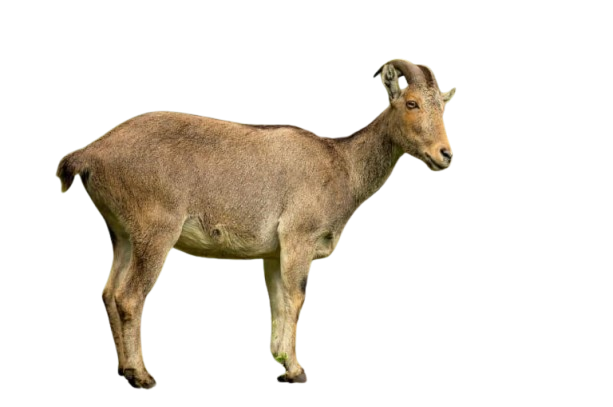
    A joint population census conducted by Kerala and Tamil Nadu has revealed the presence of 2,668 Nilgiri tahrs in the Western Ghats.

    Population Census of Nilgiri Tahrs  

    About Nilgiri Tahr (Nilgiritragus hylocrius):

    • Endemism: Found only in the Nilgiri Hills and southern Western Ghats of Tamil Nadu and Kerala, India.
    • Ecological Role: Key grazer in the montane grassland ecosystem, influencing plant growth and grassland regeneration.
    • Habitat:
      • Open montane grasslands interspersed with shola forests (South Western Ghats montane rain forests eco-region).
      • Occurs at elevations between 1,200 to 2,600 metres (3,900 to 8,500 feet).
      • Prefers steep rocky slopes, cliff edges, and grassy plateaus — areas with clear visibility to detect predators.
    • Population: Estimated 3,122 individuals in the wild; Locally extinct in about 14% of its historical habitat.
      • In Kerala (1,365): Eravikulam National Park (ENP) – largest single population (~841 individuals); Anamalai Hills landscape.
      • In Tamil Nadu (1303): Mukurthi National Park; Grass Hills National Park; Kalakkad-Mundanthurai Tiger Reserve (lesser presence)
    • Conservation Status:
      • IUCN Red List: Endangered
      • Wildlife (Protection) Act, 1972: Schedule I
    • Cultural Significance:
      • Official state animal of Tamil Nadu.
      • Mentioned in Tamil Sangam literature (~2,000 years ago).
      • Seen in Mesolithic rock art (10,000–4,000 BC), indicating its deep historical importance.
    [UPSC 2018] Consider the following fauna of India:

    1. Gharial 2. Leatherback turtle 3. Swamp deer

    Which of the above is/are endangered?

    Options: (a) 1 and 2 only (b) 3 only (c) 1, 2 and 3 * (d) None


  • What is Ayurveda Aahara?

    Why in the News?

    To align ancient Indian diets with modern nutrition, FSSAI and the Ministry of Ayush have released an official list of food items under the Ayurveda Aahara category.

    What is Ayurveda Aahara?

    About Ayurveda Aahara:

    • Definition: Refers to food products based on Ayurvedic dietary principles—focused on balance, seasonality, and natural, therapeutic ingredients.
    • Objective: Ensures standardisation, safety, and consumer trust in Ayurvedic dietary practices.
    • Legal Framework: Regulated under the Food Safety and Standards Authority of India’s Ayurveda Aahara Regulations (2022).
    • Textual Basis: Product list notified under Note (1) of Schedule B, grounded in classical Ayurvedic texts listed in Schedule A.
    • Standards: Foods must follow authentic Ayurvedic recipes, ingredients, and preparation methods.
    • New Product Inclusion: Food Business Operators (FBOs) can propose additions by citing authoritative Ayurvedic sources.
    • Institutional Support: Endorsed by the National Institute of Ayurveda and the Ministry of Ayush; the Ayush Aahara Compendium offers scientifically validated formulations for industry use.

    Significance:

    • Health Benefits: Supports preventive health, digestion, and immunity through time-tested dietary wisdom.
    • Cultural Revival: Reconnects with India’s ancient food traditions, including those from the Sangam era; recognised globally alongside Yoga and Millets.
    • Regulatory Clarity: Provides structured guidelines to manufacturers, enabling ease of business and consumer confidence in authenticity.
    [UPSC 2017] Which of the following are the objectives of ‘National Nutrition Mission’?

    1. To create awareness relating to malnutrition among pregnant women and lactating mothers.

    2. To reduce the incidence of anaemia among young children, adolescent girls and women.

    3. To promote the consumption of millets, coarse cereals and unpolished rice.

    4. To promote the consumption of poultry eggs.

    Select the correct answer using the code given below:

    Options: (a) 1 and 2 only* (b) 1, 2 and 3 only (c) 1, 2 and 4 only (d) 3 and 4 only