💥Join UPSC 2027,2028 Mentorship (August Batch) + XFactor Notes & Microthemes PDF

GS Paper: GS1

  • Anti-Mob lynching Bills passed by States go unimplemented

    Bills passed against mob lynching in some states have not been implemented since lynching is not defined as a crime under the Indian Penal Code (IPC).

    Why are the bills pending?

    • Most bills have been reserved by the Governor for consideration of the President.
    • The President has to go with the advice given by the Council of Ministers, in the case of such legislations, represented by the MHA.
    • The Union Home Ministry examines the State legislations on three grounds-
    1. Repugnancy with Central laws
    2. Deviation from national or central policy and
    3. Legal and constitutional validity

    What is Mob Lynching?

    • Lynching is a premeditated extrajudicial killing by a group.
    • It is most often used to characterize informal public executions by a mob in order to punish an alleged transgressor, or to intimidate a group.
    • Recent incident can be recalled from Pakistan where a Sri Lankan national was set ablaze over blasphemy charges.

    Dealing with lynching in India

    • In 2017, the National Crime Records Bureau (NCRB) collected data on mob lynching, hate crimes and cow vigilantism but it was not published and discontinued.
    • This is because, there is “no separate” definition for lynching under the IPC.
    • However, lynching incidents could be dealt with under Sections 300 and 302 of the IPC, pertaining to murder.
    • In 2018, the Supreme Court asked Parliament to make lynching a separate offense.
    • Since then, the government is working to overhaul the IPC framed in 1860 and the Code of Criminal Procedure (CrPC) to consider mob-lynching.

    Why anti-lynching law is necessary?

    • Fills the void: It fills a void in our criminal jurisprudence.
    • Lawlessness: The Indian Penal Code has provisions for unlawful assembly, rioting, and murder but nothing that takes cognizance of a group of people coming together to kill (a lynch mob).
    • Rise in Lynching incidents: There has been a rise in lynching incidents in recent years.

    Reason for the rise in lynchings

    • Impunity: The lynch mobs are confident of getting away with it. So far, the state has done little to shake that confidence.
    • Communalism: In the case of cow-linked lynchings, a lot depends on whether the incumbent in power considers it compatible with its political interests to crack down on such attacks.
    • Fake news: Another factor that gave rise to lynchings is the spread of fake news through social media platforms which incite a sudden wave of antagonism.
    • Alienation: With modernity, there is a growth of individualism and erosion of associational life. The sense of fraternity has been fading away due to this.
    • Unemployment: High Unemployment rates leave millions of youth unengaged.

    Effect of lynching

    (1) State

    • Violation of FR: It is against the values upheld in the constitution of India. Every individual have certain fundamental rights any violence would be a curtailment of this right.
    • Law and order crisis: Lynchings have led to degrading regard to law and order.

    (2) Economy

    • Reputation damage: Many International agencies warned India against mob lynching incidents. This impacts both foreign and domestic investment thereby adversely affecting sovereign ratings.
    • Impact on migration patterns: It directly hampers internal migration which in turn affects economy.
    • Damage of public property: Large resources deployed to tackle such menaces induces extra burden on state-exchequer.

    (3) Society

    • Fear of radicalization: Radical and extremist organizations such as ISIS etc could take leverage of the atmosphere created by such incidents.
    • Communal disharmony: This impact solidarity of society and idea of Unity in diversity. This create an atmosphere of majority v/s minority.
    • Intolerance: It could aggravate caste, class and communal hatred. Such acts shows loss of tolerance in society and people are being swayed by emotions, prejudices etc.

    Way forward

    • States should be more vigilant and proactive in flagging rumors using social media and other platforms.
    • Some states are doing it, others need to emulate these examples.
    • The more proactive the administration is in this regard, the stronger a deterrent it will be.
    • There is also a need for a special court for the trial of mob violence.


    UPSC 2022 countdown has begun! Get your personal guidance plan now! (Click here)

  • What is Public Order?

    The Karnataka High Court is hearing a challenge to the constitutionality of the state government’s ban on students wearing a hijab in educational institutions. The judges heard an argument on whether the state can justify the ban on the ground that it violates ‘public order’.

    What is Public Order?

    • Public order is one of the three grounds on which the state can restrict freedom of religion.
    • It is also one of the grounds to restrict free speech and other fundamental rights.
    • Article 25 of the Constitution guarantees to all people’s right to freedom and conscience and the right freely to profess, practise and propagate religion subject to public order, morality and health.

    Who can check it?

    • Public order is normally equated with public peace and safety.
    • What affects public order is contextual and is determined by the state.
    • According to List 2 of the Seventh Schedule of the Constitution, the power to legislate on aspects of public order rests with the states.

    How does it relate to the hijab ban?

    • According to the government order issued under the Karnataka Education Act, 1983, “public order” is one of the reasons for not allowing students to wear a headscarf in educational institutions along with “unity” and “integrity”.
    • The petitioners have asked the state to show how the mere wearing of a hijab by students could constitute a public order issue.
    • Another argument made is that the government cannot delegate the power to college committees the function of determining whether the hijab was detrimental to public order.
    • The government order states that while individual college committees are free to determine the uniform, in the absence of such rules the government order banning the headscarf would apply.
    • Only the government can make an assessment of public order.

    How has the state responded?

    • The government order makes no mention of “public order” and that the petitioners reading of the order could be an error in translation.
    • The order, in Kannada, uses the words “sarvajanika suvyavasthe”.
    • Incidentally, the official Kannada translation of the Constitution uses “sarvajanika suvyavasthe” for “public order” in all nine instances.

    How has public order been interpreted by courts?

    • Courts have broadly interpreted it to mean something that affects the community at large and not a few individuals.
    • In Ram Manohar Lohia vs State of Bihar (1965), the Supreme Court held that in the case of ‘public order’, the community or the public at large have to be affected by a particular action.
    • One has to imagine three concentric circles:
    1. the largest representing ‘law and order’
    2. the next representing ‘public order’ and
    3. the smallest representing ‘security of State’

    Arguments against the K’taka Order

    • In the Karnataka case, the petitioners have argued:
    1. Public order is not every breach of law and order.
    2. Public order is an aggravated form of disturbance that is much higher than a law and order issue.

    Conclusion

    • Thus it is evident that wordplay is given more cognisance over the interpretation of constitution.


    UPSC 2022 countdown has begun! Get your personal guidance plan now! (Click here)

  • Places in news: Erra Matti Dibbalu

    Citizens join hands to preserve the geological marvel of Erra Matti Dibbalu in Visakhapatnam.

    What is Erra Matti Dibbalu?

    • Located between Visakhapatnam and Bheemunipatnam, the Erra Matti Dibbalu are rare red sand dunes that are a reminder of the million years of geological processes.
    • Its towering red sand dunes with patches of greenery is like a meandering maze.
    • The width of the dunes, which runs for five kilometres along the coast, varies from 200 metres to two kilometres.
    • It is listed among the 34 notified National Geological Heritage Monument Sites of India by the Geological Survey of India.

    (Don’t they resemble to Ravines of Chambal?)

    Its formation

    • Studies indicate that the area was tectonically active between 2.5 million years and 11,000 years ago.
    • The sediments are mainly derived from the Khondalite rocks from the hinterland of the Eastern Ghats.
    • Geologically these red sand dune sediments particularly hold significance.
    • They are the result of the combined effect of numerous factors including global climatic changes, sea-level variations, monsoonal variability and as a result serves as valuable paleo-environment indicators.


    UPSC 2022 countdown has begun! Get your personal guidance plan now! (Click here)
  • Who was Tilka Manjhi?

    The Nation is remembering revolutionary freedom fighter and tribal leader Tilka Manjhi on his 272nd birth anniversary.

    Tilka Manjhi (1750-1785)

    • He organized Adivasis into an army and led the famous Santhal Hool in 1784 against the exploitative British.
    • In 1770, there was a severe famine in the Santhal region and people were dying of hunger.
    • Tilka Manjhi looted the treasury of the East India Company and distributed it among the poor and needy.
    • Inspired by this noble act of Tilka, many other tribals also joined the rebellion.
    • With this began his Santhal Hool, the revolt of the Santhals.
    • He continued to attack the British and their sycophantic allies.
    • From 1771 to 1784, Tilka Manjhi never surrendered.

    Offensive with the colonists

    • Tilka Majhi attacked Augustus Cleveland, an East India Company administrator and fatally wounded him.
    • The British surrounded the Tilapore forest from which he operated but he and his men held them at bay for several weeks.
    • When he was finally caught in 1784, he was tied to the tail of a horse and dragged all the way to the Collector’s residence at Bhagalpur, Bihar, India.
    • There, his deeply wounded body was hung from a Banyan tree.

    Try this question from CSP 2018:

    Q.After the Santhal uprising subsided, what was/ were the measure/measures taken by the colonial government?

    1. The territories called ‘Santhal Paraganas’ were created.
    2. It became illegal for a Santhal to transfer land to a non Santhal.

    Select the correct answer using the code given below:

    (a) 1 only

    (b) 2 only

    (c) Both 1 and 2

    (d) Neither 1 nor 2


    [wpdiscuz-feedback id=”21kicbmy07″ question=”Please leave a feedback on this” opened=”1″]Post your answers here.[/wpdiscuz-feedback]


    UPSC 2022 countdown has begun! Get your personal guidance plan now! (Click here)

  • Places in news: Chandernagore

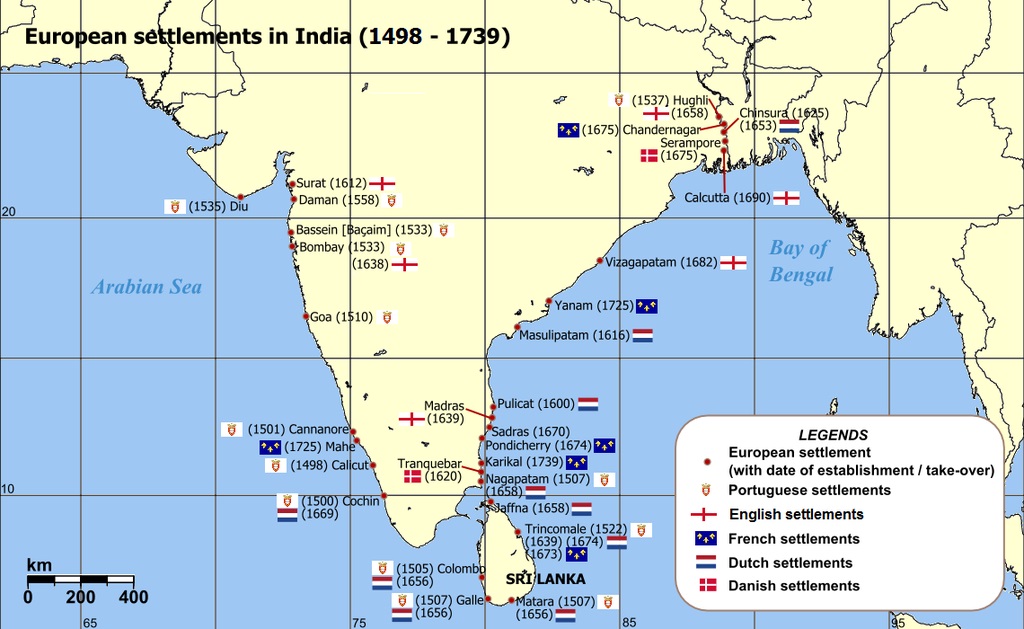
    The Registry Building, a two-storey structure at Chandernagore built in 1875 and a symbol of French settlement of the colonial town, has been awaiting restoration for a long time.

    French in India

    • France was the last of the major European maritime powers of the 17th century to enter the East India trade.
    • The French settlement in India began in 1673 with the purchase of land at Chandernagore from the Mughal Governor of Bengal.
    • The next year they acquired Pondicherry from the Sultan of Bijapur. Both became the centers of maritime commercial activities of the French in India.
    • Joseph Francois Dupleix who was initially appointed as Intendent of Chandernagore in 1731, sowed the seeds of colonization.
    • The village, which hitherto was engaged in maritime commerce along with Pondicherry, got fortified by him.

    Significance of Chandernagore

    • Chandernagore, though a part of French colonies in India, was unique in many ways.
    • It was very active in spearheading the freedom movement against the British. Due to its close proximity to Calcutta, it became a safe haven for freedom fighters of all hues.
    • Even Aurobindo Ghosh who was one of the accused in the Alipore Bomb case of 1909, was acquitted unconditionally and after a short stay at Chandernagore moved to Pondicherry.
    • Since the partition of Bengal in 1905, Chandernagore was in the thick of activities of freedom fighters against the British and produced several martyrs including Kanailal Dutt.

    Merger into India

    • As the British decided to hand over powers to the people of India by August 15, 1947, the people living under French rule in Pondicherry, Chandernagore, Karaikal, Mahe and Yanam were eager to join their homeland.
    • But the French were yet to learn their lessons. They tried all the tricks in the book to avert this.
    • Facing the onslaught from the people under their rule and the British and Indian rulers, the French declared Chandernagore as free city in 1947.
    • In June 1948, they conducted a referendum in which an overwhelming majority of 97 per cent people opted for a merger with India.
    • After so many legal hurdles, it became a part of India on October 2, 1955.

    Back2Basics: European Colonies in India


    UPSC 2022 countdown has begun! Get your personal guidance plan now! (Click here)

  • What is Coastal Vulnerability Index (CVI)?

    Indian National Centre for Ocean Information Services (INCOIS) has carried out coastal vulnerability assessment for entire Indian coast at states level.

    Coastal Vulnerability Index (CVI)

    • Under the CVI, INCOIS has brought out an Atlas comprising 156 maps on 1:1,00,000 scales to prepare a CVI.
    • These maps determine the coastal risks due to future sea-level rise based on the physical and geological parameters for the Indian coast.
    • The CVI uses the relative risk that physical changes will occur as sea-level rises are quantified based on parameters like:
    1. Tidal range
    2. Wave height
    3. Coastal slope
    4. Coastal elevation
    5. Shoreline change rate
    6. Geomorphology
    7. Historical rate of relative sea-level change

    Other components: MHVM

    • A coastal Multi-Hazard Vulnerability Mapping (MHVM) was also carried out using above mentioned parameters.
    • These parameters were synthesized to derive the composite hazard zones that can be inundated along the coastal low-lying areas due to extreme flooding events.
    • This MHVM mapping was carried for the entire mainland of India on a 1:25000 scale.
    • These maps depict the coastal low-lying areas exposed to the coastal inundation.

    Significance of CVI

    • India has a coastline of 7516.6 Km i.e. 6100 km of mainland coastline plus coastline of 1197 Indian islands touching 13 States and Union Territories (UTs).
    • Coastal vulnerability assessments can be useful information for coastal disaster management and building resilient coastal communities.

    What is Coastal Security?

    • Coastal Security is understood as a subset of maritime security. It
      involves the security of the coastal water zone against any threat or challenge that originates from the sea. Coastal water zone refers to the water area seawards of the Indian coast up to the limit of India’s contiguous zone, or the International Maritime Boundary Line (IMBL) whichever is less.
    • Coastal security has a wide connotation encompassing maritime border management, island security, maintenance of peace, stability and good order in coastal areas and enforcement of laws therein, security of ports, coastal installations, and other structures
      including Vital Areas and Vital Points (VAs/VPs) and vessels and personnel operating in coastal areas. An effective
      organization for coastal security also facilitates coastal defense.

    Why is coastal security considered indispensable for India?

    • National Security: The elaborate security arrangements on land forced the terrorists and illegal migrants to look towards the sea where security measures are comparatively lax, enabling them to ‘move, hide and strike’ with relative ease. Plugging this loophole is imperative to enable a holistic national security architecture.
    • Economic development: Coastal region plays an important part in India’s economic development. Security of the region will have a direct bearing on the following areas:
      a) Trade: India’s sea dependence on oil is about 93% which includes India’s offshore oil production and petroleum exports. Further, 95% of India’s trade by volume and 68% of trade by value comes via the Indian Ocean.
      b) Fish production: India is the second-largest fish producer in the world with a total production of 13.7 million metric tonnes in 2018-19 of which 35% was from the maritime sector. In the same period, India had exported Rs 46,589.37 crore worth of marine products.
      c) Strategic minerals: India hosts some of the largest and richest shoreline placers. The beach and dune sands in India contain heavy minerals (HMs) like ilmenite, rutile, garnet, zircon, monazite and sillimanite.
      d) Geostrategic interests: The Indian Ocean Region (IOR) has become a pivotal zone of global strategic competition.
      e) Dealing with climate-induced crises: Coastal zones are already under threat from environmental degradation. At the same time, the sinking of islands due to the rising sea levels in the Indian Ocean may result in the rise of climate refugees.

    How India’s Coastal Security Architecture has evolved over the years?

    • Customs Marine Organisation (CMO), 1974: Created on the recommendation of Nag Chaudhari Committee, it was mandated to conduct anti-smuggling operations. However, since the CMO was temporary in nature, not much attention was paid to strengthening this organisation. In 1982, it was merged with the ICG to avoid the duplication of efforts.
    • Indian Coast Guard (ICG), 1977: With the enactment of the Indian Coast Guard Act, 1978, the organization formally
      came into being as the fourth armed force of India. Its mandates include thwarting smuggling activities, safeguarding and protecting artificial islands, offshore terminals, installations, and other devices in the maritime zone, protecting and assisting fishermen in distress and preserving and protecting the marine environment, including
      controlling marine pollution.
    • Coastal Security Scheme (CSS), 2005: Instituted originally in 2005 and implemented by the Department of Border
      Management, Ministry of Home Affairs. The aim of the CSS was to strengthen infrastructure for patrolling and the surveillance of the coastal areas, particularly the shallow areas close to the coast.
    • Coastal Security Architecture Post ‘26/11’: Since then, the physical assets were built up and human resource capability was
      also enhanced to strengthen the coastal security. These
      efforts include:
      Strengthening the Multilayered Surveillance System: Before 2008, the existing multilayered surveillance system under the CSS was functioning only along the Gujarat and Maharashtra coasts.
      Indian Navy(IN): It was designated as the authority responsible for overall maritime security which includes coastal as well as offshore security. It was also made responsible for the coastal defense of the nation assisted by the ICG, the marine police, and
      other central and state agencies.
      ICG: The Director-General Coast Guard has been designated as the Commander Coastal Command, and is responsible for the overall coordination between central and state agencies in all matters relating to coastal security.
      Border Security Force (BSF): The water wing of the BSF have been deployed along with eight floating border outposts (BOPs), for the security and surveillance of the creeks in Gujarat and the Sunderbans.
      Central Industrial Security Force (CISF): It was entrusted with the responsibility of the physical security of India’s major ports. Vessel Traffic Management Systems (VTMS) are also being installed in all the major and a few non-major ports to monitor and regulate maritime traffic as well as to detect potentially dangerous ships.
      Sagar Suraksha Dal: An informal layer of surveillance, comprising the fishermen community- created following the 1993 Mumbai serial bomb blasts – has also been formalized and activated in all coastal states.
    • National Maritime Domain Awareness (NMDA) Project: It includes an integrated intelligence grid to detect and tackle threats emanating from the sea in real-time. Post 26/11, it has been strengthened by establishing NC3I network and IMAC that generate a common operational picture of activities at sea
      through an institutionalized mechanism.
    • Maritime Theatre Command (MTC): MTC structure is
      proposed to integrate the assets of the Indian Navy, Army, IAF
      and Coast Guard to achieve the goals detailed out in the Joint
      Forces Doctrine (JFD), 2017. It will enable the security forces
      to form a ‘Net-centric’ Warfare model so as to gain an
      an advantage over the adversary using a flexible force structure
      to match the varied geographic domains.
    • Inter-agency maritime exercises: Such exercises help
      build inter-service synergy, interoperability, and
      jointness. These include ‘Sagar Kavach’, ‘Sea Vigil’, TROPEX.
    • Increased cooperation with littoral countries: India
      interacts more actively with littoral states of the Indian Ocean Region and employs maritime security engagement as a cornerstone of her regional foreign policy initiatives.

    Gaps in existing architecture

    • Lackadaisical approach of the State governments resulting in the slow pace of construction of coastal infrastructure.
    • Multiplicity of agencies results in poor coordination.
    • Disproportionate focus on terrorism results in less emphasis on non-traditional threats.
    • Lack of professionalism and capacity constraints in marine police forces.
    • Technological backwardnessPort security remains neglected in most of the minor ports.

    Ways to fill gaps in the existing architecture

    • Enacting the proposed Coastal Security Bill that will facilitate the creation of NMA.
    • Strengthening the surveillance system
    • Creation of Central Marine Police Force (CMPF)
    • Promulgate the National commercial maritime security policy document for efficient, coordinated, and effective actions.
    • Effective involvement of Coastal communities such as fishermen.
    • Reinforcing Coastal Regulation Zone (CRZ) regulations
      Recalibrate the defense expenditure to increase capacity and resources.


    Back2Basics: INCOIS

    • Indian National Centre for Ocean Information Services (INCOIS) is an autonomous body under Ministry of Earth Sciences (MoES).
    • It has been issuing alerts on Potential Fishing Zone, Ocean State Forecast, Tsunami Early Warning, Storm Surge Early Warning, High Wave Alerts, etc.
    • It works through a dedicated ocean modeling, observations, computation facilities and the marine data center.


    UPSC 2022 countdown has begun! Get your personal guidance plan now! (Click here)

  • What is Operation AAHT?

    The Railway Protection Force (RPF) has launched a nationwide ‘Operation AAHT’ to curb human trafficking.

    We can site such examples in essays as well as mains as initiatives for curbing human trafficking in India

    Operation AAHT

    • As part of this operation, special teams will be deployed on all long-distance trains/routes with focus on rescuing victims, particularly women and children, from the clutches of traffickers.
    • The RPF will act as a bridge cutting across States to assist the local police in the mission to curb the menace.
    • The infrastructure and intelligence network of the force could be utilized to collect, collate and analyse clues on victims, source, route, destination, popular trains used by suspects, identity of carriers/agents, kingpins etc and shared with other law-enforcing agencies.

    Why need this mission?

    • The Railways, which operate about 21,000 trains across the country daily, is the most reliable mode of transportation for the traffickers who often move their victims on long-distance trains.
    • Thousands of Indians and persons from neighboring countries are trafficked every day to some destinations where they were forced to live like slaves.
    • They are also being trafficked for illegal adoptions, organ transplants, working in circus, begging and entertainment industry.

    Also read

    [Burning Issue] Draft Anti-Trafficking Bill, 2021


    UPSC 2022 countdown has begun! Get your personal guidance plan now! (Click here)

  • Kodiyal Theru Festival

    The annual Kodiyal Theru car (chariot) festival has begun in Mangalore, Karnataka.

    Kodiyal Theru

    • It falls in late January or early February in the Hindu month of Magha.
    • It begins on Tritiya or the third day of the bright moon and ends on the seventh to be followed by Holi (Okuli) after the festival.
    • For these six days, the Car Festival rules in the Car Street in front of the Venkatramana Temple in Mangalore.
    • The Festival begins with the Dwajarohana or hoisting of the ‘flag’ – actually a framed picture of Garuda.
    • This is done ceremoniously on the first day of the festival amidst the clanging of bells and the reverberation of drumbeats.
    • The Garuda stays aloft for the rest of the festival until he is again lowered in an equally ceremonial manner on the day of the Holi and this is the concluding event of the festival.


    UPSC 2022 countdown has begun! Get your personal guidance plan now! (Click here)

  • Issues with Population Control Bill

    The Rajya Sabha has discussed a Private Member’s Bill on population regulation.

    The Population Control Bill

    • First introduced in 2019, it is a private member bill proposed by Rakesh Sinha.
    • The purpose of the bill was to control the population growth of India.
    • The proposed bill then was signed by 125 Members of Parliament (MP) and is yet to become an act of law.

    It seeks to amend Article 47 by inserting article 47A to the Constitution of India. It proposes that-

    1. The State shall promote small family norms by offering incentives in taxes, employment, education etc. to its people who keep their family limited to two children
    2. The state shall withdraw every concession from and deprive such incentives to those not adhering to small family norm, to keep the growing population under control.

    Key provisions

    • Penalties: The 2019 bill talked about introducing penalties for couples not adhering to the two-child policy such as debarment from contesting in elections and ineligibility for government jobs.
    • Two-child policy: The 2020 bill proposes to introduce a two-child policy per couple.
    • Incentivizing adoption: It shall incentivize adoption through various measures such as educational benefits, taxation cuts, home loans, free healthcare, and better employment opportunities.
    • Birth spacings: It also proposes to ensure healthy birth spacing through measures related to augmenting the availability, accessibility and affordability of quality reproductive health services.

    Issues with penal provisions

    • Alienation: If a family was penalized for more than two children, then the third child would develop a feeling of alienation that he is an unwanted child.
    • Bar on Women: The biggest victim of such would be women, irrespective of religion. They would be debarred in political participation.
    • Selective abortions: In India, the preference for male children may lead to a greater anti-female child sex selection because parents will only have “two attempts” to have babies.
    • Violation of reproductive autonomy: To control and regulate the number of children a family can have is a gross violation of human rights, the right to self-determination and an individual’s reproductive autonomy.
    • Violation of Individual Privacy: A right to procreation is not explicitly mentioned in the Constitution but it comes under the ambit of Article 21, as discussed in Jasvir Singh vs State of Punjab.
    • Remarriage issues: A divorced person who has two children with a prior partner cannot bear a child with their next spouse.

    Why need such policy?

    • India had a land availability of only 1.2 hectare per person, while the resources that get regenerated automatically was 0.43 only.
    • We are an ecological debtor. The ecological footprint which we use and the gap between their regeneration is 187%.
    • If this continued for 30 years, then resources would be exhausted and people would not be able to lead a dignified life.
    • Some people see demographic dividend in the growing population but it was being used as cheap labour globally.

    Way forward

    • The population of India is seen as the biggest obstacle to its economic development.
    • It is the fall guy for governments seeking to justify their incompetence.
    • No legislation must be enacted unless its future impact and social effect are first completely realized.


    UPSC 2022 countdown has begun! Get your personal guidance plan now! (Click here)

  • Debate over Freedom of Religion and Attire

    A row over whether educational institutions can impose a strict dress code that could interfere with the rights of students has spilled in the Udupi district of Karnataka.

    Don’t you think that such instances incite fear among the politically destitute minorities?


    Religious Freedom in India

    • Article 25(1) of the Constitution guarantees the “freedom of conscience and the right freely to profess, practise and propagate religion”.
    • It is a right that guarantees a negative liberty — which means that the state shall ensure that there is no interference or obstacle to exercise this freedom.

    Restrictions on religious freedom

    • Like all fundamental rights, the state can restrict the right for grounds of public order, decency, morality, health and other state interests.
    • Over the years, the Supreme Court has evolved a practical test of sorts to determine what religious practices can be constitutionally protected and what can be ignored.
    • In 1954, the Supreme Court held in the Shirur Mutt case that the term “religion” will cover all rituals and practices “integral” to a religion.

    The test to determine what is integral is termed the “Essential Religious Practices” test.

    What is the essential religious practices test?

    • While these issues are largely understood to be community-based, there are instances in which the court has applied the test to individual freedoms as well.
    • In a 2004 ruling, the Supreme Court held that the Ananda Marga sect had no fundamental right to perform the Tandava dance in public streets since it did not constitute an essential religious practice of the sect.
    • For example, in 2016, the Supreme Court upheld the discharge of an airman from the Indian Air Force for keeping a beard.
    • It distinguished the case of a Muslim airman from that of Sikhs who are allowed to keep a beard.
    • In 2015, the Supreme Court restored the Jain religious practice of Santhara/Sallekhana (a ritualistic fast unto death) by staying an order of the Rajasthan HC.

    Issues with this Test

    • In the first place, what constitutes the essential part of a religion is primarily to be ascertained with reference to the doctrines of that religion itself, the SC had held in the Shirur Mutt case.
    • So the test, a judicial determination of religious practices, has often been criticized by legal experts as it pushes the court to delve into theological spaces.
    • In criticism of the test, scholars agree that it is better for the court to prohibit religious practices for public order rather than determine what is so essential to a religion that it needs to be protected.
    • In several instances, the court has applied the test to keep certain practices out.

    Precursors related to Hijab

    • Two set of rulings of the Kerala High Court, particularly on the right of Muslim women hold dressing according to the tenets of Islam.
    • In 2015, Kerala HC ruled the prescription of dress code for AIPMT exam which prescribed wearing light clothes with half sleeves not having big buttons, brooch/badge, flower, etc. with Salwar/Trouser and slippers and not shoes.
    • In 2016, it examined the issue more closely. It held that the practice of wearing a hijab constitutes an essential religious practice but did not quash the CBSE rule.
    • The court once again allowed for the “additional measures” and safeguards put in place the previous year.


    UPSC 2022 countdown has begun! Get your personal guidance plan now! (Click here)